How to Help a Procrastinator: 10 Practical Ways That Work
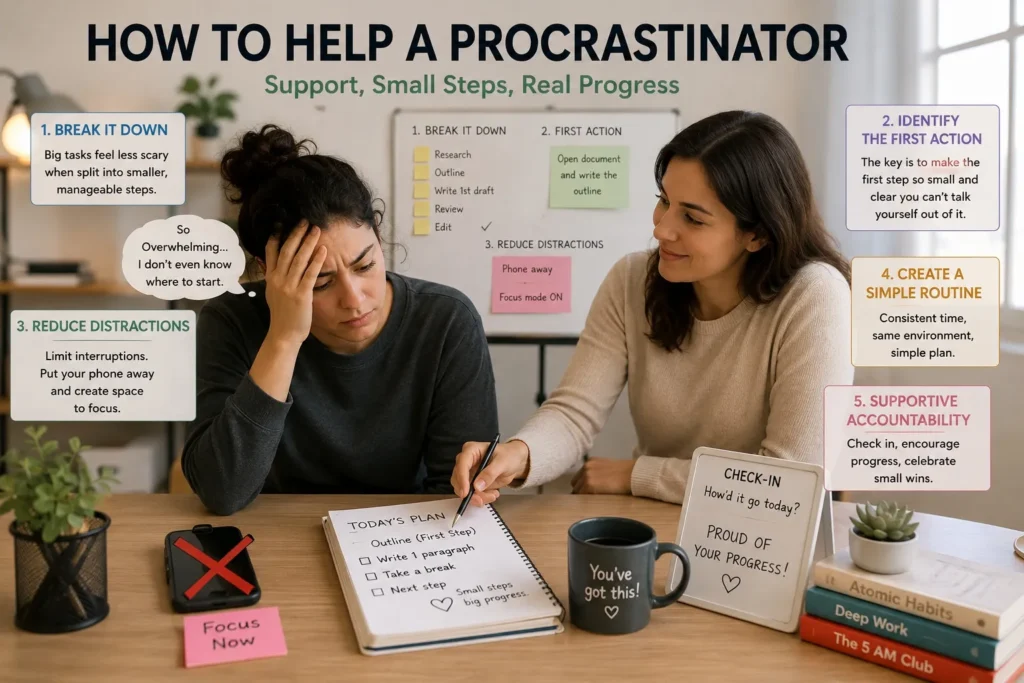
If you’re trying to help a procrastinator, pushing them harder usually isn’t the best place to start. A more useful approach is to make the task feel smaller, reduce distractions, and give them supportive accountability without taking over.
The short answer: Help a procrastinator by breaking the task into a very small first step, making the environment easier to work in, reducing distractions, lowering perfectionist pressure, and offering supportive accountability. The goal is to help them start—not to shame or control them.
How to Help a Procrastinator: 10 Practical Ways
When someone keeps delaying a task, it can be tempting to say, “Just do it.” The problem is that procrastination is often tied to the way a person responds to an unpleasant, difficult, overwhelming, or uncomfortable task. Simply increasing the pressure may not solve the reason they are avoiding it.
Instead, focus on making the next action clear and manageable. Here are practical ways you can help.
1. Help Them Break the Task Into Tiny Steps
A large task can feel harder to begin than several small ones. If someone is staring at a project and saying they do not know where to start, help them identify the smallest useful action.
For example, instead of telling them to “finish the report,” suggest starting with:
- Open the document.
- Write the heading.
- Add one idea.
- Work for five minutes.
The first step does not have to finish the task. It only needs to make starting easier.
2. Ask What Is Making the Task Hard to Start
Before offering a solution, ask a simple question: “What part are you stuck on?”
The answer can change the kind of support they need. They might be dealing with:
- an unclear first step;
- a task that feels too large;
- too many distractions;
- fear of making a mistake;
- perfectionist expectations; or
- difficulty organizing what needs to happen next.
You can be much more helpful when you solve the actual obstacle instead of assuming the person simply needs more motivation.
3. Make the First Step Easier Than the Excuse
If starting feels difficult, reduce the amount of effort required to begin. You might help them prepare the materials, open the relevant page, organize the workspace, or identify the first question they need to answer.
For example, if they need to study, “study for three hours” can feel overwhelming. “Open the notes and review the first page” gives them a much clearer starting point.
A useful rule: When someone is stuck, make the next action smaller and clearer before making the motivational speech bigger.
4. Reduce the Distractions Around Them
Sometimes the easiest way to help someone start is to change the environment. If a phone, social media, games, or constant notifications are competing with the task, make those distractions less available.
Depending on the situation, you could suggest:
- putting the phone somewhere out of reach;
- turning off unnecessary notifications;
- using a website blocker during a work period;
- clearing unnecessary items from the workspace; or
- working somewhere with fewer interruptions.
The point is not to control the person. It is to help create an environment in which the intended task is easier to begin.
5. Encourage Them to Start Before They Feel Ready
A person can spend a long time waiting for the perfect mood, perfect plan, or perfect amount of motivation. Sometimes the better approach is to begin with a rough first attempt.
If perfectionism is getting in the way, remind them that a rough first draft can be improved later. The immediate goal is not to produce perfect work; it is to create something they can work with.
6. Work Beside Them for a While
Accountability can make starting easier. You do not always need to supervise or repeatedly ask whether they have finished.
Instead, you could:
- work on your own task while they work on theirs;
- agree on a small starting period;
- check in after that period; or
- ask what they want to accomplish before the next check-in.
This creates accountability without turning the relationship into constant monitoring.
7. Help Them Create a Specific Routine
“Do it sometime today” is vague. A specific plan gives the person a clear opportunity to act.
A simple plan might look like this:
| When | Action | Goal |
|---|---|---|
| Start time | Open the task | Remove the starting barrier |
| First work period | Do one small part | Create visible progress |
| Check-in | Review what happened | Choose the next step |
The exact schedule can vary. What matters is replacing a vague intention with a specific next action.
8. Focus on Progress Instead of Shame
Calling someone lazy, irresponsible, or incapable usually does not give them a useful next step. If they already feel frustrated about delaying something, extra criticism can make the conversation less productive.
Try focusing on what can happen next: “What is one part we can get started on?” That keeps the conversation centered on action rather than blame.
9. Help Them Use Tools That Support Action
A simple timer, calendar reminder, task list, website blocker, or written plan can help turn an intention into a visible action.
For example, instead of keeping the entire project in their head, they can write:
- Open the project.
- Choose the first section.
- Write one rough paragraph.
- Review it afterward.
The tool itself is not the solution. It is useful when it makes the next action easier to see and start.
10. Check In Without Taking Over
Helping someone does not mean doing their work for them. Give support while leaving them responsible for their own choices and tasks.
A useful check-in can be as simple as asking:
- “What are you working on first?”
- “Would it help if I stayed here while you started?”
- “What is the smallest part you can finish right now?”
- “When would you like me to check back?”
That gives the person support without turning you into their manager.
Why Does Someone Keep Procrastinating?
There is not one single reason why people procrastinate. The reason can differ from one person or situation to another.
Common obstacles can include:
- a task feeling too large or unclear;
- distractions that are immediately rewarding;
- perfectionist expectations;
- uncertainty about how to begin;
- unpleasant feelings connected with the task; or
- difficulty turning an intention into a specific action.
That is why a useful first question is not simply, “Why are you so lazy?” It is, “What is getting in the way of starting?”
What Should You Do When a Procrastinator Says, “I’ll Do It Later”?
Ask them to turn “later” into one specific action and time. They do not necessarily need a huge productivity plan.
For example, you might ask: “What is the smallest part you can start, and when will you start it?”
This makes the intention more concrete. If they still cannot start, go back one step and ask what is making that first action difficult.
How Can You Help Without Making Procrastination Worse?
Support works best when it encourages action without creating unnecessary pressure.
| Less Helpful | More Helpful |
|---|---|
| “Just do it.” | “What is the smallest part you can start?” |
| Doing the task for them | Helping them identify the next step |
| Repeated criticism | Specific, supportive check-ins |
| Demanding perfect work immediately | Encouraging a rough first attempt |
Can Procrastination Be Connected to Anxiety?
Sometimes procrastination and anxiety can occur together, but you should not assume that every person who procrastinates has anxiety. Avoiding a difficult task can have many possible reasons.
If someone is experiencing persistent distress, significant difficulty functioning, or problems that go beyond ordinary task delay, it may be more useful to encourage them to speak with a qualified mental health professional rather than trying to diagnose the problem yourself.
What About the 3-2-1 Rule for Procrastination?
The phrase “3-2-1 rule” can refer to different productivity techniques, so it is better not to treat one version as a universal cure for procrastination. If you use a countdown or similar starting technique, the useful part is the same basic idea: reduce hesitation and move into a clearly defined first action.
For someone you are helping, a simple instruction such as “let’s open the document and do the first tiny step” may be more useful than focusing on a particular named technique.
When Should You Encourage Professional Support?
Occasional procrastination is common, but persistent difficulties can sometimes be part of a broader problem. If procrastination is seriously interfering with school, work, relationships, or everyday responsibilities, professional guidance may be appropriate.
You do not need to diagnose the person. You can simply say that getting support may help them understand what is making tasks so difficult and find strategies suited to their situation.
Helpful Resources for Understanding Procrastination
If you want more structured information, these resources from the research gathered for this topic can help you explore procrastination and practical ways of addressing it:
- Princeton University’s guide to understanding and overcoming procrastination
- Centre for Clinical Interventions procrastination resources
- Georgetown University’s discussion of procrastination and its practical strategies
Frequently Asked Questions
What is the best way to help a procrastinator?
Start by helping them identify the smallest next action. Then reduce distractions, make the environment easier for that action, and offer supportive accountability rather than criticism.
What causes procrastination in adults?
There is no single cause. Procrastination can involve an unclear task, feeling overwhelmed, distractions, perfectionist expectations, unpleasant feelings about the task, or difficulty deciding how to begin.
What tools can help someone stop procrastinating?
Simple tools such as a timer, calendar reminder, task list, written plan, or website blocker can help when they make the next action clearer or reduce distractions. The tool should support action rather than become another task to manage.
What are three practical ways to overcome procrastination?
Break the task into a tiny first step, remove obvious distractions, and use supportive accountability. These approaches address some of the most common barriers to getting started.
How can I help a procrastinator without pressuring them?
Ask what is making the task difficult, help them choose one small action, and agree on a reasonable check-in. Support their effort without shaming them or taking responsibility for completing their work.
The Most Useful Way to Help Someone Who Procrastinates
You do not have to find a magical motivation trick. In many situations, the most practical support is much simpler: find out what is blocking the person, make the first action smaller, remove unnecessary distractions, and give them a little accountability.
If perfectionism is the problem, help them start roughly. If the task feels overwhelming, break it down. If distractions are winning, change the environment. If they need accountability, check in without taking over.
Remember: The goal is not to force someone to work. It is to help them move from “I can’t start” to one clear, manageable action they can take themselves.
Explore Topics
Sub-Topics & Guides
Featured Guides
Top Industry Resources
Editorial Integrity
Our content is 100% human-written, evidence-backed, and continuously updated to fulfill reader intent with maximum honesty.
"Small, consistent habits compounded over time create unshakeable momentum."