Jump to:
Togglemeditation for controlling thoughts: A Science-Backed Guide to Mental Calm

What Meditation Actually Does to Your Thoughts
Meditation does not empty your mind or eliminate thinking, despite the popular misconception that it acts as an off-switch for internal dialogue. Instead, the practice fundamentally shifts your cognitive relationship with mental events, transforming automatic reactions into conscious observations. When you meditate, you train your brain to recognize thoughts as passing weather patterns rather than absolute truths or commands you must obey.
Meditation Doesn’t Empty Your Mind — It Changes Your Relationship With Thoughts
The primary misconception about mindfulness is that a successful meditation session results in a completely blank mind. Biological brains generate thoughts continuously as part of default mode network activity, meaning absolute silence is neither realistic nor the objective of practice.
Cognitive defusion: You learn to create psychological distance between your sense of self and the stream of incoming ideas, worries, and memories.
Observational stance: Mental events are viewed as transient phenomena that arise, linger, and dissolve without requiring your immediate engagement or emotional investment.
The bystander effect: Rather than identifying as the frantic voice in your head, you become the calm space observing that voice.
Thought suppression frequently backfires, creating a rebound effect where pushed-away ideas return with greater intensity. Meditation replaces this exhausting struggle with gentle acknowledgment.
Why “Controlling Thoughts” Is the Wrong Goal (and What to Aim for Instead)
Attempting to forcefully control or suppress your thoughts is counterproductive because the prefrontal cortex cannot easily bully the limbic system into silence. Every attempt to block a specific thought requires your brain to monitor for that exact thought, keeping it active in your working memory.
Target shift: Move your goal away from thought suppression and toward attentional anchoring, such as focusing on the physical sensation of the breath.
The anchor principle: When your mind inevitably wanders—which it will do repeatedly—the practice is simply noticing the drift and returning to your anchor.
Strengthening neural pathways: Every successful redirection acts as a repetition for your attention muscle, rewiring how quickly you catch yourself spiraling.
Success in meditation is measured not by how quiet your mind is, but by how quickly you notice you have been distracted and how kindly you bring your attention back.
Why Your Thoughts Feel Out of Control
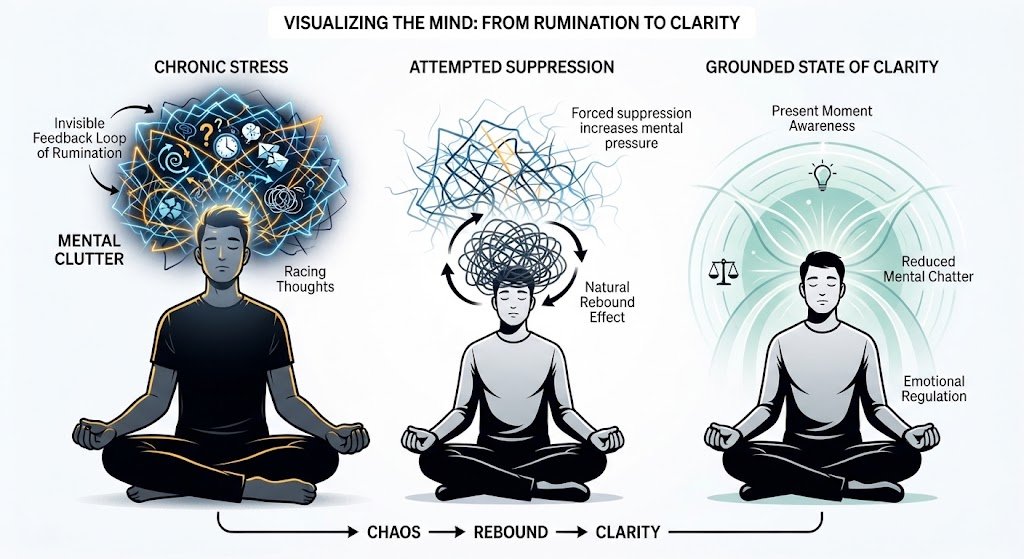
Your thoughts feel impossible to manage because the brain is an involuntary meaning-making machine designed to scan for problems, not stay quiet. When you desperately try to stop thinking about something, your brain actually increases mental monitoring of that exact topic, making the noise louder.
The Spring Effect: Why Suppressing a Thought Makes It Stronger
Attempting to forcefully banish a thought creates a psychological rebound effect, often referred to in cognitive science as ironic process theory. The more energy you spend trying to push an unwanted idea away, the more deeply embedded and accessible it becomes in your active memory.
The monitoring system: Your subconscious mind must keep a part of itself alert to check whether you are successfully ignoring the target thought.
The rebound surge: Once your cognitive guard drops even slightly, the suppressed thought snaps back with magnified emotional intensity.
Exhaustion cycle: This constant wrestling match depletes your mental energy, leaving you feeling entirely powerless over your own internal state.
Trying not to think of a specific thing is like telling yourself not to look at a bright red door—the very instruction forces your mind to locate it first.
Overthinking, Stress, and a Busy Mind — the Real Root Cause
Chronic stress and excessive mental clutter hijack your nervous system, locking your brain into a hyper-vigilant loop of rumination. When cortisol and adrenaline levels remain elevated, your brain perceives unstructured downtime not as rest, but as a potential vulnerability that requires problem-solving.
Survival wiring: An overstressed brain treats worries and past regrets as immediate survival threats, refusing to let them go.
Rumination traps: Instead of processing a situation objectively, a fatigued mind circles endlessly around the same grievances without reaching a resolution.
Sensory overload: Modern digital stimulation floods your cognitive channels, leaving zero white space for your brain to naturally decompress.
Mental clutter accumulates when you treat every fleeting idea as an emergency that demands immediate attention and cognitive action.
The Difference Between “Controlling Thoughts” AND “Not Letting Thoughts Control You”
Mastering your internal landscape requires abandoning the illusion of thought control and replacing it with radical acceptance and emotional discipline. You cannot choose what random thought pops into your head, but you have absolute sovereignty over whether you invite it in for tea.
Input vs. reaction: Thoughts arrive uninvited due to biology and environment; your power lies entirely in the space between the thought and your reaction.
Dropping the rope: Letting go of things outside your control means realizing that fighting a mental wave only drags you under, whereas observing it lets it pass beneath you.
Sovereignty shift: True mental freedom is realizing that a thought is just a neurochemical event, not a command or an accurate reflection of reality.
Letting go of what you cannot control starts the moment you stop treating every internal disturbance as an enemy that must be destroyed.
Step-by-Step Meditation Technique to Control Your Thoughts
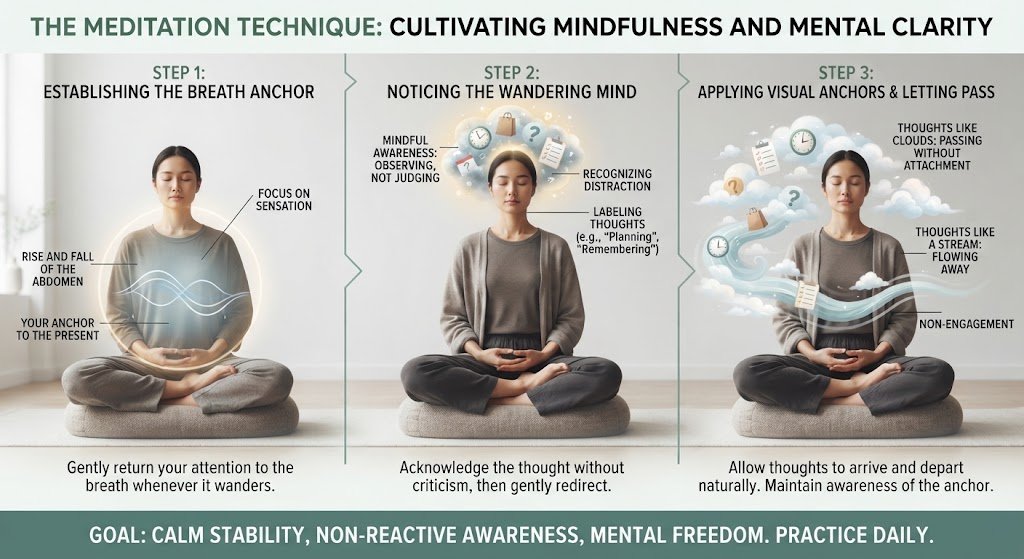
To effectively shift your relationship with your mind, you need a practical framework rather than vague advice. This step-by-step meditation technique trains your brain to break automatic cognitive loops by establishing a physical point of focus, recognizing mind wandering, and applying structured visualization anchors to let go of mental clutter.
Step 1: Get Into a Comfortable, Upright Posture
Positioning your body correctly creates the physical foundation needed to maintain alertness without building physical tension.
Upright spine: Sit on a chair or cushion with your back straight, head aligned over your shoulders, and chest open to allow unconstrained breathing.
Relaxed muscles: Unclench your jaw, drop your shoulders away from your ears, and rest your hands comfortably in your lap or on your knees.
Soft focus: Either gently close your eyes or cast your gaze downward at a 45-degree angle with a soft, un-focused eyes.
Your posture should balance stability and ease—alert enough to prevent falling asleep, yet relaxed enough to release physical resistance.
Step 2: Anchor Your Attention to Your Breath
Using a breath anchor gives your attention a neutral home base to return to whenever cognitive noise begins to build.
Locate where the physical sensation of breathing feels most distinct, such as the rise and fall of your abdomen, the expansion of your chest, or the cool air passing through your nostrils.
Focus entirely on the full rhythm of each inhalation and exhalation without trying to alter your natural pace.
Observe the subtle physical transitions between the end of an out-breath and the beginning of the next in-breath.
Step 3: Notice the Wandering Mind Without Judgment
Mind wandering is not a failure of practice; it is an inevitable cognitive event that provides the opportunity to build mindfulness.
Expect distraction: Accept that your attention will naturally drift toward memories, task lists, or emotional worries.
Catch the drift: The precise moment you realize your mind has drifted away from your anchor is the actual moment of awareness.
Label mental events: Silently acknowledge the distraction with a simple neutral tag, such as “thinking,” “planning,” or “worrying,” to categorize the event without getting pulled into its narrative.
Step 4: Use Visualization Anchors (Clouds, Leaves on a Stream, Trains at a Station)
Visualization tools provide a concrete mental framework to practice cognitive defusion and prevent you from engaging with passing thoughts.
Clouds passing: Picture your mind as a wide blue sky. Treat every thought as a cloud drifting across the horizon—letting it appear, move, and disappear without holding onto it.
Leaves on a stream: Imagine sitting beside a gently flowing river. Place each incoming thought, judgment, or memory onto a leaf and watch it float downstream out of sight.
Trains at a station: Visualize your awareness as a train platform. Mental events are arriving trains; you can watch them pause and depart without stepping inside any of the cars.
Step 5: Gently Return — No Self-Criticism
The key to long-term cognitive discipline lies in how you handle the transition back to your primary point of focus.
Release frustration: Avoid self-critical statements like “I am bad at meditating” when you catch your mind spiraling.
Soft redirection: Treat your wandering attention like a young pet; gently redirect it back to your breath anchor without harsh reprimands.
Value the turn: The act of catching yourself distracted and returning to the breath is the core exercise that rewires your brain’s attention networks.
Step 6: Start Small — 5 to 10 Minutes a Day
Consistency in your daily practice builds neural familiarity far more effectively than irregular, long sessions.
Short duration: Begin with manageable 5 to 10-minute sessions each morning to establish a low barrier to entry.
Fixed schedule: Pair your practice with an existing daily habit, such as meditating immediately after brushing your teeth or right before your morning coffee.
Gradual progression: Increase your session length by 2 to 3 minutes only after maintaining a daily streak for several consecutive weeks.
How to Handle Restlessness and Distractions During Meditation
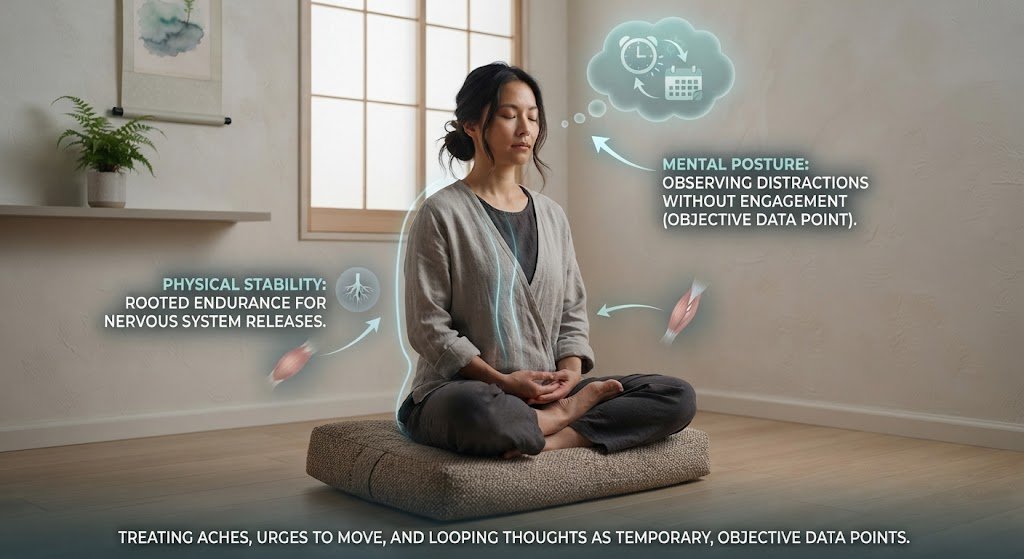
Managing physical restlessness and invasive distractions requires treating them as data points rather than obstacles to a successful session. When your body aches or your mind races mid-practice, your nervous system is simply processing accumulated tension or shifting out of autopilot.
Why Physical Restlessness Happens Early in Practice
Physical restlessness occurs because your body is unaccustomed to prolonged stillness, which immediately brings hidden musculoskeletal tension into your conscious awareness. When daily life keeps you in a perpetual state of kinetic movement, minor aches, itches, and postural strains remain masked by sensory overload.
Nervous system release: Dropping into stillness causes your sympathetic nervous system to downshift, releasing stored physical stress that demands release.
Hyper-awareness: Your sensory perception sharpens during meditation, turning minor bodily sensations into loud signals of discomfort.
Avoidance mechanics: The subconscious mind often manufactures physical discomfort as an escape tactic when meditation begins addressing deeper psychological stressors.
The physical urge to shift or scratch is frequently a manufactured distraction deployed by a restless mind that wants to escape quiet focus.
What to Do When Your Body Wants to Move
Navigating physical discomfort effectively requires a balance between mindful endurance and smart self-care so you do not injure your posture or torture your joints.
Pause and investigate: Before moving, bring your attention directly to the sensation. Notice its precise boundaries, temperature, and intensity without labeling it as bad.
The delay rule: Wait sixty seconds after noticing an itch or ache; many superficial physical sensations naturally dissolve once observed objectively.
Mindful adjustment: If the pain persists or becomes sharp, make your posture adjustment slowly, deliberately, and with complete awareness of your muscles moving.
Handling Repetitive or Intrusive Thoughts Mid-Session
Repetitive thoughts loop during meditation because your brain is trying to solve an emotional puzzle that lacks a clean conclusion. Fighting these intrusive ideas only strengthens their grip, turning your practice into an exhausting mental tug-of-war.
Acknowledge and park: Silently tag the repeating loop with a concise marker like “recurring theme” and deliberately visualize placing it in a mental holding box.
Drop into physical sensation: When an intrusive thought refuses to leave, immediately shift your focal point away from your head and down to the physical contact of your hands or feet.
Strip the drama: Remind yourself that a thought is just an electrochemical firing sequence, not an urgent crisis requiring your immediate analysis.
You cannot stop a disruptive thought from arriving, but you completely control whether you unpack its bags and invite it to stay.
When Distraction Means You Should Stop (and When It Doesn’t)
Differentiating between normal mental friction and genuine distress ensures your practice remains a tool for wellness rather than a source of self-inflicted strain.
When to push through: Stop only when distractions stem from normal boredom, minor impatience, or garden-variety mental chatter that you can resolve with breath anchors.
When to pause your session: Stop immediately if you experience sharp physical pain, acute panic attacks, or overwhelming trauma-related flashbacks that meditation tools cannot ground.
Compassionate exits: If you decide to end a session early due to genuine distress, do so with self-kindness rather than judgment, acknowledging that your well-being always takes priority.
What NOT to Do During Meditation
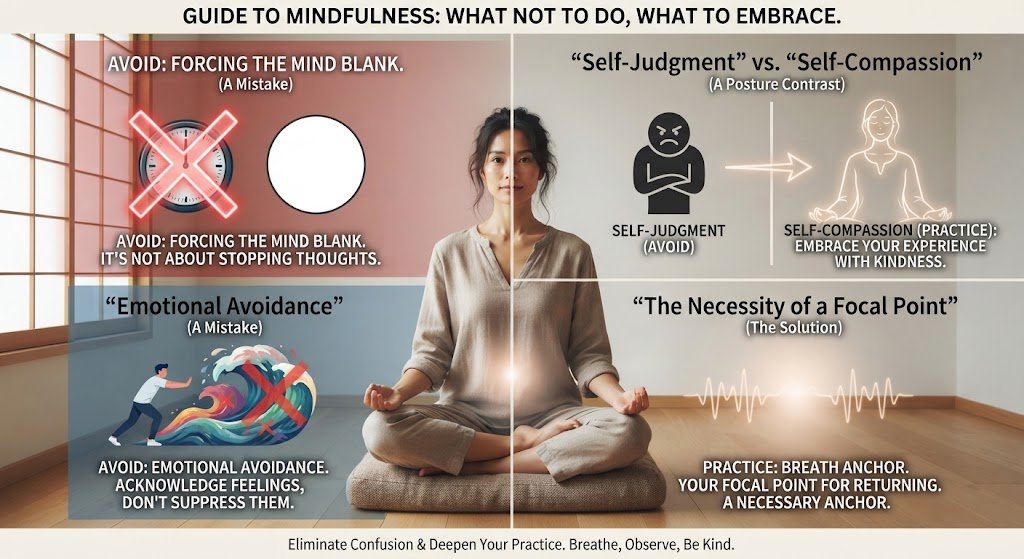
Avoiding common counterproductive habits accelerates your progress and protects you from frustration during practice. Many beginners unknowingly sabotage their sessions by treating mindfulness like a rigid performance task rather than an act of observation.
Don’t Force Your Mind to Go Blank
Attempting to force your mind into absolute silence is the single most common mistake that causes beginners to quit meditation prematurely.
Accept natural activity: The biological function of the brain is to produce thoughts, just as the heart pumps blood; trying to stop it creates unnecessary stress.
Redefine success: Judge your session by your awareness and kindness toward wandering thoughts, not by how quiet your internal dialogue becomes.
Stop fighting biology: Forcing a blank slate triggers a frustrating pressure loop that guarantees a tense and exhausting practice.
Trying to force your mind to go blank is like telling your lungs to stop processing oxygen—it is fundamentally impossible and works against your natural design.
Don’t Judge or Criticize Yourself for Wandering Thoughts
Harsh self-criticism mid-session completely defeats the purpose of mindfulness by injecting secondary anxiety into an already distracted state.
Drop the inner critic: Berating yourself for getting distracted adds a layer of frustration that keeps your nervous system activated.
Normalize the drift: Expect your attention to wander dozens of times per session; this is standard neurological behavior, not a personal flaw.
Practice gentle redirection: Treat every moment of catching a wandering thought as a successful neurological push-up for your attention muscle.
Don’t Meditate to “Escape” Emotions Instead of Observing Them
Using meditation as a chemical or psychological shield to numb your feelings transforms the practice into avoidance rather than healing.
Face the discomfort: Suppressing or bypassing emotional pain under the guise of “finding peace” leaves unresolved stress trapped in your body.
Observe the physical sensations: Bring mindful curiosity to how grief or anxiety actually feels as a physical sensation—tight chest, warm throat, heavy stomach.
Process over bypass: True mindfulness allows you to sit inside difficult emotions without drowning in them or running away from them.
Don’t Skip the Anchor (Breath or Object of Focus)
Attempting to meditate without a concrete focal point leaves your mind drifting aimlessly in an unstructured loop of rumination.
Maintain a home base: Always keep a primary anchor, such as your breath, physical posture, or a visualization, to ground your awareness.
Avoid floating awareness: Trying to “just be aware of everything” usually results in your brain getting caught up in scattered multitasking.
Return safely: When distractions pull you away, your breath anchor provides a reliable mechanism to safely guide your focus back to the present.
Meditation for Overthinking, Anxiety, and Staying Calm
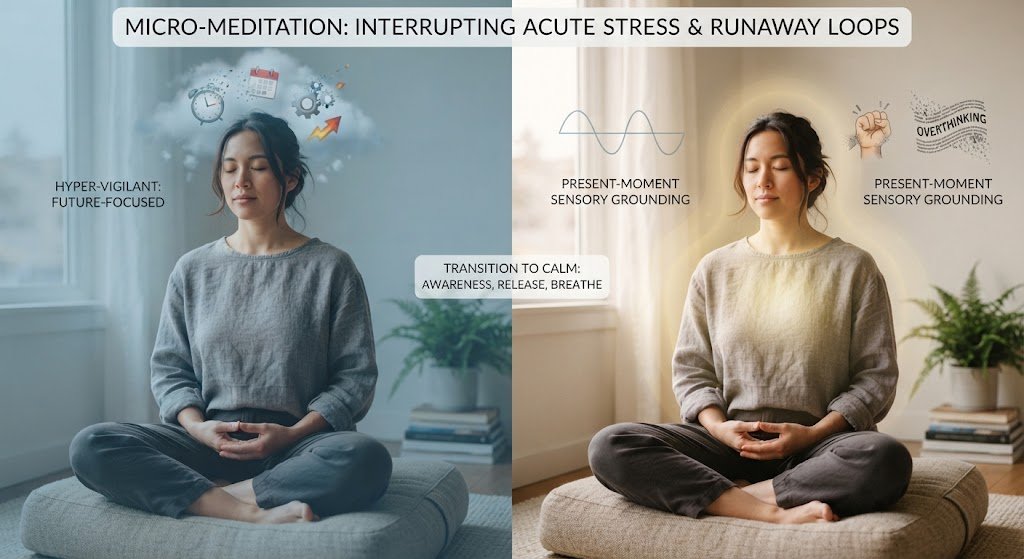
Overthinking and anxiety respond exceptionally well to meditation because they stem from the brain looping into future-based catastrophes or past regrets. Targeted mindfulness practices short-circuit these nervous system loops by shifting cognitive processing away from abstract worry and grounding it directly back into physical reality.
Why Overthinking and Anxiety Respond Well to Meditation
Anxious overthinking keeps your body locked in a prolonged fight-or-flight response, flooding your system with adrenaline and magnifying every mental stressor. Meditation systematically lowers heart rates and down-regulates the amygdala, interrupting the biological feedback loop that feeds your anxiety.
Nervous system downshift: Deliberate breathing triggers the vagus nerve, signaling safety to a hyper-vigilant brain.
Breaking cognitive loops: Shifting focus from future “what-ifs” to current sensory inputs stops the mental spiral before it gains momentum.
Reclaiming agency: Consistent practice teaches you that anxious thoughts are temporary visitor events, not emergency alarms requiring action.
Anxiety convinces you that every thought is a five-alarm fire; meditation acts as the sprinkler system that puts the panic out before it spreads.
A Quick Calming Technique for Stressful Moments
When acute stress or racing thoughts strike unexpectedly during a busy day, a micro-meditation offers immediate relief without requiring a quiet room or a cushion.
The physiological sigh: Take two quick inhales through your nose—one deep breath followed immediately by a sharp top-off breath—then release a long, slow exhale through your mouth.
Grounding scan: Quickly drop your awareness into your physical contact points, feeling your feet flat on the floor and your hands resting on your surface.
One-minute reset: Spend sixty seconds focusing exclusively on the sensation of air entering and leaving your nostrils, letting everything else pause.
Combining Breathing Exercises With Thought-Labeling for Fast Relief
Merging deep rhythmic breathing with precise cognitive labeling provides a dual-action defense against overwhelming mental clutter.
Inhale stability, exhale tension: As you breathe in, mentally note the word “calm”; as you breathe out, note the word “release.”
Tag the storm: When an anxious thought surfaces, label its category instantly—such as “future worry” or “past regret”—to remove its element of surprise.
Return to baseline: Immediately guide your focus back to the rhythm of your breath cycle, starving the anxious thought of the mental fuel it craves.
Make It a Habit — The Emotional Discipline of Daily Meditation

Developing emotional discipline through daily meditation transforms the practice from a temporary stress-relief tool into permanent structural change in how your brain processes stimuli. Consistency builds the mental resilience required to catch automatic thought loops before they spiral into anxiety.
Why Thought Control Is a Skill, Not a One-Time Fix
Thought management functions identically to physical fitness; it cannot be mastered through sporadic attempts or intense weekend efforts. Treating mindfulness as a daily hygienic habit builds the neural pathways that allow you to respond to stress with intention rather than automated reactivity.
Neurological conditioning: The brain defaults to habitual wiring unless actively interrupted by deliberate moments of nonjudgmental awareness.
Building resilience: Regular micro-sessions expand your capacity to sit with emotional discomfort without seeking immediate distraction or escape.
Long-term stability: Consistent practice shifts your baseline state from frantic hyper-vigilance to grounded composure.
Mental mastery is forged through thousands of tiny, ordinary moments where you choose to return to your breath instead of following a chaotic thought.
Can 7 Days of Meditation Really Rewire Your Brain?
While neuroplasticity is a continuous biological process, structured short-term programs provide an immediate foundation for functional changes in emotional processing and stress regulation. Clinical research tracked by Harvard-affiliated teams at Massachusetts General Hospital demonstrates that consistent mindfulness training produces measurable physical alterations in regions governing stress, memory, and emotional regulation, as detailed in this
Amydgala modulation: Short-term consistent practice correlates with reduced physical activation and gray matter density in the brain’s fear and stress center.
Enhanced integration: Daily attention anchoring strengthens neural connectivity between areas associated with sensory perception and executive function.
Immediate psychological shifts: Even a single week of daily practice yields noticeable improvements in self-reported focus, stress reduction, and rumination awareness.
The brain changes in response to how you direct your attention; teaching it to pause for a few minutes daily rewires its default reaction to chaos.
Building a Sustainable Daily Practice (Even 5 Minutes Counts)
Building a realistic routine requires removing perfectionism and lowering the daily time barrier so consistency remains achievable.
Micro-habits win: Committing to a strict five-minute daily window outperforms ambitious hour-long sessions that quickly lead to burnout and abandonment.
Anchor to existing cues: Stack your meditation habit immediately on top of an established routine, such as right after brewing morning tea or closing your laptop at night.
Embrace inconsistency without guilt: Missing a single day does not erase your progress; simply pick up right where you left off without self-criticism.
Tracking Progress Without Turning It Into Pressure
Monitoring your meditation journey should enhance your motivation rather than introduce a new performance metric to stress over.
Focus on quality of recovery: Measure progress by how quickly you catch yourself spiraling during daily life, not by how quiet your mind is during sessions.
Simple streak markers: Use a basic calendar checkmark system to track consistency without grading the “success” of individual sits.
Release outcome dependency: Approach each session with curiosity rather than a demand for instant emotional transformation.
This video provides an expert neuroscientific breakdown of how regular mindfulness practice physically reshapes brain structures associated with stress and emotional regulation.
Frequently Asked Questions
Does meditation help control your thoughts?
Meditation does not help you control or eliminate thoughts directly; instead, it trains you to change your relationship with them. By observing your mind without judgment, you stop reacting to mental events and learn to let them pass naturally.
How do you let go of things that are out of your control?
Letting go starts by recognizing that fighting external circumstances or internal worries only amplifies them. Use grounding anchors like your breath to shift your focus away from abstract loops and back to the present moment, where you have actual agency.
How to stop thoughts from controlling you?
You stop thoughts from ruling you by practicing cognitive defusion—viewing mental events as transient weather rather than absolute commands. When you catch a thought wandering, label it neutrally and gently guide your focus back to your anchor.
What is the hardest emotion to control?
Emotions tied to deep survival instincts, such as acute anxiety, anger, and panic, are typically the hardest to regulate because they trigger rapid physiological responses. Mindfulness helps by creating a crucial pause between that initial trigger and your behavioral reaction.
What is 11:11 meditation?
The 11:11 meditation is a sync-practice built around angel numbers and synchronicity, often used as a daily mindful reminder to pause, set an intention, and align your awareness with the present moment.
How can I stop thinking about something I'm always thinking about?
Actively trying to push a recurring thought away causes a rebound effect that makes it stronger. Instead, accept its presence, label it objectively as a mental loop, and deliberately redirect your focus to physical sensations or a tactile task.
Should you have control over your thoughts, or let them roam free?
Absolute control over thoughts is a biological impossibility, but letting them roam completely unchecked leads to mental chaos. The optimal balance is mindful awareness—letting thoughts arise naturally while choosing which ones you engage with.
Is the goal of meditation to control your thoughts or to stop them from controlling you?
The ultimate goal is never to stop or control your thoughts, but rather to stop them from controlling your emotional state and behavior. Mindfulness transforms you from a frantic participant into a calm observer of your internal landscape.
Kittisak Wattanakul
Kittisak Wattanakul is the Discipline Editor at Holistic Wellbeing Living. He writes about routines, focus, consistency, and practical follow-through. With nine years of experience creating personal-growth content, Kittisak helps readers build realistic systems for steady progress without extreme productivity pressure.