Jump to:
ToggleLatin Word for Discipline: Meaning, Origin, and Etymology
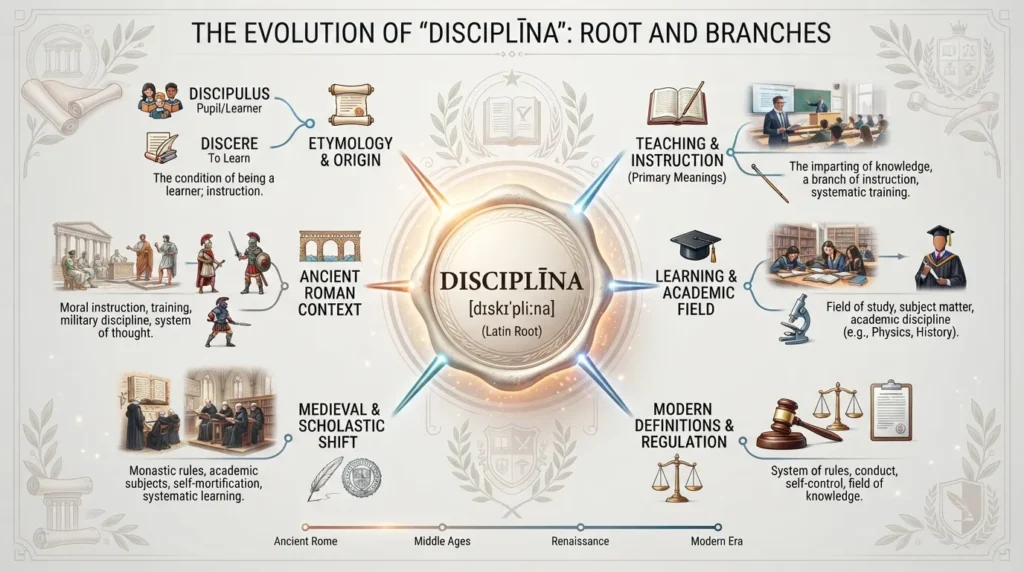
Introduction / Quick Answer
The Latin word for discipline is disciplina, which translates directly to instruction, training, knowledge, or military discipline. Rooted in the verb discere (meaning “to learn”) and closely tied to discipulus (meaning “student” or “disciple”), the term historically evolved from educational instruction to encompass systematic self-control, rigorous training, and adherence to established rules.
Core Etymology: Derived from discere (to learn) and discipulus (learner/student).
Primary Classical Meaning: Systematic instruction, teaching, learning, or a branch of knowledge.
Secondary Evolution: Public order, military training, self-restraint, and specialized systems of thought or philosophy.
Understanding this linguistic lineage clarifies why modern romance languages retain the dual sense of mental instruction and strict behavioral order. Whether referring to an academic field of study (disciplina) or personal adherence to a code, the root consistently points back to the active pursuit of learning and structured growth.
What Is the Latin Word for Discipline?

The Latin noun for discipline is disciplina, a feminine first-declension noun that encompasses a broad spectrum of meanings related to teaching, learning, and systemic order. Unlike a simple dictionary translation, understanding its full grammatical context and cultural application reveals how the ancient Romans perceived structured knowledge and behavioral control.
Disciplina — Meaning and Definition
As a noun, disciplina fundamentally refers to instruction, systematic teaching, and the acquisition of knowledge. It also denotes a branch of learning, a science, or an organized system of rules and principles.
Grammatical Classification: Feminine singular noun, first declension (disciplina, disciplinae).
Core Semantic Range: Instruction, education, training, knowledge, and custom.
Derivational Root: Built directly upon discere (to learn) and related to discipulus (student or follower).
How Disciplina Was Used in Ancient Rome
In Roman society, the term extended far beyond modern definitions of punishment or self-control, anchoring crucial aspects of civic, military, and religious life.
Military Rigor: Roman military discipline (disciplina militaris) was legendary, denoting strict adherence to combat formations, absolute obedience to commanders, and rigorous tactical training.
Educational Instruction: Writers like Cicero and Quintilian used disciplina to describe liberal arts, philosophical schools, and the systematic transmission of cultural values from masters to pupils.
The Goddess Disciplina: Roman soldiers worshipped a minor deity named Disciplina, the personification of military virtue, loyalty, and strict adherence to duty. Temples and inscriptions dedicated to this goddess frequently appeared in frontier military camps across the empire to reinforce camp morale and obedience.
The Root Word of Discipline — Full Etymology Breakdown
The modern English word discipline traces a rich linguistic journey spanning thousands of years, evolving from prehistoric Indo-European tribal roots into a cornerstone concept of Roman law, education, and medieval European vocabulary.
Step 1 — Proto-Indo-European Root dek- (“to accept/take”)
Linguistic historians trace the ultimate origins of discipline back to the Proto-Indo-European (PIE) root dek-, which means “to take” or “to accept.” According to etymological references like Etymonline, this foundational root spawned numerous derivatives across various Indo-European language families dealing with notions of seizing, receiving, and honoring.
Step 2 — Latin Discere (“to learn”)
From the broader PIE root, Latin developed the verb discere, meaning “to learn” or “to get to know.” This active verb represents the cognitive transition from merely accepting or taking information to actively processing and internalizing knowledge.
Linguistic Function: An inchoative verb form indicating the beginning or process of acquiring knowledge.
Semantic Shift: Shifts the focus from passive reception (dek-) to active intellectual engagement.
Step 3 — Latin Discipulus (“pupil/student”) — the Root of “Disciple”
As people engaged in the act of learning (discere), the noun discipulus emerged to describe the person doing the learning. This term translates directly to “learner,” “pupil,” or “follower.”
Direct Legacy: Directly yields the modern English word disciple.
Cultural Implication: Highlights a relational dynamic where a student voluntarily submits to a master’s instruction.
Step 4 — Latin Disciplina (“instruction, training”)
The immediate parent of our modern term is disciplina, which integrated the concepts of discere and discipulus into a formalized system. It bridges the gap between individual learning and institutionalized instruction, training, and systemic order.
(Video: “What Is The Origin And Meaning Of The Word Disciplina?” — https://www.youtube.com/watch?v=yqk0kAmCmQY)
Step 5 — Old French Descepline → Middle English → Modern English “Discipline”
Following the fall of Rome, the term survived through Old French as descepline, retaining its religious and educational nuances before entering Middle English around the 13th century. Over subsequent centuries, it broadened to include self-control, behavioral regulation, and specialized academic fields.
Visual Timeline Table (PIE → Latin → Old French → English)
| Historical Stage | Word Form | Language / Source | Core Meaning |
| Stage 1 | dek- | Proto-Indo-European | To take, accept, or receive |
| Stage 2 | discere | Classical Latin | To learn or acquire knowledge |
| Stage 3 | discipulus | Classical Latin | Student, pupil, or follower |
| Stage 4 | disciplina | Classical Latin | Instruction, training, and system |
| Stage 5 | descepline | Old French | Religious penance, teaching, order |
| Stage 6 | discipline | Middle to Modern English | Systematic training, self-control, and penal code |
Is Discipline a Greek Word or a Latin Word?
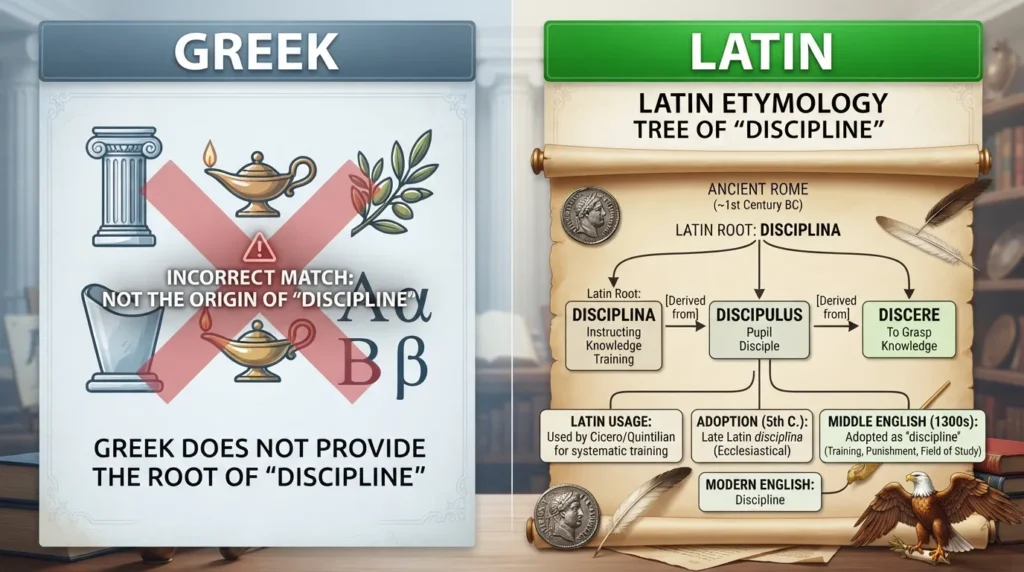
Discipline is strictly a Latin word, originating from disciplina, and has no direct etymological root in ancient Greek. Many people confuse the two classical languages because both cultures placed immense philosophical value on education, self-mastery, and civic virtue.
Why People Think “Discipline” Is Greek
The confusion between Greek and Latin roots often stems from the close parallel between ancient Greco-Roman educational systems and shared phonetic patterns in classical vocabulary. Because English frequently borrows technical and philosophical terminology from both ancient Greece and Rome, everyday speakers mistakenly attribute Latin terms like discipline to Greek origins.
Shared Cultural Themes: Both cultures emphasized rigorous physical training and mental conditioning, leading to conceptual overlap.
Complex Orthography: Multi-syllabic words ending in “-ine” appear across both classical languages, creating false etymological assumptions.
Shared Indo-European Roots: Distant prehistoric linguistic ties link ancient Greek and Latin, though their specific developmental paths diverged centuries before disciplina was coined.
The Actual Greek Word for Discipline — Paideia (παιδεία)
The closest ancient Greek equivalent to the modern concept of discipline is paideia (παιδεία), which refers to the upbringing, education, and cultural formation of a member of society. While disciplina leans toward structural instruction and rules, paideia encompasses the entire process of nurturing a well-rounded citizen.
Core Meaning: Child-rearing, general education, and cultural refinement.
Broader Scope: Focuses on character development, civic responsibility, and mastery of the liberal arts rather than strict behavioral punishment.
Philosophical Weight: Heavily utilized by Plato and Isocrates to describe the ideal moral and intellectual state of a Greek citizen.
Latin vs. Greek — Key Differences Explained
Comparing how each classical civilization framed personal and societal order highlights distinct cultural priorities embedded directly within their vocabularies.
Institutional Focus (Disciplina): The Latin framework prioritized systematic order, military obedience, authoritative instruction, and established institutional rules.
Holistic Development (Paideia): The Greek framework emphasized internal intellectual enlightenment, philosophical cultivation, and the ideal societal integration of the individual.
Linguistic Lineage: English inherited its administrative and punitive vocabulary primarily from Latin (disciplina), while retaining Greek roots primarily for specialized scientific or philosophical taxonomies.
Discipline in Other Languages (Biblical, Hebrew, Spanish, Japanese)
The concept of discipline spans diverse linguistic and cultural traditions, reflecting unique moral, spiritual, and social frameworks. Examining how different languages articulate discipline reveals distinct cultural priorities regarding authority, self-restraint, and education.
The Biblical Word for Discipline (Hebrew Musar & Greek New Testament Paideia)
Biblical literature addresses discipline through two primary linguistic lenses that connect instruction with loving correction and moral growth.
Old Testament Hebrew Focus: The scriptures utilize musar to emphasize instructional correction, parental guidance, and chastisement aimed at wisdom.
New Testament Greek Focus: Authors of the Christian Greek Scriptures employ paideia to signify divine training, spiritual upbringing, and necessary formative correction.
Theological Purpose: In both testaments, discipline is framed not as punitive cruelty, but as an essential act of care designed to cultivate righteousness and maturity.
Discipline in Hebrew
The primary Hebrew word for discipline is musar (מוּסָר), which appears extensively throughout the wisdom literature of the Hebrew Bible, particularly in Proverbs.
Primary Translations: Instruction, correction, discipline, or warning.
Etymological Root: Derived from yasar, meaning to chastise, admonish, or train.
Cultural Nuance: Combines intellectual teaching with behavioral discipline, highlighting the guidance a parent gives a child or a teacher gives a pupil.
Discipline in Spanish (Disciplina)
Spanish retains a direct phonetic and semantic descendent from Classical Latin through the feminine noun disciplina.
Primary Translations: Discipline, subject, branch of study, or self-control.
Cognate Verb: Disciplinar (to train, discipline, or whip/chastise).
Usage Context: Widely utilized in academic, military, and domestic settings, mirroring English usage while maintaining strong ties to organized religious orders and penance (disciplinas).
Discipline in Japanese (Kiritsu / Shitsuke)
Japanese separates the concept into distinct terms depending on whether it applies to social order or personal upbringing, utilizing kiritsu and shitsuke.
Kiritsu (規律): Refers to public order, rules, regulations, and institutional discipline within schools or workplaces.
Shitsuke (躾): Refers to domestic upbringing, etiquette, and the traditional training of children in good manners and personal habits.
Cultural Implication: Reflects a societal emphasis on harmony, collective responsibility, and meticulous behavioral refinement.
Comparison Table — Discipline Across Languages
| Language | Primary Term | Root / Origin | Core Meaning & Nuance |
| Latin | Disciplina | Discere (to learn) | Systematic instruction, military order, and training |
| Ancient Greek | Paideia (παιδεία) | Pais (child) | Holistic cultural education and character formation |
| Biblical Hebrew | Musar (מוּסָר) | Yasar (to correct) | Instructional correction, moral training, and wisdom |
| Spanish | Disciplina | Latin disciplina | Academic branch, self-control, and rules |
| Japanese | Kiritsu / Shitsuke | Kanji compounds | Institutional public rules (kiritsu) vs. etiquette (shitsuke) |
What Does "Disciplina" Really Mean? (Deep Meaning Explainer)

The Latin term disciplina fundamentally means a system of instruction, a branch of knowledge, or the orderly training required to acquire a skill. While modern speakers often equate discipline with strict punishment or behavioral restriction, the classical Roman understanding was rooted entirely in learning, intellectual development, and structured mentorship.
Original Meaning — “Order Necessary for Instruction”
In classical antiquity, disciplina did not imply harsh penalties or authoritarian control; instead, it described the mental and environmental order required for effective teaching to occur.
The Teacher-Student Bond: The word inherently assumed a relationship between a master (magister) and a learner (discipulus).
Systematic Knowledge: It denoted a structured curriculum or body of doctrine, such as the liberal arts (artes liberales).
Mental Focus: It represented the internal mental application a student needed to comprehend complex philosophical or practical subjects.
How the Meaning Shifted Toward “Punishment/Correction” Over Time
The semantic drift from positive instruction to punitive control occurred gradually as institutional structures—particularly the military and medieval religious orders—enforced strict compliance.
Military Prerogative: In Roman legions, maintaining order (disciplina militaris) required absolute obedience, transforming training into unyielding rule enforcement.
Ecclesiastical Influence: During the Middle Ages, religious institutions used descepline to describe penitential self-flagellation and corporal correction required to purge sin.
Modern Secularization: Over subsequent centuries, European vernaculars adopted these punitive associations, shifting the primary weight of the word from “learning” to “behavioral management and punishment.”
Modern Usage vs. Ancient Meaning
Comparing contemporary definitions with classical roots reveals a profound inversion in how humanity views self-improvement and authority.
Ancient Focus: Disciplina looked outward and forward toward mastery, education, and the acquisition of wisdom.
Modern Focus: Discipline often looks inward and backward toward self-denial, restriction, and corrective measures for broken rules.
Reclaiming the Root: Recognizing the original etymology transforms discipline from an act of punishment into an active, empowering pursuit of lifelong learning and personal growth.
A Nicer / Softer Word for Discipline

Finding a softer alternative to “discipline” often helps reframe rigid behavioral expectations into positive, empowering actions. While discipline carries heavy connotations of punishment and strict obedience, alternative vocabulary highlights growth, supportive habits, and intentional routines.
Positive Synonyms for Discipline (Structure, Self-Control, Consistency, Training)
Replacing discipline with terms that emphasize personal agency or supportive frameworks reduces resistance in parenting, coaching, and self-improvement contexts.
Structure: Establishes predictable environments and clear rhythms without imposing punitive emotional pressure.
Consistency: Focuses on steady, repeatable action over time rather than rigid perfectionism or rule-following.
Self-Control: Highlights internal mastery, emotional regulation, and personal choice rather than external authoritative control.
Training: Frames skill acquisition as a gradual athletic or intellectual process rooted in the original Latin root discere.
Commitment: Connects adherence to goals with personal values and internal motivation rather than enforced obligation.
When to Use a Softer Word Instead of “Discipline”
Choosing alternative language is particularly effective when addressing sensitive audiences, fostering collaborative environments, or shifting away from punitive mindsets.
Child Guidance: Use words like guidance, coaching, or routine instead of discipline to encourage cooperative learning over fear-based compliance.
Fitness and Wellness: Swap discipline for consistency or habits to reframe health journeys as supportive self-care rather than grueling self-punishment.
Professional Settings: Substitute structure or protocols to maintain high standards of accountability while fostering a collaborative, psychologically safe team culture.
The Four Types of Discipline

Classifying discipline into distinct categories helps educators, parents, and leaders apply appropriate strategies for behavioral management and personal development. While definitions vary across psychology and organizational management, four primary models dominate practical applications.
Preventive, Supportive, Corrective & Positive Discipline
Each type of discipline serves a distinct function in establishing boundaries, correcting mistakes, and fostering long-term behavioral growth.
Preventive Discipline: Focuses on establishing clear rules, predictable routines, and proactive environments before misbehavior occurs to minimize potential disruptions.
Supportive Discipline: Involves gentle reminders, non-verbal cues, and guidance provided while an individual is beginning to drift off track, keeping them focused without embarrassment.
Corrective Discipline: Implements logical consequences, boundaries, and corrective actions after a rule has been broken or a significant mistake has been made.
Positive Discipline: Emphasizes mutual respect, problem-solving, and teaching long-term social and emotional skills rather than relying on punitive measures.
FAQs (People Also Ask Optimized)
What is the root word for “discipline”?
The root word for discipline is the Latin verb discere, meaning “to learn,” which traces back to the Proto-Indo-European root dek-, meaning “to take” or “to accept.” This root evolved through discipulus (student or pupil) into the noun disciplina (instruction and training).
What is the Greek word for “discipline”?
The ancient Greek equivalent closely tied to the concept of education and upbringing is paideia (παιδεία). While ancient Greek lacked an exact phonetic ancestor to the Latin term, paideia encompasses cultural formation, character development, and general instruction.
What is the biblical word for discipline?
In biblical literature, discipline is primarily expressed through the Hebrew word musar in the Old Testament and the Greek word paideia in the New Testament. Both terms emphasize instructional correction, parental guidance, and loving moral training rather than harsh punishment.
What does disciplina mean?
The classical Latin noun disciplina translates directly to instruction, systematic teaching, learning, or military training. Originally, it described the mental order and specialized knowledge acquired by a student under a teacher’s guidance.
What is the Latin word for “discipline”?
The Latin word for discipline is disciplina, a feminine first-declension noun. It served as the direct linguistic parent for modern European terms related to education, specialized branches of study, and behavioral order.
What is a nicer word for discipline?
Softer alternatives to discipline include structure, consistency, self-control, guidance, and training. These synonyms help reframe rigid expectations into empowering habits and supportive personal routines.
What does the word discipline mean in Hebrew?
The Hebrew word for discipline is musar (מוּסָר), which translates to instruction, correction, or chastisement. It appears frequently in wisdom literature like Proverbs to describe the formative advice a parent or teacher gives to cultivate wisdom.
What does discipline mean in Japanese?
Japanese divides the concept into two primary terms: kiritsu (規律), which refers to public institutional rules and social order, and shitsuke (躾), which denotes domestic upbringing, etiquette, and personal habits.
What is the Spanish word for “discipline”?
The Spanish word for discipline is disciplina, a direct cognate inherited from Classical Latin. It maintains identical meanings across academic, military, and behavioral contexts.
Conclusion — Key Takeaways
Tracing the history of discipline reveals a fascinating shift from an empowering pursuit of knowledge to a modern framework of behavioral control. Understanding its true linguistic origins transforms how we view structure in our daily lives.
Latin Heritage: The word originates directly from the Latin noun disciplina, rooted in discere (to learn) and discipulus (student).
Evolution of Meaning: Originally signifying systematic instruction and the order necessary for education, the term gradually acquired punitive and authoritative connotations through military and ecclesiastical history.
Global and Biblical Contexts: Equivalent concepts like Greek paideia, Hebrew musar, and Japanese kiritsu demonstrate that diverse cultures universally value structured learning, character formation, and personal growth.
By reclaiming the original spirit of disciplina, we can reframe discipline not as a rigid punishment, but as an active, lifelong commitment to learning, consistency, and self-mastery.
Kittisak Wattanakul
Kittisak Wattanakul is the Discipline Editor at Holistic Wellbeing Living. He writes about routines, focus, consistency, and practical follow-through. With nine years of experience creating personal-growth content, Kittisak helps readers build realistic systems for steady progress without extreme productivity pressure.