Jump to:
ToggleSelf-Discipline: Definition, Types, Pillars, and How to Master It
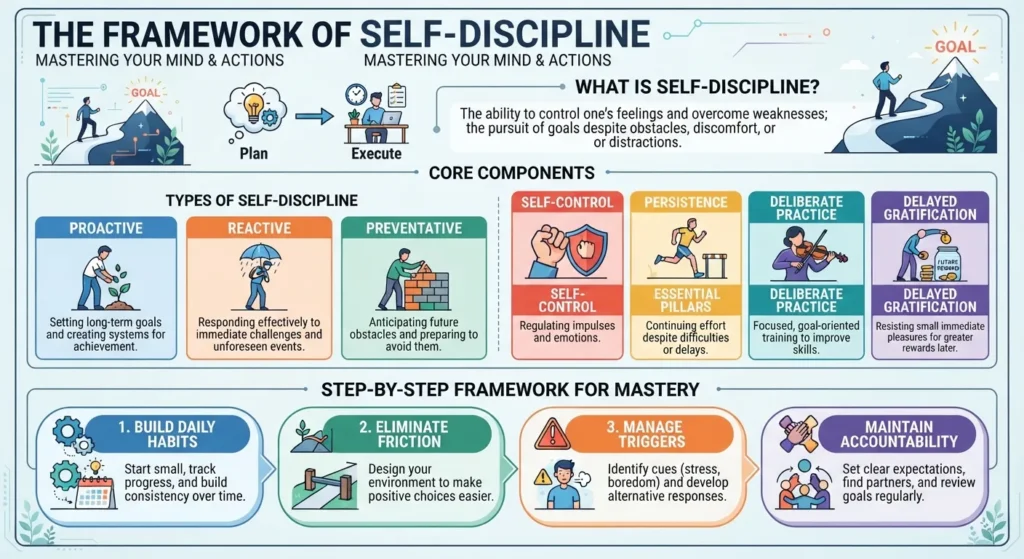
What Is Self-Discipline? (Quick Definition)
Self-discipline is the ability to control your impulses, emotions, and behaviors to resist instant gratification in pursuit of long-term goals. It functions as the foundational mechanism behind personal achievement, utilizing deliberate self-regulation and willpower to align daily actions with future objectives rather than temporary feelings.
Core Driver: Replaces short-term comfort with long-term vision through conscious choice.
Behavioral Impact: Translates intention into execution despite obstacles, fatigue, or emotional resistance.
Cognitive Component: Relies on mental resilience and conscious self-restraint to override impulsive habits.
Mastering self-discipline requires viewing it not as an innate, unchanging trait, but as a renewable mental muscle. Consistent practice strengthens your capacity for self-control, transforming challenging tasks into automatic routines.
Willpower Activation: Consciously directing mental energy toward demanding, high-priority tasks.
Habit Formation: Automating productive behaviors so they require less active self-restraint over time.
Impulse Management: Pausing between emotional triggers and physical actions to ensure alignment with stated goals.
Self-Discipline Meaning According to Dictionaries
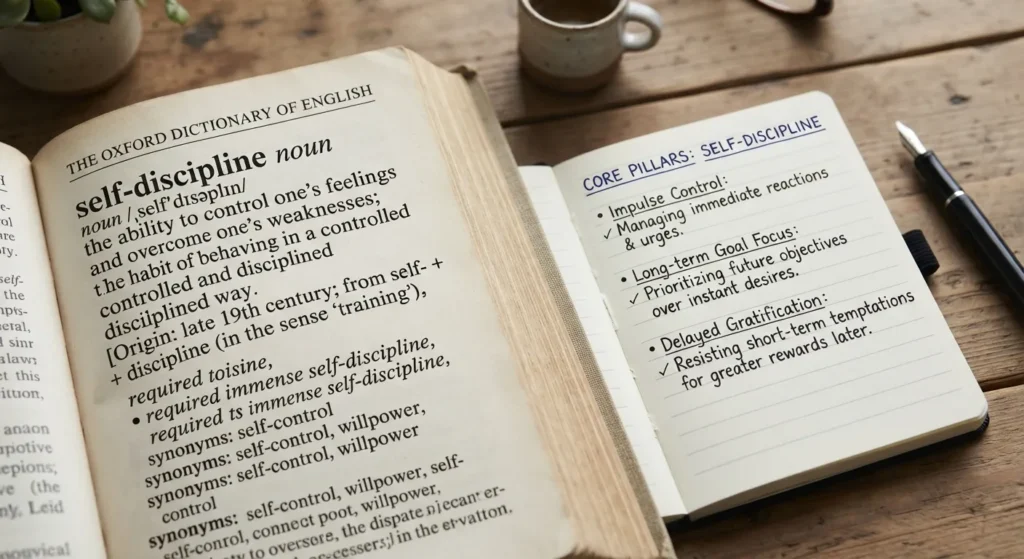
Dictionary definitions establish self-discipline as the systematic regulation of oneself for personal improvement and goal achievement. Etymological and lexicographical analyses reveal a shared consensus: it is the active suppression of immediate distractions and negative feelings to maintain consistent performance.
Merriam-Webster Definition of Self-Discipline
According to Merriam-Webster{rel=”nofollow”}, self-discipline is defined as “correction or regulation of oneself for the sake of improvement.” This definition emphasizes internal accountability rather than external enforcement.
Core Focus: Deliberate self-correction and continuous personal evolution.
Operational Scope: Applying internal standards to modify unhelpful behaviors without requiring a supervisor or system of external penalties.
Practical Application: Recognizing suboptimal patterns in real-time and adjusting actions to favor long-term growth.
Cambridge Dictionary Definition of Self-Discipline
The Cambridge Dictionary frames self-discipline as “the ability to make yourself do things that you know you should do even when you do not want to do them.” This definition targets the friction point between emotional resistance and functional execution.
Behavioral Trigger: Overcoming motivational deficits and aversions to difficult or tedious tasks.
Decision Framework: Prioritizing objective necessity over subjective mood or momentary comfort.
Execution Metric: Successfully initiating and completing high-priority actions despite strong internal reluctance.
Collins & Dictionary.com Definitions Compared
Collins Dictionary defines self-discipline as “training of oneself, usually for improvement,” while Dictionary.com highlights “discipline and training of oneself, often for self-improvement.” Comparing these sources underscores the functional parallels and distinct emphases across major lexicographical authorities.
Training Aspect: Both sources treat the trait as a trainable skill rather than an immutable personality quirk.
Directional Intent: The primary vector points inward—using structured habit loops to systematically upgrade capabilities.
Linguistic Nuance: Collins emphasizes the active training process, whereas Dictionary.com leans into the resulting self-improvement outcomes.
Key Aspects / Elements of Self-Discipline
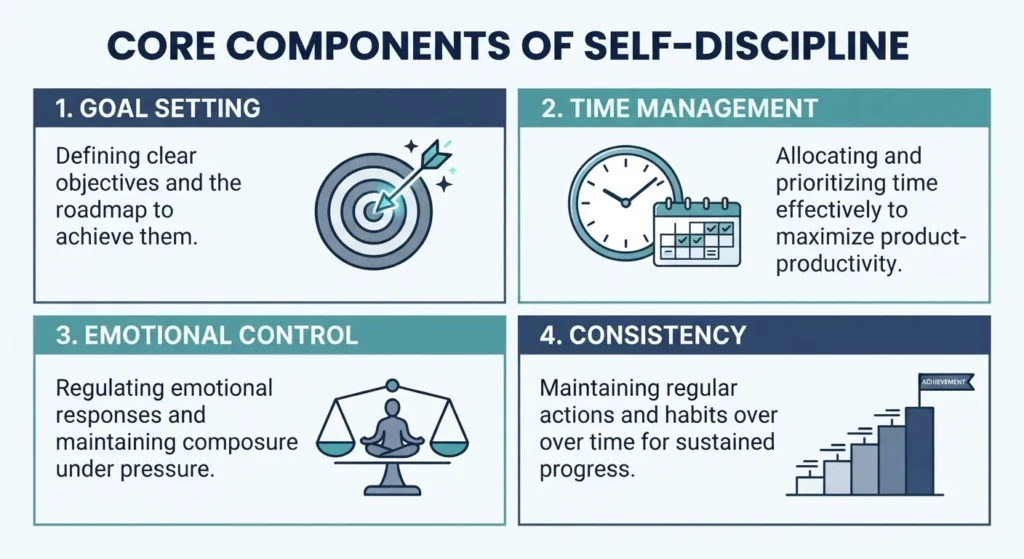
Self-discipline operates through three core pillars that transform abstract intention into reliable execution. Understanding these foundational elements allows you to diagnose where personal breakdowns occur and target specific behavioral adjustments.
Behavioral Architecture: The structural combination of emotional regulation, autonomous execution, and habitual consistency.
Functional Output: Sustained alignment between daily choices and ultimate long-term goals.
Control: Managing Impulses and Emotions
Impulse control and emotional regulation form the defensive line of self-discipline, protecting your focus from immediate distractions. This aspect requires recognizing emotional surges—such as frustration, boredom, or impatience—and preventing them from dictating your behavior.
Impulse Interception: Pausing between an external trigger and your behavioral reaction to evaluate consequences.
Emotional Detachments: Acknowledging stress or fatigue without allowing negative feelings to halt productive output.
Action: Doing the Work Without Being Told
Self-driven execution eliminates the need for external accountability or supervision to initiate critical tasks. This dimension relies on internal motivation and personal ownership to start and finish obligations independently.
Autonomous Initiation: Beginning challenging tasks without waiting for ideal conditions or external prompts.
Execution Momentum: Overcoming initial procrastination through deliberate effort and decisive action.
Consistency: Building Habits Over Time
Consistency bridges the gap between sporadic bursts of motivation and sustainable, long-term success. By establishing predictable daily routines, self-discipline shifts from an exhausting act of daily willpower into an automatic lifestyle habit.
Routine Reinforcement: Repeating productive behaviors at designated times to reduce mental friction.
Compounding Gains: Accumulating small, daily improvements that yield substantial results over extended periods.
Types of Self-Discipline
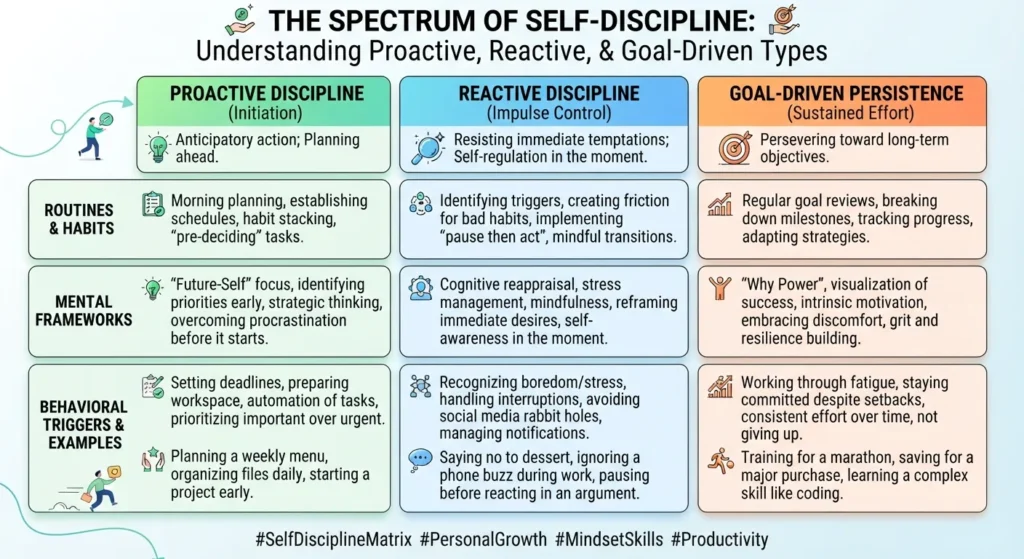
Self-discipline manifests across three primary domains, each governing a different facet of human behavior and self-mastery. Categorizing these types allows individuals to isolate specific areas of improvement and apply targeted strategies for holistic personal development.
Categorization Framework: Division into physical, mental, and emotional pillars to cover all aspects of daily functioning.
Interconnected Growth: Strengthening one domain naturally reinforces stability and control across the other two.
Physical Self-Discipline
Physical discipline governs how you treat, maintain, and command your physical body. It involves regulating physical impulses, maintaining healthy routines, and managing energy expenditure through deliberate bodily control.
Somatic Regulation: Controlling physical appetites, sleep schedules, and nutritional intake.
Endurance and Health: Committing to consistent exercise routines and resisting sedentary temptations.
Body Awareness: Recognizing physical fatigue or restlessness and responding with restorative habits rather than unhealthy escapes.
Mental Self-Discipline
Mental discipline controls cognitive focus, attention management, and intellectual resilience. It requires filtering out mental clutter, sustaining concentration on complex tasks, and overriding cognitive fatigue.
Attention Protection: Shielding your focus from digital distractions, multi-tasking traps, and information overload.
Cognitive Endurance: Pushing through mental blocks and complex problem-solving without abandoning the task.
Rational Decision-Making: Pausing reactive thought loops to analyze situations objectively before taking intellectual stances.
Emotional Self-Discipline
Emotional discipline manages internal affective states and outward behavioral responses to emotional triggers. It ensures that your feelings inform rather than dictate your actions during high-stress scenarios.
Affective Regulation: Recognizing emotional surges like anger, anxiety, or discouragement before they manifest externally.
Resilience Under Pressure: Maintaining composure and constructive output during setbacks, failures, or unexpected crises.
Impulse Moderation: Eliminating emotional eating, impulsive spending, or reactionary communication triggered by temporary moods.
Core Principles & Pillars of Self-Discipline
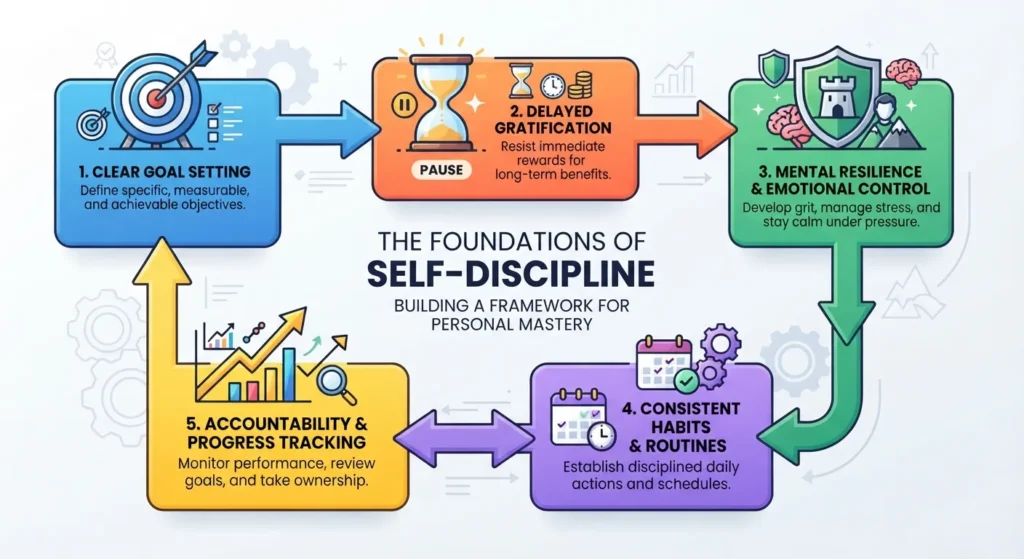
Mastering self-discipline requires breaking the concept down into distinct, actionable frameworks. Examining both the underlying principles and structural pillars provides a clear roadmap for building sustainable self-control and long-term personal growth.
The 5 Principles of Self-Discipline
The fundamental principles of self-discipline govern how you mentally approach challenges and structure your intentions. Applying these five rules ensures your efforts remain focused and productive.
Self-Awareness: Identifying your personal triggers, procrastination habits, and moments of emotional vulnerability before they derail your progress.
Goal-Setting: Establishing crystal-clear, measurable objectives so your mind understands exactly what it is working toward and why sacrifices are necessary.
Discomfort Tolerance: Embracing temporary friction, boredom, and mental fatigue as necessary costs of achieving high-value outcomes.
Habit Formation: Translating demanding tasks into automated daily routines to minimize the constant drain on your active willpower.
Accountability: Taking absolute ownership of your outcomes, successes, and failures without relying on external entities to keep you on track.
The 5 Pillars of Self-Discipline
The structural pillars of self-discipline represent the practical competencies required to sustain daily execution. These five components act as load-bearing supports for your overall self-mastery.
Commitment: Making an unwavering promise to your long-term vision that overrides short-term temptations and fleeting moods.
Focus: Directing undivided attention toward a single priority while systematically eliminating distractions and multitasking traps.
Perseverance: Continuing to take deliberate action in the face of setbacks, failures, and unexpected obstacles.
Delayed Gratification: Subduing the urge for immediate rewards in exchange for exponentially greater future benefits.
Courage: Facing difficult tasks, uncomfortable conversations, and fear of failure directly rather than retreating into comfort zones.
Signs of a Highly Disciplined Person

Highly disciplined individuals exhibit distinct behavioral and psychological patterns that set them apart. Recognizing these traits provides a clear behavioral benchmark for personal development and self-assessment.
Observable Consistency: Actions consistently align with stated values and long-term objectives, regardless of environmental pressures.
Proactive Execution: Initiating difficult tasks independently without waiting for external motivation or supervision.
Behavioral Signs (routine, punctuality, follow-through)
Behavioral indicators of discipline are visible in everyday habits, time management, and commitment delivery. These outward actions reflect a structured internal framework.
Reliable Punctuality: Consistently respecting time by arriving early or on schedule for commitments, meetings, and personal deadlines.
Strict Routine Adherence: Maintaining predictable daily habits that protect productive hours and minimize decision fatigue.
Absolute Follow-Through: Completing tasks to the highest standard, even when enthusiasm wanes or the work becomes tedious.
Mental/Emotional Signs (patience, delayed gratification, focus)
Mental and emotional indicators reveal how a disciplined person processes internal resistance, temptation, and cognitive stress. These internal attributes govern outward resilience.
Mastery of Delayed Gratification: Comfortably passing on immediate pleasures to secure exponentially greater long-term rewards.
Unwavering Focus: Maintaining deep concentration on a single high-priority task while successfully ignoring digital and environmental distractions.
Calculated Patience: Remaining calm and persistent through slow progress, setbacks, or periods of high friction without abandoning the goal.
Real-World Examples — The Most Disciplined People in the World
Examining high-achieving figures across sports, military service, and entrepreneurship provides concrete proof of how self-mastery drives extraordinary results. These real-world examples illustrate the habits of successful people who leverage extreme self-discipline to surpass conventional limitations [00:34].
Archetypes of Mastery: Real-world case studies highlight how consistency and mental fortitude compound into legendary success.
Universal Application: Demonstrates that self-discipline is the foundational common denominator across entirely different competitive fields [00:40].
Examples From Sports & Fitness
Elite athletes embody physical and mental discipline through unforgiving daily routines and uncompromising standards. Their success stems from treating training consistency as non-negotiable.
Elite Training Regimens: Waking up hours before sunrise to execute grueling physical conditioning regardless of weather or mood.
Nutritional Precision: Strictly adhering to calculated meal plans to optimize recovery and peak performance.
Examples From Military & Leadership
Military discipline and high-stakes leadership demand absolute composure under extreme stress. Operators and commanders rely on structured execution to maintain order during chaos.
Operational Resilience: Maintaining strict protocols and clear thinking in life-or-death scenarios [01:00].
Radical Accountability: Taking full responsibility for unit outcomes and mission success without making excuses.
Examples From Business & Innovation
World-class entrepreneurs and innovators utilize intense mental focus to build enduring enterprises from scratch. Their achievements rely on managing long-term strategic vision over short-term comfort.
Deep Work Habits: Guarding multi-hour blocks of uninterrupted focus to solve complex structural and creative problems.
Compounding Execution: Committing to small, daily progress increments that transform into industry-shifting innovations over decades [01:54].
Self-Discipline vs. Discipline — What's the Difference?
The fundamental distinction between self-discipline and external discipline lies in the source of control and motivation. Self-discipline originates from within as a self-directed choice, whereas external discipline relies on outside enforcement, rules, or authority figures to govern behavior.
Locus of Control: Shifting the governing power from external supervisors to internal values.
Sustainability: Internalized systems persist long after external structures, rewards, or punishments disappear.
Self-Discipline (Internal) vs. External Discipline (Imposed)
Internal self-discipline requires autonomous decision-making and personal accountability to complete tasks. External discipline uses rules, deadlines, and supervisors to compel action from the outside.
Internal Enforcement: Driven by personal goals, values, and intrinsic rewards without needing a manager to oversee execution.
External Enforcement: Reliant on parents, teachers, employers, or legal frameworks to ensure compliance through rewards or penalties.
Adaptability: Self-discipline adapts fluidly to changing environments, whereas external discipline breaks down when oversight is removed.
Is Self-Discipline Genetic or Learned?
Psychological research confirms that self-discipline is not an innate genetic trait you are simply born with. Instead, it functions as a malleable psychological skill that must be deliberately developed and strengthened over time.
Neuroplasticity and Habit: The brain builds stronger neural pathways for self-control through repeated practice and consistent behavioral loops.
Environmental Influence: Upbringing, structured routines, and mentorship accelerate an individual’s capacity for self-regulation during childhood and adulthood.
The Trainable Muscle: Anyone can improve their baseline level of self-mastery through incremental challenges and conscious habit design, regardless of their starting point.
Famous Quotes About Self-Discipline
“Discipline is the bridge between goals and accomplishment.” — Jim Rohn
“Discipline equals freedom.” — Jocko Willink
“With self-discipline, all things are possible.” — Theodore Roosevelt
“We must all suffer one of two things: the pain of discipline or the pain of regret and disappointment.” — Jim Rohn
“Self-respect is the root of discipline: The sense of dignity grows with the ability to say no to oneself.” — Abraham Joshua Heschel
Motivational Function: Using these perspectives reinforces the psychological weight of personal accountability and focus.
Practical Application: Reflecting on time-tested wisdom helps bridge the gap between abstract intention and daily execution.
How Disciplined Are You? (Self-Check)
Assessing your baseline self-discipline requires honest self-awareness and an evaluation of your daily habits. This diagnostic process uncovers hidden friction points where temporary impulses override long-term intentions.
Diagnostic Value: Measuring your current self-discipline reveals exact operational bottlenecks in your daily routines.
Actionable Awareness: Shifting from vague feelings of unproductiveness to concrete, behavior-based metrics.
Quick Self-Discipline Self-Assessment (5 reflective questions/checklist)
Answer the following five reflection questions to gauge your current capacity for self-mastery and identify areas requiring targeted improvement.
1. Do you consistently follow through on difficult tasks when no one is watching? Evaluate whether your productivity relies entirely on external accountability or internal commitment.
2. Can you delay immediate comfort for a significantly better future reward? Assess your ability to bypass instant gratification—such as skipping entertainment or junk food—to hit broader goals.
3. Do you maintain predictable daily routines without constantly negotiating with yourself? Determine whether starting key habits feels like an automated action or an exhausting daily debate.
4. How effectively do you manage unexpected stress or fatigue without abandoning your plans? Examine your emotional and physical resilience when obstacles disrupt your schedule.
5. Are you able to eliminate digital and environmental distractions during deep work sessions? Check your ability to protect your focus from notification alerts and multi-tasking impulses.
Ready to Build More Self-Discipline? (Teaser)
Building sustainable self-discipline is not an overnight transformation; it is a systematic process of upgrading your daily routines. Transitioning from understanding self-control to actively living it requires targeted habit-building strategies that protect your mental energy and minimize friction.
Sustainable Growth: Moving past abstract motivation into predictable, repeatable behavioral patterns.
Compounding Momentum: Unlocking long-term achievement through small, daily micro-commitments.
A Sneak Peek: 3 Habits That Build Self-Discipline Fast
Mastering your daily behavior starts with implementing foundational habits designed to strengthen your willpower muscle.
The Friction Audit: Systematically removing environmental temptations to make positive choices easier than bad habits.
The 10-Minute Rule: Committing to work on a dreaded task for just ten minutes to effortlessly bypass initial procrastination.
The Temptation Bundle: Pairing a high-friction necessary task with an immediate, enjoyable reward to sustain momentum.
Frequently Asked Questions (FAQ)
What are the 10 rules of self-discipline?
The 10 foundational rules of self-discipline outline the structural and mental requirements for sustained personal control. Following these principles transforms sporadic bursts of motivation into a dependable daily lifestyle.
1. Define Clear Goals: Establish specific, measurable objectives so your mind understands what you are prioritizing.
2. Identify Your Triggers: Recognize the emotional and environmental cues that lead to procrastination or impulsive choices.
3. Eliminate Temptations: Restructure your surroundings to make bad habits difficult and good choices effortless.
4. Start Small: Break intimidating objectives down into manageable micro-habits to build early momentum.
5. Embrace Discomfort: Accept temporary friction, boredom, and mental fatigue as non-negotiable costs of growth.
6. Establish Routines: Automate your daily schedule to conserve limited active willpower for complex tasks.
7. Practice Delayed Gratification: Forego instant comforts to secure exponentially greater long-term rewards.
8. Maintain Accountability: Take absolute ownership of your outcomes without shifting blame to external factors.
9. Track Your Progress: Monitor your daily execution visually to reinforce consistency and positive feedback loops.
10. Forgive Setups and Failures: Treat setbacks as objective data points rather than reasons to abandon your overall plan.
What is the 3/2:1 rule for discipline?
The 3-2-1 rule is a streamlined cognitive resetting method used to lower stress, regain focus, and interrupt impulsive reactions during a hectic day. It provides a fast physiological and mental pause button when willpower begins to wane.
3 Deep Breaths: Inhale slowly to lower your heart rate, deactivate the fight-or-flight response, and signal safety to the brain.
2 Minutes of Silence: Pause all external stimuli for 120 seconds to clear cognitive clutter and reset your mental bandwidth.
1 Clear Intention: Ask yourself what matters most right now and establish a single, actionable focus for your next block of time.
What are 7 ways to gain self-discipline?
Building self-discipline requires actionable strategies that strengthen your capacity for self-regulation over time. Implementing these seven methods accelerates long-term habit formation.
Conduct a Friction Audit: Audit your daily routine to remove barriers that block positive tasks while adding friction to bad habits.
Use the 10-Minute Rule: Commit to starting any dreaded task for just ten minutes to easily overcome initial procrastination.
Practice Temptation Bundling: Pair a high-friction necessary obligation with an immediately enjoyable reward.
Protect Your Sleep: Maintain consistent rest schedules, as cognitive fatigue directly degrades impulse control.
Pre-Plan Your Decisions: Decide what you will wear, eat, and work on ahead of time to defeat decision fatigue.
Build Single-Tasking Habits: Eliminate multitasking to train your brain for sustained, deep concentration.
Review Daily Wins: Reflect on completed commitments every evening to reinforce your identity as a disciplined person.
What are 5 ways to fix self-discipline?
When your self-discipline breaks down, quick structural interventions can help you reset your trajectory. These five corrective steps repair broken routines and restore momentum.
Radical Simplification: Cut your daily to-do list down to a single, non-negotiable priority to eliminate overwhelm.
Environment Reset: Physically clean your workspace and hide digital distractions like notifications and open tabs.
Revisit Your “Why”: Reconnect with the deeper emotional reasons behind your long-term goals to reignite intrinsic motivation.
Lower the Bar Temporarily: Reduce your daily habit targets to microscopic levels (e.g., writing one sentence) to break paralysis.
Enlist External Guardrails: Temporarily lean on an accountability partner or structured blocker apps until your internal control recovers.
What are Jung’s 5 pillars of a good life?
Psychiatrist Carl Jung identified five core pillars essential for achieving a balanced, happy, and fulfilling life. These foundational elements support overall mental stability and personal longevity [1.2.3].
Good Physical and Mental Health: Maintaining bodily vitality and emotional regulation through proper care, rest, and activity [1.2.3].
Healthy Personal Relationships: Nurturing strong connections with family, intimate partners, and trusted friends [1.2.3].
Appreciation of Beauty: Cultivating the ability to perceive and experience beauty in art and nature [1.2.3].
Satisfactory Work and Standard of Living: Engaging in meaningful labor that provides purpose and financial security [1.2.3].
A Philosophical or Religious Outlook: Maintaining an inner worldview that fosters resilience and perspective during life’s difficulties [1.2.3].
What is the definition of habitual discipline?
Habitual discipline is the advanced stage of self-control where conscious effort is replaced by automated daily routines. At this level, productive behaviors require minimal active willpower because repetition has transformed them into second nature.
Reduced Cognitive Load: Automating high-friction tasks so they run smoothly in the background without draining your mental energy.
Compounding Stability: Locking in long-term success through sustainable, everyday actions that persist effortlessly over years.
For a deeper look into the core principles of personal growth and daily routines, watch Five Pillars for a (Pretty) Happy Life.
Kittisak Wattanakul
Kittisak Wattanakul is the Discipline Editor at Holistic Wellbeing Living. He writes about routines, focus, consistency, and practical follow-through. With nine years of experience creating personal-growth content, Kittisak helps readers build realistic systems for steady progress without extreme productivity pressure.