Jump to:
ToggleSwitch Discipline Complete Guide History Alternatives and Modern Rules

What Is Switch Discipline?
Switch discipline is a historical and traditional form of corporal punishment that involves striking a child with a flexible twig, branch, or “switch” harvested from specific trees. Predominantly practiced in the American South and rural parts of Great Britain during the 19th and 20th centuries, this method relies on the stinging sensation of a thin, whippy branch rather than blunt force.
What Is a Switch?
A switch is a slender, flexible, and resilient shoot or branch stripped of its leaves before use. Parents or caregivers traditionally sent misbehaving children outside to select and cut their own switch from local flora, a practice thought to prolong the disciplinary process and encourage remorse.
Common Materials: Traditional switches are harvested from specific trees known for flexible, non-shattering wood that bends easily without breaking on impact.
Willow: Highly favored for its exceptional flexibility, yielding a whippy motion that produces a sharp, stinging sensation with minimal bruising.
Birch: Historically utilized across both rural America and Europe due to its slender branches and tough, resilient bark.
Hickory: Selected for its durability and springiness, though denser hickory switches pack a sharper, more severe sting than willow or peach.
Peach: Popular in agricultural regions of the American South where peach orchards were readily accessible, providing smooth, pliable twigs.
Why Is It Called a “Switch”?
The term “switch” originates from Middle English and Germanic root words associated with flexible rods, flexible twigs, or the sharp snapping sound a thin branch makes when whipped through the air. In the context of corporal punishment, the noun transitioned to describe both the implement itself and the specific motion of striking someone with a slender, flexible rod. This etymology directly aligns with People Also Ask queries regarding historical terminology, distinguishing the act from hitting with a rigid stick, paddle, or hand.
Switch Discipline vs. Other Forms of Corporal Punishment
Switch discipline differs significantly from other historical domestic punishments like manual spanking or wooden paddling in both mechanics and cultural execution.
Impulse vs. Preparation: Manual spanking is frequently administered immediately and impulsively with an open hand, whereas gathering a switch requires a deliberate, time-consuming preparation phase.
Force Mechanics: Paddles and heavy belts rely on blunt-force trauma to impact broader muscle groups, while a switch delivers a localized, high-velocity stinging sensation via a thin surface area.
Psychological Element: The ritualistic requirement for a child to harvest their own disciplinary implement introduces a unique psychological deterrent that is absent in traditional spanking or paddling.
The History and Cultural Background of Switch Discipline
Switch discipline is deeply embedded in the agrarian history of the American South and various rural traditions where localized, self-reliant methods of child-rearing prevailed for generations. Understanding the historical context requires examining the generational transmission of parenting norms, the ritualistic aspects of harvesting the tool, and the massive cultural turning point that brought the practice under intense national scrutiny.
Origins in Rural and Southern Households
In 19th- and mid-20th-century rural communities, physical chastisement was widely viewed as a necessary pillar of moral instruction and domestic order. Families isolated on farms relied on immediate, tangible deterrents for misbehavior rather than modern psychological interventions.
Agricultural Roots: The widespread availability of wooded areas, orchards, and thickets made tree branches an accessible, free, and zero-cost disciplinary tool.
Generational Continuity: Generational parenting norms dictated that because “sparing the rod spoiled the child,” using a switch was a sign of parental care rather than malice.
Community Consensus: Neighbors and local school systems largely shared these values, normalizing corporal punishment as a standard community-enforced standard of childhood discipline.
The Ritual: Sending a Child to Cut Their Own Switch
The practice often involved a psychological ritual designed to maximize compliance and instill long-term dread before any physical contact occurred.
The Mandate: Parents typically ordered a misbehaving child to go outside, select a suitably flexible branch, and bring it back for their own punishment.
Compounded Deterrence: Selecting a switch forced the child to contemplate their wrongdoing, evaluate the thickness and flexibility of potential branches, and actively participate in the preparation of their own penalty.
Psychological Impact: This prolonged preamble meant the anxiety of the waiting period often inflicted more emotional distress than the actual physical strike.
How the Adrian Peterson Case Shifted Public Opinion (2014)
A major cultural shift regarding switch discipline occurred in September 2014, when NFL running back Adrian Peterson was indicted on felony child abuse charges for disciplining his four-year-old son with a switch. The high-profile legal case thrust a traditional southern disciplinary method into the center of a fierce national debate.
Media Spotlight: News outlets nationwide dissected the definition of a switch, contrasting rural nostalgic defenses of the practice with modern medical and legal classifications of child abuse.
Public Polarization: While some defenders argued the case reflected a double standard regarding traditional minority and rural child-rearing customs, child welfare advocates emphasized the severe physical injuries caused by whippings.
The Aftermath: Peterson publicly apologized and stated he would never use a switch again, marking a watershed moment that forced many families to abandon the practice under the weight of changing legal definitions.
Timeline: How Attitudes and Laws Have Changed Since Then
Public consensus and legal frameworks surrounding physical punishment have evolved dramatically over the last several decades, shifting away from state-sanctioned domestic violence toward comprehensive child protection.
Late 20th Century: A wave of state-level reforms between 1974 and 1994 banned corporal punishment across dozens of public school systems, though domestic use remained largely protected under parental discretion laws.
The 2014 Watershed: The Peterson case punctured the insulation of private family traditions, sparking widespread public dialogue on the line between cultural heritage and physical abuse.
Present Day: While corporal punishment in schools remains legal in a diminishing number of southern and western states, societal intolerance for implements like switches has grown exponentially, redefining historical norms as legally and socially unacceptable.
Adrian Peterson on Disciplining Children
This archival interview clip captures Adrian Peterson discussing his high-profile legal case and his public commitment to abandoning the use of switches for discipline.
Is Switch Discipline — or Harmful?
Is physical discipline effective or does it cross the line into abuse? Decades of empirical data show that while physical strikes like switch discipline can force immediate obedience, they carry severe psychological and developmental risks that far outweigh short-term compliance.
What Child Psychology Research Shows
Extensive child psychology and behavioral research consistently demonstrate that corporal punishment does not teach children how to regulate their emotions or solve problems. Instead, it teaches them to fear the punisher and hide future mistakes.
Neurological Impact: Chronic physical punishment has been linked in neuroimaging studies to alterations in brain development, specifically affecting areas responsible for emotional regulation, stress response, and impulse control.
Aggression Modeling: Children subjected to physical force frequently model that behavior, exhibiting higher rates of bullying, peer aggression, and antisocial conduct later in life.
Erosion of Trust: Fear-based discipline damages the foundational parent-child bond, replacing open communication with secretive behavior and anxiety.
Short-Term Compliance vs. Long-Term Behavioral Effects
Parents often rely on physical discipline because it yields an immediate cessation of unwanted behavior, creating a false illusion of long-term success.
Immediate Stopping Power: The sharp sting of a switch commands instant attention, forcing the child to stop the immediate action out of self-preservation.
Failure to Internalize Morals: Long-term studies indicate that children disciplined physically comply out of fear of detection rather than a genuine understanding of right and wrong.
Escalating Force: Because children habituate to physical punishment over time, parents often feel forced to increase the severity or frequency of the discipline to achieve the same behavioral result.
The American Academy of Pediatrics’ Official Position
The American Academy of Pediatrics (AAP) maintains an unambiguous, evidence-based stance against all forms of corporal punishment, including switch discipline, spanking, and paddling.
Zero Tolerance for Striking: The AAP explicitly advises parents never to strike a child under any circumstances, stating that physical punishment is entirely ineffective for long-term behavioral correction.
Alternative Strategies: The organization advocates for positive discipline techniques, such as proactive communication, consistent boundaries, time-outs, and reinforcement of positive behaviors.
Protection of Well-Being: The AAP classifies physical punishment as a major risk factor for escalated physical abuse and lifelong mental health struggles, including depression and anxiety.
Warning Signs Discipline Has Crossed Into Abuse
Determining whether discipline has crossed the legal and psychological threshold into is physical discipline abuse involves evaluating the severity, intent, and physical aftermath of the act.
Physical Injury: Any disciplinary act that leaves lasting marks, welts, bruises, cuts, or requires medical attention legally constitutes child abuse regardless of cultural tradition.
Disproportionate Intensity: Punishment administered out of parental rage, frustration, or loss of emotional control rather than calm instruction violates safety boundaries.
Fear and Withdrawal: If a child exhibits extreme anxiety, chronic fear of caregivers, or attempts to hide from adults, the home environment has shifted from structure to emotional trauma.
The 4 Types of Discipline Every Parent Should Know
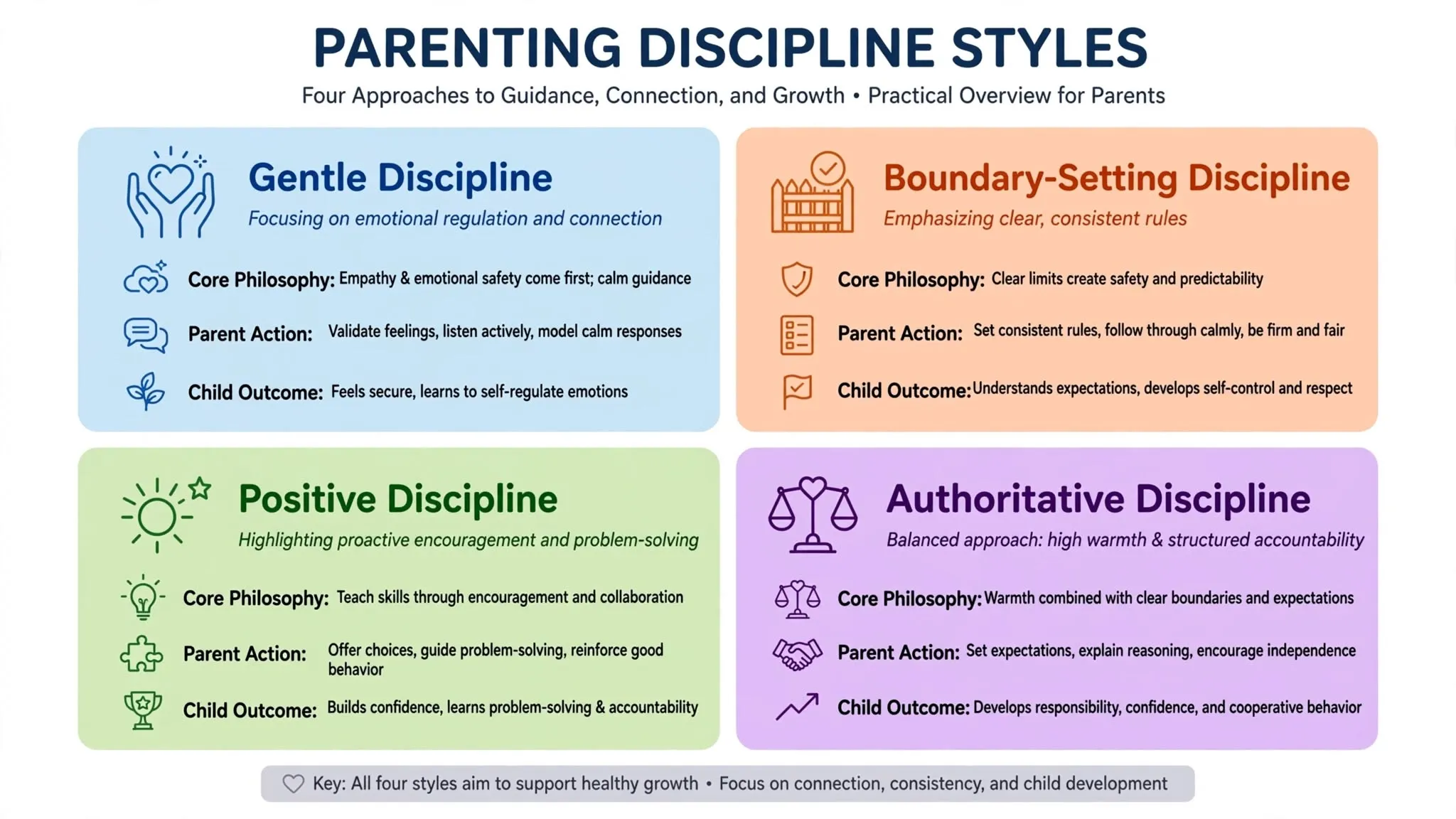
Understanding the 4 types of discipline helps caregivers navigate childhood development using structured, evidence-based methods rather than reactive physical punishment. Developed from Diana Baumrind’s foundational research on Baumrind parenting styles, these four distinct approaches categorize how adults balance demands, rules, emotional warmth, and responsiveness in the home.
Authoritative Discipline
Authoritative discipline balances high expectations with high emotional support, establishing clear behavioral boundaries while respecting a child’s individual autonomy.
Clear Rules and Rationales: Parents set firm, consistent guidelines and explain the underlying reasons behind rules rather than demanding blind obedience.
Open Communication: Children are encouraged to express their feelings, ask questions, and participate in problem-solving discussions.
Constructive Consequences: Discipline focuses on teaching and natural consequences rather than arbitrary or harsh physical punishments.
Authoritarian Discipline
Authoritarian discipline relies on strict rules, high demands for compliance, and low emotional responsiveness, operating under a strict hierarchical family structure.
Unquestioned Obedience: The philosophy is rooted in traditional commands, famously summarized by the mindset of strict adherence without room for negotiation.
Punitive Measures: Misbehavior is met with swift, heavy-handed penalties, including corporal punishment or loss of privileges, with little focus on teaching emotional regulation.
Emotional Distance: Parents show minimal warmth or affection, prioritizing control and order over relational connection.
Permissive Discipline
Permissive discipline is characterized by high emotional warmth and nurturing behavior coupled with very few rules, demands, or structural boundaries.
Friend Rather Than Authority: Parents avoid enforcing strict routines or consequences, preferring to act as close confidants rather than traditional disciplinarians.
Minimal Intervention: Children are given immense freedom to regulate their own behavior, schedules, and choices with little parental pushback.
Lack of Limits: The absence of structured boundaries often leaves children struggling with self-discipline, impulse control, and frustration tolerance.
Neglectful/Uninvolved Discipline
Neglectful or uninvolved discipline features low demands, minimal rules, and a distinct lack of emotional responsiveness or parental engagement.
Detached Parenting: Caregivers provide basic physical survival needs but remain emotionally and physically disengaged from the child’s daily life.
Absence of Guidance: Children receive no instruction on moral boundaries, emotional coping skills, or behavioral expectations.
Severe Developmental Risks: This style correlates with the highest rates of behavioral delinquency, emotional insecurity, and academic struggles.
Which Style Actually Produces Better Outcomes?
Longitudinal developmental studies overwhelmingly show that authoritative discipline produces the healthiest psychosocial outcomes for children.
Emotional Resilience: Children raised with authoritative methods develop superior self-esteem, coping mechanisms, and emotional intelligence.
Academic and Social Success: Clear boundaries combined with supportive warmth foster better academic performance and healthier peer relationships.
Internalized Morals: Unlike authoritarian methods that rely on fear of detection, authoritative guidance teaches children to make ethical choices independently.
Discipline Frameworks Parents Search For
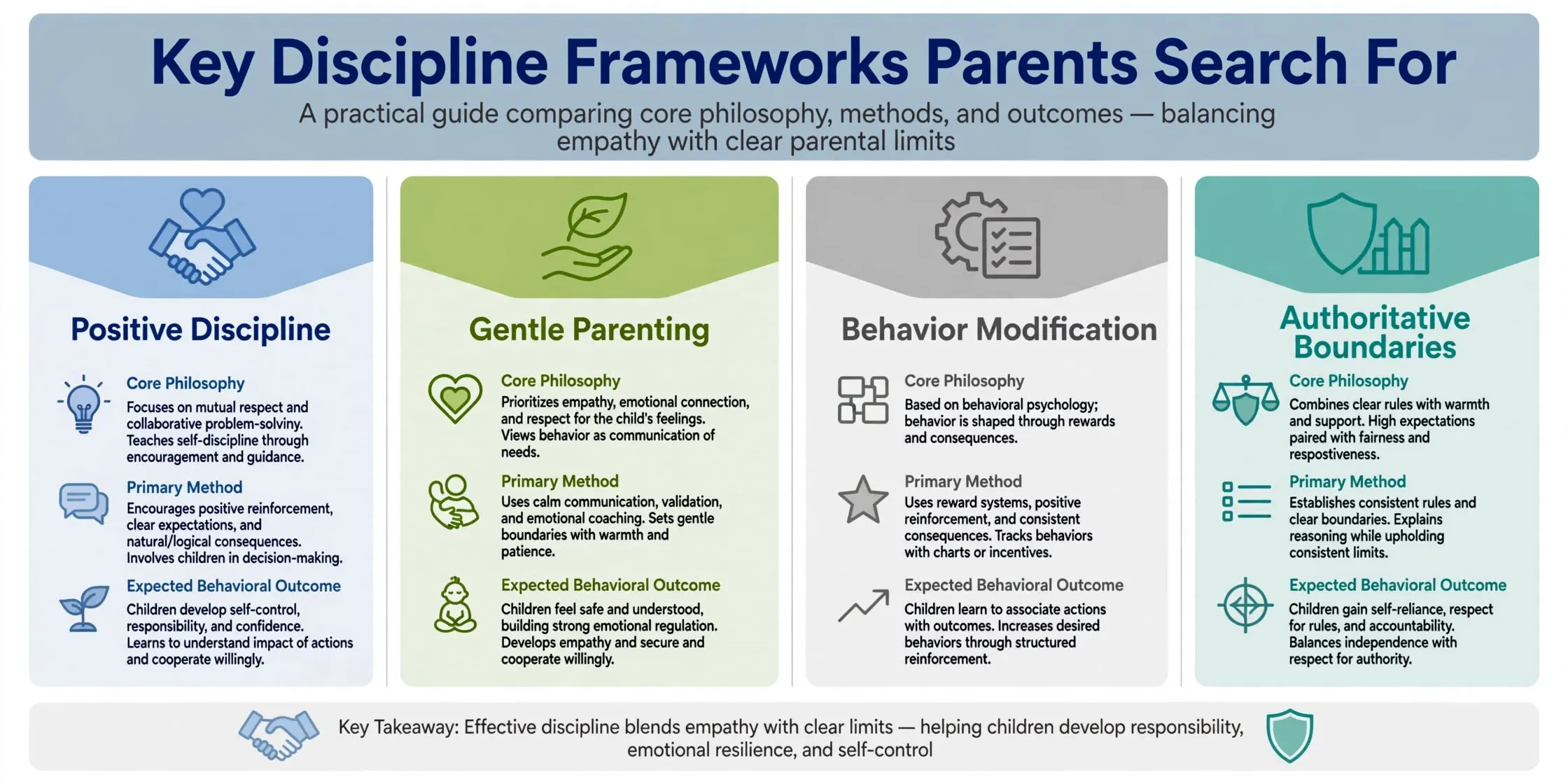
Parents frequently look for structured frameworks to simplify household management and replace reactive physical punishment with proactive strategies. Modern child psychology offers several popular mental models—such as the three C’s of discipline, the five pillars of discipline, and the infamous 7-7-7 rule—that provide distinct blueprints for guiding children.
The 3 C’s of Discipline (Consistency, Clarity, Consequences)
The 3 C’s framework provides a foundational checklist for effective daily behavior management, ensuring that expectations remain stable and predictable for developing minds.
Consistency: Enforcing rules and boundaries reliably every time a behavior occurs, eliminating mixed messages that confuse children.
Clarity: Communicating rules in simple, age-appropriate language so the child fully understands what is expected before an infraction happens.
Consequences: Applying logical, related outcomes immediately following misbehavior so the child connects their actions directly to the result.
The 5 Pillars of Effective Discipline
Beyond basic rules, comprehensive behavioral management relies on five psychological pillars designed to build emotional intelligence alongside compliance.
Connection First: Establishing a secure emotional bond before addressing misbehavior, ensuring the child feels safe rather than attacked.
Proactive Teaching: Instructing children on alternative positive behaviors before a meltdown or rule violation occurs.
Emotional Co-Regulation: Helping children calm their nervous systems during distress rather than punishing them for being overwhelmed.
Predictable Routines: Creating structured daily rhythms that reduce anxiety and minimize power struggles.
Positive Reinforcement: Consistently acknowledging cooperative behavior to wire neural pathways toward good choices.
What Is the 7-7-7 Rule? (Clearing Up 3 Different Versions)
The term “7-7-7 rule” causes widespread confusion online because parenting and lifestyle blogs use it to describe three entirely different concepts. Disambiguating these versions helps parents apply the correct strategy without confusion.
Version 1: The Connection-Time Rule: A family ritual dictating that parents should spend 7 minutes every day giving a child undivided attention, 7 hours every week on dedicated one-on-one activities, and 7 days every year on a trip without other children or distractions.
Version 2: The Developmental Stages Rule: A milestone framework dividing childhood into three distinct seven-year phases (ages 0-7 of foundational nurturing, 7-14 of guided independence, and 14-21 of peer-focused autonomy).
Version 3: The Screen-Time Rule: A digital wellness guideline suggesting that children under 7 should have zero screen time, kids aged 7 to 14 should have limited monitored access, and older youths follow structured hourly caps.
Which Framework Should You Actually Follow?
No single framework works in isolation, and rigid adherence to a strict acronym often fails when faced with diverse temperaments and daily parenting challenges.
Adopt a Hybrid Approach: Combine the daily reliability of the 3 C’s with the proactive emotional support embedded in the 5 pillars.
Prioritize Flexibility: Tailor your strategy to your child’s age, sensory needs, and developmental stage rather than forcing a trending internet rule.
Focus on Relationship-Building: Frameworks succeed only when built on a foundation of mutual respect, clear communication, and emotional safety.
Positive Discipline Alternatives (No Yelling, No Hitting)
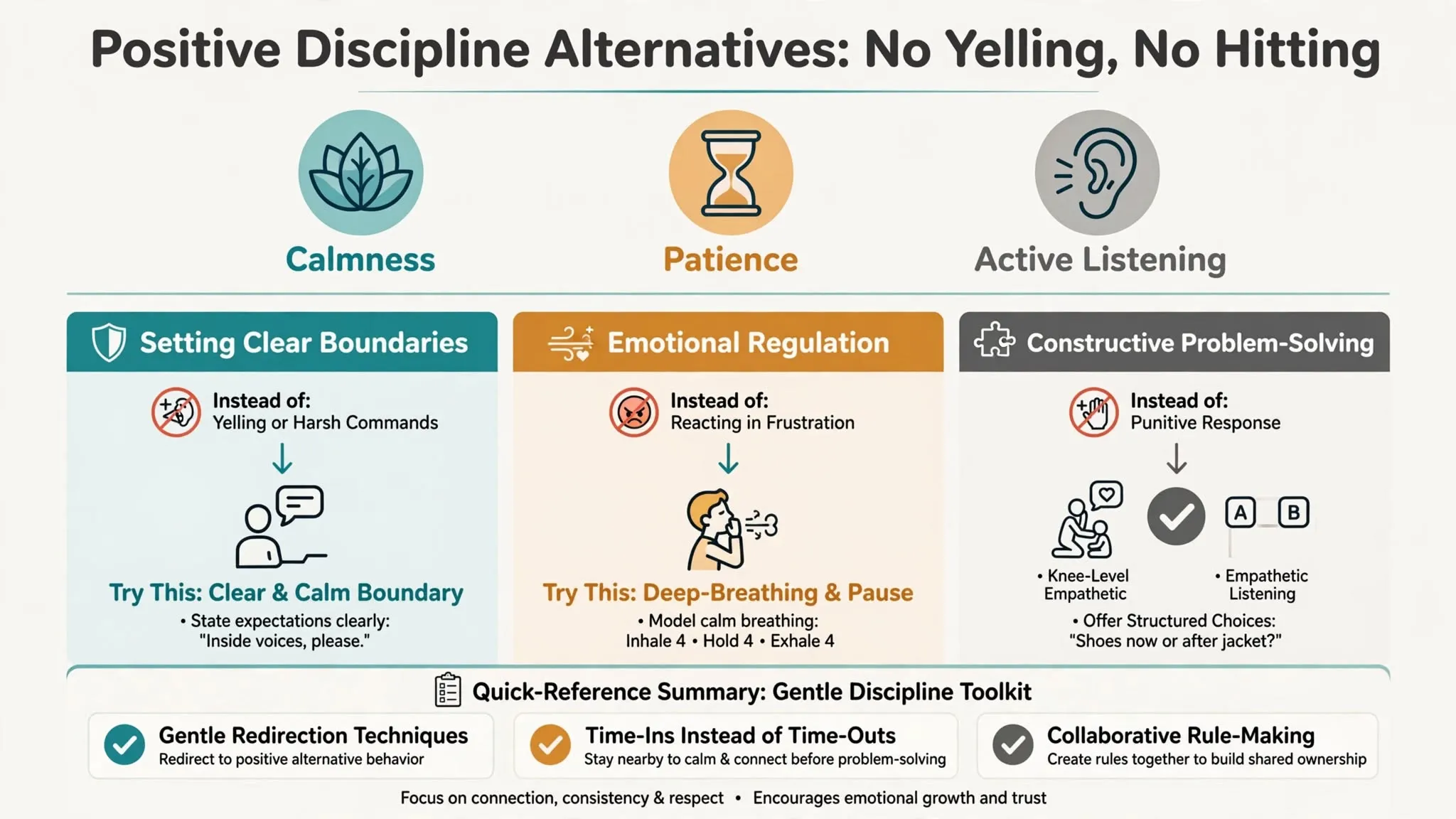
Transitioning away from physical punishment requires mastering proactive tools that teach emotional regulation and accountability. Aligned with AAP recommendations, positive discipline focuses on guiding behavior through connection, clarity, and constructive boundaries rather than fear or intimidation.
The 4 Types of Redirecting Behaviors
Redirecting behaviors helps defuse challenging moments by shifting a child’s focus away from a disruptive action toward a productive alternative without escalating tension.
Physical Redirection: Gently guiding a toddler away from a fragile item or physically moving them to a new activity area to break an impulsive loop.
Distraction and Substitution: Introducing a fresh, engaging task that satisfies the child’s underlying curiosity or sensory need safely.
Verbal Redirection: Using positive phrasing to state what to do instead of what not to do, such as asking to “walk inside” instead of shouting “stop running.”
Humor and Playfulness: Lightening a tense power struggle with a silly voice or playful challenge to reset a frustrated nervous system.
Time-Ins vs. Time-Outs
While traditional time-outs isolate a distressed child, modern positive discipline favors strategies that teach self-soothing and emotional awareness.
The Limitation of Time-Outs: Forcing an isolated child to sit alone often triggers abandonment fears, heightening stress hormones and blocking the brain’s ability to learn from mistakes.
The Power of Time-Ins: A time-in involves sitting together in a calm, designated space to help the child process intense emotions and regulate their breathing.
Co-Regulation First: Once the child is calm, parents can discuss what happened, reinforcing that emotional safety and connection remain intact even during misbehavior.
Natural and Logical Consequences
Teaching accountability is most effective when outcomes are directly connected to the child’s choices rather than imposed through arbitrary punishment.
Natural Consequences: Allowing the child to experience the unassisted result of their choices, such as feeling cold because they refused to pack a jacket. (Script example: “I notice you didn’t bring your coat. It is chilly outside, so we will need to head home a bit early today to warm up.”)
Logical Consequences: Enforcing a parental boundary that directly relates to the broken rule, repairing the harm caused. (Script example: “Since crayons were used on the wall, screen time is paused until we finish wiping the marks together.”)
Positive Reinforcement in Action
Consistency thrives when good behavior is noticed, valued, and reinforced more frequently than misbehavior is corrected.
Labeled Praise: Specific verbal encouragement builds internal motivation by identifying exact positive actions. (Script example: “Thank you for sharing your building blocks without being asked; that showed great teamwork.”)
Token and Habit Trackers: Visual reward charts help younger children track milestones, building pride and consistent habits over time.
When to Seek Outside Support
Persistent behavioral challenges sometimes signal underlying developmental, emotional, or sensory needs that require professional expertise.
Family Counseling: Licensed family therapists help households untangle generational cycles of conflict, communication breakdowns, and chronic emotional stress.
Pediatric Guidance: Consulting a pediatrician rules out medical, neurological, or developmental factors contributing to severe behavioral dysregulation.
7 Discipline Mistakes Parents Make and Better Alternatives That Work
This video explores common parenting pitfalls and outlines practical, evidence-based alternatives to replace reactive punishment with constructive behavioral strategies.
Age-by-Age Discipline Guide
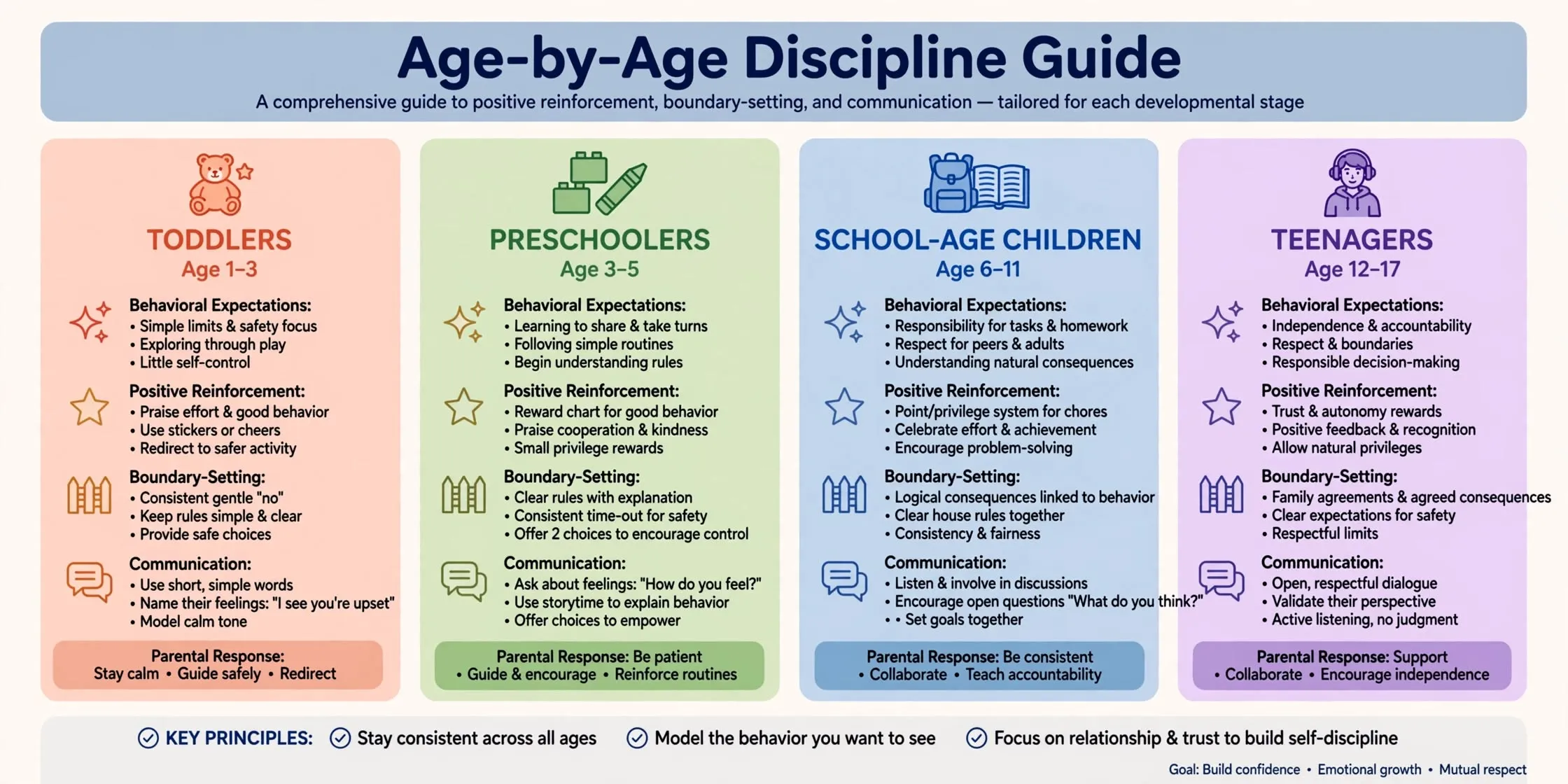
Child development dictates that guidance strategies must evolve alongside cognitive milestones. An effective approach requires matching discipline methods to a child’s neurological development, addressing the exact queries of when do babies start understanding discipline and when to start disciplining baby while spanning all developmental stages up through adolescence.
Babies & Toddlers (0–18 Months): When Understanding of Discipline Begins
Infants and very young infants do not possess the cognitive capacity for moral reasoning or intentional disobedience, meaning traditional discipline is developmentally inappropriate.
The Reality of Infancy: Babies under 6 months explore the world through sensory input and reflex, reacting purely to basic needs rather than breaking rules.
Early Limit Setting (6–18 Months): A 16-month-old or 18-month-old begins registering the word “no” and parental tone, marking the developmental window when to start disciplining baby through redirection and safe environmental proofing.
Primary Strategy: Rely entirely on physical redirection, removing hazards, and shifting attention rather than verbal reprimands or punitive actions.
Toddlers (18 Months–3 Years)
A 2-year-old or 3-year-old experiences rapid language and emotional expansion, frequently testing boundaries as they discover their own independence.
Emotional Flooding: Toddlers frequently throw tantrums because their brains cannot yet process frustration or verbalize complex feelings.
Actionable Guidance: Keep instructions brief, clear, and immediate. Use simple choices (e.g., “Do you want to wear the red shirt or the blue shirt?”) to provide autonomy within safe limits.
Core Tool: Prioritize immediate physical redirection and calm co-regulation over isolation or lengthy explanations.
Preschoolers (3–6 Years)
A 4-year-old, 5-year-old, or 6-year-old develops greater empathy, advanced imagination, and the ability to understand basic cause-and-effect relationships.
Rule Comprehension: Children at this stage can grasp household rules, take turns, and understand the concept of making amends for mistakes.
Actionable Guidance: Implement logical consequences and collaborative problem-solving. Allow them to help fix messes they created or apologize directly.
Core Tool: Use time-ins and visual routine charts to encourage predictable habits and independent emotional self-regulation.
School-Age Children (6+ Years)
Children aged six and older possess advanced moral reasoning and a growing desire for peer validation and independent decision-making.
Collaborative Boundaries: Involve school-age children in creating household expectations and establishing fair consequences for broken rules.
Actionable Guidance: Focus heavily on natural consequences. If they forget their homework or sports gear, let them experience the school-level result rather than rushing to rescue them.
Core Tool: Regular family meetings to discuss conflicts, evaluate household rules, and reinforce mutual respect.
Teenagers Who Won’t Listen or Don’t Care About Consequences
Adolescence brings radical neurological rewiring, shifting a teenager’s focus toward peer acceptance, autonomy, and questioning parental authority.
The Shift from Control to Influence: Traditional punitive measures fail with teenagers because they can easily disconnect, tune out, or rebel against arbitrary restrictions.
Actionable Guidance: Build collaborative agreements where privileges are tied directly to safety, responsibility, and mutual trust rather than unilateral parental decree.
Core Tool: Maintain open, non-judgmental lines of communication, ensuring your teen knows emotional support remains constant even when behavioral boundaries are tested.
From Punishment to Positive Discipline
This expert interview breaks down how to transition from fear-based punishment to connection-focused positive discipline across all developmental stages, including challenging adolescent years [02:45].
When Your Child Won't Listen — Troubleshooting Guide

When traditional discipline fails and a child refuses to cooperate, parents often fall into a cycle of escalating punishments that breeds resentment rather than obedience. Overcoming ongoing defiance requires shifting focus away from rigid control and toward effective communication strategies that rebuild trust, eliminate consequence fatigue, and teach genuine accountability.
Why Consequences Stop Working (And What To Do Instead)
When children become immune to repeated punishments, parents often assume they simply do not care about rules when the real issue is physiological or psychological habituation.
Consequence Fatigue: Repeatedly issuing empty threats or escalating penalties teaches children to tune out warnings because the punishments lack consistency or logical relevance.
Emotional Disconnect: If a child feels attacked or unheard, their nervous system triggers a fight-or-flight response, completely blocking out the parent’s message.
The Solution: Pivot from reactive punishments to predictable, immediate, and logically relevant outcomes that require active participation from the child to resolve.
Communication Strategies That Rebuild Cooperation
Defiance is frequently a symptom of miscommunication, poor timing, or instructions that overwhelm a child’s cognitive processing capacity.
Lower to Eye Level: Establish physical connection and eye contact before delivering an instruction, ensuring you have the child’s undivided attention.
Use “When/Then” Framing: Frame expectations around positive outcomes rather than ultimatums, such as saying, “When your shoes are on, then we can head out to the park.”
Limit Multi-Step Commands: Break complex tasks into single, manageable steps for younger children to prevent cognitive overload and frustration.
Teaching Respect Without Fear or Punishment
True respect is rooted in mutual dignity, empathy, and emotional safety rather than the compliance born out of intimidation or fear.
Model Respectful Conflict Resolution: Children internalize how adults handle frustration, arguments, and emotional stress by observing how parents treat them during disagreements.
Validate Before Correcting: Acknowledge a child’s feelings—even when their behavior is unacceptable—so they feel emotionally secure enough to listen to guidance. (Script example: “I understand you are angry that it is time to turn off the game, but screen time is finished for today.”)
Focus on Problem-Solving: Involve children in finding solutions to behavioral challenges, teaching them how to repair mistakes rather than simply enduring a penalty.
Frequently Asked Questions
What is a switch in discipline?
A switch is a slender, flexible branch or twig harvested from a tree—such as willow, birch, hickory, or peach—traditionally used in historical domestic settings to strike a child as a form of corporal punishment.
Why was it called a switch?
The term originates from Middle English and Germanic root words associated with flexible rods and the sharp snapping sound a thin branch makes when whipped through the air, describing both the implement and the striking motion.
Is physical discipline the same as abuse?
While cultural traditions historically classified physical punishment separately, major medical and child welfare organizations like the American Academy of Pediatrics classify striking a child as harmful, noting that any physical punishment resulting in lasting marks, injury, or severe psychological trauma constitutes abuse.
What is the difference between discipline and punishment?
Discipline focuses on teaching, guiding, and instilling long-term emotional regulation through consistent boundaries, whereas punishment relies on fear, pain, or the arbitrary loss of privileges to force immediate compliance.
What are the four types of redirecting behaviors?
The four primary redirection methods are physical redirection, distraction and substitution, verbal redirection using positive phrasing, and humor or playfulness to reset a frustrated child’s nervous system.
What is the 7-7-7 rule for parents?
The 7-7-7 rule is an ambiguous term used online to describe three different concepts: a family connection routine (7 minutes daily, 7 hours weekly, 7 days yearly), a developmental stage model divided into seven-year phases, or a digital screen-time management guideline.
Kittisak Wattanakul
Kittisak Wattanakul is the Discipline Editor at Holistic Wellbeing Living. He writes about routines, focus, consistency, and practical follow-through. With nine years of experience creating personal-growth content, Kittisak helps readers build realistic systems for steady progress without extreme productivity pressure.