Jump to:
ToggleDiscipline in the Bible: What It Means and How to Apply It
Introduction — What Does the Bible Say About Discipline?
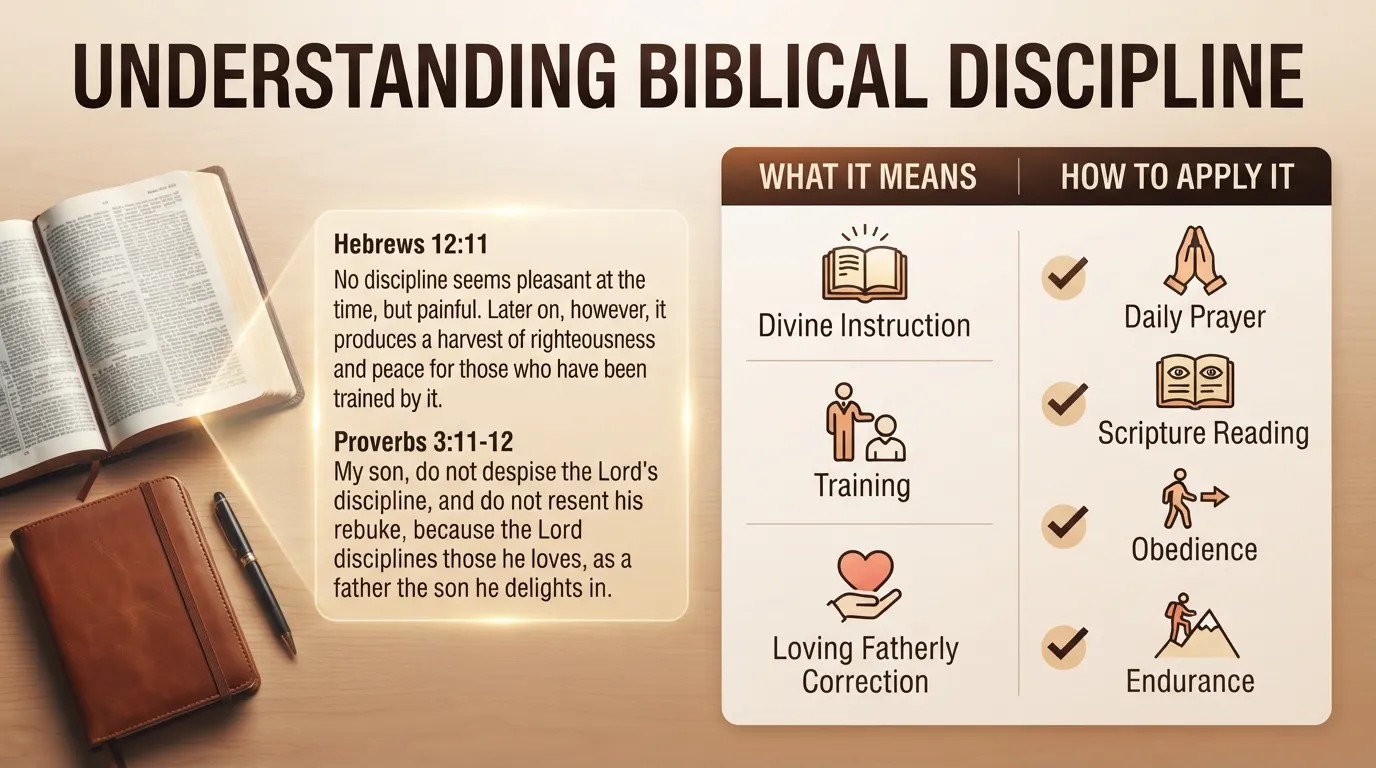
Discipline in the Bible is defined primarily as an expression of divine love, parental guidance, and structural training rather than merely punitive punishment. Across both the Old and New Testaments, biblical discipline—often translated from the Hebrew musar and the Greek paideia—focuses heavily on correction, instruction, and the cultivation of spiritual maturity.
Divine Affection: Scripture explicitly frames correction as proof of sonship and deep care, most notably in Hebrews 12:6, which states that the Lord disciplines the one He loves and chastises every son He receives.
Long-Term Fruit: While immediate correction is often painful, passages like Hebrews 12:11 emphasize that it ultimately yields the peaceful fruit of righteousness to those who have been trained by it.
Character Formation: Biblical discipline aims to move believers away from destructive paths and toward holiness, wisdom, and steadfast endurance.
Understanding what the Bible says about discipline requires looking past rigid legalism to see correction as a vital mechanism for personal transformation and enduring spiritual growth.
What Is Biblical Discipline?

Biblical discipline is the intentional process of training, instructing, and correcting believers to cultivate spiritual maturity, godly character, and alignment with God’s moral standard. Unlike punitive measures that focus solely on retribution, biblical discipline is rooted in relational redemption and designed to guide individuals back to righteousness.
Discipline vs. Punishment — What’s the Real Difference?
The fundamental distinction between discipline and punishment lies in their underlying motivation and ultimate objective. While punishment looks backward to penalize a past wrong, discipline looks forward to shape future behavior and character.
Punishment: Driven by anger or justice, punishment inflicts pain or consequence as a penalty for disobedience without guaranteed developmental growth.
Discipline: Driven by love and instruction, biblical discipline uses correction as a training tool to build endurance and moral fortitude.
Objective: Punishment aims to satisfy a penalty, whereas discipline aims to restore fellowship, correct misdirection, and foster lifelong wisdom.
The Hebrew and Greek Meaning of “Discipline” in Scripture
Scriptural languages provide deep linguistic nuance that separates divine instruction from harsh punitive action. Examining the primary original terms reveals a framework built on mentorship and child-rearing rather than condemnation.
Musar (Hebrew): Found frequently in Proverbs, musar translates to discipline, chastening, correction, or instruction. It carries the dual meaning of verbal warning and physical or situational correction intended to impart wisdom and restrain folly.
Paideia (Greek): Used prominently in the New Testament (such as in Ephesians 6:4 and Hebrews 12), paideia refers to the whole upbringing and training of a child. This includes instruction, cultivation of the mind and morals, and sometimes corrective chastening necessary for proper development.
How Does God Discipline Us?
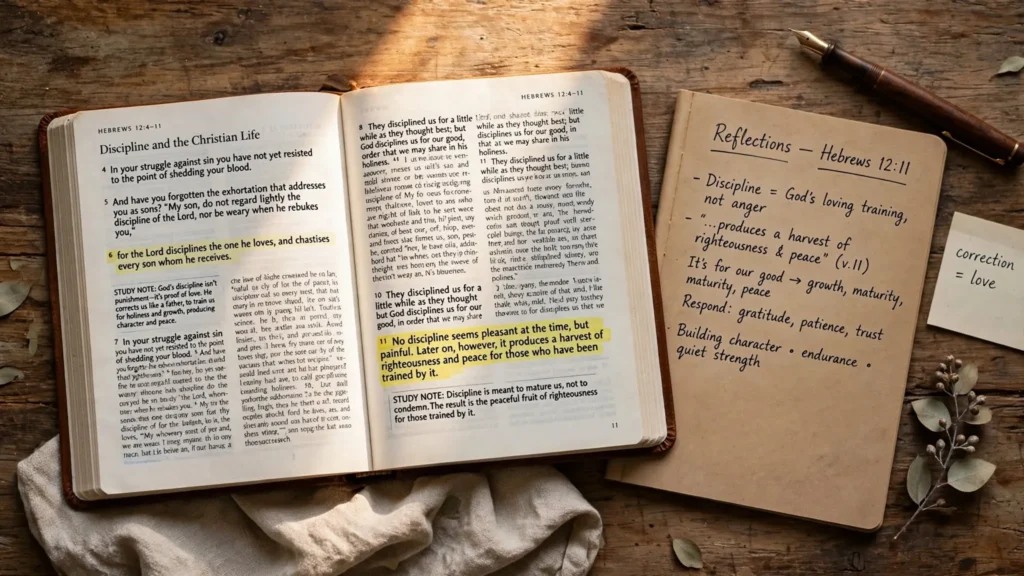
God’s discipline operates as a proactive, fatherly act of love designed to realign believers with His standard of holiness. Rather than reacting with arbitrary anger, God uses targeted correction to refine character, restore spiritual focus, and cultivate lasting righteousness.
Hebrews 12:6 — The Lord Disciplines Those He Loves
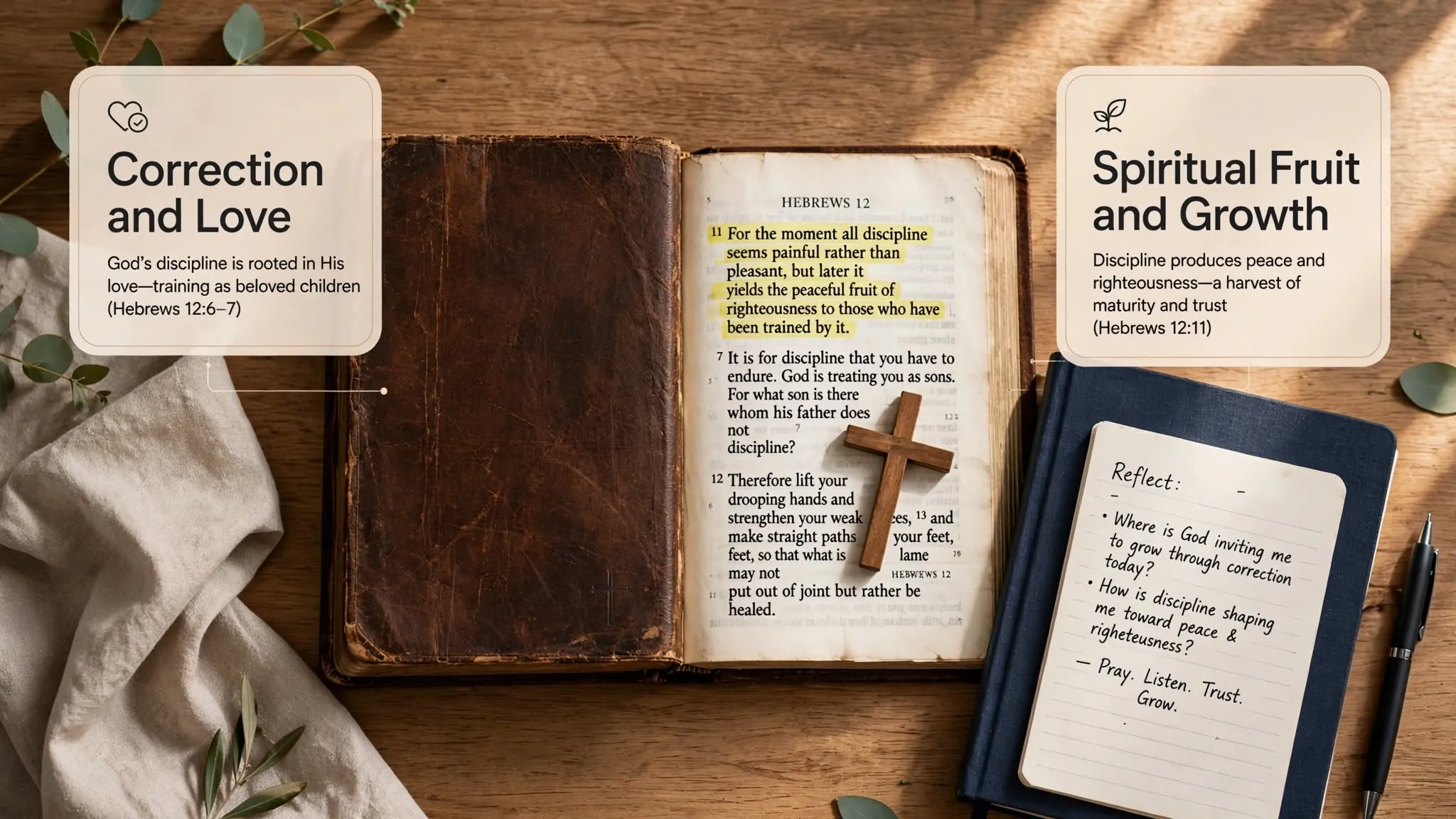
This foundational verse establishes that divine correction is a primary indicator of sonship and deep affection.
The Father-Child Relationship: Hebrews 12:6 explicitly states that the Lord disciplines the one He loves and chastises every son He accepts.
Proof of Belonging: Experiencing God’s correction is evidence of His active engagement in a believer’s life, distinguishing legitimate children from those left to unbridled paths.
Redemptive Motivation: Every instance of divine discipline is rooted entirely in grace and a desire for spiritual preservation, echoing the sentiment of Deuteronomy 8:5 regarding a father disciplining his son.
Hebrews 12:11 — The Peaceful Fruit of Righteousness
While immediate correction brings discomfort, Scripture reframes the end result as essential for long-term spiritual stability and growth.
Temporary Pain vs. Lasting Gain: Hebrews 12:11 acknowledges that no discipline seems pleasant at the time, but rather painful.
The Yield of Transformation: The passage guarantees that those trained by discipline will subsequently reap a harvest of righteousness and peace.
Spiritual Conditioning: Just as an athlete trains through rigorous exercise, divine correction conditions the soul to respond to God with steady obedience.
Proverbs 12:1 — Discipline and the Love of Knowledge
Wisdom literature connects a person’s willingness to accept correction directly to their capacity for learning and personal growth.
Embracing Correction: Proverbs 12:1 notes that whoever loves discipline loves knowledge, while the person who hates correction remains stupid or unteachable.
The Antidote to Arrogance: Openness to divine instruction shatters self-reliance and invites divine wisdom into everyday decisions.
Pathways to Discernment: Accepting reproof is framed not as a weakness, but as the primary gateway to intellectual and spiritual maturity.
What Does God’s Discipline Look Like Today?
God utilizes a variety of relational, circumstantial, and internal methods to correct and guide believers in contemporary life.
Internal Conviction: The Holy Spirit brings a deep, persistent awareness of sin, producing godly sorrow that leads directly to repentance.
Natural Consequences: God often allows the logical fallout of poor decisions to serve as a classroom, teaching caution and obedience.
Scriptural Confrontation: Reading or hearing God’s Word acts as a mirror, exposing hidden flaws and prompting necessary behavioral adjustments.
Providential Trials: Difficult seasons and external pressures are sometimes permitted by God to test endurance, strip away self-reliance, and foster Christlike character, as referenced in Revelation 3:19.
What Are the Spiritual Disciplines in the Bible?
Spiritual disciplines are the intentional, habitual practices instituted by God to foster spiritual growth, deepen intimacy with Christ, and transform believers into His image. Rather than acting as legalistic requirements to earn favor, these practices function as channels of grace that condition the soul for godliness.
What Is a Spiritual Discipline?
A spiritual discipline is a regular, purposeful activity rooted in Scripture that trains the inner life for spiritual fitness.
Active Engagement: These are practices believers actively participate in, aligning human effort with the internal work of the Holy Spirit.
Grace-Powered Habits: They do not merit salvation, but rather position the believer to receive God’s transforming grace more fully.
The Core Spiritual Disciplines of Christianity
A structured approach to Christian practice involves several foundational habits designed to anchor the faith and nurture spiritual vitality.
Prayer: Direct, ongoing communication with God that aligns human desires with divine will.
Bible Study and Meditation: Reading, memorizing, and deeply reflecting on Scripture to renew the mind.
Fasting: Voluntarily abstaining from food or normal comforts to focus entirely on God and spiritual hunger.
Worship: Expressing adoration, reverence, and gratitude to God individually and corporately.
Solitude: Stepping away from distractions and noise to rest in the presence of God.
Service: Humbly meeting the practical needs of others as an expression of Christ-like love.
Fellowship and Community: Engaging regularly with other believers for mutual encouragement, accountability, and growth.
How to Practice Spiritual Disciplines Daily
Integrating spiritual disciplines into a busy routine requires intentional planning and sustainable rhythms rather than overwhelming legalism.
Start Small: Choose one or two disciplines, such as morning prayer and short scripture reading, to build consistency before adding more.
Establish a Routine: Designate a specific time and quiet place each day to eliminate distractions and focus on spiritual growth.
Focus on Heart Attitude: Approach each practice with a desire for communion with God rather than viewing them as a checklist to complete.
Self-Discipline as a Fruit of the Spirit
Scripture links personal discipline directly to the inner transforming work of the Holy Spirit within the believer’s life.
Galatians 5:22-23: The apostle Paul lists self-control—often translated as self-discipline—as a core fruit of the Spirit.
Internal Transformation: True self-control is not achieved through sheer human willpower alone, but is supernatural fruit produced by the Holy Spirit.
1 Corinthians 9:27 — The Athlete’s Discipline Analogy
Paul uses athletic training as a powerful metaphor to explain the strict self-mastery required for a faithful Christian life.
Rigorous Conditioning: In 1 Corinthians 9:27, Paul notes that he disciplines his body and keeps it under control so that he will not be disqualified.
Purposeful Endurance: Spiritual discipline requires the same intentional sacrifice, focus, and perseverance demonstrated by elite athletes striving for a permanent crown.
What Does the Bible Say About Disciplining Children
Biblical parenting views discipline as a vital, loving responsibility aimed at shaping a child’s character, moral compass, and long-term well-being. Scripture consistently frames parental correction not as an outlet for anger or harsh treatment, but as an essential act of guidance intended to rescue a child from self-destructive folly and foster wisdom.
What Is the “Rod of Discipline” in Proverbs?
Wisdom literature frequently references the “rod” in connection with child-rearing, utilizing historical metaphors from ancient Near Eastern shepherd imagery.
The Shepherd’s Metaphor: In the Bible, a shepherd used a rod to guide, protect, and gently redirect sheep away from danger rather than merely to inflict harm.
Proverbs 22:15: This verse states that folly is bound up in the heart of a child, but the rod of discipline will drive it far away, pointing to the need for proactive parental correction.
Proverbs 29:15: Scripture notes that a rod and a reprimand impart wisdom, but a child left undisciplined disgraces their mother, emphasizing that neglectful parenting produces harmful outcomes.
Proverbs 13:24 — “Spare the Rod, Spoil the Child” Explained
One of the most frequently cited yet widely misunderstood phrases in biblical parenting originates from the broader context of Proverbs 13:24.
The Exact Phrase Origin: The famous phrase “spare the rod, spoil the child” is actually a seventeenth-century proverb derived from the thematic principles of Proverbs rather than a direct verbatim scriptural quote.
Proverbs 13:24 Text: The verse states that whoever spares the rod hates their children, but the one who loves their children is careful to discipline them.
The Underlying Motivation: The verse uses hyperbole to emphasize that failing to correct a child stems from indifference or permissive neglect, whereas true love demands the hard work of setting boundaries and administering consequences.
Is Physical Discipline Required by the Bible? Different Christian Perspectives
Christian theologians, denominations, and parents hold diverse interpretations regarding whether biblical discipline mandates corporal punishment or allows for modern, non-physical alternatives.
Traditional Corporal View: Some conservative traditions interpret the proverbs literally, arguing that physical spoking or corporal correction remains a biblically sanctioned method for young children when administered calmly and out of love.
Redemptive and Relational View: Many modern theologians and Christian psychologists argue that the “rod” represents authority, structural boundaries, and verbal or situational correction, pointing out that New Testament instructions focus heavily on patience and avoiding exasperation.
Core Agreement Across Views: Regardless of the method chosen, virtually all Christian frameworks agree that parental discipline must be free of rage, abuse, or cruelty, aligning instead with Christlike patience and instruction. For a deeper academic look at balanced theological interpretations, you can review this Christian parenting and discipline overview.
5 Biblical Principles for Disciplining Children with Love
Effective biblical parenting relies on consistent principles that integrate moral boundaries with grace, patience, and emotional safety.
Prioritize Instruction over Anger: Discipline should be deliberate and calm, avoiding reactive outbursts or emotional intimidation.
Refuse to Exasperate Your Children: Following the directive in Ephesians 6:4, parents must avoid harshness that embitters or discourages their children.
Combine Correction with Affection: Discipline must always be followed by reassurance of love, forgiveness, and restored fellowship.
Model Godly Behavior: Children learn more from observing parental integrity and self-control than from verbal instruction alone.
Point Them to Grace: Ultimate discipline should lead children to understand their need for self-governance and God’s ultimate mercy.
What Is Church Discipline in the Bible?
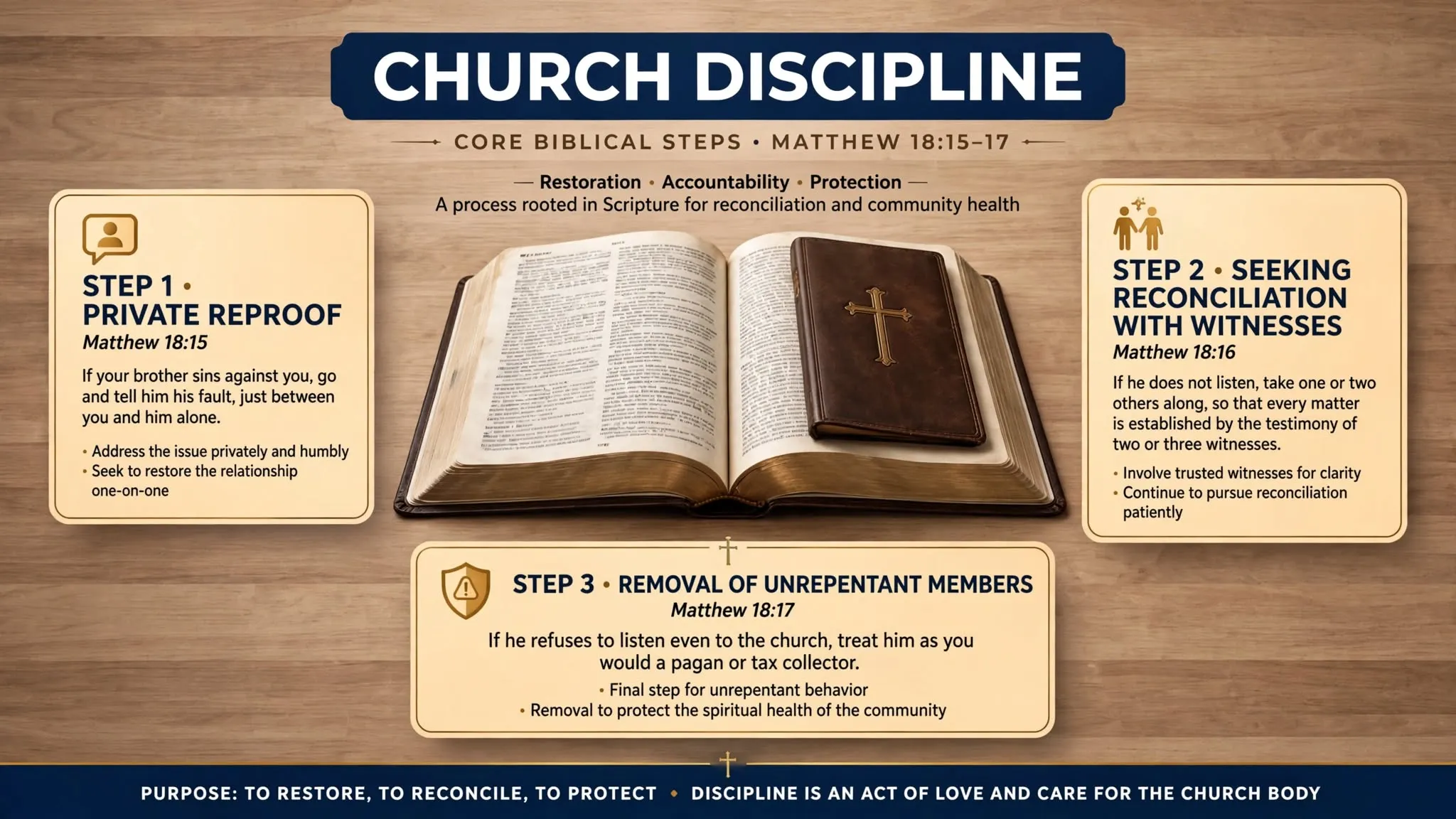
Church discipline is the orderly, collective process by which a local body of believers addresses unrepentant sin among its members to maintain spiritual purity and protect the fellowship. Rooted in both Old and New Testament theology, church accountability is designed not to ostracize individuals, but to preserve the integrity of the witness of Christ and promote genuine repentance.
The Process of Church Discipline (Matthew 18:15-17)
Jesus outlines a clear, step-by-step procedure for handling sin and conflict within the Christian community in Matthew 18, prioritizing private reconciliation before taking public action.
Step One (Private Confrontation): If a believer sins, the injured party should go and point out the fault just between the two of them; if the offender listens, the relationship is restored.
Step Two (Small-Group Mediation): If the individual refuses to listen, the person must take one or two others along so that every matter may be established by the testimony of witnesses.
Step Three (Church Involvement): If the unrepentant person refuses to listen to them, the matter must be told to the broader church community for corporate appeal.
Step Four (Final Separation): If the offender refuses to listen even to the church, they are to be treated as a pagan or a tax collector, marking the formal enactment of church discipline or excommunication.
What Sins Require Church Discipline?
Scripture indicates that church discipline is reserved for unrepentant, serious, and disruptive moral or doctrinal deviations rather than minor human mistakes or personal grievances.
Unrepentant Moral Sin: Flagrant, ongoing violations of God’s moral law—such as sexual immorality, greed, swindling, or drunkenness—that are defended without remorse (as outlined in 1 Corinthians 5).
Destructive Heresy: Persistent promotion of false doctrines that subvert core Christian truths and cause division within the body of Christ.
Intentional Divisiveness: Behavior that intentionally causes factions or malice within the congregation, unaddressed despite repeated warnings.
The Purpose of Church Discipline — Restoration, Not Punishment
The ultimate goal of exercising discipline within a church body is deeply pastoral, aiming for healing rather than condemnation.
Reclaiming the Wayward: The primary objective is to wake up the conscience of the unrepentant sinner, bringing them to genuine sorrow, repentance, and restoration of fellowship.
Protecting the Flock: Just as physical hygiene protects a body from infection, removing unrepentant influence prevents toxic patterns from spreading throughout the congregation.
Honoring God’s Name: Upholding moral and doctrinal standards ensures that the church accurately reflects the holy character of Jesus Christ to a watching world.
What Did Jesus Say About Discipline?
Jesus addressed discipline primarily through the lens of wholehearted discipleship, daily self-denial, and personal spiritual rhythms. Rather than establishing a rigid legal code, He demonstrated and taught that following Him requires intentional sacrifice and a surrendered will.
Jesus’s Teaching on Self-Denial and Discipline (Luke 9:23)
Jesus made it clear that active, daily discipline is an absolute prerequisite for anyone choosing to follow His path.
The Call to Daily Surrender: In Luke 9:23, Jesus stated that whoever wants to be His disciple must deny themselves, take up their cross daily, and follow Him.
Overcoming Self-Will: This radical command requires the daily discipline of putting aside personal desires, comfort, and pride to align fully with the will of God.
The Cost of Discipleship: Jesus emphasized that genuine spiritual transformation cannot happen without active, intentional self-mastery and perseverance.
How Jesus Modeled Discipline (Prayer, Fasting, Solitude)
While Jesus is the sinless Son of God, His earthly ministry was anchored by rigorous spiritual disciplines that served as a model for believers.
Devotion Through Solitude and Prayer: Jesus frequently withdrew from demanding crowds into isolated places to pray, prioritizing unbroken communion with His Father (as seen in Luke 5:16).
Spiritual Fortitude in the Wilderness: Before launching His public ministry, Jesus practiced strict physical and spiritual discipline by fasting in the wilderness for forty days, using Scripture to successfully resist temptation.
Intentional Rhythms: Jesus balanced intense public service with quiet moments of rest and communion, proving that spiritual endurance requires disciplined personal habits.
What Are the Benefits of Biblical Discipline
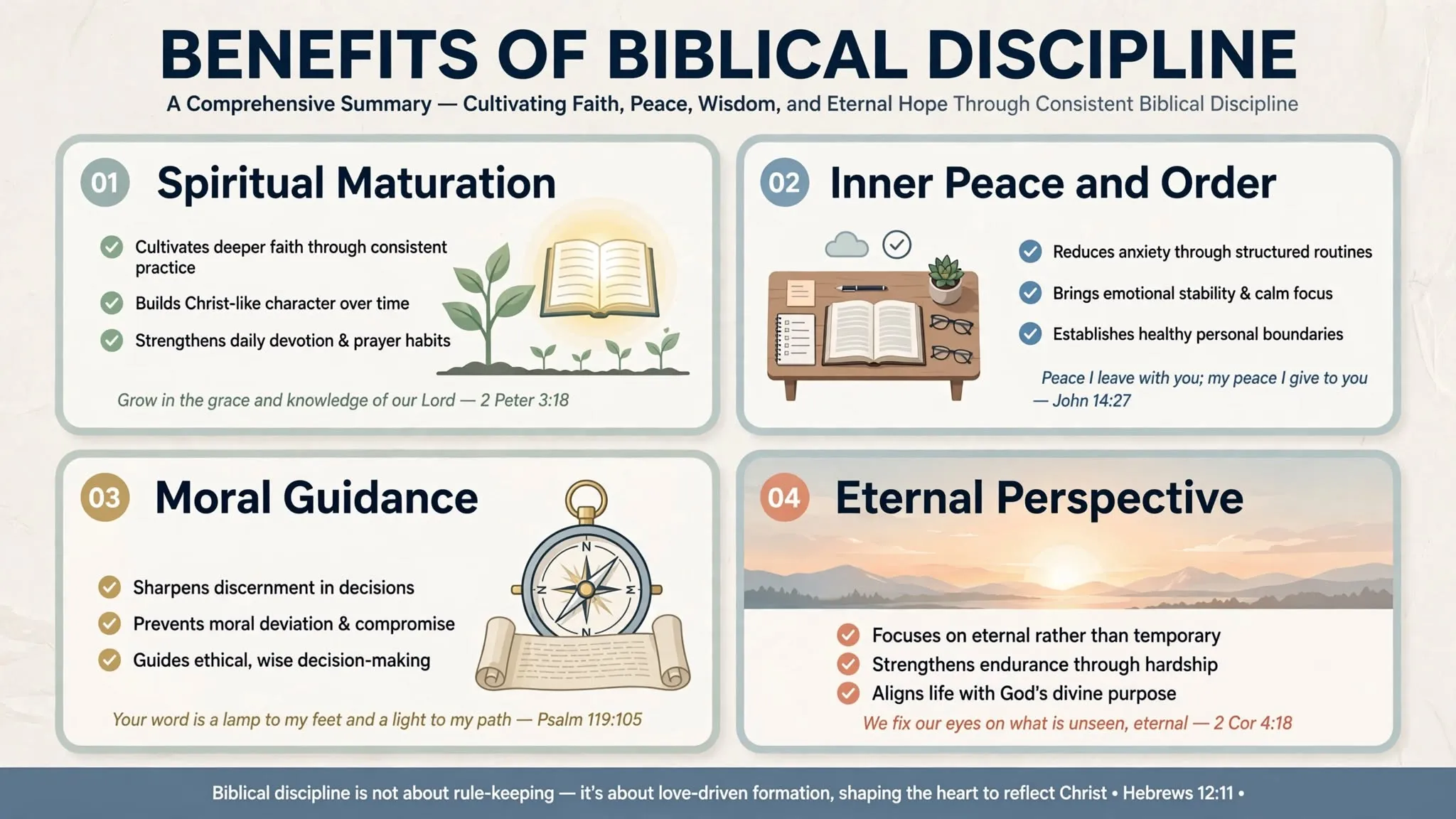
Biblical discipline yields transformative personal and spiritual rewards, moving believers from immaturity into lasting godliness. Far from being a punitive burden, divine and personal discipline serves as the primary mechanism for cultivating a stable, fruitful, and holy life.
5 Biblical Benefits of Discipline
Scripture outlines distinct spiritual outcomes that flow directly from embracing both divine correction and personal spiritual habits.
Acquisition of Wisdom and Knowledge: As highlighted in Proverbs 12:1, embracing discipline opens the mind to instruction, replacing foolishness and arrogance with discernment and practical wisdom.
The Peaceful Fruit of Righteousness: Hebrews 12:11 assures believers that enduring corrective training ultimately yields a harvest of righteousness and inner peace, shaping character long-term.
Sharing in God’s Holiness: Hebrews 12:10 notes that God disciplines us for our good, in order that we may share in His holiness, refining us to reflect His moral standard.
Development of Self-Control: Grounded in Galatians 5:22-23, regular spiritual training cultivates self-discipline as a fruit of the Spirit, empowering believers to master impulsive desires.
Attainment of Spiritual Maturity: Consistent habits and a willingness to accept correction build spiritual endurance, moving believers from infancy in the faith to mature, stable leadership.
Frequently Asked Questions About Biblical Discipline
What is James 4:17 saying?
James 4:17 states that anyone who knows the good they ought to do and doesn’t do it sins. This verse emphasizes the discipline of moral action, pointing out that sin involves sins of omission as well as direct acts of disobedience.
Conscience and Duty: It highlights personal accountability when a believer recognizes a clear path of righteousness but chooses inaction or negligence.
The Call to Obedience: True spiritual discipline requires not just avoiding evil, but actively executing the good tasks God places before us.
What does James 1:19 say?
James 1:19 instructs believers to be quick to listen, slow to speak, and slow to become angry. This verse provides foundational emotional discipline for effective communication, relationships, and conflict resolution within daily life.
Mindful Listening: Practicing emotional restraint requires prioritizing listening over hasty arguments or defensive reactions.
Temperance: Cultivating patience directly counteracts destructive outbursts, reflecting the calm composure modeled by Christ.
What does Proverbs 27:17 say?
Proverbs 27:17 declares that iron sharpens iron, and one person sharpens another. This verse highlights the necessity of community accountability, mentorship, and interpersonal discipline in shaping strong, godly character.
Mutual Growth: Just as metal tools require friction to sharpen an edge, believers need honest feedback and peer correction to remove spiritual dullness.
Relational Accountability: Spiritual maturity is rarely achieved in isolation; it requires active engagement within a local community.
What is Proverbs 17:13 saying?
Proverbs 17:13 warns that evil will never leave the house of anyone who pays back evil for good. This wisdom verse underscores the discipline of breaking toxic cycles of retaliation and bitterness.
Refusing Vengeance: Biblical discipline demands overcoming natural desires for revenge, calling instead for grace, peace, and patience.
Generational Impact: Choosing grace over retaliation protects family environments from ongoing strife and destructive patterns.
Which book of the Bible teaches most about self-discipline?
The Book of Proverbs is universally recognized as the primary scriptural text focusing on wisdom, self-control, and moral discipline. It offers practical maxims contrasting the diligent person with the sluggard.
Practical Wisdom: Proverbs emphasizes daily habits, speech control, financial prudence, and openness to correction.
Behavioral Guidance: It serves as a direct manual for training the mind and actions toward godliness and personal responsibility.
Is there a difference between discipline and punishment in the Bible?
Yes, biblical discipline is focused on relational training and future restoration, whereas punishment is retrospective and retributive. Godly correction seeks to guide believers into maturity rather than merely exacting a penalty.
Redemptive Intent: Discipline is motivated by love and aims to refine character (Hebrews 12:6).
Punitive Retribution: Punishment addresses guilt with a penalty, lacking the developmental and instructional focus found in biblical training.
What does the Bible say about disciplining a wife?
Scripture contains no instructions or authority for a husband to discipline his wife. Biblical marriage instructions call husbands to love their wives sacrificially, just as Christ loved the church, ruling out any paternalistic or punitive domestic correction.
Mutual Submission: New Testament household codes emphasize mutual honor, respect, and self-sacrificial love rather than hierarchy-based correction.
Christlike Leadership: Authentic spiritual leadership in marriage is modeled through gentle service, understanding, and emotional safety.
Conclusion
Biblical discipline is fundamentally an expression of God’s deep love and a vital framework for lifelong spiritual growth. Rather than arbitrary punishment, scriptural correction and the intentional practice of spiritual disciplines serve as gracious tools designed to refine character, foster holiness, and draw believers into closer communion with their Creator.
Embracing Correction: Recognizing divine discipline as proof of sonship transforms how believers respond to trials, setbacks, and personal conviction.
Cultivating Habits: Committing to regular rhythms of prayer, scripture study, and self-control conditions the soul for enduring spiritual stability.
Choosing to lean into this transformative process this week—by committing to a single daily spiritual discipline—establishes a powerful foundation for lifelong wisdom, peace, and fruitfulness.
Kittisak Wattanakul
Kittisak Wattanakul is the Discipline Editor at Holistic Wellbeing Living. He writes about routines, focus, consistency, and practical follow-through. With nine years of experience creating personal-growth content, Kittisak helps readers build realistic systems for steady progress without extreme productivity pressure.