How to Build Good Habits That Actually Stick: The Complete Guide
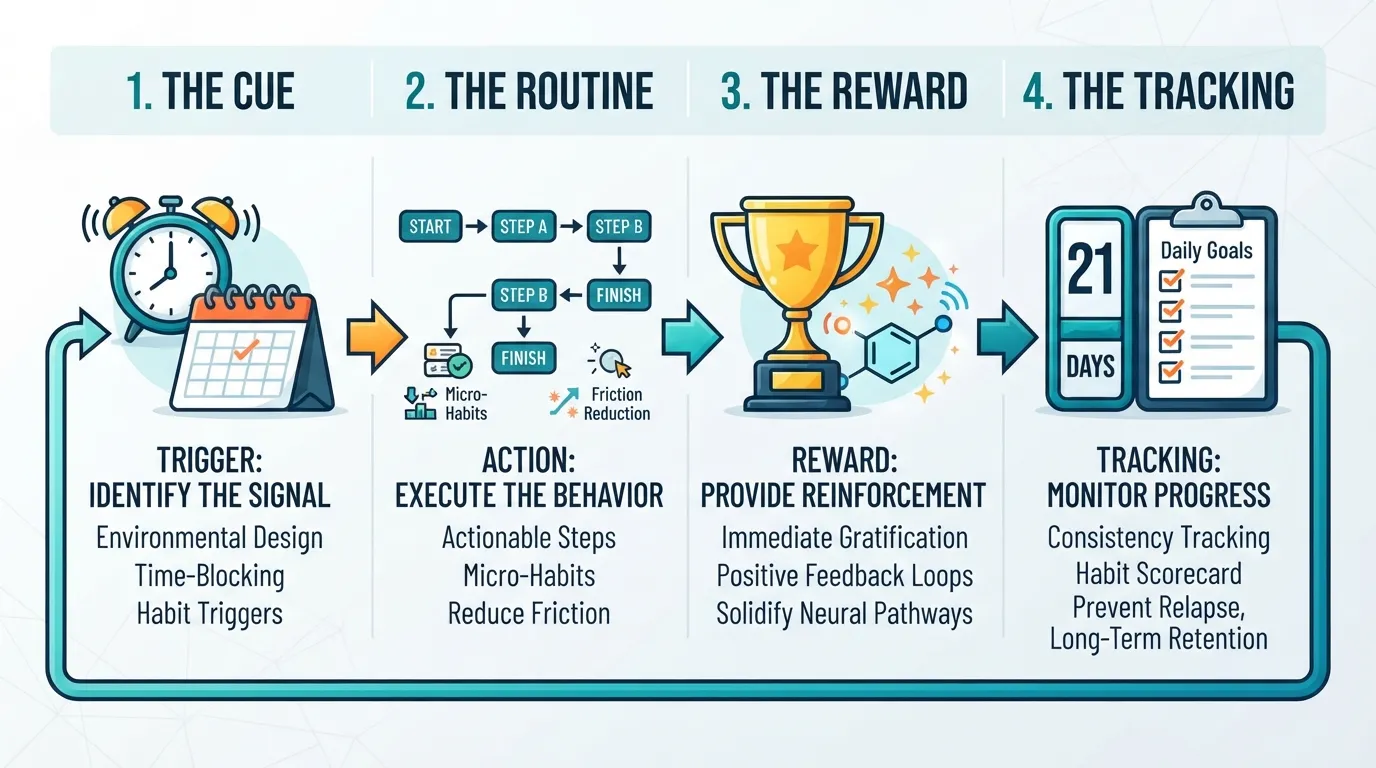
How to Build Good Habits (And Actually Make Them Stick)
Lasting personal transformation does not rely on intense bursts of willpower, but rather on understanding the neuroscience of habit formation. Most people fail to sustain changes because they attempt massive overhauls instead of leveraging small consistent changes that compound over time. Establishing better habits fundamentally alters your daily trajectory, elevating your overall quality of life by replacing friction-heavy routines with automatic, positive behaviors. This guide explores the proven frameworks required to design routines that endure, turning fleeting motivation into permanent lifestyle architecture.
What Is a Habit? The Psychology Behind Habit Formation
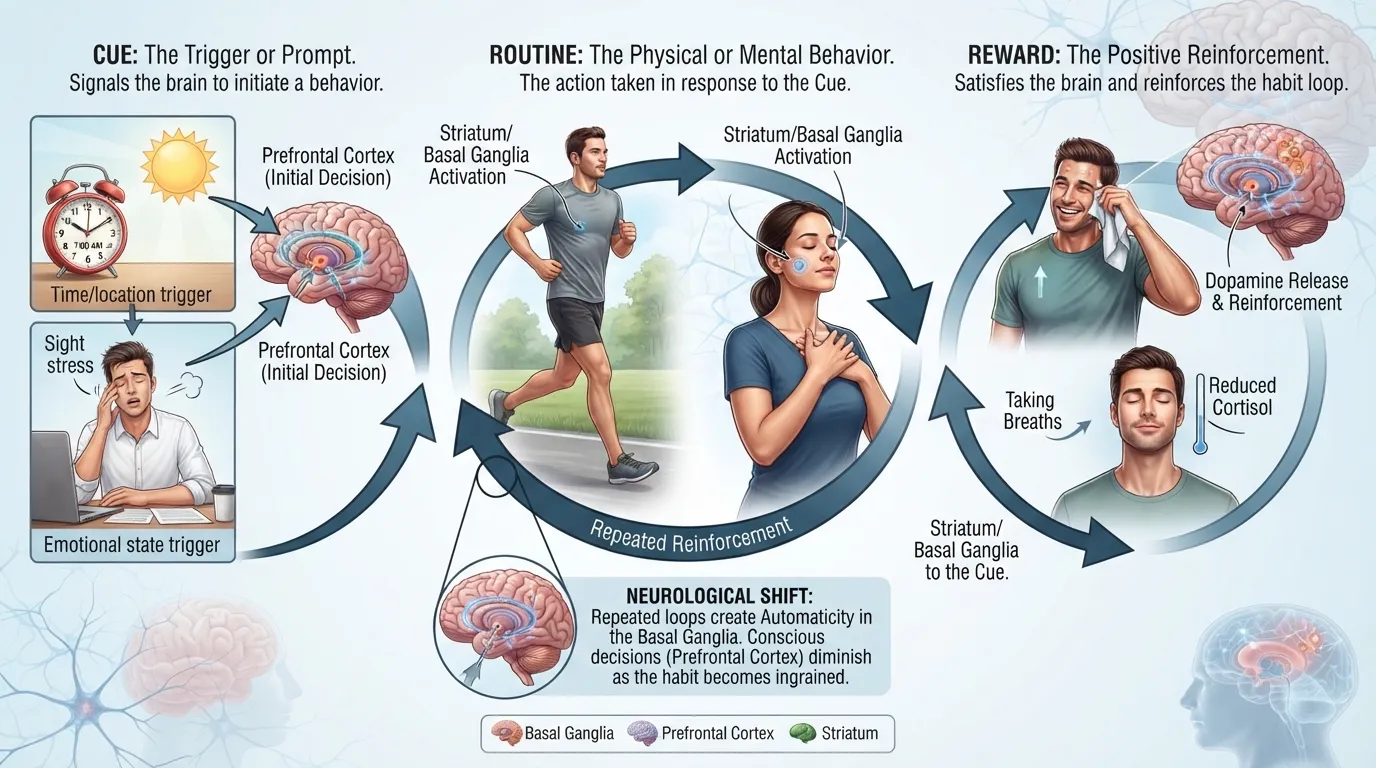
What Is a Habit? (Simple Definition)
Within habit formation psychology, a habit is defined as a behavior that has been repeated enough times to become automatic, bypassing conscious decision-making. This psychological automation frees up vital mental bandwidth, allowing your brain to focus on complex problem-solving while routine tasks run seamlessly in the background.
Automaticity: The core marker of a true habit where actions occur with little to no conscious intent.
Efficiency: Transforming complex behavioral sequences into single, streamlined cognitive scripts.
Compounding Effect: Small, everyday actions that accumulate into significant long-term personal outcomes.
The Habit Loop: Cue, Routine, Reward
Popularized by researchers and writers like James Clear in Atomic Habits, behavior change relies entirely on mastering the neurological feedback loop. Every single routine you perform, whether helpful or destructive, follows a predictable three-part neurological sequence.
The Cue: The trigger or initial spark that initiates the behavior, such as a specific time of day, location, or emotional state.
The Routine: The actual physical, mental, or emotional behavior you perform in response to the cue.
The Reward: The ultimate benefit or dopamine release you experience, which reinforces the loop in your brain and tells it to remember this pattern for the future.
Why Your Brain Loves Habits (Neuroscience in Plain English)
Your brain is an evolutionary efficiency organ designed to conserve energy at all costs through a process called chunking. When you repeat an action, the basal ganglia—the neural structure responsible for motor control and procedural learning—takes over from the prefrontal cortex.
Cognitive Conservation: Shifting behaviors from conscious thought to the basal ganglia drastically reduces your brain’s daily energy expenditure.
Neural Pathways: Repeated neural firing physically strengthens synapses, cementing the behavior into a deep, long-lasting memory trace.
Dopamine Driven: Anticipation of the reward triggers a dopamine spike, driving the craving that compels you to complete the habit loop automatically.
How Long Does It Really Take to Build a Habit? (Myth-Busting)
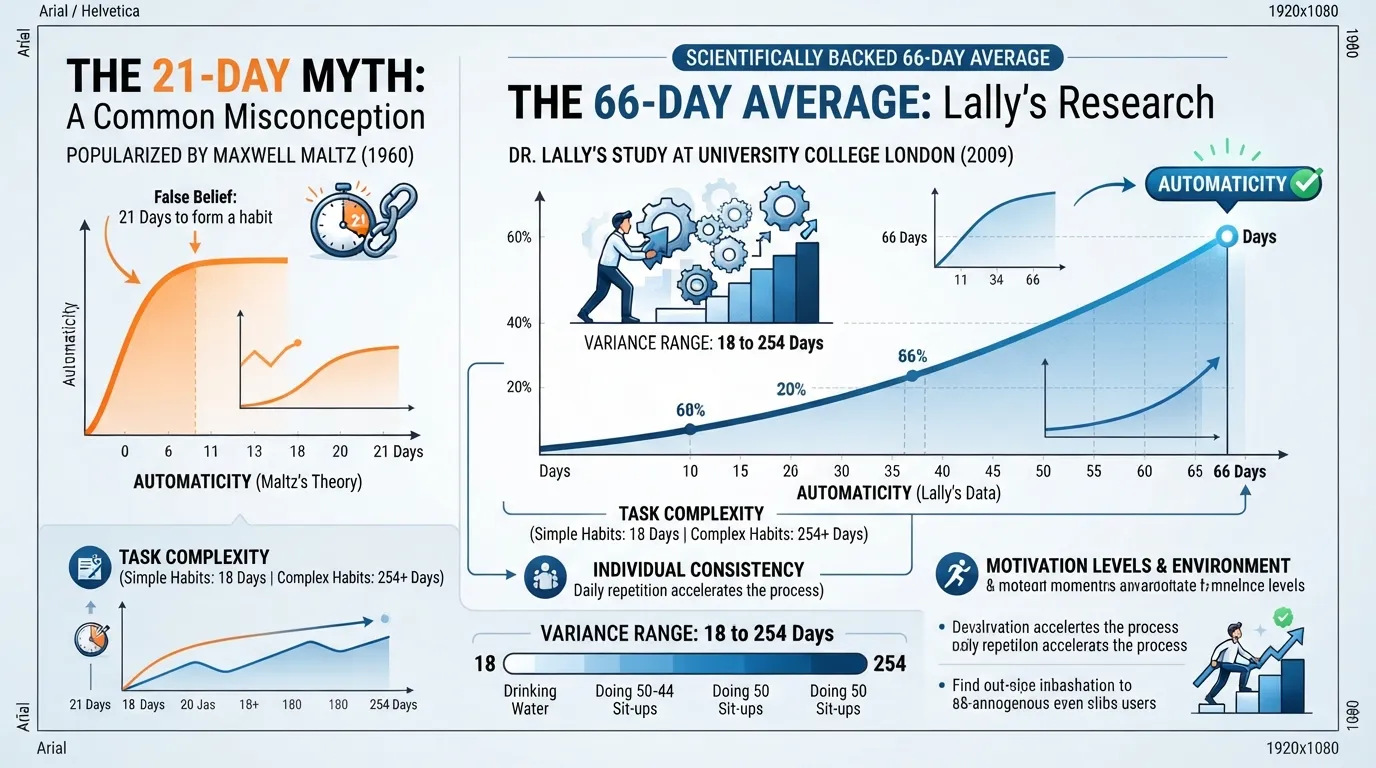
The 21-Day Myth: Where It Came From and Why It’s Wrong
The widely cited belief that it takes exactly 21 days to form a habit originated from a misinterpretation of Psycho-Cybernetics, a 1960 book by plastic surgeon Dr. Maxwell Maltz. Maltz observed that patients took about 21 days to get used to seeing their new facial features or adjusted amputated limbs. Over decades, pop-culture self-help gurus stripped away the surgical context, transforming a casual observation about plastic surgery recovery into a universal law for behavioral change.
The Misapplication: Adapting to a physical trauma or physical change bears no scientific correlation to rewiring neural pathways for complex behaviors.
The Danger of the Myth: Expecting complete behavioral automation in three weeks leads to widespread frustration and premature quitting when routines still require conscious effort on day 22.
The Real Number: 18 to 254 Days (What the Research Actually Says)
Empirical data from a landmark behavioral study published in the European Journal of Social Psychology by health psychology researcher Dr. Phillippa Lally and her team at University College London (UCL) completely dismantles the 21-day timeline. Tracking 96 participants as they tried to establish new daily habits over 12 weeks, researchers discovered that automaticity follows an asymptotic curve rather than a swift linear trajectory.
The 66-Day Average: Across all participants, the median time required to reach a plateau of automaticity was actually 66 days—more than triple the popular myth.
The Broad Spectrum: The actual duration needed to solidify a behavior ranged drastically from 18 days up to 254 days, depending on the individual and the complexity of the task.
The Grace Period: Crucially, the UCL study proved that missing a single daily opportunity did not derail the habit-formation process, offering empirical relief for people who experience occasional lapses.
Why Habit Timelines Vary by Person and Behavior
Asking “how long does it take to form a habit” is similar to asking how long it takes to run a marathon; the answer relies entirely on context, complexity, and personal physiology. Drinking a glass of water after breakfast automates exponentially faster than executing a 50-rep core workout before dawn because the cognitive and physical friction loads differ entirely.
Task Complexity: Simple additions to existing routines (like eating a piece of fruit) integrate quickly, whereas multi-step behaviors demand prolonged prefrontal cortex engagement.
Environmental Consistency: Habits anchored to rock-solid, unyielding contextual cues (such as brushing your teeth) form much faster than routines dependent on chaotic, shifting daily environments.
Individual Neuroplasticity: Baseline differences in how efficiently an individual’s basal ganglia encodes procedural memory mean two people tackling the exact same goal will cross the automaticity threshold at completely different times.
Step-by-Step: How to Build a New Habit
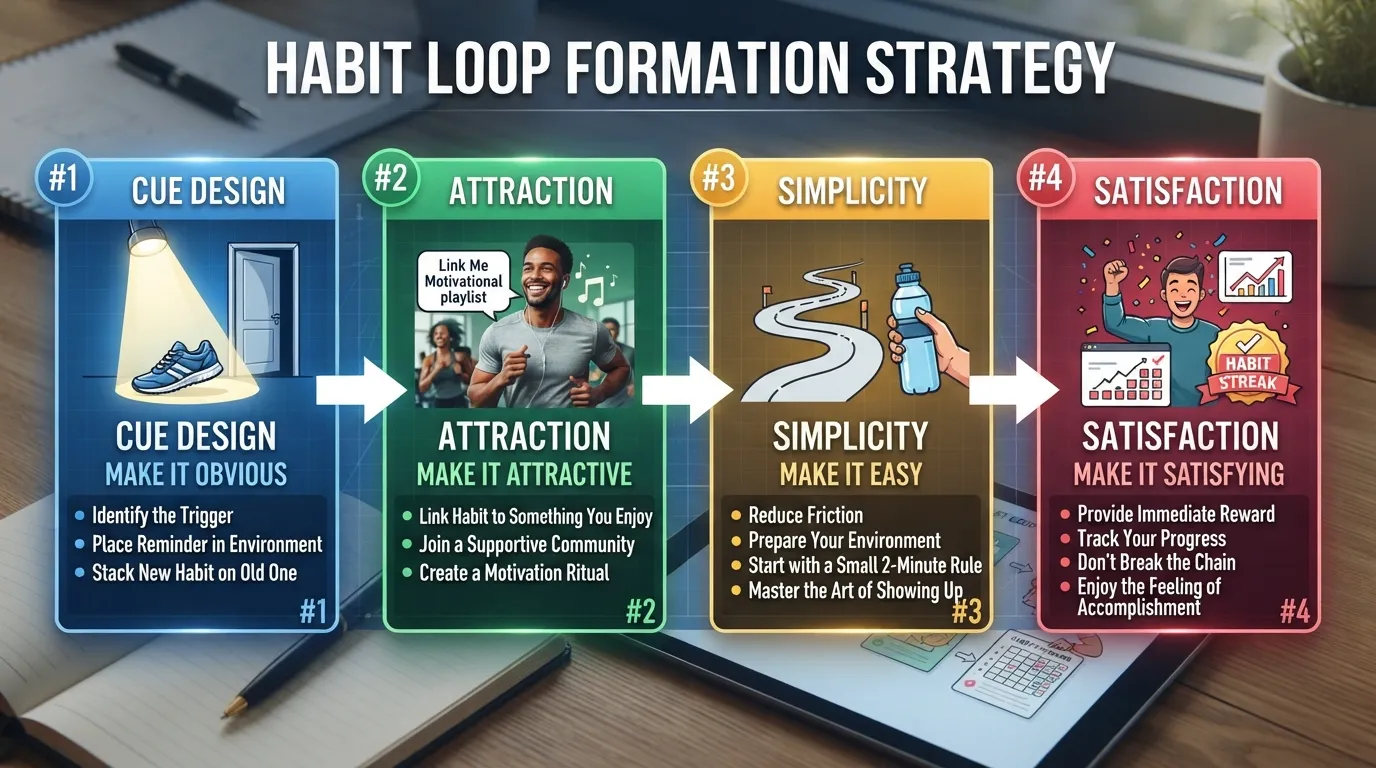
Step 1: Start Small (Make It Ridiculously Easy)
When attempting to build habits, human motivation is an unreliable foundation because it fluctuates wildly based on mood, energy, and stress. The most effective way to bypass low motivation is to shrink the behavior down to a microscopic scale, ensuring execution requires minimal cognitive resistance.
The Two-Minute Rule: Scale any new routine down so it takes two minutes or less to perform, such as reading one page of a book or doing a single push-up.
Eliminate Friction: Remove environmental barriers by prepping your workspace or laying out your workout gear the night before.
Build Momentum: Consistently executing a tiny version of your goal is infinitely superior to planning an ambitious routine you never start.
Step 2: Anchor Your Habit to an Existing Trigger (Habit Stacking)
Trying to remember to perform a behavior out of nowhere is a primary reason new routines fail. Habit stacking leverages your current neurological wiring by attaching a desired new action directly onto an established daily behavior.
The Formula: After [Current Established Habit], I will [New Habit].
Contextual Cues: Using an unchangeable daily anchor—like pouring your morning coffee or brushing your teeth—guarantees a reliable reminder.
Seamless Transition: This technique embeds the new behavior into your existing daily sequence, requiring significantly less mental effort to initiate.
Step 3: Track Your Progress Daily
Visual tracking transforms abstract goals into concrete evidence, providing immediate psychological rewards that reinforce the habit loop. Seeing a streak grow on a calendar or habit tracker activates a powerful sense of accomplishment and accountability.
Visual Proof: Mark an ‘X’ on a calendar or check off a box every single day you successfully complete your routine.
Never Miss Twice: Treat missing one day as an isolated incident rather than a failure, ensuring you immediately jump back on track the next day.
Dopamine Reinforcement: The physical act of checking off a task triggers a subtle satisfaction spike that reinforces your dedication.
Step 4: Be Patient and Consistent — Progress Over Perfection
Habit formation is a nonlinear journey defined by adaptation rather than rigid perfectionism. Accepting that setbacks will happen prevents the toxic all-or-nothing mindset that causes most people to abandon their goals entirely.
Prioritize Frequency Over Intensity: Showing up consistently every day matters far more than executing a massive effort once a week.
Embrace Adaptation: Fine-tune your approach if a specific trigger or routine fails to stick in your actual environment.
Focus on Identity: Shift your mindset from chasing temporary outcomes to becoming the type of person who naturally embodies the habit.
Real-World Example: A Sample Habit Stack Walkthrough
Applying these principles requires a simple, highly predictable sequence that integrates seamlessly into a busy morning. Combining micro-habits with established anchors eliminates guesswork and sets the tone for a productive day.
The Anchor: After I pour my first cup of morning coffee, I will sit down at my desk.
The Two-Minute Action: I will open my journal and write down exactly three things I am grateful for.
The Built-In Reward: I get to sip my warm coffee while experiencing a brief moment of mental clarity before checking emails.
The 3-3-3 Rule for Habits
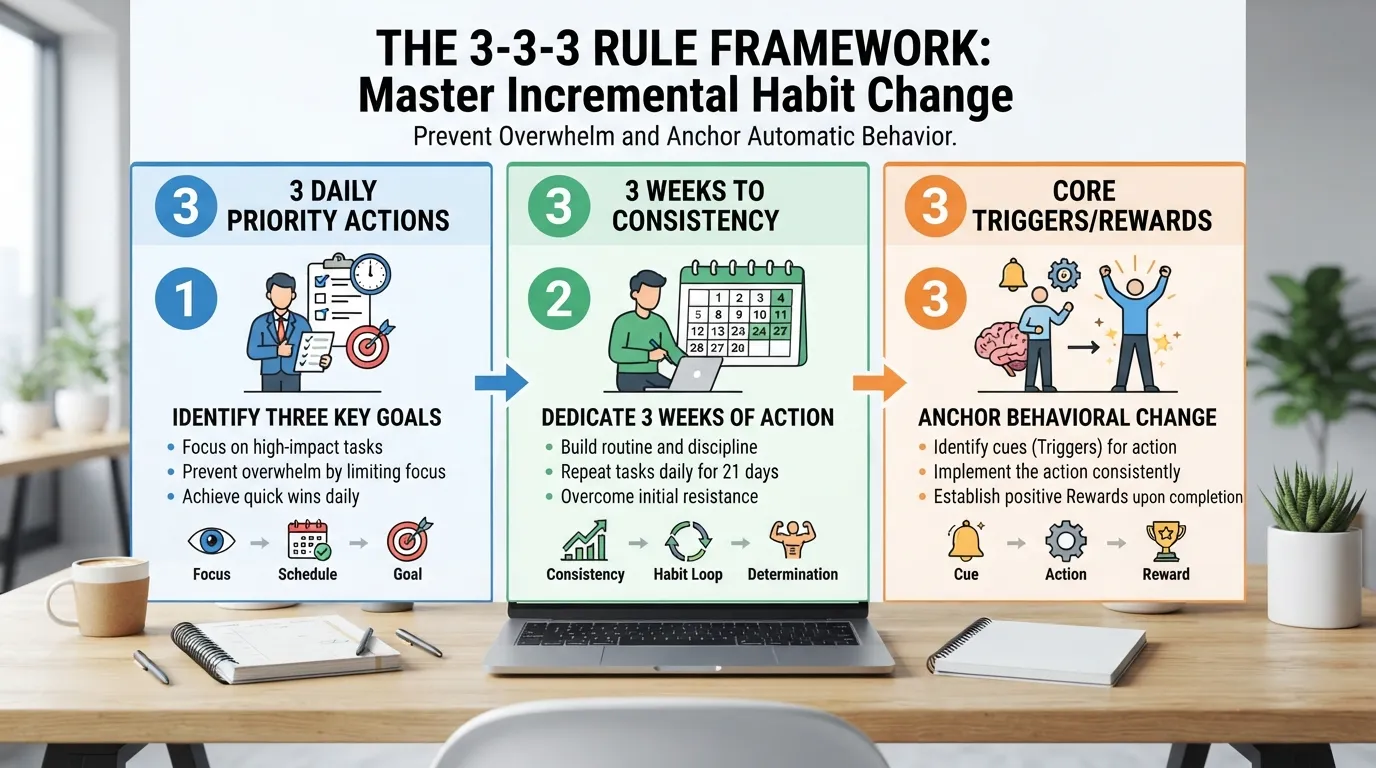
What Is the 3-3-3 Rule?
The 3-3-3 rule is a simplified productivity and behavioral framework designed to prevent cognitive overwhelm when pursuing multiple self-improvement goals simultaneously. Instead of trying to overhaul every aspect of your life at once, this system restricts your focus to three distinct actions across three strategic timeframes.
The Core Principle: Limiting your active behavioral experiments to a manageable quantity protects your finite daily willpower.
Cognitive Focus: Preventing choice fatigue by narrowing your attention to a few high-impact daily priorities.
Structured Balance: Spreading your behavioral energy evenly across micro-commitments rather than concentrating all resources on a single, fragile goal.
How to Apply the 3-3-3 Rule to Your Own Habits
Implementing the framework requires dividing your focus into a balanced triad that addresses different facets of your personal growth without triggering burnout. You select three specific categories or timelines to target, ensuring your daily routine remains agile and sustainable.
Target Three Habits: Focus exclusively on three new habits at any given time, preventing the trap of over-commitment.
Three Daily Weeks of Consistency: Commit to practicing these three behaviors consistently for a baseline period before attempting to layer on new ones.
Three Minutes or Less: Ensure each of the three habits has a micro-version that can be executed in under three minutes on low-energy days.
Why This Framework Works (Simplicity Reduces Overwhelm)
The human brain experiences severe paralysis when faced with too many choices or simultaneous demands, a phenomenon known as cognitive overload. The 3-3-3 rule leverages psychological minimalism to lower the threshold of entry and maintain high execution rates.
Lowering Resistance: Micro-focus eliminates the anxiety associated with massive, ambiguous self-improvement projects.
Clarity of Action: Eliminating ambiguity ensures you always know exactly what needs to be done when you wake up.
Sustainable Momentum: Achieving three small daily wins builds profound psychological confidence, fueling long-term behavioral transformation.
How to Break a Bad Habit
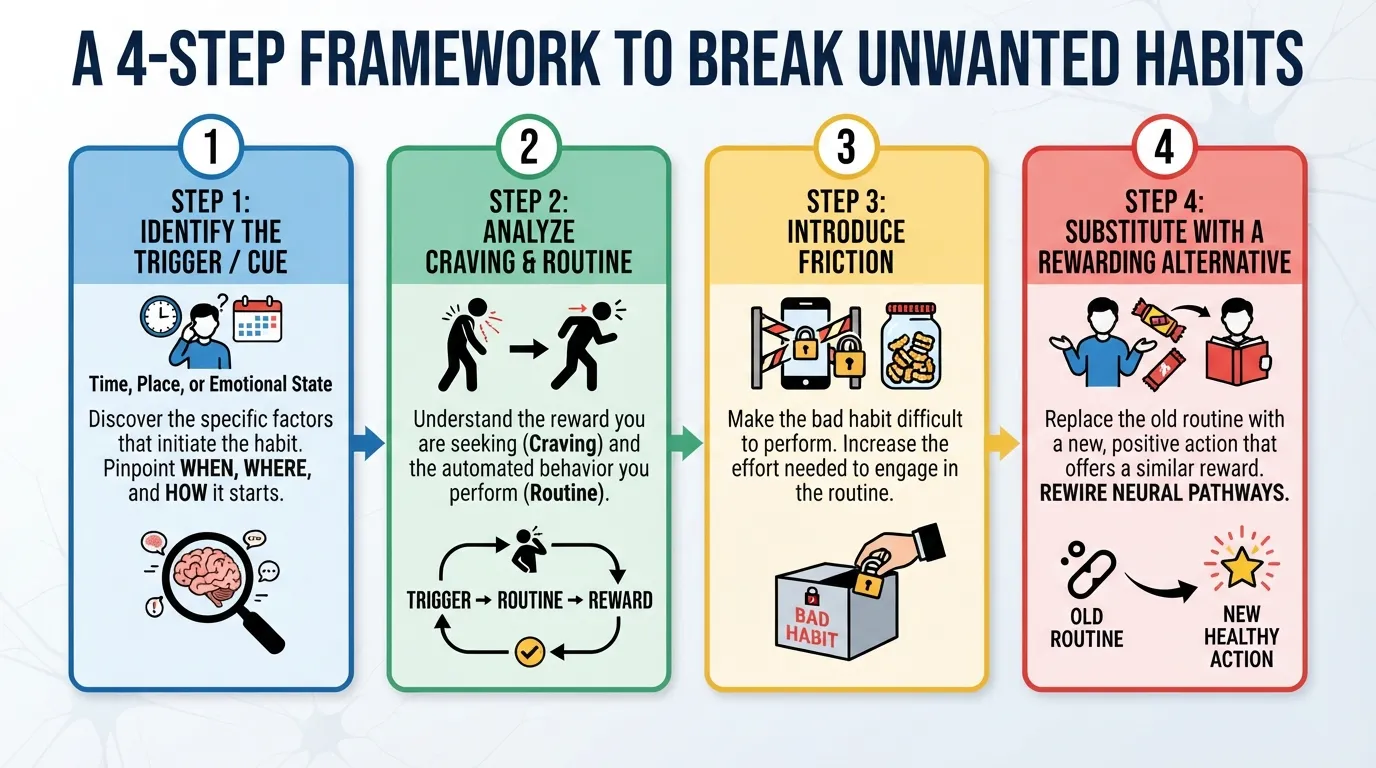
Identify Your Triggers
Breaking an unwanted behavior requires mapping out the exact hidden cues that unconsciously activate your automatic response loop. Behavioral research shows that bad habits rarely happen at random; they are consistently triggered by specific emotional states, times of day, locations, or social environments.
Audit Your Environment: Pay close attention to the exact moments immediately preceding your routine to isolate the root catalyst.
Track the Urge: Note what you were feeling, who you were with, or what stressor you experienced right before the craving hit.
Awareness as a Barrier: Simply shining a spotlight on an unconscious trigger interrupts the automatic autopilot of the habit loop.
Replace, Don’t Just Remove
Attempting to erase a bad habit through pure willpower usually leaves an uncomfortable psychological void that invites relapse. According to behavioral guidelines from the American Heart Association and top psychologists, the most effective strategy is to keep the existing cue and reward while swapping out the harmful routine.
Keep the Cue and Reward: If you stress-eat a sugary snack at 3 PM because you crave a break, keep the 3 PM break but replace the snack with a walk.
Familiar Substitution: Give your brain a different physical or mental outlet to satisfy the underlying craving without the destructive side effects.
Sustainable Adaptation: Changing the middle step of the loop works with your brain’s natural wiring rather than fighting against it.
Add Friction to Bad Choices
You can systematically engineer your daily environment to make unwanted behaviors inconvenient, exhausting, or difficult to execute. Increasing the friction between yourself and a bad habit forces your prefrontal cortex back online, giving you time to make a conscious choice.
Increase Physical Distance: Hide junk food in a high cabinet, leave your phone in another room while working, or log out of distracting apps after every use.
Create Barriers: Require multiple manual steps to perform the bad habit, such as turning off your Wi-Fi router or putting physical locks on distractions.
Streamline Good Alternatives: Conversely, make your preferred behaviors as frictionless as possible so they become the path of least resistance.
What Are the 20 Bad Habits? (Quick Reference List)
Recognizing common behavioral pitfalls helps you target subtle daily friction points that drain your energy, productivity, and physical wellness.
Digital Distractions: Unconscious phone checking, doomscrolling social media feeds late at night, and multitasking during focused work.
Physical Neglect: Chronic sleep deprivation, skipping water intake, sitting for prolonged periods, and poor posture.
Nutritional Pitfalls: Emotional stress-eating, consuming sugary beverages daily, and mindless snacking while watching television.
Mental Traps: Procrastinating on high-impact tasks, negative self-talk, perfectionism paralysis, and chronic worrying about uncontrollable events.
Social and Lifestyle: Hitting the snooze button repeatedly, disorganized daily planning, impulsive spending, and failing to set firm personal boundaries.
Good Habits List — Examples You Can Start Today
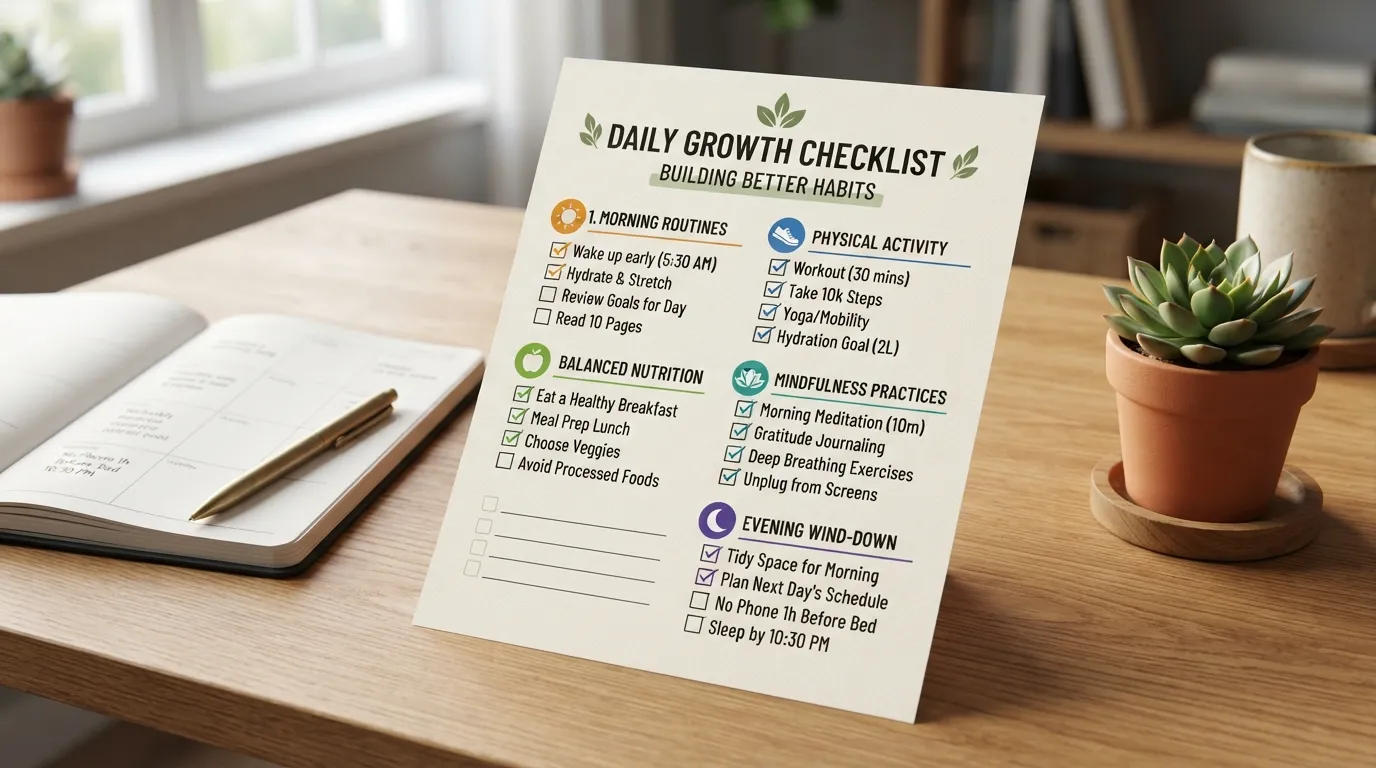
5 Good Habits to Start With
Beginning your transformation requires selecting foundational actions that yield immediate compounding returns without overwhelming your schedule. These five high-impact micro-habits serve as the bedrock for more advanced personal development.
Morning Hydration: Drinking a full glass of water immediately upon waking to kickstart your metabolism and cognitive alertness.
Daily Reading: Committing to reading just 10 pages of a physical book every single day to expand your knowledge base.
Five-Minute Journaling: Writing down three daily gratitudes or reflections to clear mental clutter and stabilize emotional well-being.
Micro-Movement: Incorporating a 15-minute brisk walk or light stretching session into your afternoon slump window.
Digital Sunset: Turning off screens 30 minutes before bed to optimize melatonin production and deep sleep quality.
10 Good Daily Habits for a Better Routine
Scaling up to a robust daily rhythm introduces practices that optimize your physical health, mental clarity, and professional output. Integrating these ten habits transforms an average day into a high-performance engine.
Prioritize the “Big Three”: Identifying and completing your three most important tasks before checking email or social media.
Mindful Breathing: Taking two minutes of intentional diaphragmatic breathing whenever you feel work-related stress rising.
Consistent Sleep Schedule: Going to bed and waking up at the exact same time every day to reinforce your circadian rhythm.
Healthy Snacking: Replacing processed sugary treats with whole foods like nuts, berries, or Greek yogurt.
Postural Resets: Setting an hourly reminder to stand up, stretch your spine, and correct your desk posture.
Evening Planning: Writing out tomorrow’s task list the night before to eliminate morning decision fatigue.
Continuous Learning: Listening to an educational podcast or audio lesson during your daily commute or chores.
Meaningful Connection: Reaching out to a friend, family member, or mentor with a quick, supportive text or check-in.
Workspace Decluttering: Spending five minutes at the end of your workday clearing your desk for a fresh start tomorrow.
Daily Outdoor Time: Getting at least 15 minutes of natural sunlight exposure before noon to boost mood and focus.
20 Healthy Habits Worth Building Over Time
Achieving long-term mastery involves layering advanced lifestyle changes that protect your physical longevity, mental resilience, and financial health. These twenty habits represent the ultimate blueprint for sustained self-improvement.
Physical Longevity: Strength training three times a week, tracking daily step counts, and incorporating mobility work.
Nutritional Discipline: Meal prepping weekly, minimizing ultra-processed foods, and cooking dinner at home consistently.
Mental Resilience: Practicing mindfulness meditation, reframing negative self-talk, and setting healthy emotional boundaries.
Financial Wellness: Automating monthly savings, reviewing subscription expenses regularly, and avoiding impulsive purchases.
Environmental Control: Purging living spaces of clutter, filtering indoor air, and keeping indoor plants for vitality.
Professional Growth: Networking consistently, tracking professional milestones, and seeking constructive feedback.
Rest and Recovery: Scheduling weekly digital detoxes, taking tech-free walks, and prioritizing dedicated hobby time.
Practical Habit Tracker
Simple 30-Day Habit Tracker Table (Cue → Habit → Reward → Done?)
A visual logging system transforms abstract intentions into accountable daily data. Use this markdown-friendly tracking structure to map out your core habit loops, ensuring every action has an explicit trigger and a built-in reinforcement mechanism.
| Day | The Cue (Trigger) | The Habit (Micro-Action) | The Reward | Done? |
| Day 1 | Pouring morning coffee | Read 1 page of a book | Savoring the warm coffee | [ ] |
| Day 2 | Pouring morning coffee | Read 1 page of a book | Savoring the warm coffee | [ ] |
| Day 3 | Pouring morning coffee | Read 1 page of a book | Savoring the warm coffee | [ ] |
| Day 4 | Pouring morning coffee | Read 1 page of a book | Savoring the warm coffee | [ ] |
| Day 5 | Pouring morning coffee | Read 1 page of a book | Savoring the warm coffee | [ ] |
| Day 6 | Pouring morning coffee | Read 1 page of a book | Savoring the warm coffee | [ ] |
| Day 7 | Pouring morning coffee | Read 1 page of a book | Savoring the warm coffee | [ ] |
How to Use This Tracker Daily
Maximizing the effectiveness of your 30-day challenge requires consistent interaction with your tracking log rather than letting it sit forgotten in a notebook. Integrating this quick check-in into your existing daily wrap-up cements your behavioral accountability.
Review at Night: Spend 30 seconds before bed checking off completed boxes and reviewing your progress.
Keep It Visible: Place your printed or digital tracker directly on your desk or refrigerator where your eyes land every morning.
Embrace Flexibility: If you miss a day, pick right back up on the current date without wasting energy on guilt or self-criticism.
Frequently Asked Questions
What Is the 3-3-3 Rule for Habits?
The 3-3-3 rule is a behavioral framework that restricts your focus to three active habits at any given time, maintains consistency for a baseline period, and ensures each habit takes under three minutes to execute. This prevents cognitive overload and eliminates burnout when pursuing personal growth.
Three Habits: Limit active behavioral changes to three simultaneous goals.
Three Weeks Plus: Practice them consistently to build foundational momentum.
Under Three Minutes: Keep the micro-action effortless on low-energy days.
What Are 10 Good Daily Habits?
Ten high-impact daily habits include prioritizing your most important tasks, drinking morning water, practicing mindful breathing, maintaining a consistent sleep schedule, replacing sugary snacks with whole foods, taking postural resets, planning your schedule the evening before, listening to educational audio, connecting with a loved one, and clearing your workspace.
Productivity: Focus on top priorities and evening planning.
Physical Health: Hydration, proper posture, whole food snacking, and consistent sleep.
Mental Wellbeing: Breathing exercises, learning, connecting, and workspace decluttering.
What Are 5 Good Habits?
Five foundational habits to start immediately are drinking a glass of water upon waking, reading 10 pages of a book daily, writing three gratitudes in a journal, taking a 15-minute afternoon walk, and initiating a digital sunset 30 minutes before sleep.
Morning Hydration: Kickstarts metabolism and mental clarity.
Daily Reading: Expands knowledge incrementally.
Gratitude Journaling: Lowers stress and clears mental clutter.
What Are 20 Healthy Habits?
Twenty healthy habits span physical longevity, mental resilience, nutritional discipline, and financial wellness. Examples include strength training three times a week, tracking daily steps, meal prepping weekly, minimizing processed foods, practicing mindfulness, setting emotional boundaries, automating savings, reviewing expenses, purging living spaces of clutter, and scheduling regular tech-free walks.
Physical and Nutritional: Strength workouts, meal prep, and whole foods.
Mental and Environmental: Meditation, boundaries, clutter reduction, and nature exposure.
Lifestyle and Financial: Automated savings and regular device-free recovery time.
What Are 10 Habits That Can Improve My Life?
Ten life-enhancing habits include waking up at a consistent time, practicing daily gratitude, reading regularly, exercising for 20 minutes daily, drinking sufficient water, planning daily tasks in advance, expressing appreciation to others, meditating or practicing breathwork, keeping a clean living environment, and prioritizing deep, uninterrupted sleep.
Routine Optimization: Early morning consistency and advance daily planning.
Mind and Body: Regular exercise, breathwork, and optimal sleep hygiene.
Environment and Connection: Clean living spaces and intentional gratitude.
What Are the 20 Bad Habits?
Twenty common bad habits include checking your phone compulsively, late-night doomscrolling, multitasking during work, sleep deprivation, skipping water intake, prolonged sitting, poor posture, stress-eating, drinking sugary beverages, mindless snacking, procrastinating on major tasks, negative self-talk, perfectionism paralysis, chronic worrying, hitting the snooze button, poor daily organization, impulsive spending, neglecting personal boundaries, ignoring physical movement, and failing to plan meals.
Digital and Focus: Phone checking, doomscrolling, and task-switching.
Health and Nutrition: Sleep deprivation, poor posture, and sugary snacking.
Mental and Lifestyle: Chronic worrying, procrastination, and impulsive spending.
How Long Does It Take to Form a Habit?
Research from University College London shows that forming a habit takes anywhere from 18 to 254 days, with a median average of 66 days. The duration depends entirely on task complexity, individual neuroplasticity, and environmental consistency rather than the outdated 21-day myth.
The Average: 66 days to reach a plateau of automaticity.
The Range: 18 to 254 days depending on behavioral complexity.
The Grace Factor: Missing an occasional day does not ruin your long-term progress.
Conclusion — Key Takeaways
Lasting personal change relies on systems rather than sheer willpower, transforming how you approach daily routines. Lasting transformation does not require massive overhauls, but rather the compounding effect of small consistent changes executed daily.
Embrace the Habit Loop: Master the sequence of cue, routine, and reward to work with your brain’s natural neurology instead of fighting against it.
Respect the Timeline: Understand that building a new automatic behavior takes anywhere from 18 to 254 days, making patience and consistency far more critical than rigid perfectionism.
Start Small: Use frameworks like habit stacking and the 3-3-3 rule to reduce cognitive friction, eliminate overwhelm, and make good habits stick for the long term.