What Is a Habit? Definition, Science, and the Habit Loop
What Is a Habit? (The Core Definition)
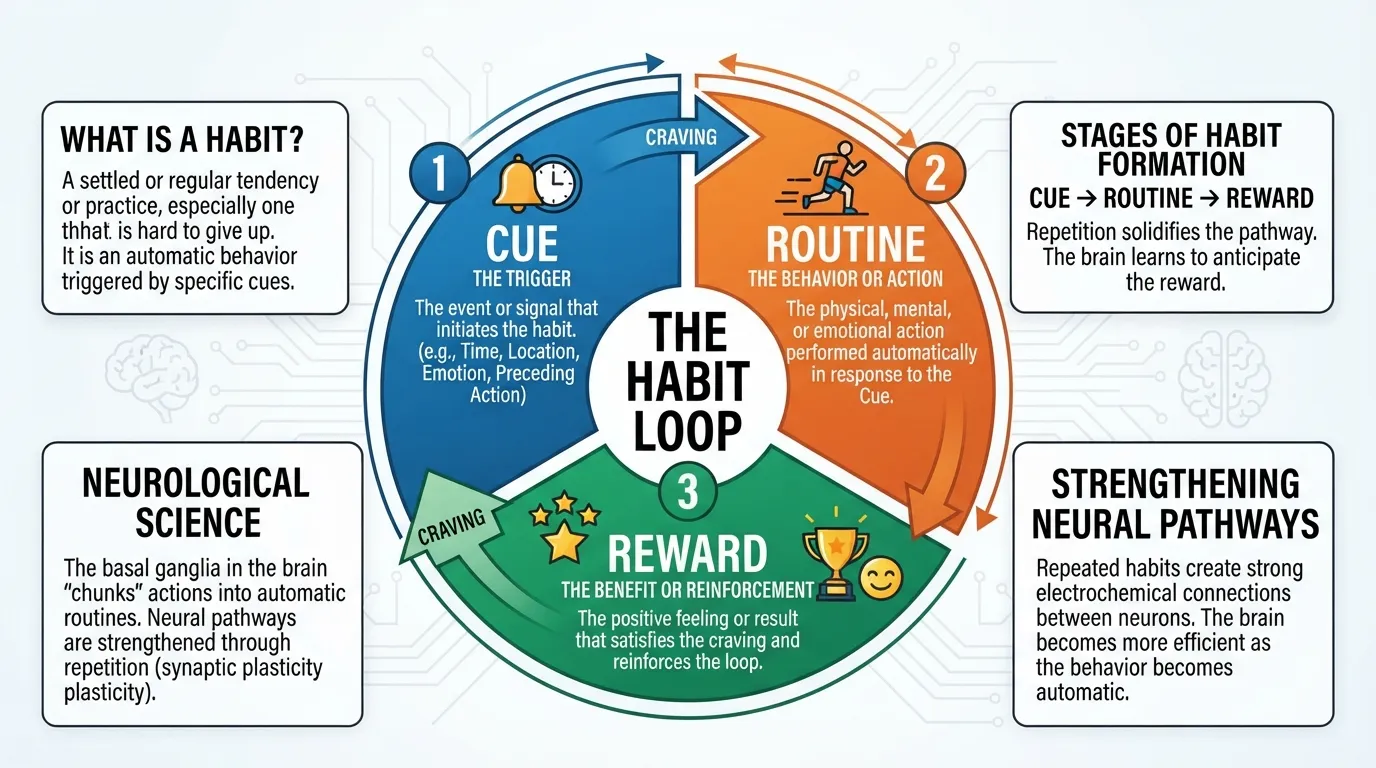
A habit is a regular behavior or routine that has become an automatic action performed largely without thinking, typically triggered by specific contextual cues in daily life. Understanding the core definition of a habit is the foundational step toward mastering behavioral change and breaking unwanted patterns.
A Simple, One-Line Definition of a Habit
The Core Concept: A habit represents a fixed, automatic behavioral response acquired through frequent repetition and reinforced by associated rewards.
Featured Snippet Target: To define a habit simply, it is an automated routine or regular behavior executed subconsciously in response to familiar environmental triggers.
Behavioral Automation: When humans repeatedly perform an action in a consistent context, neural pathways strengthen, shifting cognitive control from conscious decision-making to automatic execution.
Breaking Down the Definition: What Makes an Action a “Habit”?
Automaticity: The defining characteristic of any habit is its execution without active, conscious thought or deliberate mental deliberation.
Contextual Cues: Habits rely on specific environmental triggers—such as a time of day, a location, or an emotional state—that initiate the routine automatically.
Repetition & Consistency: Regular behavior transforms into a true habit only after sustained, frequent repetition within a stable setting over a period of time.
Loop Structure: Every established habit operates on a psychological loop consisting of a cue, a routine, and a rewarding outcome that reinforces the cycle.
The Key Characteristics of a Habit
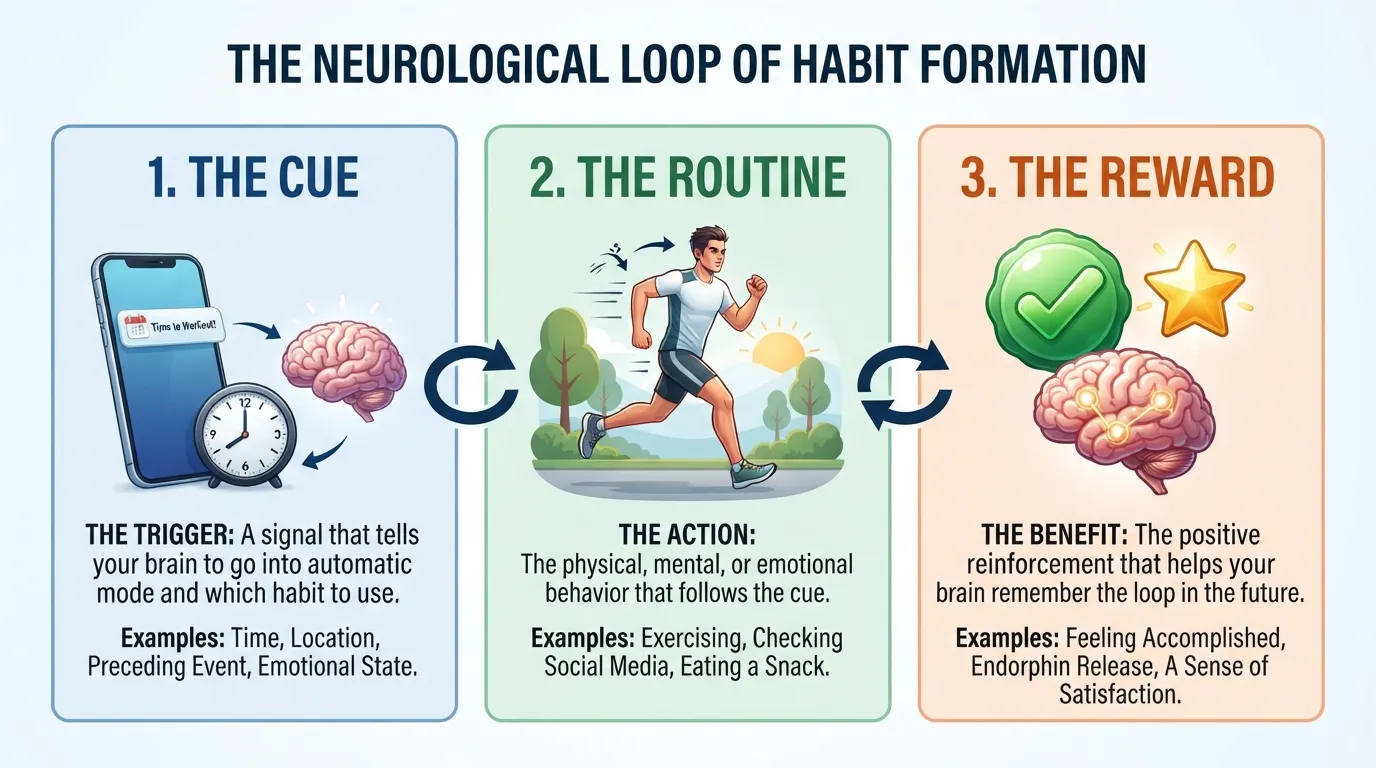
Habits are distinguished from conscious decisions and deliberate actions by specific psychological traits that dictate how they form and operate. Understanding these characteristics explains why routines feel effortless and why they persist over time.
Automaticity: Why Habits Happen Without Thinking
Effortless Execution: Automatic action allows individuals to carry out complex routines, such as driving or tying shoes, while focusing their mental energy elsewhere.
Subconscious Triggering: Once established, a behavior transitions into second nature, bypassing the brain’s prefrontal cortex where conscious decision-making occurs.
Cue-Driven Response: Instead of weighing pros and cons, the brain simply recognizes familiar cues and launches the corresponding action automatically.
Formed Through Repetition
Neural Pathway Reinforcement: Every time an action is repeated within a consistent context, the brain strengthens the synaptic connections associated with that behavior.
Gradual Transition: What starts as a deliberate choice requiring heavy conscious effort slowly morphs into an automated reflex through sustained, frequent practice.
Consistency Over Intensity: The durability of a habit depends more on how regularly the action is performed than on the scale or difficulty of the task itself.
Why Habits Are Hard to Break
Deeply Rooted Pathways: Because automatic behaviors require minimal conscious effort, they become deeply ingrained structural shortcuts in the brain’s circuitry.
Resilience to Change: When stress or distraction occurs, humans naturally default to these established routines because they demand zero mental bandwidth.
Rewiring Requirements: Overwriting a ingrained habit requires active awareness, introducing new cues, and deliberately replacing the old routine with a healthier alternative.
The Habit Loop — How a Habit Actually Works
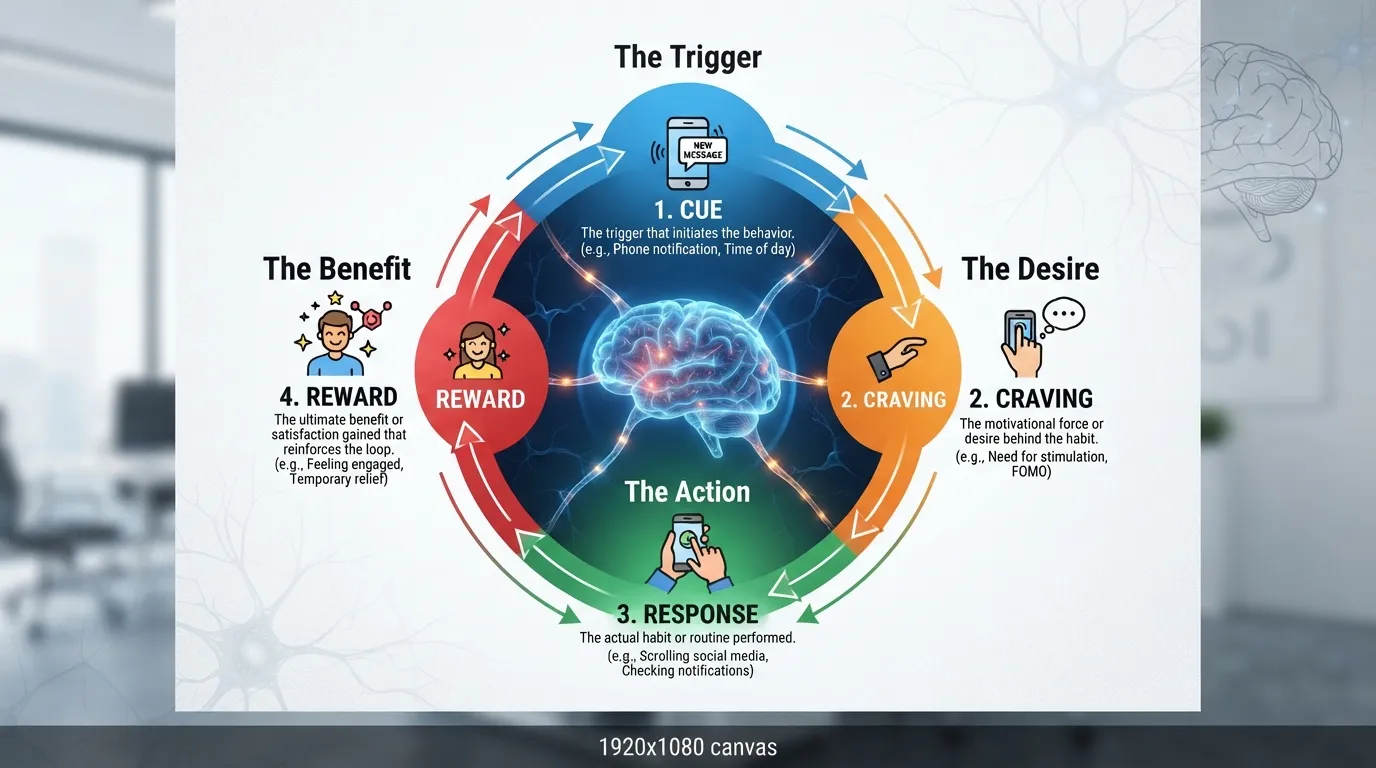
The habit loop is a neurological feedback loop that governs every automated behavior pattern, consisting of a cue, a routine, and a reward. Understanding this three-part cycle allows individuals to dissect their daily actions and strategically reshape unwanted behaviors.
Step 1: The Cue (What Triggers a Habit)
The Initial Spark: The cue acts as a trigger that tells the brain to enter an automatic mode and determines which routine to use.
Types of Triggers: Environmental cues can range from a specific time of day and physical locations to emotional states or preceding actions.
Brain Response: Upon encountering a familiar trigger, the brain instantly initiates a predictive neurological response anticipating the outcome.
Step 2: The Routine (The Behavior Itself)
Execution of Action: The routine represents the actual behavior pattern performed, which can be physical, mental, or emotional.
Automatic Flow: Once triggered, this sequence unfolds smoothly with minimal conscious oversight or decision-making required.
Step 3: The Reward (Why the Brain Repeats It)
Reinforcement Mechanism: The reward provides a positive feedback signal that helps the brain evaluate whether this specific loop is worth remembering for the future.
Chemical Release: Achieving the reward triggers dopamine release, reinforcing the neural pathways associated with the cue and routine.
Real-Life Example: Morning Coffee Habit Loop Explained
The Cue: Waking up and walking into the kitchen serves as the primary environmental trigger.
The Routine: Brewing a fresh cup of coffee becomes the automatic behavior pattern executed without heavy thinking.
The Reward: The warmth, taste, and caffeine boost deliver an immediate reward, solidifying the habit loop for the next morning.
The Psychological / Scientific Definition of a Habit
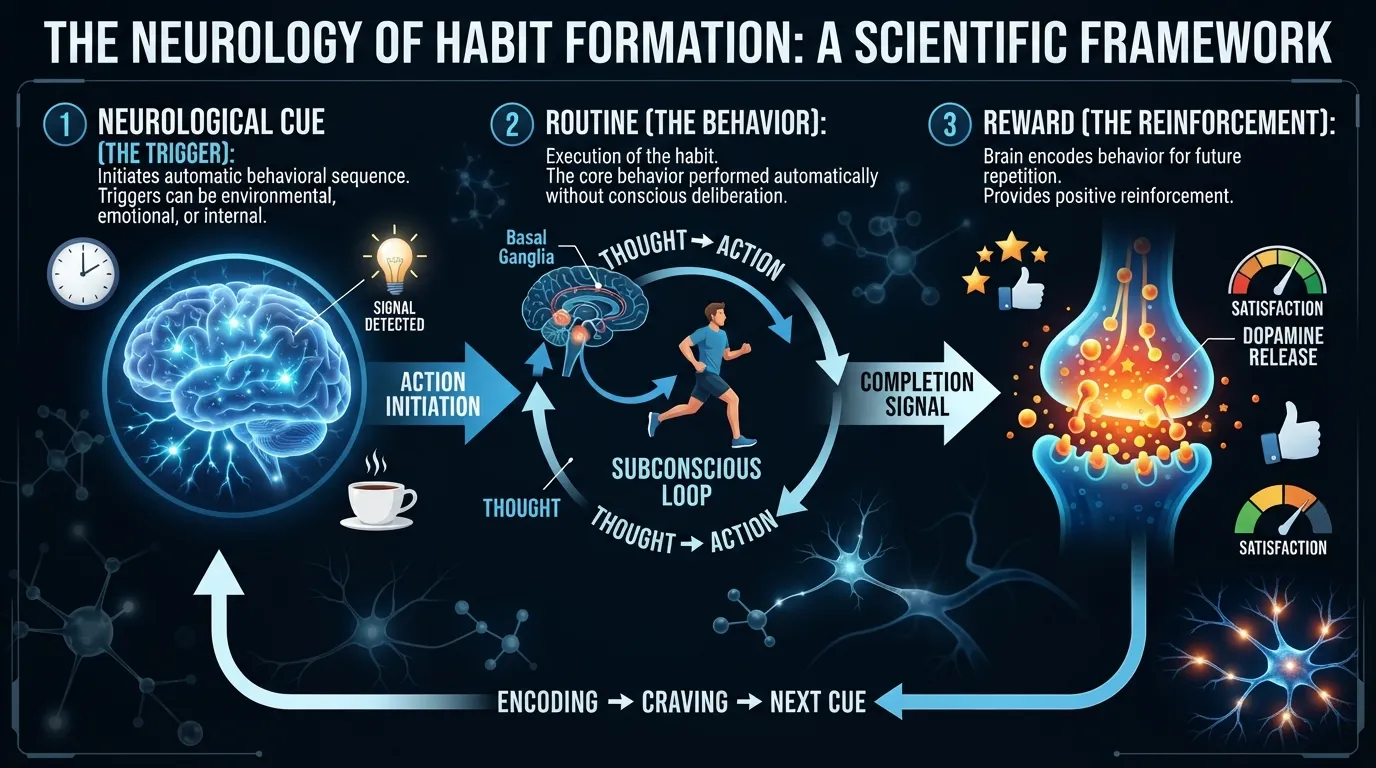
In behavioral science, a habit is defined as a learned, automatic response to a specific contextual cue, forged through frequent repetition and reinforced by past rewards. According to academic research outlined in the EBSCO Research Starters on Habit Psychology, habits represent the brain’s mechanism for conserving mental energy by automating routine tasks.
How Psychologists Define a Habit
Automatic Behavioral Response: Behavioral scientists emphasize that habits are actions stripped of deliberate intent, functioning as fixed patterns triggered by environmental stimuli.
Context-Dependent Cues: Research indicates that habit formation requires a stable setting; consistent repetition within the same context links the trigger directly to the behavior in human memory.
Shift from Goal-Directed to Automatic: When a behavior first starts, it is driven by conscious goals, but over time, neural efficiency takes over and transforms it into an automatic reflex.
The Role of the Brain (Basal Ganglia & Dopamine, in Simple Terms)
The Basal Ganglia’s Function: This central structure of the brain acts as the command center for procedural memory, retaining the neurological script for routines so the prefrontal cortex can rest.
Dopamine as a Chemical Messenger: Dopamine acts as the brain’s reward signal, reinforcing neural pathways whenever a routine concludes successfully.
Structural Brain Changes: Frequent repetition physically alters synaptic connections, creating deeply imprinted pathways that make established habits feel effortless to execute.
Types of Habits (The 4 Categories)
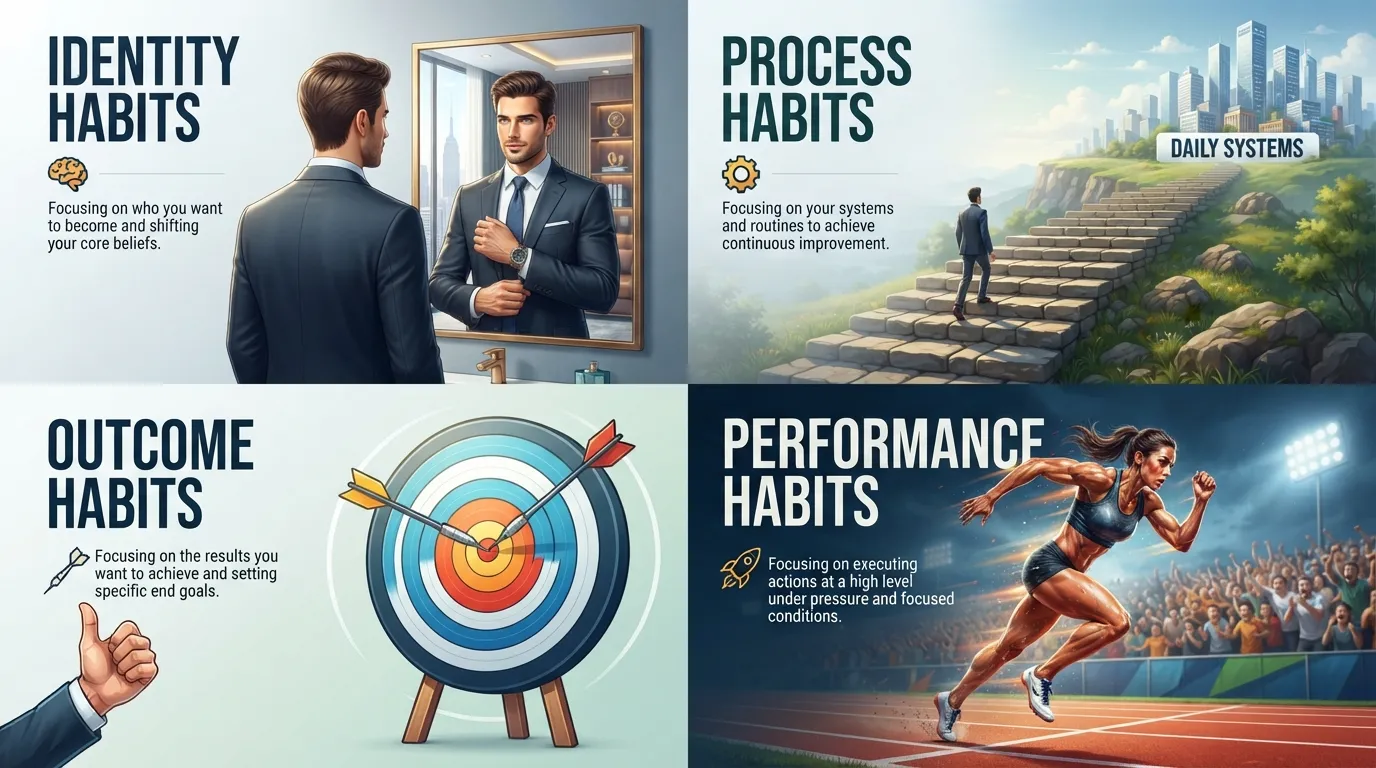
Habits vary widely in their structure, impact on daily life, and psychological origin. Categorizing them helps individuals identify which routines build personal growth and which ones hinder progress.
Good Habits vs. Bad Habits
Productive Actions: Good habits encompass behaviors that improve physical health, mental well-being, financial stability, or productivity over the long term.
Destructive Patterns: Bad habits involve automatic actions that offer immediate short-term comfort while causing negative physical, mental, or lifestyle consequences.
The Role of Awareness: Distinguishing between the two requires examining the ultimate outcome of each routine rather than how it feels in the moment.
Keystone Habits (Habits That Trigger Other Habits)
Catalyst Behaviors: Keystone habits are specific routines that spark a cascade of positive changes across multiple areas of life without deliberate effort.
Systemic Ripple Effects: Establishing a keystone habit, such as regular exercise or daily journaling, naturally alters eating patterns, sleep quality, and stress levels.
High Leverage Points: These habits provide maximum return on investment because changing one foundational routine automatically reshapes adjacent behaviors.
Identity-Based Habits
Belief-Driven Routines: Identity-based habits focus on shifting self-perception first, anchoring behavior changes to who a person wants to become.
Internal Alignment: Instead of focusing purely on external outcomes, individuals adopt actions that reflect their core values and desired personal identity.
Sustainable Motivation: Acting in alignment with personal beliefs makes the routine feel natural rather than forced, ensuring long-term persistence.
Instant vs. Gradual Habits
Immediate Execution: Instant habits are simple reflexes or quick responses formed after very few repetitions due to high emotional or physical salience.
Compound Growth: Gradual habits require sustained, deliberate repetition over weeks or months before the neural pathway becomes fully automated.
Adaptation Speeds: Recognizing whether a routine forms quickly or slowly helps set realistic expectations for behavioral modification and skill acquisition.
Habit vs. Routine vs. Addiction vs. Principle — Know the Difference
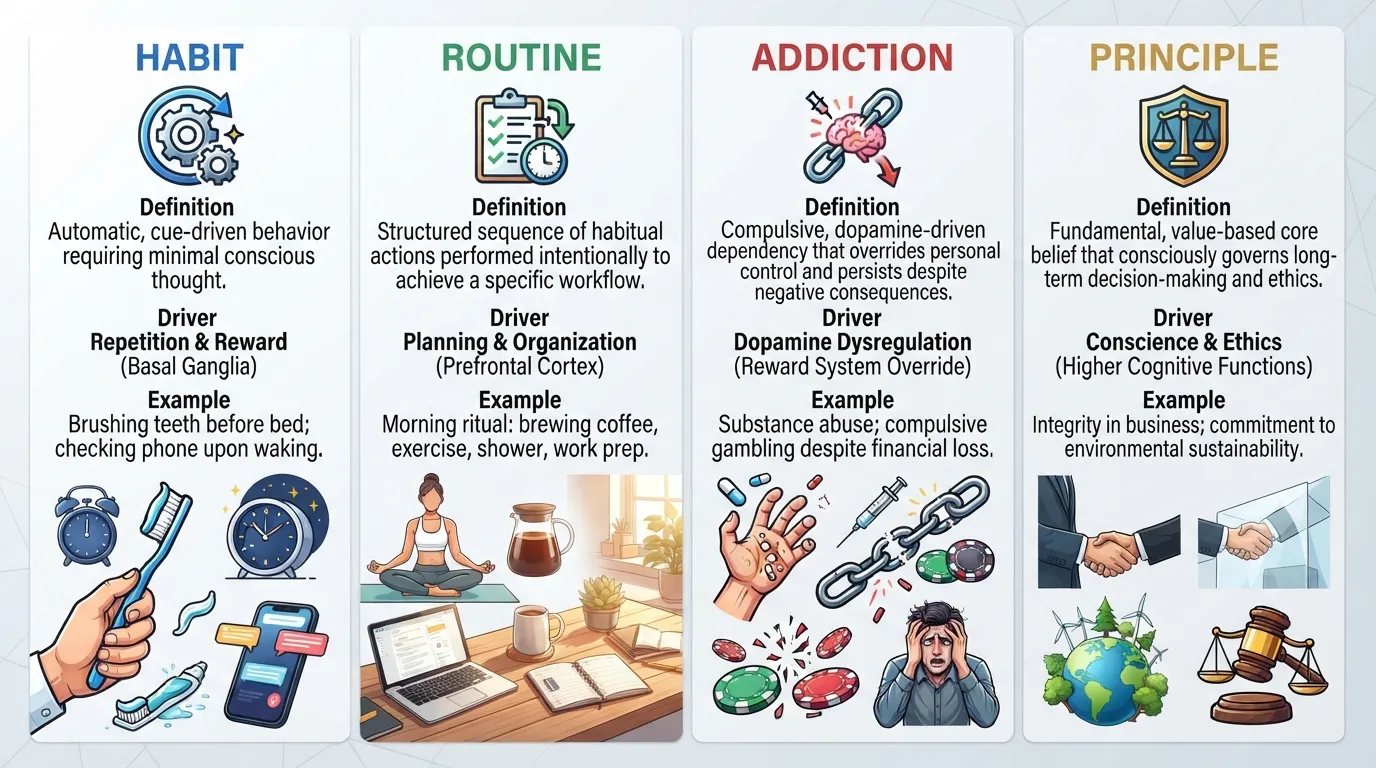
Distinguishing habits from routines, addictions, and principles prevents conceptual confusion and provides clarity for personal development. While these terms are often used interchangeably in everyday conversation, they represent distinct psychological and behavioral frameworks.
Habit vs. Routine: What’s the Difference?
Level of Automation: A habit is executed entirely on autopilot triggered by a subconscious cue, whereas a routine requires deliberate intention and conscious organization.
Scope and Scale: A routine is a series of actions performed in a specific order, such as a morning getting-ready checklist, which may contain multiple individual habits within it.
Flexibility: Routines can be easily altered or stopped with conscious thought, while deeply ingrained habits require active friction to break or modify.
Habit vs. Addiction: Where Does One End and the Other Begin?
Control and Choice: A habit can be consciously paused or replaced when attention is brought to it, whereas an addiction involves compulsive behavior that persists despite severe negative consequences.
Brain Chemistry Impact: Addictions hijack the brain’s reward circuitry, creating intense chemical dependency and withdrawal symptoms that go far beyond standard habit loops.
Functional Impact: Habits conserve mental energy to simplify daily life, while addictions ultimately disrupt life stability, emotional regulation, and decision-making capacity.
Habit vs. Principle: Behavior vs. Belief
Action vs. Core Conviction: A habit represents an automated physical or mental behavior, whereas a principle is a fundamental belief or moral guideline that directs judgment.
Origin of Formation: Habits are built through environmental cues and repetition, while principles are developed through reflection, philosophy, and value alignment.
Guidance Mechanism: Principles shape how an individual chooses their goals and ethics, while habits dictate the day-to-day execution required to pursue them.
How Long Does It Take to Build or Break a Habit?
Building or breaking a habit depends on consistency, complexity, and behavioral reinforcement, with scientific timelines showing that automaticity takes anywhere from 18 days to several months. Understanding real-world formation metrics helps manage expectations and establish sustainable routines.
What Is the 3-3-3 Rule for Habits?
Phase Breakdown: The 3-3-3 rule suggests dividing habit adoption into structured milestones, focusing on 3 days of strict commitment, 3 weeks of consistency, and 3 months of permanent integration.
Initial Momentum: The first 3 days require high conscious effort to overcome initial friction and establish the preliminary cue-routine-reward loop.
Milestone Tracking: Reaching the 3-month mark signifies that the behavior has transitioned from a deliberate chore into a stable, long-term lifestyle pattern.
What Is the 21-90 Rule?
The Myth vs. Reality: Popularized by self-help culture, the 21-90 rule states it takes 21 days to form a new habit and 90 days to make it a permanent lifestyle change.
Neurological Adjustment: While 21 days is often enough time to notice a shift in daily comfort, deep neural pathway rewiring typically requires the extended 90-day window.
Individual Variability: Psychological research shows that timelines vary wildly depending on the difficulty of the behavior and personal consistency.
How Many Repetitions Does It Take to Build (or Break) a Habit?
Frequency Over Time: Automaticity is achieved through repetition count rather than a strict calendar duration, requiring consistent performance whenever the cue appears.
Variable Thresholds: Simple actions like drinking a glass of water after waking up automate quickly, whereas complex routines like daily physical exercise take significantly more repetitions.
Breaking Cycles: Breaking a bad habit requires interrupting established repetitions and replacing the reward loop with a healthier alternative.
How Long Until Something Becomes a Habit? (Realistic Timeline)
University Research Data: Landmark psychological studies by researchers like Dr. Phillippa Lally show that it takes an average of 66 days for a new behavior to become automatic [00:19].
The Range of Adaptation: Depending on the person and task complexity, establishing a reliable routine can take anywhere from 18 to 254 days [00:23].
Consistency is Key: Missing a single day occasionally does not ruin progress, but regular, unbroken repetition significantly accelerates automaticity [00:31].
Habits and ADHD — A Unique, Underserved Angle
People with ADHD face distinct neurological challenges when trying to build or break habits, primarily due to executive dysfunction and dysregulated dopamine pathways. Addressing these neurodivergent factors is crucial because traditional habit-formation advice often fails individuals who process rewards and time differently.
Why Habit Formation Can Be Harder for People With ADHD
Executive Dysfunction: The brain’s prefrontal cortex struggles with working memory, impulse control, and organizing multi-step tasks, making routine planning difficult.
Dopamine Deficit: Because the ADHD brain is chronically starved for immediate chemical reinforcement, delayed rewards fail to motivate consistent behavior.
Time Blindness: Difficulty perceiving future consequences prevents individuals from recognizing the long-term value of maintaining a daily routine.
Working Memory Bottlenecks: Out of sight often means out of mind, causing environmental cues to be completely overlooked before a habit loop can even start.
Practical Tips for Building Habits With ADHD
Visual Cues: Place reminders directly in sight—such as sticky notes on mirrors or items laid out on the floor—to bypass working memory limitations.
Instant Rewards: Pair tedious tasks with immediate dopamine boosters, like listening to favorite music while cleaning or working out.
Habit Stacking: Anchor a new behavior to an already established, highly automatic daily action like brushing teeth or making morning coffee.
Externalize Time: Use visual timers and alarms to reduce time blindness and create urgency without relying solely on internal motivation.
Common Habit Phrases Explained ("Sheer Habit," "Breaking a Habit")
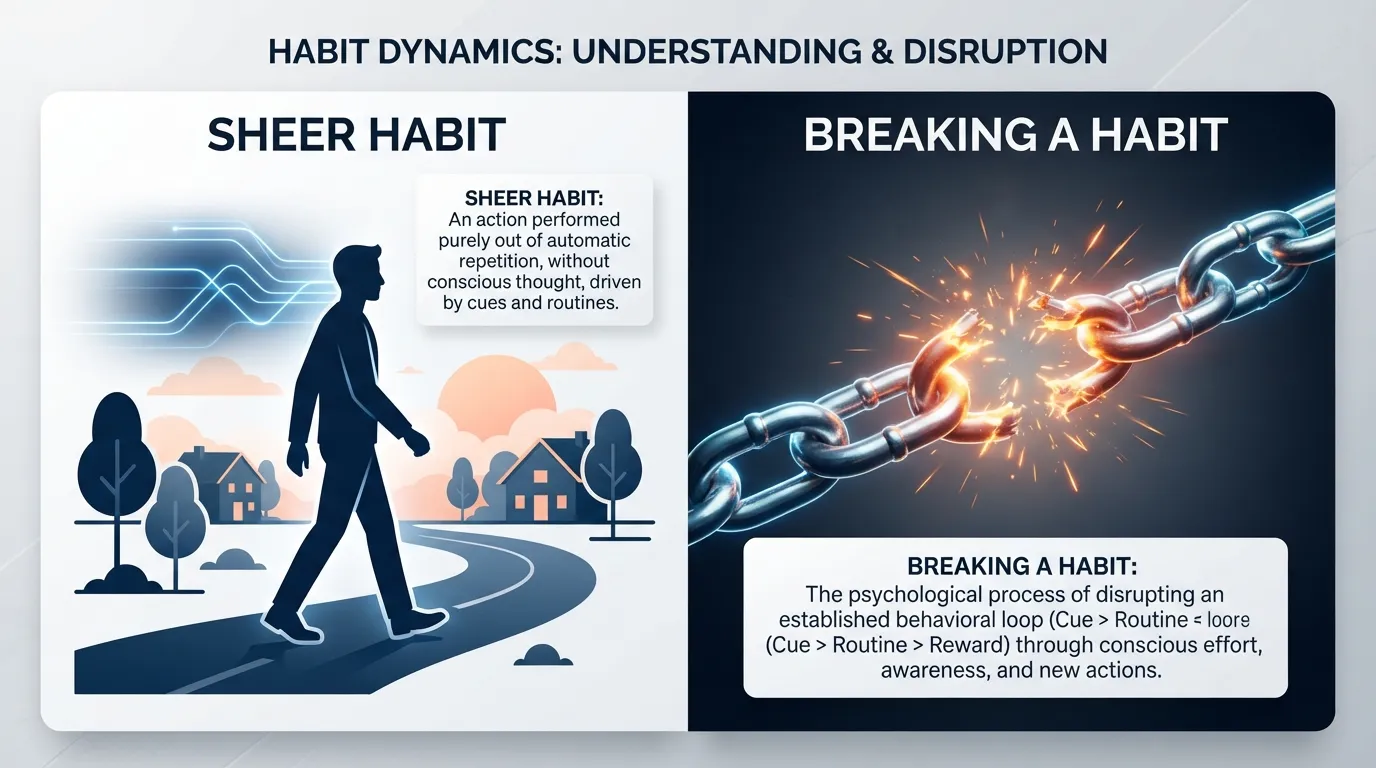
Idiomatic expressions and common phrases surrounding daily routines often carry specific psychological meanings that clarify how the human brain automates behavior. Understanding these terms demystifies the mechanics behind involuntary actions and long-term behavioral changes.
What Does “Sheer Habit” Mean?
Pure Automatic Execution: The phrase “sheer habit” describes an action performed completely on autopilot without any conscious thought, deliberation, or emotional investment.
Absence of Intent: When someone acts out of sheer habit, they are relying entirely on deeply ingrained neural pathways rather than making a deliberate choice in the moment.
Environmental Driving Force: This term highlights how powerful external triggers and subconscious cues can compel a person to complete a familiar routine effortlessly.
What Does “Breaking a Habit” Actually Mean?
Rewiring Neural Pathways: Breaking a habit does not mean erasing the old brain script; instead, it involves building a competing neural pathway that overrides the original response.
Interrupted Loops: The process requires identifying the core cue or trigger and consciously substituting the old routine with a healthier alternative action.
Friction and Awareness: True habit breaking demands sustained mindful attention to catch the automatic trigger before the subconscious brain takes over.
Can a Habit Be Permanently “Turned Off”?
Latent Neural Traces: Once a habit loop is deeply imprinted in the basal ganglia, the original neurological pathway remains dormant in the brain rather than disappearing entirely.
Vulnerability to Relapse: Under high stress, exhaustion, or when exposed to strong original cues, an old habit can easily reactivate even after years of disuse.
Permanent Modification: While old habits cannot be truly deleted, they can be permanently suppressed and replaced by consciously maintaining new routines and environmental boundaries.
Real-World Examples of Habits

Examining real-world examples across personal life, health, and the workplace clarifies how abstract behavioral loops manifest in daily routines. Recognizing these patterns makes it easier to identify one’s own automatic actions and implement intentional changes.
Everyday Personal Habits (Morning, Digital, Health)
Morning Hygiene and Cues: Brushing teeth immediately after waking up or stepping out of bed serves as an automated sequence driven by the bathroom sink environmental trigger.
Digital Check-In Reflex: Reaching for the smartphone to check notifications the moment an alarm goes off represents a deeply conditioned digital habit loop.
Hydration Routines: Drinking a full glass of water right after placing feet on the floor each morning acts as a positive health habit anchored to a physical cue.
Workplace and Productivity Habits
Email Management Scans: Opening the inbox first thing upon sitting at the office desk establishes a routine triggered by arrival at the workspace.
Task Batching: Setting a timer for focused work sessions without checking messaging apps provides a structured productivity rhythm.
End-of-Day Review: Writing down the top three priorities for the next day before closing the laptop creates a closure ritual that reduces morning friction.
Frequently Asked Questions About Habits
How do you describe a habit?
A habit is best described as an automatic behavior or routine performed regularly without conscious thought, typically triggered by specific environmental cues and reinforced by a reward.
What qualifies as a habit?
An action qualifies as a habit when it requires minimal mental effort, is driven by a subconscious cue, follows a predictable routine, and delivers a consistent reward that reinforces the neural pathway over time.
What are the 7 habits that will change your life?
Popularized by personal development frameworks, life-changing habits typically include proactive planning, starting with clear goals in mind, prioritizing important tasks first, seeking mutual benefit, communicating effectively, encouraging collaboration, and committing to continuous self-improvement.
How many repetitions to break a habit?
Breaking a habit does not rely on a fixed number of repetitions, but rather on interrupting the existing cue-routine loop, maintaining consistent awareness, and replacing the old behavior with a new, healthier response over weeks of practice.
How long until something turns into a habit?
Psychological research shows that it takes an average of 66 days for a new behavior to become automatic, though the actual timeline can range from 18 to 254 days depending on the individual and the complexity of the task.
Conclusion — Understanding Habits Is the First Step to Changing Them
Mastering the science of habits transforms how you approach personal growth, providing the structural clarity needed to replace unwanted routines with positive actions. Recognizing that behavior is governed by predictable cues and neural pathways empowers you to design environments that naturally support your long-term goals.
Key Takeaways Recap
Automatic Nature: Habits are fixed routines executed with minimal conscious thought, allowing the brain to conserve vital cognitive energy.
The Habit Loop: Every behavior pattern operates through a continuous cycle of a cue, a routine, and a rewarding outcome.
Neuroplastic Reality: Building or changing a habit requires consistent repetition over time, with neural adaptation timelines varying based on task complexity.
Intentional Design: Understanding how your brain automates actions is the foundational step toward taking conscious control of your daily life.