Study Habits: Ultimate Guide to Definition, Types & Success Strategies
What Are Study Habits?
Study habits are the consistent, regular routines and behavioral patterns students use to acquire, process, and retain information. Unlike isolated learning tactics, these ingrained actions form a predictable framework that directly dictates long-term academic performance and cognitive retention.
Quick Definition
Study habits refer to the habitual, regular routines and learning behaviors individuals employ to absorb new material, complete assignments, and prepare for examinations. Establishing a consistent approach to learning transforms studying from a reactive, stressful chore into a structured, highly efficient cognitive process.
Why Understanding Study Habits Matters for Academic Success
Mastering your daily learning routines alters your entire educational trajectory by eliminating cognitive fatigue and erratic cramming. Adopting a structured framework yields several distinct advantages:
Eliminates Decision Fatigue: Operating on a pre-planned schedule removes the daily mental friction of deciding when and what to study.
Enhances Long-Term Retention: Regular practice leverages the spacing effect, embedding information into long-term memory far more effectively than marathon study sessions.
Reduces Academic Anxiety: Consistent preparation builds deep confidence, replacing last-minute panic with a calm, methodical grasp of the subject matter.
Builds Transferable Competencies: The discipline developed through effective study skills translates directly into professional project management and lifelong learning capabilities.
In Your Own Words — Define Study Habits (Simplified)

Study habits are simply the everyday habits and personal learning routines you naturally fall into when you sit down to do schoolwork. Think of them as your personal blueprint for how you handle homework, read textbooks, and get ready for tests.
A Simple Way to Explain Study Habits (No Jargon)
Study habits are the normal, repeated ways you choose to learn. Instead of being a single action, your study habits are the steady routines you rely on every day, like reviewing notes right after class or studying in a quiet spot without your phone.
The Personal Routine: Your unique schedule and preferred steps for tackling school assignments.
The Everyday Actions: Small, repeated behaviors like tracking deadlines, organizing your desk, or asking questions when confused.
The Goal: Making learning feel automatic and less overwhelming by sticking to a predictable rhythm.
How a Student Might Define It
If a teacher asks you to define study habits in your own words for an assignment, you can explain it like this:
Study habits are the everyday actions and routines you use to get your schoolwork done. It is not just about studying for a test the night before, but the consistent way you approach learning overall—like setting aside the same time every afternoon to review notes, keeping your workspace clean, and making sure you actually understand the material instead of just memorizing it.
Study Habits Meaning & Other Terms for It
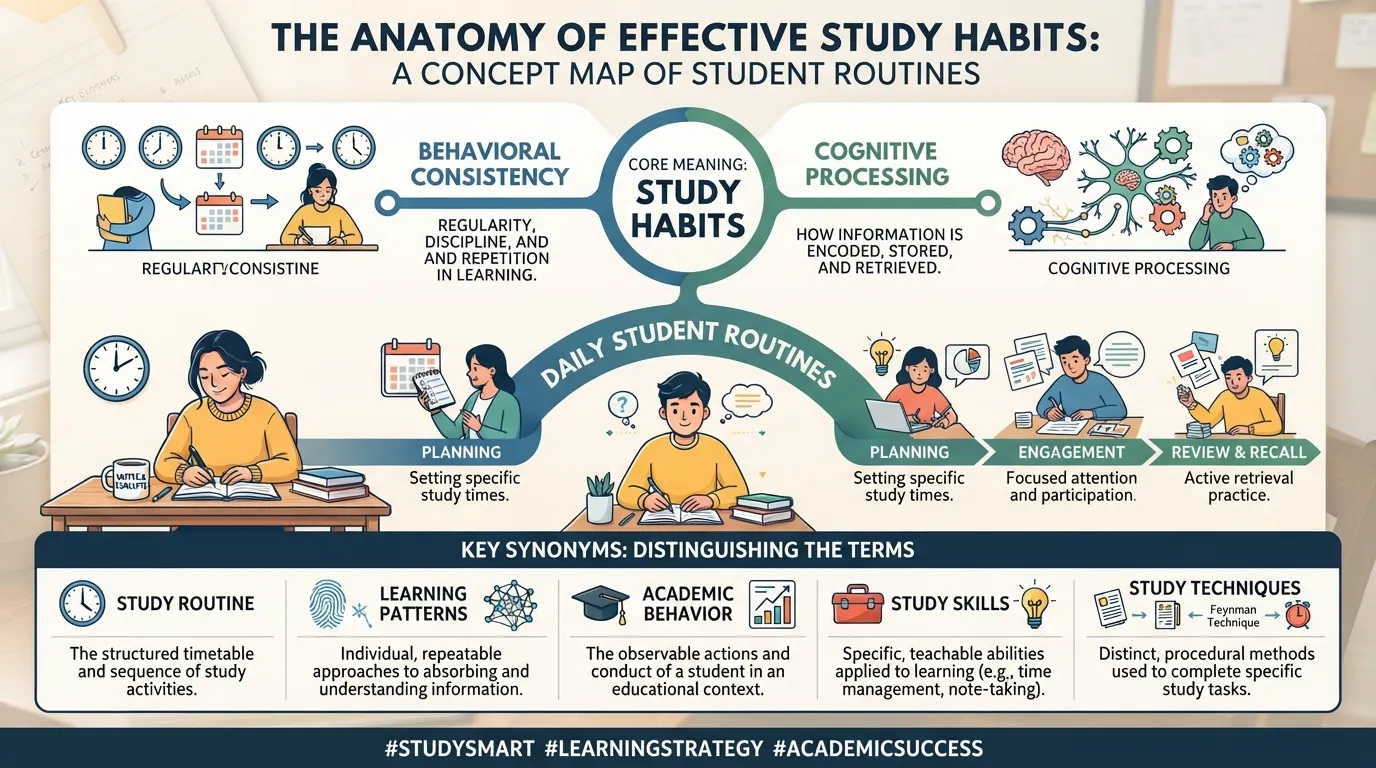
Study habits describe the fundamental meaning behind how a student consistently interacts with educational material over time. Grasping this core concept reveals that learning is less about raw intellectual capability and more about the structured, predictable patterns you maintain every single day.
Deeper Meaning Behind the Term
The true study habits meaning goes beyond simple test preparation to encompass a holistic view of your academic behavior. It reflects the intersection of cognitive psychology and daily discipline, showing how small, repeated actions shape long-term knowledge retention.
Behavioral Consistency: The psychological drive that compels you to sit down and engage with coursework at designated times.
Cognitive Processing: The underlying mental frameworks you utilize to decode, organize, and store new information.
Academic Adaptation: The ongoing refinement of your learning approach based on what yields the best grades and lowest stress.
Other Words Used for Study Habits (Synonyms List)
When searching for alternative ways to describe these behaviors, several common terms capture different angles of the concept. You can use these synonyms interchangeably depending on whether you are focusing on the routine, the skill set, or the mindset:
Study Routine: Highlights the predictable, scheduled nature of your daily academic prep.
Learning Patterns: Focuses on the behavioral cycles and cognitive styles you naturally repeat when mastering material.
Academic Behavior: A broader term used by educators to describe how students approach coursework, attendance, and assignments.
Study Skills: Emphasizes the actionable techniques and tactics—such as active recall or mind-mapping—used during learning sessions.
Study Techniques: Refers to specific, mechanical methods applied to retain facts, formulas, or complex theories.
Study Habits vs. Study Skills — What's the Difference?
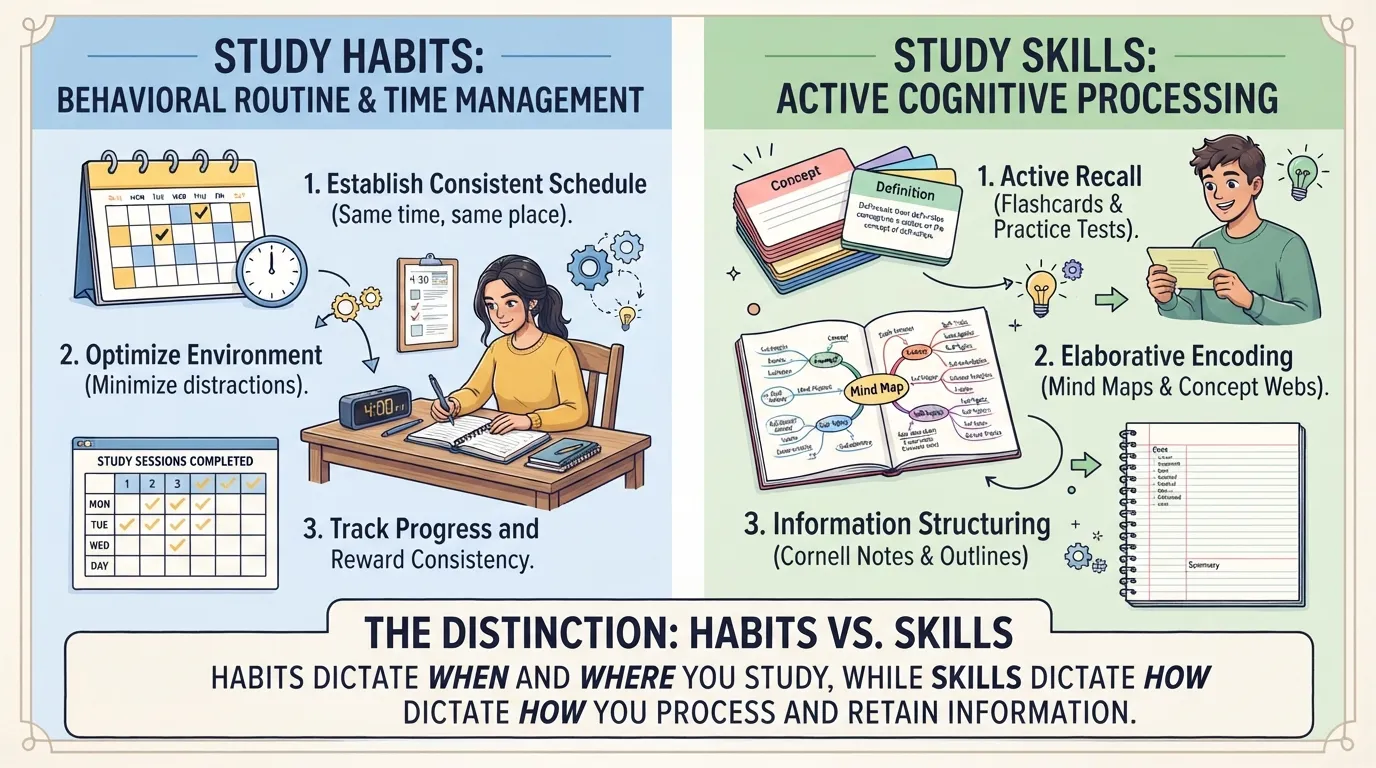
Study habits represent your consistent behavioral routines, whereas study skills are the specific tactical methods you execute during those sessions. Distinguishing between the two clarifies why knowing how to study effectively differs from actually making yourself do it every day.
Study Habits = Behavior & Routine
Study habits deal with the when, where, and how often you engage with your coursework. They are the behavioral foundations and discipline-driven patterns that dictate your daily academic schedule.
Behavioral Focus: Centers on consistency, time management, and environmental setup.
Core Examples: Setting aside 60 minutes every evening at 7 PM to review notes, keeping your desk free of smartphone distractions, and maintaining a planner.
The Goal: Building automated discipline so studying becomes a non-negotiable part of your daily routine.
Study Skills = Techniques & Methods
Study skills deal with the mechanics of how you process, retain, and apply information once you have sat down to work. They are cognitive tools rather than routine habits.
Tactical Focus: Centers on comprehension strategies, memory retention, and information organization.
Core Examples: Utilizing active recall, creating Cornell notes, building flashcards, or applying the Feynman technique to simplify complex theories.
The Goal: Maximizing the efficiency and depth of your cognitive processing during learning time.
How They Work Together
Successful academic performance requires a seamless integration of both elements to prevent failure at either stage. Excellent techniques are useless without the routine to apply them, and daily routines fall flat without effective tactics.
The Synergy: Good study habits get you to your desk and keep you consistent, while good study skills ensure the time you spend there actually yields results.
The Practical Cycle: Your study habit establishes the regular 8 PM review window, and your study skills dictate that you use that window for active flashcard testing rather than passive rereading.
Types of Study Habits (Categorized)
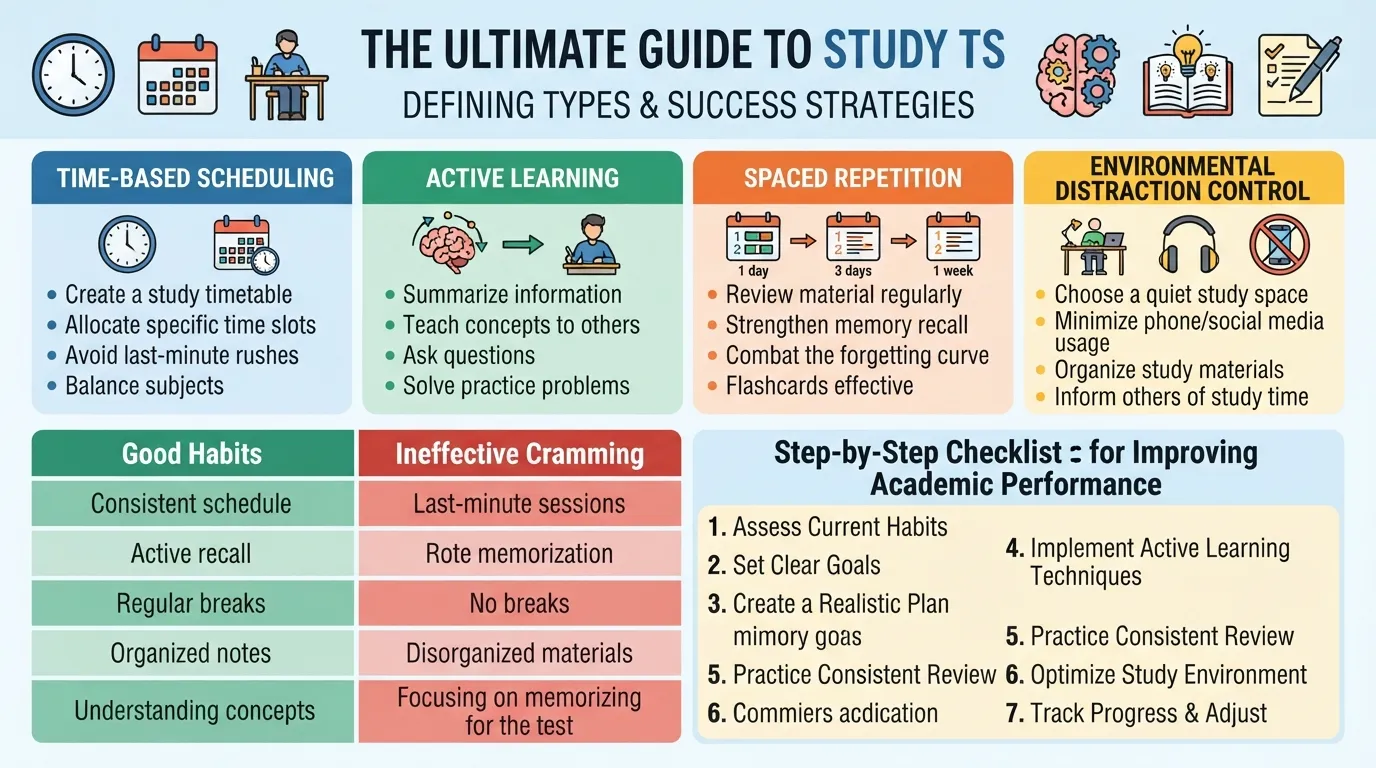
Categorizing study habits into structured groups helps you move away from random studying and toward a systematic approach to learning. Different types of habits target unique aspects of cognition, time management, and environmental control to maximize your academic performance.
Time-Based Habits (Routine, Scheduling)
Time-based habits govern when and how long you engage with your material, transforming studying from a chaotic chore into a predictable daily event.
Consistent Scheduling: Setting aside the exact same hour every day to review coursework builds automatic behavioral triggers, eliminating [01:13] decision fatigue.
Timeboxing Sessions: Breaking your study blocks into fixed durations—such as 45 minutes of deep work followed by a 10-minute break—maintains high focus levels.
Active Learning Habits (Summarizing, Teaching Back)
Active learning habits replace passive tasks like rereading with dynamic cognitive processing to ensure information actually registers in your brain.
Self-Explanation & Summarization: Putting complex textbook paragraphs into your own words forces your brain to build deeper neural pathways [02:15].
The Feynman Technique: Teaching a concept out loud to an imaginary audience or a peer instantly exposes gaps in your comprehension [03:21].
Memory-Based Habits (Spaced Repetition, Flashcards)
Memory-based habits leverage cognitive science to override the forgetting curve, moving data smoothly from short-term memory to long-term storage.
Spaced Repetition Intervals: Reviewing material across expanding time intervals—such as one day, one week, and one month later—prevents cognitive overload [05:46].
Active Recall Testing: Utilizing flashcards or practice questions to pull answers directly from your mind rather than recognizing them on a page.
Environment-Based Habits (Distraction Control)
Environment-based habits focus on engineering your physical and digital surroundings to protect your attention span from modern interruptions.
Digital Quarantine: Moving your smartphone to another room or using app blockers during study windows prevents constant notification disruptions [05:04].
Dedicated Workspace: Establishing a clean desk designated strictly for academics trains your brain to switch into “focus mode” the moment you sit down.
Good vs. Bad Study Habits (Comparison)
Your daily academic performance hinges directly on distinguishing between productive routines and counterproductive traps. Adopting good study habits accelerates your mastery of material, while relying on bad study habits leads to burnout, high anxiety, and poor test scores.
Good Study Habits vs. Bad Study Habits
| Feature / Behavior | Good Study Habits | Bad Study Habits |
| Preparation Style | Planning specific topics and goals before every study session. | Opening a textbook without a plan and wandering aimlessly through pages. |
| Information Processing | Using active recall, flashcards, and summarizing concepts in your own words. | Passive rereading, mindless highlighting, and copying text verbatim. |
| Time Management | Spreading review sessions out across weeks using spaced repetition. | Cramming all your studying into a panicked marathon the night before an exam. |
| Environment & Focus | Studying in a quiet, dedicated space with your phone stored in another room. | Multitasking while answering texts, scrolling social media, or watching TV. |
| Mindset & Reflection | Treating mistakes as learning opportunities and adjusting strategies. | Engaging in negative self-talk or ignoring past test errors completely. |
Common Ineffective Habits Students Should Avoid
Many students waste hours studying because they rely on comfortable routines that feel productive but fail to build actual cognitive retention. Eliminating these bad habits instantly frees up your time and improves comprehension:
Massed Practice (Cramming): Trying to learn an entire semester’s worth of material in one frantic night overloads your short-term memory and guarantees rapid forgetting.
Over-Reliance on Highlighting: Marking up every other sentence gives a false sense of mastery because your brain recognizes the text rather than recalling it from scratch.
Continuous Multitasking: Keeping your phone next to your notebook fractures your attention span, doubling the time it takes to complete simple assignments.
Passive Rereading: Glancing over chapters repeatedly without testing yourself creates an illusion of competence that shatters the moment you face an exam question.
Which Study Habit Is Considered Most Effective?
Cognitive scientists and academic researchers consistently rank spaced repetition combined with active recall as the single most effective study habit you can build.
Why It Works: Spacing out your reviews forces your brain to struggle slightly to retrieve information, which strengthens the neural connections required for long-term storage.
How to Apply It: Instead of studying a topic for five hours straight on Sunday, review it for 20 minutes on Monday, Wednesday, Saturday, and the following week.
Real Examples of Study Habits (Practical)
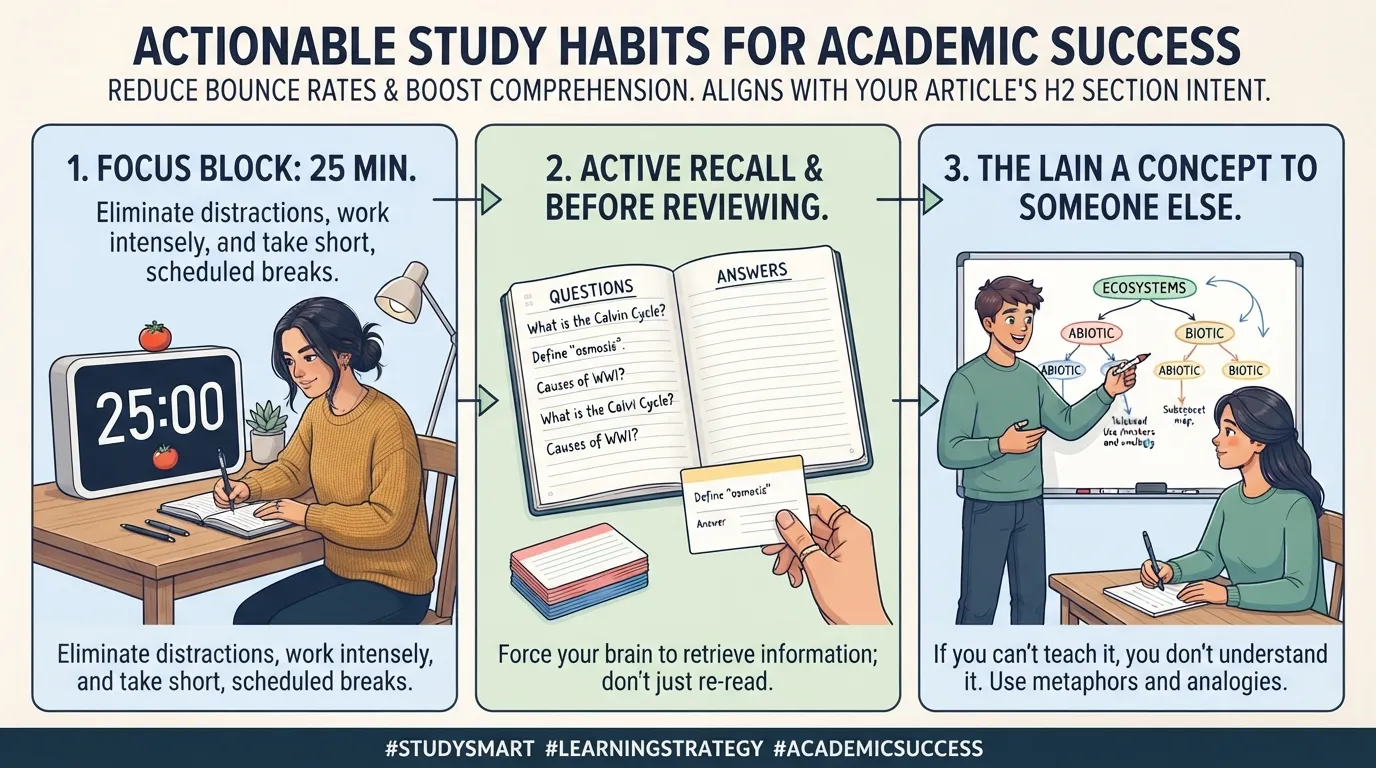
Examining concrete study habits examples helps bridge the gap between abstract academic advice and your actual daily routine. Implementing these proven scenarios transforms theoretical concepts into reliable, repeatable daily actions that drive top-tier academic results.
Example 1: The Pomodoro Routine
The Pomodoro routine is a time-based habit designed to eliminate mental fatigue and sustain high focus during long writing or reading assignments.
The Setup: Set a timer for 25 minutes of uninterrupted deep work, followed immediately by a strict 5-minute break to stretch or grab water.
The Execution: Complete four consecutive cycles (totaling two hours), then take a longer 20-minute restorative break to completely reset your brain.
Why It Works: Breaking daunting workloads into bite-sized sprints prevents procrastination and stops your attention from wandering.
Example 2: Active Recall & Self-Testing
This memory-based habit shifts your focus away from passive reading and forces your brain to retrieve information independently.
The Setup: Instead of reviewing chapter summaries, create your own test questions on index cards or a blank document right after a lecture.
The Execution: Close your textbook, look at your prompt, and force yourself to write or speak the answer entirely from memory before checking your notes.
Why It Works: The slight mental struggle of retrieval strengthens neural pathways, ensuring you can actually access the knowledge during a high-pressure exam.
Example 3: Study Group / Teach-Back Method
The teach-back method leverages social learning and verbal articulation to solidify complex or abstract concepts in your mind.
The Setup: Meet with a classmate or explain a difficult scientific theory out loud to an empty room as if you are teaching a beginner.
The Execution: Monitor where you stumble or use complicated jargon; if you cannot explain a concept simply, you do not yet fully understand it.
Why It Works: Simplifying technical ideas exposes immediate comprehension gaps and anchors the material deeply into your long-term memory.
A Real Student Scenario (Practical Insight)
Consider how a successful college student organizes their weekly workflow by combining these habits into a cohesive schedule:
Sarah, a pre-med student juggling heavy chemistry and biology courses, abandoned her old habit of cramming the night before exams. Instead, she established a rigid 6 PM study window in her apartment’s common room, leaving her phone in her bedroom. She uses two 25-minute Pomodoro blocks to read new material, a third block to build active recall flashcards, and spends her final 15 minutes teaching the toughest concept out loud to her roommate. This simple, repeatable blueprint cut her study time in half while raising her GPA.
Study Habits of Successful Students
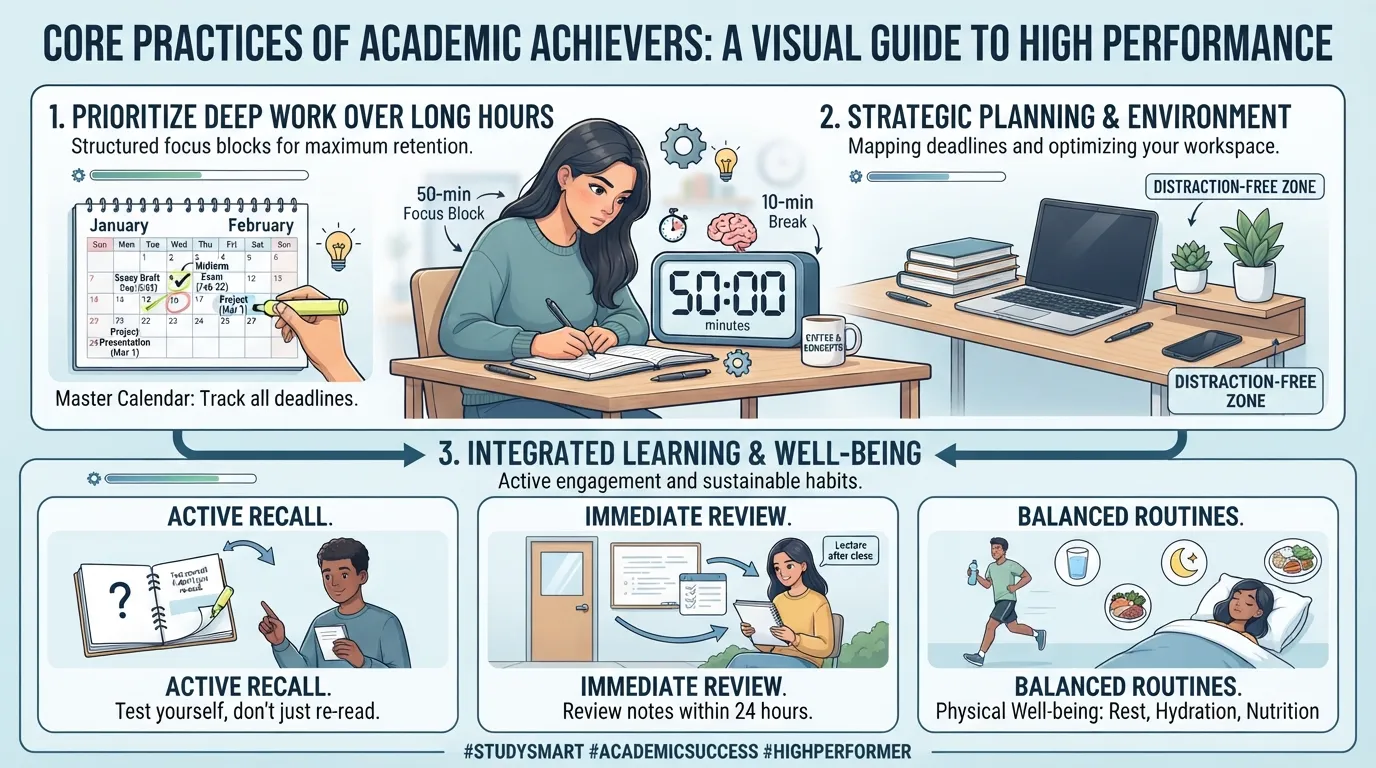
Top-performing scholars rarely rely on raw intelligence alone; instead, they maintain a disciplined set of daily routines that maximize cognitive retention and minimize wasted effort. Analyzing the daily practices of academic achievers reveals the exact behavioral blueprints required to excel across any subject or educational level.
5 Good Study Habits of Top Students
High achievers consistently integrate core foundational behaviors into their weekly schedules to keep their workload manageable and organized.
Prioritizing Deep Work Over Long Hours: Successful students focus intensely for shorter, uninterrupted blocks rather than sitting at a desk for six hours while distracted by their phones.
Reviewing Notes Immediately After Class: Fixing short-term lecture memory within 24 hours prevents the rapid forgetting curve from erasing vital concepts.
Maintaining a Master Calendar: Top students map out all exam dates, project deadlines, and reading assignments weeks in advance to eliminate panic.
Curating an Optimized Environment: They deliberately choose distraction-free study spots—such as quiet library corners or clean home desks—to build immediate focus triggers.
Prioritizing Physical Well-Being: High performers recognize that adequate sleep, hydration, and exercise are non-negotiable biological requirements for optimal cognitive processing.
7 Effective Study Habits Backed by Research
Educational psychology and cognitive research consistently point to specific, evidence-based practices that separate top-tier students from the rest of the class.
Interleaved Practice: Mixing different topics or problem types within a single session rather than studying one subject block continuously.
Elaborative Interrogation: Asking “how” and “why” a fact is true, then connecting new data to concepts you already understand.
Concrete Example Generation: Translating abstract theories into real-world scenarios to prove functional comprehension.
Dual Coding: Combining verbal explanations with visual aids, diagrams, or mind maps to trigger multiple sensory pathways in the brain.
Scheduled Retrieval Practice: Testing yourself frequently under exam-like conditions instead of passively reviewing textbook highlights.
Distributed Practice (Spacing): Spreading study time across multiple smaller sessions over weeks rather than cramming the night before.
Post-Exam Reflection: Thoroughly analyzing returned tests to identify specific knowledge gaps and correct flawed study strategies.
Benefits & Effects of Good Study Habits (Research-Backed)
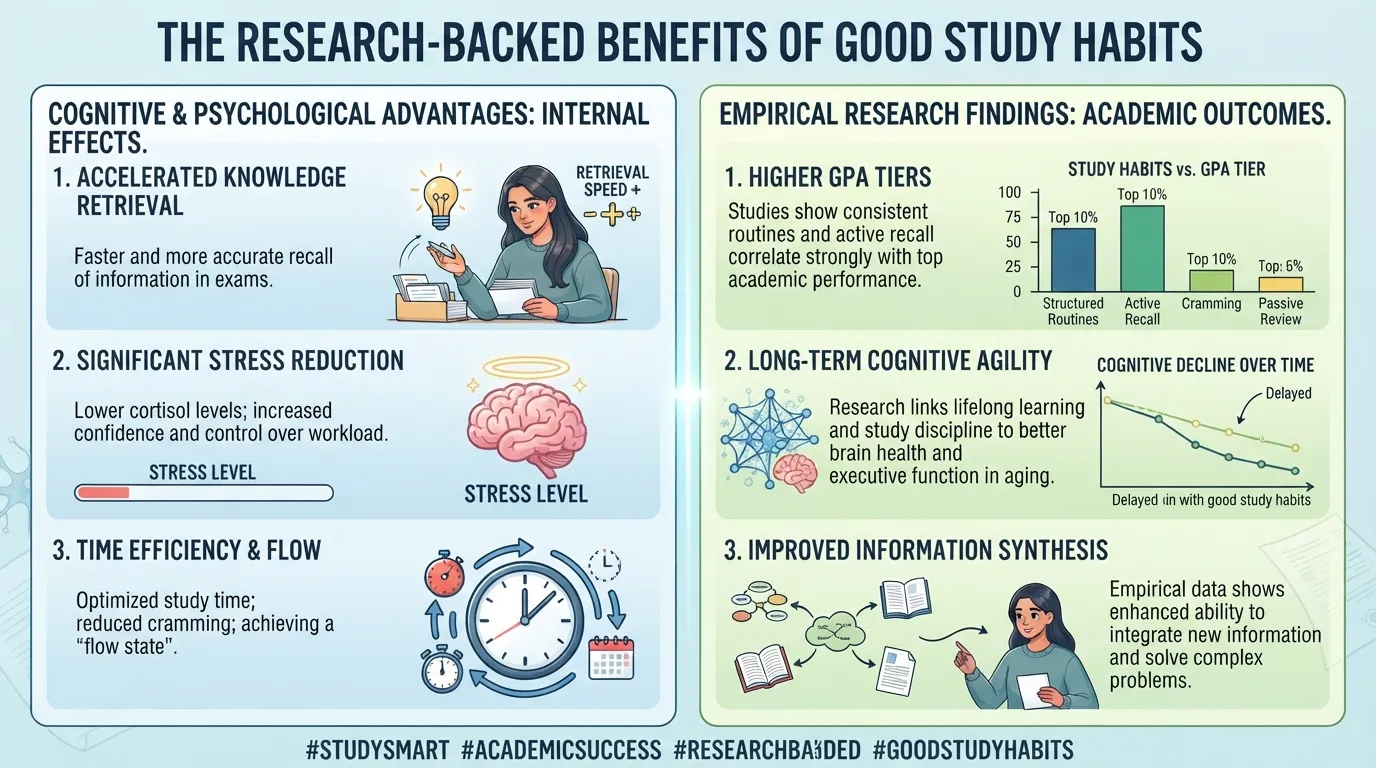
Maintaining consistent, structured study routines yields profound cognitive, psychological, and professional advantages that extend far beyond the classroom. Embracing evidence-based learning behaviors permanently alters how your brain processes complex information, ensuring sustainable academic excellence.
Benefits of Consistent Study Habits
Establishing a reliable academic routine transforms your relationship with learning, replacing chronic stress with steady confidence.
Accelerated Knowledge Retrieval: Regular practice strengthens neural pathways, allowing you to recall complex facts instantly during high-stakes exams.
Significant Stress Reduction: Operating on a pre-planned schedule removes last-minute panic and eliminates the psychological weight of procrastination.
Maximized Time Efficiency: Focused, structured sessions accomplish more in one hour than four hours of distracted, passive reading.
Long-Term Cognitive Agility: The discipline required to maintain study habits builds lifelong mental resilience and efficient problem-solving capabilities.
Effect of Study Habits on Academic Performance (Research Insight)
Empirical research consistently validates the direct correlation between disciplined learning routines and superior grade point averages.
The Scientific Consensus: A comprehensive study published in PMC highlights that structured study habits and active information recall are statistically tied to higher academic achievement and overall student satisfaction.
Key Statistical Drivers: Data from educational research reveals that students who regularly utilize active testing and systematic review schedules achieve significantly higher GPA tiers than peers relying on unstructured cramming.
How to Improve Your Study Habits (10 Practical Ways)
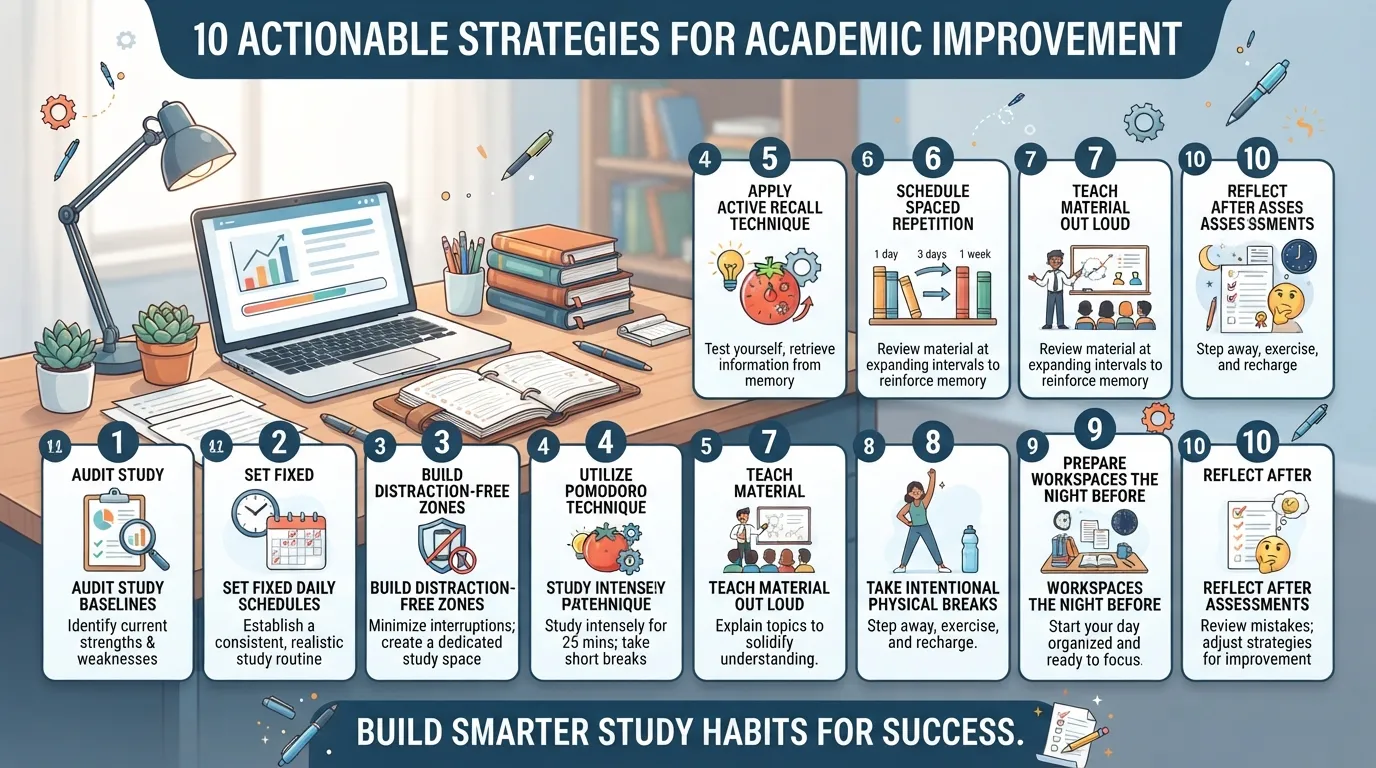
Transforming your academic performance requires replacing erratic routines with deliberate, evidence-based behavioral shifts. Upgrading your daily approach to learning turns studying from a source of high anxiety into an efficient, predictable system that guarantees long-term retention.
Step-by-Step Practical Tips (10 Points)
Audit Your Current Baseline: Track your study sessions for three days to identify exactly where you lose focus, procrastinate, or waste time on passive reading.
Establish a Fixed Schedule: Assign dedicated time blocks for specific subjects every week so studying becomes an automatic part of your daily routine.
Build a Distraction-Free Zone: Clear your desk of clutter and store your smartphone in another room or inside a drawer during work blocks.
Leverage the Pomodoro Technique: Work with intense focus for 25-minute sprints followed by a strict 5-minute break to prevent mental fatigue.
Switch from Passive to Active: Replace mindless highlighting with active recall, flashcards, and writing summaries entirely from memory.
Apply Spaced Repetition: Review challenging material across expanding intervals—such as one day, three days, and one week later—to beat the forgetting curve.
Teach the Material Outloud: Use the Feynman technique by explaining complex concepts to an empty room or a peer in simple, everyday language.
Incorporate Intentional Breaks: Step away from your desk during breaks to walk, stretch, or hydrate, giving your brain time to consolidate information.
Prepare Your Workspace Ahead: Set up your books, notes, and laptop the night before to eliminate friction and decision fatigue when it is time to start.
Reflect After Every Assessment: Review returned tests and assignments to spot recurring mistakes and adjust your study strategies accordingly.
Quick Checklist to Self-Evaluate Your Study Habits
Regularly auditing your academic habits ensures you catch bad routines before they negatively impact your grades. Run through this quick evaluation checklist at the end of each week:
The Planning Check: Did I map out specific goals and topics before opening my textbooks this week?
The Focus Check: Did I successfully keep my smartphone out of reach during my study blocks?
The Method Check: Did I use active recall and self-testing instead of just rereading notes?
The Timing Check: Did I spread my study sessions out, or did I leave everything for a frantic final night?
The Recovery Check: Did I take proper physical and mental breaks to maintain my energy levels?
FAQs (People Also Ask + Quora Integration)
What are study habits?
Study habits are the consistent, daily routines and behavioral patterns students use to process, organize, and retain academic material. They encompass everything from when and where you sit down to work to whether you rely on active recall or passive reading.
Can you define the best study habits for school students?
The best study habits combine distributed practice, active recall, and structured time management. Top-performing students consistently schedule fixed study blocks, use flashcards to test themselves rather than rereading notes, and eliminate digital distractions to maximize focus.
What are bad study habits, and how do you overcome them?
Bad study habits include last-minute cramming, continuous multitasking with smartphones, and passive highlighting. You can overcome these counterproductive routines by replacing them with a master calendar, adopting the Pomodoro technique, and reviewing lecture notes within 24 hours of class.
What are three types of study skills?
The three primary categories of study skills include time-management tactics (such as scheduling and timeboxing), active processing techniques (like the Feynman technique and self-summarization), and memory optimization methods (such as spaced repetition and active recall testing).
Conclusion — Building Your Own Study Habit System
Mastering your academic performance does not require an overhaul of your entire lifestyle overnight; it starts with building a predictable, sustainable personal routine. By intentionally replacing passive tactics with active, research-backed learning behaviors, you set the foundation for lifelong educational achievement and reduced stress.
Key Takeaways Recap
Routine Drives Results: True study habits represent your consistent behavioral patterns, creating an automated structure that eliminates daily decision fatigue.
Active Beats Passive: Swapping mindless highlighting and rereading for active recall, flashcards, and the teach-back method dramatically improves knowledge retention.
Consistency Trumps Intensity: Distributing your preparation across manageable, spaced intervals beats marathon cramming sessions every single time.
Final Encouragement to Start Small
Pick just one new habit from this guide—whether it is stowing your phone in another drawer, running a 25-minute Pomodoro sprint, or reviewing your notes within 24 hours of class—and commit to it today. Consistency turns small, manageable actions into automatic wins, transforming your relationship with learning for the long haul.