Bad Study Habits That Destroy Your Grades and How to Fix Them
Why Your Study Habits Might Be Sabotaging Your Grades
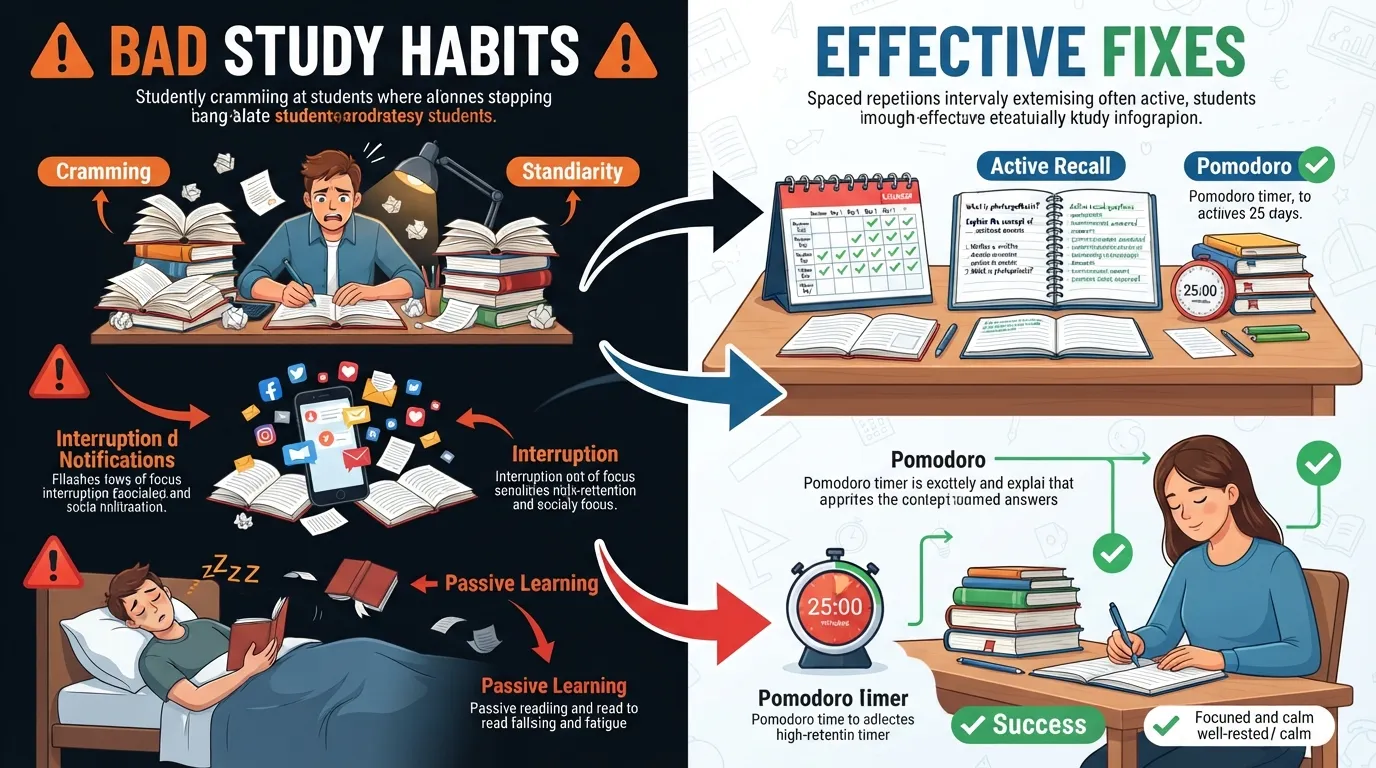
Spending hours at your desk with highlighters and open textbooks only to watch your GPA stagnate is one of the most demoralizing experiences in education. This disconnect between effort and outcome usually stems from ineffective learning techniques like passive re-reading and marathon cram sessions, which create a false sense of mastery while leading to severe low retention. When your daily routine relies on these bad study habits, you end up dealing with wasted study time and mounting academic stress that burns you out before exams even begin. Recognizing that your strategy—rather than your intelligence—is the bottleneck is the first step toward transforming how you process and retain information.
What Are Bad Study Habits?
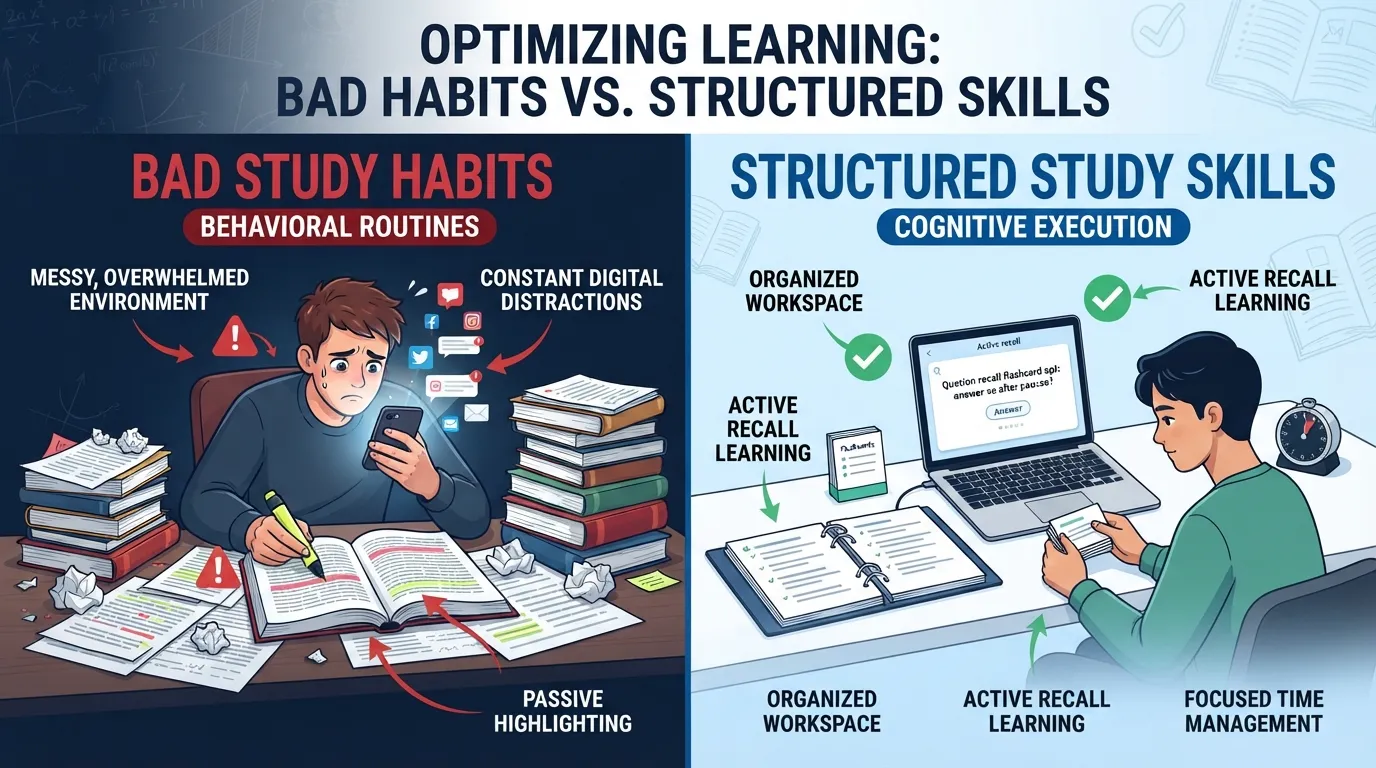
Bad study habits are repetitive, poor learning techniques—such as rereading textbooks or pulling all-nighters—that feel productive in the moment but fail to encode information into long-term memory. These behaviors rely on passive learning, which severely limits information retention and results in ineffective studying despite hours of logged effort.
Bad Study Habits vs. Bad Study Skills — What’s the Difference?
Bad Study Habits represent behavioral routines and time-management choices, such as studying with background TV or cramming the night before an exam.
Bad Study Skills refer to cognitive mechanics and execution deficits, such as not knowing how to construct concept maps, outline complex texts, or actively test your own recall.
The Distinction: While a student might possess solid foundational study skills, they can still fall victim to bad habits like procrastination; conversely, a disciplined student with poor mechanical skills will still struggle with deep comprehension.
The Complete List of Bad Study Habits
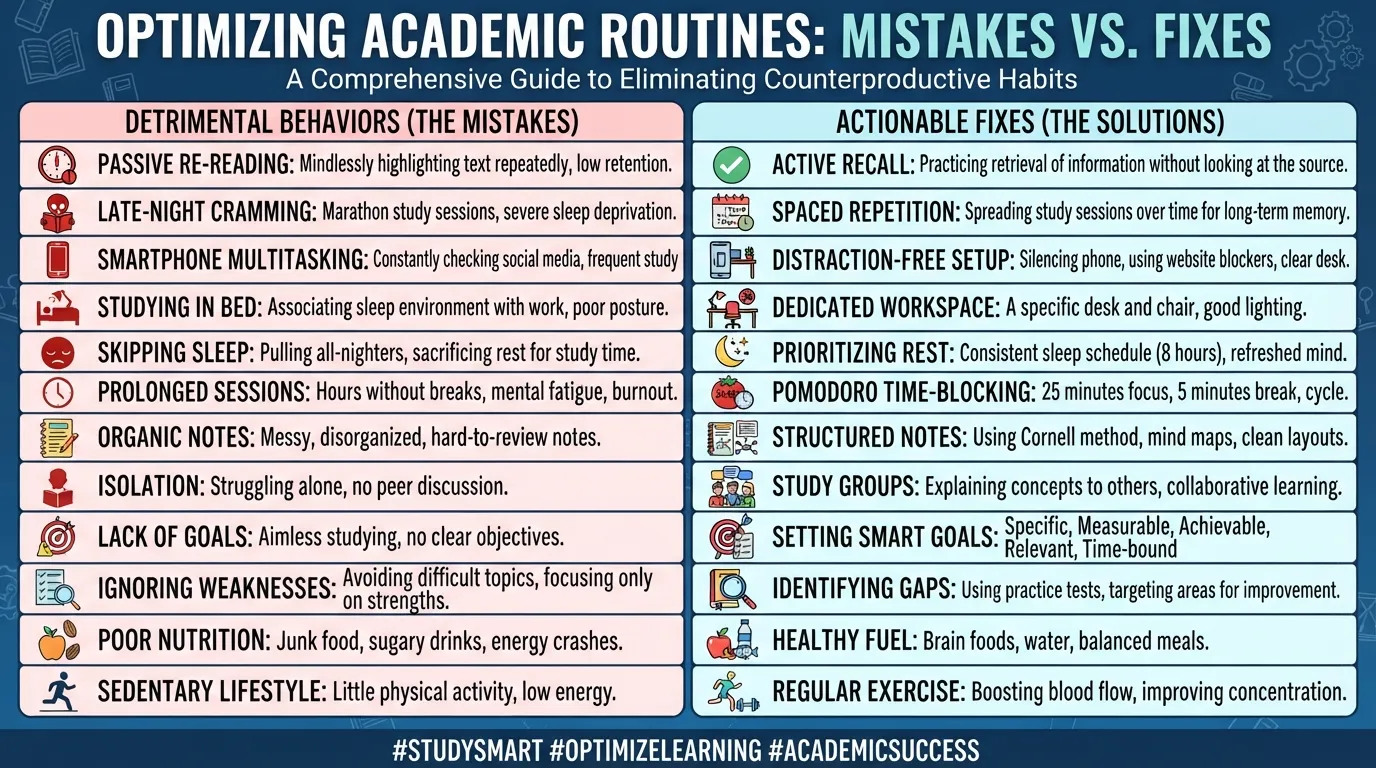
Passive Re-Reading & Over-Highlighting
Passive re-reading and color-coding text create a dangerous illusion of competence without actually encoding information into long-term memory.
Why It’s Bad: It relies entirely on recognition rather than active retrieval, making you believe you know the material when you are merely familiar with the page layout.
How to Fix: Replace highlighters with active recall techniques like the Feynman Technique or blank-sheet mind mapping.
Cramming the Night Before an Exam
Massed practice or marathon cram sessions force your brain to process massive amounts of information under extreme stress.
Why It’s Bad: It overloads short-term memory capacity and bypasses the crucial spacing effect required for neural consolidation.
How to Fix: Implement a distributed practice schedule using a digital calendar and spaced repetition flashcard software like Anki.
Multitasking While Studying (Phone, TV, Social Media)
Attempting to study while keeping notifications on or streaming a TV show splits your cognitive focus.
Why It’s Bad: Multitasking fragments attention, degrades comprehension quality, and drastically inflates the total time needed to complete basic tasks.
How to Fix: Adopt distraction-free studying protocols by placing your phone in another room and using website blockers like Freedom or Forest.
Studying Without a Plan or Clear Goals
Sitting down at a desk with a vague intention to study “science” usually results in aimless flipping and low productivity.
Why It’s Bad: Without clear objectives, you lack structural milestones, leading to decision fatigue and wasted study hours.
How to Fix: Set explicit, time-blocked micro-goals for every study session, such as mastering Chapter 4 practice problems by 3:00 PM.
Procrastination & Last-Minute Assignments
Delaying critical tasks until the eleventh hour triggers a frantic cycle of panic and subpar output.
Why It’s Bad: Procrastination activates a stress response that impairs executive functioning and creative problem-solving capacities.
How to Fix: Break daunting projects down into minuscule, non-threatening starting steps, such as writing just a single title sentence or outline bullet.
Disorganized Notes and Study Materials
Scattered loose sheets, messy margins, and unorganized digital folders waste precious cognitive energy just trying to find resources.
Why It’s Bad: Disorganized notes block efficient review cycles and create friction every time you attempt to prepare for an assessment.
How to Fix: Standardize your note-taking framework using structured systems like the Cornell method or centralized cloud databases like Notion.
Studying to Memorize Instead of Understand
Rote memorization treats complex concepts as disconnected facts rather than interconnected frameworks.
Why It’s Bad: Memorized data evaporates quickly under exam pressure the moment an instructor alters the question format or context.
How to Fix: Force conceptual understanding by asking “why” and “how” continuously, translating raw definitions into real-world applications.
Skipping Breaks and Studying When Mentally Tired
Pushing through exhaustion past the point of diminishing returns leads directly to mental burnout.
Why It’s Bad: Burnout diminishes neural plasticity, slows processing speeds, and increases the likelihood of careless mistakes.
How to Fix: Structure your workflow around sustainable intervals, such as the Pomodoro technique, pairing 25 minutes of focus with 5 minutes of physical rest.
Being Too Shy to Ask for Help
Attempting to silently struggle through confusing concepts due to fear of embarrassment stalls academic progress.
Why It’s Bad: Misunderstandings compound over time, making future modules increasingly difficult to decode independently.
How to Fix: Cultivate a growth mindset by proactively attending office hours, posting in course forums, or forming peer study circles.
Studying in the Wrong Environment/Posture (e.g., in bed, in front of TV)
Lounging in bed or studying in high-traffic, noisy spaces sends conflicting neurological signals to your brain.
Why It’s Bad: An improper study posture and relaxed study environment lower physical alertness and link your sleeping quarters with stress instead of rest.
How to Fix: Designate a dedicated, upright workspace exclusively for academic tasks to condition your brain for deep focus upon arrival.
Poor Sleep, Exercise & Nutrition Habits (junk food, no sleep)
Neglecting biological foundations like consistent rest, physical activity, and balanced nutrition sabotages academic potential at the cellular level.
Why It’s Bad: Sleep and memory consolidation are inextricably linked; sleep deprivation directly prevents your brain from converting daily learning into permanent neural pathways.
How to Fix: Prioritize 7 to 9 hours of nightly rest, maintain stable hydration, and incorporate light cardiovascular exercise to optimize cognitive performance.
Solving Only Easy/Familiar Problems (No Variety in Practice)
Stickiness to comfortable, repetitive problem types creates a false sense of mastery.
Why It’s Bad: It leaves you entirely unprepared for unpredictable, multi-layered exam questions that require variable application.
How to Fix: Interleave your practice sets by intentionally mixing difficulty levels and problem formats during every revision session.
The Science Behind Why These Habits Fail You
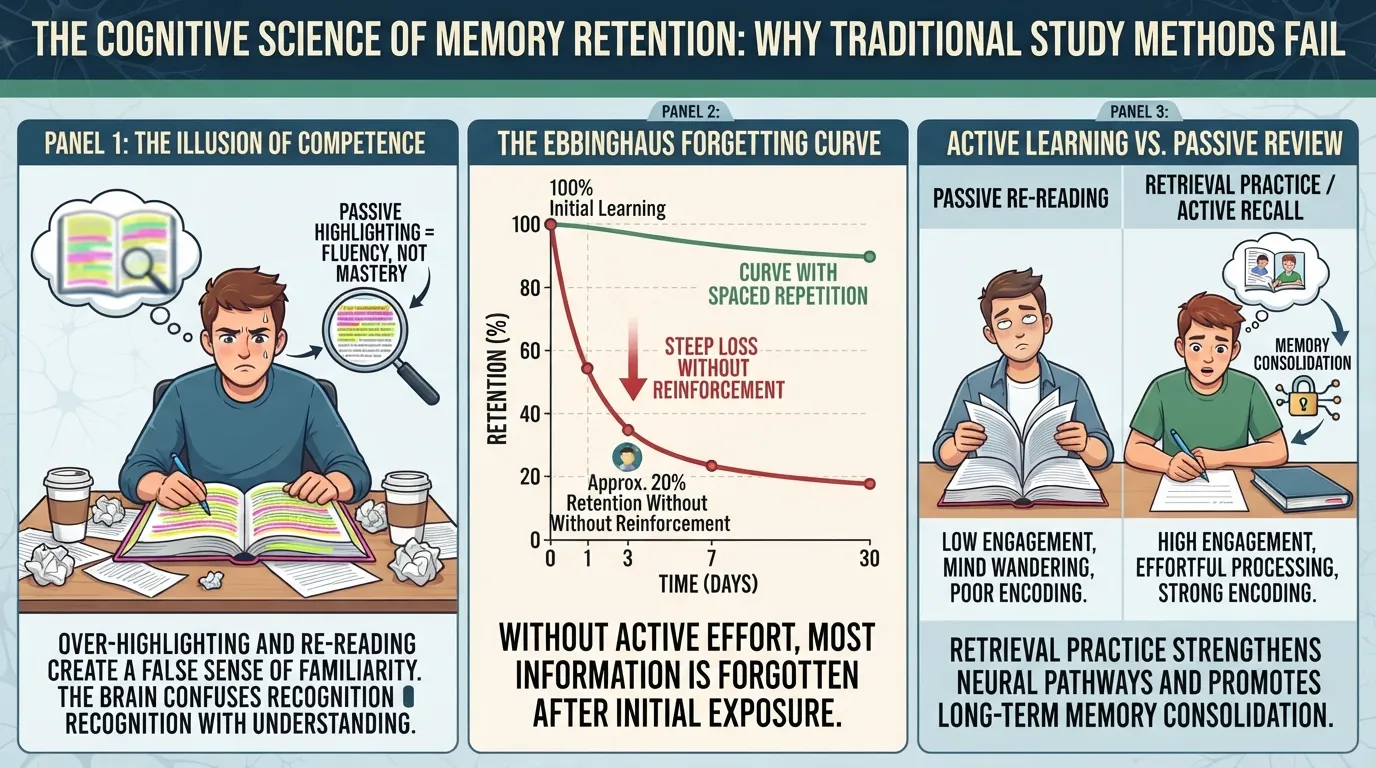
Ineffective study habits persist because they trick our metacognitive monitoring systems, making us feel productive while starving the brain of the mechanical processes required for long-term encoding. Cognitive science demonstrates that learning is a biological rewiring process rather than a passive accumulation of facts, meaning your study techniques must align directly with how memory traces form, stabilize, and retrieve.
Why Passive Re-Reading Tricks Your Brain (Illusion of Competence)
Passive review creates a psychological phenomenon known as the illusion of competence, where fluid familiarity is mistaken for durable mastery.
When you look at an underlined textbook page multiple times, perceptual fluency skyrockets, sending false signals to your prefrontal cortex that the concept is fully secured.
Cognitive architecture processes re-read material with increasing ease, but this fluency disappears the moment the text is removed and you are asked to generate the concept from scratch.
True memory consolidation requires the friction of effortful retrieval, which passive techniques intentionally bypass.
The Forgetting Curve and Why Cramming Fails Long-Term Memory
Hermann Ebbinghaus’s foundational research on the forgetting curve reveals that humans lose up to 50% of unreinforced information within the first 24 hours.
Marathon cram sessions rely entirely on short-term working memory capacity, which is strictly limited to holding a handful of elements for seconds at a time.
Pushing massive volumes of information into working memory under acute exam stress bypasses the structural changes needed to build stable neural pathways.
Without distributed intervals that interrupt the forgetting curve, the brain treats crammed data as temporary noise and discards it immediately after the test concludes.
What Research Says About Active Recall vs. Re-Reading
Extensive cognitive research confirms that retrieval practice dramatically outperforms traditional review methods by forcing the brain to reconstruct memory traces rather than simply recognize them. Landmark studies in cognitive psychology, such as those evaluated in comprehensive analyses by institutions like the American Psychological Association, show that self-testing strengthens neural pathways and pinpoints exact knowledge gaps.
Every time you actively pull an answer from your mind, you destabilize and subsequently reconsolidate the memory trace, making it stronger and more accessible for future exams.
This active struggle is classified by cognitive scientists as a “desirable difficulty”—the precise friction required to transform temporary short-term exposure into permanent, long-term knowledge.
How to Fix Bad Study Habits — A Step-by-Step System
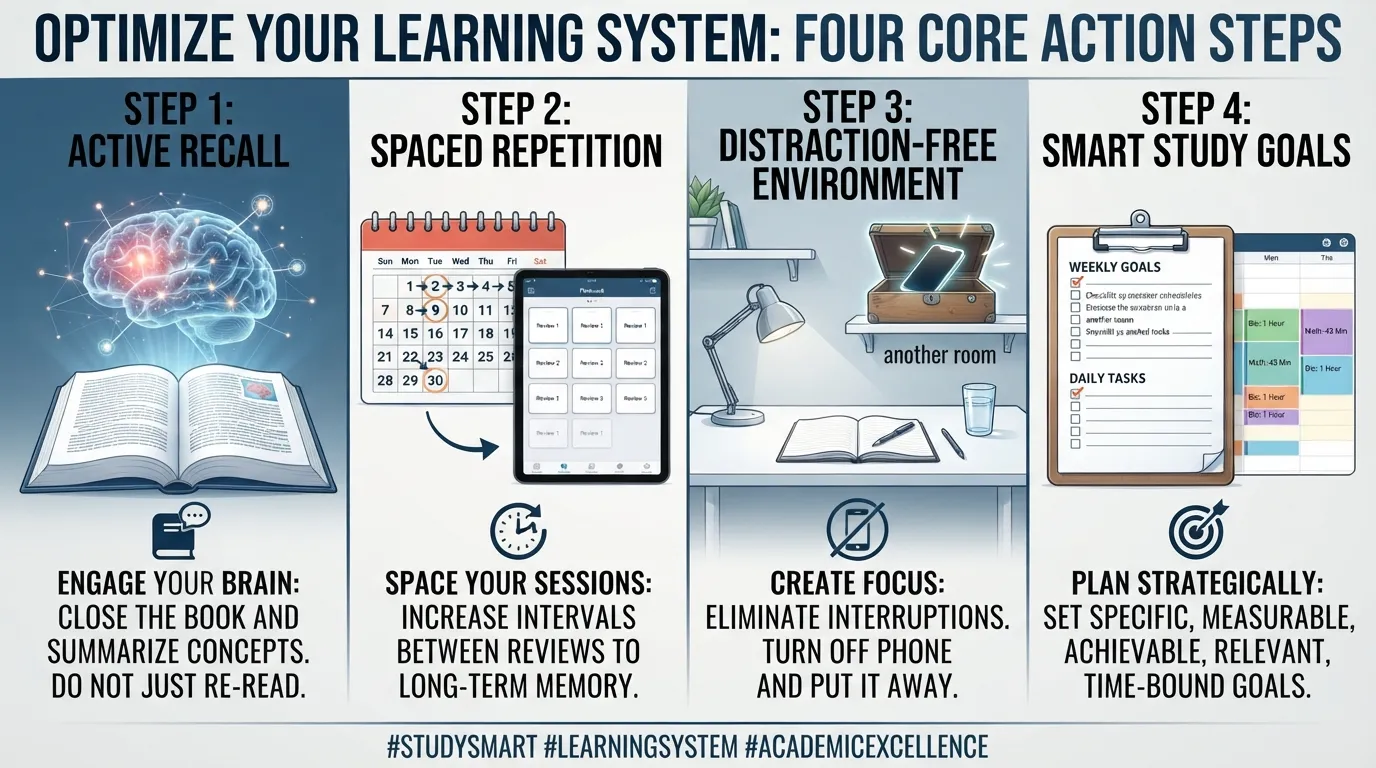
Replacing entrenched routines requires a systematic replacement of passive mechanics with proven cognitive workflows. A structured approach transforms chaotic study sessions into high-yield, repeatable intervals that maximize retention and eliminate wasted time.
Use Active Recall Instead of Re-Reading
Shift your primary learning mechanism from reviewing notes to actively generating answers without looking at source materials.
Close your textbooks and notebooks immediately after reading a section, then write down or speak aloud every core concept you can remember from scratch.
Utilize the Feynman Technique by explaining complex topics in simple, plain language as if teaching them to someone else.
Cross-reference your recalled notes with the original text to instantly identify and correct blind spots.
Apply Spaced Repetition to Your Study Schedule
Distribute your review sessions across increasing time intervals rather than condensing them into single blocks.
Build a consistent study schedule that revisits challenging material after 1 day, 3 days, 7 days, and 14 days.
Leverage digital flashcard applications like Anki or RemNote that automate spacing algorithms based on how difficult a card is for you to recall.
Treat revision as a daily maintenance habit rather than an emergency response to an upcoming test.
Eliminate Distractions Before You Start (Phone, Notifications, Environment)
Protect your cognitive bandwidth by creating a frictionless, distraction-free environment before opening your books.
Move your smartphone to another room or turn on strict Do Not Disturb modes that block non-essential notifications.
Clear your physical and digital desktop of unrelated tabs, clutter, and entertainment sources to minimize visual temptation.
Position yourself at a dedicated desk sitting upright to signal to your brain that focus time has officially begun.
Set Specific, Testable Goals for Every Study Session
Replace vague intentions with concrete, measurable objectives that dictate the exact outcome of your time investment.
Establish SMART study goals for every block, such as “mastering practice problems 1 through 15 for Chapter 3” rather than a general goal to “study math.”
Pair your objectives with specific focus techniques like the Pomodoro method to maintain high energy and prevent cognitive fatigue.
Track your completed milestones at the end of each session to maintain clear momentum and accountability.
Myth-Busting — Common Misconceptions About Study Habits
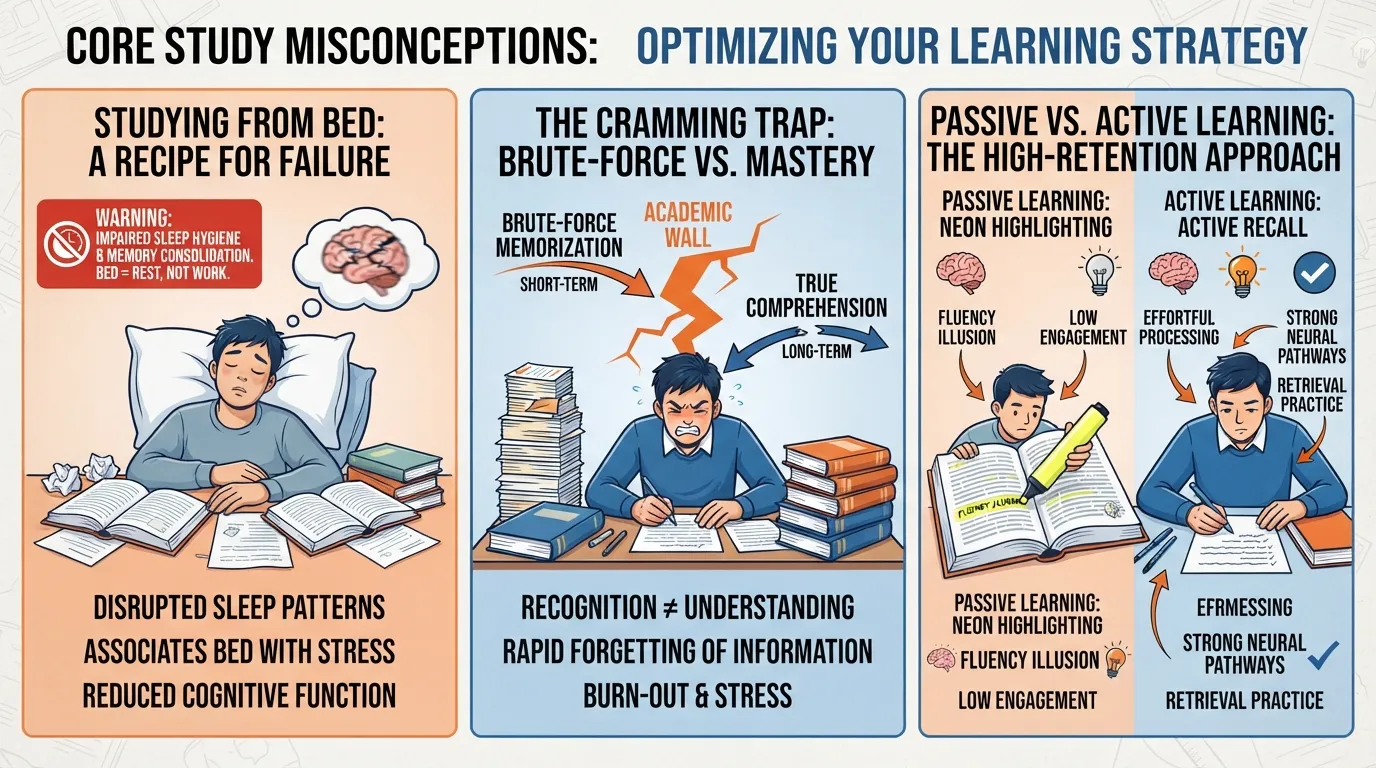
Academic folklore is packed with well-intentioned advice that often contradicts basic cognitive science. Unpacking these widespread myths helps you stop wasting effort on ineffective strategies and refocus your energy on methods that genuinely drive academic performance.
Can Good Students Still Have Bad Study Habits?
Many high-achieving students rely on brute-force memorization and marathon study sessions throughout secondary school without ever developing efficient learning systems.
The Reality: While raw intelligence or high working memory capacity can mask poor techniques early on, these students almost always hit a hard wall when academic complexity scales up in advanced university courses or standardized exams.
Why It Matters: Developing robust good students bad habits blind spots prevents individuals from scaling their output, leading to sudden academic burnout once natural talent is no longer enough to secure top grades.
Is Studying in Bed Actually a Bad Habit?
Lounging under the covers with a textbook or laptop feels like the ultimate comfort, but it wreaks havoc on your neurological sleep cues.
The Reality: Your brain relies heavily on environmental contextual conditioning; when you use your bed for studying, worrying, and scrolling, it stops associating that space exclusively with rest and sleep.
Why It Matters: Studying in bed severely degrades your sleep hygiene, triggering insomnia and fragmenting overnight memory consolidation processes that are critical for locking in daily learning.
Does Highlighting Ever Actually Help?
Color-coding passages with neon markers is arguably the most common study ritual in the world, yet it offers minimal cognitive return.
The Reality: Highlighting effectiveness is near zero when used as a primary review method because running a marker across a sentence requires zero cognitive friction or active retrieval.
Why It Matters: Highlighting should only be treated as a preliminary indexing tool to flag key sections for future active recall sessions, never as a substitute for actual studying.
Frequently Asked Questions
What Is an Example of a Bad Study Habit?
A classic example of a bad study habit is passive re-reading, where you review highlighted textbook pages over and over without testing your actual memory.
Why it fails: It gives you a false sense of security while leaving your brain unprepared to retrieve information under exam conditions.
The fix: Replace re-reading with active recall by closing your book and writing down everything you remember from scratch.
What Are 7 Effective Study Habits?
Transitioning from poor techniques to effective study habits requires implementing evidence-based cognitive strategies into your weekly routine.
Practicing active recall instead of passive review
Applying spaced repetition across increasing time intervals
Studying in a distraction-free environment away from phones and TVs
Setting specific, time-blocked goals for every single session
Interleaving different problem types and difficulty levels
Prioritizing 7 to 9 hours of sleep for memory consolidation
Explaining complex concepts aloud using simple language
What Are the 10 Rules of Studying?
Mastering academic performance requires adhering to foundational cognitive and organizational study rules.
Always prioritize retrieval over recognition.
Distribute your practice sessions rather than cramming.
Eliminate digital and environmental distractions entirely.
Structure your workspace for physical and mental alertness.
Set explicit, measurable objectives before opening your notes.
Take regular, structured breaks to prevent mental burnout.
Seek help immediately when encountering persistent knowledge gaps.
Maintain consistent sleep, nutrition, and exercise routines.
Connect abstract facts to real-world applications.
Review challenging material more frequently than easy topics.
What Can Help You Study Better?
Learning how to study better comes down to leveraging modern digital tools and proven cognitive frameworks.
Utilize spaced repetition flashcard software like Anki or RemNote to automate your review schedule.
Implement structured note-taking frameworks like the Cornell method or cloud databases like Notion.
Use website blockers and timers to maintain deep focus during study blocks.
Engage in peer study groups or office hours to stress-test your conceptual understanding.
How Do I Undo Bad Study Habits?
Breaking bad habits requires conscious behavioral replacement rather than sheer willpower alone.
Identify your specific triggers, such as opening your phone or studying in bed.
Redesign your environment to make good habits easy and bad habits friction-filled.
Swap out passive study tasks for active, high-yield challenges immediately when you sit down.
Track your consistency over time to build new, sustainable academic routines.
Conclusion — Your Next Steps
Transforming your academic trajectory does not require overhauling your entire life overnight, but it does demand a deliberate shift from comfortable passivity to rigorous cognitive engagement. By systematically identifying your personal bottlenecks—whether you are stuck in an endless loop of re-reading, falling victim to late-night cramming, or sabotaging your focus with constant multitasking—you can reclaim your time and radically elevate your retention.
Building sustainable study discipline begins with choosing just one evidence-based strategy today, such as swapping out your highlighters for active recall or setting up a distraction-free workspace. True academic success is built on consistency, proper biological recovery, and continuous self-testing. Take control of your learning process right now, implement these systems during your next session, and watch how quickly your grades reflect your true potential.