Best Study Methods: Science-Backed Techniques for Better Grades
Introduction Direct Answer Hook
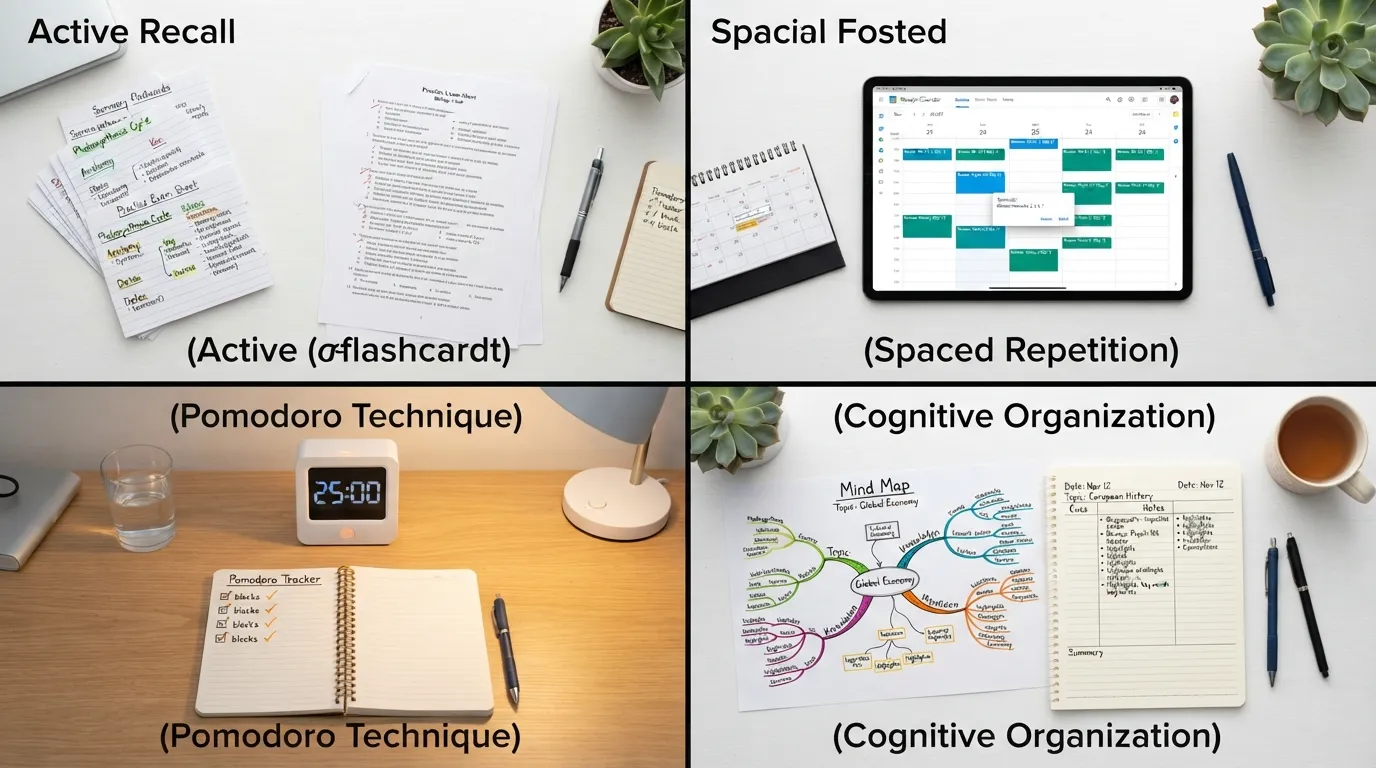
Effective studying is built on two scientifically proven cognitive pillars: active recall and spaced repetition. Rather than relying on passive reading or highlighting—which create an illusion of competence—top-performing students actively retrieve information from memory and distribute their practice over increasing intervals of time. By moving away from cramming and integrating evidence-based study methods into a structured routine, you significantly improve long-term retention and conceptual mastery.
What Are Study Methods? (Definition + Why They Matter)
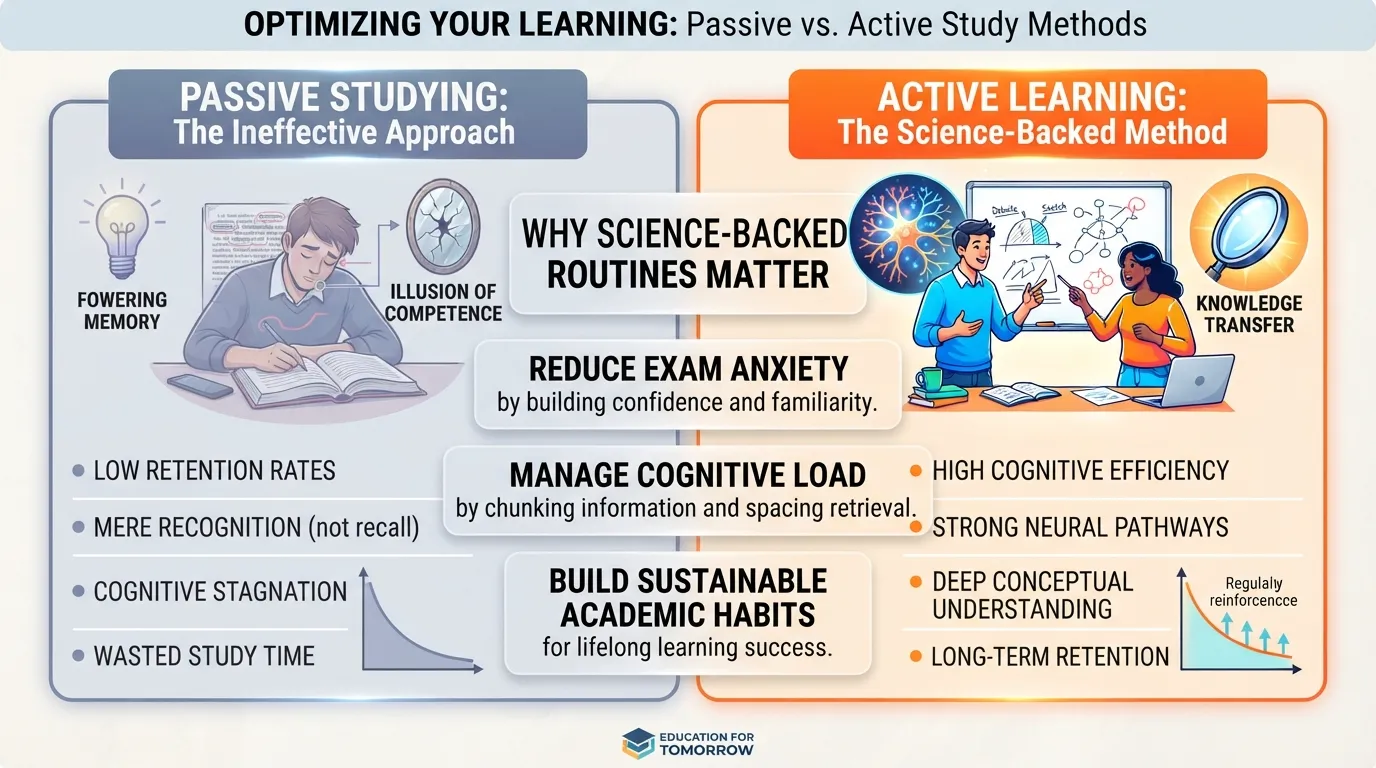
Study methods are structured learning strategies and cognitive routines designed to help you encode, retain, and apply information efficiently. They provide a systematic blueprint for transforming raw, complex data into long-term knowledge, replacing disorganized effort with cognitive science.
Cognitive Efficiency: Minimizes wasted time by focusing your brain on high-yield retrieval practices rather than repetitive review.
Knowledge Transfer: Bridges the gap between short-term memorization and deep, conceptual understanding.
Self-Regulation: Builds sustainable study habits that reduce exam anxiety and eliminate the need for stressful last-minute cramming.
What Makes a Study Method “Effective”?
An effective study method relies on cognitive science principles like the testing effect and distributed practice rather than intuition or comfort. Science-backed methods force your brain to struggle productively, strengthening neural pathways through exertion.
Neuroplastic Engagement: Forces the brain to physically adapt and build stronger synaptic connections through effortful retrieval.
Objective Validation: Relies on measurable feedback (such as correct practice exam scores) rather than subjective feelings of familiarity.
Cognitive Load Management: Breaks complex materials into manageable pieces to prevent mental fatigue and cognitive overload.
Passive Studying vs. Active Studying — The Key Difference
Passive studying involves receiving information without cognitive friction, whereas active studying requires you to manipulate, question, and reconstruct the material yourself. While passive methods feel easier in the moment, active methods are the primary driver of actual learning and memory consolidation.
Passive Studying (Low Retention): Rereading textbook chapters, highlighting text blocks, and listening to lectures without taking notes.
Active Studying (High Retention): Creating flashcards, teaching concepts out loud to an empty room, and writing practice exam questions.
The Cognitive Gap: Passive methods create an illusion of competence where familiarity is mistaken for mastery, while active methods expose exact knowledge gaps immediately.
Top Science-Backed Study Methods (Core Listicle)
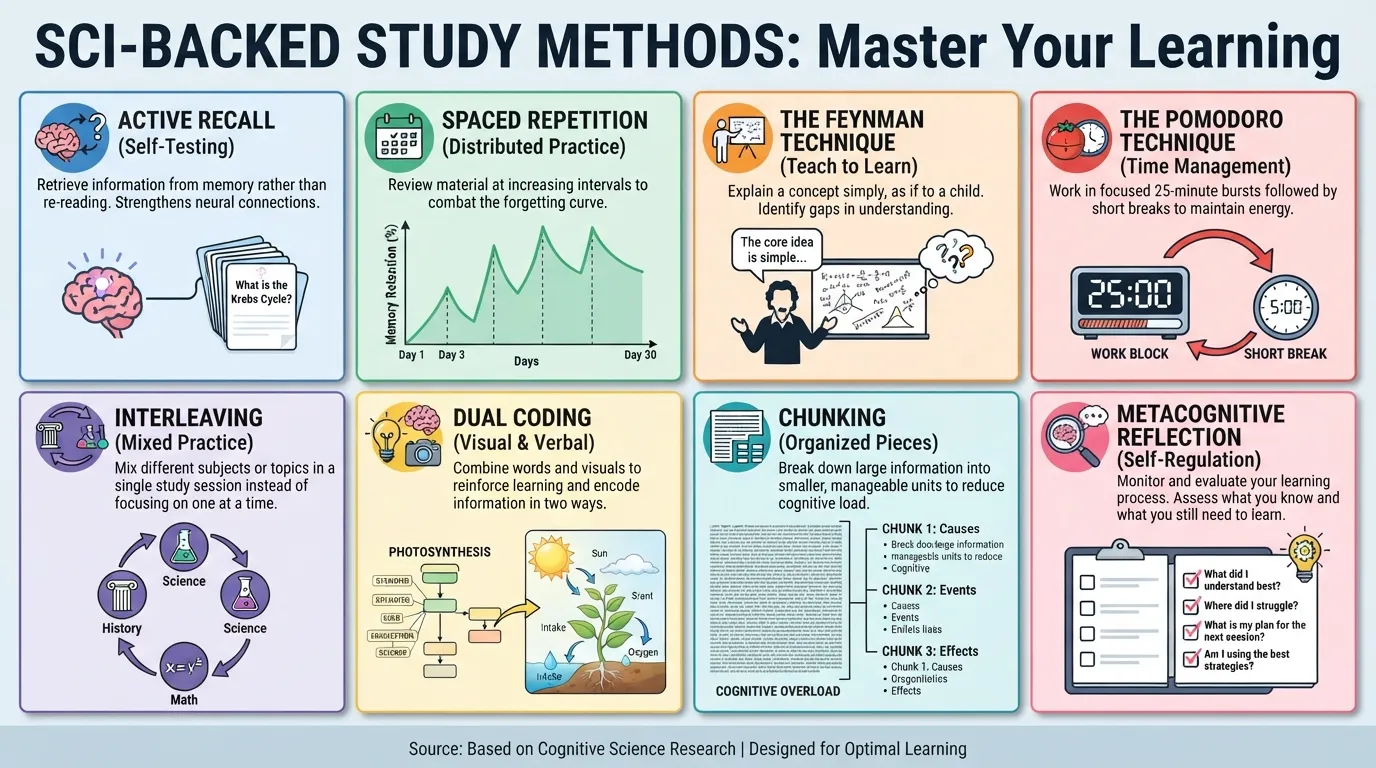
Mastering your academic or professional goals requires shifting from random effort to proven learning strategies. These science-backed techniques optimize cognitive load and transform how your brain encodes long-term knowledge.
1. Active Recall / Retrieval Practice
Active recall is the practice of actively stimulating your memory during the learning process rather than passively reviewing notes. By forcing your brain to pull information from scratch, you strengthen neural pathways and combat the illusion of competence.
Self-Testing: Close your textbook and write down everything you can remember about a specific topic from memory.
Flashcard Integration: Use digital or physical prompt cards to test definitions and problem-solving steps.
Immediate Feedback: Compare your recalled answers against your study materials to instantly identify and correct gaps.
2. Spaced Repetition
Spaced repetition involves reviewing material at systematically increasing intervals over time to combat the natural forgetting curve. This strategy leverages psychological spacing effects to permanently lock information into long-term memory with minimal total study time.
Interval Scheduling: Review new material after 1 day, 3 days, 1 week, and 3 weeks rather than cramming the night before.
Algorithm-Driven Tools: Utilize software like Anki or RemNote to automatically calculate optimal review dates based on your accuracy.
Long-Term Consolidation: Flattens the forgetting curve documented in foundational memory research, ensuring durable retention.
3. The Feynman Technique
The Feynman Technique breaks down complex ideas by forcing you to explain them in simple, plain language as if teaching a beginner. This process exposes hidden gaps in your understanding and strips away jargon-masked confusion.
Plain-Language Translation: Write out a concept using everyday vocabulary without relying on academic shorthand.
Gap Identification: Note exact moments where your explanation stumbles or requires complex technical terms.
Source Review: Return to your core texts to master those specific weak spots before trying again.
4. The Pomodoro Technique
The Pomodoro Technique is a time-management method that uses structured work intervals paired with short breaks to maintain high mental focus. It prevents cognitive fatigue and keeps your attention sharp throughout long study sessions.
Timed Sprints: Study with intense, distraction-free focus for 25 minutes.
Rest Periods: Take a strict 5-minute break to walk, stretch, or hydrate.
Cycle Reset: Complete four consecutive cycles before taking a longer 15-to-30-minute break.
5. SQ3R Method (Survey, Question, Read, Recite, Review)
The SQ3R method is a comprehensive reading comprehension framework that transforms textbook review from passive reading into an active dialogue. It primes your brain to look for specific answers before you dive into heavy chapters.
Survey & Question: Scan headings and turn them into questions before reading a single paragraph.
Read & Recite: Read the section to answer your questions, then immediately recite the core points out loud.
Review: Finalize your session by reviewing your summaries to solidify the framework in your mind.
6. Interleaving
Interleaving involves mixing different topics or problem types within a single study session rather than practicing one skill in isolation. This method trains your brain to discriminate between concepts and select the correct strategy dynamically.
Topic Rotation: Switch between different subjects or problem sets every 20 to 30 minutes.
Cognitive Flexibility: Prevents mindless repetition by forcing your brain to adapt to shifting mental frameworks.
Exam Readiness: Mirrors real-world tests where questions appear out of order and require flexible thinking.
7. Dual Coding
Dual coding combines verbal information with visual elements like diagrams, charts, and concept maps to process data through two distinct cognitive channels. This dual approach doubles your encoding pathways and enhances later retrieval.
Visual Mapping: Draw flowcharts or mind maps to connect abstract concepts visually.
Symbolic Coding: Use color-coding and icons to categorize different themes within your notes.
Multi-Modal Integration: Pair written definitions alongside corresponding visual diagrams to reinforce memory.
8. Chunking
Chunking breaks large bodies of information down into smaller, meaningful clusters or units that fit comfortably within working memory limitations. By organizing data into logical groups, you make complex systems much easier to digest.
Information Grouping: Organize long lists or dense concepts into categories of three to five items.
Hierarchical Structuring: Group sub-topics under broader umbrella headings to create mental scaffolding.
Working Memory Relief: Reduces cognitive load by treating a chunk of data as a single cohesive unit.
9. Metacognitive Reflection
Metacognitive reflection is the practice of thinking about your own thinking, evaluating which study strategies work best, and adjusting your approach accordingly. It builds self-awareness and ensures you continuously refine your learning habits.
Post-Study Audits: Evaluate why you missed specific questions after a practice test.
Strategy Calibration: Drop study tactics that feel productive but yield low retention scores.
Progress Tracking: Monitor your comprehension milestones to maintain motivation and strategic momentum.
The 2-3-5-7 Study Rule (Content Gap — Dedicated PAA Capture)
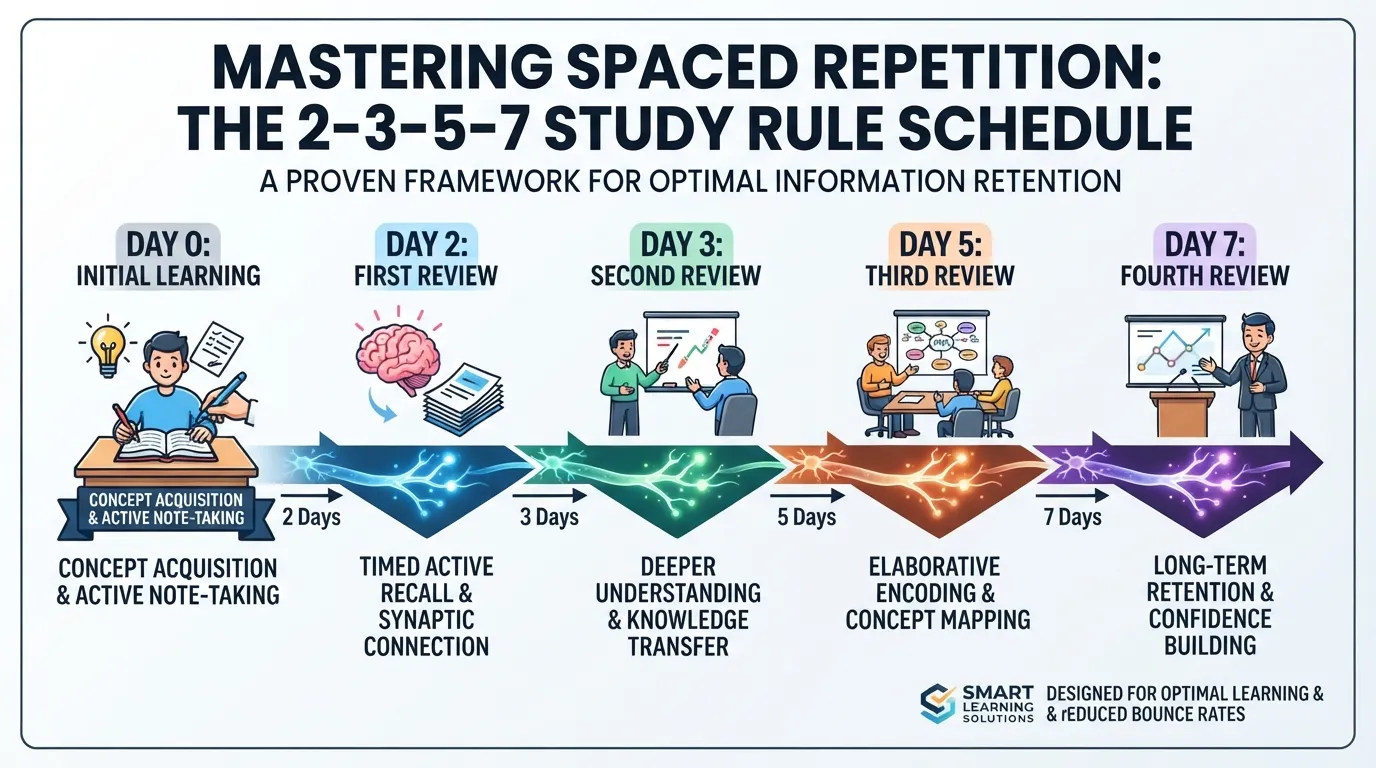
The 2-3-5-7 study rule is a high-efficiency spaced repetition schedule designed to systematically lock new information into your long-term memory. By timing your reviews to hit exact cognitive intervals, this technique preempts the forgetting curve and eliminates the need for stressful last-minute cramming.
Targeted Intervals: Schedules reviews at specific day gaps to match natural cognitive decay rates.
Maximized Retention: Converts temporary short-term memories into durable, accessible knowledge.
Time Efficiency: Reduces total hours spent studying by focusing effort precisely when retention begins to drop.
How the 2-3-5-7 Schedule Works (Day 0, Day 2, Day 3, Day 5, Day 7)
This step-by-step revision technique maps your study sessions across a strict timeline starting the moment you first encounter the material. Following this exact day-by-day sequence ensures your brain is tested right as memories start to fade.
Day 0 (Initial Learning): Learn the new concept, take concise notes, and test your baseline understanding immediately.
Day 2 (First Review): Perform your first active recall session 48 hours later to capture the sharpest drop in the forgetting curve.
Day 3 (Second Review): Revisit the material after another 24 hours to reinforce neural pathways and clarify lingering confusion.
Day 5 (Third Review): Test your recall two days later, checking whether the core principles are moving into long-term storage.
Day 7 (Final Baseline Review): Conduct a comprehensive review one week after initial learning to cement the knowledge for long-term mastery.
Why This Spacing Pattern Beats Cramming
Cramming relies on short-term working memory, which dumps information almost immediately after an exam concludes. The 2-3-5-7 rule forces your brain to reconstruct memories multiple times, signaling that the data is important enough to store permanently.
Combats the Forgetting Curve: Intervenes right before memory retention drops off significantly, resetting the decay curve.
Strengthens Synaptic Connections: Rebuilding memories from scratch repeatedly makes future retrieval faster and easier.
Eliminates Exam Anxiety: Spreads workload evenly across days, ensuring complete confidence well before test day.
How to Study When Your Exam Is Close (Gap — Exam-Panic Scenario)
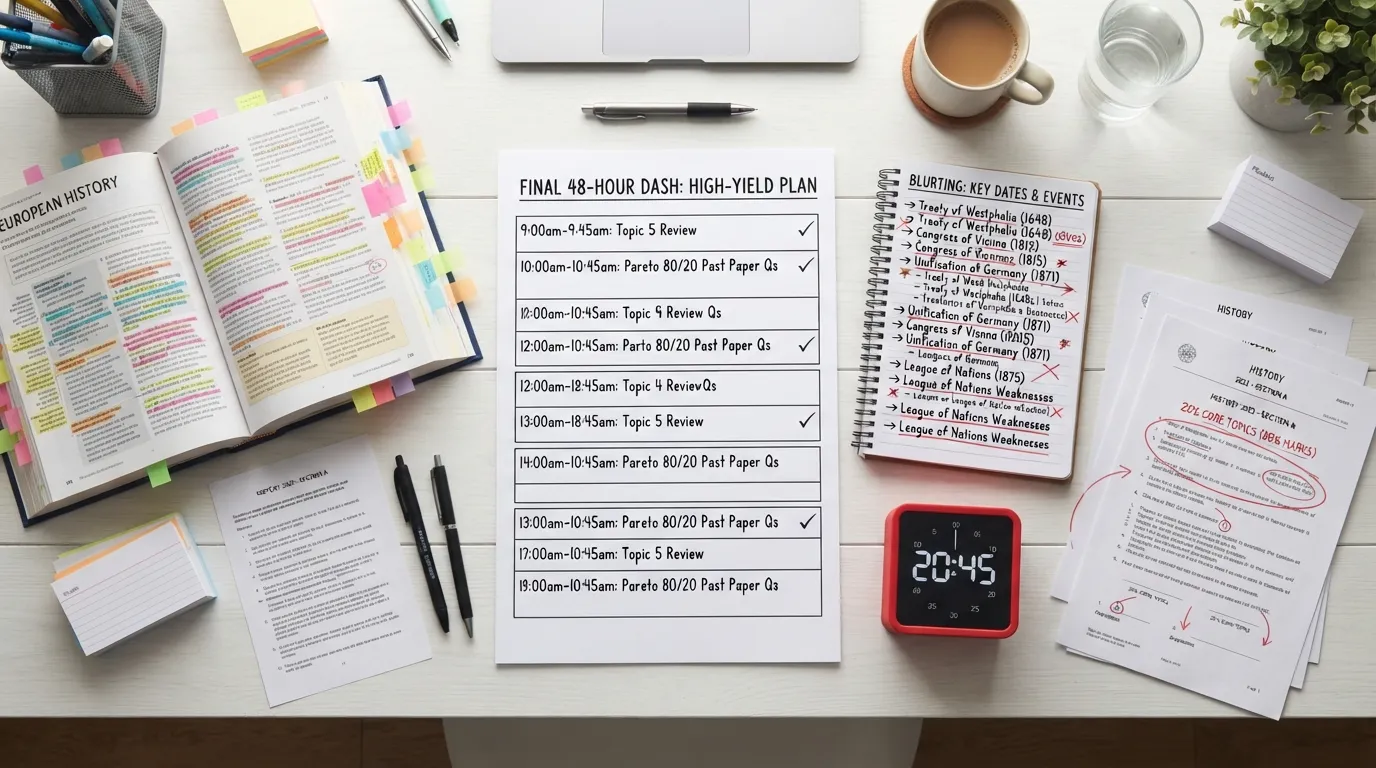
When exam day is rapidly approaching and you have fallen behind, panic is your biggest enemy. To salvage your grade, you must immediately abandon passive reading and switch to high-yield triage and accelerated active recall.
Immediate Focus Shift: Stop trying to read every textbook chapter cover-to-cover.
High-Yield Triage: Focus exclusively on topics that carry the heaviest weight on the exam.
Active Output Only: Spend 80% of your time testing yourself and only 20% reviewing notes.
Triage Your Material — What to Prioritize First
In a time crunch, prioritizing your study material determines whether you pass or fail. Audit your syllabus and lecture slides to identify recurring core themes and heavily weighted exam topics.
Syllabus & Past Papers: Look at previous exams to find patterns in the questions instructors ask most frequently.
Pareto Principle (80/20 Rule): Focus on the 20% of core concepts that will yield 80% of your potential exam points.
Strategic Omission: Drop minor, low-yield details entirely if time runs out, ensuring you master major concepts thoroughly.
Fast Active Recall Drills for Last-Minute Prep
Traditional note-taking is too slow when you are cramming under pressure. Speed up your exam preparation by using aggressive active recall drills that force instant memory retrieval.
Blurting Method: Read a summary page for two minutes, close the book, and rapidly write down everything you remember on a blank sheet.
Reverse Engineering Practice Exams: Start directly with practice questions, look up the answers when you fail, and write down the rationale.
The 5-Minute Teach-Back: Explain complex formulas or historical events out loud to yourself in under five minutes without using notes.
A Realistic Crash-Study Timetable
A structured crash-study plan prevents burnout and panic during high-stress exam prep. Divide your available hours into strict, manageable blocks to maximize focus and retention.
Timed Pomodoro Sprints: Run 45-minute intense study blocks followed by 10-minute rest breaks to maintain peak alertness.
Subject Rotation: Switch subjects every two hours to prevent mental fatigue and keep your brain engaged.
Night-Before Review: Spend your final hour reviewing mistakes made during practice drills rather than learning brand-new material.
Best Study Methods by Student Type (Gap — Audience Segmentation)
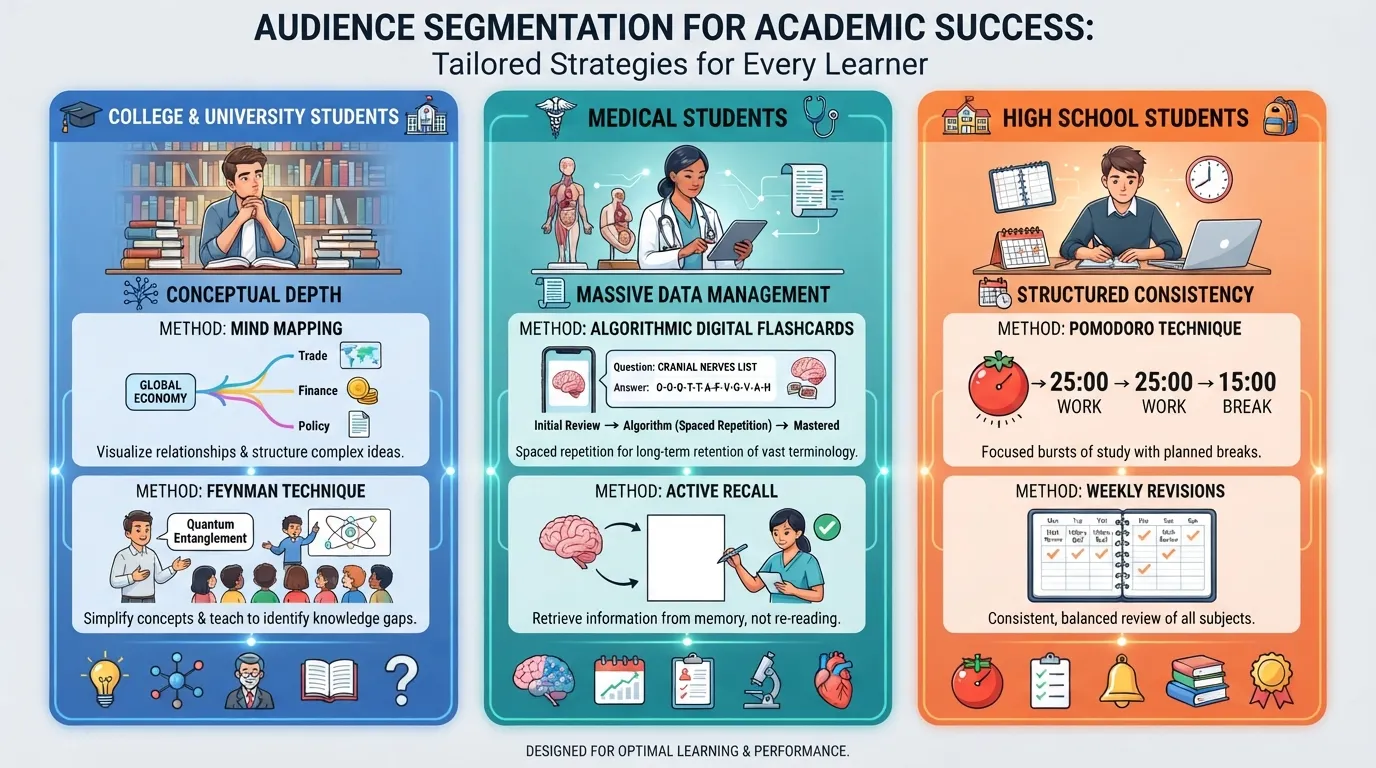
Different academic fields and educational stages require tailored learning strategies to maximize efficiency. Aligning your study techniques with your specific student profile ensures you spend your time on methods that match your workload and testing format.
Targeted Efficiency: Eliminates generic study habits that do not fit your specific curriculum demands.
Workload Scaling: Matches your strategy to the sheer volume of data you need to process.
Optimized Tool Selection: Directs you toward the software and frameworks most relevant to your discipline.
For College/University Students
College and university students face complex, conceptual material that requires deep critical thinking rather than simple rote memorization. Success at this level depends on synthesizing multiple sources and constructing original arguments.
Primary Method: Combine the Feynman Technique with mind mapping to break down dense theoretical lectures into plain-language concepts.
Strategic Focus: Prioritize essay outlines and thematic synthesis over memorizing isolated facts.
Recommended Tool: Use Notion or RemNote to connect lecture notes with primary research sources.
For Medical Students (High-Volume Memorization)
Medical students face an unprecedented volume of high-stakes anatomical, pharmacological, and clinical data. Surviving this curriculum requires automated, high-frequency retrieval systems.
Primary Method: Leverage algorithmic spaced repetition paired with dense digital flashcard decks.
Strategic Focus: Focus heavily on image occlusion and active recall to master intricate biological systems and drug interactions.
Recommended Tool: Utilize Anki daily to manage massive, multi-thousand-card medical decks without falling behind.
For High School Students
High school students often transition from basic memorization to foundational analytical thinking across diverse subjects. Establishing disciplined study routines early prevents burnout during pivotal exam years.
Primary Method: Use the Pomodoro Technique combined with the 2-3-5-7 study rule for weekly subject revisions.
Strategic Focus: Build strong organizational habits and master foundational active recall before tackling advanced coursework.
Recommended Tool: Use physical flashcards or simple study apps like Quizlet to build quick, repeatable testing habits.
Digital Tools That Support These Methods
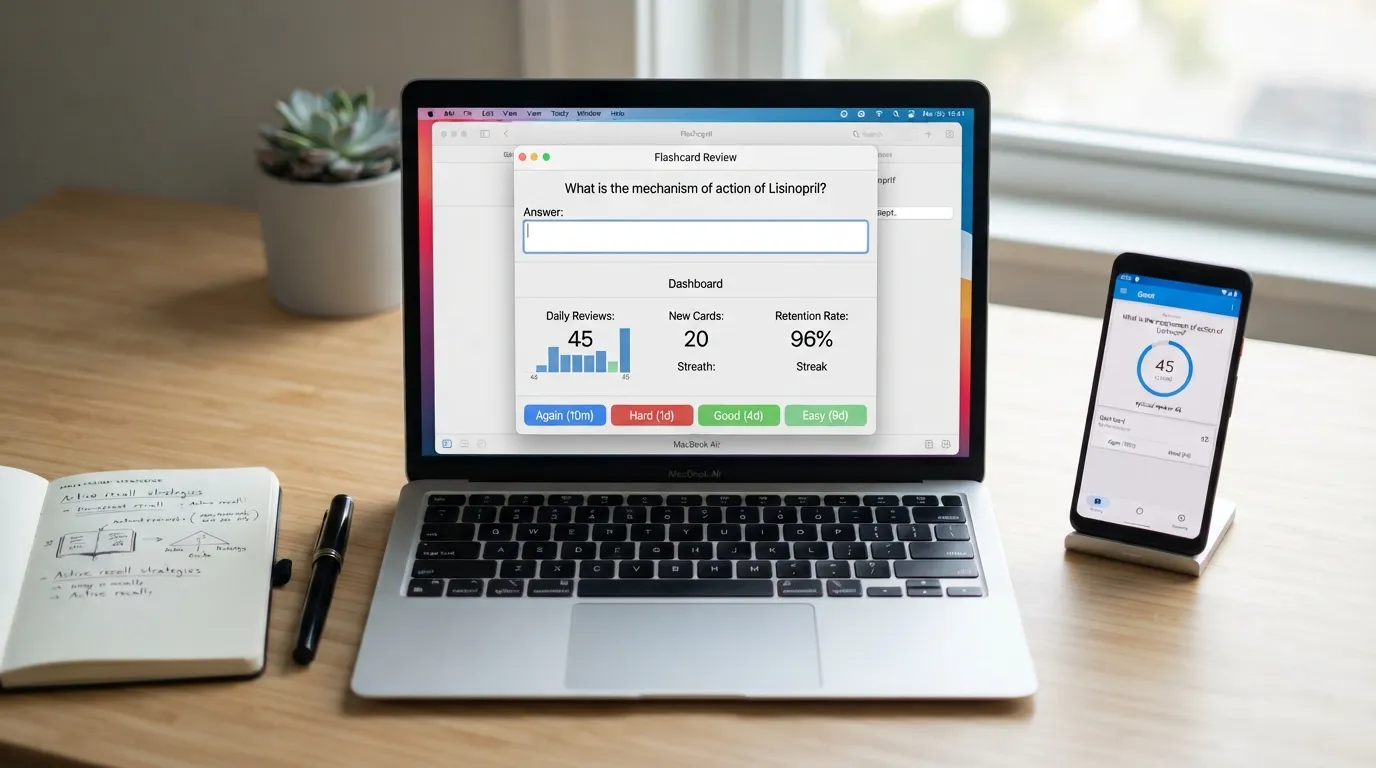
Leveraging modern software automates the logistics of active recall and spaced repetition, removing manual friction from your study routine. Integrating the right digital platforms into your workflow ensures your reviews happen on schedule without requiring manual tracking.
Automated Scheduling: Eliminates guesswork by calculating exact memory retention intervals for you.
Multi-Device Sync: Allows you to review flashcards and notes seamlessly across smartphones, tablets, and laptops.
Multimedia Integration: Embeds images, audio clips, and diagrams directly into your digital study materials.
Flashcard & Spaced Repetition Apps (Anki, Quizlet)
Digital flashcard applications turn analog study cards into dynamic, algorithm-driven review engines. They track your personal accuracy and present cards right when your brain is on the verge of forgetting them.
Anki: The gold standard for heavy memorization, utilizing a powerful open-source spaced repetition algorithm and custom decks.
Quizlet: User-friendly and ideal for collaborative learning, offering ready-made study sets and interactive practice games.
RemNote: Combines note-taking and flashcard generation into a single platform, automatically turning notes into spaced-repetition prompts.
How to Set Up a Digital Spaced-Repetition Schedule
Configuring your flashcard software correctly ensures you get the maximum cognitive benefit without experiencing notification fatigue or review backlogs. Setting clear daily limits keeps your study sessions manageable and sustainable.
Configure Daily Limits: Set realistic new-card limits (e.g., 20 new cards per day) to prevent massive review backlogs.
Rate Honestly: Use the difficulty rating buttons accurately (Again, Good, Easy) so the algorithm can calibrate your custom intervals.
Establish a Daily Habit: Complete your reviews at the same time every day—such as during your morning commute or before logging off—to build unbreakable study consistency.
Does Note-Taking Actually Work?
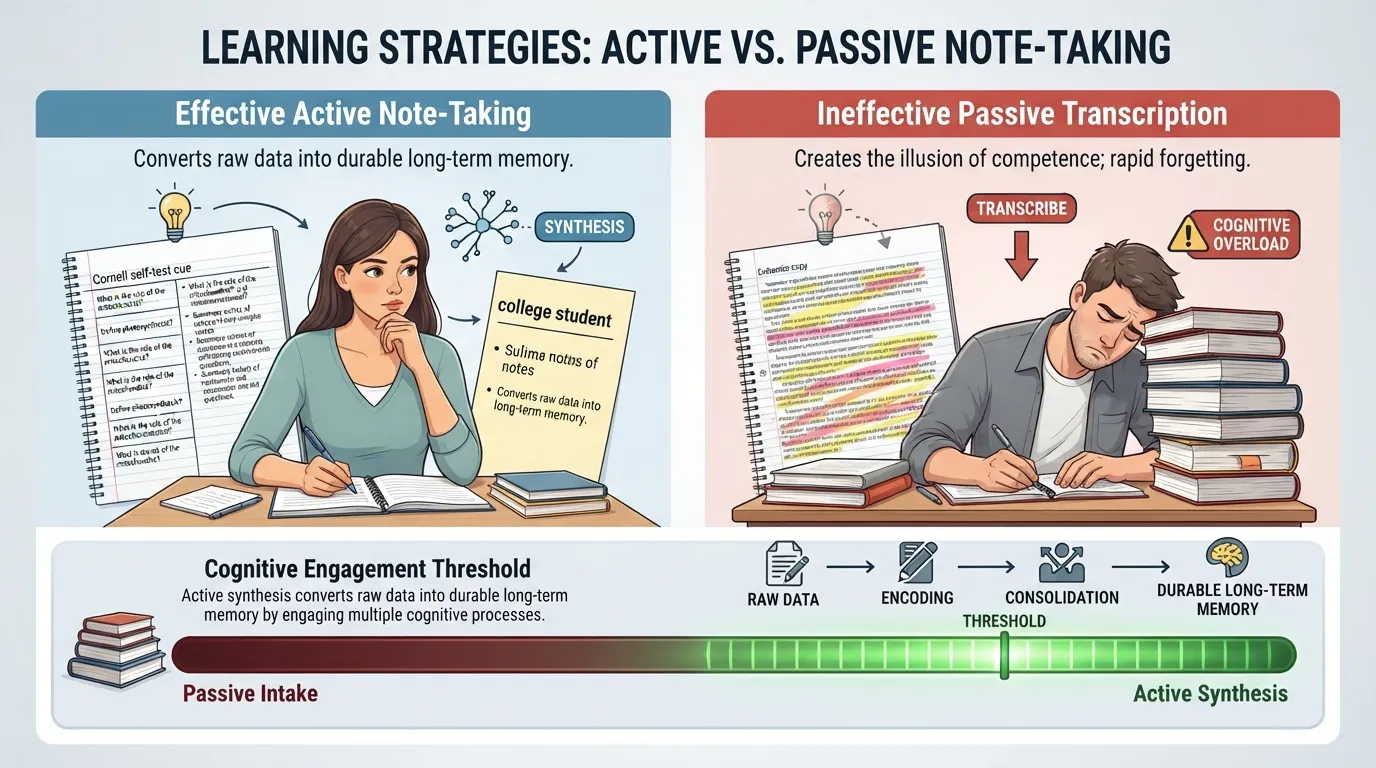
Note-taking is highly effective, but only when executed as an active cognitive process rather than a verbatim transcription exercise. Rewriting lectures word-for-word creates passive note-taking habits that yield poor retention, whereas synthesizing ideas in your own words turns note-taking into a powerful tool for memory encoding.
Encoding Benefit: Processing information into your own words forces immediate mental engagement and comprehension.
External Storage: Creates clean, reliable reference materials for future active recall and spaced repetition sessions.
The Transcribing Trap: Verbatim copying uses minimal brainpower, giving a false sense of productivity without real learning.
When Note-Taking Helps vs. When It Wastes Time
Note-taking helps when it forces you to summarize, analyze, and structure raw information in real time. It becomes a waste of time when you focus on aesthetic formatting, exhaustive copying, or creating neat notes that you never re-engage with through self-testing.
When It Helps: Summarizing main concepts during lectures, identifying connections between topics, and creating custom prompt questions for testing.
When It Wastes Time: Highlighting entire paragraphs, re-copying textbook pages word-for-word, and spending hours perfecting handwriting instead of testing retention.
The Engagement Threshold: If your hand is moving faster than your brain is processing, you have drifted into low-yield passive note-taking.
Active Note-Taking Methods (Cornell Method, Outline Method)
Structured frameworks transform raw notes into active recall engines by embedding self-testing mechanisms directly into your layout. Systems like the Cornell method and Outline method force you to categorize information hierarchically and generate review questions during lectures.
The Cornell Method: Divides pages into note-taking, cue/question, and summary sections, creating built-in flashcard prompts for rapid self-testing.
The Outline Method: Uses indented hierarchies to organize core concepts, supporting details, and examples into clear logical relationships.
Synthesis Sprints: End every note-taking session by writing a brief summary section entirely from memory to solidify new learning.
Building Your Own Personalized Study System (E-E-A-T / Experience Section)
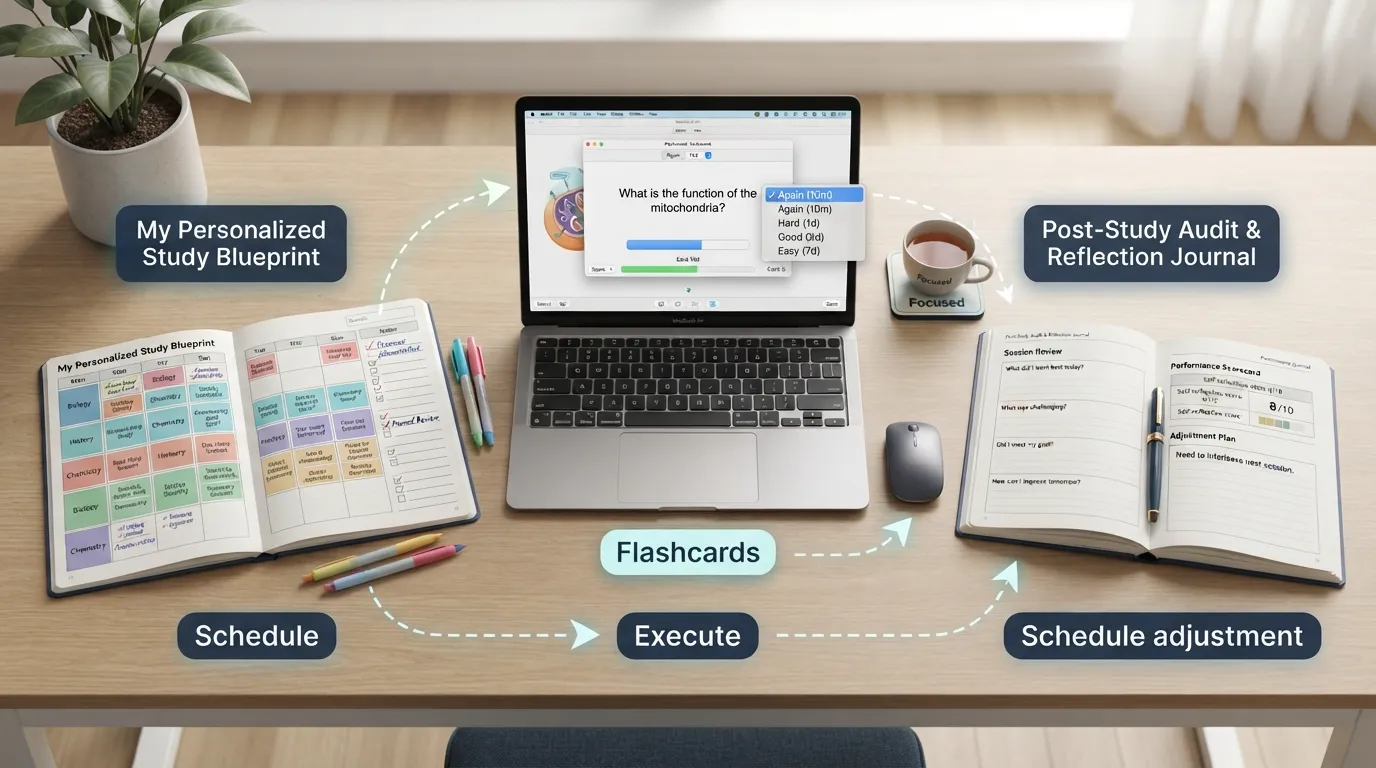
A successful study routine is not built by forcing yourself into a rigid, one-size-fits-all framework, but by combining complementary techniques into a sustainable system. By experimenting with active recall, spaced repetition, and structured time blocks, you can tailor a customized workflow that fits your specific learning style and academic demands.
Method Synergy: Pairing flashcards with weekly reviews creates a multi-layered defense against forgetting.
Flexibility Over Rigor: Adjust your study schedule dynamically based on upcoming deadlines and personal energy levels.
Sustainable Habit Formation: Focus on consistency and small daily gains rather than exhausting marathon study sessions.
How to Combine 2-3 Methods Without Overwhelm
Trying to use every study technique at once leads to decision fatigue and burnout. Instead, anchor your weekly routine around two or three core pillars, such as active recall paired with the Pomodoro technique and spaced repetition.
The Core Trio: Use Anki for daily 15-minute spaced repetition sessions, Pomodoro sprints for focused study blocks, and the Feynman technique to review difficult concepts.
Sequential Integration: Read chapters using active note-taking, immediately convert key takeaways into flashcards, and schedule those cards into your 2-3-5-7 review calendar.
Simplicity First: Master one method completely before introducing another to prevent cognitive clutter.
Tracking What Actually Works for You (Metacognitive Journal)
A metacognitive journal is a simple log where you evaluate which study sessions yielded the highest retention and which left you confused. Tracking your performance data eliminates guesswork and helps you optimize your strategy over time.
Performance Logging: Note your accuracy scores on practice tests and identify which subjects require more frequent reviews.
Method Auditing: Drop study habits that feel productive in the moment but result in low test scores.
Iterative Refinement: Fine-tune your review intervals and study lengths based on concrete, tracked results.
A Sample Weekly Study Plan (Practical Example)
A structured weekly blueprint balances deep learning, active recall, and necessary rest to keep your brain performing at its peak. This practical schedule illustrates how to weave multiple methods into a single, manageable week.
Monday & Wednesday (New Learning): Spend 45 minutes reading new material using active note-taking, followed by creating flashcards for tricky concepts.
Tuesday & Thursday (Active Recall & Spaced Repetition): Run 20-minute digital flashcard reviews and practice the Feynman technique on weak topics.
Friday (Interleaving & Practice Exams): Mix different subject problem sets for 60 minutes to test your ability to switch cognitive gears.
Saturday & Sunday (Review & Rest): Conduct a 30-minute weekly baseline review of accumulated notes, and take Sunday entirely off to recharge.
Study Psychology — Motivation, Focus & Environment (Gap — Psychological Angle)
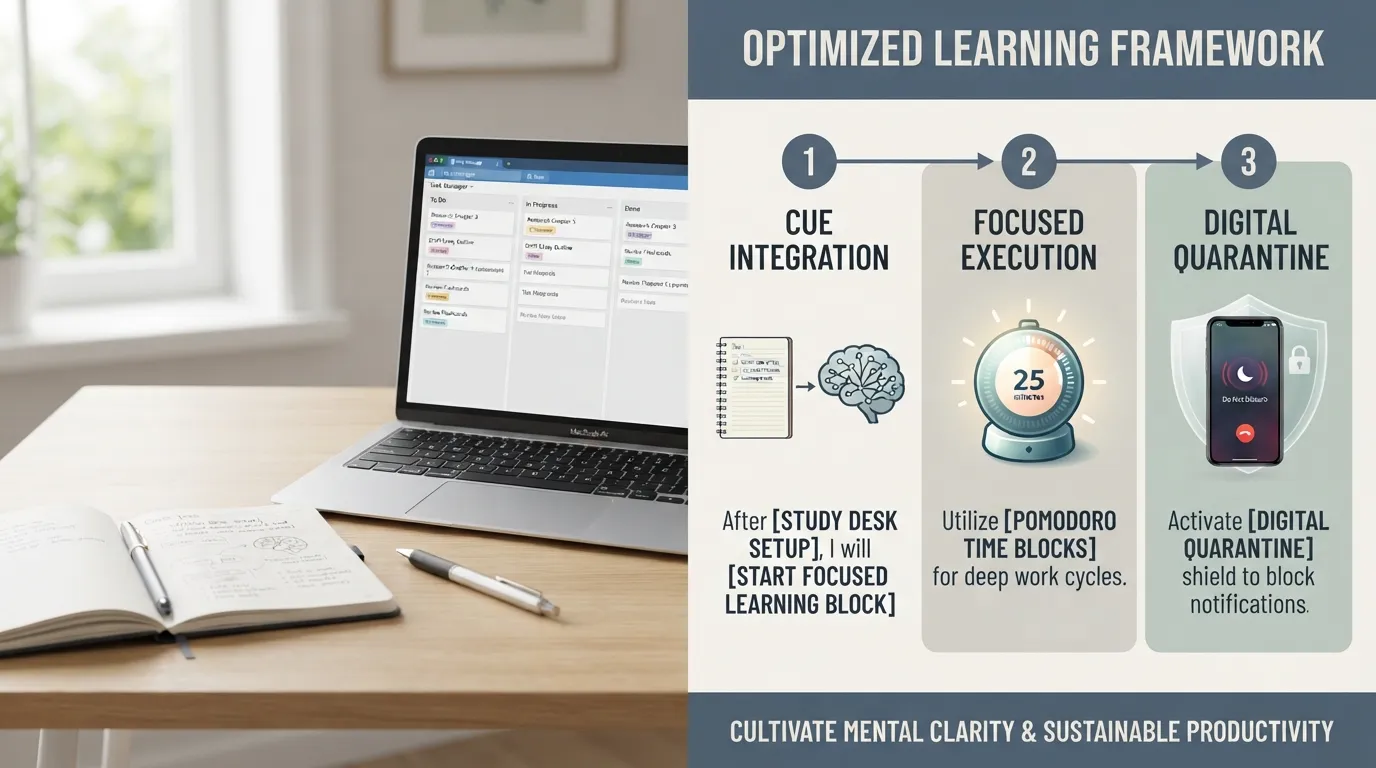
Mastering your mindset and study environment is just as important as choosing the right learning techniques. When you align your psychological triggers, physical surroundings, and digital boundaries with your academic goals, studying requires less willpower and becomes a natural part of your daily routine.
Friction Reduction: Design your environment to make starting your study sessions effortless and automatic.
Cognitive Endurance: Protect your attention span from digital clutter and environmental distractions to maintain deep focus.
Consistency Over Intensity: Build steady daily habits that outperform erratic, high-stress study marathons.
Habit Stacking to Build Study Consistency
Habit stacking is a proven behavioral psychology technique that links a new study habit to an existing daily routine, removing the friction of starting. By anchoring your study sessions to established behaviors, you build unbreakable consistency without relying purely on fleeting motivation.
Anchor Routines: Attach your study session to an immutable daily habit, such as reviewing flashcards immediately after your morning coffee.
The Two-Minute Rule: Commit to studying for just two minutes when you start; breaking the initial inertia makes it easy to keep going.
Cue Integration: Place your study materials on your desk the night before so the visual trigger is waiting for you the next day.
Choosing the Right Study Environment (Noise, Location, Lighting)
Your physical workspace sends powerful neurological signals to your brain that dictate whether it is time to relax or focus. Selecting a dedicated, optimized study environment eliminates ambient distractions and accelerates deep cognitive entry.
Dedicated Study Zones: Reserve your desk exclusively for studying so your brain associates that physical location with focus, not leisure.
Auditory Control: Use instrumental background music, white noise, or noise-canceling headphones to drown out unpredictable disruptions.
Lighting Optimization: Position your workspace near natural light or use bright, glare-free task lighting to reduce eye strain and fatigue.
Avoiding Multitasking and Digital Distractions
True multitasking is a cognitive myth; switching between your study notes and notifications fragments your attention and destroys memory retention. Establishing strict digital boundaries protects your working memory and ensures your study hours are genuinely productive.
Digital Quarantine: Put your phone in another room or use strict app blockers (such as Freedom or Forest) during your study sprints.
Single-Tasking Discipline: Keep only the tabs and materials open that are directly relevant to your current active recall session.
Notification Silencing: Turn off all non-essential alerts and email pop-ups before beginning your scheduled Pomodoro cycles.
Frequently Asked Questions (PAA Capture Block)
What are 7 effective study methods?
Seven of the most effective study methods include active recall, spaced repetition, the Feynman Technique, the Pomodoro Technique, interleaving, dual coding, and chunking. These science-backed strategies optimize cognitive load, combat the forgetting curve, and transform passive reading into long-term memory retention.
What are the four types of study methods?
The four primary types of study methods categorize learning by cognitive approach: visual/spatial methods like dual coding and mind mapping, kinesthetic methods involving hands-on problem solving, auditory methods such as recitation and the Feynman Technique, and interactive digital retrieval practices like spaced repetition apps.
What are the top 5/10 study techniques?
The top study techniques prioritize active engagement over passive review, featuring active recall, spaced repetition, the Pomodoro Technique, the Feynman Technique, interleaving, dual coding, chunking, SQ3R reading comprehension, metacognitive journaling, and structured habit stacking for sustained academic consistency.
What is the most successful study method?
Active recall combined with spaced repetition is universally recognized by cognitive scientists as the most successful study method. This pairing forces your brain to retrieve information from memory at systematically increasing intervals, permanently strengthening neural pathways and preventing the forgetting curve.
How to be a top 1% student?
Becoming a top 1% student requires replacing brute-force cramming with systematic, high-yield learning strategies. Top performers rely on daily active recall, algorithmic spaced repetition, rigorous post-study metacognitive audits, and distraction-free study environments to maximize efficiency and achieve mastery.
Conclusion — Key Takeaways
Achieving academic excellence is not a result of endless hours spent staring at textbooks, but of applying targeted cognitive science to your daily routine. By replacing passive reading with active recall, managing your schedule with spaced repetition, and maintaining strict study discipline, you transform how your brain processes and retains information.
Prioritize Active Output: Always choose self-testing, flashcards, and the Feynman technique over rereading notes.
Embrace Spaced Scheduling: Use frameworks like the 2-3-5-7 rule or digital tools to beat the forgetting curve.
Protect Your Focus: Build distraction-free study environments and rely on habit stacking to maintain consistent momentum.
Commit to testing just one new study method during your next session, and watch how intentional effort permanently elevates your academic performance.