Free Recall: The Ultimate Guide to Mastering Long-Term Memory Retention

What Is Free Recall?
Free recall is a cognitive process where an individual retrieves information from long-term memory without the help of explicit cues, prompts, or hints. Unlike recognition tasks (such as multiple-choice questions), free recall requires your brain to search for, locate, and reconstruct stored knowledge entirely on its own.
Core Mechanism: Relies purely on internal memory search strategies.
Cognitive Load: Demands higher mental effort, which significantly strengthens neural pathways.
Core Benefit: Serves as the gold standard for durable, long-term learning and authentic knowledge retention.
Free Recall Definition (Simple Explanation)
At its core, free recall is the psychological phenomenon of pulling facts, concepts, or experiences out of your memory bank with zero external assistance. When you engage in this process, you bypass passive reading and force your brain to perform heavy lifting. This active retrieval practice sends strong signals to your hippocampus and cortex, cementing the information for future access.
Active vs. Passive: Moving from reading notes (passive) to staring at a blank page and writing everything you remember (active free recall).
Memory Retrieval: The brain maps out internal pathways to reconstruct the original learning event piece by piece.
Retrieval Practice: Regularly testing yourself without cues accelerates long-term memory consolidation.
Free Recall in Everyday Study Life (Relatable Example)
Imagine you just finished reading a dense chapter on European history for an upcoming exam. Instead of re-reading the text, you close your textbook, grab a blank sheet of paper, and write down every single date, name, and event you can possibly remember.
The Blank Slate Approach: You start listing the French Revolution, key figures, and economic triggers without looking at any chapter summaries or flashcard hints.
Spotting the Gaps: Once your mind goes blank, you open the book to check what you missed, revealing exact weak points in your understanding.
Real-World Impact: This exact habit transforms messy short-term impressions into robust long-term knowledge ready for exam day.
How do you currently test your knowledge after reading a complex article or chapter?
Free Recall vs Active Recall vs Passive Review
Understanding how memory techniques differ is essential for optimizing study efficiency and avoiding wasted time. While these terms are often used interchangeably, they represent distinct cognitive processes with vastly different impacts on long-term memory retention.
Cognitive Spectrum: Ranging from zero-effort passive re-reading to high-effort unprompted free recall.
Brain Adaptation: Higher mental friction directly correlates with stronger neural encoding and easier knowledge retrieval later.
Strategic Selection: Matching the right technique to your learning phase prevents cognitive burnout and accelerates mastery.
Free Recall vs Active Recall — What’s the Real Difference?
The primary distinction between free recall and broader active recall lies in the presence or absence of retrieval cues. Free recall is a specific, unprompted subset of active recall where you retrieve information completely from scratch with zero hints.
Free Recall Mechanics: You stare at a blank page and generate information without any specific prompts, questions, or flashcard clues (similar to serial recall where order matters).
Active Recall Scope: A broader umbrella term that includes flashcards, practice test questions, and specific prompt-based problem solving.
Effort Level: Free recall demands the highest level of cognitive struggle because your brain must self-generate both the questions and the answers.
Why Passive Re-Reading Fails Compared to Free Recall
Passive review, such as highlighting text or re-reading a textbook chapter, creates a dangerous psychological illusion of competence. Your brain recognizes the words on the page, tricking you into believing you have mastered the material when you have only encoded it into short-term memory.
The Illusion of Fluency: Familiarity with text is easily mistaken for actual knowledge retrieval capability.
Lack of Neural Stress: Passive review bypasses the struggle needed to forge permanent pathways in long-term memory.
The Recognition Trap: Recognition memory makes multiple-choice tests feel easy, but fails you completely when you need to pull facts out independently during real-world tasks.
Comparison Table
| Metric | Free Recall | Active Recall | Passive Review |
| Definition | Unprompted retrieval of information from scratch. | Any study method that actively stimulates memory retrieval. | Re-reading, highlighting, or listening to recorded lectures. |
| Cue Use | Zero cues or prompts allowed. | Uses specific cues like flashcard questions or practice prompts. | Continuous external cues from the open text or notes. |
| Effort Level | Extremely High (requires complete self-generation). | Moderate to High (guided by specific questions). | Very Low (primarily passive visual processing). |
| Best Use Case | Deep consolidation, blank-slate testing, and conceptual mapping. | Quick Q&A, definitions, and vocabulary building. | Initial content overview or light review when fatigued. |
What study method do you rely on most when preparing for a high-stakes exam?
The Science Behind Free Recall — Why It Works
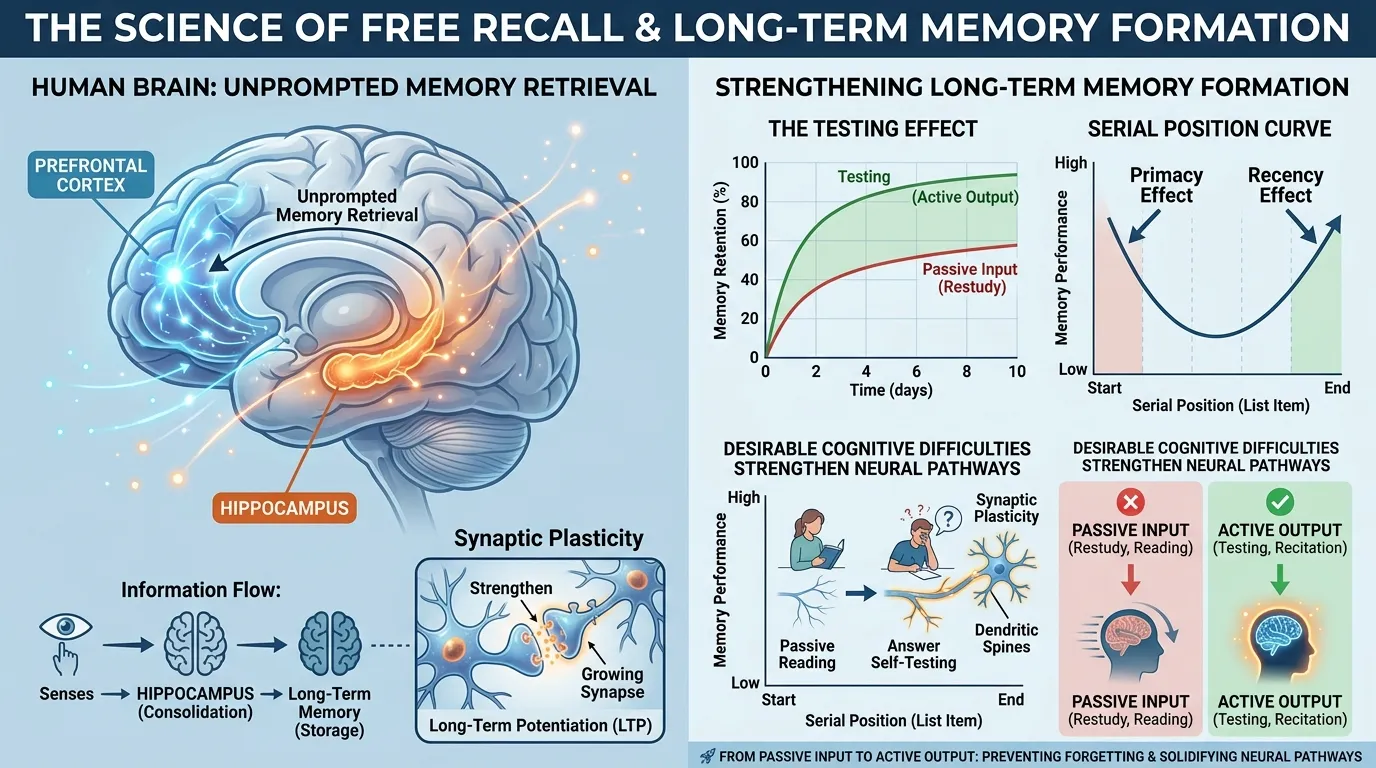
Free recall is not just a study tactic; it is a scientifically proven catalyst for structural brain modification. Cognitive science demonstrates that retrieving information without prompts alters the physical architecture of neural networks, turning fragile short-term thoughts into durable long-term memories.
Neural Strengthening: Actively pulling data from memory forces the brain to rebuild pathways rather than passively trace them.
Cognitive Friction: Desirable difficulties during recall trigger deeper processing levels, reducing long-term forgetting rates.
Encoding vs. Retrieval: Shifting focus from input (encoding) to output (retrieval) fundamentally changes how memories are consolidated.
The Testing Effect and Retrieval Practice
The testing effect proves that the act of retrieving knowledge modifies memory traces far more effectively than repeatedly studying the source text. When you force your brain to engage in retrieval practice, you trigger deep mental processing that protects information against natural decay. Landmark cognitive research highlights that unprompted retrieval outperforms passive review by significant margins on delayed tests.
Beyond Assessment: Testing acts as a powerful learning event rather than a mere metric of what you know.
Error Correction: Struggling to recall information highlights precise knowledge gaps, preparing your brain to encode corrections more deeply.
Deepening Connections: According to research published on Wikipedia’s Testing Effect Overview, effortful retrieval builds robust multi-route connections to target information.
Primacy and Recency Effect in Free Recall
When you execute a free recall session—such as writing down a list of items or concepts—serial position curves dictate what your brain captures first and best. The primacy effect ensures items at the beginning of a study session are deeply encoded into long-term memory due to extended rehearsal time. Meanwhile, the recency effect accounts for items at the very end lingering in your short-term working memory.
Primacy Advantage: Early items receive undivided initial attention, transferring smoothly into permanent storage networks.
Recency Buffer: Final concepts remain active in working memory, making them the easiest targets for immediate free recall.
The Middle Gap: Items in the middle of a study block suffer the highest rates of omission unless targeted with deliberate spacing and active testing.
What Neuroscience Says About Free Recall
Neuroimaging studies reveal that free recall places heavy demands on the prefrontal cortex and the hippocampus. The prefrontal cortex acts as an executive search engine, executing strategic memory queries, while the hippocampus coordinates the reconstruction of distributed neural fragments back into a coherent memory.
Hippocampal Activation: Dual-action neural pathways in the hippocampus fire intensely during unprompted memory searches.
Inhibitory Control: The brain actively suppresses competing, irrelevant memories to isolate and retrieve the precise target data.
Synaptic Plasticity: Repeated successful retrievals encourage long-term potentiation, permanently lowering the electrical threshold required to access that knowledge in the future.
What specific neuroscience or memory retention concept do you want to integrate into your study routine next?
How to Practice Free Recall — Step-by-Step Method
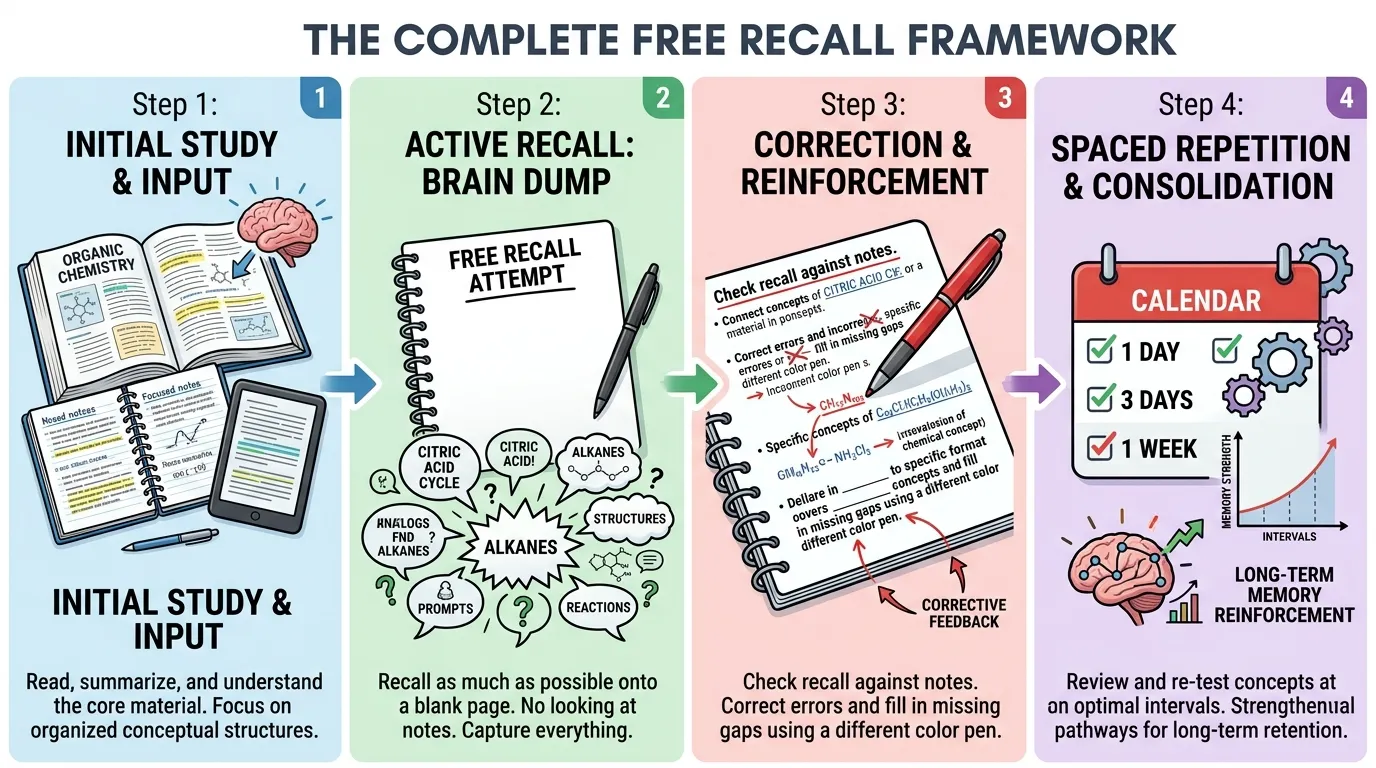
Mastering free recall requires a structured, repeatable workflow that moves you away from passive study habits and into high-impact cognitive engagement. By transforming raw reading into active blank page retrieval, you force your brain to build permanent memory traces.
The Blurting Method: Popularly known as “blurting,” this technique relies on unfiltered brain dumps to expose what you actually know.
Continuous Feedback Loops: Immediate self-assessment prevents you from reinforcing incorrect information or false assumptions.
Sustainable Routine: Combining retrieval with spaced repetition creates a bulletproof system for long-term mastery.
Step 1 — Study the Topic First
Before you can pull information out of your brain, you must feed quality data into it. Read your textbook chapter, review your lecture notes, or watch an educational video with focused attention, but avoid the trap of mindless highlighting.
Intentional Input: Read with the explicit goal of understanding core concepts rather than just finishing the page count.
Concept Mapping: Mentally organize how different ideas connect to each other while you study.
Time Boxing: Keep your initial study session concise to leave maximum mental energy for the upcoming retrieval phase.
Step 2 — Close the Book and Write Everything You Remember
Once your initial study block is complete, put your materials completely out of sight. Grab a blank sheet of paper or open a blank document, and execute an unfiltered brain dump of everything you can recall.
Blank Page Retrieval: Write down definitions, keywords, diagrams, and formulas without worrying about neatness or structure.
Embrace the Struggle: When your mind goes blank, pause and push through the mental friction instead of opening your notes right away.
Unfiltered Speed: Dump thoughts as fast as they come to capture what your working memory and long-term storage hold organically.
Step 3 — Check and Fill the Gaps
Open your original source material using a different colored pen to review your blank page output. Compare your blurted notes side-by-side with the textbook to uncover exactly what you remembered correctly and what you missed.
Spotting Omissions: Circle missing concepts, incorrect dates, or misunderstood definitions in a contrasting color.
Targeted Correction: Focus your revision strictly on those highlighted gaps rather than re-reading the entire chapter.
Error Analysis: Ask yourself why you missed specific points to prevent the same lapse during future study sessions.
Step 4 — Space It Out (Spaced Repetition Tie-In)
Doing free recall once is helpful, but repeating the process across increasing time intervals is what locks information into permanent long-term memory. Integrate your blank page sessions into a structured spaced repetition schedule.
The Repetition Timeline: Revisit the topic after 1 day, 3 days, 1 week, and 1 month to combat the natural forgetting curve.
Diminishing Effort: Notice how each successive free recall session requires less struggle and yields higher accuracy.
Long-Term Retention: Transform temporary exam cramming into lifelong conceptual mastery.
What subject or topic are you planning to apply this step-by-step free recall method to first?
Free Recall Techniques & Variations
Free recall is a flexible cognitive strategy that adapts to different formats depending on your goals, time constraints, and the structure of the subject matter. Customizing your retrieval approach prevents study fatigue and maximizes memory encoding across diverse academic and professional fields.
Method Flexibility: Ranging from unstructured brain dumps to structured question-based protocols.
Temporal Control: Adjusting the timing between study input and retrieval output to test different memory tiers.
Complex Mapping: Handling multi-layered subjects by breaking them down into chronological or process-driven chains.
The Brain Dump Method
The brain dump is the purest, most unconstrained form of free recall. It involves taking a completely blank sheet of paper immediately after studying and writing down every single thought, concept, formula, or keyword that comes to mind without worrying about formatting.
Unfiltered Output: Captures raw working memory and tests how much material stuck during your initial reading pass.
Zero Constraints: Bypasses the friction of structuring sentences, allowing you to focus entirely on information retrieval.
Instant Clarity: Quickly highlights major knowledge gaps when your pen runs dry and you hit a mental wall.
The Blurting Technique
Popularized across modern study communities, “blurting” is a high-speed, intensive variation of the brain dump. Students read a section of notes, close the book, and rapidly write or type everything out as fast as possible before cross-referencing with corrections.
Pacing Pressure: Forces quick neural retrieval, mirroring the time constraints you face during actual exams.
Color-Coded Correction: Uses a second pen color to mark missing items, turning mistakes into clear visual targets for next time.
High Engagement: Keeps your attention sharp by transforming passive notes into an active, high-energy sprint.
Immediate vs. Delayed Free Recall
The timing of your free recall sessions drastically changes how memory systems process and store the incoming information. Choosing between immediate and delayed sessions depends on whether you want to test short-term working memory or long-term consolidation.
Immediate Free Recall (IFR): Performed seconds after reviewing material, testing short-term retention and immediate encoding fidelity.
Delayed Free Recall (DFR): Executed hours or days later, measuring true long-term memory retrieval strength and highlighting fading neural pathways.
Strategic Synergy: Use immediate recall to verify initial understanding, and delayed recall to cement durable memory storage.
Free Recall for Large, Interconnected Topics (Process/Timeline Learning)
When dealing with complex, multi-step subjects like historical timelines or biological pathways, standard free recall can feel overwhelming. Applying a sequential or process-driven framework ensures you retrieve information in logical order rather than as isolated facts.
Chronological Anchoring: Start by jotting down major milestones or anchor dates before filling in the intermediate details.
Causality Chains: Map out “cause and effect” relationships instead of random bullet points to mirror how the brain stores narratives.
Modular Recall: Break massive topics down into smaller sub-processes, retrieving one section at a time before assembling the full picture.
Which free recall variation—such as a fast-paced blurting session or a structured process map—best fits your current study workflow?
Common Mistakes When Using Free Recall
Even highly motivated learners often undermine their own progress by making avoidable execution errors during free recall sessions. Recognizing these pitfalls transforms free recall from a frustrating chore into a precision instrument for high-retention studying.
Process Awareness: Identifying common procedural mistakes prevents wasted effort and eliminates false confidence.
Quality Control: Maintaining strict standards for self-correction ensures you never accidentally memorize incorrect information.
Cognitive Balance: Integrating varied recall strategies builds true intellectual adaptability rather than rigid rote memorization.
Mistake #1 — Treating Free Recall as “Just Dumping Words”
A frequent trap is turning a free recall session into an unthinking typing or writing marathon where you chase quantity over quality. Simply scribbling everything that comes to mind without mental structure results in disorganized notes that fail to build meaningful cognitive links.
Mindless Repetition: Writing words mechanically without engaging with their underlying concepts provides zero long-term memory benefit.
Lack of Prioritization: Failing to distinguish between core foundational concepts and minor peripheral details wastes valuable study time.
The Correction: Treat your blank page session as an active explanation challenge, asking yourself why concepts connect rather than just listing terms.
Mistake #2 — Skipping the Review/Correction Step
The most dangerous error in free recall practice is performing the blank page brain dump and then immediately closing your books without checking your work. If you never compare your output against source materials, you risk cementing errors and false facts into your long-term memory.
Reinforcing Mistakes: Leaving uncorrected inaccuracies unaddressed hardwires wrong information into your neural pathways.
Missing Growth Data: Skipping the gap-analysis phase hides your exact weak spots, preventing targeted remediation during future review cycles.
The Correction: Always reserve at least half of your study block to rigorously cross-examine your recalled notes with a contrasting colored pen.
Mistake #3 — Not Alternating Topics for Cognitive Flexibility
Sticking to a single topic for an entire study session creates a false sense of mastery through immediate repetition. Neglecting to alternate between distinct subjects deprives your brain of the cognitive flexibility required to retrieve knowledge dynamically under pressure.
Blocked Practice Traps: Studying only one concept at a time prevents your brain from practicing the mental shifts needed during real-world exams.
Stagnant Neural Pathways: Failing to mix subjects limits the brain’s ability to discriminate between similar or overlapping ideas.
The Correction: Interleave different topics or chapter themes within your free recall sessions to train your brain for unpredictable retrieval challenges.
What is the most common study habit you find yourself needing to unlearn when preparing for tough exams?
Frequently Asked Questions
Navigating memory retrieval techniques often raises practical questions about timing, scope, and application. Reviewing these direct answers helps you fine-tune your study habits for maximum efficiency and long-term retention.
Targeted Clarity: Instant answers to high-frequency search queries about cognitive learning strategies.
Practical Implementation: Actionable guidelines on study frequency and subject compatibility.
What Is Free Recall?
Free recall is an unprompted cognitive process where you retrieve information from long-term memory without relying on external cues, hints, or multiple-choice options. It forces your brain to search for and reconstruct knowledge entirely from scratch, strengthening neural pathways and boosting durable retention.
Core Action: Blank page retrieval or unfiltered brain dumping immediately after studying a topic.
Cognitive Benefit: Higher mental effort yields stronger memory consolidation compared to passive review.
Is Free Recall the Same as Active Recall?
Free recall is a specific subset of active recall. While active recall encompasses any study method that stimulates memory retrieval—including flashcards and practice questions—free recall requires you to generate information with zero prompts or structural hints.
Scope Difference: Active recall often uses specific prompts; free recall demands complete self-generation from a blank slate.
Effort Level: Free recall typically requires greater cognitive struggle because you must remember both the questions and the answers.
How Often Should I Practice Free Recall?
For optimal memory retention, you should integrate free recall into a spaced repetition schedule. Revisit a topic after 1 day, 3 days, 1 week, and 1 month to actively combat the natural forgetting curve.
Initial Check: Perform an immediate free recall session right after finishing your study block.
Long-Term Scaling: Gradually increase the gaps between sessions as your mastery and confidence grow.
Does Free Recall Work for All Subjects?
Yes, free recall is highly adaptable across virtually all academic and professional subjects, though the execution style varies. Conceptual fields use written summaries and blurting, while quantitative or technical subjects rely on step-by-step problem-solving and process mapping.
Text-Based Subjects: History, law, and medicine thrive on brain dumps and chronological mind maps.
Quantitative Subjects: Math and physics benefit from recalling core formulas, theorems, and problem-solving steps from scratch.
What specific subject are you most eager to test using these free recall strategies today?
Conclusion — Building Free Recall Into Your Study Discipline
Mastering free recall is more than just adopting a clever study trick; it is the cornerstone of building a resilient, high-performance study discipline. By replacing passive re-reading with active, unprompted retrieval practice, you permanently upgrade how your brain encodes, stores, and accesses critical knowledge.
The Power of Friction: Embracing the mental struggle of blank-page retrieval turns fragile short-term study sessions into permanent, long-term mastery.
Systematic Growth: Combining immediate and delayed free recall within a structured framework eliminates the illusion of competence.
Topical Authority: Consistently applying these evidence-based techniques transforms your entire approach to learning, setting the stage for advanced cognitive endurance.
Key Takeaways
Integrating free recall into your academic or professional routine requires a shift from consuming information to actively generating it. Review these foundational principles to keep your retrieval practice sharp and effective.
Zero Cues Required: Force your brain to reconstruct knowledge from scratch without relying on flashcard prompts or open textbooks.
The Correction Phase: Always cross-examine your recalled notes with original source materials using a contrasting pen to eliminate errors.
Spaced Reinforcement: Schedule your free recall sessions across expanding intervals to successfully outsmart the natural forgetting curve.
Making Free Recall a Daily Study Habit
Lasting academic success is built through consistent execution rather than sporadic, last-minute cramming. Seamlessly embedding free recall into your daily routine ensures continuous progress without leading to mental burnout.
Micro-Sessions: Dedicate the final 10 minutes of any study block to a rapid, unfiltered brain dump of the core concepts you just covered.
Habit Stacking: Pair your daily review sessions with existing habits, such as summarizing a chapter right after your morning lecture.
Progressive Tracking: Use color-coded tracking systems to focus your future retrieval efforts strictly on unresolved knowledge gaps.
What is one small change you can make to your daily study routine starting today to incorporate active free recall?