Disciplinary Meaning, Workplace Actions & HR Procedures Explained
Quick Definition — What Does "Disciplinary" Mean?
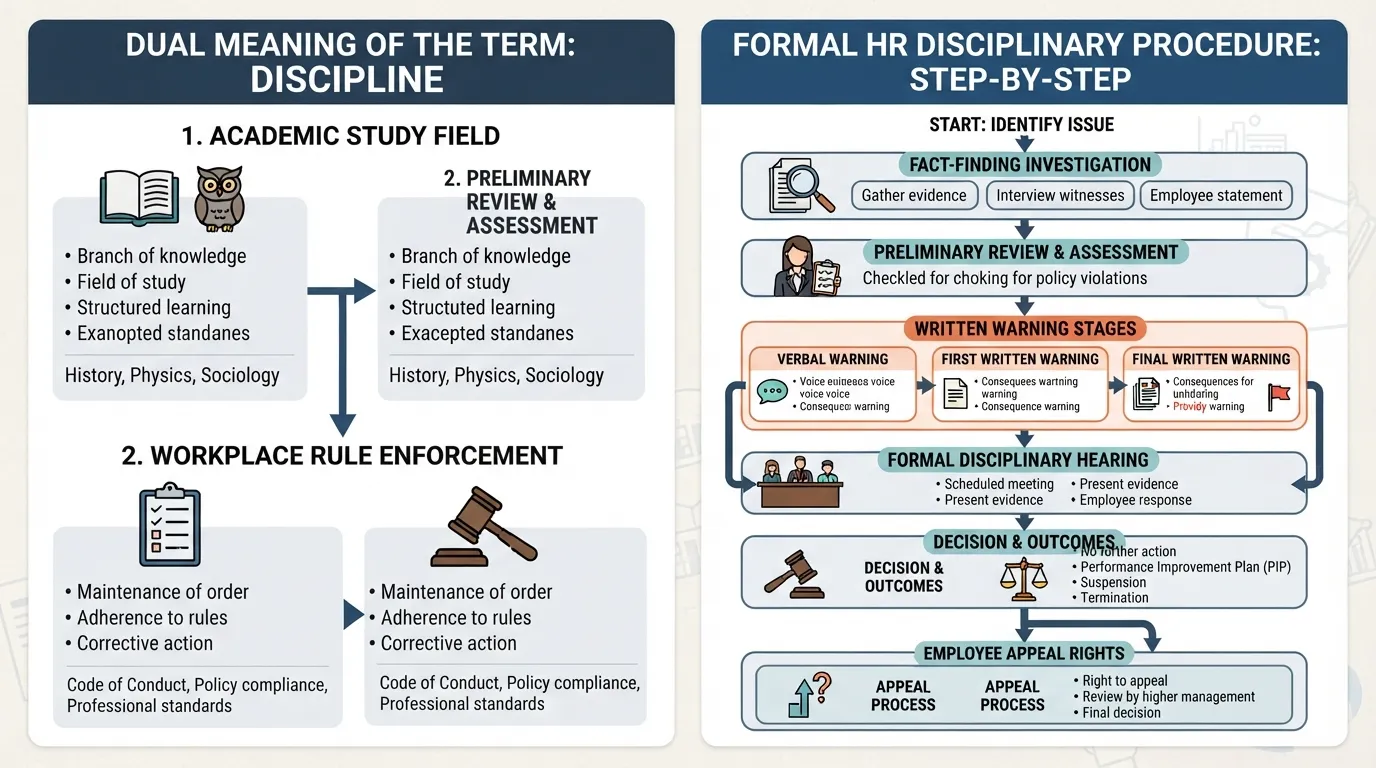
Disciplinary primarily functions as an adjective relating to the enforcement of rules, organizational standards, or a specific branch of instruction. It frequently describes actions taken to correct behavior, maintain order, or manage professional and academic conduct.
Disciplinary Meaning in One Sentence
The term disciplinary describes measures, actions, or procedures implemented to enforce compliance with established rules, correct improper behavior, or govern specialized academic and professional fields.
Word Origin (from “Discipline”)
Derives from the Latin root disciplina, meaning instruction, knowledge, or training.
Evolves from discipulus, meaning pupil or follower, connecting the concept directly to learning and guidance.
Historically shifted from denoting general teaching and branch of instruction toward the enforcement of correction and systemic rules.
Part of Speech (Adjective)
Functions grammatically to modify nouns such as action, committee, procedures, or measures.
Connects directly to core entities like discipline, rules, and correction.
Contrasts with the noun form by focusing on the active, governing property of an institutional system rather than the body of knowledge itself.
The Two Core Meanings of "Disciplinary"
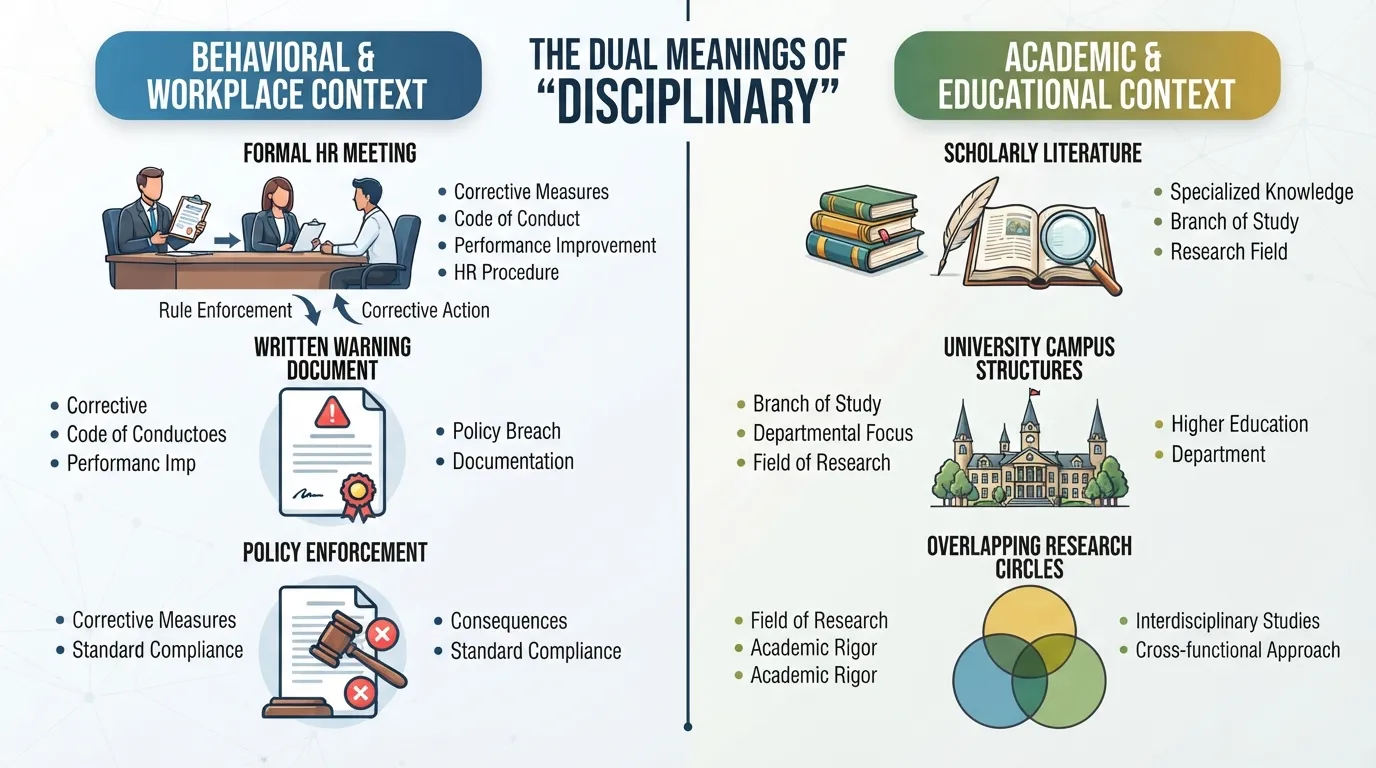
The term “disciplinary” splits into two distinct semantic contexts depending on whether it is used in a behavioral or educational setting. As documented by the Cambridge Dictionary, the word moves fluidly between penal enforcement and academic specialization.
Meaning 1: Punishment & Rule Enforcement (Workplace/School Context)
In professional, legal, or educational environments, disciplinary relates to the correction of misconduct and the enforcement of standards. It governs how institutions penalize behavior that violates codes of conduct.
Disciplinary Action: Formal penalties or measures taken against an employee or student for breaking workplace or school rules.
Disciplinary Hearing: A structured proceeding or meeting where an individual accused of a violation defends their actions before a panel or HR representative.
Common Association: Linked directly to words like punishment, reprimand, suspension, and regulatory compliance.
Meaning 2: Academic Field of Study (e.g., “Interdisciplinary,” “Disciplinary Knowledge”)
In educational and research contexts, disciplinary refers to a distinct branch of knowledge, academic study, or professional domain. It defines the boundaries of specialized fields like physics, history, or economics.
Disciplinary Expertise: Specialized knowledge, methods, and frameworks native to a specific academic field of study.
Interdisciplinary/Cross-disciplinary: Terms describing collaborative efforts or research that bridge two or more distinct academic fields.
Common Association: Linked to curriculum design, scholarly literature, methodologies, and peer review structures.
How to Know Which Meaning Applies in a Sentence
Determining which context applies requires looking closely at the modified noun and surrounding subject matter.
Check the Nouns: If “disciplinary” precedes words like action, hearing, committee, measures, or code, it refers to rule enforcement and penalties.
Examine the Academic Scope: If it modifies words like boundaries, knowledge, expertise, approach, or combines with prefixes like cross- or inter-, it relates to an academic field of study.
Disciplinary Action at Work — What It Actually Means
A disciplinary action at work is a formal HR process implemented by an employer to address and correct employee misconduct, performance failures, or policy violations. It serves as a structured corrective measure rather than an immediate termination [00:19], protecting workplace standards.
Definition of Disciplinary Action in Employment Context
Establishes a formal protocol for employers to document and penalize workplace infractions [00:28].
Provides employees with a clear notification of substandard behavior or rules broken [00:34].
Aims to modify and rehabilitate employee conduct [00:19] before resorting to dismissal.
Common Reasons Employers Issue Disciplinary Action
Chronic Lateness or Absenteeism: Failing to adhere to required shift timings and attendance policies without notice.
Insubordination: Refusing to obey reasonable instructions given by management or supervisors.
Policy Violations: Breaching company guidelines regarding safety, harassment, confidentiality, or use of company equipment.
Verbal Warning vs Written Warning vs Formal Disciplinary
Verbal Warning: An informal, documented discussion between a manager and employee [00:19] to address minor first-time issues.
Written Warning: A formal document placed in the employee’s HR file detailing the specific infraction and consequences of repetition.
Formal Disciplinary Hearing: A high-stakes proceeding involving HR, management, and the employee to determine penalties like suspension or demotion.
Real Workplace Example / Scenario
Imagine a scenario where an employee repeatedly misses project deadlines without communication. The manager first issues a verbal reminder, followed by a formal written warning outlining performance expectations. If the behavior continues, HR initiates a formal disciplinary meeting to review contract terms and decide on final employment sanctions.
The Disciplinary Procedure — Step-by-Step Process
A formal disciplinary procedure follows a structured, legally sound HR process designed to handle workplace grievances and behavioral issues fairly. Every organization relies on these transparent steps to protect both employer rights and employee due process.
Step 1: Investigation
The employer initiates a fact-finding inquiry to gather objective evidence, witness statements, and documentation regarding the alleged incident [00:21].
Management determines whether there are grounds substantial enough to proceed with a formal disciplinary process.
Step 2: Disciplinary Meeting/Hearing Invitation
The employee receives a formal written notice outlining the specific allegations, potential consequences, and the time and place of the upcoming hearing.
The notice grants the employee adequate time to prepare a defense and secure representation or a companion.
Step 3: The Disciplinary Hearing Itself
Both parties review the gathered evidence, and the employee is given a full opportunity to present their side of the story and offer mitigating factors.
An impartial manager or HR representative oversees the proceedings to ensure fairness and adherence to company policy.
Step 4: Outcome & Written Decision
Management evaluates all presented facts and issues a formal outcome letter detailing the decision, whether it involves dismissal, a final warning, or no action.
If sanctions are applied, the letter outlines the exact duration of the warning and required performance improvements.
Step 5: Right to Appeal
The employee retains the formal right to challenge the disciplinary outcome if they believe the process was biased, unfair, or handled incorrectly.
A separate, higher-level manager or independent panel reviews the appeal to uphold, modify, or overturn the original decision.
Does a Disciplinary Mean You'll Be Fired?
Receiving a disciplinary notice does not automatically mean you will be fired. In most professional settings, a disciplinary process acts as a corrective measure designed to address performance or behavioral issues before any employment contract is terminated.
Disciplinary vs Termination: Key Differences
Disciplinary Action: A structured administrative process aimed at correcting, coaching, and warning an employee about policy breaches or substandard performance.
Termination: The complete severance of the employment relationship, which only occurs after lower-level warnings fail or when severe violations take place.
Core Contrast: While a disciplinary procedure can lead to firing, its primary goal is behavioral rehabilitation rather than immediate job loss.
When Does a Disciplinary Lead to Dismissal?
Gross Misconduct: Severe offenses like theft, fraud, physical violence, or extreme insubordination can bypass standard warnings and result in instant summary dismissal.
Repeated Infractions: Failing to correct behavior after receiving multiple verbal or written warnings demonstrates a persistent disregard for company standards.
Unresolved Performance Issues: Failing to meet mandatory performance improvement plan targets over an extended timeframe despite active HR support.
Levels of Disciplinary Outcomes (Warning → Final Warning → Dismissal)
Stage 1 (First Written Warning): Issued for minor or first-time policy infractions, serving as an official notice recorded in your HR file.
Stage 2 (Final Written Warning): Triggered if similar misconduct occurs again or if initial performance issues persist, signaling that employment is in jeopardy.
Stage 3 (Dismissal or Sanction): The final stage where management decides between demotion, suspension, or termination based on the severity of the unresolved issue.
How Long Does a Disciplinary Stay on Your Record?
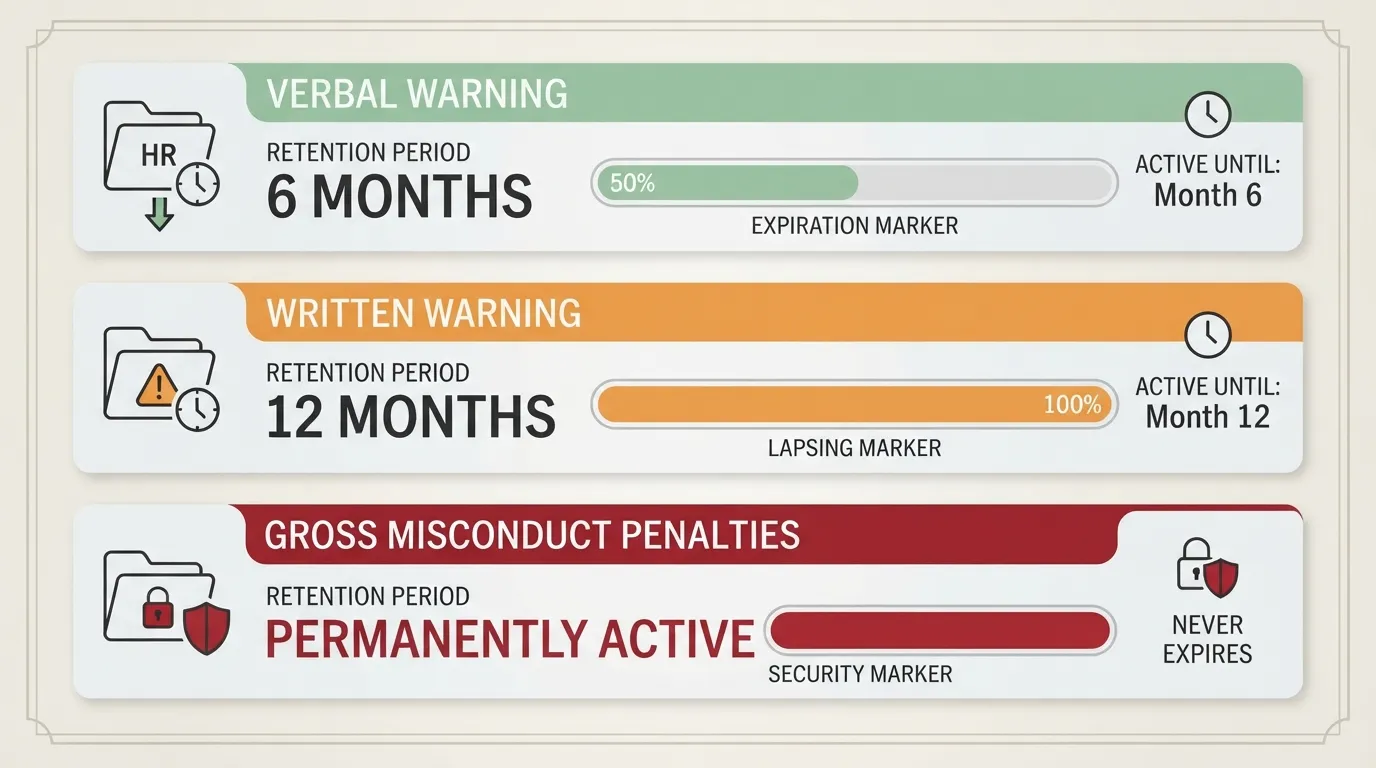
A disciplinary record remains in your personnel file for a predetermined retention period defined by company policy and local labor regulations. Most standard warnings expire over time provided no further infractions occur.
Typical Retention Periods (6 Months / 12 Months / Permanent for Gross Misconduct)
Verbal Warnings: Typically expire and become inactive after 6 months of satisfactory conduct and improved performance.
Written Warnings: Generally remain active in your personnel file for 12 months before being disregarded for future disciplinary steps.
Gross Misconduct Penalties: Final warnings or records involving severe violations can remain permanently or stay active for extended periods depending on internal legal frameworks.
Does It Affect Future Job References?
Standard Practice: Many human resources departments only disclose dates of employment and job titles, omitting past internal warnings.
Open Disclosure Policies: Certain employers legally include active disciplinary records or reasons for dismissal in professional references if requested by future employers.
Expired Warnings: Once a disciplinary warning lapses past its retention period, it generally cannot be used or disclosed in formal reference checks.
Can a Disciplinary Record Be Removed Early?
Appeals and Overturns: A record can be expunged immediately if an employee successfully appeals the decision and proves the warning was unjustified.
Discretionary Review: Employers occasionally agree to remove a warning early if the employee demonstrates exceptional performance improvement and rehabilitation.
Policy Limitations: Most organizations maintain strict document retention schedules that prevent premature removal unless specific legal or contractual criteria are met.
Can You Quit Before a Disciplinary?

You are legally permitted to resign before a disciplinary hearing takes place, provided you fulfill your contractual notice period. However, stepping down preemptively does not erase the situation or automatically protect your professional reputation.
Is Resigning Before a Disciplinary Hearing Allowed?
Every employee holds the right to resign from their position at any time by submitting formal notice according to their employment contract.
Management cannot legally force you to stay employed solely to subject you to a disciplinary hearing.
Choosing to resign immediately terminates your active employment status, but it shifts how the final exit is documented.
Pros and Cons of Resigning Early
Potential Benefit: Resigning allows you to bypass the stress of a formal disciplinary hearing and avoid an immediate dismissal on your record.
Major Risk: Many employers will note on your personnel file that you resigned while under active disciplinary investigation.
Loss of Defense: Leaving early prevents you from clearing your name or presenting evidence that could have resulted in a lesser outcome, such as an exoneration or warning instead of termination.
Does Resigning Stop the Disciplinary Process?
Internal Proceedings: Most companies will halt formal disciplinary hearings once a resignation is submitted because the employment relationship is already ending.
Continuation in Severe Cases: For allegations of gross misconduct, financial fraud, or regulatory breaches, certain organizations continue the internal process to establish factual findings.
Impact on References: An ongoing or completed disciplinary investigation often influences future reference checks, meaning resignation does not always secure a clean slate.
How HR Handles Disciplinary Action
The HR department handles disciplinary actions by ensuring that internal company policies are applied consistently, fairly, and in compliance with labor laws. Human resources acts as an impartial facilitator between management and employees to safeguard corporate standards and due process.
Role of HR in the Disciplinary Process
Advises management on appropriate corrective actions and ensures consistency across different departments [00:11].
Manages official documentation, schedules hearings, and coordinates objective investigations.
Protects the organization from legal liability by guaranteeing that employees receive fair treatment and clear communication.
What Is a Disciplinary Action Report? (With Example Structure)
A disciplinary action report is a formal HR document that records an employee’s policy violation, performance failure, or behavioral misconduct. It creates a paper trail required for legal and administrative compliance.
Employee & Incident Details: Captures employee name, title, department, manager name, and the exact date of the infraction.
Description of Violation: Outlines the specific rule broken [00:11] or performance metric missed, supported by objective evidence.
Action Plan & Consequences: Details the required behavioral changes, timeline for improvement, and penalties if expectations are unmet.
Signatures: Includes formal acknowledgment signatures from the employee, manager, and HR representative.
Employee Rights During HR Investigation
Right to Notice: Employees must receive advance written notice detailing the specific allegations against them before any formal hearing.
Right to Representation: Employees are generally entitled to bring a coworker, union representative, or legal companion to disciplinary meetings.
Right to Respond: Employees must be given full opportunity to present their side of the story, offer counter-evidence, and explain mitigating circumstances.
Synonyms and Related Terms for "Disciplinary"
Finding the right alternative for “disciplinary” depends heavily on whether your sentence refers to rule enforcement or academic structure. Selecting the precise synonym ensures your professional and technical writing remains accurate.
Common Synonyms (Punitive, Corrective, Penal)
Corrective: Focuses on rehabilitation and improving behavior rather than administering punishment.
Punitive: Relates directly to punishment, penalties, and strict enforcement of rules for infractions.
Penal: Refers specifically to legal or institutional punishments, often carrying a more formal or criminal weight.
Regulatory: Pertains to the enforcement of established industry standards, compliance codes, and governance frameworks.
How Context Changes Which Synonym Fits Best
For Workplace Policies: Use corrective when describing coaching sessions or performance improvement plans aimed at fixing an issue.
For Severe Infractions: Use punitive or penal when discussing strict legal penalties, fines, or official reprimands for major policy breaches.
For Institutional Standards: Use regulatory or reformative when talking about compliance protocols, systemic guidelines, or organizational governance.
Frequently Asked Questions
How Serious Is a Disciplinary at Work?
A workplace disciplinary is moderately to very serious depending on the stage of the process. Initial verbal or written warnings serve primarily as corrective coaching, while formal hearings or final written warnings indicate that your continued employment is at risk if performance or behavior fails to improve.
What Happens During a Disciplinary Meeting?
During a disciplinary meeting, management and HR present evidence of the alleged misconduct or performance failure. The employee is given the opportunity to respond, present counter-evidence, explain mitigating circumstances, and have a representative or companion present.
What Is Official Disciplinary Action?
Official disciplinary action is a formal, documented intervention taken by an employer against an employee for violating company policies, safety rules, or performance standards. It includes documented warnings, formal hearings, suspension, demotion, or termination.
Will a Disciplinary Affect Future Employment?
An expired standard warning typically does not affect future employment or standard background checks. However, active warnings, final written warnings, or dismissals resulting from gross misconduct can be disclosed in professional references if company policy permits.
What Is Disciplinary Action in the Workplace?
Disciplinary action in the workplace is a structured HR process used to address and correct employee misconduct, policy breaches, or poor performance. Its primary goal is to guide the employee back to expected standards of workplace conduct rather than immediate termination.
Key Takeaways / Conclusion
Understanding the term “disciplinary” requires looking at its dual context across rule enforcement and academic specialization. Whether navigating a professional workplace policy or studying cross-disciplinary academic frameworks, recognizing these core definitions ensures clear communication.
Disciplinary Meaning at a Glance
Behavioral Context: Relates to the enforcement of rules, correction of misconduct, and administration of formal workplace warnings or hearings.
Academic Context: Pertains to specialized branches of knowledge, scholarly fields of study, and interdisciplinary research frameworks.
Core Purpose: Designed to provide structured guidance, maintain organizational standards, and foster professional or academic growth.
What to Do If You’re Facing a Disciplinary
Review Company Policy: Carefully read your employee handbook to understand the exact steps and your rights during the procedure.
Gather Documentation: Collect emails, project logs, or witness statements that support your side of the situation.
Attend with a Companion: Exercise your right to bring a union representative or colleague to help keep the process objective and fair.