Business Accountability: The Definitive Guide to Building a Culture of Ownership

What Is Business Accountability?
Business accountability is the foundational organizational commitment where individuals, teams, and leadership take complete ownership of their decisions, actions, and resulting outcomes. It bridges strategic planning with execution, ensuring that performance aligns directly with established ethical standards, operational goals, and stakeholder expectations.
Business Accountability: A Clear, Simple Definition
At its core, business accountability means being answerable for both success and failure without deflecting blame. Organizations achieve true accountability when every team member understands their obligations and accepts the direct consequences of their performance.
Ownership of Outcomes: Moving past task completion to embrace the ultimate business results of those tasks.
Ethical Alignment: Ensuring all operational decisions adhere strictly to internal codes of conduct and legal guidelines.
Performance Transparency: Maintaining open channels where metrics, successes, and setbacks are clearly visible to stakeholders.
Accountability transforms a workplace from a collection of isolated tasks into a cohesive, goal-oriented ecosystem where trust and reliability drive daily progress.
Accountability vs. Responsibility: What’s the Real Difference?
While often used interchangeably, responsibility and accountability represent distinct organizational dynamics. Understanding this difference prevents role ambiguity and ensures smoother project execution.
| Feature | Responsibility | Accountability |
| Core Meaning | The obligation or duty to complete a specific task. | The absolute ownership of the final outcome. |
| Delegation | Can be shared or delegated across multiple team members. | Cannot be shared; rests with a single individual. |
| Timing | Focuses on the doing phase of a project. | Focuses on the results phase after completion. |
| Focus | Input-driven (doing the work). | Output-driven (owning the success or failure). |
Internal Accountability vs. External Accountability
Business accountability operates on two distinct fronts: internal dynamics within the organization and external obligations to outside entities. Balancing both dimensions is critical for long-term corporate sustainability and risk management.
Internal Accountability:
Focuses on peer-to-peer alignment, employee performance, and adherence to company culture.
Reinforced through routine internal audits, transparent performance reviews, and management check-ins.
Drives day-to-day operational efficiency and team trust.
External Accountability:
Focuses on fulfilling promises made to customers, investors, partners, and regulatory bodies.
Governed by external/regulatory obligations, industry compliance frameworks, and legal standards.
Protects the organization’s legal standing, market reputation, and stakeholder confidence.
Why Business Accountability Matters (The Data-Backed Case)
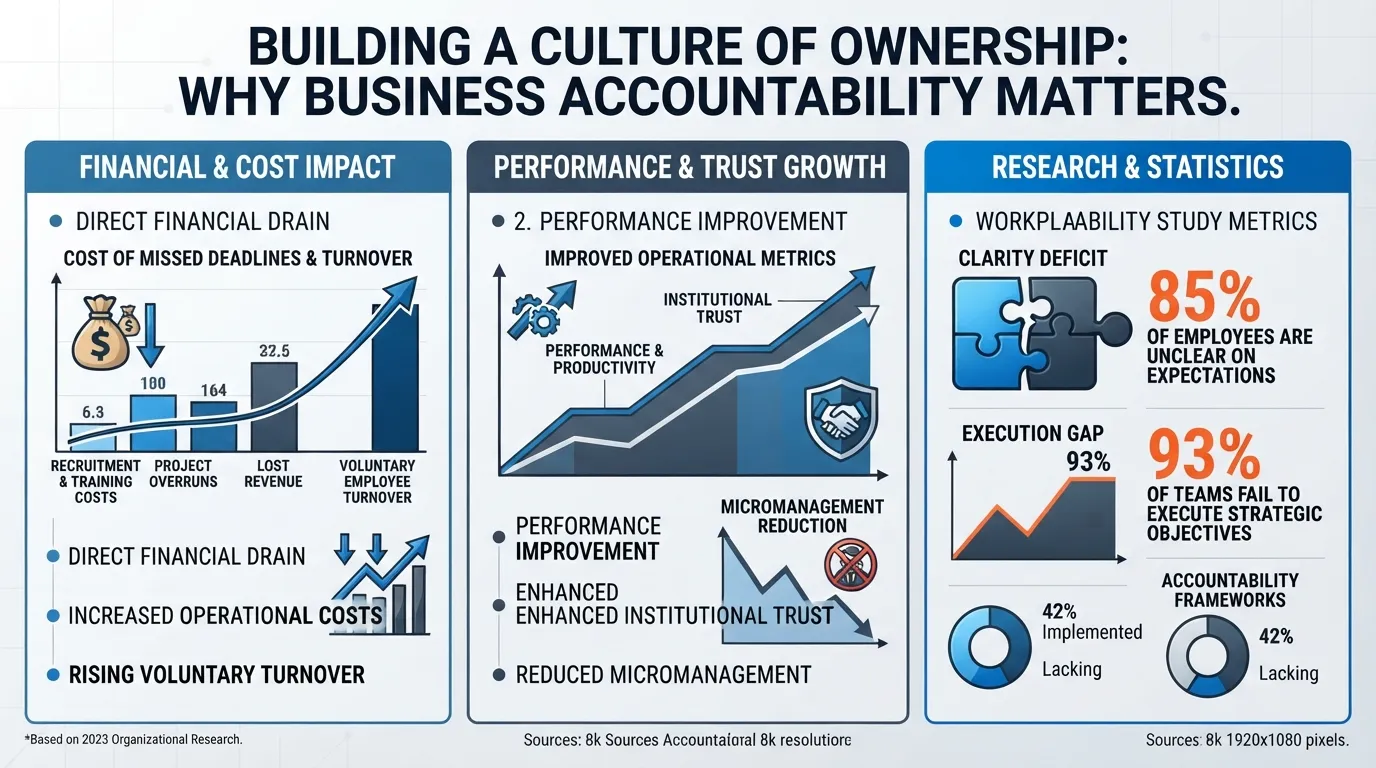
Business accountability is critical because it directly dictates organizational survival, execution speed, and financial stability. Without explicit accountability frameworks, companies suffer from systemic strategic drift, eroded trust, and inflated employee turnover.
The Real Cost of Low Accountability in Business
When accountability is absent, organizations experience immediate operational decay that bleeds into the bottom line. Missed deadlines become normalized, finger-pointing replaces problem-solving, and top performers burn out from carrying unowned weights.
Financial Drain: Projects routinely exceed budgets when deliverables lack a single clear owner to manage scope creep.
Voluntary Turnover: High performers leave toxic, low-accountability environments where underperformers face no consequences.
Execution Gridlock: Missed deadlines accumulate, stalling product launches and delaying market responses.
Key Benefits: Performance, Trust, and Reduced Micromanagement
Establishing a strong culture of accountability unlocks powerful compounding advantages across every tier of an enterprise. It shifts the corporate environment from reactive chaos to proactive execution.
Performance Improvement: Teams hitting goals consistently because roles, milestones, and metrics are transparently tracked.
Trust Building: Employees trusting leadership to be fair, transparent, and consistent in how success and failure are handled.
Reduced Micromanagement: Leaders stepping back from daily task monitoring because ownership is decentralized and trusted.
What the Research Says (Statistics on Workplace Accountability Gaps)
Data reveals a profound corporate disconnect regarding how accountability functions day-to-day. Comprehensive organizational research highlights deep gaps in clarity, alignment, and execution across teams.
The Clarity Deficit: Landmark organizational research documented in the Workplace Accountability Study revealed that 85% of survey participants were unsure what their organizations were ultimately trying to achieve.
SlideshareThe Execution Failure: The same study showed that 93% of surveyed professionals were unable to successfully align their daily work or take complete accountability for core strategic results.
SlideshareThe Feedback Vacuum: Over 80% of workers reported that performance feedback only surfaces when things go wrong, proving that proactive, developmental accountability is missing.
Slideshare
Types and Frameworks of Accountability in Business Management
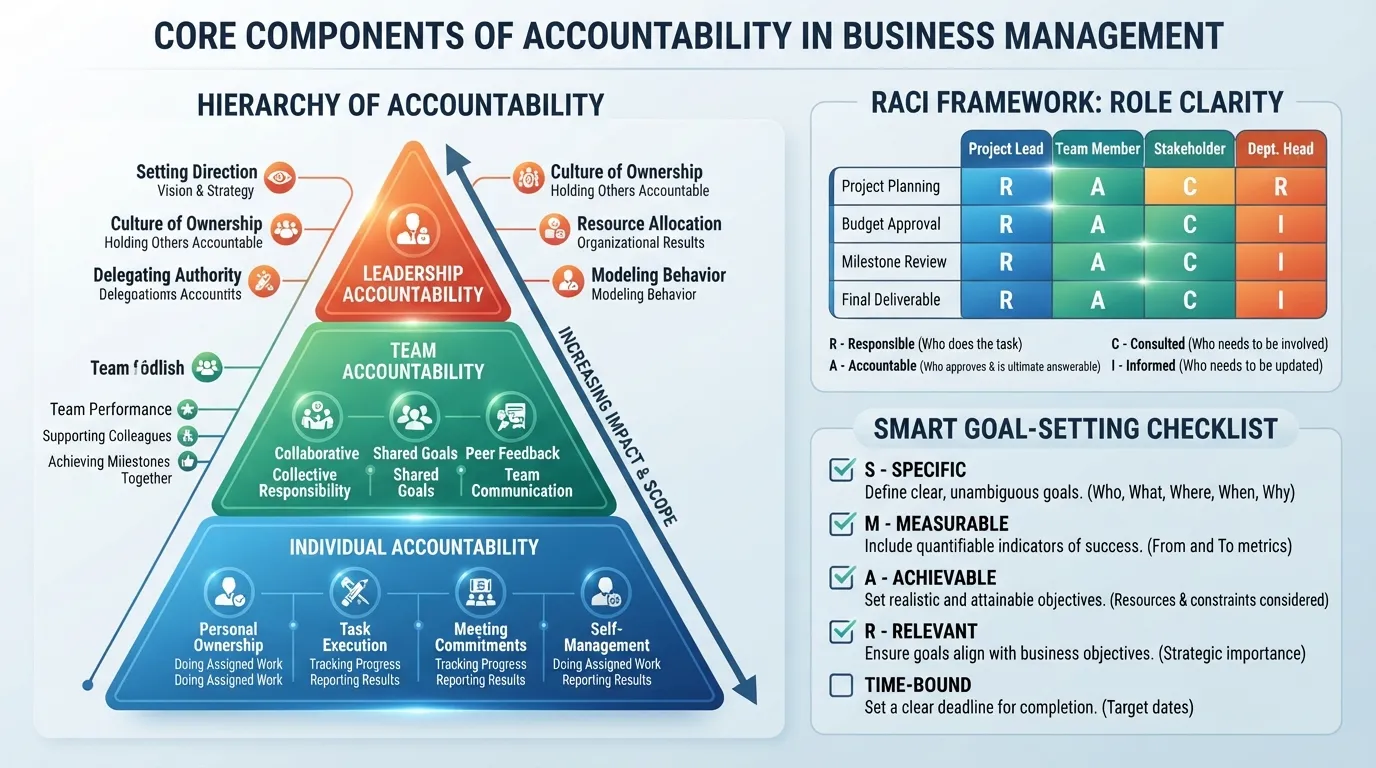
Business management accountability operates across multiple structural layers, requiring deliberate frameworks to maintain alignment and ownership. Implementing structured execution frameworks ensures that strategy translates seamlessly into daily tasks without role confusion.
Individual Accountability
Individual accountability forms the bedrock of organizational execution, focusing on a single person’s dedication to their specific duties. When employees embrace individual ownership, they track their own performance metrics and proactively solve blockers.
Self-Directed Tracking: Employees monitor their key performance indicators without waiting for managerial reminders.
Personal Integrity: Owning up to mistakes immediately and proposing corrective solutions rather than making excuses.
Task Mastery: Taking the initiative to bridge skill gaps required to meet assigned performance standards.
Team Accountability
Team accountability shifts the focus from individual heroics to collective collaboration, ensuring entire units share the burden of success or failure. This dimension prevents siloed mentalities and encourages peer-to-peer support.
Peer-to-Peer Review: Team members hold one another to established timelines, quality standards, and team norms.
Shared Objectives: Aligning daily group efforts toward unified departmental milestones rather than fragmented tasks.
Collective Problem-Solving: Addressing project bottlenecks together as a unit rather than deflecting responsibility across departments.
Leadership/Organizational Accountability
Leadership and organizational accountability set the ethical and operational tone from the top down. Executives and managers must demonstrate total transparency, accepting the ultimate consequences of corporate strategy and resource allocation.
Resource Provision: Ensuring teams have the necessary tools, budgets, and training to succeed before assigning goals.
Transparent Communication: Openly sharing company performance, financial realities, and strategic shifts with all employees.
Walking the Talk: Demonstrating the same behavioral and ethical standards expected from junior staff members.
The RACI Model Explained (Responsible, Accountable, Consulted, Informed)
The RACI model is a premier operational matrix designed to eliminate ambiguity by defining precise roles for every project task. Utilizing this ownership structure ensures that every initiative has absolute clarity on who is doing the work versus who owns the outcome.
Responsible (R): The person or team who actually executes the task and gets the work done.
Accountable (A): The single decision-maker who has final ownership and veto power over the outcome. (Remember: Only one “A” can be assigned per task).
Consulted (C): Subject matter experts whose input and feedback are actively sought before finalizing decisions.
Informed (I): Stakeholders who are kept updated on project progress, milestones, and completed deliverables.
Goal-Setting Frameworks That Support Accountability (SMART Goals)
Structured goal-setting frameworks provide the objective measuring stick required to make accountability enforceable. Vague goals destroy accountability, whereas precise targets make performance tracking objective and indisputable.
Specific: Defining precise objectives so there is zero confusion about what needs to be accomplished.
Measurable: Establishing quantifiable metrics and indicators to track progress objectively over time.
Achievable: Setting realistic benchmarks that stretch teams while remaining attainable given current constraints.
Relevant: Ensuring every goal directly aligns with broader organizational priorities and growth strategies.
Time-Bound: Imposing strict deadlines and milestones to create urgent execution focus.
The Pillars, C's, and Qualities of Accountability
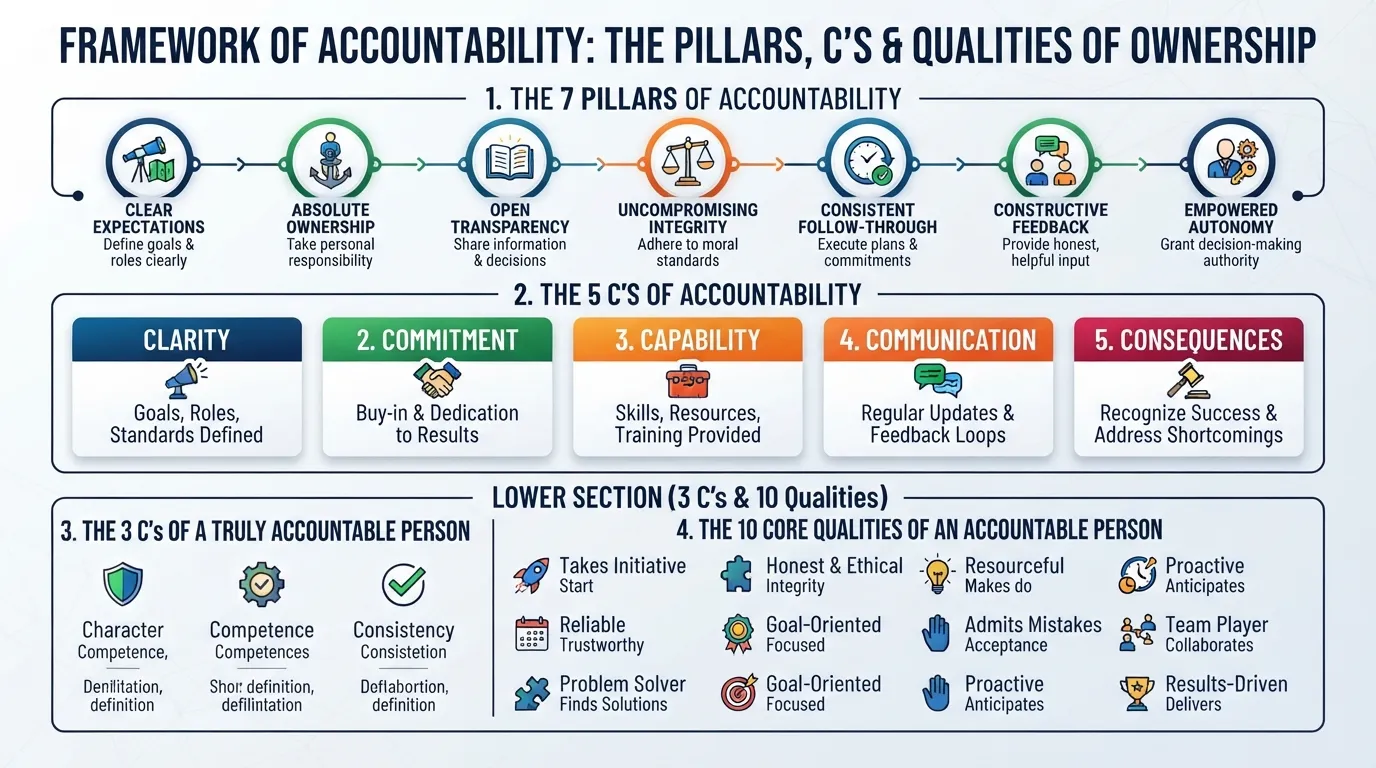
Strong organizational accountability relies on structured frameworks that break abstract concepts down into daily habits. Defining these core dimensions ensures leaders and teams have actionable roadmaps to measure and improve personal ownership.
The 7 Pillars of Accountability
The seven pillars of accountability form the structural framework necessary to sustain a high-performance culture across any organization. Building these pillars prevents confusion and aligns individual tasks with overarching corporate strategy.
Clear Expectations: Establishing unambiguous definitions of success, explicit deadlines, and targeted deliverables before any project begins.
Absolute Ownership: Accepting total responsibility for outcomes, eliminating finger-pointing, and treating every result as a reflection of personal effort.
Open Transparency: Maintaining full visibility into workflows, project blocks, and performance metrics so stakeholders remain completely informed.
Uncompromising Integrity: Aligning daily actions with stated company values and ethical standards, even when facing difficult business pressures.
Consistent Follow-Through: Delivering on promises reliably and maintaining momentum until tasks are fully completed to standard.
Constructive Feedback: Fostering a continuous improvement loop where mistakes are analyzed objectively and used as developmental milestones.
Empowered Autonomy: Giving team members the freedom to choose how they execute their work as long as they deliver on the agreed-upon outcomes.
The 5 C’s of Accountability
The five C’s framework provides a memorable operational model that managers use to evaluate, coach, and reinforce accountability habits within their teams.
Clarity: Ensuring every team member understands their specific role, scope of authority, and expected targets.
Commitment: Securing genuine buy-in from individuals rather than forcing compliance through top-down mandates.
Capability: Verifying that employees possess the necessary skills, training, and resources to successfully fulfill their duties.
Communication: Keeping communication channels open and frictionless for reporting progress, obstacles, and pivot points.
Consequences: Establishing predictable, fair outcomes for both high performance and missed commitments to maintain operational standards.
The 3 C’s of Accountability
A streamlined variation of accountability management, the three C’s focus on the fundamental behavioral triad required for individual reliability.
Character: Demonstrating honesty, moral strength, and dependability in all professional interactions and decisions.
Competence: Backing good intentions with the technical skills and industry knowledge required to execute tasks properly.
Consistency: Delivering predictable, stable high-quality output over time rather than sporadic bursts of performance.
10 Qualities of a Truly Accountable Person
Spotting and cultivating accountability in individuals comes down to observing specific behavioral traits that separate high-ownership professionals from passive workers.
Takes the Initiative: Solves problems proactively without waiting for management to point out an issue.
Owns Mistakes Instantly: Admits errors openly and immediately shifts focus toward finding a practical solution.
Avoids Excuses: Resists the urge to blame external market forces, bad luck, or other departments for setbacks.
Honors Deadlines: Treats time commitments as sacred and communicates early if unexpected delays threaten a milestone.
Seeks Feedback Actively: Welcomes constructive criticism and uses performance reviews as tools for genuine growth.
Maintains Composure: Stays calm and solution-oriented when facing high-pressure crises or shifting project scopes.
Supports Peers: Holds teammates accountable with respect and steps in to help when collaborative goals are at risk.
Demonstrates Resilience: Bounces back quickly from failure without losing momentum or confidence.
Practices Self-Reflection: Regularly audits their own performance to identify blind spots and areas for improvement.
Drives Results: Focuses relentlessly on final business outcomes rather than just checking off busywork.
How to Build a Culture of Accountability in Your Business
Building an enduring culture of accountability requires an intentional blend of soft skills, structured workflows, and leadership commitment. Rather than happening organically, accountability is engineered through transparent processes that eliminate ambiguity and empower teams to own their outcomes.
Step 1: Define Clear Roles and Expectations
Accountability collapses when employees do not know where their boundaries begin and end. Leaders must establish explicit job scopes, precise deliverables, and standard operating procedures before project execution starts.
Documented Ownership: Every major workflow or project milestone must map back to one single named owner.
Eliminating Gray Areas: Prevent overlapping duties that allow team members to assume someone else is handling critical components.
Accessible Knowledge Bases: Centralize operational guidelines so employees can verify expectations independently at any time.
Step 2: Set Measurable Goals and Metrics (KPIs for Accountability)
Vague objectives make accountability impossible to enforce objectively. Establishing rigorous key performance indicators turns subjective performance reviews into data-driven alignment check-ins.
Output-Oriented KPIs: Measure results rather than tracking hours spent or busywork completed.
Quantitative Benchmarks: Set clear numerical targets so both managers and staff can instantly gauge success.
Progress Dashboards: Maintain shared, real-time dashboards so performance metrics remain visible to the entire team.
Step 3: Model Accountability From Leadership Down
Teams mirror the behavior of their leadership; executive hypocrisy destroys accountability faster than any operational failure. Leaders must hold themselves to the exact same performance, communication, and ethical standards they demand from staff.
Own Executive Mistakes: Publicly acknowledge leadership missteps rather than deflecting blame onto market conditions or junior staff.
Fulfill Commitments: Deliver on promises made to the team reliably to build foundational institutional trust.
Operational Reciprocity: Ensure management is just as accountable to supporting the team as the team is to management.
Step 4: Create a Safe, Blame-Free Environment for Mistakes
Fear of harsh punitive action drives employees to hide errors, pass blame, and dodge accountability. Establishing psychological safety encourages transparency, allowing teams to flag and fix issues early.
Growth Mindset Framing: Treat mistakes as data-driven learning opportunities rather than occasions for punishment.
Encourage Early Disclosure: Reward employees who report blockers or failures immediately instead of waiting until deadlines pass.
Focus on Process Fixes: Analyze why a failure occurred within the system before questioning individual competence.
Step 5: Use Regular Check-ins and Feedback Loops
Accountability requires continuous maintenance through structured communication cadences. Consistent check-ins prevent minor misalignments from compounding into major project failures.
Weekly Alignment Syncs: Review progress against established KPIs in regular, brief one-on-one or team meetings.
Constructive Reciprocity: Offer real-time developmental feedback while actively welcoming upward critique from team members.
Course Correction: Adjust workflows promptly during check-ins when external factors threaten original timelines.
A Real-World Example: What Accountability Looks Like in Practice
To see how these principles operate in a scaling organization, explore the strategies discussed in this breakdown on team ownership:
When an enterprise successfully embeds these steps, delegation transforms from a source of anxiety into a seamless operational rhythm. As highlighted at [02:13], when executives and team members are mutually accountable to one another, everyday friction dissolves, replaced by absolute operational trust.
Signs of a Lack of Accountability
Recognizing the early warning signs of eroding accountability allows managers to intervene before operational performance degrades. When ownership disappears, organizations inevitably slip into reactive chaos, finger-pointing, and systemic stagnation.
Common Warning Signs in Employees
When individual and team ownership breaks down, everyday behaviors shift from proactive problem-solving to passive avoidance. Spotting these red flags early helps managers address cultural decay before it spreads across departments.
Chronic Blame-Shifting: Automatically pointing fingers at other departments, external market forces, or bad luck whenever a deadline is missed.
Rampant Missed Deadlines: Treating promised delivery dates as flexible suggestions rather than binding commitments.
Passivity and Waiting: Sitting idle when roadblocks arise instead of taking initiative to find solutions or communicate blockers.
Hiding Mistakes: Sweeping errors under the rug out of fear, leading to larger, cascading operational failures down the line.
Common Warning Signs in Leadership
Accountability failures at the top trickle down rapidly, poisoning the entire organizational culture. Executive teams display distinct warning signs when they lose touch with operational ownership.
Playing Favorites: Exempting high-revenue producers or long-tenured staff from the rules and standards enforced on others.
Passing the Buck: Blaming lower-level employees or general economic conditions for strategic miscalculations made by the executive suite.
Micromanagement Loops: Hovering obsessively over daily tasks because leadership fundamentally mistrusts whether teams will execute work correctly.
Lack of Follow-Through: Making sweeping promises during company-wide meetings but failing to deliver on structural improvements or resources.
Common Barriers That Cause Accountability to Break Down
Accountability rarely fails because people are inherently malicious; instead, it collapses due to structural and cultural roadblocks. Identifying these core barriers allows organizations to fix the root causes of dysfunction.
Unclear Expectations: Vague job descriptions and ambiguous project scopes that make it impossible to determine who owns specific outcomes.
Toxic Blame Culture: Punishing honesty and failure so harshly that employees learn to protect themselves by hiding errors rather than fixing them.
Fear of Failure: Stifling innovation and proactive decision-making because the penalty for falling short outweighs the reward for trying.
Poor Communication: Siloed information flow and broken feedback loops that leave teams blind to changing priorities and performance standards.
Real-World Examples of Accountability and Responsibility at Work
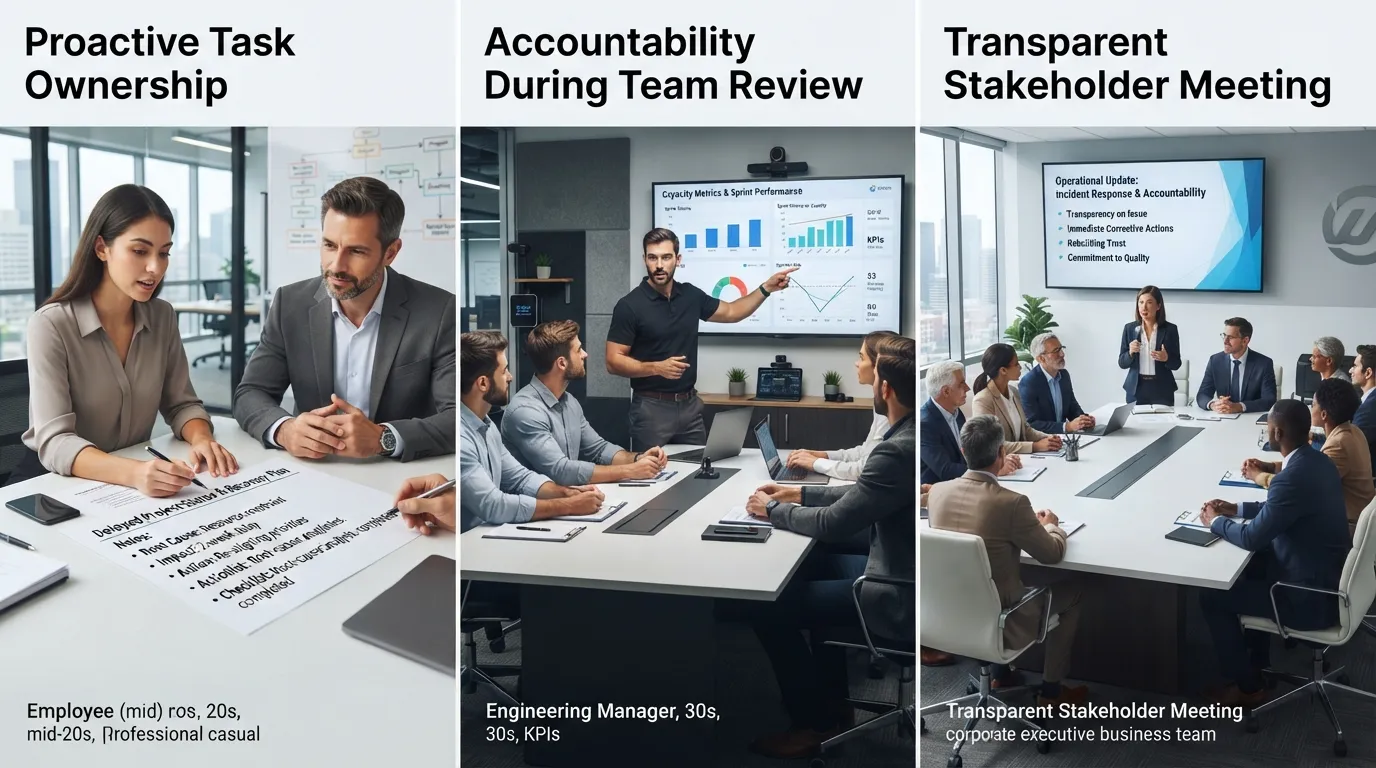
Understanding how accountability and responsibility function in daily professional life requires concrete scenarios. Examining practical workplace examples clarifies the exact behavioral difference between completing a task and owning an outcome.
Example 1: An Employee Taking Ownership of a Missed Deadline
An illustrative example of individual accountability involves a marketing specialist who misses a major campaign launch date.
The Responsibility (The Task): The specialist’s core duty was drafting and scheduling email copy for the product release.
The Breakdown: Due to poor time management, the final email batch went live twelve hours late, causing minor friction with the sales team.
The Accountability Action: Instead of blaming IT server lags or copywriting delays from a freelancer, the specialist scheduled an immediate sync with their manager. They owned the delay explicitly, presented a detailed root-cause analysis, and instituted a personal checklist to ensure future scheduling buffers.
Example 2: A Manager Taking Accountability for Team Performance
Leadership accountability requires looking past individual employee errors to examine systemic support structures.
The Responsibility (The Task): A software engineering manager is responsible for overseeing sprint deliverables and feature updates.
The Breakdown: An entire engineering squad misses three consecutive feature delivery sprints, leading to frustrated stakeholders.
The Accountability Action: Rather than publicly reprimanding or firing junior developers, the manager evaluates their own leadership approach. They realize they assigned an unrealistic scope without verifying resource capability. The manager steps up during the executive review, takes full ownership of the capacity miscalculation, and reorganizes sprint planning with cross-functional stakeholders.
Example 3: Organizational Accountability After a Mistake or Failure
At the highest enterprise level, corporate accountability requires total transparency and public corrective action when product or service failures occur.
The Responsibility (The Task): A financial services firm is tasked with securing client data and maintaining operational uptime.
The Breakdown: A database misconfiguration exposes limited client contact details, though no financial credentials are compromised.
The Accountability Action: Instead of minimizing the incident through opaque PR statements, executive leadership issues immediate, transparent notifications to all affected clients. They publish a complete forensic breakdown of the error, waive platform fees for the quarter as an act of good faith, and undergo an independent external audit to prevent future occurrences.
How to Measure and Write About Accountability (Performance Review Angle)

Measuring accountability transforms an abstract cultural concept into concrete, trackable performance metrics. Integrating accountability into formal performance reviews ensures that ownership becomes a non-negotiable standard for professional evaluation and career advancement.
Metrics and KPIs to Measure Accountability
Tracking accountability requires objective indicators that measure follow-through, independent problem-solving, and outcome ownership. Organizations can evaluate these dimensions using specific, quantifiable metrics.
Deadline Adherence Rate: Tracking the percentage of tasks and projects delivered on schedule without requiring management reminders.
Proactive Issue Escalation: Measuring how quickly employees flag emerging blockers before they spiral into critical failures.
Error Ownership Index: Evaluating how transparently an individual acknowledges mistakes and initiates corrective solutions.
Goal Completion Percentage: Comparing set key performance indicators against actual final outcomes delivered over a quarterly review cycle.
Sample Phrases for an Accountability Performance Review
Writing impactful feedback for employee evaluations requires clear, objective phrasing that highlights ownership behaviors. Managers can utilize these tested statements to capture high accountability during performance reviews.
“Consistently takes total ownership of project outcomes, ensuring every milestone is met without requiring micro-supervision.”
“Demonstrates exceptional reliability by delivering high-quality deliverables on or ahead of schedule, even under tight constraints.”
“Proactively identifies potential operational roadblocks and communicates them early alongside actionable solutions.”
“Accepts constructive feedback gracefully and immediately applies insights to improve future execution.”
Positive Phrases vs. Constructive Feedback Phrases
Balancing praise with developmental guidance helps managers address both high performers and employees struggling with ownership gaps. Using precise language prevents misunderstandings during review discussions.
Positive Evaluation Phrases:
“Takes immediate personal responsibility when errors occur, focusing entirely on resolution rather than deflection.”
“Sets a strong cultural example by honoring commitments and maintaining complete transparency with team members.”
“Drives projects independently from conception to completion with unwavering attention to detail.”
Constructive Feedback Phrases:
“Needs to improve follow-through on promised timelines by communicating delays proactively before deadlines arrive.”
“Should focus on owning the final results of assigned tasks rather than viewing work as simply checking off steps.”
“Must work on minimizing blame-shifting during cross-functional setbacks by focusing on objective problem-solving.”
Frequently Asked Questions
What is the difference between responsibility and accountability in people management?
Responsibility refers to the obligation or duty to complete a specific task and can be shared across multiple team members. Accountability is the absolute ownership of the final outcome and rests with a single individual who cannot delegate or share the ultimate consequences.
What are the advantages of accountability in a business?
Accountability drives performance improvement, builds trust between leadership and staff, reduces the need for micromanagement, minimizes project bottlenecks, and significantly decreases voluntary turnover by establishing clear, fair standards.
How do you keep employees accountable without micromanaging?
Managers can maintain accountability without micromanaging by defining clear expectations upfront, establishing output-oriented key performance indicators (KPIs), fostering psychological safety, and relying on regular progress check-ins instead of hovering over daily tasks.
What does accountability mean to you, and how can you show it daily?
Accountability means taking total ownership of your decisions, actions, and resulting outcomes without making excuses or shifting blame. You can show it daily by honoring deadlines, admitting mistakes instantly, communicating roadblocks early, and proactively proposing solutions.
Making Accountability a Business Advantage
Business accountability is far more than an administrative buzzword or a punitive management tool; it is the fundamental engine that drives sustainable execution, trust, and enterprise growth. When organizations replace ambiguity with clear ownership, they unlock a powerful competitive advantage that sets them apart in crowded markets.
Key Takeaways Recap
Mastering business accountability requires a balanced approach that combines structural clarity with supportive, transparent leadership.
Define Ownership Clearly: Distinguish between tasks (responsibility) and final results (accountability) using operational frameworks like RACI and SMART goals.
Bridge the Performance Gap: Address warning signs of low accountability early by eliminating blame cultures and fostering psychological safety.
Embed Structured Habits: Use regular check-ins, output-oriented KPIs, and objective performance review phrases to reinforce continuous ownership at every level.
Accountability as a Competitive Advantage
Companies that build a resilient culture of ownership do not just survive market volatility—they thrive through it. By holding leadership and teams mutually accountable to the highest standards, you eliminate operational friction, build deep institutional trust, and transform accountability from an obligation into your greatest competitive advantage.