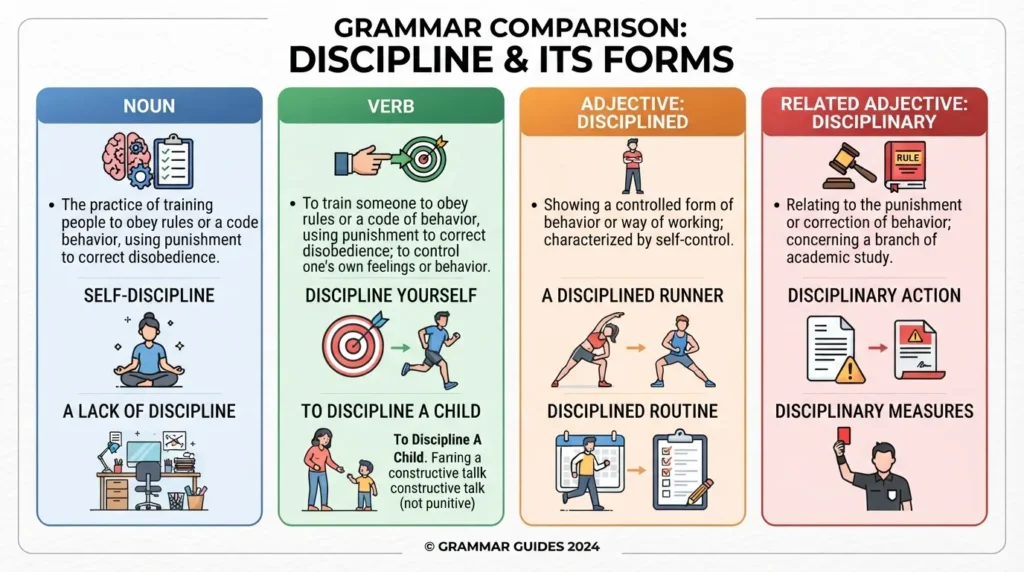
If you’re wondering whether discipline is an adjective, the short answer is no. Discipline is primarily used as a noun and a verb. The adjective forms you are probably looking for are disciplined and disciplinary, but they do not mean exactly the same thing.
The easiest way to understand the difference is to look at how each word functions in a sentence. Once you separate discipline, disciplined, and disciplinary, choosing the right form becomes much easier.
discipline is a noun and a verb; disciplined is an adjective describing someone or something that shows control or follows a method; and disciplinary is an adjective related to rules, punishment, correction, or an academic discipline.
Is Discipline an Adjective?
No. Discipline is not normally an adjective. It is most commonly a noun or a verb.
As a noun, discipline can mean self-control, a system of rules, training, correction, or an area of study. For example, you might say, “She has excellent discipline,” or “Biology is an academic discipline.”
As a verb, discipline means to train, correct, or control someone’s behavior. For example, “Parents may discipline a child for breaking an important rule.”
If you need an adjective to describe a person who demonstrates self-control, disciplined is usually the correct choice.
| Word | Part of Speech | Typical Meaning |
|---|---|---|
| discipline | Noun | Self-control, training, rules, correction, or a field of study. |
| discipline | Verb | To train, control, or correct someone’s behavior. |
| disciplined | Adjective | Showing self-control, order, consistency, or careful behavior. |
| disciplinary | Adjective | Related to discipline, especially rules, correction, punishment, or an academic field. |
What Part of Speech Is Discipline?
Discipline can be both a noun and a verb. Its part of speech depends on how you use it in the sentence.
Discipline as a noun
When discipline names a thing, quality, practice, system, or field of study, it is a noun.
- “Self-discipline helps you stay focused.”
- “The school has strict discipline policies.”
- “Psychology is an academic discipline.”
In each example, discipline names a concept or thing rather than describing a noun.
Discipline as a verb
When discipline describes an action, it functions as a verb.
- “The coach disciplined the team for repeatedly ignoring the rules.”
- “Parents sometimes discipline children by setting clear consequences.”
Here, discipline describes what someone does, so it is functioning as a verb.
What Is the Adjective Form of Discipline?
There are two important adjective forms related to discipline: disciplined and disciplinary. The correct choice depends on what you are trying to describe.
Disciplined
Disciplined describes someone or something that demonstrates control, order, consistency, or careful behavior.
For example:
- “She is a disciplined student.”
- “He follows a disciplined training routine.”
- “The team took a disciplined approach to the project.”
If your meaning is self-controlled, well-organized, consistent, or controlled, disciplined is usually the adjective you want.
Disciplinary
Disciplinary has a different focus. It generally relates to discipline as a system of rules, correction, or punishment. It can also describe something connected with an academic or professional discipline.
- “The employee received disciplinary action.”
- “The school has a disciplinary procedure.”
- “The research required a multidisciplinary approach.”
So, disciplinary is not simply another way to say disciplined. The two adjectives describe different ideas.
A useful shortcut: If you mean a person who has self-control, use disciplined. If you mean rules, correction, punishment, or formal discipline, disciplinary is usually the better choice.
Discipline vs. Disciplined vs. Disciplinary
These three words are related, but you cannot freely substitute one for another. The simplest way to see the difference is to compare their jobs in a sentence.
| Word | Use It When… | Example |
|---|---|---|
| discipline | You are naming the concept or describing the action. | “Discipline is important for long-term progress.” |
| disciplined | You are describing someone or something as controlled, consistent, or methodical. | “She is a disciplined runner.” |
| disciplinary | You are describing something connected with formal rules, correction, punishment, or a discipline. | “The company began a disciplinary investigation.” |
How Do You Use Disciplined in a Sentence?
Use disciplined when you want to describe a person, behavior, routine, method, or approach that shows control and consistency.
Here are some examples:
- “A disciplined writer follows a consistent writing schedule.”
- “She is disciplined about completing her daily tasks.”
- “The athlete maintained a disciplined training routine.”
- “He took a disciplined approach to managing his time.”
Notice that disciplined describes the noun that follows or accompanies it. That is why it functions as an adjective in these sentences.
How Do You Use Disciplinary in a Sentence?
Use disciplinary when the meaning involves a formal system of discipline, especially rules, correction, punishment, or official action.
For example:
- “The employee faced disciplinary action.”
- “The school reviewed its disciplinary policy.”
- “The organization has a formal disciplinary process.”
In these examples, disciplinary does not mean that a person is self-controlled. It connects the noun to a formal system or process involving discipline.
What Is the Adverb Form of Discipline?
There is no single everyday adverb formed simply by changing discipline. If you want to describe the manner in which someone does something, the most natural choice depends on the meaning of the sentence.
For example, if you mean that someone acts with self-control, you might restructure the sentence using phrases such as with discipline or in a disciplined manner.
- “She approached her training with discipline.”
- “He worked in a disciplined manner.”
This is often clearer than trying to force an uncommon word form into the sentence.
What Are Some Synonyms for Discipline?
The best synonym depends on which meaning of discipline you intend. There is no single replacement that works in every sentence.
When discipline means self-control
Possible related words include self-control, restraint, control, and determination, depending on the context.
When discipline means training or practice
Depending on the sentence, related words can include training, practice, routine, or method.
When discipline means correction or punishment
Depending on the context, related terms may include correction, punishment, control, or disciplinary action. These words are not interchangeable in every situation, so the surrounding sentence matters.
Is It Discipline or Disciplined?
Use discipline when you are talking about the concept, quality, system, or action itself. Use disciplined when you are describing someone or something that demonstrates control or consistency.
| Use “discipline” | Use “disciplined” |
|---|---|
| “Discipline takes practice.” | “She is disciplined.” |
| “Self-discipline can improve consistency.” | “He has a disciplined routine.” |
Is Discipline a Noun or a Verb?
It can be either. You determine the part of speech from the word’s function in the sentence.
Noun: “Discipline is important for consistent progress.”
Verb: “The coach may discipline players who repeatedly break the rules.”
A useful test is to ask whether discipline is naming something or describing an action. If it names a concept, quality, system, or field, it is a noun. If it describes an action someone performs, it is a verb.
Common Mistakes With Discipline and Its Adjective Forms
Most mistakes happen because the related forms look similar. The easiest way to avoid them is to focus on the meaning you want to express.
Mistake: Calling discipline an adjective
If you want to describe someone as having self-control, discipline is not normally the adjective. Use disciplined.
Mistake: Using disciplinary to mean self-controlled
Disciplinary generally refers to rules, correction, punishment, or a discipline. If you mean that someone shows self-control, disciplined is the better choice.
Mistake: Assuming every synonym has the same meaning
Words such as control, training, restraint, and punishment overlap with particular meanings of discipline, but they are not universal replacements. Always check what discipline means in your specific sentence.
A Simple Way to Choose the Right Word
When you’re writing and you’re unsure which form to use, ask yourself one question: What exactly am I describing?
- The concept, quality, system, or field? Use discipline as a noun.
- An action of training, controlling, or correcting? Use discipline as a verb.
- A person, behavior, routine, or approach that shows control? Use disciplined.
- A formal rule, correction, punishment, or related process? Use disciplinary.
The easiest distinction to remember: discipline names or describes the action, disciplined describes someone or something showing control, and disciplinary describes something connected with formal discipline.
Frequently Asked Questions
What is a better word for discipline?
It depends on the meaning. For self-control, self-control or restraint may fit. For training, practice or training may work. For correction or punishment, a term such as correction may be more precise.
Is disciplined an adjective?
Yes. Disciplined is an adjective when it describes someone or something that demonstrates self-control, consistency, order, or careful behavior.
Is disciplinary an adjective?
Yes. Disciplinary is an adjective. It usually describes something related to formal discipline, rules, correction, punishment, or a particular discipline.
What is another word for being disciplined?
Depending on context, you might use self-controlled, restrained, methodical, or consistent. The best choice depends on the particular quality you want to emphasize.
What is a positive word for discipline?
If you are talking about personal discipline, positive alternatives can include self-control, consistency, determination, and commitment, depending on the intended meaning.
What are strong synonyms for disciplined?
Useful alternatives include self-controlled, methodical, consistent, and restrained. Choose the word that matches the exact behavior you are describing rather than replacing disciplined automatically.
If you’re searching for the adjective form of discipline, the answer is usually disciplined or disciplinary, depending on your meaning.
Discipline is a noun and a verb. Disciplined is the adjective you use for someone or something that shows self-control, consistency, or order. Disciplinary is the adjective used for things connected with formal discipline, rules, correction, punishment, or a discipline.
Once you identify whether you’re naming the concept, describing an action, describing self-control, or referring to a formal disciplinary process, the correct word form becomes much easier to choose.
For further reference: You can compare definitions and usage examples in Cambridge Dictionary, Merriam-Webster, and Oxford Learner’s Dictionaries.