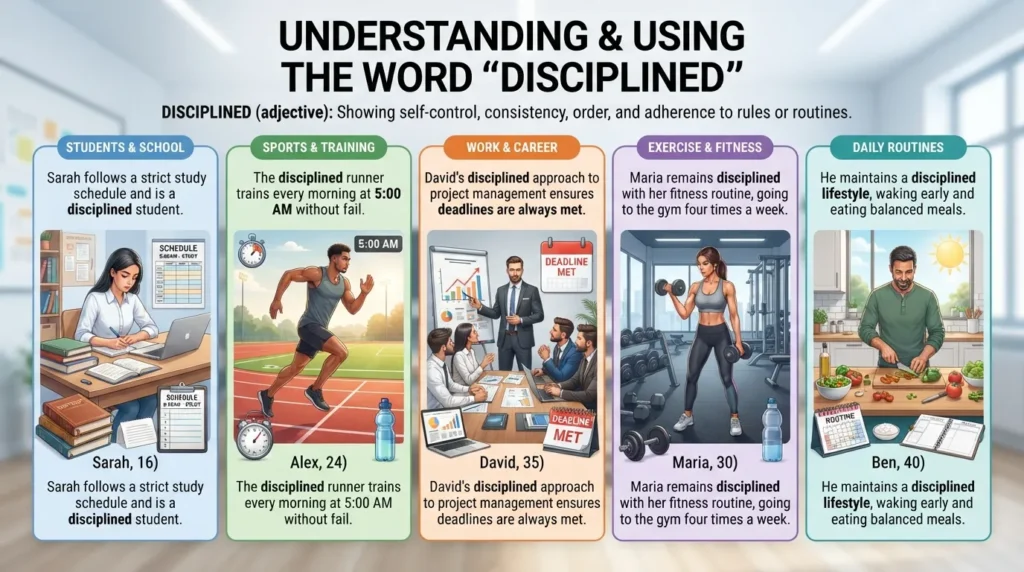
Discipline Meaning in a Sentence: Definitions, Examples & Usage Guide
What Does "Disciplined" Mean?
Being disciplined means consistently exhibiting self-control, adhering to an orderly routine, and following established rules even when faced with distractions or impulses. This behavioral trait bridges the gap between intention and execution, enabling individuals to pursue long-term goals through structured daily habits.
Disciplined (Adjective) — Quick Definition
The adjective disciplined describes a person, behavior, or environment characterized by strict self-control, systematic routines, and unwavering adherence to rules. A disciplined individual successfully regulates their actions to align with specific standards or objectives.
Key Characteristics: Consistent execution, emotional regulation, and resistance to immediate gratification.
Common Contexts: Describing high-performing professionals, rigorous athletic training regimes, or structured academic study habits.
Authoritative Reference: For an extensive lexicographical breakdown, consult the Merriam-Webster Definition of Disciplined.
Discipline (Noun) — Quick Definition
As a noun, discipline refers to the controlled behavior resulting from systematic training or the enforcement of rules and order. It represents the internal faculty or external system that compels obedience and focus.
Core Dimensions: Mental fortitude, institutional regulations, and specialized fields of study.
Practical Manifestation: The inner drive required to wake up early, maintain a budget, or stick to a nutritional plan.
Structural Role: Acts as the foundation upon which complex skill acquisition and habit formation are built.
Discipline (Verb) — Quick Definition
As a verb, discipline means to train someone physically or mentally to obey rules or codes of behavior, often utilizing punishment to correct disobedience. It also describes the act of self-imposing strict controls over one’s own habits.
Primary Actions: Correcting behavioral deviations, establishing corrective routines, and enforcing accountability.
Operational Usage: A coach disciplining an athlete for missing practice, or an individual disciplining themselves to limit daily screen time.
"Discipline" Used as a Noun in a Sentence
Using discipline as a noun denotes the practice of training people to obey rules, a controlled state of mind, or a specific branch of knowledge. It functions as the core subject or object in sentences involving personal growth, professional standards, and athletic performance.
Discipline in Everyday Life (5 examples)
Integrating discipline into daily life requires consistent effort and strong willpower to maintain positive routines. These examples illustrate how the noun is applied in common personal scenarios.
It takes immense discipline to wake up at 5:00 AM every morning and meditate before checking email.
Maintaining a strict household budget requires daily discipline and careful tracking of expenses.
Her remarkable discipline allowed her to finish writing a novel while balancing a full-time job.
Developing good study habits demands mental discipline and freedom from digital distractions.
Regular fasting and mindful eating call for a high level of personal discipline.
Discipline in the Workplace (3 examples)
Professional environments rely on structure, work ethic, and adherence to operational guidelines to achieve team goals. These examples highlight noun usage in corporate or career settings.
The engineering team showed incredible discipline by meeting every tight project milestone without compromising code quality.
Workplace discipline ensures that all safety protocols and compliance measures are followed meticulously.
A strong discipline in daily operations helps reduce errors and boosts overall team productivity.
Discipline in Sports & Fitness (3 examples)
Athletic success is rarely born from raw talent alone; it demands relentless physical training and strict lifestyle management. These examples demonstrate how the noun functions in fitness contexts.
Marathon training requires unyielding discipline to log miles through rain, wind, and fatigue.
The champion boxer attributed his undefeated career to the strict discipline of his training camp.
Athletic discipline extends beyond the gym into proper nutrition and adequate sleep recovery.
"Disciplined" Used as a Adjective in a Sentence
The adjective disciplined modifies nouns by describing individuals, groups, or methods that exhibit strict control, systematic routines, and consistent execution. These sentence examples illustrate proper usage across personal, professional, and lifestyle contexts.
Describing a Disciplined Person
Applying the adjective to an individual highlights their personal self-control, structured habits, and ability to stay focused on long-term objectives.
The disciplined musician practiced her scales for two hours every single day, regardless of her mood.
As a disciplined student, Marcus always completed his assignments ahead of schedule and reviewed his notes nightly.
A disciplined investor resists the urge to panic-sell during market downturns, sticking firmly to a long-term strategy.
Describing a Disciplined Team or Group
When applied to collectives, the adjective emphasizes synchronized coordination, mutual accountability, and adherence to shared tactical plans.
The disciplined soccer team maintained their defensive formation throughout the final ten minutes under heavy pressure.
Operating with a disciplined approach, the software engineering squad shipped bug fixes with zero regression errors.
The disciplined military unit executed the complex nighttime maneuver with flawless precision and timing.
Describing a Disciplined Approach (Finance, Fitness, Study)
Using the term to describe strategies or methodologies underscores the presence of structured rules, consistency, and resistance to deviation.
Adopting a disciplined fitness routine transformed his health markers over the course of six months.
The firm achieved record profitability by maintaining a disciplined approach to operational cost management.
Success on the bar exam requires a disciplined study schedule that covers every required legal domain systematically.
"Discipline" Used as a Verb in a Sentence
Using discipline as a verb involves taking corrective action, training someone to obey rules, or exerting conscious control over one’s own impulses. These sentence examples illustrate how the verb operates when directing actions toward others or oneself.
To Discipline (Someone) — Meaning & Examples
When used transitively, to discipline means to train someone through instruction and practice, or to penalize someone for breaking a code of conduct. These sentences show how supervisors, educators, and leaders apply this action.
The manager had to discipline the employee who repeatedly violated safety protocols on the manufacturing floor.
Effective teachers know how to discipline a disruptive classroom without resorting to harsh or counterproductive punishments.
The head coach decided to discipline the tardy players by benching them for the first quarter of the game.
Common Phrases: “Discipline Yourself,” “Discipline a Child”
Reflexive and targeted verb constructions highlight personal accountability and parental guidance. These examples capture everyday applications of these specific phrases.
You must learn to discipline yourself if you want to achieve mastery in any complex instrument or skill.
Parents often struggle to find the right balance when trying to discipline a child while maintaining a warm relationship.
Instead of waiting for external motivation, she chose to discipline herself to write 1,000 words before eating breakfast.
10 Example Sentences Using Discipline
True discipline requires mastering your thoughts and actions even when motivation fades away.
The disciplined athlete maintained his strict nutrition plan throughout the entire off-season.
Parents often find it challenging to discipline a toddler without raising their voice.
Professional success is rarely an accident; it is the direct result of daily discipline and persistence.
She demonstrated remarkable discipline by studying for her medical boards for six hours every day.
A disciplined approach to saving money helps families build long-term financial security.
The sergeant had to discipline the cadet who neglected to shine his boots before inspection.
Without inner discipline, even the most brilliant talents fail to reach their full potential.
The orchestra played with a disciplined focus that left the audience completely mesmerized.
To achieve your fitness goals, you must discipline your schedule to prioritize regular workouts.
Discipline in Parenting — Positive & Child Discipline Examples
Implementing effective child discipline requires a balance of clear boundaries, emotional support, and consistent guidance. Modern parenting frameworks emphasize teaching self-regulation over punitive measures to foster long-term behavioral growth.
Sentences About Positive Discipline
Positive discipline focuses on communication, mutual respect, and teaching children problem-solving skills rather than relying on reactive punishments.
The mother practiced positive discipline by sitting down with her son to talk through his emotional outburst [00:01].
Using positive discipline, the teacher encouraged the class to establish their own cooperative rules for the playground.
Implementing positive discipline helps children understand the natural consequences of their choices without damaging their self-esteem.
Sentences About Disciplining a Child
These sentence examples demonstrate how caregivers apply guidance and structure when correcting behavioral issues during child-rearing.
Wise parents know that disciplining a child requires consistency, patience, and clear communication [00:20].
Instead of shouting, she focused on calmly disciplining her daughter for tracking mud across the clean carpet.
Early childhood discipline lays the groundwork for emotional intelligence and academic success later in life [00:25].
Practical Note: Positive Discipline vs Punishment
A successful disciplinary approach differentiates between punitive control and skill-building instruction. While traditional punishment seeks to penalize past mistakes through fear or deprivation, positive discipline teaches alternative behaviors, equipping children with the internal framework needed to regulate their future actions independently.
Types of Discipline
Categorizing discipline into distinct types helps clarify how structure, self-control, and rules are applied across different environments. Understanding these frameworks allows individuals and organizations to choose the most effective approach for behavioral management and personal growth.
Self-Discipline
Self-discipline is the internal ability to monitor and control your actions, impulses, and desires to achieve long-term objectives. It relies on personal willpower rather than external enforcement.
Core Focus: Overcoming procrastination, managing time effectively, and resisting short-term temptations.
Application: Waking up early to work on a personal project or sticking to a strict dietary regimen.
Corrective Discipline
Corrective discipline involves implementing consequences or corrective actions after a rule has been broken or an unacceptable behavior has occurred. Its primary goal is to prevent future infractions.
Core Focus: Accountability, behavioral correction, and upholding established standards.
Application: A supervisor issuing a formal warning to an employee who violated company safety policies.
Preventive Discipline
Preventive discipline focuses on establishing clear expectations, rules, and environments that discourage misbehavior before it happens. It proactively reduces the likelihood of rule violations.
Core Focus: Setting boundaries, clear communication, and structured operational planning.
Application: A teacher reviewing classroom code-of-conduct guidelines on the very first day of the school year.
Positive Discipline
Positive discipline emphasizes mutual respect, open communication, and teaching problem-solving skills rather than relying on fear or punishment. It builds long-term emotional resilience.
Core Focus: Skill-building, collaboration, and reinforcing desired behaviors through encouragement.
Application: A parent guiding a child through a calming exercise after a tantrum to discuss better communication choices.
Progressive Discipline
Progressive discipline is a structured workplace framework that uses increasingly severe responses for repeated offenses. It ensures fairness and gives employees clear opportunities to improve.
Core Focus: Due process, documented warnings, and structured escalation paths.
Application: Moving from a verbal warning to a written reprimand, and finally to suspension for ongoing tardiness.
How to Become More Disciplined (Practical Tips)
Developing robust self-discipline is not an innate trait that you either have or lack; rather, it is a skill forged through intentional habits and structured routines. Building consistent willpower requires systematic strategies that reduce reliance on fleeting motivation.
Build Small, Consistent Habits
Relying purely on willpower often leads to burnout. Instead, lower the barrier to entry by breaking large goals into micro-habits that are easy to repeat daily [00:27].
Start Micro: Commit to reading just two pages of a book or doing a five-minute stretch rather than overwhelming yourself with unrealistic targets.
Anchor Behaviors: Attach new habits to established routines, such as reviewing your daily priorities immediately after pouring your morning coffee.
Set Clear Personal Rules
Ambiguity breeds procrastination. Establishing non-negotiable personal boundaries eliminates decision fatigue and guides your daily focus.
Define Boundaries: Set explicit rules, such as turning off all non-essential phone notifications after 8:00 PM.
Create Systems: Design your physical and digital environments to make good behaviors frictionless and bad habits inconvenient.
Track Progress & Stay Accountable
Visibility drives consistency. When you actively monitor your actions, you create immediate feedback loops that reinforce your commitment [00:27].
Use Habit Trackers: Check off daily boxes on a calendar or digital app to create a visual chain of momentum.
Find an Accountability Partner: Share your targets with a colleague or mentor who can check in on your execution and help you stay on track.
Using "Discipline" in an Essay (Student Life Angle)
Crafting a compelling academic essay on discipline requires strong topic sentences that immediately establish the core theme. Integrating the term effectively within a student life context bridges abstract concepts with relatable, real-world applications.
Example Opening Sentence for a Discipline Essay
An effective introductory sentence sets the tone for your entire paper by capturing both the definition and the broader significance of the subject.
Discipline serves as the foundational bridge between a student’s daily academic aspirations and their ultimate career achievements.
Without a structured framework of personal accountability, even the most ambitious educational goals easily dissolve into unfulfilled potential.
Example Sentence for “Importance of Discipline in Student Life”
Body paragraphs benefit from targeted topic sentences that explore how self-regulation shapes academic performance and character development.
The true importance of discipline in student life extends far beyond the classroom, cultivating time management skills that last a lifetime.
Students who master academic discipline are better equipped to navigate stressful exam periods, balance extracurricular commitments, and avoid burnout.
Quick Tip: Using Discipline as a Strong Essay Keyword
To maximize academic impact, vary your grammatical usage rather than repeating the exact same noun phrase throughout your paper.
Mix Parts of Speech: Alternate between the noun form (discipline) when discussing core values, the adjective form (disciplined) when describing successful study habits, and the verb form (discipline) when addressing time-blocking techniques.
Anchor Your Arguments: Place the target keyword near the beginning of your body paragraph topic sentences to signal clear focus to graders and examiners.
Frequently Asked Questions (FAQ)
What is a short sentence for discipline?
True discipline is the bridge between setting goals and achieving them.
What are 5 sentence examples using discipline?
It takes immense discipline to wake up at dawn for daily practice.
The disciplined runner completed her marathon training without missing a single scheduled run.
Parents must guide and discipline children with patience and clear communication.
Professional success is the direct result of consistent daily discipline.
A disciplined approach to budgeting helps families secure long-term financial stability.
What are some examples of being disciplined?
Sticking to a strict study schedule for two hours every evening before checking social media.
Preparing healthy meals at home instead of ordering takeout during a busy work week.
Maintaining a regular fitness routine regardless of whether you feel motivated.
How can you tell someone is disciplined?
Consistent Execution: They consistently meet deadlines, show up on time, and follow through on commitments.
Emotional Regulation: They remain calm under pressure and resist immediate temptations or distractions.
Structured Routines: They maintain organized daily habits that clearly support their long-term objectives.
Can you give an example of positive discipline?
A teacher pausing a noisy classroom not to issue a punishment, but to guide students through a collaborative discussion on mutual respect and noise levels.
Explore Topics
Sub-Topics & Guides
Featured Guides
Top Industry Resources
Editorial Integrity
Our content is 100% human-written, evidence-backed, and continuously updated to fulfill reader intent with maximum honesty.
"Small, consistent habits compounded over time create unshakeable momentum."