Header — Holistic Wellbeing Living

Synonyms for Discipline: Ultimate Guide to 50+ Meanings & Alternatives

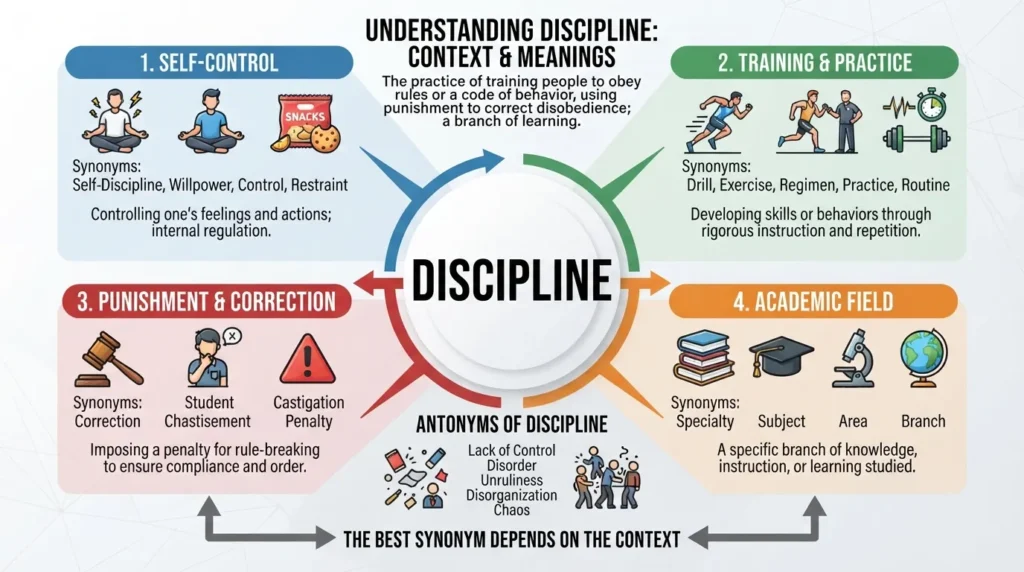
Comprehensive visual guide listing top synonyms and alternative meanings for the word discipline, categorized by self-control, punishment, and field of study.

What Does "Discipline" Really Mean?

Discipline is a remarkably ambiguous term that shifts its core meaning entirely based on context. While many writers treat it as a monolithic concept, it actually spans four distinct definitions, which is why a generic, one-size-fits-all synonym list almost always fails writers and speakers. Understanding these core categories is essential for selecting the precise word that matches your exact intent.

The 4 Core Meanings of “Discipline”

  • Self-Control: The capacity to regulate one’s emotions, behaviors, and desires to achieve long-term goals or adhere to personal standards (e.g., maintaining rigorous daily writing discipline).

  • Training: A structured system of rules, drills, and instruction designed to develop a specific skill, physical ability, or mental pattern (e.g., athletic discipline or military training).

  • Punishment: A penalty administered to enforce obedience, correct inappropriate behavior, or uphold institutional rules (e.g., facing workplace discipline for a policy violation).

  • Field of Study: An academic branch of knowledge, specialized profession, or domain of professional expertise (e.g., the discipline of quantum physics or economics).

Why Choosing the Right Synonym Depends on Context

Selecting an appropriate synonym requires looking closely at the surrounding sentence structure and the intended subject matter. Using a term like “chastisement” works well when discussing punishment, but it completely fails when referring to academic study or personal self-control.

  • Analyze the Domain: Determine whether the subject is behavioral, educational, punitive, or professional.

  • Match the Tone: Ensure the chosen word fits formal academic writing, casual conversation, or legal contexts.

  • Verify Nuance: Check whether the term implies voluntary personal growth or external enforcement.

Quick Answer — Top 5 Strongest Synonyms for Discipline

Infographic listing the top five strongest synonyms for discipline with clear visual context for improving focus and self-control.

The five strongest and most versatile synonyms for discipline are self-control, training, punishment, order, and field. The ideal choice depends entirely on whether you are referring to personal willpower, institutional rules, or an academic domain.

The 5 Most Common & Strongest Synonyms

  • Self-Control: The primary synonym when focusing on personal restraint, willpower, and the ability to maintain focus without supervision.

  • Training: The ideal alternative when describing structured practice, skill acquisition, physical regimens, or athletic preparation.

  • Punishment: The precise match for contexts involving penalties, corrective measures, or consequences for breaking rules.

  • Order: The best term for capturing systematic organization, adherence to routine, and systemic compliance.

  • Field: The most accurate choice when referring to an academic discipline, branch of knowledge, or professional specialty.

Synonyms for "Discipline" by Meaning

Categorizing synonyms by their exact contextual meanings prevents linguistic errors and guarantees precise writing. Because discipline shifts meaning across behavior, routines, penalties, and academia, each specific category requires dedicated alternatives with matching usage examples [00:00].

Self-Control & Restraint

When discipline refers to personal behavior and emotional mastery, terms like self-control and willpower capture the mental fortitude required to resist impulses [00:03].

  • Self-Control: The psychological ability to manage one’s actions, emotions, and urges under pressure.

  • Example: Maintaining strict emotional self-control [00:35] during heated negotiations is essential for professional success.
  • Willpower: The inner strength and determination needed to delay gratification and pursue long-term objectives.

  • Example: It takes immense willpower to resist late-night snacking when following a strict dietary plan.
  • Self-Discipline: The deliberate, habitual practice of overriding short-term comfort for greater future rewards.
  • Example: Daily writing requires intense self-discipline to consistently finish chapters ahead of publishing deadlines.
  • Restraint: The conscious act of holding back or limiting one’s desires, speech, or impulses.
  • Example: Exercising financial restraint helped her save enough capital to launch her own startup.
  • Control: The active management and regulation of one’s habits, focus, and emotional states.

  • Example: Keeping composure and mental control [00:35] is vital for elite competitive athletes.

Training & Practice

In contexts focused on skill development, physical conditioning, and structured preparation, training alternatives highlight systematic repetition and instruction [00:03].

  • Drill: A repetitive exercise designed to reinforce specific technical mechanics or physical movements.

  • Example: The basketball team spent an hour running passing drills to sharpen court coordination.
  • Exercise: A planned physical or mental activity performed to develop specific functional capabilities.
  • Example: Regular cardiovascular exercise [00:09] requires daily commitment and physical routine.
  • Practice: The systematic repetition of an activity to refine technique and achieve mastery.
  • Example: Consistent piano practice transforms awkward finger movements into fluid musical performances.
  • Regimen: A structured, systematic schedule of routines designed to achieve a specific health or performance goal.
  • Example: The Olympic runner maintained a grueling morning training regimen [00:49] throughout the winter months.
  • Training: The comprehensive process of receiving instruction and education in a particular skill set.
  • Example: Rigorous pilot training [00:49] ensures absolute safety during high-risk flight operations.

Punishment & Correction

When discipline signifies punitive measures, rule enforcement, or corrective actions for misconduct, terms related to penalties and institutional correction apply [00:13].

  • Castigation: Severe verbal or written reprimand aimed at sharply criticizing unacceptable behavior.

  • Example: The public official faced severe castigation from editorial boards after missing crucial oversight meetings.
  • Chastisement: A formal penalty or strict reprimand administered to correct future behavior.
  • Example: The juvenile offender received mild chastisement and community service instead of jail time.
  • Correction: A constructive penalty or adjustment method designed to realign behavior with established standards.
  • Example: Classroom management often relies on behavioral correction rather than harsh penalties.
  • Penalty: An enforced consequence or disadvantage imposed for breaking an explicit rule or law.

  • Example: Violating company security protocols carries an immediate financial penalty and suspension.
  • Punishment: The infliction of a penalty as retribution or deterrent for an offense or rule violation [00:13].

  • Example: Fair enforcement of workplace policies ensures appropriate punishment matches the severity of the infraction.

Field of Study or Profession

When discipline denotes an academic domain, specialized profession, or branch of intellectual investigation, terminology shifts toward educational taxonomy [00:25].

  • Area: A broad sector of professional activity or general academic focus.

  • Example: Artificial intelligence is a rapidly expanding area of modern technological research.
  • Branch: A distinct subdivision of a larger body of knowledge, science, or institutional organization.
  • Example: Organic chemistry is a complex branch of physical science.
  • Field: An overarching domain of professional practice, work, or scholarly inquiry.
  • Example: History is an academic discipline [00:31] and a vital field of human humanities.
  • Specialty: A narrow, highly focused sub-segment of a profession or scientific study.
  • Example: Pediatric neurology is her chosen medical specialty within healthcare.
  • Subject: A discrete topic or branch of learning taught within educational curricula.
  • Example: Mathematics remains a core subject across primary and secondary education programs.

Antonyms for Discipline

Understanding the antonyms of discipline requires looking at its contrasting meanings across personal behavior, systematic order, and institutional consequences. Exploring these opposites clarifies word choice when expressing a lack of control or structural breakdown.

Antonyms Related to Self-Control

When discipline denotes personal restraint and willpower, its opposites describe yielding to impulses, giving up structure, and abandoning moderation.

  • Indulgence: The act of allowing oneself to enjoy pleasures, desires, or impulses without restriction.

  • Example: Weekend dietary indulgence can quickly derail weeks of careful meal planning.
  • Laxity: Slackness, carelessness, or a negligent lack of strictness in upholding rules or standards.

  • Example: Management laxity regarding security protocols led to the data breach.
  • Unrestraint: A total absence of emotional, mental, or behavioral control and moderation.

  • Example: His emotional unrestraint during board meetings damaged professional relationships.

Antonyms Related to Order

When discipline represents structure, organization, and adherence to routine, its antonyms highlight systemic collapse, random chaos, and operational failure.

  • Chaos: Complete disorder, unpredictability, and total absence of organization or governance.

  • Example: Without clear management, the warehouse operations descended into complete chaos.
  • Confusion: A state of bewilderment, mixed signals, and lack of clear directional planning.

Example: Last-minute schedule changes caused widespread confusion among the team.

Disorder: A lack of system, method, or regular arrangement within an environment or process.

  • Example: The filing system fell into total disorder after the office relocation.
  • Indiscipline: A direct failure or refusal to submit to established rules, authority, or training.
  • Example: Rampant indiscipline on the trading floor resulted in major financial compliance penalties.

Antonyms Related to Punishment

When discipline functions as a punitive consequence or corrective measure, its direct opposites involve acknowledgment, positive reinforcement, and celebration.

  • Reward: A prize, benefit, or positive recognition given in return for exceptional effort, achievement, or adherence to high standards.

  • Example: The company offered a generous year-end financial reward for top-performing departments.
  • Award: A formal honor, trophy, or official distinction granted to recognize superior performance or merit.

  • Example: She received a national research award for her breakthroughs in academic study.

Nicer / More Positive Words for "Discipline"

A colorful word cloud displaying positive synonyms for the word discipline, such as focus, dedication, structure, and commitment.

The word “discipline” often carries a harsh, punitive connotation reminiscent of strict rules, scoldings, or rigid military enforcement. When writers want to convey the exact same dedication without sounding authoritarian or overly severe, positive alternatives help frame habits and routines through an inspiring lens.

Positive & Motivational Alternatives

  • Dedication: A heartfelt commitment and devoted loyalty to a specific cause, project, or long-term goal.

  • Example: Her lifelong dedication to environmental science transformed regional conservation efforts.
  • Diligence: Careful, persistent, and energetic effort applied consistently to any undertaking.
  • Example: Through meticulous diligence, the research team verified every data point before publication.
  • Persistence: The steadfast continuation of an action or pursuit despite obstacles, delays, or setbacks.

  • Example: Unyielding persistence allowed the entrepreneur to secure funding after dozens of rejections.
  • Consistency: The steady, dependable repetition of positive habits or performance standards over time.
  • Example: Daily consistency in workout routines yields far better long-term health outcomes than occasional intense bursts.
  • Structure: A supportive framework or organized system that provides stability and guides daily momentum.
  • Example: Creating a daily structure helps remote workers maintain high productivity without burnout.
  • Focus: The deliberate concentration of attention and mental energy on a single priority.
  • Example: Deep focus is required to solve complex software engineering challenges.
  • Mastery: The comprehensive skill, deep understanding, and exceptional command achieved through dedicated practice.

  • Example: Years of focused practice led to his ultimate mastery of classical guitar performance.

When to Use Positive Synonyms Instead of “Discipline”

Switching from traditional terms to positive alternatives depends heavily on the audience, the medium, and the emotional tone you wish to set.

  • Motivational & Coaching Content: Use words like dedication and consistency to inspire readers rather than making self-improvement feel like an exhausting chore.

  • Creative & Professional Writing: Choose terms like structure or focus when describing workplace environments to emphasize supportive organization over rigid micromanagement.

  • Personal Development Frameworks: Frame habit-building around mastery and diligence to celebrate progress and skill acquisition rather than punishment-based compliance.

Best Synonyms for "Disciplines" in Essays & Formal Writing

A comparison chart showing academic and professional synonyms for disciplines in formal writing, such as fields of study, domains, and branches.

Academic essays and scholarly papers demand precise, elevated vocabulary that accurately conveys intellectual domains or rigorous behavior. Using the plural noun “disciplines” usually refers to branches of study, while singular references address self-regulation or conduct. Choosing the right formal synonym protects your academic tone and elevates the sophistication of your argument.

Formal/Academic Synonyms

When discussing academic fields, research domains, or branches of university study, certain scholarly alternatives fit formal prose seamlessly.

  • Field of Study: A clearly defined domain of academic inquiry, scientific research, or professional investigation.
  • Example: Interdisciplinary research across multiple fields of study yields the most innovative technological breakthroughs.
  • Branch of Knowledge: A distinct division or systematic body of learning within human understanding.

  • Example: Philosophy is an foundational branch of knowledge that underpins modern ethical frameworks.
  • Specialization: A targeted, highly focused area of professional expertise or academic concentration.
  • Example: Her doctoral thesis bridges two distinct specializations within environmental economics.
  • Subject Area: A categorized division of curriculum, learning, or educational instruction.

    • Example: Faculty members collaborated to update course offerings across every core subject area.

Formal Synonyms for Behavioral Discipline

When your essay addresses human behavior, institutional compliance, or psychological self-regulation, formal alternatives replace conversational phrasing.

  • Self-Regulation: The internal cognitive mechanism used to monitor and manage emotional states, urges, and behaviors.

  • Example: Developing robust emotional self-regulation helps students manage academic stress effectively.
  • Conduct: The manner in which a person behaves, performs, or manages themselves within a professional or social setting.

  • Example: University codes of conduct establish clear behavioral boundaries for all enrolled scholars.
  • Orderliness: The state of being methodically arranged, systematic, and compliant with established structural routines.

  • Example: The rigorous orderliness of the laboratory protocol prevented sample contamination.
  • Words to Avoid in Formal/Academic Writing

Certain casual terms or idioms should be strictly avoided in formal essays because they diminish scholarly authority.

  • Slang or Colloquialisms: Avoid terms like “toughing it out” or “keeping your head on straight,” which undermine academic gravitas.

  • Overly Dramatic Phrasing: Steer clear of melodramatic alternatives like “draconian crackdowns” when discussing behavioral rules, as they introduce subjective bias.

  • Vague Catch-alls: Do not use overly broad filler words like “stuff” or “things” in place of precise academic terminology.

Synonyms for Related Word Forms — Disciplined, Disciplinary, and To Discipline

Infographic chart comparing the definitions and parts of speech for the related word forms disciplined, disciplinary, and to discipline.

Language flexibility requires adapting root words into their proper grammatical forms. Shifting from nouns to adjectives or verbs changes the semantic landscape, requiring targeted alternatives for terms like disciplinary, disciplined, or the act of disciplining.

Another Word for “Disciplinary”

When modifying rules, actions, or bodies related to enforcement and penalties, words like corrective, punitive, and regulatory provide precise adjectival clarity. These terms specify whether an action aims to mend behavior, penalize infractions, or enforce systemic compliance.

  • Corrective: Aimed at reforming bad habits or fixing errors rather than inflicting harm.

  • Example: The school implemented corrective action plans for struggling students.
  • Punitive: Inflicting or intended as punishment for breaking an established rule or law.

  • Example: The regulatory agency imposed severe punitive fines on the corporation.
  • Regulatory: Concerned with managing, governing, or enforcing official standards and guidelines.
  • Example: Strict disciplinary frameworks maintain order across financial institutions.

Another Word for “Being Disciplined”

Describing a person or environment characterized by strong focus, obedience, and self-restraint requires adjectives like well-behaved, orderly, self-controlled, and regimented. These alternatives capture individual character traits as well as structured systemic environments.

  • Well-behaved: Exhibiting proper, polite, and rule-compliant conduct in social settings.

  • Example: The teacher praised the well-behaved students during the museum tour.
  • Orderly: Neatly arranged, systematic, and functioning according to a predictable routine.
  • Example: Warehouse staff maintained an orderly inventory tracking system.
  • Self-controlled: Exhibiting mastery over emotional urges, reactions, and impulses.
  • Example: The self-controlled negotiator kept her composure under extreme pressure.
  • Regimented: Strictly organized, controlled, and bound by a rigid daily schedule or routine.

  • Example: Elite athletes follow a highly regimented morning training program.

Synonyms for “To Discipline”

Translating the action verb of discipline into alternative terms requires distinguishing between instruction, correction, punishment, and system regulation. Verbs like train, correct, punish, and regulate capture these distinct active processes.

  • Train: To teach and instruct a person or animal through practice and repeated exercise.

  • Example: Coaches train athletes to peak performance levels before competition.
  • Correct: To rectify an error, fault, or improper behavior through constructive guidance.
  • Example: Editors meticulously correct syntax errors in manuscript drafts.
  • Punish: To inflict a penalty as a consequence of wrongdoing or rule violation.

  • Example: Managers must punish policy breaches fairly and consistently.
  • Regulate: To control or supervise an activity or system by means of rules and oversight.

    • Example: Central banks regulate national monetary policy to ensure economic stability.

Another Word for "Academic Disciplines"

A comprehensive list and conceptual diagram showing common synonyms and alternative terms used for academic disciplines, such as fields of study, branches of learning, and scholarly domains.

Searching for a phrase to replace “academic disciplines” usually happens when writing university prospectuses, research papers, or educational syllabi. Because academic disciplines represent structured branches of knowledge and intellectual investigation, alternative phrases must convey scholarly depth, institutional taxonomy, and formal rigor.

Common Alternatives

  • Academic Fields: Broad spheres of scholarly inquiry, research, and intellectual investigation taught within higher education.

  • Example: Modern universities encourage cross-disciplinary collaboration between diverse academic fields.
  • Branches of Study: Subdivisions of human knowledge organized systematically for educational and research purposes.

    • Example: Philosophy, physics, and history represent foundational branches of study in the liberal arts.

  • Subject Areas: Distinct domains of learning or academic curriculum targeted by institutional instruction.

    • Example: High school curriculums divide instruction across core subject areas like mathematics and literature.

  • Areas of Specialization: Specific concentrations of professional expertise or advanced academic focus within a broader degree program.

    • Example: Graduate students select narrow areas of specialization for their master’s theses.

Example Usage in Academic and Research Context

Applying these phrases correctly ensures that your educational writing maintains scholarly precision and readability.

  • Curriculum Design: Designing a robust university course of study requires balancing core requirements across multiple academic fields.

  • Interdisciplinary Research: Breakthrough innovations frequently occur at the intersection of different branches of study.

  • Faculty Organization: Departments are traditionally organized by distinct subject areas to streamline faculty administration and student advising.

Synonyms for "Discipline Behavior" (Parenting, HR & Psychology Context)

A comparison chart showing alternative terms and synonyms for discipline behavior across parenting, human resources, and psychology contexts.

When applying discipline to human behavior—whether managing a classroom, raising a child, or supervising employees—the phrase “discipline behavior” carries distinct operational contexts. Because generic dictionary lists ignore these practical fields, finding the precise functional alternative requires examining specialized terminology used by child development experts and human resources professionals.

Parenting Context

In child development and family psychology, modern frameworks shift away from punitive control toward constructive guidance [1.1.3]. Alternative terms help parents and caregivers reframe discipline as a teaching mechanism [1.1.5].

  • Behavior Management: A structured psychological approach aimed at helping individuals modify problematic actions into positive habits [1.1.4].

  • Guidance: Compassionate instruction and directional support designed to teach children appropriate social conduct [1.1.3].

  • Correction: Gentle, real-time intervention implemented to realign actions with established family or safety standards.

According to research from the American Psychological Association, effective child discipline focuses on teaching children self-regulation and problem-solving skills rather than relying on punitive fear [1.1.3] (rel=”nofollow”).

Workplace / HR Context

In human resources and organizational management, addressing employee conduct requires formal phrasing that adheres to legal standards and progressive framework policies.

  • Disciplinary Action: The formal institutional process of addressing policy violations through progressive warnings or penalties.

  • Corrective Action: A proactive, non-punitive manager-led process aimed at improving an employee’s attendance, performance, or workplace conduct [1.2.1].

  • Performance Management: The ongoing, systematic process of monitoring, evaluating, and guiding employee behavior to meet organizational goals.

Practical Example: How the Right Synonym Changes Tone in Real Conversations

  • Harsh / Punitive Phrasing: “We need to discipline this behavior immediately or face penalties.” This creates defensiveness and fear.

  • Reframed Professional Phrasing: “Let us initiate a corrective action plan to address these performance gaps.” This highlights collaborative improvement and objective growth [1.2.1].

Frequently Asked Questions

What is another word for “academic disciplines”?

Academic disciplines are commonly referred to as fields of study, branches of knowledge, or subject areas. These terms describe structured educational categories taught within universities and research institutions.

What is another word for disciplinary?

Depending on the context, disciplinary can be replaced by corrective, punitive, or regulatory. These alternatives specify whether an action aims to mend behavior, penalize infractions, or enforce compliance.

What is another word for “disciplines” that would be appropriate for an essay?

Scholarly essays benefit from terms like specializations, areas of inquiry, or professional domains when discussing academic subjects. These alternatives maintain an elevated academic register and prevent repetitive phrasing.

What is another word for being disciplined?

Being disciplined can be described as being self-controlled, regimented, orderly, or well-behaved. These adjectival forms capture both internal willpower and consistent adherence to external routines.

What is a nicer word for discipline?

Gentle and motivational alternatives include dedication, diligence, consistency, and focus. Using these words helps frame personal habits and daily routines through an inspiring, positive lens.

What’s a more positive word for discipline?

Structure and mastery are excellent positive substitutes that emphasize supportive systems and skill acquisition rather than rigid enforcement. They reframe hard work as a pathway to achievement rather than a punitive chore.

What can I say instead of discipline?

Depending on your exact meaning, you can use self-control for personal habits, training for skill acquisition, or penalty for rule-breaking. Selecting a precise synonym ensures your writing matches your exact intent.

What are 5 strong synonyms?

The five most versatile synonyms for discipline are self-control, training, punishment, order, and field. This core group covers personal restraint, structured practice, institutional rules, and academic domains.

What is a new word for “discipline”?

Modern alternatives that offer a fresh perspective include self-regulation, consistency, and behavioral management. These terms avoid the authoritarian undertones often associated with traditional discipline.

What is another word for discipline behavior?

Managing behavior constructively is often referred to in professional and psychological contexts as behavior management, guidance, or corrective action. These terms emphasize teaching and growth over punitive measures.

Conclusion

Mastering discipline synonyms requires recognizing that context dictates word choice. Because the term spans personal self-control, institutional punishment, professional training, and academic study, relying on a generic thesaurus list often results in awkward phrasing.

Choosing the Right Synonym for Your Context

  • For Personal Habits & Willpower: Rely on positive alternatives like self-control, consistency, diligence, or dedication to frame routines constructively.

  • For Institutional & Workplace Rules: Use precise terms such as corrective action, penalty, order, or regulatory compliance to maintain professional clarity.

  • For Academic & Scholarly Writing: Elevate your prose using formal phrases like branches of study, academic fields, or specializations.

Selecting the ideal synonym or antonym transforms your writing, ensuring your vocabulary matches your exact intent and engages your audience with precision.

Link copied to clipboard!

Editorial Integrity

Our content is 100% human-written, evidence-backed, and continuously updated to fulfill reader intent with maximum honesty.

Daily Mindset Shift

"Small, consistent habits compounded over time create unshakeable momentum."

Leave a Comment