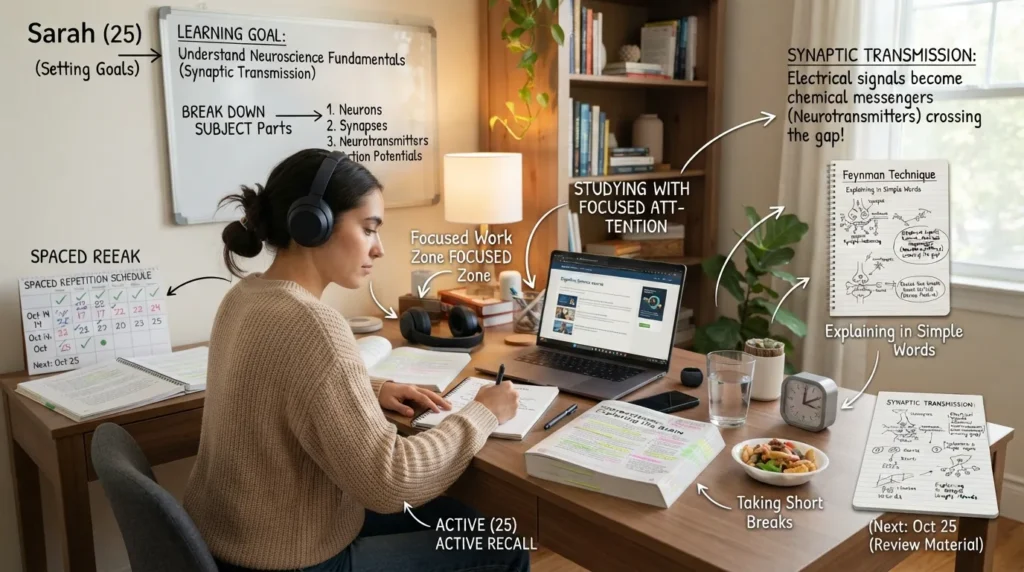
If you’re asking, “How can I learn better?”, the answer is not simply to study for more hours. Learning becomes much more effective when you know what you are trying to learn, actively work with the information, test what you remember, and return to it over time.
I would start with a simple idea: don’t measure learning by how much you read or watch; measure it by what you can remember, explain, and use without help. That one change can make your study time much more productive.
The basic learning cycle: set a clear goal → break the subject into manageable parts → learn actively → retrieve what you know → practise → review over time → test yourself in a new situation.
Below, I’ll show you how to turn that cycle into a practical system you can use for a school subject, a professional skill, a language, an exam, or something you’re teaching yourself.
How Can I Start Learning Something New?
Start by deciding exactly what you want to be able to do. “I want to learn programming” or “I want to learn biology” is too broad to guide your study very well. A better goal describes the result you want.
For example:
- Instead of “learn Spanish,” aim for “hold a basic 10-minute conversation in Spanish.”
- Instead of “learn mathematics,” aim for “solve a particular class of algebra problems without looking at worked solutions.”
- Instead of “learn photography,” aim for “take and edit well-exposed indoor portraits.”
- Instead of “learn history,” aim for “explain the main causes, events, and consequences of a particular period.”
Once the destination is clear, you can decide what to study, what to practise, and how to tell whether you’re making progress.
Break a Big Subject Into Smaller Pieces
A large subject can feel difficult simply because you don’t know where to begin. Instead of trying to learn everything at once, create a small map of the subject.
- List the major areas. Identify the main concepts or skills you need.
- Put them in a sensible order. Learn prerequisites before advanced ideas when they depend on one another.
- Choose one small target. Give each study session a specific objective.
- Check your understanding. Don’t move forward simply because you’ve finished reading a chapter.
This also makes it easier to notice exactly where you’re struggling. “I don’t understand chemistry” is difficult to fix. “I understand the definition but cannot explain how this reaction works” gives you a specific problem to solve.
Learn Actively Instead of Just Reading
One of the easiest traps in learning is confusing exposure with learning. You can read a chapter several times and still struggle to explain it later.
Active learning asks you to do something with the information. You might explain an idea, answer a question, solve a problem, draw a concept map, predict an outcome, or recall information without looking at your notes.
| More passive approach | More active approach |
|---|---|
| Rereading the same notes | Closing the notes and recalling the main ideas |
| Highlighting large amounts of text | Turning important ideas into questions |
| Watching a lesson repeatedly | Pausing to predict, explain, or solve before continuing |
| Reading a solution immediately | Trying the problem first and then checking the solution |
| Cramming everything into one session | Returning to the material across multiple sessions |
You don’t have to eliminate reading, watching, or listening. They are useful for getting new information. The key is to follow them with an activity that makes you retrieve, explain, apply, or connect what you just learned.
Use Active Recall to Remember What You Learn
Active recall means trying to retrieve information from memory instead of immediately looking at it again. It turns studying into a test of what you can actually produce.
A simple active-recall session can look like this:
- Study a small section. Focus on one manageable concept rather than an enormous chapter.
- Close the material. Put the book, notes, or video out of sight.
- Recall what you learned. Write or say the main ideas in your own words.
- Check your answer. Compare your recall with the original material.
- Find the gaps. Pay attention to what you forgot or misunderstood.
- Try again later. Retrieval becomes more useful when you return to the material over time.
A useful test: if your notes are open while you’re answering the question, you’re mostly recognizing the information. Close the notes and try to produce the answer yourself when you want to practise retrieval.
Use Spaced Repetition Instead of Cramming
Spaced repetition means reviewing material across separate sessions rather than trying to remember everything in one long session. The spacing gives you repeated opportunities to retrieve information as it becomes less immediately available.
You don’t need a complicated system to begin. For example, after learning a topic, you might revisit it the next day, then several days later, and again after a longer interval. The exact schedule should depend on how difficult the material is and how well you can recall it.
| Stage | What you do |
|---|---|
| Learn | Understand the new concept and create useful questions or practice prompts. |
| Recall | Try to answer without looking at the material. |
| Review | Check mistakes and revisit the parts you could not recall. |
| Repeat | Increase the interval when you can reliably retrieve the material. |
The important part is not memorizing a particular calendar. The important part is avoiding a pattern where you study once, feel familiar with the material, and never ask your memory to produce it again.
Try the Feynman Technique When a Concept Feels Confusing
The Feynman technique is a simple way to expose gaps in your understanding. Instead of being satisfied because a definition looks familiar, try to explain the concept in plain language.
- Choose one concept.
- Explain it as if you’re teaching a beginner. Avoid hiding behind complicated terminology.
- Notice where you get stuck. Those points often reveal what you do not fully understand.
- Return to the source. Study only the part needed to fix the gap.
- Explain it again. Make the explanation simpler and more precise.
This works particularly well for concepts that require understanding rather than simple memorization. If you cannot explain an idea without copying the wording from your notes, that is a useful signal that you need to work with the idea more deeply.
Match Your Learning Method to What You’re Learning
There isn’t one learning technique that is equally useful for every task. The best approach depends on whether your goal is to remember facts, understand concepts, perform a skill, solve problems, or communicate in a new language.
| Learning goal | Useful emphasis | How to check yourself |
|---|---|---|
| Facts | Active recall and spaced review | Answer questions without notes |
| Concepts | Explanation, connections, examples | Explain the idea simply and apply it |
| Practical skills | Practice, feedback, repetition | Perform the task independently |
| Exam preparation | Retrieval, practice questions, spaced review | Complete questions under realistic conditions |
| Language | Comprehension, retrieval, speaking and writing practice | Use the language without relying on translation |
The goal is to match the method to the outcome. If you need to perform a skill, eventually you have to practise performing it. If you need to remember information, you have to practise retrieving it.
Practice What You Learn, Not Just What You Understand
Understanding something while reading an explanation is useful, but it does not automatically mean you can use that knowledge independently. Practice creates a bridge between understanding and performance.
Depending on the subject, practice could mean:
- solving problems without seeing the solution first;
- writing a short explanation from memory;
- speaking a new language instead of only reading it;
- building a small project with a programming concept;
- performing a practical task repeatedly;
- answering increasingly unfamiliar questions; or
- teaching the concept to another person.
Try to make some practice slightly more difficult than simply repeating an example you already know. You want to discover whether you can transfer what you’ve learned to a new situation.
How Do I Know If I’m Actually Learning?
This is one of the most useful questions you can ask yourself. Feeling familiar with a page is not the same thing as being able to retrieve or use the information.
Try these tests:
- Can I explain the idea without looking at my notes?
- Can I answer questions about it from memory?
- Can I solve a new problem using it?
- Can I give a simple example?
- Can I identify when the concept should and should not be used?
- Can I still recall the important parts after some time has passed?
- Can I teach the idea without simply repeating the source?
A useful warning sign: if everything looks obvious when your notes are open but disappears when you close them, spend more time retrieving the information rather than rereading it.
Build a Simple Daily Learning Routine
You don’t need an enormous study schedule to start learning. A small, repeatable routine is often easier to maintain than an ambitious plan that you abandon after a few days.
If You Have About 20 Minutes
- Spend a few minutes learning one small concept.
- Close the material and recall the main points.
- Spend the remaining time answering questions or practising.
- Write down what you need to review next time.
If You Have About an Hour
- Set one clear objective for the session.
- Learn or review a manageable section.
- Use active recall without your notes.
- Spend a substantial part of the session practising.
- Finish by identifying weak areas and scheduling another retrieval session.
These are examples, not universal rules. The right session length depends on your subject, attention, experience, available time, and the type of work you’re doing. The bigger goal is to create a routine you can realistically repeat.
Create a Study Environment That Helps You Focus
Your learning strategy can be excellent and still be undermined by constant interruptions. Before a study session, remove as many avoidable distractions as you reasonably can.
- Keep only the materials you need for the current task nearby.
- Silence unnecessary notifications.
- Choose a place where you can concentrate.
- Take breaks rather than trying to maintain intense concentration indefinitely.
- Return to your learning at a consistent time when possible.
Consistency matters because learning is not only about what happens during one session. It is the result of repeated cycles of learning, retrieval, practice, feedback, and review.
How Can I Learn Faster Without Just Studying Longer?
Learning faster does not necessarily mean forcing more information into your brain in less time. A better goal is to reduce wasted effort and spend more of your available time on activities that actually move you toward your goal.
Ask yourself:
- Am I studying information I actually need?
- Am I spending too much time rereading?
- Am I testing myself?
- Am I practising the skill I eventually want to perform?
- Am I spending too much time collecting resources instead of using one effectively?
- Am I reviewing the areas I get wrong, or only the material I already find comfortable?
Sometimes the fastest route is not adding another course or another book. It is removing unnecessary material and spending more time actively working with the most relevant material you already have.
Avoid These Common Learning Mistakes
If you’re working hard but not progressing, the problem may not be your ability to learn. It may be the way you’re spending your study time.
1. Rereading Without Testing Yourself
Rereading can make information feel familiar. Add retrieval questions or explanations from memory so you can see what you actually know.
2. Cramming Everything at Once
A long session can feel productive because you see a lot of material in a short time. Build additional review sessions when the information needs to stay available over time.
3. Collecting Too Many Resources
Ten videos, five courses, and several books do not automatically produce better learning. Choose a suitable primary resource, use a practical way to practise, and test yourself before deciding you need another resource.
4. Avoiding Difficult Practice
If you always practise what you already know, you get very little information about your weak points. Include questions or tasks that require you to think and apply the material.
5. Never Checking Whether Your Method Is Working
Give yourself a simple test. If your ability to recall, explain, or perform is not improving, change something in the learning process instead of simply adding more hours.
How Should I Choose Learning Resources?
Start with the resource that best matches your goal rather than trying to consume everything available. A good resource should help you understand the subject and give you enough material to practise or check your understanding.
A simple setup can be:
- One primary learning resource for explanations and foundations.
- One practice source for questions, exercises, projects, or real use.
- One review method for retrieval and spaced practice.
If you want a structured introduction to learning strategies, Learning How to Learn on Coursera is one resource you can explore. For subject-based practice, a platform such as Khan Academy may also be useful depending on what you’re studying.
You do not need to use either resource—or every resource you find. Choose based on your actual learning objective.
What Is the Best Way to Learn?
There is no single method that is best for every person, subject, or learning goal. For many learning tasks, a strong general approach is to combine clear goals, active learning, retrieval practice, spaced review, deliberate practice, and feedback.
The best combination depends on what “learn” means in your situation. If you’re memorizing facts, retrieval and review are central. If you’re learning a physical or professional skill, you need actual practice. If you’re learning a complex concept, explanation, examples, connections, and problem-solving may matter more.
A practical rule: choose your learning method by asking, “What will I eventually need to do with this knowledge?” Then make your practice resemble that outcome as closely as you reasonably can.
What Is the Easiest Skill to Learn?
“Easy” depends on your existing knowledge, interest, available time, and the level of ability you want to reach. A skill can be easy to begin but difficult to master.
Instead of looking for one universally easiest skill, choose something with a clear beginner path and a result you can practise frequently. That gives you a way to see progress and adjust your learning method as you go.
How Can I Learn Better If I Keep Forgetting?
First, don’t assume that forgetting means you are incapable of learning. Instead, check whether you are giving yourself enough opportunities to retrieve and revisit the material.
Try this:
- Break the material into smaller concepts.
- Turn important information into questions.
- Answer those questions without looking at the source.
- Review the parts you missed.
- Repeat retrieval after an interval rather than relying on one long study session.
Also ask whether you’re trying to memorize something that you should first understand. A concept that makes sense is usually easier to retrieve and apply than disconnected facts with no meaningful relationships between them.
How Can I Learn Something on My Own?
Self-directed learning works best when you create the structure that a formal class would normally provide. You need a goal, a sequence of material, opportunities to practise, and a way to evaluate yourself.
- Define the outcome. Decide what being competent means for you.
- Find a reliable starting resource. Avoid jumping between unrelated explanations.
- Build a small learning plan. Decide what you will study first and what comes next.
- Practise from the beginning. Don’t wait until you have finished every lesson.
- Test yourself. Use questions, projects, explanations, or real tasks.
- Get feedback when possible. Another person, instructor, test, or objective result can reveal mistakes you cannot see yourself.
- Adjust the plan. Spend more time on the areas that remain weak rather than following the original plan blindly.
This turns “I want to learn this” into a process you can actually follow.
A Simple Learning System You Can Start Today
If all of the techniques above feel like too much at once, start with this simple system.
| Stage | Action |
|---|---|
| 1. Goal | Write one sentence describing what you want to understand, remember, or do. |
| 2. Learn | Study one manageable section from a suitable resource. |
| 3. Recall | Close the source and explain or answer questions from memory. |
| 4. Practise | Use the knowledge in a problem, task, conversation, project, or other relevant activity. |
| 5. Review | Return later and test what you can still remember. |
| 6. Adjust | Identify the weakest part and change your next study session accordingly. |
You can repeat this cycle for almost any subject. The content changes, but the basic process remains useful: know the goal, engage with the material, retrieve it, practise it, review it, and check your progress.
Frequently Asked Questions About Learning
What is the best way to learn?
The best approach depends on your goal, but a strong general method is to set a clear objective, learn actively, retrieve information from memory, practise what you need to do, and review important material over time.
How can I actually learn instead of just reading?
After reading or watching an explanation, close the material and try to explain it, answer questions, solve a problem, or use the skill yourself. That gives you a clearer test of what you can actually produce.
How can I start learning if I don’t know where to begin?
Define a small outcome first. Then identify the basic concepts you need, choose one reliable starting resource, and create a short first session. You don’t need to understand the entire subject before you begin.
What is a powerful skill to learn?
There is no single universally “most powerful” skill for everyone. A useful approach is to choose skills that support your actual goals and that you can practise consistently. The ability to learn effectively is itself broadly useful because it helps you acquire other skills.
How can I learn better for an exam?
Start by identifying what the exam requires you to recall or perform. Use practice questions and retrieval rather than relying only on rereading, and distribute your review across multiple sessions. As the exam approaches, practise under conditions that resemble the real task.
How do I learn a skill quickly?
Focus on the specific ability you need, use a reliable learning resource, practise the actual skill, and get feedback on mistakes. Avoid spending most of your time consuming information that you never put into practice.
What should I do if a learning method isn’t working?
First identify the problem. If you cannot remember information, increase retrieval and review. If you understand the theory but cannot perform the task, add more practical practice. If the subject feels too broad, narrow your goal and break it into smaller parts.
Start With One Small Learning Goal
If you want to learn better, you don’t need to change everything about the way you study today. Start with one subject and one clear outcome.
Learn a manageable piece, close the material, recall what you can, practise using it, and return to it later. Then use your results to decide what to do next.
The most useful shift is simple: stop treating learning as the amount of information you consume and start treating it as what you can remember, explain, and use