Stress can make you reach for whatever gives you relief fastest. Sometimes that means avoiding the problem, withdrawing from people, scrolling for hours, eating for comfort, working nonstop, or relying on alcohol, nicotine, or other substances. The relief can feel real in the moment, but some ways of coping can make the original stress harder to manage later.
The important question is not whether you ever use one of these behaviors. Everyone has unhelpful reactions sometimes. What matters is whether a coping habit repeatedly gives you short-term relief while creating bigger problems for your health, relationships, responsibilities, or ability to handle stress.
In simple terms: an unhealthy way to manage stress is a coping behavior that may make you feel better temporarily but does not address the stressor and can create additional problems when you rely on it repeatedly.
What are some unhealthy ways to manage stress?
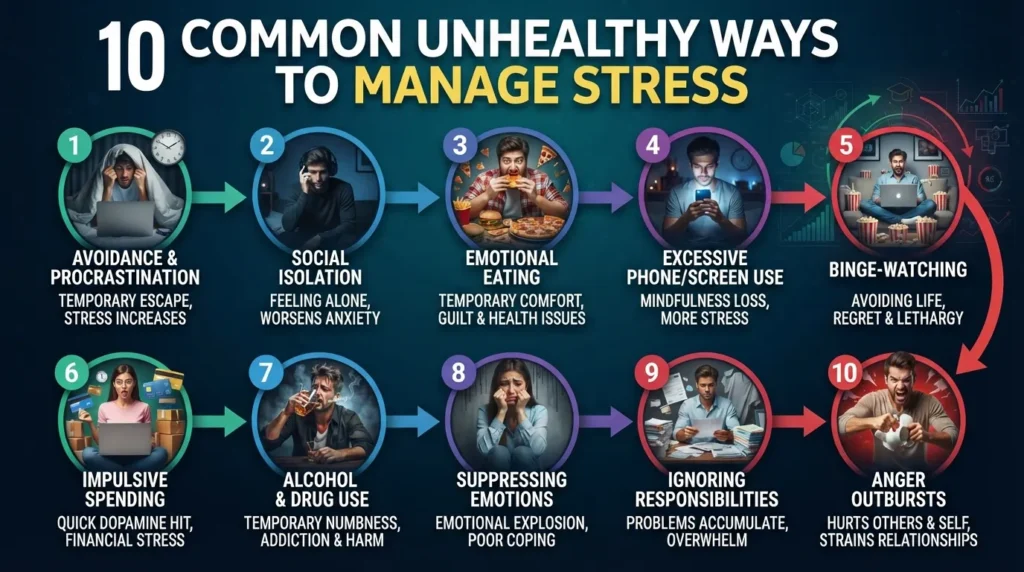
Some of the most common unhealthy coping patterns include:
- Avoiding problems or responsibilities
- Isolating yourself from supportive people
- Using alcohol, drugs, nicotine, or other substances to numb stress
- Eating too much or too little because of emotional distress
- Spending excessive time scrolling, gaming, streaming, or online
- Suppressing emotions and pretending everything is fine
- Procrastinating or constantly distracting yourself
- Overworking instead of dealing with the source of stress
- Sleeping far more or far less than you normally need
- Using anger, aggression, or conflict to release tension
- Making impulsive purchases or using other quick rewards to escape difficult feelings
These behaviors are not all equally harmful, and having one of them occasionally does not automatically mean you have an unhealthy coping pattern. The bigger concern is repetition, loss of control, increasing consequences, or using the behavior as your main way of dealing with stress.
Why can an unhealthy coping strategy feel helpful at first?
This is one of the most important things to understand about unhealthy coping: the behavior may actually provide short-term relief. That is often why it becomes a habit.
For example, avoiding an unpleasant task can immediately reduce anxiety. Scrolling through your phone can temporarily take your attention away from an upsetting situation. Comfort eating can provide a moment of pleasure. Drinking may temporarily dull difficult emotions.
The problem is that temporary relief is not always the same as solving the problem. If the behavior repeatedly becomes your automatic response, the underlying stressor may remain while a second problem develops around the coping habit.
A useful way to think about it:
Stress → uncomfortable feeling → quick escape or relief → problem remains → stress returns → same coping behavior becomes easier to repeat.
10 unhealthy ways of dealing with stress and what to do instead
Rather than simply labeling a behavior “bad,” it helps to understand what the behavior is doing for you and what could meet the same need in a healthier way.
1. Avoiding the problem
Avoidance can include ignoring an important conversation, putting off a difficult task, refusing to open an email, or continually finding something else to do whenever the stressful issue comes to mind.
Why it feels helpful: you get an immediate break from the uncomfortable thought or feeling.
Why it can backfire: the task, conflict, or uncertainty is still there. Delaying it can also allow deadlines, worries, or consequences to grow.
Try instead: identify the smallest useful action you can take. You do not have to solve the entire problem at once. Opening the document, making one phone call, writing down the first three steps, or asking for clarification can turn avoidance into action.
2. Isolating yourself
When stress becomes overwhelming, you may stop answering messages, cancel plans, or withdraw from people who normally support you.
Why it feels helpful: being alone can reduce social demands when you feel exhausted or overstimulated.
Why it can backfire: prolonged isolation can remove useful emotional support and leave you dealing with stressful thoughts on your own.
Try instead: keep the amount of contact manageable. You might send one message saying, “I’m having a stressful day and could use someone to talk to.” Support does not always require a long conversation.
3. Using alcohol or drugs to numb stress
Using alcohol or drugs specifically to escape difficult emotions can become a risky coping pattern, particularly when the amount or frequency increases.
Why it feels helpful: substances can temporarily change how you feel or distract you from distress.
Why it can backfire: relying on substances does not resolve the source of stress and can introduce serious health, relationship, work, or dependence-related problems.
Try instead: if substance use is becoming your primary way of coping, consider talking with a qualified healthcare or mental-health professional. If you already feel unable to control your use, getting support is more useful than trying to manage the problem through willpower alone.
4. Emotional eating or restricting food
Stress can change appetite. Some people eat more for comfort, while others lose interest in food or deliberately restrict what they eat.
Why it feels helpful: food can provide comfort, distraction, routine, or a temporary sense of control.
Why it can backfire: repeatedly using eating or restriction as the primary response to emotional distress can create another source of worry and may interfere with healthy eating patterns.
Try instead: notice the trigger before automatically responding to it. Ask yourself whether you are physically hungry, emotionally overwhelmed, tired, or looking for a break. If eating patterns are becoming difficult to control or causing significant distress, professional support can help.
5. Endless scrolling, gaming, or binge-watching
Phones, social media, games, videos, and streaming services can provide an easy escape when your mind feels overloaded.
Why it feels helpful: concentrating on something entertaining gives your attention a temporary break from stressful thoughts.
Why it can backfire: an intentional short break can become hours of avoidance, especially when online activity begins interfering with sleep, work, relationships, or responsibilities.
Try instead: make the break deliberate. Set a reasonable stopping point, put the device away when the break is finished, and then return to one small action that addresses the original source of stress.
6. Bottling up your feelings
Suppressing emotions can look like pretending you are fine, refusing to talk about what is bothering you, or constantly telling yourself that you should not feel upset.
Why it feels helpful: you avoid an uncomfortable conversation or the vulnerability of expressing difficult emotions.
Why it can backfire: the stressor does not disappear simply because the feeling is hidden. Unprocessed distress can continue affecting your thoughts, behavior, relationships, and ability to concentrate.
Try instead: name the emotion without judging yourself for having it. Writing in a journal, talking with someone you trust, or discussing the situation with a qualified professional can give the feeling somewhere constructive to go.
7. Procrastinating and distracting yourself constantly
Procrastination is not always laziness. Sometimes it is an attempt to avoid the anxiety associated with a difficult task.
Why it feels helpful: doing something easier immediately reduces the discomfort associated with the difficult task.
Why it can backfire: the unfinished task remains in the background, and the approaching deadline can create even more stress.
Try instead: shrink the task. Instead of “finish the report,” choose “write the first paragraph.” Instead of “clean the house,” choose one room or one small area. The goal is to replace avoidance with manageable action.
8. Overworking to escape stress
Keeping yourself constantly busy can sometimes look productive while actually functioning as a way to avoid difficult thoughts, emotions, or problems outside work.
Why it feels helpful: work gives you structure and keeps your attention focused on something you can measure or control.
Why it can backfire: without enough recovery time, the cycle of pressure and exhaustion can continue. You may also neglect sleep, relationships, movement, or other parts of your life.
Try instead: distinguish productive action from escape. Prioritize the work that genuinely matters, then protect time for rest and activities that help you recover.
9. Sleeping too much or too little
Stress can disrupt sleep in either direction. You may struggle to fall asleep, wake frequently, or want to stay in bed much longer than usual.
Why it feels helpful: sleep can feel like an escape when you are emotionally or mentally exhausted.
Why it can backfire: consistently disrupted sleep can make daily functioning and stress management more difficult.
Try instead: protect a regular sleep routine and treat persistent sleep problems as something worth addressing rather than simply pushing through them. If stress is repeatedly interfering with sleep or daily life, consider seeking professional advice.
10. Taking stress out on other people
Irritability, shouting, blaming, hostility, or aggressive behavior can become an outlet when someone feels overwhelmed.
Why it feels helpful: expressing anger can create a brief feeling of release or control.
Why it can backfire: it can damage relationships and create additional conflict that adds to the original stress.
Try instead: create a pause before responding. Step away if you need time to calm down, then return to the conversation when you can describe the problem without attacking the other person. If you are worried that you might hurt someone, prioritize immediate safety and seek professional help.
Unhealthy vs. healthier ways to respond to stress
You do not need a perfect coping strategy. The goal is to move from automatic reactions toward responses that either address the stressor, regulate your emotions, support your body, or connect you with other people.
| Stress response | Short-term effect | Possible longer-term problem | Healthier direction |
|---|---|---|---|
| Avoiding a difficult task | Less anxiety for the moment | Deadline or problem remains | Take one small action |
| Isolating yourself | Fewer social demands | Less access to support | Contact someone you trust |
| Excessive scrolling | Mental distraction | Lost time or disrupted sleep | Use a deliberate short break |
| Emotional eating | Comfort or distraction | Stress becomes linked to eating | Identify the trigger and another response |
| Substance use | Temporary emotional escape | Health and dependence-related risks | Seek appropriate support |
| Bottling up emotions | Avoids vulnerability | Underlying distress remains | Name and express the feeling safely |
How can I tell if a coping habit is becoming unhealthy?
The behavior itself is only part of the picture. Pay attention to the pattern around it.
- You use the behavior almost every time you feel stressed.
- You need more of the behavior to get the same sense of relief.
- You keep doing it even after it causes problems.
- It interferes with work, school, relationships, sleep, or everyday responsibilities.
- You are increasingly avoiding the original source of stress.
- You feel unable to cope without the behavior.
- The behavior creates guilt, shame, conflict, financial problems, health problems, or other consequences.
- The behavior has become your only reliable way to change how you feel.
A single difficult day does not define your coping style. Look for repeated patterns and whether the response is helping you function better or gradually making life harder.
What are healthier ways to manage stress?
Healthy coping is not about pretending that stress does not exist. It is about choosing responses that help you regulate the immediate reaction while also dealing with what is causing the stress.
Start by identifying the trigger
Ask yourself: What happened immediately before I started feeling this way? It might be a deadline, relationship problem, financial pressure, uncertainty, lack of sleep, conflict, or simply having too many demands at once.
Separate what you can control from what you cannot
If part of the situation can be changed, focus your energy there. If something cannot be changed immediately, your goal may shift toward managing your reaction and deciding what you can do next.
Use a short reset before taking action
A few slow breaths, a short walk, stretching, time outside, journaling, or another calming activity can give you enough space to respond rather than react automatically.
Talk to someone you trust
You do not have to wait until a problem becomes severe before asking for support. A trusted friend, family member, counselor, therapist, or other qualified professional may help you see the situation differently and identify practical next steps.
Take care of the basics
Regular sleep, nutritious meals, physical activity, breaks, and time away from constant news or social-media exposure can support your ability to handle everyday stress.
A simple way to replace an unhealthy coping pattern
- Notice the trigger. Identify what happened just before the urge appeared.
- Name the urge. Instead of automatically acting on it, say what you are trying to escape, change, or feel.
- Pause. Give yourself a short gap between the stressful feeling and the usual reaction.
- Choose the smallest useful response. Take one action that either reduces the stressor or supports you while you deal with it.
- Review what happened. Ask whether the new response actually helped and what you could change next time.
- Get support when the pattern is difficult to change alone. Repeated or high-risk coping behaviors deserve appropriate professional attention.
For example:
If you usually scroll for two hours after receiving a stressful work message, do not demand that you suddenly become perfectly calm. Notice the trigger, take a brief reset, write down what the message actually requires, and complete one small next step. You are replacing automatic avoidance with manageable action.
What are the 5 most common unhealthy coping strategies?
There is no universal ranking of the “worst five,” because the impact depends on the behavior, how often you use it, and what consequences it creates. Five commonly recognized unhealthy patterns are avoidance, isolation, substance use, unhealthy eating patterns, and excessive distraction.
Other patterns, including emotional suppression, overworking, sleep disruption, aggression, and compulsive reward-seeking, can also become problematic when they are repeatedly used to escape stress.
When should you get professional help for stress?
Consider professional support when stress is persistent, feels difficult to manage, interferes with everyday life, causes you to avoid important activities, or is accompanied by a coping behavior you cannot control.
Professional support can be especially important when alcohol or drug use, severe eating problems, persistent sleep disruption, aggression, self-harm, or thoughts of suicide are involved.
If you feel unsafe or may hurt yourself or someone else:
Seek immediate help through your local emergency service or a crisis service in your country. If you are in immediate danger, do not rely on self-help techniques alone.
Frequently asked questions about unhealthy ways to manage stress
What is the worst habit for anxiety or stress?
There is not one habit that is automatically the worst for everyone. A more useful warning sign is relying on a behavior that creates serious harm, becomes difficult to control, or repeatedly prevents you from addressing the source of stress. Substance misuse, self-harm, and dangerous aggression require particular attention and appropriate support.
Is avoiding stress always unhealthy?
No. Taking a short break from a stressful situation can be useful. The problem is persistent avoidance that prevents you from addressing something important or makes the situation harder over time. A healthy break helps you recover so you can return to the issue; unhealthy avoidance keeps you from dealing with it.
Can stress cause changes in eating or sleeping?
Yes. Stress can affect appetite, energy, concentration, and sleep. Eating much more or much less than usual, or sleeping substantially more or less, can also become part of an unhealthy coping pattern when it persists or interferes with daily life.
What is the difference between healthy and unhealthy coping?
Healthy coping generally helps you manage the emotion, address the stressor, protect your wellbeing, or connect with useful support. Unhealthy coping may provide immediate relief but repeatedly leaves the original problem unresolved or creates additional problems.
What can I do instead of using an unhealthy coping mechanism?
Start by identifying the trigger and the need behind the behavior. Then choose a response that fits that need. If you need to calm down, try breathing, movement, a break, or another relaxing activity. If you need to solve a problem, take one small practical action. If you need connection, contact someone you trust. If the pattern feels uncontrollable or risky, seek professional support.
The goal is not to cope perfectly
Everyone has moments when they avoid a problem, lose patience, eat for comfort, stay online too long, or simply want to escape. You do not need to judge yourself for having a stress reaction.
What matters is the pattern. If a behavior gives you a moment of relief but repeatedly makes your life harder afterward, it may be time to try a different response.
Start small: identify what is triggering you, pause before following the usual reaction, choose one healthier action, and ask for support when you need it. Good stress management is not about eliminating every difficult feeling. It is about developing ways to move through difficult moments without creating bigger problems for yourself later.
Trusted health information: For additional guidance about stress, healthy coping, symptoms that may require support, and professional resources, consider information from established public-health and mental-health organizations such as the CDC, NHS, and National Institute of Mental Health.