"Watch Your Habits, They Become Your Character" — The Full Quote, Its Real Origin, and What It Means
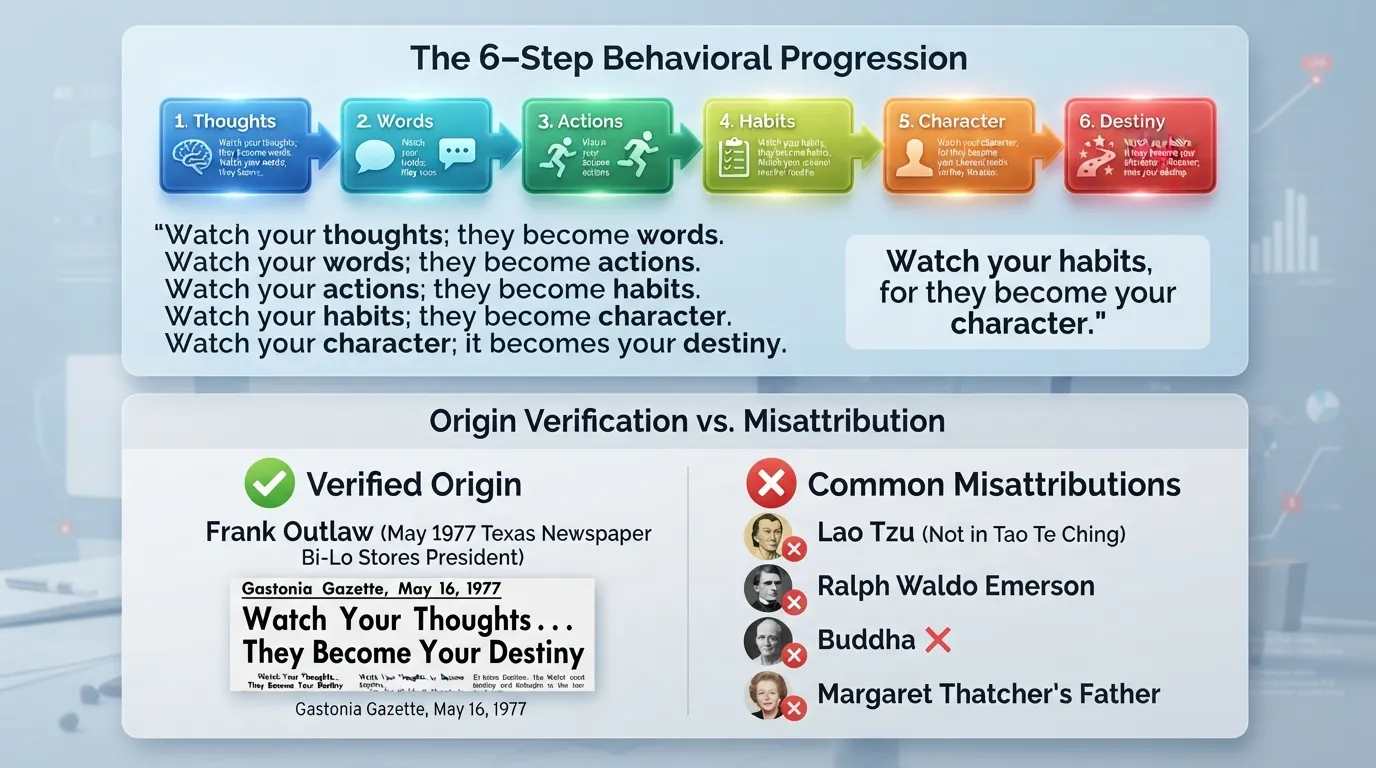
The quote “Watch your thoughts, they become your words; watch your words, they become your actions; watch your actions, they become your habits; watch your habits, they become your character; watch your character, it becomes your destiny” traces to Frank Outlaw in 1977, though often misattributed to Lao Tzu, Ralph Waldo Emerson, or Gautama Buddha.
The Full Quote in Its Complete Form
Watch your thoughts, they become your words;
watch your words, they become your actions;
watch your actions, they become your habits;
watch your habits, they become your character;
watch your character, it becomes your destiny.
The shortened version—frequently cited on social media, in motivational speeches, and across quote databases—strips away the preliminary steps to focus squarely on the core progression:
“Watch your habits, for they become your character.”
The Quote at a Glance — Thought → Word → Action → Habit → Character → Destiny
The full text functions as a six-part behavioral chain, where each stage serves as the direct trigger for the next:
| Stage | Mechanism | Resulting Output |
| 1. Thought | Internal focus and internal monologue | Words |
| 2. Word | Expressed statements and self-talk | Actions |
| 3. Action | Repeated behaviors over time | Habits |
| 4. Habit | Automated patterns of behavior | Character |
| 5. Character | Core identity and moral composition | Destiny |
| 6. Destiny | Long-term life trajectory and outcomes | Final Outcome |
Who Actually Said It?
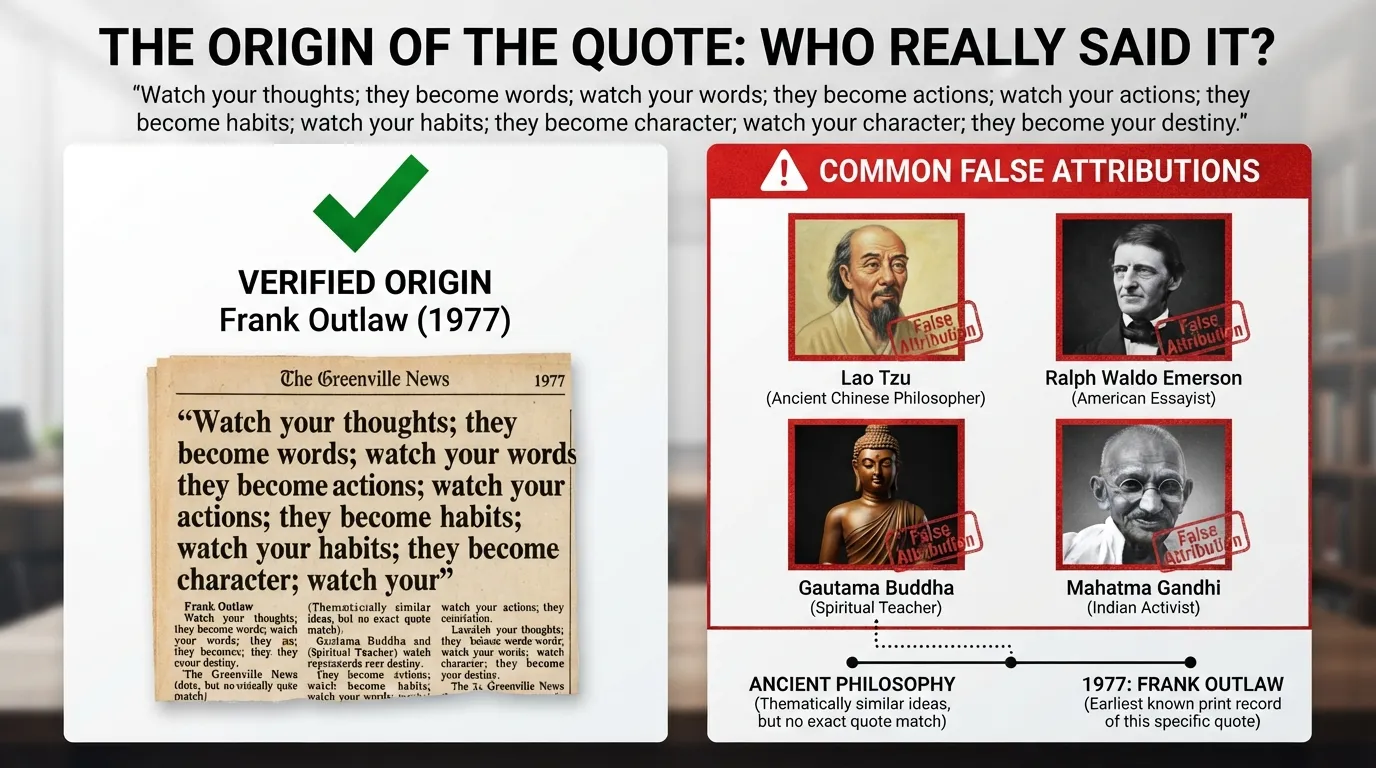
The Lao Tzu Attribution — And Why It’s Wrong
The most common online attribution points to Lao Tzu, the ancient Chinese philosopher traditionally considered the founder of Taoism. However, this attribution is entirely incorrect. The 6-line progression does not appear anywhere in the Tao Te Ching, nor does it exist in classical Taoist literature. The text is modern in both phrasing and structure, lacking any historical record in Chinese translations prior to the late 20th century.
The Real Source — Frank Outlaw, 1977
According to detailed historical tracking by Quote Investigator, the precise modern formulation was penned by Frank Outlaw, the late president of the Bi-Lo supermarket chain.
The exact progression made its earliest verified print appearance in a May 1977 Texas newspaper feature titled “What They’re Saying,” where it was explicitly attributed to Frank Outlaw. A few months later, in October 1977, it appeared again in a Canandaigua, New York newspaper under a “Words of Wisdom” column, preserving the identical wording and credit.
Who Was Lao Tzu, and What Did He Actually Write?
Lao Tzu (also translated as Laozi) was a 6th-century BCE Chinese philosopher and central figure in Taoism. Historical information about his life remains limited, according to the Encyclopædia Britannica, but he is traditionally credited with authoring the Tao Te Ching.
His actual writings emphasize flow, non-action (wu wei), harmony with nature, and simplicity—concepts quite distinct from the linear, step-by-step behavioral chain found in the habits-to-destiny quote.
Other Misattributions — Emerson, Buddha, Bishop Beckwaith, Margaret Thatcher’s Father
Over the years, several other prominent figures have been incorrectly credited with the modern quote:
Ralph Waldo Emerson: Frequently credited on quote aggregated websites, but the passage never appears in any of his published essays, journals, or speeches.
Gautama Buddha: Often misattributed due to the Dhammapada (“We are what we think”), which discusses thoughts shaping experience, but does not contain the specific 6-step progression.
Bishop Beckwaith: In 1885, a precursor variant using similar key terms was linked to a Bishop Beckwaith, making it an early evolutionary step rather than the final 1977 text.
Alfred Roberts (Margaret Thatcher’s Father): Margaret Thatcher famously cited the quote, noting that her father taught it to her growing up. While this helped popularize the phrasing globally, her father was repeating a known 20th-century maxim rather than originating it.
The Gandhi Variant — A Different (Also Misattributed) Quote
A widely circulated quote attributed to Mahatma Gandhi follows a strikingly similar structural progression, leading many to conflate the two. While both discuss internal states leading to destiny, they feature distinct language and distinct lineage.
| Feature | Frank Outlaw Quote | Gandhi Variant |
| Starting Point | “Watch your thoughts…” | “Your beliefs become your thoughts…” |
| Full Chain | Thoughts → Words → Actions → Habits → Character → Destiny | Beliefs → Thoughts → Words → Actions → Habits → Values → Destiny |
| First Verification | May 1977 (Texas newspaper) | Conflated in late 20th-century anthologies |
| Actual Status | Confirmed source: Frank Outlaw | Spurious attribution; not found in Gandhi’s Collected Works |
The Cowboy Outlaw Myth
A lesser-known internet myth claims the quote was written by a 19th-century Wild West outlaw named Frank Jackson (a member of the Sam Bass gang) or a legendary “Frank Outlaw.” This is a literal misunderstanding of a name. “Frank Outlaw” was not a line-of-duty fugitive or a Western bandit, but the real, legal name of the 20th-century executive who served as president of Bi-Lo Stores.
Quick Verdict Table
| Claimed Author | Evidence | Verdict |
| Lao Tzu | Absent from Tao Te Ching and ancient Chinese texts | False |
| Frank Outlaw | Earliest verified print match (May 1977 Texas newspaper) | Verified |
| Mahatma Gandhi | Absent from Gandhi’s 98-volume Collected Works | False |
| Ralph Waldo Emerson | Absent from all published essays and journals | False |
| Margaret Thatcher’s Father | Cited orally by Thatcher; popularized an existing maxim | Misattributed Origin |
| 19th-Century Western Outlaw | Misinterpretation of Bi-Lo executive Frank Outlaw’s last name | False (Myth) |
The Quote's Family Tree — Older Versions That Came First
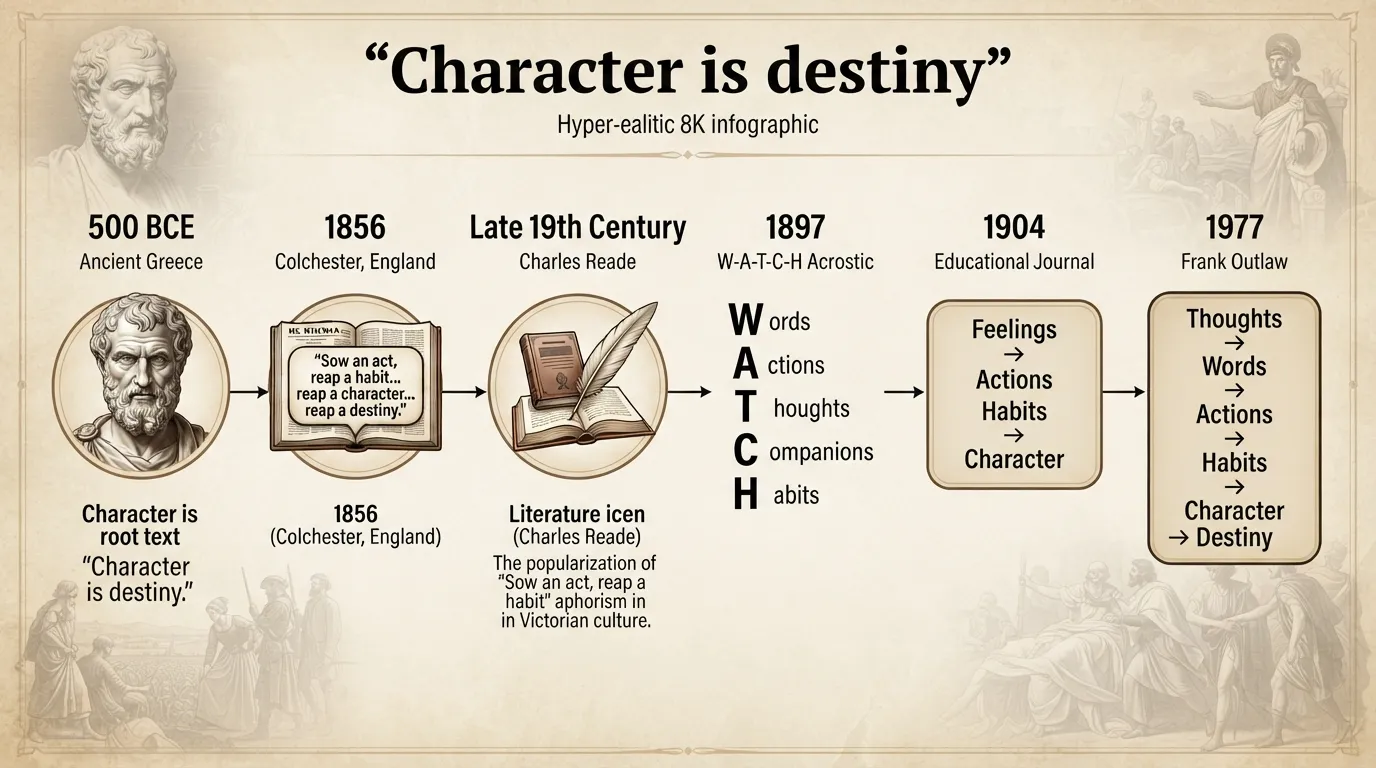
While Frank Outlaw coined the modern phrasing in 1977, the quote is the product of a long evolutionary tree. Writers, ministers, and educators spent over a century refining the causal chain before it reached its six-step form.
1856 Colchester, England Speech
The earliest recorded ancestor of this causal chain appeared in an 1856 report from a Colchester, England newspaper. Reporting on an address given to students by a speaker named Mr. Wiseman, the article noted:
“You sow an act, you reap a habit (acts repeated constitute habits); you sow a habit, you reap a character; you sow a character, you reap a destiny.”
This early version established the foundational “sow/reap” framing—borrowed directly from biblical agriculture metaphors—connecting individual actions straight through to human destiny.
1897 W-A-T-C-H Acrostic Sermon
By the late 19th century, religious educators began using the word WATCH as an acrostic tool to teach moral self-discipline to children. Sunday school sermons used each letter to anchor a core lesson:
W — Watch your Words
A — Watch your Actions
T — Watch your Thoughts
C — Watch your Companions
H — Watch your Habits
This mnemonic framework introduced the crucial imperative verb “watch” into the progression, merging the behavioral chain with an explicit command for self-awareness.
1904 Education Article
As educational theory evolved in the early 20th century, writers began incorporating psychological concepts into the moral chain. A 1904 article published in an educational journal described character formation through emotional triggers:
“Out of feelings, it has been said, spring actions; actions become habit; and habits crystallize into character.”
This variation pushed the origin point one step further back into internal psychological states, laying the groundwork for “thoughts” to eventually head the chain.
Charles Reade (1814–1884) — “Sow an Act…”
The 19th-century English novelist and dramatist Charles Reade is frequently cited as the creator of the famous aphorism:
“Sow an act and you reap a habit; sow a habit and you reap a character; sow a character and you reap a destiny.”
While Reade helped popularize this exact triadic phrasing in popular literature during his lifetime, he was drawing from the broader Victorian pulpit tradition rather than inventing the concept out of whole cloth.
Heraclitus and “Character Is Destiny”
At the deepest root of this idea sits the ancient Greek philosopher Heraclitus (c. 535 – c. 475 BCE). His original fragment—Ethos anthropoi daimon—is most famously translated as:
“Character is destiny.”
Heraclitus provided the ultimate endpoint for the entire chain. While he did not detail the middle steps of thoughts, words, or habits, his insight established the core philosophical premise that a person’s life trajectory is governed by their internal moral composition rather than external fate.
Evolution of the Chain Over Time
| Version / Source | Era / Date | Core Wording Difference | Primary Framing |
|---|---|---|---|
| Heraclitus | c. 500 BCE | "Character is destiny." | Philosophical premise (no chain steps) |
| Colchester Speech | 1856 | "You sow an act... reap a habit... reap a character... reap a destiny." | Agricultural sow/reap metaphor |
| W-A-T-C-H Acrostic | 1897 | "Watch your Words, Actions, Thoughts, Companions, Habits" | Mnemonic instructional command |
| Education Journal | 1904 | "Feelings spring actions; actions become habit; habits crystallize into character." | Early psychological model |
| Frank Outlaw | 1977 | "Watch your thoughts... words... actions... habits... character... destiny." | Fully articulated 6-stage linear chain |
What the Quote Means — Line by Line
Watch your thoughts, they become your words. Your internal focus and inner monologue directly dictate how you speak to others and yourself.
Watch your words, they become your actions. Language reinforces intent, shaping the specific choices and behavioral commitments you make each day.
Watch your actions, they become your habits. Repeated behaviors lose their conscious effort over time, consolidating into automatic routines.
Watch your habits, they become your character. The collection of your daily automated choices ultimately forms your moral identity and core personality.
Watch your character, it becomes your destiny. Your long-term outcomes and overall life trajectory stem directly from who you choose to be each day.
How Habits Actually Become Character — And Is It Even True?
The Mechanism (Repetition → Automaticity → Identity)
The transition from a simple habit to a core character trait relies on neural and behavioral reinforcement. When an action is repeated consistently in response to a specific cue, the brain offloads the decision-making process to the basal ganglia, turning a conscious effort into an automatic routine.
Over time, this automaticity changes how a person views themselves. Doing something repeatedly moves the behavior from an external task (“I am practicing a routine”) to an internal identity statement (“This is simply who I am”).
What Aristotle and Research Say
This behavioral model aligns closely with both ancient philosophy and modern psychology:
Aristotelian Virtue Ethics: Aristotle famously argued in the Nicomachean Ethics that moral virtue is not an innate trait, but a habit formed through practice: “We are what we repeatedly do. Excellence, then, is not an act, but a habit.” Virtue is acquired through action, much like learning a trade.
Self-Perception Theory: Formulated by psychologist Daryl Bem in 1972, this theory demonstrates that people infer their own attitudes and values by observing their own behavior. If you consistently observe yourself helping others, your brain concludes that you are an empathetic person, solidifying the trait into your self-concept.
The Limits — Genetics, Circumstances, and Trauma
While habits play a major role in shaping behavior, asserting that habits alone determine character is an oversimplification. Modern science and honest philosophical analysis point to critical limiting factors:
Genetics and Temperament: Behavioral genetics show that personality traits (such as neuroticism, extroversion, and impulsivity) have a heritability rate of roughly 40% to 50%, setting baseline boundaries for how character develops.
Socioeconomic Circumstances: Chronic poverty, systemic inequality, and environmental safety heavily constrain the choices available to an individual, often forcing survival-based actions that do not reflect their underlying moral desire.
Trauma and Neurological Shifts: Traumatic events and brain injury can instantly alter emotional regulation, impulse control, and personality regardless of decades of prior habit formation.
Is "Habits Become Character" a Bible Verse?
The short answer is no. The phrase “Watch your habits, they become your character” does not appear anywhere in the Old or New Testaments. While the progression mirrors biblical principles regarding self-discipline and moral growth, it is a modern secular observation, not scripture.
Proverbs 23:7 — The Verse People Confuse It With
The most common biblical mix-up stems from Proverbs 23:7, which is frequently misquoted out of context as “As a man thinketh in his heart, so is he.” On the surface, this King James Version rendering sounds identical to the “thoughts become character” principle.
However, as shown in full context on Bible Gateway, the verse is not a statement about mindset or self-actualization. It is a practical warning about dining with a selfish host:
“Do not eat the food of a begrudging host, do not crave his delicacies; for he is the kind of person who is always thinking about the cost. ‘Eat and drink,’ he says to you, but his heart is not with you.”
The passage warns the reader against trusting someone who acts hospitable on the outside while inwardly calculating expenses—it is about insincerity, not the power of thought to shape character.
Proverbs 4:23 — The Closer Parallel
While the quote isn’t in scripture, the closest conceptual match in the Bible is found in Proverbs 4:23:
“Above all else, guard your heart, for everything you do flows from it.”
In ancient Hebrew thought, the “heart” (leb) represented the seat of thoughts, mind, and intent. This verse captures the same core mechanism as the modern quote: internal mental focus serves as the ultimate spring from which all actions, choices, and life outcomes flow.
What Real People Say About This Quote
The Reddit Discussion
When discussions about this quote surface in online communities like r/DeepThoughts, users generally divide into two main perspectives. Many resonate deeply with the practical, bottom-up framework, sharing how tracking small daily choices helped them regain a sense of agency during periods of personal burnout or behavioral stagnation. To them, the linear progression serves as an empowering roadmap that demystifies personal growth.
At the same time, commenters frequently emphasize the fragility of the early links in the chain. A recurring point of debate is how easily unexamined thoughts or casual self-talk can quietly compound into negative habits long before a person realizes their character is being reshaped.
The Common Criticism
The most persistent critique of the quote centers on its strict determinism and disregard for external realities. Skeptics point out that reducing human life entirely to internal choices overlooks the massive impact of systemic pressures, acute trauma, and physical environment.
Critics argue that a person forced into survival mode by chronic poverty or dangerous circumstances may adopt reactive behaviors that do not reflect their true moral baseline or innate desires. In these views, treating character solely as the product of personal habit ignores the complex interplay between individual agency and the heavy weight of lived experience.
The Quote as a Shareable Image
Here are three visual quote-card design concepts tailored for modern typography and clean layout presentation:
Option 1: Minimalist Typography Card
Visual Styling: High-contrast presentation featuring bold serif typography on a textured, warm neutral canvas.
Text Layout: A prominent header displaying the core 4-stage progression: “Thoughts → Actions → Habits → Character.” Below, a subtle subtext reads: “Watch your habits; they become your character.”
Design Purpose: Optimized for square formats and quick visual scanning on image-first feeds.
Option 2: Full Linear Chain Layout
Visual Styling: Dark slate backdrop accented with crisp white lettering and minimalist line-art connecting nodes.
Text Layout: Displays the entire 6-stage quote structured as a vertical flow chart, highlighting the progression from Thoughts down to Destiny. Frank Outlaw’s name appears centered at the bottom.
Design Purpose: Ideal for story formats and detailed educational posts where readers can follow the complete chain.
Option 3: Modern Aesthetic Graphic
Visual Styling: Soft gradient background using earthy sage green and muted gold hues, framed by a delicate border.
Text Layout: Focuses strictly on the short quote: “Watch your habits, for they become your character.” The text is set in an elegant sans-serif font with generous line spacing.
Design Purpose: Designed for mood boards and lifestyle sites emphasizing clean, contemporary aesthetics.
20 More Quotes About Habits and Character
Classic Philosophy
“We are what we repeatedly do. Excellence, then, is not an act, but a habit.”
— Aristotle (as summarized by Will Durant)
Highlights how moral and intellectual virtue is built through continuous daily practice rather than occasional effort.
“Habits in our early youth make all the difference, or rather, make all the difference.”
— Aristotle
Emphasizes the foundational role early environmental conditioning plays in shaping lifelong personal identity.
“Nothing is stronger than habit.”
— Ovid
Points to the overwhelming power of ingrained routines over pure willpower.
“Men’s natures are alike, it is their habits that carry them far apart.”
— Confucius
Argues that innate human potential is largely equal, while behavioral differences dictate life outcomes.
“Character is simply habit long continued.”
— Plutarch
Defines moral reputation and disposition as the direct, cumulative result of long-term routines.
“Cultivate only the habits that you would have rule your life.”
— Elbert Hubbard
Warns that unexamined habits will eventually govern your decision-making and autonomy.
“Character is destiny.”
— Heraclitus
The foundational ancient Greek premise that internal moral structure dictates external fate.
“Habit is a second nature which destroys the first.”
— Blaise Pascal
Describes how acquired behaviors can eventually override innate instincts and human tendencies.
“The chains of habit are too weak to be felt until they are too strong to be broken.”
— Samuel Johnson
Illustrates how daily actions subtly solidify into rigid patterns before we notice their impact.
“Small habits don’t add up, they compound.”
— Marcus Aurelius
Reflects Stoic principles regarding the massive long-term momentum generated by tiny, consistent actions.
Modern Voices
“Sow a thought, and you reap an act; sow an act, and you reap a habit; sow a habit, and you reap a character; sow a character, and you reap a destiny.”
— Stephen Covey
Framed the classic agricultural metaphor for a modern leadership audience in his work on personal effectiveness.
“You do not rise to the level of your goals. You fall to the level of your systems.”
— James Clear
Reframes habit formation away from outcome goals toward practical, repeatable daily processes.
“Every action you take is a vote for the type of person you wish to become.”
— James Clear
Connects small daily choices directly to identity formation and self-perception.
“Motivation is what gets you started. Habit is what keeps you going.”
— Jim Ryun
Distinguishes temporary emotional momentum from the sustainable power of structured routines.
“First we make our habits, and then our habits make us.”
— John Dryden
Captures the dynamic feedback loop where choices initially created by us end up defining our behavior.
“Character is the ability to carry out a good resolution long after the excitement of the moment has passed.”
— Cavett Robert
Focuses on the discipline required to maintain behavioral commitments when emotional motivation fades.
“Habit, if not resisted, soon becomes necessity.”
— Saint Augustine
Highlights the compounding nature of unaddressed habits as they shift from choice to compulsion.
“The trick is in what one emphasizes. We either make ourselves miserable, or we make ourselves strong. The amount of work is the same.”
— Carlos Castaneda
Points out that building constructive habits requires the same energy as sustaining destructive ones.
“Successful people are simply those with successful habits.”
— Brian Tracy
Demystifies high achievement by reducing it to the execution of effective daily routines.
“You’ll never change your life until you change something you do daily. The secret of your success is found in your daily routine.”
— John C. Maxwell
Stresses that meaningful personal transformation requires modifying immediate, day-to-day actions.
How to Use This Quote
If you are incorporating this quote into an article, a speech, or a social media post, you have two primary versions to choose from.
Short Version (Copy-ready):
“Watch your habits, they become your character.”
Full Version (Copy-ready):
“Watch your thoughts, they become your words; watch your words, they become your actions; watch your actions, they become your habits; watch your habits, they become your character; watch your character, it becomes your destiny.”
When citing the quote, it is important to correct the historical record. Because the Lao Tzu myth is so widespread, simply attributing it to him damages your credibility as a writer or speaker. Instead, use a citation format that acknowledges the popular myth while providing the accurate historical origin.
Correct Citation Format:
— Frank Outlaw (Commonly misattributed to Lao Tzu)
If you are writing a more formal academic or journalistic piece and need to explain the origin in-text, use this framing:
“While often incorrectly attributed to the ancient philosopher Lao Tzu, this quote first appeared in print in 1977, credited to Bi-Lo Stores president Frank Outlaw.”
Thanawat Rattanakul
Thanawat Rattanakul is the Habits Editor at Holistic Wellbeing Living. He writes about daily routines, habit systems, small behavior changes, and sustainable progress. With eight years of experience creating personal-growth content, Thanawat helps readers build practical routines that fit real life.