The Power to Change: Mastering the Habits That Matter Most — Complete Guide
What Is "The Power to Change" About? Book Overview
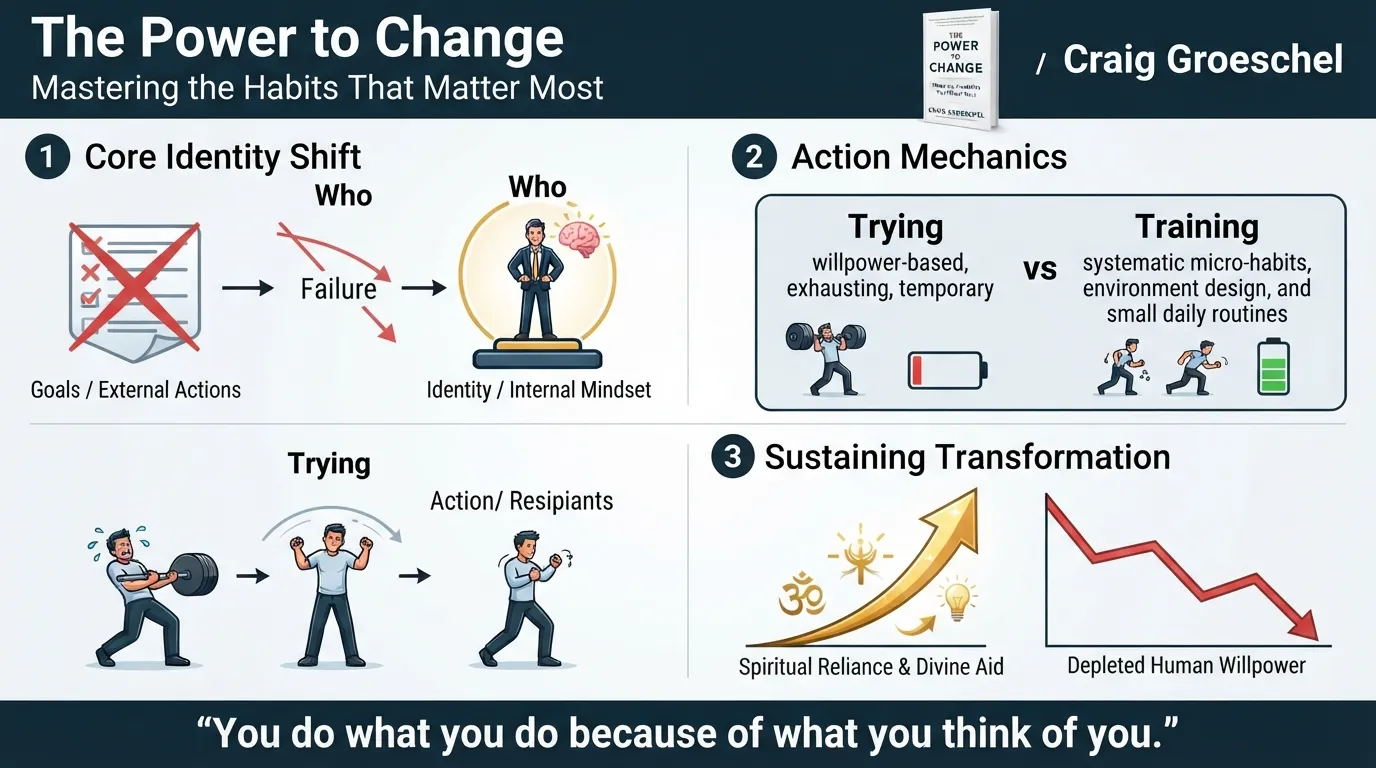
The Power to Change: Mastering the Habits That Matter Most addresses a frustration almost everyone encounters at some point: wanting to break bad habits or build better ones, making a firm resolution, and then failing to stick with it. While standard behavioral psychology points to willpower, routine design, and tracking systems as the solution, Craig Groeschel approaches the challenge from a distinct angle. He argues that lasting change isn’t primarily a willpower issue—it’s an identity and spiritual alignment issue.
Rather than relying purely on motivation or practical hacks, the book bridges real-world behavioral science with biblical principles. Groeschel outlines a framework centered on who you are becoming, emphasizing that habits flow from identity rather than sheer effort. By shifting the focus from “what I want to do” to “who I am in Christ,” the book offers readers a structured path to reframe their thought patterns, break destructive loops, and establish practical, daily routines that last.
Author — Craig Groeschel & Life.Church Background
Craig Groeschel is the founding and senior pastor of Life.Church, an innovative multi-site church based in Edmond, Oklahoma, widely recognized for creating the YouVersion Bible App. Under his leadership, Life.Church grew into one of the largest evangelical churches in the United States, known for its emphasis on combining technology, practical teaching, and leadership development.
In addition to his pastoral work, Groeschel hosts the popular Craig Groeschel Leadership Podcast, where he analyzes organizational dynamics, personal effectiveness, and team building for business leaders and pastors alike. As a New York Times bestselling author, his writing frequently tackles real-world personal struggles—such as mental discipline, communication, and habits—through a blend of practical psychology, personal anecdotes, and Christian theology. This dual perspective as both an organizational leader and spiritual mentor strongly shapes the practical, actionable style found in The Power to Change.
Publication Details
Publication Date: February 14, 2023
Publisher: Zondervan (HarperCollins Christian Publishing)
Page Count: 256 pages
ISBN-10: 0310362776 (Hardcover) / 0310367182 (Paperback)
ISBN-13: 978-0310362777 (Hardcover) / 978-0310367185 (Paperback)
Watch: The Power to Change Explained Video Section
To fully grasp the core message of The Power to Change: Mastering the Habits That Matter Most, watching Craig Groeschel break down these concepts in his own words provides invaluable context. Below are key video sessions where Pastor Craig explains the framework, identity-driven habits, and practical applications outlined in the book.
1. Mastering the Habits That Matter Most (Leadership Deep Dive)
In this comprehensive 20-minute episode, Craig Groeschel unpacks why standard willpower often fails and introduces the "Who Before Do" framework. He explains how high achievers battle imposter syndrome and details how small, identity-shaping habits act as "votes" toward the person you are becoming.
2. The Power to Change Your Habits: Identity Drives Behavior
Featuring a direct excerpt from the book’s official audiobook release, this session addresses the frustration of trying to change through simple behavior modification. Pastor Craig explains why behavior modification is merely first-order change and shares Biblical and psychological insights into why true transformation requires changing how you think about yourself.
3. You Have The Power to Change (Short Highlight)
A quick, powerful message highlighting the spiritual foundation of personal transformation. In under a minute, Pastor Craig delivers an inspiring reminder that lasting change is possible when relying on God's strength rather than self-reliance.
Core Themes of the Book
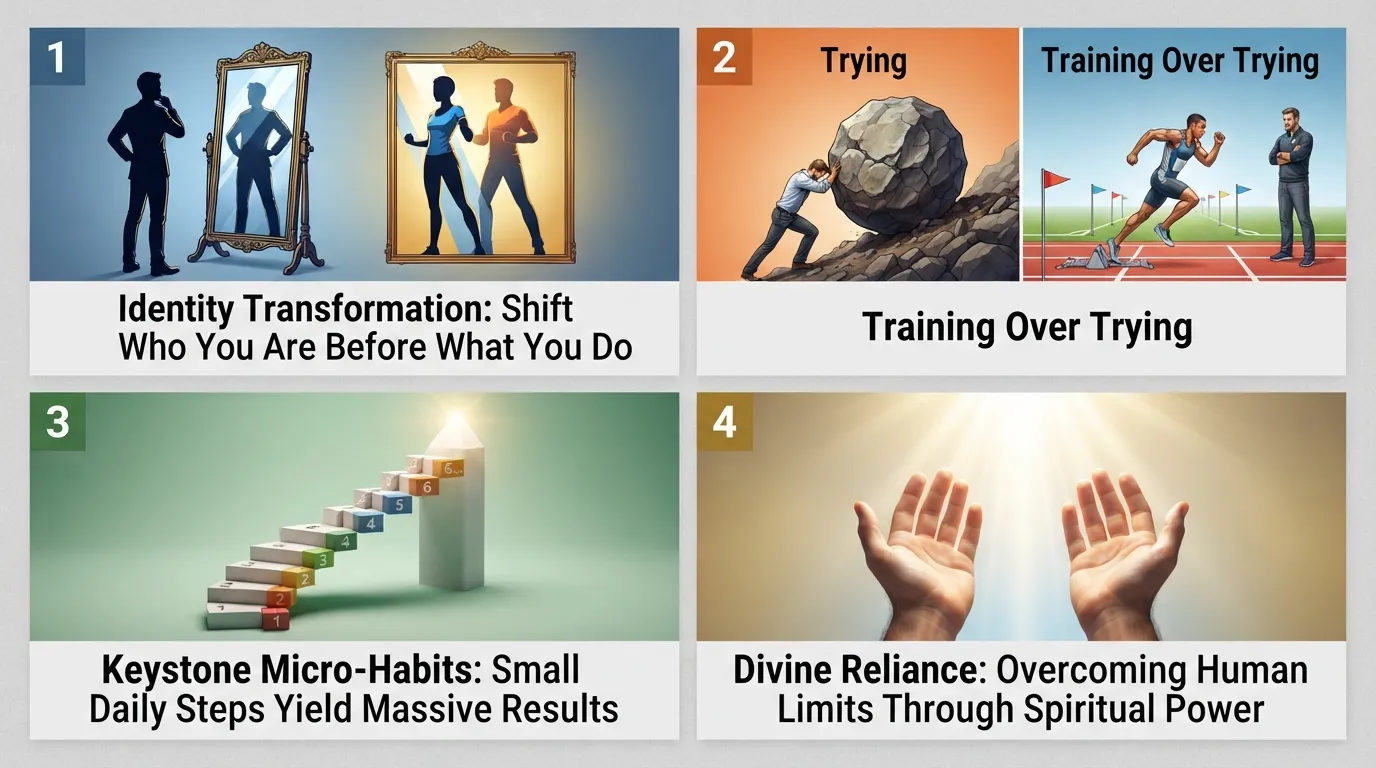
In The Power to Change: Mastering the Habits That Matter Most, Craig Groeschel outlines a framework designed to break the endless loop of resolution, effort, and inevitable burnout. Instead of relying on conventional self-help tactics that treat habits as isolated routines, the book anchors daily behavior in internal transformation. Four core themes form the foundation of this approach.
Identity Over Behavior
The most fundamental shift Groeschel advocates is moving from a outcome-based focus (“what I want to do”) to an identity-based focus (“who I want to become”). Most people attempt to alter their lives through behavior modification—trying to stop bad actions or force good ones through sheer effort. However, behavior modification targets symptoms rather than roots.
Groeschel emphasizes that you ultimately do what you do because of what you think of yourself. Drawing on Proverbs 23:7 (“as he thinks within himself, so he is”) alongside modern psychological frameworks like James March’s identity model of decision-making, the book highlights that every choice stems from three subconscious questions:
What kind of situation is this?
What kind of person am I?
What does a person like me do in a situation like this?
When change begins with identity—aligning who you are with your spiritual values—habits follow naturally. Each small choice acts as a vote cast toward the identity you are building, gradually establishing undeniable proof of the new person you are becoming.
Training Over Trying
When people fail to maintain a habit, they often assume they simply did not try hard enough. Groeschel challenges this assumption by distinguishing between trying and training.
Trying relies on temporary bursts of motivation and willpower—two resources that inevitably run out when stress or fatigue hits. Training, by contrast, is a deliberate, systematic process built on preparation, consistency, and skill acquisition.
Trying: Attempting to run a marathon on a whim through sheer determination, leading to quick exhaustion or injury.
Training: Following a structured, progressive regimen that builds endurance over time, making success a natural outcome of preparation.
By shifting from a mindset of “trying harder” to “training intentionally,” you remove the reliance on fickle emotions and focus instead on building systems that sustain long-term growth.
Small Habits (The Power of “Keystone” Routines)
Grand, sweeping overhauls rarely stick. Groeschel argues that monumental changes often trigger resistance and overwhelm, whereas small, consistent actions compound into massive long-term transformation over time.
The book focuses heavily on establishing small, manageable habits—often referred to as “keystone habits.” A keystone habit is a single, small discipline that creates a ripple effect across other areas of life. For instance, committing to a simple 2-minute daily routine or a small act of discipline reinforces a self-image of control and consistency, making subsequent positive choices far easier to adopt.
Rather than stacking ten major life goals at once, Groeschel encourages picking one specific, micro-level action that reinforces your target identity and practicing it consistently until it becomes second nature.
Spiritual Reliance
What separates The Power to Change from purely secular self-help models like Atomic Habits is its explicit reliance on divine power. Groeschel acknowledges that human willpower is finite, but argues that spiritual transformation relies on an infinite power source.
True, lasting change requires pairing practical behavioral strategies with faith. The book framing centers on the belief that human effort alone is insufficient for deep heart and character transformation. Rather than striving entirely in your own strength, real freedom from deeply ingrained patterns comes through spiritual renewal—letting God transform your mind (Romans 12:2) and relying on the Holy Spirit to supply the strength that human discipline lacks.
| Core Concept | Standard Self-Help Approach | "The Power to Change" Framework |
|---|---|---|
| Starting Point | External Goals ("What do I do?") | Internal Identity ("Who am I?") |
| Execution Method | Relying on willpower & trying harder | Systematic training & routines |
| Scale of Change | Sweeping, drastic overhauls | Small, compounding micro-habits |
| Power Source | Self-reliance & motivation | Spiritual reliance & divine aid |
Chapter-by-Chapter Breakdown
In The Power to Change, Craig Groeschel structures the journey of habit formation across distinct parts that move from deep internal mindsets to practical execution and long-term momentum. Below is the breakdown of how the book guides readers from foundational identity work to lasting transformation.
Part 1 – Understanding Change
The initial chapters focus on breaking down why past attempts at change failed and laying a solid psychological and spiritual foundation. Before giving you practical steps, Groeschel addresses the root causes of personal frustration and self-sabotage.
Focusing on Who, Not Do: Change begins with identity, not actions. Groeschel explains that your habits are a direct reflection of what you believe about yourself. Instead of setting goals based on outcomes (“I want to lose 20 pounds”), you start by defining your identity (“I am a healthy person”).
Targeting the Root, Not the Symptom: Behavior modification fails because it only trims the visible surface of a problem while leaving the root intact. Real growth happens when you examine the limiting beliefs, past pain, or false narratives driving negative choices.
Reframing Your Mindset: Drawing on Romans 12:2, these chapters emphasize that lasting personal transformation requires renewing how you think. You learn to align your self-talk with spiritual truth rather than past failures.
Part 2 – Building New Habits
Once the identity foundation is established, the book shifts toward actionable mechanics. Part 2 gives you concrete strategies for designing daily routines that minimize friction and bypass reliance on willpower.
Training Over Trying: Groeschel contrasts the exhausting cycle of “trying harder” with the structured discipline of “training.” Training treats growth like conditioning for a sport—focusing on preparation, consistency, and repeatable systems rather than spontaneous bursts of effort.
Starting Small with Keystone Habits: Instead of attempting massive, overwhelming life overhauls, you start with micro-habits. Establishing one small “keystone habit”—such as praying for two minutes or writing a single daily gratitude note—creates positive momentum that spills into other areas of life.
Designing Your Environment: Practical habit loops rely on your surroundings. You are guided to structure your physical and digital environments to make desirable actions friction-free and bad habits harder to access.
Part 3 – Sustaining Transformation
The final chapters address long-term perseverance, overcoming setbacks, and tapping into a power source larger than personal discipline.
The Law of Sowing and Reaping: Groeschel reminds readers that habits operate on compounding returns. Small, positive choices often feel invisible initially, but consistent daily investments inevitably yield a significant harvest over time.
Overcoming Discouragement and Relapse: Setbacks are a normal part of the process, not a reason to abandon your journey. The book provides practical steps for breaking out of shame spirals after a slip-up, encouraging readers to re-anchor immediately in their target identity rather than accepting defeat.
Relying on Divine Power: Human willpower is a depletable resource. True, enduring transformation happens when you stop relying solely on self-effort and surrender your habits to God, allowing spiritual strength to sustain you when personal motivation runs dry.
The Power to Change — Workbook, Sermon Series & Bible Study
The Companion Workbook
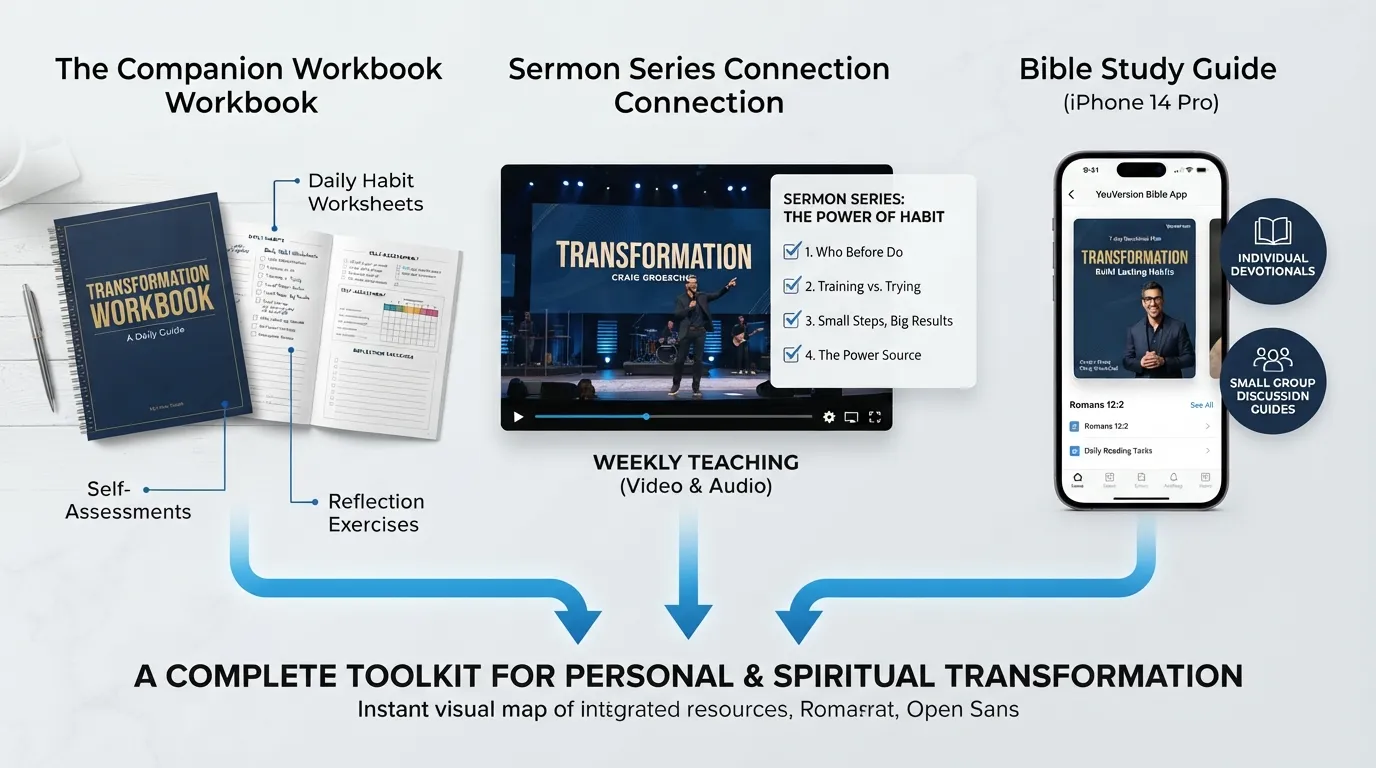
The workbook acts as a practical field guide to accompany the main text, helping you translate concepts into tangible daily habits. It contains reflection prompts, habit-tracking worksheets, and exercises designed to uncover core limiting beliefs and replace them with empowering routines.
Get the book: The Power to Change Workbook on Amazon
Sermon Series Connection
Designed for individual listeners, small groups, and church communities, the 4-part sermon series complements the book’s core teachings. Delivered at Life.Church by Craig Groeschel, the message series breaks down complex psychological principles into accessible spiritual truths:
Part 1: Who Before Do — Discovering identity-driven transformation.
Part 2: Training vs. Trying — Shifting from willpower to structured systems.
Part 3: Small Steps, Big Results — The power of micro-habits and keystone behaviors.
Part 4: The Power Source — Tapping into divine strength when motivation fails.
Watch the series: Access full video messages, group discussion guides, and daily devotionals at Life.Church – The Power to Change Resources.
Bible Study Guide & Reading Plan
To ground the transformation process directly in scripture, a companion study plan connects behavioral change with biblical principles. This resource is ideal for 7-day personal devotionals or structured 4-to-6-week small group Bible studies.
Key Focus: Aligning personal habit loops with biblical renewal (Romans 12:2) and learning to rely on spiritual strength rather than self-reliance.
Start the study: Read the companion devotional directly on YouVersion via The Power to Change 7-Day Bible Plan.
Key Quotes & Takeaways from the Book
Craig Groeschel’s The Power to Change distills complex behavioral science and spiritual principles into memorable insights. Below are the foundational quotes and key takeaways that summarize the book’s core philosophy.
Core Principles & Key Quotes
Identity Drives Action
“You do what you do because of what you think of you.”
Takeaway: True behavior change fails when you only focus on external tasks. Real transformation starts from the inside out—when you shift your self-identity from “I’m trying to stop doing X” to “I am not the kind of person who does X.”
Training Over Trying
“To try is to attempt to do the right thing by exerting effort in the moment. To train is to commit to developing strategic habits that equip you to do the right thing in the moment.”
Takeaway: Willpower is a limited, depletable resource. Winners don’t rely on momentary effort; they rely on daily systems, routines, and preparation.
The Power of Discipline
“Discipline is choosing what you want most over what you want now.”
Takeaway: Long-term success requires trading immediate gratification for delayed compounding returns. Small, unseen daily choices yield the big results everyone desires.
Identity-First Goals
“To experience change that lasts, focus on who, not do.”
Takeaway: Goals give you direction, but identity gives you staying power. Define the person you want to become before outlining the tasks you want to accomplish.
Divine Reliance
“Acknowledging ‘I can’t’ is the path to possessing a power you don’t possess.”
Takeaway: Human effort has natural limits. Admitting your inability to change in your own strength opens the door to relying on divine power and spiritual transformation.
Key Summary Table
| Core Takeaway | Traditional Mindset | “The Power to Change” Approach |
| Focus | Changing behaviors (Do) | Transforming identity (Who) |
| Strategy | Relying on willpower & effort | Building repeatable daily systems |
| Scale | Drastic, immediate overhauls | Small, compounding micro-habits |
| Source | Self-reliance | Divine strength & spiritual routines |
Is "The Power to Change" Worth Reading? Review
Craig Groeschel’s The Power to Change offers a practical bridge between contemporary habit literature and Christian spiritual growth. If you are deciding whether to add it to your reading list, its strengths and potential limitations clarify who will benefit most.
Strengths
Spiritual Integration with Science: Unlike purely secular habit books like Atomic Habits or The Power of Habit, Groeschel grounds proven psychological concepts (identity loops, micro-steps, environment design) in biblical scripture and faith practices.
Highly Actionable Framework: The book avoids dry theology or vague motivation. Every chapter provides clear steps—such as replacing “I’m trying” with “I’m training”—to transform daily behavior.
Relatable Tone & Vulnerability: Groeschel candidly shares his own past failures with habit formation, personal discipline, and spiritual frustration, making the advice feel personal and grounded rather than preachy.
Focus on Sustained Identity: By prioritizing who you become before what you accomplish, the book addresses the root beliefs driving long-term behavior rather than offering temporary “quick fixes.”
Who Might Not Resonate
Secular Readers Seeking Non-Religious Advice: The core premise heavily relies on divine aid, prayer, and biblical references. Readers looking for a strictly secular, science-only self-help book may find the heavy faith emphasis distracting.
Avid Self-Help Readers: Those who have already read Atomic Habits by James Clear or Tiny Habits by BJ Fogg will recognize many overlapping core mechanics (such as identity-based habits and small wins). While Groeschel adds a distinct spiritual overlay, the foundational habit science is largely familiar.
People Looking for Deep Academic Research: The book is written for accessibility and quick application rather than exhaustive psychological research. Readers expecting a deep academic dive into neuroscience may find the structure overly simplified.
The Power to Change is worth reading for Christians and faith-minded readers who want to break personal cycles of defeat, build lasting spiritual discipline, and apply practical habit frameworks through a biblical lens.
The Power to Change vs The Power of Habit Comparison
While both books focus on behavioral transformation, Craig Groeschel’s The Power to Change (2023) and Charles Duhigg’s The Power of Habit (2012) address habit formation from distinct perspectives. Understanding their core differences in structure, power source, and intended audience helps readers choose the right approach for their personal development goals.
Core Philosophy & Focus
The Power of Habit (Charles Duhigg): Duhigg writes as an investigative journalist, focusing heavily on neuroscience, organizational psychology, and real-world case studies. His work breaks habits down into a neurological framework—the Habit Loop (Cue $\rightarrow$ Routine $\rightarrow$ Reward)—and examines how habits function within individuals, major corporations, and social movements.
The Power to Change (Craig Groeschel): Groeschel writes from a pastoral and practical leadership perspective. While he incorporates elements of habit mechanics, his main focus is identity-driven and spiritual transformation. He argues that mechanical cues and rewards are insufficient for lasting change unless an individual addresses their underlying identity and relies on divine strength.
Key Differences at a Glance
| Feature | The Power of Habit (Duhigg) | The Power to Change (Groeschel) |
| Primary Perspective | Analytical & Science-based | Pastoral & Action-oriented |
| Core Mechanics | Cue $\rightarrow$ Routine $\rightarrow$ Reward | Who (Identity) $\rightarrow$ Do (Habits) |
| Power Source | Environmental triggers & Willpower systems | Spiritual reliance & Divine renewal |
| Scope of Application | Individuals, Companies, & Societies | Personal growth, Discipline, & Faith |
| Target Audience | General readers, Managers, & Researchers | Christian readers & Faith-minded leaders |
Which Book Should You Read?
Read The Power of Habit if you want an analytical, evidence-based breakdown of how habits form in the brain and how organizations (like Alcoa or Target) leverage behavioral science to drive large-scale change.
Read The Power to Change if you want a faith-anchored, highly practical guide to breaking personal cycles of defeat, aligning daily routines with spiritual values, and building lasting discipline from the inside out.
About the Author — Craig Groeschel
Who Is Craig Groeschel?
Craig Groeschel is a New York Times bestselling author, speaker, and the founding and senior pastor of Life.Church, one of the largest multi-site churches in North America. Under his leadership, Life.Church pioneered the use of digital media in ministry, most notably creating the YouVersion Bible App, which has been downloaded hundreds of millions of times globally.
Known for his transparent, practical, and highly engaging communication style, Groeschel frequently bridges the gap between organizational strategy, behavioral psychology, and spiritual growth.
Leadership Philosophy
Groeschel’s approach to leadership and self-improvement is widely recognized across both Christian and corporate sectors. His key tenets include:
People-First Delegation: Believing that “If you want to have an impact, delegate authority, not just tasks.”
Consistency Over Intensity: Championing small, discipline-driven daily habits over sporadic bursts of motivation.
Open-Source Ministry: Giving away resources, technology, and curriculum for free to churches worldwide through the Life.Church Open Network.
Psychological & Spiritual Renewal: Focusing on cognitive reframing, mindsets, and spiritual grounding to drive personal development.
Quick Facts
Roles: Senior Pastor (Life.Church), Author, Host of the Craig Groeschel Leadership Podcast.
Bestselling Books: Author of over 15 books, including Winning the War in Your Mind, The Power to Change, Lead Like It Matters, and Think Ahead.
Key Innovation: Spearheaded the development of the YouVersion Bible App.
Global Influence: Speaks regularly at global leadership summits, advising corporate CEOs, non-profit directors, and ministry leaders worldwide.
What Readers Are Saying (Reddit/Quora — paraphrased)
Online discussions across platforms like Reddit, Quora, and Goodreads highlight how readers react to Craig Groeschel’s approach to habit formation. The general feedback falls into a few key themes:
Key Themes & Reader Sentiment
The “Training vs. Trying” Shift resonated deeply:
“Changing my mindset from ‘I’m trying to eat healthier’ to ‘I am in training to treat my body well’ completely changed my daily routine. It takes away the guilt of failing and turns daily choices into practice sessions.”
Bridges the gap for Christian readers who felt unfulfilled by secular self-help:
“I read Atomic Habits and loved the practical framework, but as a Christian, relying strictly on self-will felt incomplete. Groeschel takes those same practical habit structures and grounds them in faith and reliance on God.”
Familiar concepts, but wrapped in a fresh, accessible delivery:
“If you’ve read James Clear or Charles Duhigg, 60% of the core mechanics here will feel familiar. However, Pastor Craig’s conversational tone, personal vulnerability, and focus on internal identity make it much easier to apply in everyday spiritual life.”
Practical exercises prevent it from being just another “feel-good” book:
“A lot of faith-based books tell you ‘what’ to change without showing you ‘how.’ Having structured reflections, habit declarations, and space for notes at the end of chapters made this much more actionable than standard devotional reads.”
Community Consensus Summary
| Sentiment | Percentage | Common Feedback |
| Highly Positive | ~85% | Loved the identity-first approach, spiritual grounding, and practical “training” mindset. |
| Mixed / Neutral | ~12% | Found heavy overlap with Atomic Habits, though appreciated the Christian perspective. |
| Critical | ~3% | Felt the habit mechanics were too basic or wanted a deeper academic approach. |
For a visual breakdown of the key takeaways, watch The Power to Change Book Review, which explains why the shift from trying to training makes a lasting impact.
Frequently Asked Questions
What is the book about?
The Power to Change: Mastering the Habits That Matter Most by Craig Groeschel is a practical, faith-based guide to personal transformation. It combines proven behavioral science with biblical wisdom to help readers break negative cycles, shift their mindset from "trying" to "training," and build lasting micro-habits rooted in their core identity.
Is there a PDF or free version?
The full book is a copyrighted work published by Zondervan and is sold through major retailers like Amazon, Audible, and Google Books. However, official free resources include:
- Free sample chapters and previews on digital platforms like Google Books or Amazon Kindle.
- Free companion video messages and discussion guides on the Life.Church Open Network.
- Free 7-day devotional reading plan on the YouVersion Bible App.
Is there a Bible study guide?
Yes. Craig Groeschel released an official companion resource titled The Power to Change Study Guide with DVD, designed for small group Bible studies and individual devotionals. Additionally, there is a standalone The Power to Change Workbook featuring self-assessments, habit trackers, and reflection questions to guide group discussions.
What religion is Craig Groeschel?
Craig Groeschel is an evangelical Christian minister. He is the founding and senior pastor of Life.Church, an evangelical, non-denominational multi-site church in North America known for developing the popular YouVersion Bible App.
Not to be confused with "The Power of Change" (Disambiguation)
Please note: This guide specifically covers "The Power to Change: Mastering the Habits That Matter Most" (2023) by Craig Groeschel. It should not be confused with:
- The Power of Change by other authors focusing on business management or general self-help.
- The Power of Habit (2012) by Charles Duhigg, which is a secular neuroscience book on organizational behavior.
Where to Buy / Read
Barnes & Noble: The Power to Change on Barnes & Noble
Goodreads: The Power to Change on Goodreads
Google Play: The Power to Change Audiobook & Ebook on Google Play
Thanawat Rattanakul
Thanawat Rattanakul is the Habits Editor at Holistic Wellbeing Living. He writes about daily routines, habit systems, small behavior changes, and sustainable progress. With eight years of experience creating personal-growth content, Thanawat helps readers build practical routines that fit real life.