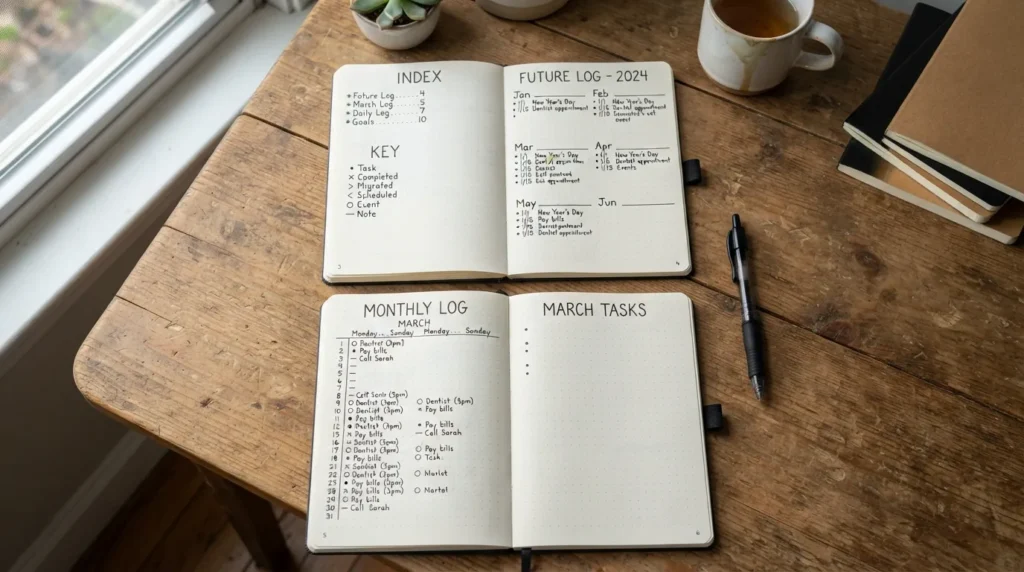
What Is a Bullet Journal?
A bullet journal is a customizable analog planning system that combines tasks, events, notes, schedules, and personal collections in one notebook. The original Bullet Journal Method was created by Ryder Carroll and is built around a technique called Rapid Logging. Instead of writing long descriptions for everything that happens during the day, you record information using short entries and simple symbols. This makes it easier to capture something quickly and decide later whether it needs action, scheduling, or simply recording. A bullet journal can function as a planner, diary, notebook, task list, or combination of all four. The important point is that you adapt the system to your needs rather than trying to create a perfect-looking notebook.What Is the Bullet Journal Method?
The Bullet Journal Method is the structured system behind bullet journaling. Its basic approach is to capture information quickly, organize it so you can find it later, and regularly review what deserves your attention. The method uses several core components, including Rapid Logging, the Index, Future Log, Monthly Log, Daily Log, Collections, and Migration. You do not need to use every possible page or tracker. The strength of the method is that it can be adapted as your needs change.What Do You Need to Start a Bullet Journal?
One of the easiest ways for beginners to get overwhelmed is assuming that bullet journaling requires a large collection of stationery. It does not.1. A Notebook
Any notebook can work. A dot-grid notebook is popular because it makes it easier to create tables, calendars, lists, and simple layouts, but lined, blank, or squared paper can work just as well. Choose a notebook that you will actually enjoy carrying and using. Paper quality, size, portability, and writing comfort matter more than having a specific brand.2. A Pen
Start with one pen that writes comfortably. A black or blue gel pen, ballpoint, or fineliner is enough. If you later discover that you enjoy color coding or decorating your pages, you can add more supplies. There is no reason to buy them before you know what you actually need.3. Optional Supplies
- A ruler for straight lines
- Highlighters for simple color coding
- Colored pens or pencils
- Stickers or washi tape for decoration
- A pencil for planning layouts before writing in pen
How Does Bullet Journaling Work?
The basic idea is simple: capture information quickly, organize it, and review it regularly. Instead of maintaining separate notebooks for tasks, appointments, notes, goals, and random ideas, you can keep them together and organize them with a simple indexing and logging system.Rapid Logging
Rapid Logging is the shorthand system used to record information quickly. Rather than writing a paragraph, you use a short sentence or phrase with a symbol that identifies what kind of information it is. For example:- • Finish project outline
- ○ Dentist appointment at 3 PM
- — Idea for weekend trip
Bullet Journal Symbols Explained
The symbols are one of the simplest parts of the system. They allow you to recognize the type of entry without reading a long explanation.| Symbol | Meaning | Example |
|---|---|---|
| • | Task | Finish report |
| ○ | Event | Team meeting |
| — | Note | Try the new library |
| X | Completed task | Task has been finished |
| > | Migrated task | Move an unfinished task forward |
| < | Scheduled task | Move a task to a future date |
| * | Signifier or priority | Important task |
How to Start a Bullet Journal Step by Step
If you have never used a bullet journal before, start small. You can build your system as you discover what works for you.Step 1: Choose Your Notebook and Pen
Pick a notebook that feels practical for your daily life. If you travel frequently, a smaller notebook may be more useful. If you write extensively, you may prefer a larger notebook. Start with one pen. You can add decorative supplies later if you want them.Step 2: Create Your Index
Reserve the first few pages for an Index. As you create important collections or sections, record their page numbers here. Think of the Index as the table of contents for your notebook. It becomes especially useful when your journal contains information from different areas of your life.Step 3: Set Up a Future Log
The Future Log gives you a place to record events, deadlines, appointments, trips, or other information that belongs to upcoming months. You do not need to design an elaborate calendar. A simple list organized by month can be enough.Step 4: Create Your Monthly Log
The Monthly Log gives you a quick view of the current month. You can use it to record important dates, appointments, deadlines, and tasks that need attention during the month. Keep the layout simple enough that you can update it quickly.Step 5: Start Your Daily Log
The Daily Log is where you record what is happening today. Add tasks, events, and notes as they occur rather than trying to plan every detail in advance. For example:- • Send project email
- ○ 2:00 PM dentist appointment
- — Remember to compare two laptop options
Step 6: Review Your Entries
At the end of the day or during your next planning session, look at unfinished tasks. Decide whether each task is still important, should be scheduled for later, or no longer needs to be done. This review is one of the parts that turns a notebook full of tasks into a useful planning system.What Pages Do You Actually Need in a Bullet Journal?
Beginners often make the mistake of creating too many spreads before they know how they will use them. You can start with only the pages that solve an actual problem.| Page | Purpose | Beginner Priority |
|---|---|---|
| Index | Find important pages and collections | Essential |
| Future Log | Track upcoming events and deadlines | Useful |
| Monthly Log | Plan and review the current month | Essential for many users |
| Daily Log | Capture daily tasks, events, and notes | Core component |
| Collections | Organize information around a specific topic | As needed |
| Habit Tracker | Monitor repeated habits | Optional |
| Gratitude Log | Record things you appreciate | Optional |
What Are Collections in a Bullet Journal?
A Collection is a group of related information kept together on one or more pages. Collections allow you to move beyond daily planning and organize information around a particular project, interest, goal, or need. Examples include:- Books to read
- Travel planning
- Project notes
- Meal ideas
- Gift ideas
- Study topics
- Home projects
- Personal goals
- Things to research
Simple Bullet Journal Ideas for Beginners
Once you understand the basic method, you can add simple collections that match your lifestyle. Start with one or two rather than creating dozens at once.1. Weekly Priorities
Write down the few tasks that would make the biggest difference if completed during the week.2. Books to Read
Keep a simple list of books you want to read. You can later add ratings, favorite quotes, or reading notes if that is useful.3. Monthly Goals
Choose a small number of realistic goals rather than filling an entire page with ambitious plans.4. Habit Tracker
Track only habits you genuinely want to monitor. A tracker becomes less useful when it contains too many items to maintain.5. Gratitude List
Add a short list of things you appreciated during the day or week. You do not need a decorative layout.6. Brain Dump
Create a temporary place to capture ideas, reminders, worries, or tasks when your mind feels crowded. Review the list later and decide what deserves to become a task, note, or collection.What Should I Put in My Bullet Journal?
If you are staring at an empty notebook and do not know what to write, start with information that you already need to manage.For Planning
- Appointments
- Deadlines
- Important dates
- Daily tasks
- Weekly priorities
For Personal Organization
- Things to buy
- Books to read
- Movies to watch
- Travel plans
- Ideas to research
For Reflection
- What went well today?
- What needs more attention?
- What am I grateful for?
- What do I want to change tomorrow?
For Goals
- Monthly goals
- Project milestones
- Study goals
- Personal projects
- Long-term ideas
Bullet Journal Prompts for Beginners
Prompts can help when you want your bullet journal to include more than tasks and appointments.Daily Reflection Prompts
- What was the most important thing I completed today?
- What took more time than expected?
- What should I carry forward to tomorrow?
- What made today easier or better?
Goal Prompts
- What is the most important goal this month?
- What is the next action I can take?
- What is getting in the way?
- What can I simplify?
Self-Reflection Prompts
- What am I currently spending too much time on?
- What deserves more of my attention?
- What habit is helping me most?
- What do I want to remember about this week?
Bullet Journal for Students
Students can use a bullet journal to bring assignments, exams, study tasks, project deadlines, and notes into one system. The key is to avoid creating a complicated school planner that takes longer to maintain than the actual planning. Useful student collections include:- Assignment deadlines
- Exam dates
- Study priorities
- Reading lists
- Project tasks
- Important class notes
Bullet Journal for Work and Productivity
For work, the system can be used to capture meetings, follow-up tasks, project notes, deadlines, and ideas. One useful approach is to separate information by function rather than creating a new decorative page for every project. Use your daily log for quick capture and collections for projects that require more detailed information.Bullet Journal vs. Regular Journal
A regular journal and a bullet journal can overlap, but they usually serve different purposes.| Regular Journal | Bullet Journal |
|---|---|
| Often focused on free-form writing | Uses a structured logging system |
| Often emphasizes reflection | Combines planning, notes, tasks, and reflection |
| No required symbol system | Uses rapid logging symbols |
| Usually organized by writing sessions or dates | Uses an Index and flexible collections |
Minimalist Bullet Journaling for Beginners
You do not have to create an artistic bullet journal. A minimalist setup can be just as useful and is often easier to maintain. A simple minimalist setup could contain:- Index
- Future Log
- Monthly Log
- Daily Log
- One or two useful collections
Do You Have to Be Artistic to Bullet Journal?
No. Artistic ability is not required. Decorative spreads can make a journal visually attractive, but decoration is separate from the basic planning method. Someone who prefers simple lists can use a completely functional bullet journal without drawing, lettering, painting, or using stickers. If elaborate pages make you less likely to use your journal, simplify them.Common Bullet Journaling Mistakes Beginners Make
1. Making the Journal Too Complicated
Creating ten trackers and numerous decorative spreads can make the journal feel like another responsibility. Start with the pages you genuinely need.2. Copying Someone Else’s Layout Exactly
A layout that works beautifully for another person may not fit your schedule, writing habits, or priorities. Use examples as inspiration rather than rules.3. Buying Too Many Supplies
More stationery does not automatically create a better planning system. Start with a notebook and pen and discover what you actually use.4. Tracking Too Many Habits
A tracker containing twenty habits may look impressive but become difficult to maintain. Start with one or two habits that actually matter to you.5. Treating Missed Days as Failure
Missing a few days does not mean the system has failed. Open the notebook again and continue. The purpose of a planning system is to support your life, not create guilt.6. Writing Tasks Without Reviewing Them
A long task list can become clutter if unfinished items are repeatedly carried forward without consideration. Review them and decide whether they are still worth your time.What Should You Do If You Miss Several Days?
You do not need to recreate every missed day. Start from the current day. Look at the unfinished tasks and decide which ones still matter. Migrate important tasks, schedule time-sensitive items, and discard tasks that are no longer relevant. This is one reason a flexible logging system can be easier to maintain than a rigid planner. You can continue from where you are instead of feeling obligated to fill every empty page.What Is Migration in Bullet Journaling?
Migration is the process of reviewing an unfinished task and deciding what should happen to it next. If a task is still important, you can move it forward to a future date or planning period. If it is no longer relevant, you can remove it. Repeatedly migrating the same task can also provide useful information: perhaps the task is too vague, no longer important, or needs to be broken into a smaller action.How to Keep Your Bullet Journal Simple
A sustainable bullet journal should fit into your routine rather than compete with it.- Start with the basic logs.
- Add collections only when you need them.
- Use one pen if that is enough.
- Do not create layouts simply because they look attractive online.
- Review unfinished tasks regularly.
- Remove trackers you no longer use.
- Allow imperfect pages.
- Adapt the system as your needs change.
A Simple First Bullet Journal Setup
If you want to start today without spending hours designing your notebook, use this basic setup.- Choose a notebook and pen.
- Reserve the first pages for your Index.
- Create a simple Future Log for important upcoming dates.
- Create your current Monthly Log.
- Start a Daily Log.
- Use simple symbols for tasks, events, and notes.
- Add one useful collection when a real need appears.
- Review unfinished tasks and migrate only what still matters.