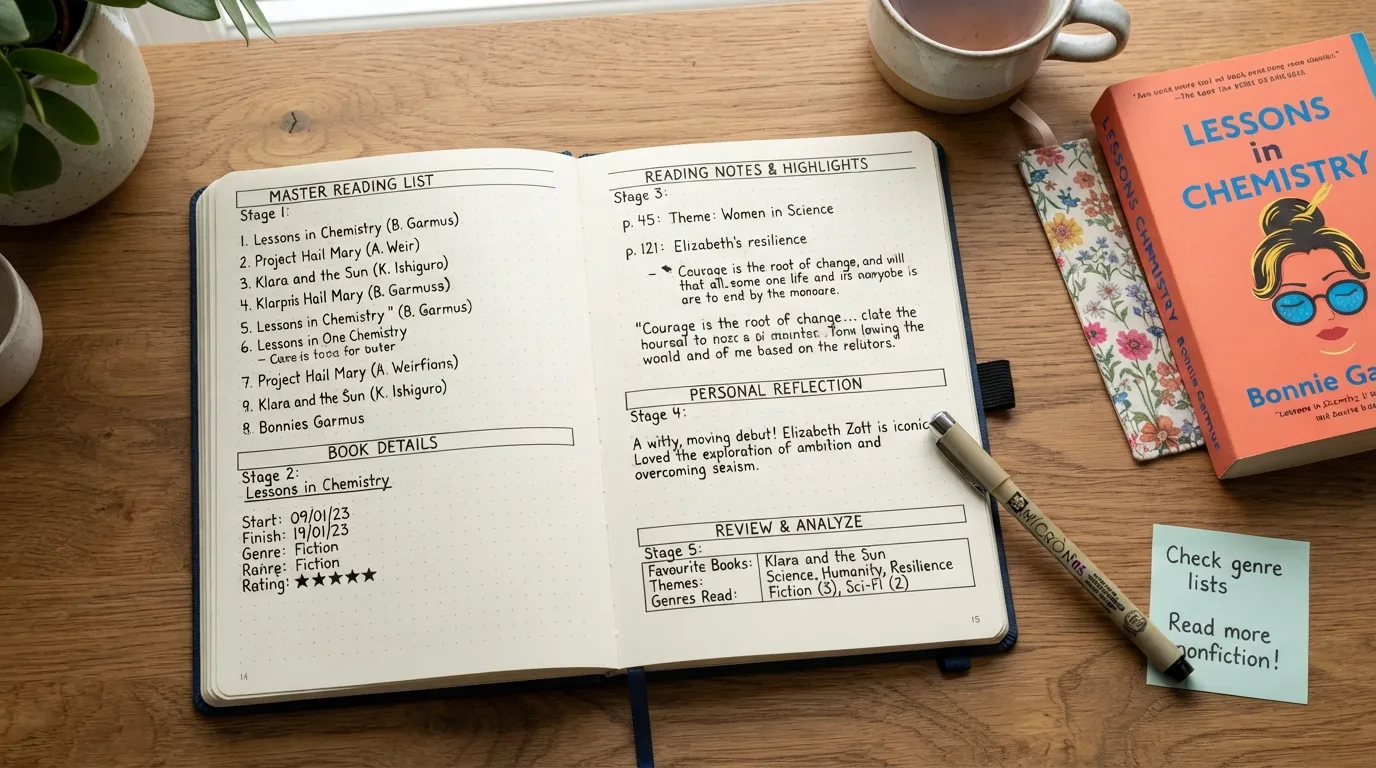
Keeping a reading journal can be very simple: choose a paper notebook, digital document, database, or reading app; make a list of the books you read; and record a few useful details, such as the title, author, dates, rating, favorite quotes, and your own thoughts. You do not need elaborate layouts or a full-page review for every book. The best reading journal is one you can keep using without turning reading into homework.
If you are starting today: create one master reading list, give each finished book its own short entry, and write at least one sentence about what you want to remember. You can add ratings, quotes, statistics, artwork, or longer reviews later if they actually make the journal more useful to you.
What Is a Reading Journal?
A reading journal, sometimes called a book journal, is a personal record of what you read and what you thought about it. It can be as basic as a chronological list of finished books or as detailed as a collection of reviews, quotations, reading statistics, vocabulary, themes, character notes, and personal reflections.
The important distinction is that a reading journal is more than a tracker. A tracker tells you what you read. A journal can also preserve what the book meant to you, what surprised you, what you learned, and what you may want to revisit months or years later.
Choose a Format You Will Actually Use
Before you design pages, decide where your journal will live. There is no universally best format. I would choose based on how you naturally read and take notes rather than on which journal looks best online.
| Format | Best for | Main trade-off |
|---|---|---|
| Paper notebook | Handwriting, sketches, creative spreads, physical keepsakes | Harder to search or reorganize later |
| Digital document | Fast typing and simple chronological notes | Less structured for statistics and filtering |
| Notion or database | Sorting by genre, author, rating, status, or date | Can become over-engineered |
| Reading app | Automatic tracking, shelves, statistics, and social discovery | Less personal control than your own journal |
If you like structured digital tracking, tools such as Notion, Goodreads, and The StoryGraph can complement or replace a paper journal. You can also combine formats—for example, keep statistics digitally while using a notebook for personal reflections.
How to Keep a Reading Journal Step by Step
1. Start with a master reading list
Reserve a page or digital view for every book you finish. At minimum, record the title and author. Adding the completion date makes the list much more useful when you look back later.
A simple master list might contain:
- Book title
- Author
- Date finished
- Rating, if ratings are useful to you
That alone is enough to create a functional reading log. Everything after this point is optional.
2. Decide what you want each book entry to remember
Do not collect information simply because another reading journal contains it. Ask what you would genuinely like to know if you opened this entry two years from now.
Useful fields can include:
- Title and author
- Date started and finished
- Genre
- Your rating
- A one- or two-sentence summary in your own words
- Your reaction to the book
- Favorite quotations with page numbers
- Themes or ideas you noticed
- New vocabulary
- Questions the book raised
- One idea or lesson you want to remember
- Who you would recommend the book to
You probably do not need all of these. Three useful fields maintained consistently are better than fifteen fields that make you stop journaling.
3. Capture notes while you read
You do not have to stop after every chapter and write a formal response. Keep the interruption small. If something matters, record a page number and a few words about why it caught your attention.
For a paper journal, you can temporarily use a bookmark, sticky note, index card, or margin note and transfer only the best material later. With an ebook or digital journal, you can record the page or location and a short thought immediately.
A useful rule: do not copy every interesting sentence. Record the passages that changed your understanding, captured an idea particularly well, or triggered a reaction you want to remember.
4. Write a short reflection when you finish
A reading journal becomes more valuable when it captures your response rather than only book metadata. After finishing a book, write a few sentences while your reaction is still fresh.
If you do not know what to write, answer two or three of these:
- What did I like or dislike?
- What surprised me?
- What is the main thing I will remember?
- Did anything change my mind?
- Which character, argument, scene, or idea stayed with me?
- Would I recommend it? To whom?
- What do I want to read next because of this book?
5. Review the journal occasionally
A journal is most useful when you revisit it. At the end of a month, season, or year, scan your entries for patterns. You may notice that your favorite books share a genre, subject, author style, or theme. You may also notice books you rated highly but barely remember—a useful sign that your journal could capture more personal reflection next time.
A Simple Reading Journal Template
If you want a format you can use immediately, start with this. It works in a notebook, Notes app, document, or database.
Book: ______________________________
Author: _____________________________
Started: __________ Finished: __________
Rating: _____________________________
In one sentence, this book is about:
__________________________________________
What I thought:
__________________________________________
What I want to remember:
__________________________________________
Favorite quote or page:
__________________________________________
What a Reading Journal Entry Can Look Like
A finished entry does not need to resemble a school book report. Here is a fictional example showing the level of detail that is often enough:
Book: Example Book
Author: Example Author
Finished: March 18
Rating: 4/5
My reaction: I enjoyed the central idea more than the ending. The middle section made me reconsider an assumption I had made early in the book.
What I want to remember: Pay more attention to how the author builds the main argument rather than only whether I agree with the conclusion.
That entry takes little time, but months later it tells you far more than a title and star rating alone.
Reading Journal Ideas That Are Actually Useful
Once the basic habit feels easy, add pages that answer a purpose. You do not need every popular spread.
A to-be-read list
Keep books you genuinely intend to read rather than every title that sounds vaguely interesting. You can separate the list into “next,” “someday,” and “maybe” if a single long TBR becomes difficult to use.
Favorite quotes
Maintain a running quotation page if you frequently return to passages. Include the book and page or location so you can find the original context again.
Reading goals
Goals do not have to be a yearly book count. You might aim to read more from a particular subject, finish books you already own, explore authors you have not read before, or simply protect regular reading time.
Monthly or yearly favorites
Choosing a favorite forces you to compare books instead of treating every rating in isolation. Write one sentence explaining why it stood out.
Reading statistics
If numbers motivate you, track completed books, genres, formats, authors, or ratings. If statistics start making reading feel competitive, drop them. The journal should serve your reading life, not control it.
Vocabulary and ideas
For nonfiction, classics, academic reading, or books with unfamiliar language, keep a small list of new terms and ideas. Write definitions in your own words when possible so the page becomes something you can understand later rather than a collection of copied phrases.
A Minimal Reading Journal for Beginners
If you are new to book journaling, I would deliberately start smaller than you think you need. For your first five books, record only four things:
- Title and author
- Date finished
- Your rating or overall reaction
- One sentence you want to remember
After five books, look back and ask what information you wish you had recorded. Add that—not ten decorative sections you may never use.
The five-minute version: If you are tired, write the title, your rating, and one sentence. A tiny entry keeps the habit alive and is more valuable than the perfect journal page you never create.
How Students Can Use a Reading Journal
A student’s journal may need to do more than preserve memories. It can help organize information for discussion, assignments, or revision. Instead of only rating the book, a student can track:
- Important characters or people
- Major themes or arguments
- Questions that remain unresolved
- Evidence or quotations worth revisiting
- Connections to another book, class topic, or real-world issue
- A short summary written from memory
Writing a short summary from memory can also reveal whether you understood the chapter or only recognized it while reading. If the summary is difficult, revisit the relevant passage rather than copying a ready-made summary into the journal.
How to Remember More of What You Read
A reading journal cannot guarantee that you will remember a fixed percentage of a book. Claims such as “remember 80% of everything you read” are too neat to be a useful target. A better approach is to make yourself retrieve, explain, and revisit the ideas you care about.
After a reading session or finished chapter, close the book and write what you remember before looking back. Then compare your notes with the text. You can also turn important ideas into questions, connect them to something you already know, and revisit your journal later.
This makes the journal active rather than archival: instead of merely storing quotations, you are using your own words to decide what mattered.
How to Keep the Habit Without Making It a Chore
Most reading journals fail for a simple reason: the system asks for more effort than the reader wants to give after finishing a book. If you repeatedly postpone entries, reduce the system.
- Keep the minimum tiny. A rating and one meaningful sentence can be enough.
- Log notes as you go. Save page numbers or brief reactions instead of reconstructing the whole book later.
- Do not aim for visual perfection. A useful messy page beats an unfinished decorative spread.
- Change the format when it stops helping. Your journal does not need the same fields for fiction, nonfiction, poetry, and reference books.
- Allow skipped entries. Missing one book does not invalidate the journal. Continue with the next one.
The advice to keep journaling low-pressure and adaptable appears repeatedly in practical reading-journal guidance, including resources from Notebook Therapy and Jane Heinrichs’ discussion of keeping a reading or book journal.
Common Reading Journal Mistakes
Trying to record everything
A journal full of copied quotations and plot details may still tell you very little about your own reading experience. Prioritize what you will value later.
Writing a complete review for every book
Long reviews are useful when you have something meaningful to say, but they should not become a requirement. Some books deserve two pages; others deserve two sentences.
Designing before you know what you need
Creating dozens of trackers before your first entry can produce a beautiful empty notebook. Start with real books, then let repeated needs determine new pages.
Treating a rating as the whole review
A number tells you whether you liked a book, but not why. Add one sentence explaining the rating and the entry becomes far more useful.
Forcing yourself to finish books for the journal
Your journal should not trap you in a book you no longer want to read. You can record a book as unfinished and briefly note why you stopped. That information may be more useful than forcing yourself through the remaining pages.
Should You Use the 50-Page Rule?
The so-called 50-page rule is a personal decision rule rather than a requirement: give a book roughly the first 50 pages, then decide whether continuing feels worthwhile. You can use that as a checkpoint, but there is no need to treat 50 pages as a universal threshold.
A reading journal makes this decision more useful. If you stop a book, note where you stopped and why—slow pacing, lack of interest, wrong book for your current mood, difficult writing, or simply a change in priorities. Over time, those notes can show you what reliably loses your interest.
A Visual Example of Reading-Tracker Layouts
If you prefer a paper journal and want to see different layout ideas rather than only read about them, this short walkthrough demonstrates several ways to organize a book tracker visually.
Questions Readers Often Have
Do I need to write in my reading journal every day?
No. A reading journal can follow your reading rather than the calendar. Write when you finish a chapter, encounter something worth remembering, finish a book, or have a useful thought. A daily schedule is optional.
What is the difference between a reading journal and a reading log?
A reading log usually records measurable details such as titles, authors, dates, pages, or ratings. A reading journal can include those details but also adds reactions, reflections, questions, quotes, themes, or lessons. One notebook can easily serve both purposes.
Should I keep my reading journal on paper or digitally?
Use paper if handwriting, sketching, and a physical keepsake make you more likely to journal. Use digital tools if searching, sorting, editing, statistics, and access across devices matter more. A hybrid system is perfectly reasonable.
What should I write when I have nothing to say about a book?
Write one sentence answering, “What is the main thing I will remember about this book?” If even that feels unnecessary, record the title and your reaction and move on. Not every book needs a deep analysis.
Can I journal about a book I did not finish?
Yes. Record how far you read and why you stopped. An unfinished-book entry can help you understand your reading preferences just as much as a completed-book review.
Keep the Journal Useful, Not Perfect
You can keep a reading journal with nothing more than a notebook and a few lines after each book. Start with a master reading list, record the details you genuinely care about, capture important notes while you read, and add a short personal reflection when you finish.
Once that habit works, expand it only where the extra detail gives you something useful: better recall, clearer reading preferences, meaningful quotations, stronger study notes, or a record of how your thinking has changed. A journal that grows from your actual reading life will usually last longer than one built around somebody else’s perfect layout.