Mindfulness Journal Prompts: 100+ Prompts to Practice Presence Every Day
What Are Mindfulness Journal Prompts?
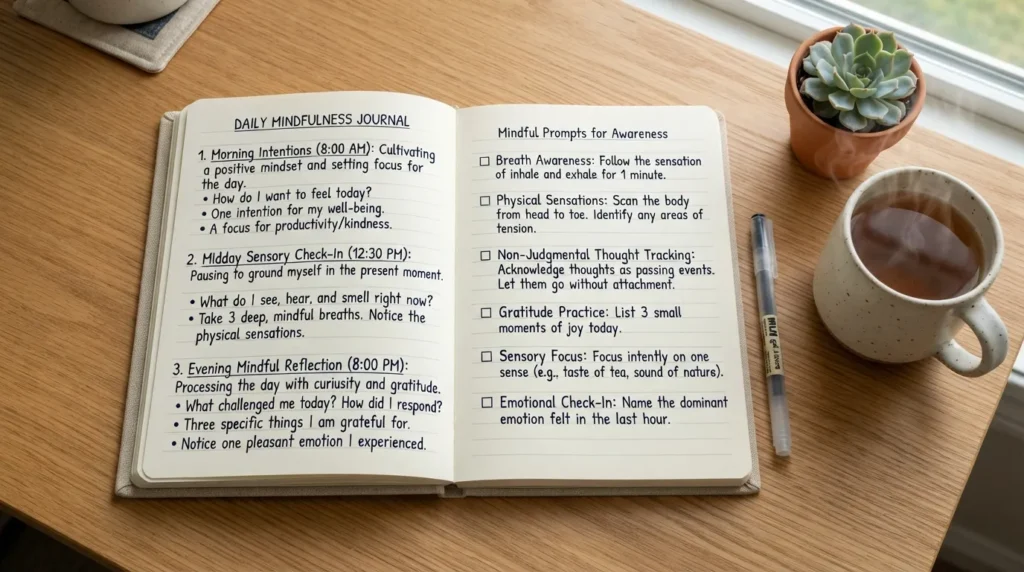
Mindfulness journal prompts are specific questions or statements that guide your writing toward the present moment. Instead of letting your mind wander aimlessly across your page, a prompt acts as an anchor for your attention. They invite you to observe your current thoughts, physical feelings, and environment without trying to fix or change anything.
Think of a prompt as a gentle nudge to slow down. When you respond to one, you move away from auto-pilot mode and start noticing what is actually happening right now.
Mindfulness Journaling vs. Regular Journaling
Regular journaling often focuses on events, plans, or deep problem-solving. You might record what happened during your day, vent about a stressful interaction, or map out your goals for next month. It is mostly about the story of your life—the past and the future.
Mindfulness journaling shifts the focus entirely to your immediate, real-time experience. You are not trying to figure out why your day went wrong or plan your next career move. Instead, you tune into what it feels like to sit in your chair, the emotion sitting in your chest, or the thoughts passing through your mind in this exact minute.
| Feature | Regular Journaling | Mindfulness Journaling |
|---|---|---|
| Primary Focus | Past events, future plans, and long-term goals. | The present moment and current sensory experience. |
| Main Goal | Expressing feelings, solving problems, and tracking life events. | Building awareness and practicing non-judgmental observation. |
| Mindset | Analyzing, evaluating, and processing stories. | Observing, accepting, and staying grounded in the now. |
Why Mindfulness Journal Prompts Work
They quiet the chatter in your brain: Prompts give your active mind a single point of focus, which stops you from getting lost in overthinking.
They build self-awareness without judgment: Writing down your raw experiences helps you notice your thought patterns as an observer rather than getting swept up by them.
They ground your physical body: Answering questions about your senses forces your nervous system to recognize that you are safe in the current moment.
They remove the fear of the blank page: A focused prompt gives you an immediate starting line so you do not waste energy wondering what to write.
How to Use These Mindfulness Journal Prompts
Tools Needed
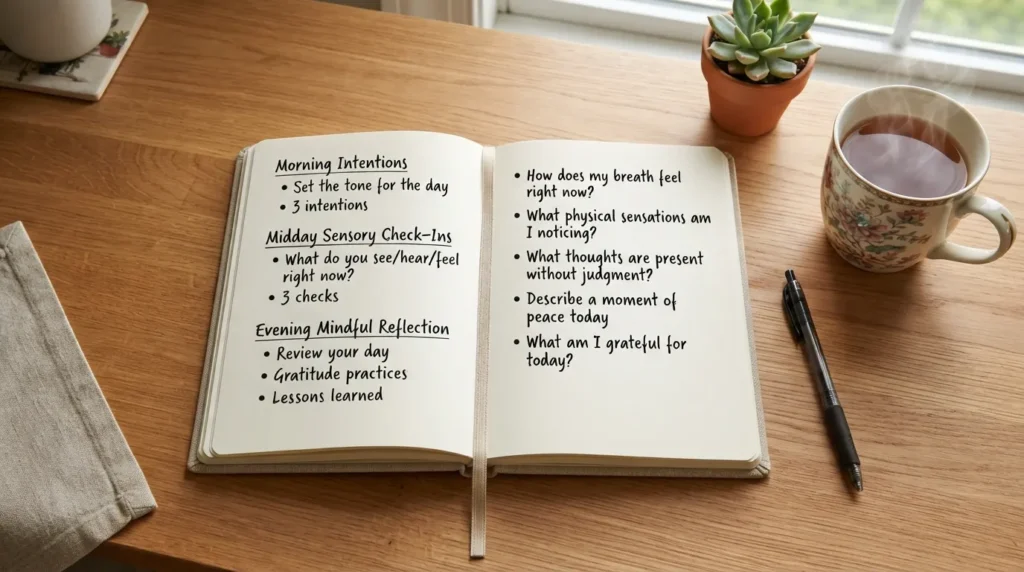
A simple notebook: Any paper notebook works fine. You do not need a fancy lined journal to begin.
A smooth pen: Pick a pen that feels comfortable in your hand so writing feels easy.
A quiet spot: Sit somewhere you can be uninterrupted for just five to ten minutes.
Step 1: Brief Breath Check-in Before Writing
Before you touch the pen to paper, close your eyes and take three slow, deep breaths. Pay attention to the physical feeling of your chest rising and falling. This quick reset brings your mind out of planning mode and into the present moment.
Step 2: Pick One Prompt, Write Without Editing
Choose a single prompt from the list and start writing whatever comes to mind. Do not worry about spelling, grammar, or making sense, and do not cross out any words. Writing without judging your thoughts helps you notice what is actually happening in your mind right now.
Step 3: Close With One Grounding Sentence
When you finish writing, end your entry with one simple statement about your current environment or physical body. For example, write down the temperature of the room or the sound of birds outside. This final step anchors your awareness back in your immediate surroundings before you move on with your day.
Present-Moment Awareness Prompts
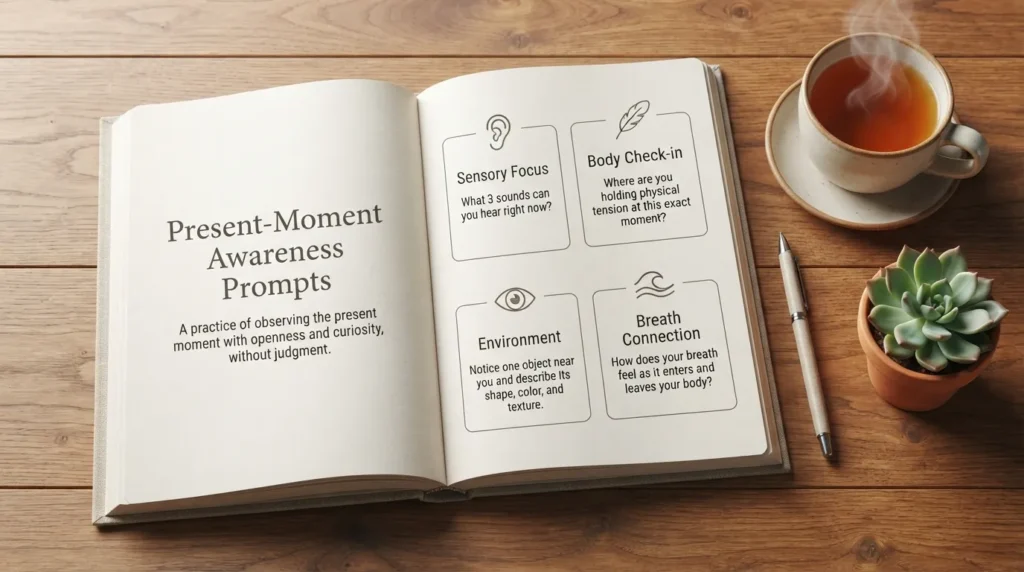
Notice three distinct sounds around you right now, and describe the quietest one in detail. (This forces your brain to filter out internal chatter and focus on current sensory input.)
What physical sensation is most noticeable in your body right now, and where do you feel it? (Focusing on physical sensations grounds your mind directly in the physical present.)
Start at your toes and slowly move your attention up to your head, writing down any tension or warmth you feel in each area. (A written body scan builds direct connection between your mind and your current physical state.)
Look at an object nearby and list five small details about it that you normally ignore. (Observing tiny visual details stops your mind from wandering into past or future thoughts.)
Take three slow breaths, and describe how the air feels as it enters and leaves your nostrils. (Tracking your breath gives your awareness a physical anchor in the exact current moment.)
What temperature is the air on your exposed skin right now, and how does it feel? (Noticing immediate environmental conditions pulls you out of abstract thinking.)
Describe the exact texture of whatever your hands are touching right this second. (Touch feedback instantly resets your attention to your immediate surroundings.)
Write down the thoughts passing through your mind right now without trying to fix, judge, or change them. (Observing your thoughts as neutral events reduces emotional reactivity.)
What color stands out the most in your room right now, and where do you see it? (Visual tracking anchors your attention outward instead of keeping it trapped in your head.)
Write down one physical need your body is asking for in this exact minute. (Listening to real-time physical cues builds genuine body awareness.)
Describe the taste or lingering aftertaste currently in your mouth. (Sensory awareness of taste relies entirely on present-moment perception.)
Emotional Awareness Prompts
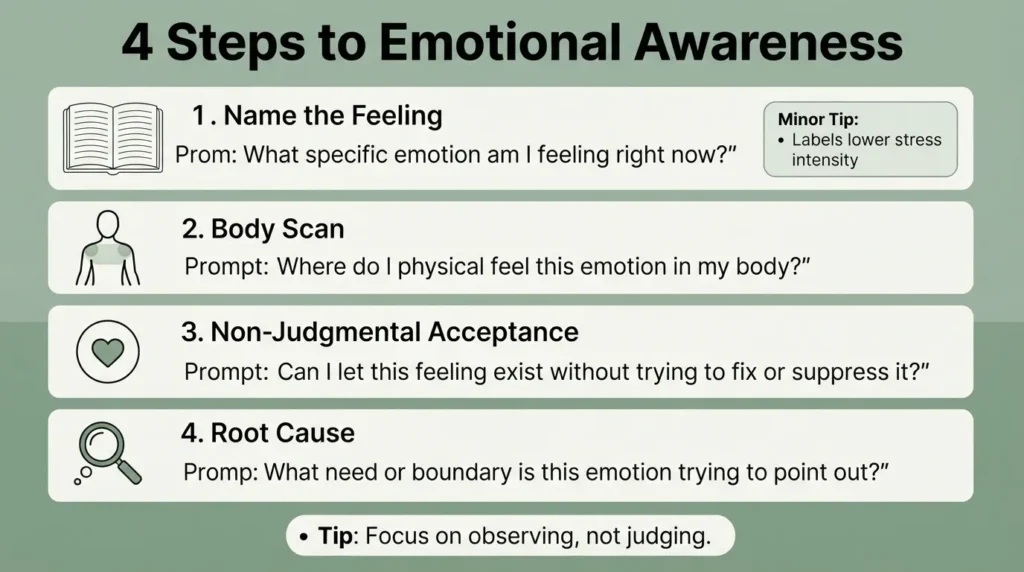
What emotion is sitting in your body right now, and where exactly do you feel it physically? Observing physical sensations helps you stay grounded in the present moment instead of getting lost in mental stories.
Name the strongest feeling you experienced today without calling it “good” or “bad.” Stripping away labels reduces judgment and helps you accept your natural emotional shifts.
Write down a current worry, then list three facts about this exact moment that show you are safe right now. This anchors your mind in current reality rather than anxious future scenarios.
If your current mood had a color, texture, or weight, how would you describe it? Translating feelings into sensory details helps you observe emotions with curiosity instead of reacting to them.
Describe a moment today when your body felt tense. What were you thinking right before that happened? Tracking physical cues builds awareness of how your thoughts directly impact your physical state.
What emotion have you been trying to push away this week? Acknowledging hidden feelings prevents them from quietly driving your stress behind the scenes.
Complete this sentence five times with different endings: “Right now, I give myself permission to feel…” Giving yourself permission ends the internal struggle against your own emotions.
Think of a minor frustration from today. How can you treat yourself with kindness about it? Replacing self-criticism with gentle understanding helps quiet your nervous system.
How does your breath feel in your body when you switch from a calm moment to a tense one? Noticing your breath pattern creates a bridge between your physical body and your emotional state.
Describe an emotion you felt today as if it were a weather pattern passing through the sky. Viewing feelings as temporary weather reminds you that emotions come and go without defining who you are.
What is one feeling you experienced today that surprised you, and what might it be pointing toward? Curiosity turns unexpected reactions into useful self-knowledge instead of moments of confusion.
Thought-Observation Prompts
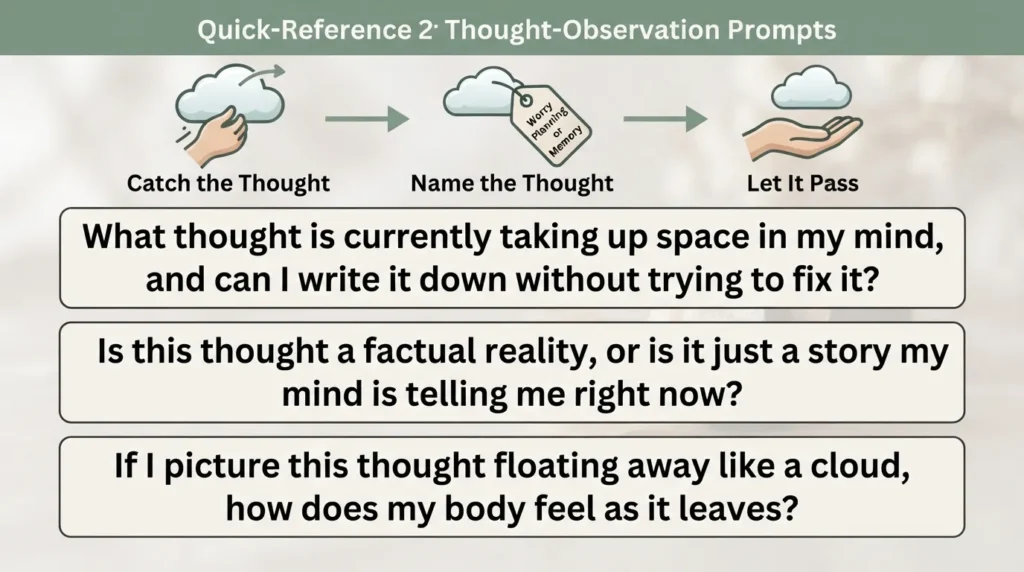
Notice the main thought occupying your mind right now, write it down, and describe it like an object sitting in front of you. Naming thoughts visually strips away their power to control your mood.
What is one judgment you made today about yourself or someone else, and how can you reframe it neutrally? Mindfulness means catching your inner critic and returning to plain facts.
Write down a thought that keeps looping in your head, then list three physical details in your room to anchor yourself back to reality. This breaks the mental loop by pulling your focus back into your physical senses.
If your current mood had a color, texture, and temperature, what would those be? Expressing feelings through physical traits helps you observe emotions without getting consumed by them.
Describe a story your mind is telling you about the future, then write down what is actually true in this exact minute. Separating mental predictions from current facts instantly reduces anxiety.
What is one thought you are trying to fight or ignore today, and what happens if you let it just exist on the page? Allowing uncomfortable thoughts to be seen removes the friction of resisting them.
Trace the lifecycle of a strong emotion you felt recently, from the physical trigger to how it eventually faded. Observing emotions as temporary events reminds you that no feeling lasts forever.
What is a belief you held strongly this morning that shifted by this evening? Noticing how your mind changes focus builds flexibility and reduces black-and-white thinking.
Write down three thoughts passing through your mind right now, tagging each one as either past, present, or future. Categorizing thoughts reveals how rarely our minds actually stay in the current moment.
Gratitude & Self-Compassion Prompts
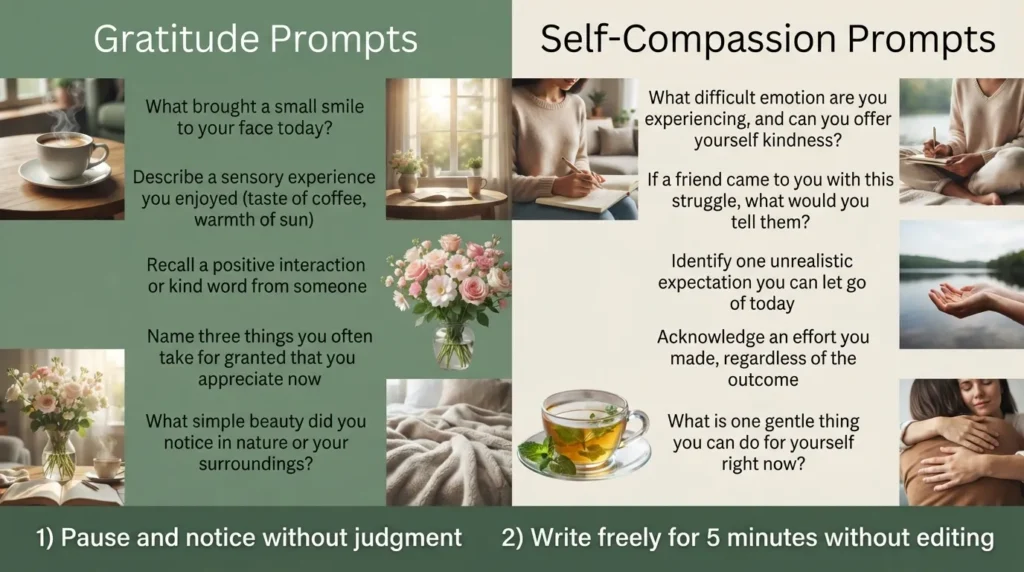
Name three small, unremarkable things that went right today, and describe how your body felt when they happened. Noticing physical comfort grounds your gratitude in present reality rather than abstract thought.
Write down a harsh thought you had about yourself today, then rewrite it as if speaking to a friend who made the same mistake. This shifts your internal voice from habitual judgment to objective kindness.
What is one part of your body that supported you today, and how can you thank it right now? Focusing on function over appearance builds direct appreciation for your physical self.
Describe a moment today when you felt calm or neutral, no matter how brief it was. Tracking subtle positive states trains your brain to notice peace when it occurs.
List five things in your immediate room that bring you quiet comfort, using your physical senses to describe them. Using sight and touch connects your immediate environment to emotional ease.
Write about a recent mistake you made, and state clearly: “I am allowed to be a work in progress.” Naming the mistake without shame breaks the cycle of self-criticism.
What is one boundary you set recently that protected your energy, and why are you proud of it? Recognizing self-protection reinforces your worth and personal limits.
Recall a moment today when you felt overwhelmed. What did you need to hear in that exact moment? Identifying missing support helps you offer that comfort to yourself in the future.
What simple pleasure brought you a moment of genuine ease today? Highlighting small joys helps balance the brain’s natural bias toward stress.
Write down one expectation you are holding for yourself right now, and give yourself permission to lower the bar. Releasing unrealistic pressure creates instant mental relief.
What is a physical sensation of comfort you can access right now, like warm tea or a soft blanket? Focusing on current sensory comfort grounds your mind in safety.
Relationship Mindfulness Prompts
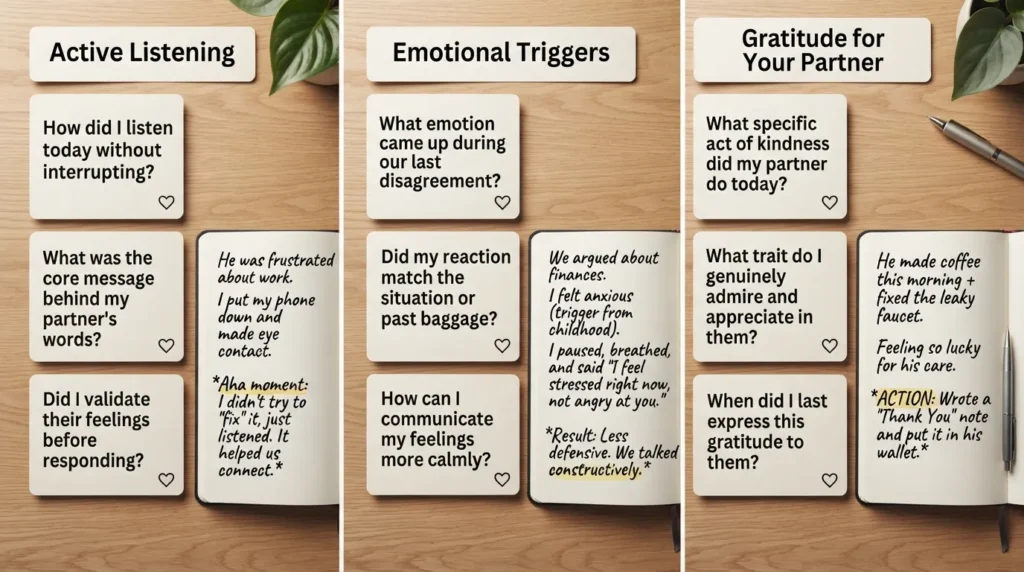
Notice one small kindness your partner or friend did today. Write down how it felt in your body when you saw it. Noticing small acts builds real appreciation instead of taking people for granted.
Think of a recent argument or tension. Describe what happened using only objective facts, without using words like “always,” “never,” or assigning blame. Removing judgment helps you see the event clearly instead of staying stuck in emotional reactions.
Write about a moment today when you were fully present with someone. What did their voice sound like? What were their facial expressions? Observing sensory details forces your mind out of distraction and into the shared space.
Identify a habit someone close to you has that bothers you. Where do you feel that annoyance in your body (tight chest, clenched jaw)? Tracking physical sensations keeps you grounded so you can respond calmly instead of reacting on impulse.
List three things you often assume about a person in your life. How would you interact with them today if you dropped those assumptions entirely? Questioning old stories makes room to see people as they actually are right now.
Reflect on a moment today when you listened to someone. Did you truly focus on their words, or were you mentally preparing your reply? Recognizing your listening habits helps you return your focus to the speaker.
Recall a time today when you felt disconnected from someone nearby. What thoughts or distractions created that distance? Identifying your mental barriers helps you step back into the present interaction.
Write down a boundary you need to set with a loved one. State it clearly, plainly, and without apologizing for having the boundary. Setting clear limits protects your energy without creating unnecessary conflict.
Think of a person you find difficult. Write down one neutral or positive quality they displayed recently. Looking for neutral facts balances out selective memory caused by frustration.
Letting Go & Non-Attachment Prompts
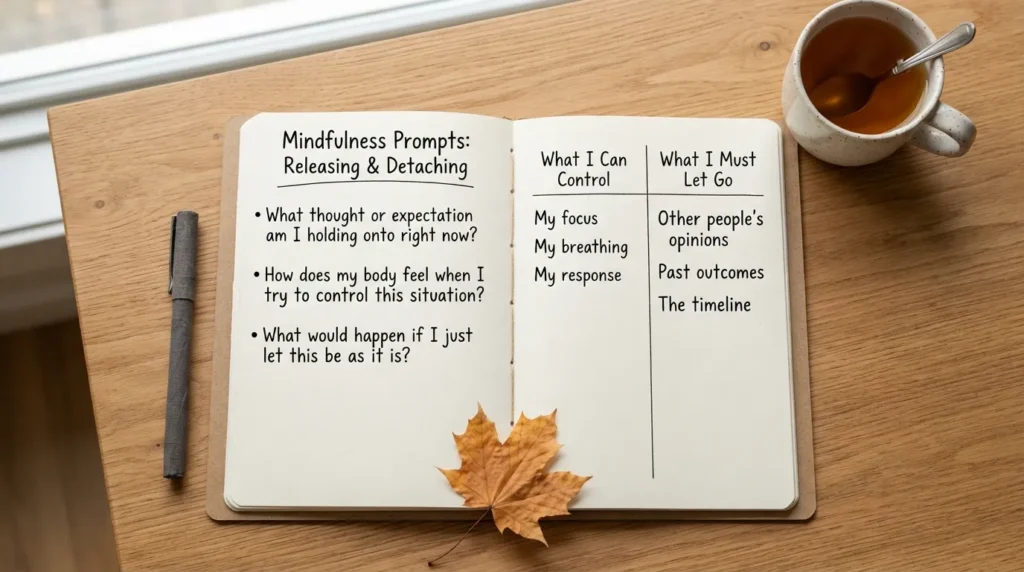
What is one thought you keep replaying today, and what happens in your body when you decide to just let it sit there without fixing it? Noticing physical reactions helps you catch tension before it turns into full-blown stress.
Write down a expectation you had for this week that did not happen. Can you write “and that is okay” right next to it? Acknowledging reality as it is reduces the friction caused by wishful thinking.
Name an emotion you are trying to avoid feeling right now. Where do you feel it in your physical body? Locating emotions physically makes them feel less overwhelming and more like temporary sensations.
Describe a situation right now that you have zero control over. What would it feel like to step back and let it unfold? Focusing only on what you can control conserves your mental energy.
What is something you are holding onto simply because you have spent a long time holding onto it? Recognizing outdated habits helps you see that past effort does not require future effort.
List three things that did not go according to your plan today, along with one neutral observation about each. Stripping away judgment neutralizes the instinct to beat yourself up.
Write about a strong opinion you held strongly earlier today. What changes if you allow someone else to have a completely different view? Releasing the need to win creates immediate mental space.
Imagine your current worry is a cloud passing through the sky. How does it look as it slowly drifts out of view? Visualizing thoughts as moving objects prevents you from identifying with them.
What is a story you tell yourself about who you are supposed to be? What happens if you stop telling it for just five minutes? Dropping rigid self-labels helps you experience the present moment without pressure.
Morning Mindfulness Journal Prompts
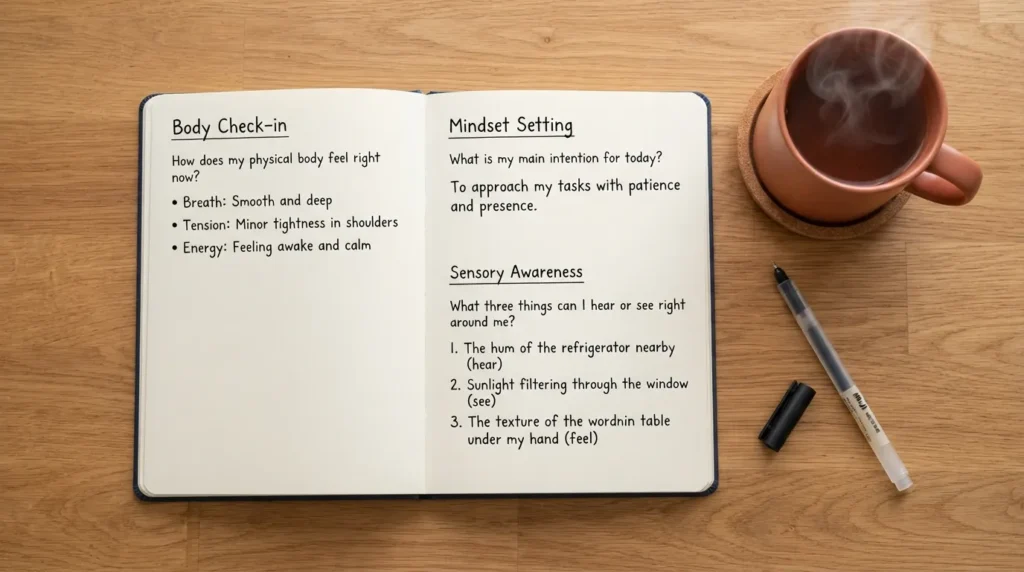
Before you touch your phone, what is one real physical sensation you notice in your body right now? Grounds your focus in physical reality before digital noise takes over.
What is the main mood you are carrying into this morning, and can you let it exist without trying to fix it? Builds non-judgmental awareness of your current emotional state.
Pick one mundane task you will do today—like washing dishes or walking to your car. How can you give it your full attention? Turns an everyday chore into an active anchor for presence.
What is one small thing you can simplify or let go of today to create a little breathing room? Keeps your mental energy focused on what actually matters today.
If today gets stressful, what is one gentle reminder you can tell yourself in that moment? Prepares a calm, mindful response before stress happens.
What is one simple sound, sight, or texture around you right now that you usually ignore? Trains your eyes and ears to notice the present moment.
Complete this sentence: “Today, I give myself permission to…” Sets a clear, realistic intention for your emotional well-being.
Evening Mindfulness Journal Prompts

What exact physical feeling am I holding in my shoulders or jaw right now, and what happens when I breathe directly into it? Notice bodily tension from the day without trying to force it to leave instantly.
Which conversation today left me feeling drained, and what specific emotion was I holding back during it? Naming unspoken feelings helps your brain process and release them before sleep.
Write down three small sights, sounds, or textures from today that I barely paid attention to while they were happening. Replaying sensory details pulls your mind out of evening overthinking and grounds you in real experiences.
What is one lingering task or thought from today that is trying to keep me awake, and where can I “store” it on paper until tomorrow? Writing down unresolved items signals to your nervous system that it is safe to rest.
Describe a moment today where I felt judged or frustrated, without using any harsh words about myself or anyone else. Observing difficult moments with neutral facts strips away late-night emotional drama.
What is one thing I did today purely out of habit, and how did my body actually feel while I was doing it? Checking in on automatic habits helps you build clearer awareness for tomorrow.
Right now, in this quiet room, what are three things that are completely safe and okay? Focusing on immediate safety calms the active mind so you can unwind.
Tips to Build a Consistent Mindfulness Journaling Habit
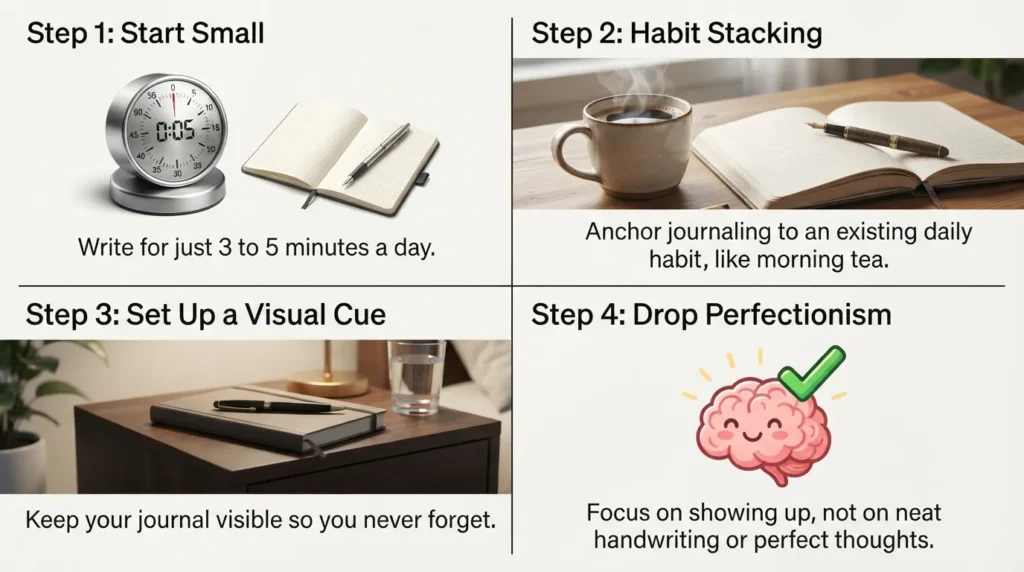
Pick a Fixed Time and Spot
Your brain loves predictable routines. Pick one specific moment in your day, like right after your morning coffee or right before turning off your bedroom lights. Sit in the same spot each time. When you link journaling to an existing habit, you spend zero energy deciding when to write.
Take Three Deep Breaths First
Writing straight from a busy mind often leads to a simple to-do list instead of actual reflection. Pause for 30 seconds before your pen hits the paper. Close your eyes, inhale deeply, and feel your body settle into the chair. This short shift moves your focus from your racing thoughts to the physical present moment.
Use a Physical Anchor
If your mind wanders while you try to write, focus on a physical sensation. Notice the feel of your pen on the paper, the weight of your journal on your lap, or your feet resting flat on the floor. Returning to a real physical anchor grounds you instantly whenever your thoughts drift toward tomorrow’s schedule.
Drop the Need for Perfect Writing
Mindfulness journaling is not a book draft, and nobody else will read it. Forget about neat handwriting, proper grammar, or sounding wise. If you only write three messy words or draw a quick squiggly line to show your current stress, that still counts. Letting go of judgment is the core of mindfulness.
Prioritize Frequency Over Session Length
Writing for two minutes every single day does far more for your brain than writing for an hour once a month. Short, frequent check-ins build a real neural habit. On busy days, write one single sentence about how your body feels right now. Consistency keeps the channel open.
To learn more about how daily routines shape your brain, read this guide on building healthy habits.
Free Mindfulness Journal Prompts PDF
Want to keep these prompts handy on your phone or print them for your journal? Download our free, beautifully designed PDF guide with all 50 prompts organized by category.
- Format: Printable PDF (works on iPad and digital planners too)
- Price: 100% Free
- Access: Instant download (no sign-up required)
Frequently Asked Questions
How do I start mindfulness journaling as a beginner?
Pick one simple prompt and set a timer for five minutes. Write down whatever comes to your mind without fixing mistakes or judging your thoughts. Focus on what you feel right now in this exact moment.
How long should a mindfulness journal entry be?
There is no required length for an entry. A single sentence about how your body feels can be just as useful as two full pages. Aim for daily consistency instead of long entries so the practice stays easy.
Can journaling replace meditation?
Journaling can be a active form of meditation, but it works a bit differently. Quiet meditation trains raw focus, while journaling helps you process active thoughts on paper. Using both together gives you the best results.
What's the difference between mindfulness journaling and gratitude journaling?
Gratitude journaling focuses only on finding positive things you appreciate. Mindfulness journaling asks you to observe everything in the present moment, including uncomfortable feelings and neutral thoughts without trying to change them.
Explore Topics
Sub-Topics & Guides
Featured Guides
Top Industry Resources
Editorial Integrity
Our content is 100% human-written, evidence-backed, and continuously updated to fulfill reader intent with maximum honesty.
"Small, consistent habits compounded over time create unshakeable momentum."