Jump to:
ToggleBook Journal Pages: 40+ Layout Ideas, Templates & a Step-by-Step Guide to Starting Yours
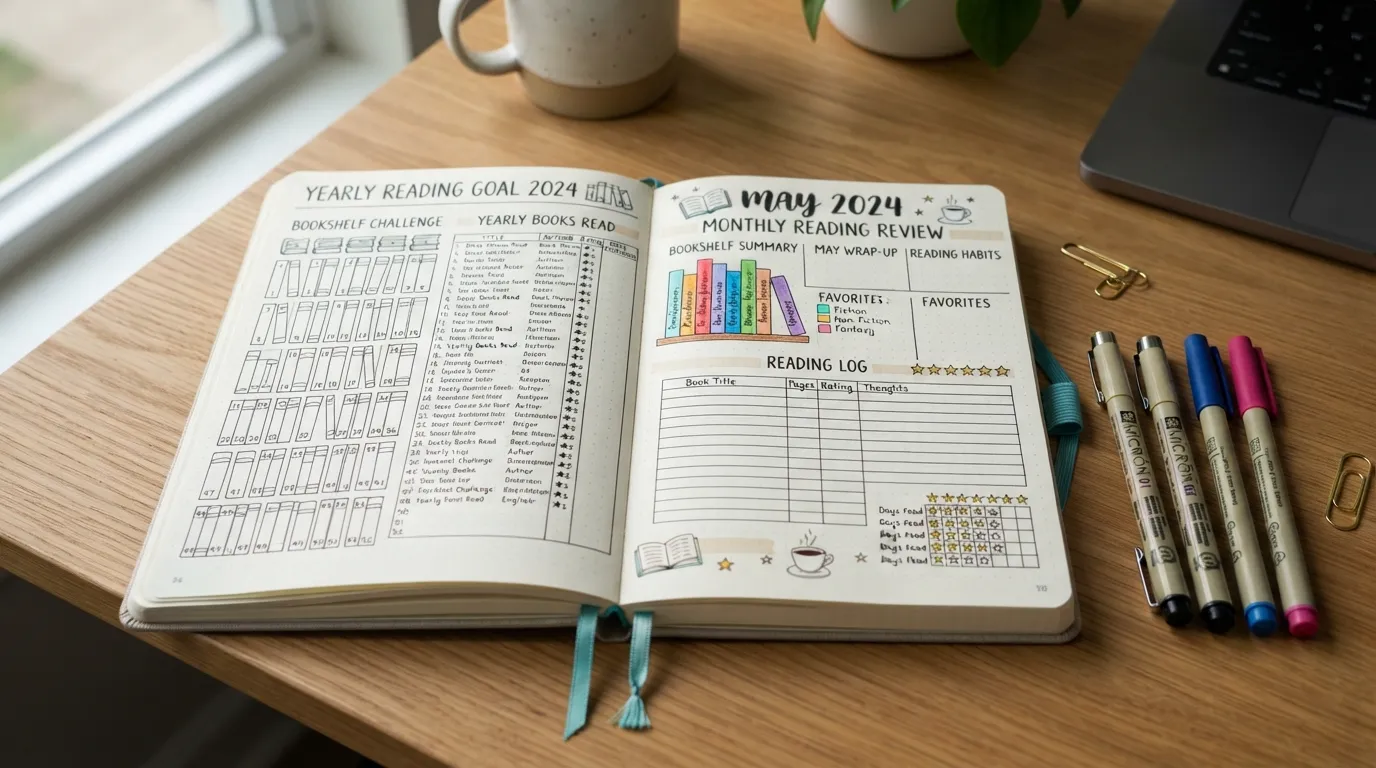
You either have a pristine, blank notebook staring at you with intimidating white pages, or your Pinterest boards are overflowing with gorgeous spreads that feel entirely too complex to recreate. I want to take the friction out of the process. This guide gives you the exact structural framework of what to include in your reading log alongside 40+ ready-to-copy layout ideas tailored for both artistic creators and complete minimalists. Whether you are tracking your annual reading goals or deconstructing complex literature, you can explore more foundational techniques and setups in our full journaling guide before we dive into the anatomy of a great book journal.
What Is a Book Journal, Exactly? And How It's Different From a Book Review
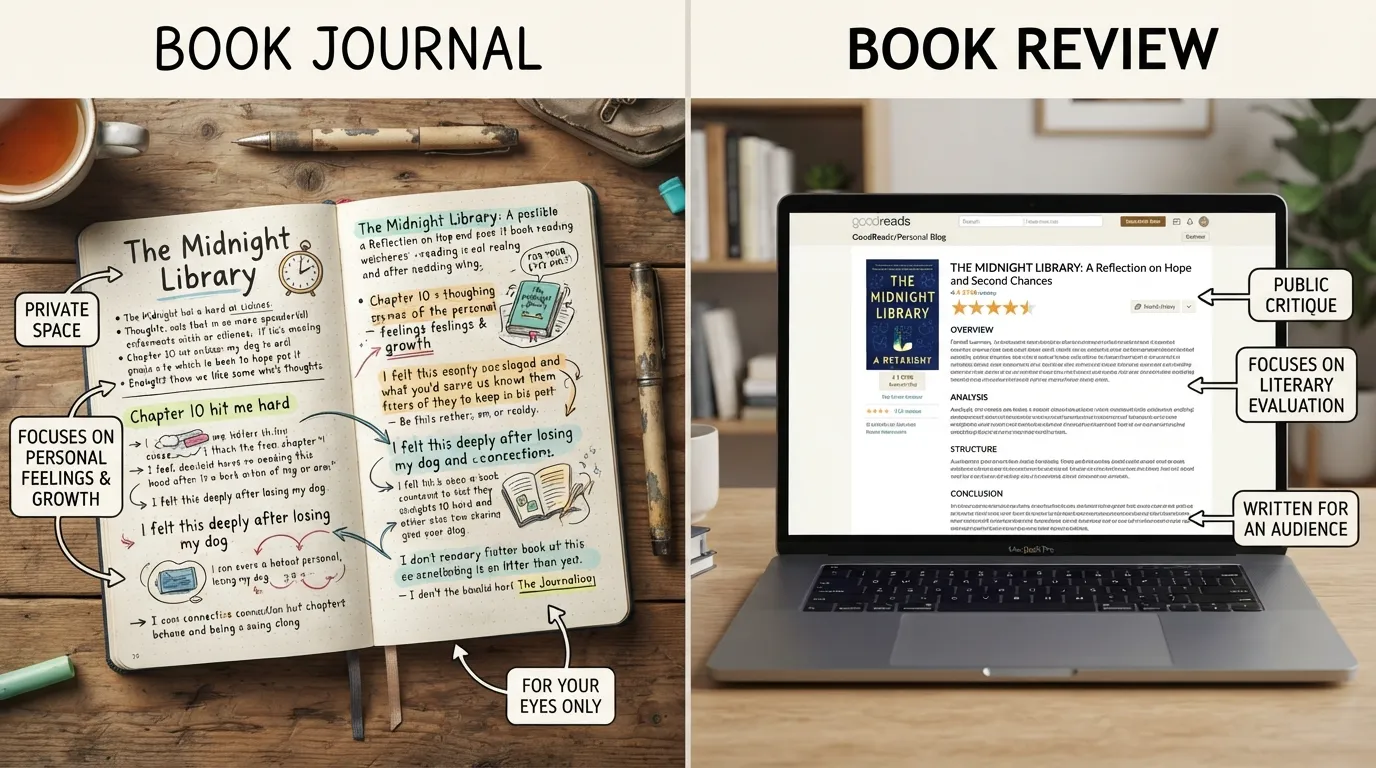
A book journal is a dedicated, personalized archive where you record your active reading journey, track your literary habits, and document your personal reflections on every title you consume.
While a traditional book review is written for an external audience to evaluate, critique, and summarize a book’s literary merits for public consumption, a reading journal is entirely private, reflective, and built exclusively for you. It captures your raw emotional responses, evolving perspectives, and personal growth without the pressure of public critique or formal academic structure.
A comprehensive reading journal typically tracks:
Reading progress: Ongoing page counts, completion timelines, and annual goals.
Reflective thoughts: Character analysis, thematic takeaways, and emotional reactions.
Memorable quotes: Standout passages and authorial choices that resonate with you.
Personal ratings: Multi-metric scoring systems for pacing, enjoyment, and depth.
Moods and environments: How your surroundings and state of mind affect your reading experience.
Reading patterns: Long-term genre preferences, author habits, and completion rates.
Reading Journal vs. Bullet Journal vs. Book Log — Which One Are You Actually Making?
Before you draw your first line or buy your next notebook, it helps to identify which format matches your habits and available time. Here is how the three main variations compare:
Standalone Reading Journal: A dedicated notebook exclusively used for books. It offers unlimited space for deep character studies, comprehensive reviews, long-form reflections, and elaborate artistic spreads without crowding your everyday scheduling tasks.
Reading Section Inside a General Bullet Journal: A curated collection of 10 to 30 pages integrated into your daily or weekly planner. This option is ideal if you prefer keeping your life centralized in one notebook but want a streamlined way to track monthly TBR (to-be-read) lists and reading challenges.
Simple Book Log: A minimalist, data-driven tracker containing only the essentials—such as the title, author, completion date, and star rating. This is perfect if you want the accountability of a reading log without investing time in creative layouts or lengthy written reflections.
What to Include on a Book Journal Page The Core Checklist
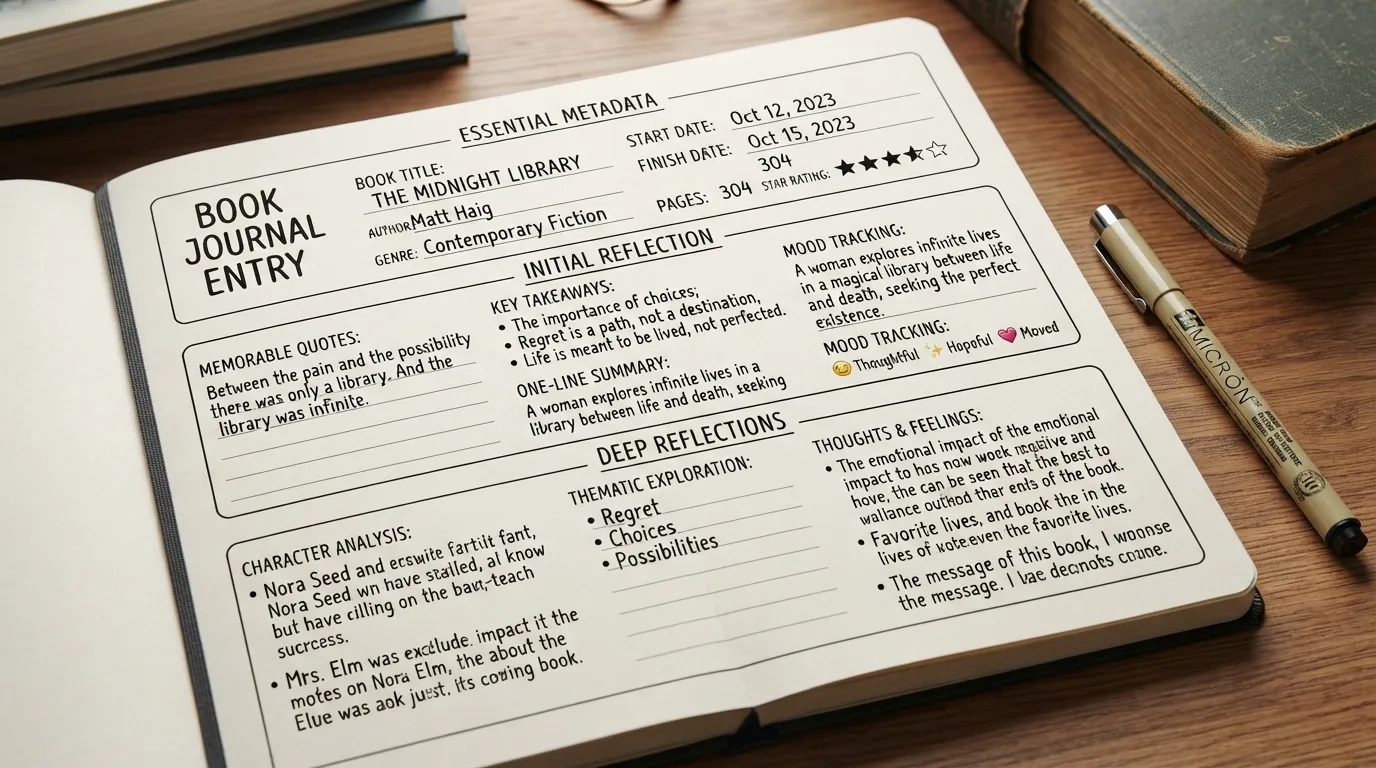
When you sit down to design your spreads, knowing what data actually matters keeps you from abandoning your log halfway through the year. I break down the core elements into three digestible tiers so you can start simple and layer in depth as your journaling habit grows.
Tier 1: The Essentials (Every Page Needs These)
Book Title and Author: The foundational anchor for your log.
Start and Finish Dates: Tracks your reading velocity and helps you spot slumps.
Star Rating: A quick, at-a-glance metric for how you felt about the read.
Tier 2: The Reflection Layer
Favorite Quote: A standout line, passage, or piece of dialogue that stayed with you.
Key Takeaway: The central message, lesson, or lingering thought the book left behind.
One-Line Summary: A punchy synopsis captured entirely in your own voice.
Mood While Reading: The emotional tone the book set (e.g., cozy, suspenseful, melancholic).
Tier 3: The Optional & Advanced Layer
Character Notes: Brief breakdowns of character arcs, alignments, and dynamics.
Themes and Motifs: Recurring symbols, philosophical questions, or deeper subtexts.
New Vocabulary: Unfamiliar words encountered along with their definitions.
Would-Recommend-To: Specific friends, moods, or scenarios that call for this exact book.
Playlist or Song Pairing: The musical score or atmospheric album that matches the book’s vibe.
Which elements you choose to feature depends entirely on the layout style you select below.
6 Book Journal Styles, Sorted by Who You Are Not Just Pretty Pictures
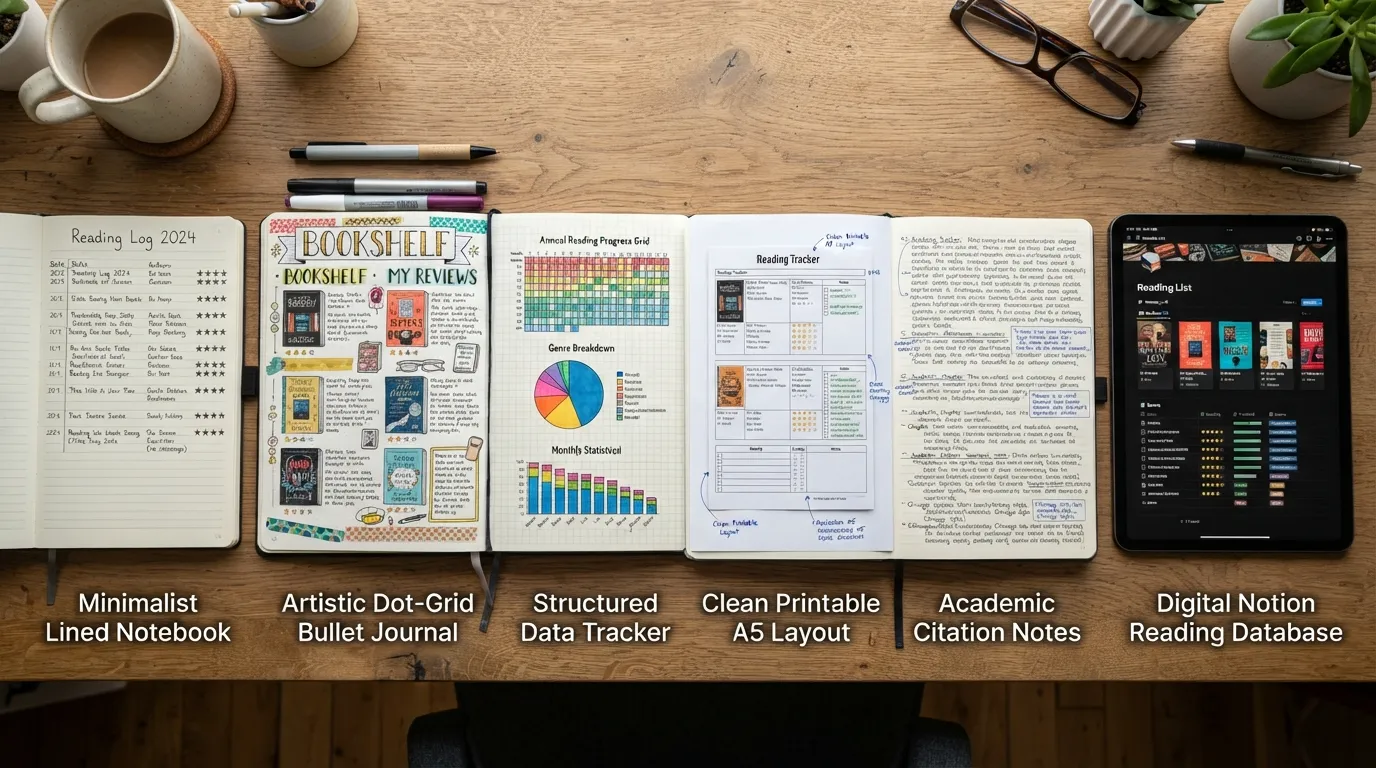
Most articles show you one creator’s hyper-specific aesthetic and assume it works for everyone. I prefer a different approach. Your journal needs to match your actual lifestyle, available time, and natural creative inclination. Find the style below that fits your habits.
1. The Beginner / Minimalist Layout
What it includes: Clean text, the Tier 1 essentials, and a simple rating system without any decorative doodles.
Time to complete: Roughly 5 minutes per entry.
Best notebook type: A simple plain lined, grid, or dot-grid notebook where the focus stays entirely on your words.
If you are setting up your first notebook and want to explore durable bindings or paper that handles daily ink without wearing you down, you can browse journaling supplies that won’t bleed through to pick out a reliable foundation.
2. The Aesthetic / Artsy Bullet Journal Layout
What it includes: Hand-lettered headers, creative book cover doodles, layered washi tape borders, and color-coded genre tags.
Technique focus: Using accessible lettering styles like faux calligraphy or clean print blocks to make headers pop without needing advanced illustration skills.
Best notebook type: A higher-GSM dot-grid notebook where you can experiment with watercolor washes or markers. Because you are testing out heavy mediums here, investing in the right pens and notebook paper weight makes all the difference in keeping your spreads crisp and clean on both sides of the page.
3. The Data-Driven / Stats Tracker Layout
What it includes: Comprehensive yearly stats grids, percentage-based genre breakdowns, pages-per-day calculations, and reading pace charts.
Addressing the PAA: When people search for how many pages is a journal book, they are often confusing physical book length with journal page allocation. In a reading journal, standard practice is to dedicate one full spread (two pages) or one concise single page per book entry.
Best notebook type: Grid or squared notebooks that make drawing tracking columns and reading-pace graphs effortless.
4. The Printable / No-Draw Layout (for Non-Artists)
What it includes: Pre-formatted digital templates, a cut-and-paste method for text blocks, and structured prompt boxes.
Standard sizing: Designed to fit standard A5 journals, which measure 5.8 x 8.3 inches—the most popular notebook size for inserts.
Best notebook type: Any standard blank or lined notebook where you can paste your printed templates straight onto the paper.
5. The Student / Academic Layout
What it includes: Chapter-by-chapter tracking, core thesis breakdowns, citation logs, and analytical discussion questions for dense non-fiction or literature classes.
Best notebook type: A larger B5 or A4 notebook that provides ample margin space for marginalia and scholarly notes.
6. The Digital / App-Based Layout
What it includes: Notion reading databases, GoodNotes PDF templates on a tablet, or custom tables built right into your workspace.
Addressing the PAA: If you are wondering, Is there a journal template in Pages? Yes, you can easily access minimalist table templates inside Apple Pages’ built-in template gallery or create a customized reading log table in under five minutes.
Best notebook type: Your tablet, e-reader, or laptop screen for a completely paperless archive.
15 Book Journal Page Ideas You Can Actually Recreate
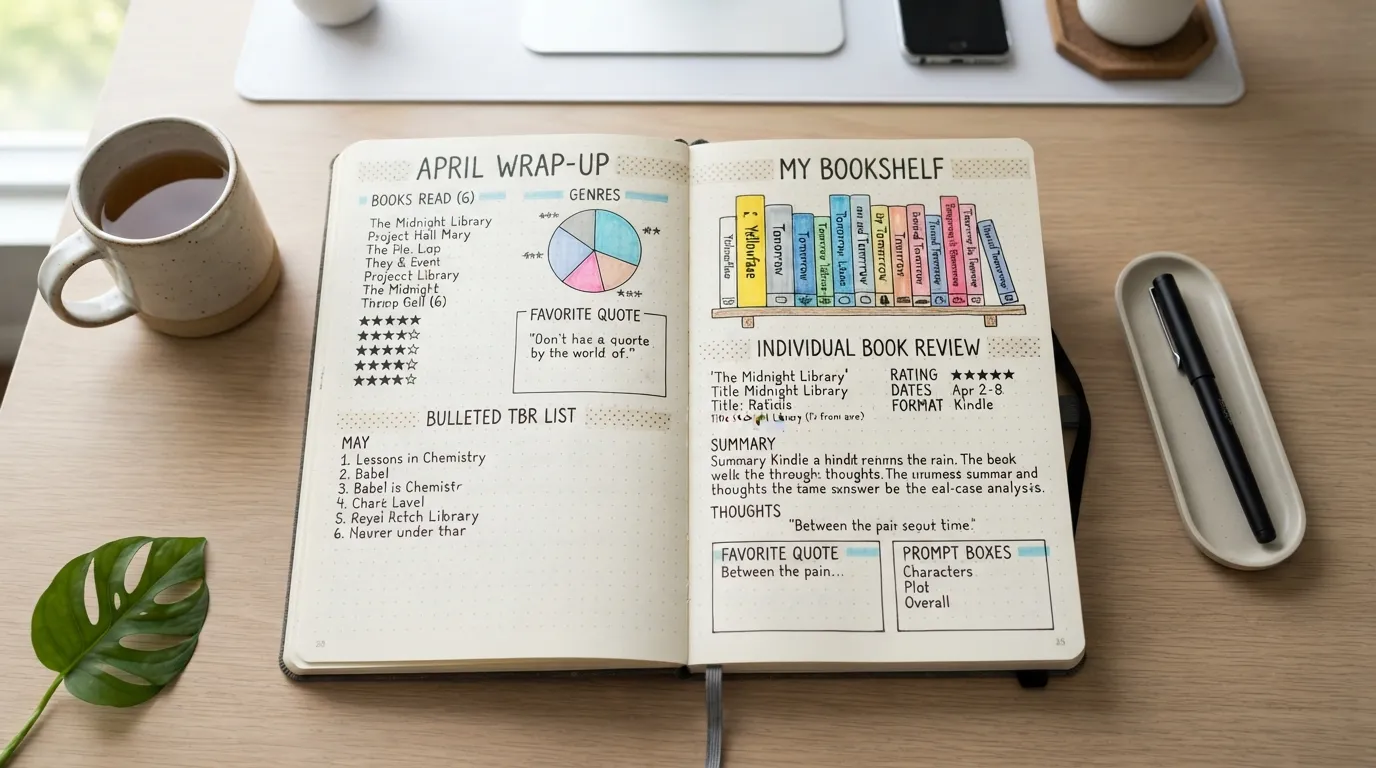
1. Cover Page
Description: Sets the aesthetic tone for your entire reading log at the start of your notebook.
What to include: A bold title, a year marker, and simple botanical or literary doodles.
Difficulty: Easy
2. Yearly Reading Goal Tracker
Description: Keeps your annual reading target in plain sight to monitor your pacing.
What to include: A target number (e.g., 50 books) paired with a visual progress bar or numbered icons.
Difficulty: Easy
3. Currently Reading Spread
Description: A dedicated holding space for the book on your nightstand right now.
What to include: Book title, author, start date, a mini progress bar, and your immediate first impressions.
Difficulty: Easy
4. TBR (To Be Read) List
Description: A master holding pen for every title you want to pick up next.
What to include: A clean bulleted or numbered list of book titles, authors, and source tags (e.g., library, gift).
Difficulty: Easy
5. TBR Sorted by Genre
Description: Organizes your backlog so you can match your next read to your current mood.
What to include: Segmented category columns for fiction, non-fiction, fantasy, thriller, and memoir.
Difficulty: Medium
6. Book Log / Master Tracker
Description: A chronological, data-dense archive of every book finished throughout the year.
What to include: Columns for index number, title, author, completion date, and star rating.
Difficulty: Medium
7. Individual Book Review Page
Description: Your deep-dive reflection spread for a specific title that left a lasting impact.
What to include: Plot synopsis, favorite quotes, character notes, and a multi-metric score breakdown.
Difficulty: Easy
8. Favorite Quotes Page
Description: A curated sanctuary for standout lines, dialogue, and prose that resonated with you.
What to include: The quote text, speaker or author attribution, and the page number for reference.
Difficulty: Easy
9. Bookshelf Spread (color-coded by genre or rating)
Description: A hand-drawn bookshelf where every spine represents a finished book.
What to include: Outline sketches of book spines filled in with color-coded markers based on genre or rating.
Difficulty: Advanced
10. Reading Challenge / Bingo Card
Description: A gamified grid to push you out of your reading comfort zone.
What to include: A 4×4 or 5×5 grid featuring diverse prompts like “a book over 500 pages” or “published in the 90s.”
Difficulty: Medium
11. Series Tracker (Dutch-door style)
Description: Monitors your progress through multi-book fantasy or sci-fi series.
What to include: Series titles, individual book checkboxes, and release date reminders for upcoming sequels.
Difficulty: Advanced
12. Monthly Wrap-Up Spread
Description: A retrospective snapshot celebrating your reading achievements at the end of every month.
What to include: Total books read, top-rated favorite, average star rating, and a mini reflection paragraph.
Difficulty: Easy
13. Book Bracket (favorite-of-the-year knockout)
Description: A tournament-style bracket that pits your favorite reads against each other until one wins.
What to include: Paired match-up lines leading to a single championship box for your ultimate book of the year.
Difficulty: Medium
14. New Release Anticipation Spread
Description: Tracks upcoming book launches so you never miss a publication day.
What to include: Author names, forthcoming titles, release dates, and pre-order status checkboxes.
Difficulty: Easy
15. Read-What-You-Own Tracker
Description: Keeps you accountable to read the physical books already sitting on your shelves.
What to include: A checklist of unread backlog titles paired with location tags (e.g., shelf 2, box 4).
Difficulty: Easy
How to Set Up Your First Book Journal Page, Step by Step
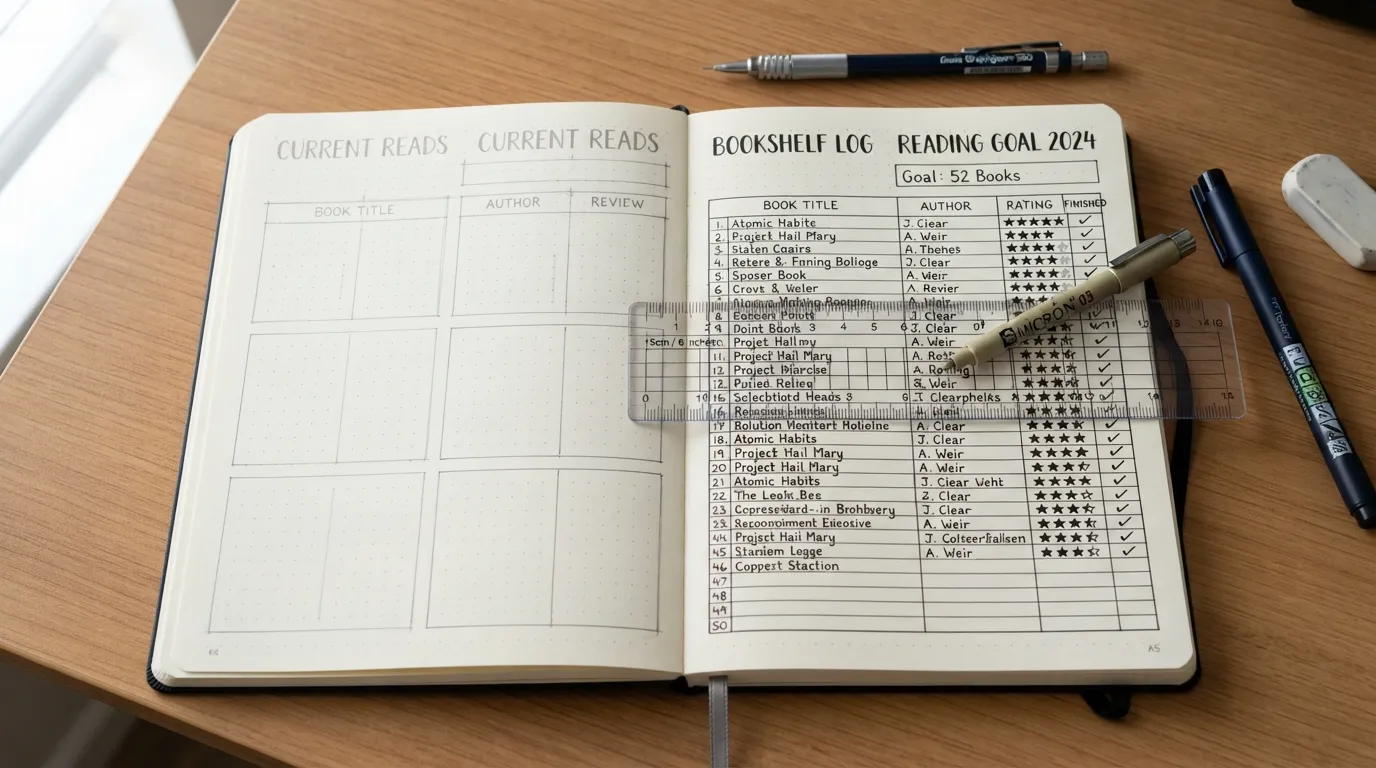
Most articles show you pristine, finished layouts that make starting feel intimidating, but they rarely show you the actual construction process. If you are a non-artist or a beginner looking to avoid ruined pages, follow this straightforward, stress-free setup sequence:
Choose your journal: Pick a notebook that fits your workflow. Whether you prefer hardcovers, softcovers, or spiral bindings, you can explore the best options in our full journaling guide before making your final pick.
Pick 3 to 5 page types from the list above: Resist the urge to draw all 15 layouts on day one. Start simple with a Cover Page, a Yearly Reading Goal Tracker, a Currently Reading Spread, and a basic TBR list to build momentum.
Sketch your layout in pencil first: Lightly map out your boxes, tracking grids, and title placements with a 0.5mm HB pencil so you can easily erase alignment mistakes.
Add headers and titles: Once your proportions look right, go over your pencil lines with your permanent pens, experimenting with simple print blocks or faux calligraphy.
Fill in your tracking grid or table: Draw in your data columns, write out your book titles, and establish your core tracking metrics.
Add color and decoration last (optional): Bring your spread to life with minimalist highlighters, subtle washi tape borders, or stamps only after the structural ink is completely dry.
DIY Reading Journal: What Supplies You Actually Need to Start
You do not need an expensive artist’s studio to build a functional and beautiful reading log. Keeping your toolkit minimal saves you money and keeps the focus where it belongs: on your books.
A reliable notebook: A dot-grid or lined journal that handles daily writing comfortably.
Black fine-liner pens: Waterproof pigment pens (like 0.38mm or 0.5mm tips) that won’t smudge when you highlight over them.
A clear plastic ruler: Essential for drawing clean tables, tracking grids, and straight dividing lines.
Optional accents: A roll of neutral washi tape or minimalist date stickers for quick page decoration.
For a deeper dive into paper GSM weights, pen bleed testing, and binding durability, check out our full journaling supplies guide to find tools that match your writing style.
3 Simple Journaling Methods to Borrow for Your Book Journal
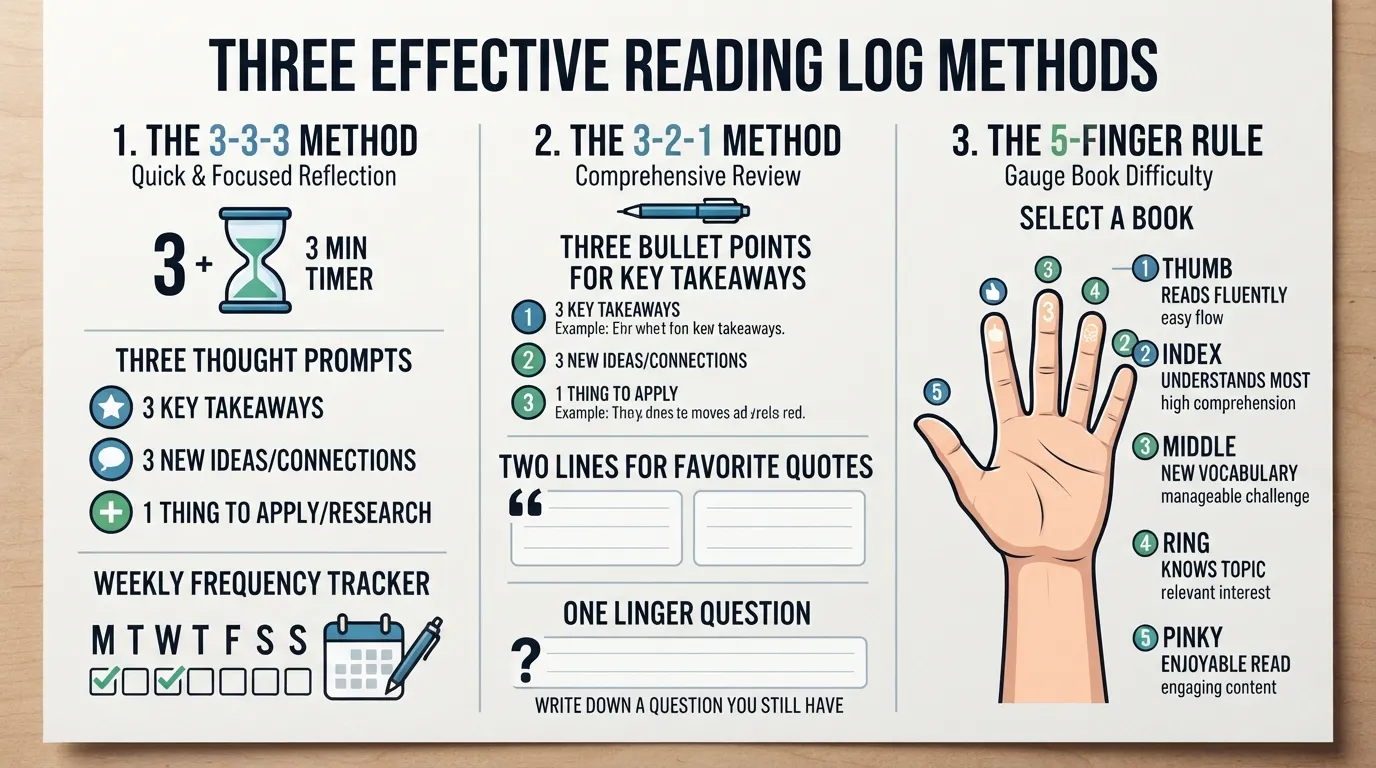
Borrowing established journaling structures helps you avoid the “blank page syndrome” by giving you a proven routine to follow. You can adapt these popular methods into your reading log to keep your entries consistent, concise, and deeply personal.
What Is the 3-3-3 Journaling Method?
The 3-3-3 method is designed for rapid clarity and consistency. Traditionally used for mental decluttering, the book-journal variant helps you process a book without writing a full-blown critique.
The Method: Dedicate 3 minutes of focused writing immediately after finishing a reading session.
The Book Application: Force yourself to capture 3 key plot points, 3 quick emotional reactions, or 3 unanswered questions that emerged during your reading. By setting a strict 3-minute timer, you bypass overthinking and capture your raw, honest perspective before it fades.
What Is the 3-2-1 Method for Journaling?
The 3-2-1 method is an excellent framework for those who want structured reflection without the pressure of long-form essay writing. It turns your reading log into a high-value summary sheet.
The Structure:
3 Things Learned: Key concepts, historical facts, or character insights you gathered.
2 Favorite Quotes: The most impactful lines that defined the book’s tone.
1 Lingering Question: A prompt or thought the book left you with that you want to revisit later.
The Book Application: This layout works perfectly for non-fiction or analytical reading, turning a casual log into a permanent archive of your personal learning journey.
What Is the 5 Finger Rule for Books?
The 5 Finger Rule is a classic diagnostic tool used by educators and librarians to determine if a book is at the right reading level for you. However, it also serves as a perfect “pre-read” note for your journal.
The Method: Open a book to any page and read it. Put up one finger for every word you don’t know or don’t understand. If you have 5 fingers up by the end of the page, the book might be too difficult for your current comfort level.
The Book Application: Log your 5-Finger score as a “Difficulty Rating” at the top of your review page. This helps you understand why you might be breezing through certain genres while struggling through others, allowing you to curate your TBR list with better self-awareness of your current reading capacity.
7 Types of Journals and Where Book Journaling Fits In
Understanding where your reading log fits into the broader journaling landscape helps you decide if you need a dedicated notebook or if your book entries should share space with other habits. Here are the seven primary journal types:
Bullet Journal: A customizable, modular system for rapid daily task management, habits, and scheduling.
Gratitude Journal: A focused, daily reflection space dedicated entirely to listing things you appreciate.
Dream Journal: A bedside notebook meant for capturing fleeting subconscious imagery immediately upon waking.
Travel Journal: A dynamic scrapbook preserving itineraries, tickets, sketches, and memories from trips.
Art Journal: A creative playground emphasizing mixed media, paint, collage, and visual expression over text.
Reading / Book Journal: A specialized archive dedicated to tracking literary progress, reviews, quotes, and reading goals.
Mental Health / Therapy Journal: A private emotional outlet for processing trauma, anxiety, tracking triggers, and practicing self-care.
Ultimately, a book journal operates as a specialized subtype of personal journaling that bridges analytical tracking with creative expression, giving your literary life a permanent, beautiful home.
How to Make a Beautiful Book Journal Page Without Being an Artist
You do not need an art degree or a collection of expensive markers to create a stunning spread. Clean layouts look sophisticated precisely because they rely on restraint rather than complex illustration. Here is how to keep your pages looking intentional and polished:
Stick to a strict 2–3 color palette: Pick one neutral dark ink for your text, one accent marker for headers, and one highlighter or soft pastel shade for background blocks. Limiting your palette instantly prevents visual clutter.
Embrace generous white space: Resist the urge to fill every square millimeter of the page. Leaving empty margins around your text and tracking boxes gives your spreads a clean, high-end editorial feel.
Always use a ruler for structural grids: Shaky freehand lines can make a layout look messy. Use a clear plastic ruler to map out your tracking tables, boxes, and column dividers before writing.
Letter your main titles last: Write out your body text and data points first so you don’t accidentally misjudge your spacing and run out of room for your headers.
Never waste time erasing minor mistakes: If a line slips or a letter gets crooked, resist the urge to scrub at the paper with an eraser until it pills. Cross it out neatly, adapt it into a design accent, or simply move on to the next line.
Unique & Creative Book Journal Page Ideas Beyond the Basics
If you have mastered the standard reading logs and want to push your creativity into fresh territory, try these unconventional layouts. They move past basic data tracking into deep psychological reflections and imaginative world-building.
Book playlist pairing page: Dedicate a spread to curating the exact soundtrack, instrumental score, or ambient album that matches a specific book’s atmosphere, complete with tracklists and scene-matching notes.
“Books that changed my mind” spread: A powerful retrospective page documenting titles that actively challenged your worldview, shifted your perspective, or forced you to unlearn an old belief.
Villain or antagonist analysis page: Step inside the mind of the antagonist. Map out their motivations, psychological turning points, and why their perspective makes structural sense within the narrative arc.
Setting and world-building sketch page: Map out fictional landscapes, architectural layouts, or fantasy kingdoms mentioned in the book using rough cartography, pin drops, and geographical notes.
“If this book was a person” character page: Personify your read as a human being. Describe their fashion style, their posture, what coffee shop they would hang out in, and the exact vibe they carry into a room.
Comfort re-reads shelf: A specialized tracker celebrating the books you return to over and over again when you need emotional safety, noting why each particular title acts as a literary anchor for you.
Books recommended by friends (with who recommended it): A dedicated referral page where you log titles given to you by specific peers, allowing you to follow up with them later and share your thoughts once you finish reading.
Frequently Asked Questions About Book Journal Pages
What should be in a book journal?
A well-rounded book journal should include core structural elements like a reading log, index, and detailed review templates. For a complete itemized breakdown of essential sections, please reference the checklist section above.
What pages should be in a book journal?
If you are starting from zero, the minimum recommended page set includes a title cover page, an annual reading tracker, a chronological reading log, and dedicated review spreads. This baseline structure provides enough flexibility to track titles without feeling overwhelming.
What are some unique journal ideas?
To elevate your reading experience beyond standard logs, you can incorporate creative layouts like character arc maps, quote memory webs, and seasonal reading challenges. Explore these concepts in detail within the "Unique Ideas" section above.
Start Your Book Journal Today
The secret to a successful reading log isn’t having immaculate handwriting or buying every accessory on the market; it’s simply giving your thoughts a permanent place to land. Pick just one or two page types from our list above—perhaps a simple reading goal tracker and a currently reading spread—and open your notebook tonight. You don’t need a finished masterpiece on page one. You just need to turn it. Whenever you are ready to expand your practice, explore more journaling ideas to keep your creative momentum going long after you finish your next great read.
Pimchanok Srisuk
Pimchanok Srisuk is the Journaling Editor at Holistic Wellbeing Living. She writes about journaling prompts, reflective writing, emotional clarity, and mindful routines. With seven years of experience creating personal-growth content, Pimchanok helps readers use simple writing practices to understand their thoughts and make calmer everyday decisions.