Understanding the Core Mechanics of This MCQ
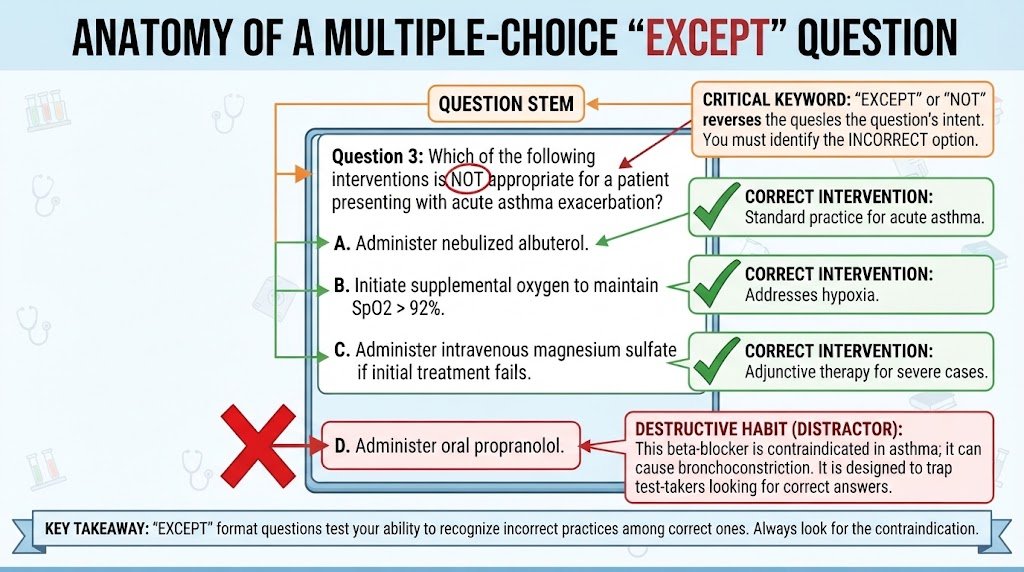
This question format typically appears in time management assessments where test-takers must identify the odd-one-out among standard behavioral interventions.
The query is designed to test your comprehension of evidence-based strategies for overcoming delay behaviors versus counterproductive habits that worsen chronic avoidance.
Mastering this distinction requires evaluating psychological drivers like emotional regulation, task aversion, and self-efficacy rather than just looking at surface-level scheduling tricks.
Quick Answer Blueprint for Multiple-Choice Options
The correct choice depends entirely on the specific options provided in your test or quiz, as examiners usually pair three proven time management techniques with one destructive habit.
Look for an option that promotes avoidance, distraction, or unstructured delay—such as waiting for inspiration or passive multitasking—since these represent what a strategy is not.
Authentic interventions for managing procrastination typically involve breaking tasks into micro-steps, implementing the two-minute rule, or utilizing time-boxing techniques.
Common Test-Bank Variations of This Question
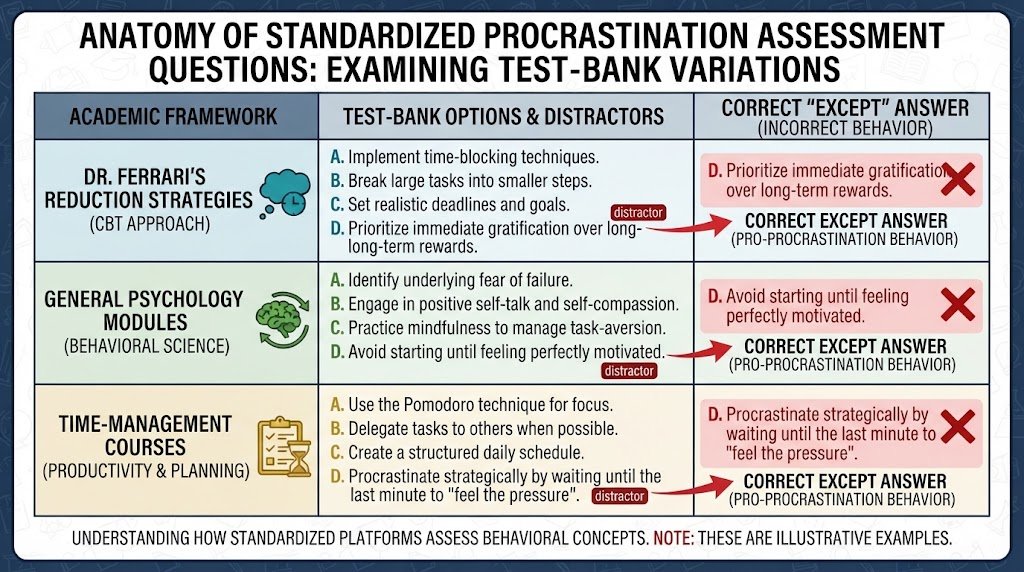
Multiple-choice assessments draw from standardized academic item banks, meaning the same core concept appears across platforms like Chegg, Brainly, and Gauthmath with slight wording shifts.
Recognizing these patterns prevents confusion when your specific quiz alters the framing or substitutes alternative distractors for the “except” condition.
Examining these variations side-by-side reveals how testing platforms structure psychological distractors versus evidence-based interventions.
Version 1: Dr. Ferrari’s Procrastination Reduction Strategies (Except)
Joseph Ferrari, a leading researcher on chronic avoidance, emphasizes behavioral accountability and emotional regulation over mere scheduling adjustments.
Test banks utilizing his framework typically list active coping mechanisms like reframing irrational beliefs or managing time pragmatically as valid strategies.
The correct answer for this version is almost always the distractor promoting unstructured waiting, self-blame, or waiting until the emotional state improves before starting.
Version 2: General Psychology Course Variation
Introductory psychology assessments frame procrastination as a self-regulation failure closely linked to low distress tolerance and perfectionism.
Valid interventions highlighted in these modules include stimulus control, implementation intentions, and cognitive restructuring to reduce task aversiveness.
The “except” choice in this context is frequently a counterproductive habit like chronic cramming or relying entirely on sudden bursts of adrenaline.
Version 3: Time-Management Course Variation
Business and productivity-focused test banks approach the topic through operational efficiency and structural frameworks like Pomodoro or time-boxing.
Standard correct options focus on minimizing friction, prioritizing high-impact tasks, and utilizing environmental design to reduce cognitive load.
The incorrect exception option usually advocates for passive task-switching, multitasking, or ignoring deadlines until external pressure forces execution.
Procrastination Question Variations Compared
| Question Version | Common Test Bank Options | Correct “Except” Answer |
| Dr. Ferrari Framework | Cognitive reframing, time management, emotional regulation, waiting for the right mood | Waiting for the right mood |
| General Psychology | Stimulus control, goal-setting, implementation intentions, relying purely on cramming | Relying purely on cramming |
| Time-Management Course | Time-boxing, micro-steps, priority filtering, multitasking to catch up | Multitasking to catch up |
Why the "Except" Answer Is Usually a Myth or Counterproductive Habit
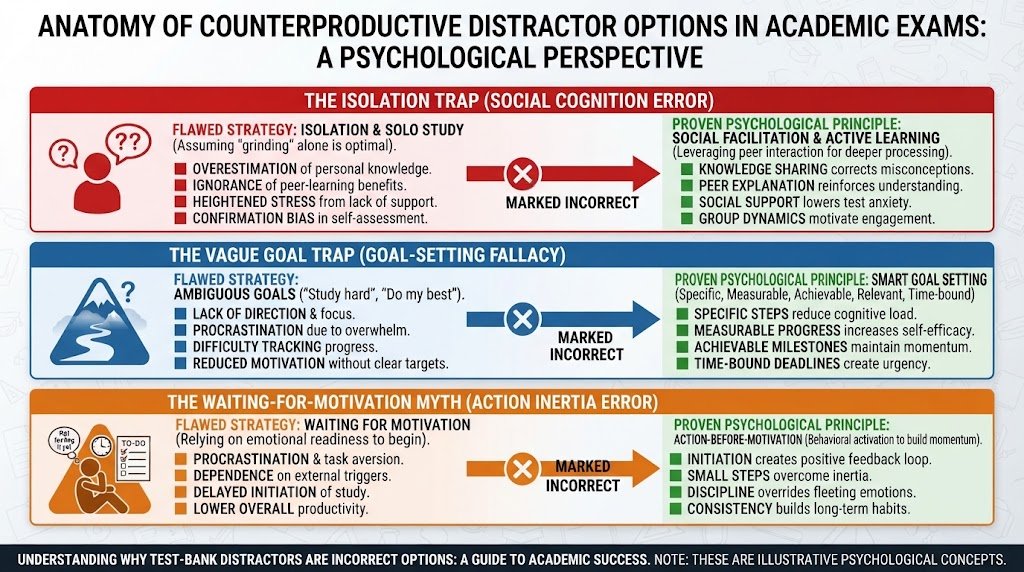
Multiple-choice questions built around the “except” format rely on identifying behavioral interventions that actively worsen chronic avoidance rather than resolving it.
The distractor option typically masquerades as a logical choice to stressed students, making it a critical trap to deconstruct through the lens of behavioral psychology.
Understanding the underlying mechanics of these counterproductive habits guarantees you will spot the incorrect choice instantly, regardless of how the question is phrased.
The Isolation Trap — Why Going It Alone Backfires
Procrastinators frequently choose isolation because shame and guilt make them want to hide their unfinished work from peers and mentors.
In a test bank, any option suggesting you should cut off social support networks or handle deep task aversion completely in secret is mathematically destined to be the wrong answer.
Behavioral science confirms that accountability partnerships and external check-ins significantly lower the psychological barrier to starting difficult tasks.
The “Vague Big Goal” Trap — Why Ambiguous Targets Increase Avoidance
Vague objectives like work on the project or study for the exam trigger high cognitive load and overwhelm the executive functions of the brain.
When test options suggest keeping goals broad to maintain flexibility, they are describing a primary catalyst for paralysis rather than an effective strategy.
Effective interventions require breaking projects down into concrete, immediate micro-steps with unambiguous completion criteria.
The “Waiting for Motivation” Myth — Why Action Precedes Motivation
Waiting until you feel inspired or motivated before beginning a task is the single most common self-deception associated with chronic delay.
Test options that endorse waiting for the right mood or emotional readiness always represent the incorrect exception choice.
The behavioral activation model proves that micro-actions spark momentum, meaning action must precede motivation rather than follow it.
Psychological Reasoning Behind Each Wrong Option
Relying on willpower alone: Ignores cognitive fatigue and assumes self-control is an infinite resource rather than a depletable asset.
Suppressing negative thoughts: Amplifies the intrusive anxiety surrounding the task instead of using cognitive restructuring to reframe it.
Prioritizing perfectionism: Paralyzes execution by setting unrealistically high standards that heighten the emotional cost of making mistakes.
Proven Strategies That DO Work for Managing Procrastination
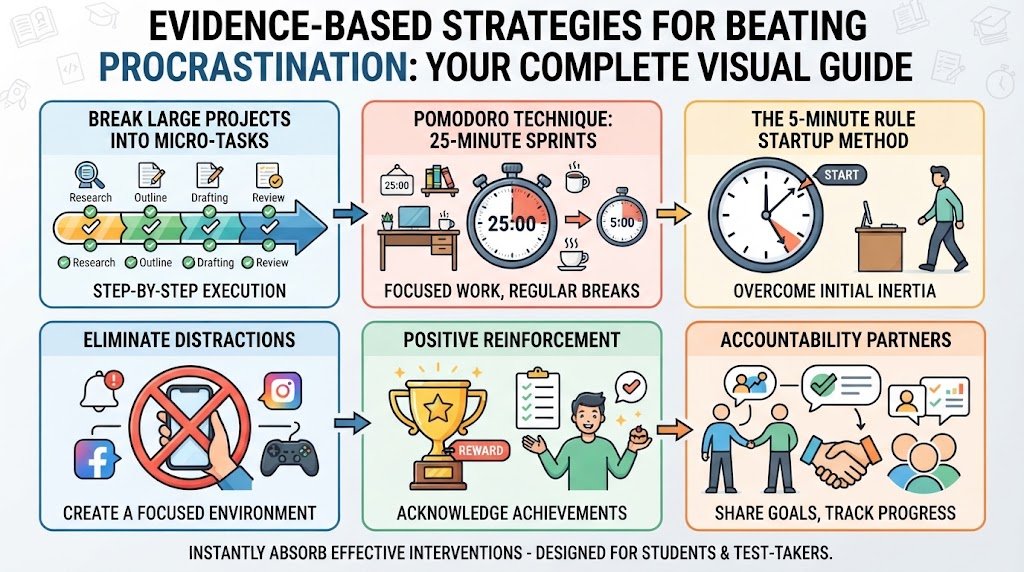
Implementing evidence-based behavioral strategies helps overcome avoidance by transforming overwhelming assignments into manageable actions. Utilizing structured routines and active coping mechanisms replaces delay habits with steady productivity momentum [00:00].
Breaking Large Tasks Into Smaller Steps
Dividing daunting projects into bite-sized micro-tasks significantly lowers the perceived cognitive hurdle required to begin working.
Focusing on a single sub-task prevents mental overload and reduces the stress that triggers chronic avoidance behaviors.
The Pomodoro Technique Explained
Working in focused 25-minute intervals followed by a short 5-minute break helps maintain high cognitive engagement without burnout.
This time-boxing method creates a sense of urgency that limits distractions and structures your workflow effectively.
The 5-Minute Rule
Committing to work on a task for just five minutes tricks your brain into overcoming the initial friction of starting.
Once the barrier of entry is breached, momentum often carries you naturally past the initial five-minute mark.
Eliminating Distractions (Phone, Notifications, Website Blockers)
Environmental design removes digital temptations by placing phones in other rooms and utilizing focus apps to block distracting sites.
Reducing context-switching protects your attention span and preserves energy for deep work.
Reward-Based Milestones
Associating completed milestones with intentional treats creates positive reinforcement loops that strengthen productive habits over time.
Celebrating small wins maintains motivation and emotional engagement throughout lengthy projects.
Accountability Partners & Study Groups
Sharing your daily targets with a peer or mentor introduces external accountability that minimizes the temptation to slack off.
Regular check-ins provide social encouragement and structured deadlines that keep you on track.
Types of Procrastination
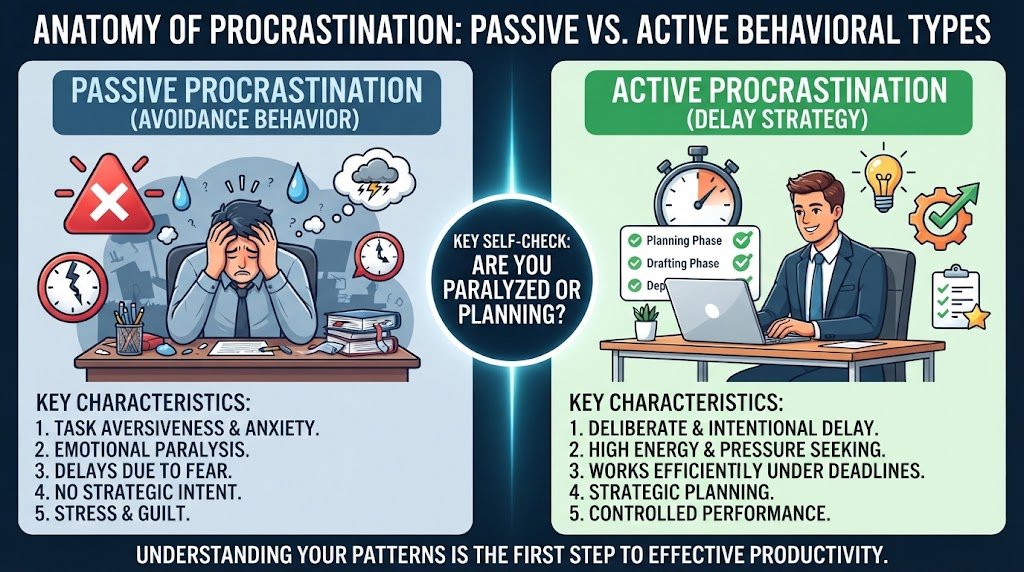
Categorizing procrastination into distinct behavioral archetypes helps pinpoint the psychological drivers behind your delay habits.
Recognizing whether your avoidance stems from distress or deliberate strategy changes how you apply corrective interventions.
Passive Procrastination (Avoidance-Based)
Passive procrastination occurs when you freeze, feel overwhelmed, and fail to act due to task aversiveness or severe self-doubt.
This traditional form is driven by anxiety and paralysis, resulting in missed deadlines and heightened emotional distress.
Active Procrastination (Deliberate Delay Under Pressure)
Active procrastinators intentionally postpone tasks because they consciously perform better and feel more energized under tight deadlines.
Unlike passive avoiders, active procrastinators maintain control and still achieve successful outcomes despite the compressed timeframe.
Which Type Do You Have? (Self-check angle)
Ask yourself if your delay is accompanied by feelings of guilt and helplessness, which signals destructive passive avoidance.
If your postponement is deliberate, controlled, and yields strong results without panic, you are practicing intentional active delay.
Procrastination Strategies for Students
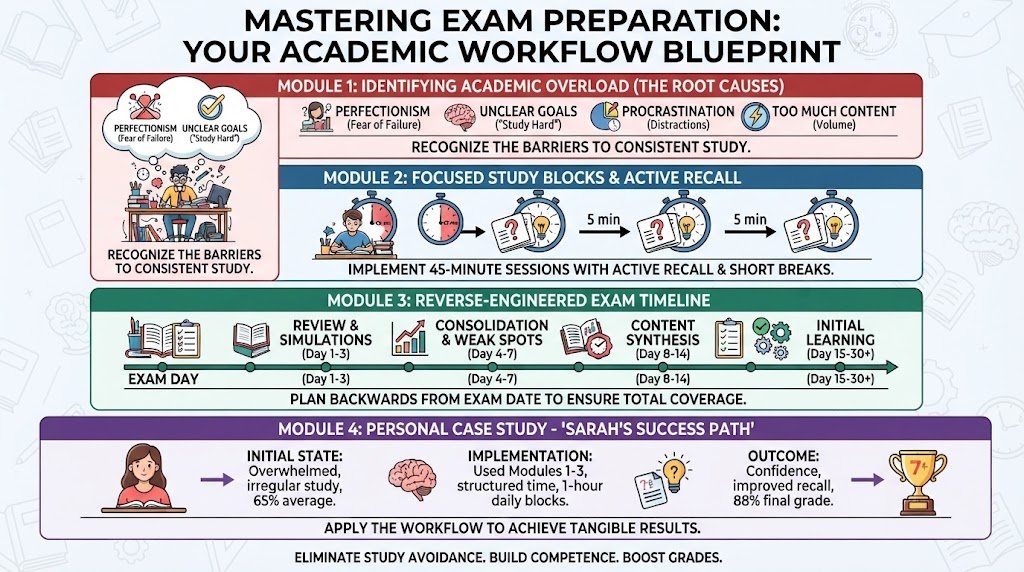
Academic settings create unique psychological pressures that make students particularly vulnerable to chronic delay and task avoidance. Implementing targeted study workflows replaces overwhelming workloads with sustainable, high-performance academic habits.
Why Students Procrastinate More Than Other Groups
Students face ambiguous long-term assignments like term papers and final exams, which naturally trigger executive function overload and high anxiety.
The lack of immediate oversight in independent study hours leaves students solely responsible for self-regulation, making avoidance an easy default trap.
Study-Specific Techniques (Timed Study Blocks, Active Recall Pairing)
Pairing 45-minute focused study intervals with 10-minute active recall testing prevents passive reading loops and deepens memory retention.
Testing yourself on core concepts immediately after reading forces active cognitive engagement, which lowers task boredom and resistance.
Exam Prep Without Last-Minute Panic
Reverse-engineering your exam syllabus by mapping out weekly milestones eliminates the need for destructive, high-stress cramming sessions.
Reviewing solved past papers in structured increments builds test-taking familiarity and lowers performance anxiety well before exam day.
Real-World Example / First-Hand Practical Insight
Shifting from marathon study sessions to scheduled 30-minute micro-blocks transformed a chronically delayed revision schedule into a manageable daily habit.
By treating study periods like non-negotiable appointments and pairing them with immediate post-study breaks, the initial resistance to opening textbooks vanished entirely.
Myth vs. Fact — Common Procrastination Misconceptions
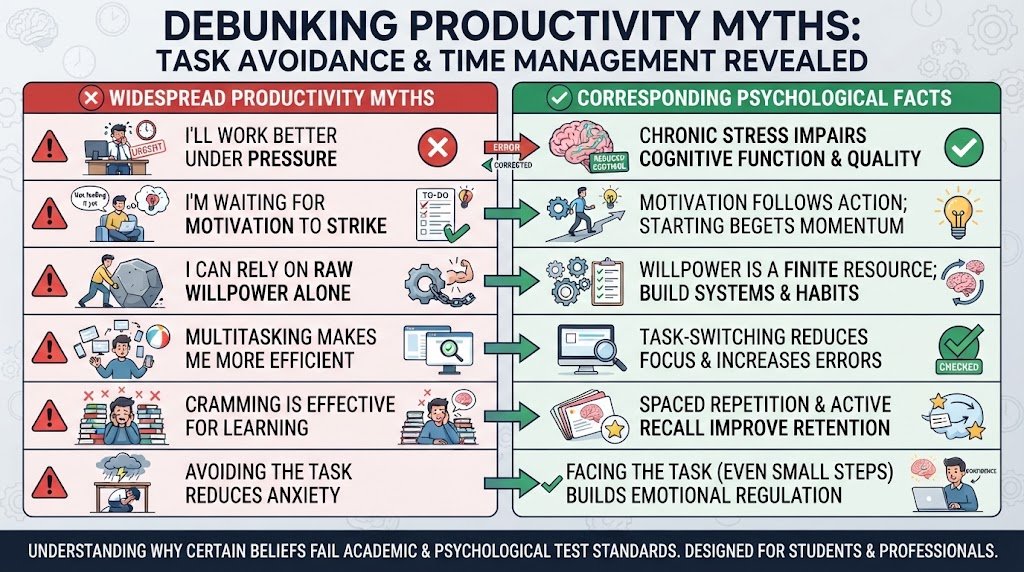
Examining common misconceptions about procrastination reveals why traditional productivity advice frequently backfires under test conditions.
Separating psychological myths from evidence-based behavioral facts ensures you correctly evaluate trick choices in academic assessments.
Myth vs. Fact Table
| Procrastination Myth | Psychological Fact |
| Procrastination is just poor time management. | It is primarily an emotional regulation failure driven by task aversiveness, stress, and anxiety rather than an inability to read a clock. |
| You need to wait for motivation to start. | Action must precede motivation; as noted by the Cleveland Clinic, starting with small micro-steps builds the momentum required to generate focus. |
| Working under intense pressure makes you more creative. | Chronic last-minute cramming triggers high cortisol levels, which impairs cognitive flexibility and damages long-term memory consolidation. |
| Procrastinators simply do not care about outcomes. | Chronic delay is frequently linked to perfectionism and fear of failure, meaning procrastinators often care deeply but fear being judged. |
| Willpower alone is enough to overcome avoidance. | Relying entirely on willpower ignores cognitive fatigue, whereas environmental design and structured systems create sustainable change. |
| Keeping goals broad gives you helpful flexibility. | Vague objectives trigger analysis paralysis, whereas concrete micro-tasks lower executive function overload and initiate prompt execution. |
Quick Self-Test: Are You Following a Myth-Based Strategy?
Review your current study habits to see if you are relying on waiting for the right mood or pushing tasks off until deadlines force action.
Swap out passive avoidance tactics for structured interventions like the Pomodoro technique or micro-tasking to test whether your productivity improves.
Frequently Asked Questions
About Procrastination Strategies
Addressing frequently asked questions provides quick, authoritative answers to high-intent search queries. These structured responses target Google’s People Also Ask boxes and support FAQ schema implementation for rich search snippets.
Which of the following are good strategies to avoid procrastination?
Effective strategies include breaking large assignments into smaller micro-steps, utilizing time-boxing frameworks like the Pomodoro technique, and setting up environmental accountability.
Correct quiz options typically focus on active behavioral planning, while incorrect options involve waiting for motivation or isolating yourself.
What are the strategies to avoid procrastination?
Core tactics involve reducing task friction through the 5-minute rule, eliminating digital distractions, and pairing milestones with intentional rewards.
Prioritizing emotional regulation and tackling high-resistance tasks first also prevents executive function overload.
What are 7 ways to overcome procrastination?
Break tasks down: Turn intimidating projects into tiny, manageable steps.
Use the 5-minute rule: Commit to working for just five minutes to spark initial momentum.
Implement time blocking: Work in focused 25-minute sprints using the Pomodoro method.
Remove distractions: Put your phone in another room and use website blockers.
Establish accountability: Share your daily goals with a study partner or group.
Reframe negative self-talk: Combat perfectionism by accepting imperfect initial drafts.
Reward milestones: Celebrate completed sub-tasks to reinforce productive habits.
What are 10 ways to stop procrastinating?
Practice cognitive reframing to reduce task aversiveness and anxiety.
Establish a dedicated, distraction-free workspace for studying or working.
Reverse-engineer big deadlines into weekly milestone checkpoints.
Use the two-minute rule for small tasks that can be finished immediately.
Prioritize your MITs (Most Important Tasks) at the start of the day.
Track your time usage to identify specific triggers for delay.
Maintain physical energy through proper sleep, hydration, and nutrition.
Visualize the relief of completion rather than focusing on the effort required.
Eliminate multitasking to protect your attention span and reduce cognitive fatigue.
Accept that action precedes motivation instead of waiting for the right mood.
Which strategy is most effective for overcoming procrastination?
Breaking large tasks into micro-steps is widely considered the most effective intervention because it directly lowers the neurological resistance to starting.
Overcoming the initial barrier of entry triggers behavioral activation, making subsequent progress much easier to sustain.
What are 5 management techniques?
The Pomodoro Technique: Alternating focused intervals with short, structured breaks.
Eisenhower Matrix: Categorizing tasks by urgency and importance to prioritize effectively.
Time-Boxing: Assigning fixed time slots on a calendar for specific project deliverables.
Active Recall Pairing: Testing yourself immediately after reading to improve memory retention.
Implementation Intentions: Creating explicit if-then plans for when and where you will complete tasks.