What Is Procrastination and Why Does It Really Happen?
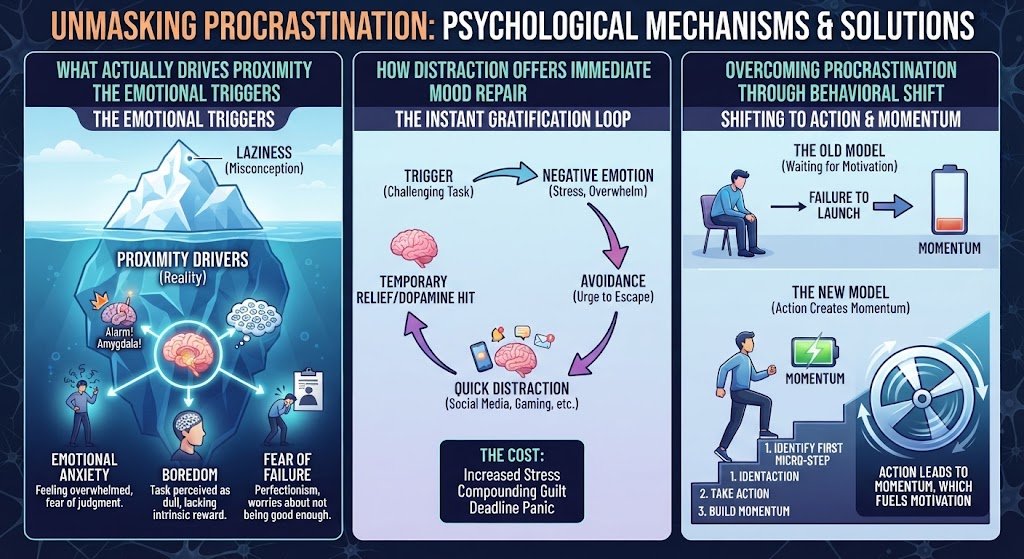
Procrastination is rarely a simple failure of time management or a character flaw rooted in laziness. At its core, procrastination is an emotional regulation problem where your brain prioritizes short-term mood repair over long-term goals. Understanding this psychological mechanism is the first step toward breaking the cycle permanently.
The Real Psychology Behind Procrastination
Procrastination is driven by emotional avoidance rather than a lack of work ethic. When faced with a challenging or ambiguous task, the brain’s limbic system—particularly the amygdala—perceives it as a threat, triggering a stress response that pushes us to seek immediate relief.
Emotional Avoidance: We delay tasks to escape negative feelings like anxiety, boredom, insecurity, or self-doubt.
Fear of Failure: Subconsciously, many people delay starting so they can blame a lack of time rather than a lack of ability if they perform poorly.
Instant Gratification: Engaging in mindless scrolling or cleaning offers an immediate dopamine hit, trading future success for present comfort.
Research published by APA Psychology Topics highlights that chronic procrastination is deeply tied to our inability to manage negative moods rather than poor planning skills.
Action Creates Motivation, Not the Other Way Around
Traditional productivity advice suggests waiting until you feel inspired or motivated to start a task. In reality, motivation is a lagging indicator that follows action rather than preceding it.
The Behavioral Loop: Taking even a tiny, imperfect step triggers a release of dopamine, which alters your brain chemistry and builds momentum.
The 5-Minute Rule: Committing to work on a dreaded project for just five minutes lowers the psychological barrier to entry, bypassing the brain’s threat response.
Overcoming Friction: Once physical motion begins, internal resistance typically fades, proving that action creates the very motivation we were waiting for.
Common Myths About Procrastination
Misunderstandings about why we delay tasks often lead to counterproductive solutions like self-criticism. Dispelling these myths allows you to adopt healthier, science-backed self-regulation strategies.
Myth: Procrastination is just extreme laziness. Fact: Laziness is apathy and a lack of desire to act; procrastination involves an active, albeit counterproductive, choice to do something else instead of the primary task due to stress.
Myth: Pressure makes you perform better. Fact: While adrenaline from a looming deadline creates a rush, chronic last-minute scrambling leads to higher error rates, burnout, and diminished long-term output quality.
Myth: Better time management will cure it. Fact: Planners and productivity apps only help if time is the bottleneck; if emotional avoidance is the root cause, scheduling tools alone will not stop the delay.
Quick-Start Frameworks to Stop Procrastinating Right Now
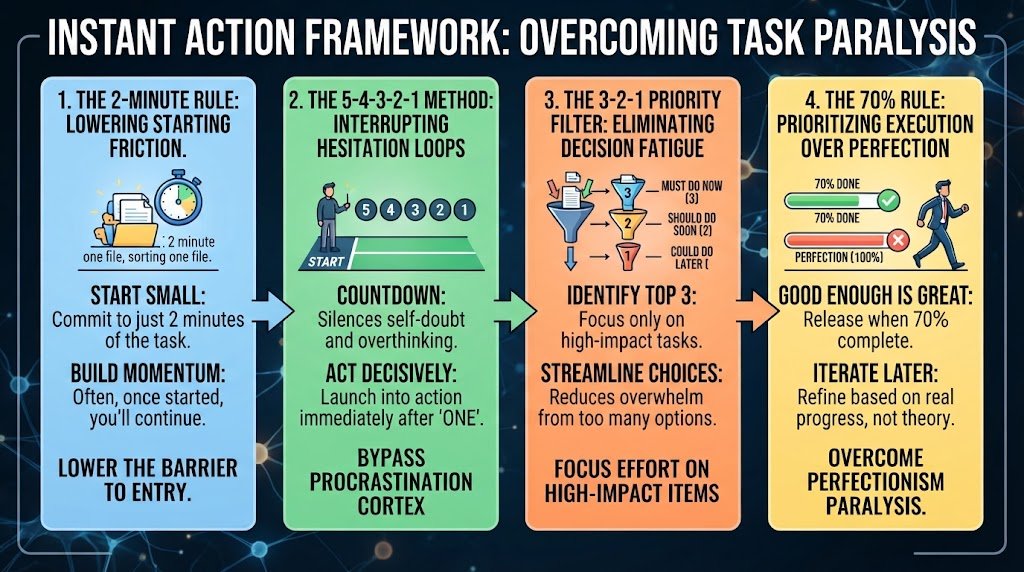
Overcoming chronic procrastination requires practical, low-friction systems rather than relying on unreliable willpower. Utilizing tactical execution frameworks can immediately disrupt paralysis, reduce cognitive load, and jump-start behavioral momentum to help you finish important tasks.
The 2-Minute Rule (How and Why It Works)
The 2-minute rule lowers the psychological barrier to entry by committing to work on a dreaded project for just two minutes [07:55]. Physics teaches us that it takes more energy to start moving than to keep moving, meaning the hardest part is simply beginning [07:41].
Micro-Commitment: Tell yourself you only have to work for two minutes without any pressure to finish the whole task [08:08].
The Momentum Effect: Once physical motion begins, your brain naturally wants to continue, bypassing the initial paralysis [08:13].
The 5-4-3-2-1 Rule (Mel Robbins Method) — Explained Step-by-Step
The 5-4-3-2-1 countdown method acts as a cognitive circuit breaker that interrupts hesitation loops in the brain before self-doubt creeps in.
Reverse Counting: Mentally count down from five to one (5-4-3-2-1) and immediately take physical action when you hit one.
Activating the Prefrontal Cortex: Counting engages your brain’s active thought processes, overriding the emotional avoidance center and forcing executive control.
The 3-2-1 Rule for Procrastination
The 3-2-1 structured planning rule simplifies complex execution by eliminating overwhelming choices at the start of a work session.
Focus Filtering: Pick three top priorities, narrow them down to two critical execution blocks, and commit to one single essential outcome for the day.
Reducing Decision Fatigue: Limiting active choices preserves mental energy so you spend bandwidth executing rather than planning.
The 70% Rule — Done Is Better Than Perfect
Perfectionism is a primary disguise for procrastination, keeping people trapped in endless planning phases out of fear of failure.
Imperfect Action: Give yourself permission to execute when information or readiness is at 70%, rather than waiting for impossible ideal conditions.
Iterative Progress: Shipping an imperfect draft or project allows you to gather real-world feedback and refine it faster than waiting for perfection.
The 10-Minute Rule
Similar to shorter variations, the 10-minute rule offers an extended psychological runway for tasks that feel intimidating or heavy.
Time-Boxed Focus: Set a timer for 10 minutes and dedicate undivided attention to the project [08:11].
Permission to Stop: You are free to stop once the timer goes off, though momentum usually inspires you to keep going [08:13].
Watch the referenced video Stop Wasting Hours: 11 Hacks That Beat Procrastination.
Break Down Tasks So They Feel Less Overwhelming
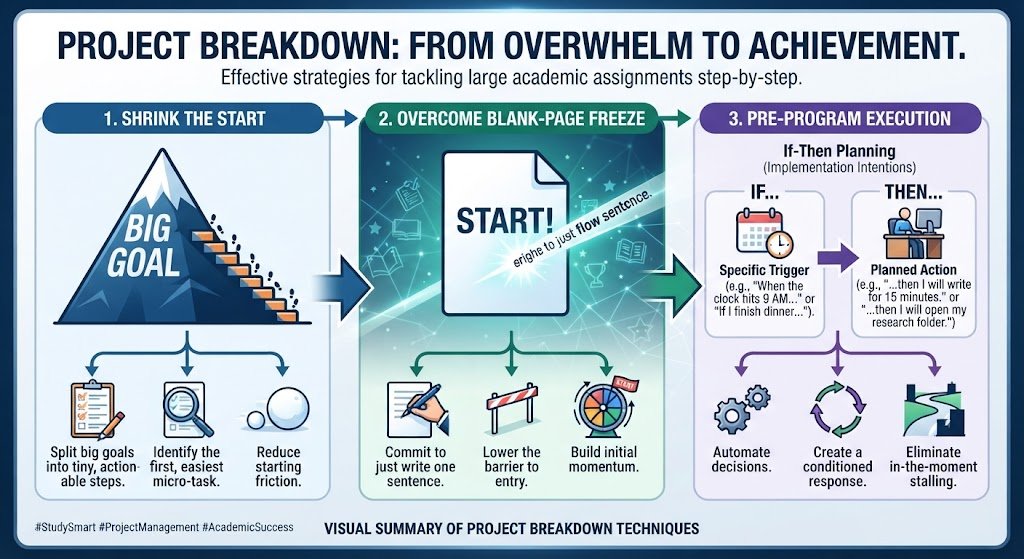
Big projects often trigger procrastination because the human brain perceives monumental goals as ambiguous threats. Breaking tasks down into micro-tasks removes intimidation, lowers cognitive load, and transforms an overwhelming workload into an achievable checklist.
Shrink the Start — Splitting Big Projects Into Tiny Steps
When a project looks too massive to handle, your brain freezes and seeks distractions to escape the stress. Shrinking the start means cutting a daunting assignment into granular, hyper-specific pieces that require zero heavy thinking to begin.
Deconstruct the Scope: Instead of writing “Complete research report,” break it down into micro-steps like “Open document,” “Find three source links,” and “Write section heading.”
Remove Ambiguity: Vague tasks cause hesitation; highly specific actions tell your brain exactly what physical movement to execute next.
Accumulate Micro-Wins: Crossing off tiny, manageable steps triggers quick dopamine releases that build sustained execution momentum.
The “Just Write One Sentence” Technique
Perfectionism makes starting a creative or analytical project terrifying because we expect the first output to be brilliant. Lowering the bar to a ridiculously low threshold completely neutralizes the fear of a blank page.
Micro-Thresholds: Give yourself permission to write just one terrible sentence, fix a single line of code, or format one slide.
Breaking the Paralysis: Once the absolute lowest barrier is cleared, the psychological weight of starting vanishes entirely.
Expanding Output: The hardest part is behind you, making it effortless to naturally write a second, third, and fourth sentence.
Using If-Then Planning (Implementation Intentions)
Relying on willpower to start tasks is unreliable because it depends entirely on your fleeting mood. Implementation intentions, or if-then planning, pre-program your brain’s response to specific triggers so execution becomes automatic.
Pre-Deciding Triggers: Tie a specific action directly to a predictable cue, such as time of day or location, to eliminate real-time decision fatigue.
The Formula: Use the structure “If [Situation/Time], then I will [Specific Action].”
Example Execution: “If it is 9:00 AM after my coffee, then I will open my presentation draft and type for ten minutes.”
Manage Your Environment to Remove Temptation
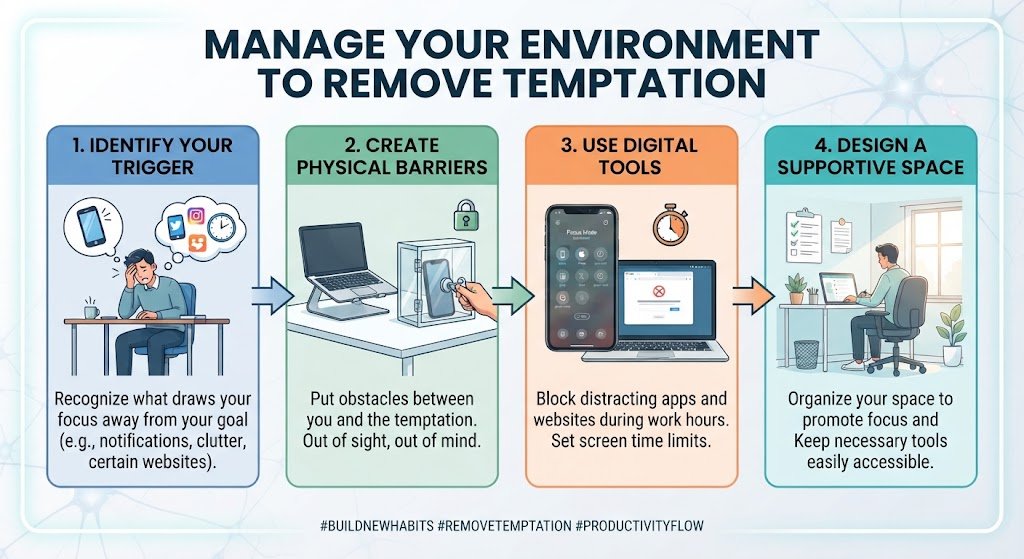
Relying on discipline alone to resist distractions is a losing battle because digital algorithms and immediate comforts are engineered to override willpower. Successful productivity relies on environmental design, which involves reshaping your physical and digital surroundings to make bad habits difficult and good habits effortless.
Remove Physical Distractions (Phone, Notifications, App Blockers)
Your phone and nearby notifications act as constant cognitive interruptions that fracture your focus and drain mental bandwidth. Eliminating these physical temptations removes the environmental cues that trigger mindless task-switching.
Out of Sight, Out of Mind: Place your smartphone in another room or inside a drawer while working to eliminate the visual cue to check social media.
Aggressive Notification Control: Turn off all non-essential push notifications and enable “Do Not Disturb” modes during deep work blocks.
Automated Barriers: Use robust app blockers or website restriction tools to lock yourself out of distracting platforms during core working hours.
Design a Distraction-Free Workspace
Your brain associates physical spaces with specific behaviors, meaning a cluttered or recreational desk will naturally invite procrastination. Crafting a dedicated workspace signals to your brain that it is time to focus.
Clear the Physical Desk: Keep only the tools required for your current task—such as a laptop, notebook, and pen—within arm’s reach.
Establish Spatial Anchors: Dedicate a specific desk or chair exclusively to work so your brain automatically enters a focused state when you sit there.
Eliminate Sensory Clutter: Clear away stray items, dirty dishes, or household clutter that can tempt you into procrastination through random chores.
Digital Triggers — Hiding Icons and Tabs
Digital clutter can be just as paralyzing as a messy physical desk, tempting you to open browser tabs or games when a task gets difficult. Practicing digital minimalism keeps your workspace clean and intentional.
Clean Browser Management: Keep your browser minimized to only the essential tabs needed for the current project, closing everything else out.
Hide Desktop Clutter: Clear distracting application icons off your computer’s main desktop screen to reduce visual temptation upon startup.
Separate User Profiles: Create distinct user profiles on your computer for work and personal use to completely isolate distracting apps and bookmarks.
Change Your Mindset — The Self-Compassion Approach
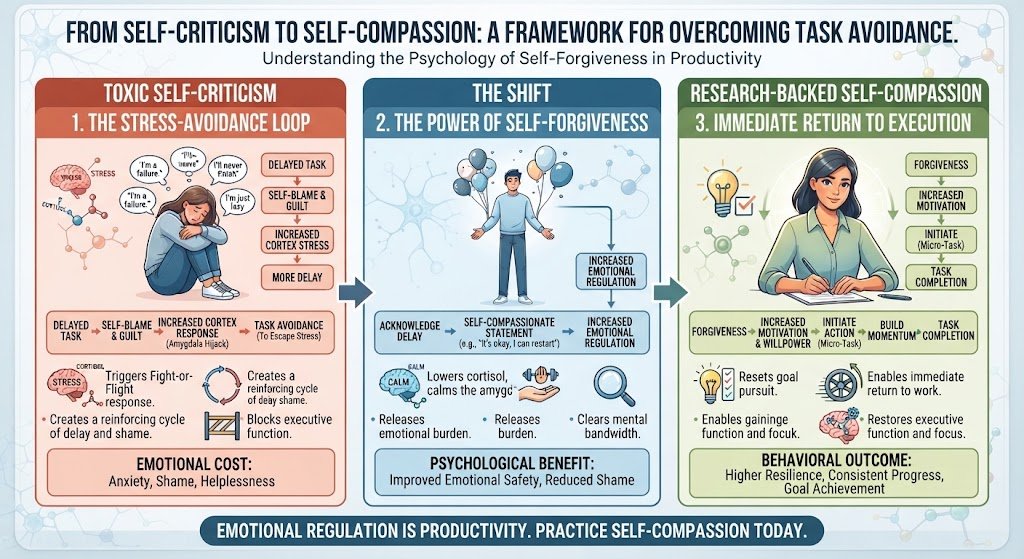
Traditional productivity methods often rely on harsh self-discipline, treating procrastination as a personal failure that must be punished away. In reality, shifting from toxic self-criticism to active self-compassion is a powerful psychological reset that breaks the avoidance loop and restores emotional regulation.
Why Self-Criticism Makes Procrastination Worse
Beating yourself up for delaying a task creates an intense cycle of guilt and anxiety that only makes future procrastination more likely. When you internalize delay as a character flaw, your brain experiences elevated stress, triggering more emotional avoidance.
The Stress-Avoidance Loop: Harsh self-blame increases emotional distress, causing your brain to seek immediate comfort through further distraction.
Heightened Resistance: Viewing a task as a punishment associated with past failure makes you dread opening it even more.
Forgive Yourself for Past Delays (Research-Backed Reasoning)
Psychological research confirms that students and professionals who forgive themselves for past procrastination exhibit significantly lower delays on subsequent tasks. Self-forgiveness removes the heavy emotional baggage that paralyzes future execution.
Lowering Stress Hormones: Letting go of guilt reduces cortisol levels, clearing the mental bandwidth needed to focus on current execution.
Decoupling Past from Present: Forgiveness helps you treat past delays as objective data about broken systems rather than permanent evidence of personal inadequacy.
A First-Hand Example: What Happens When You Stop Guilt-Tripping Yourself
When managing complex content projects or studying heavy academic syllabi, falling behind often triggers a downward spiral of overthinking and shame. Breaking this pattern by dropping the guilt allows you to instantly pivot back to execution without emotional friction.
Dropping the Narrative: Shifting away from phrases like “I am so lazy for missing yesterday” neutralizes the emotional charge holding you back.
Instant Recovery: Treating a missed deadline as a minor logistical hiccup rather than a moral catastrophe lets you resume work within minutes instead of wasting days feeling miserable.
Watch the referenced video How to Beat Procrastination Like It Owes You Money.
Is It Procrastination or Could It Be ADHD?
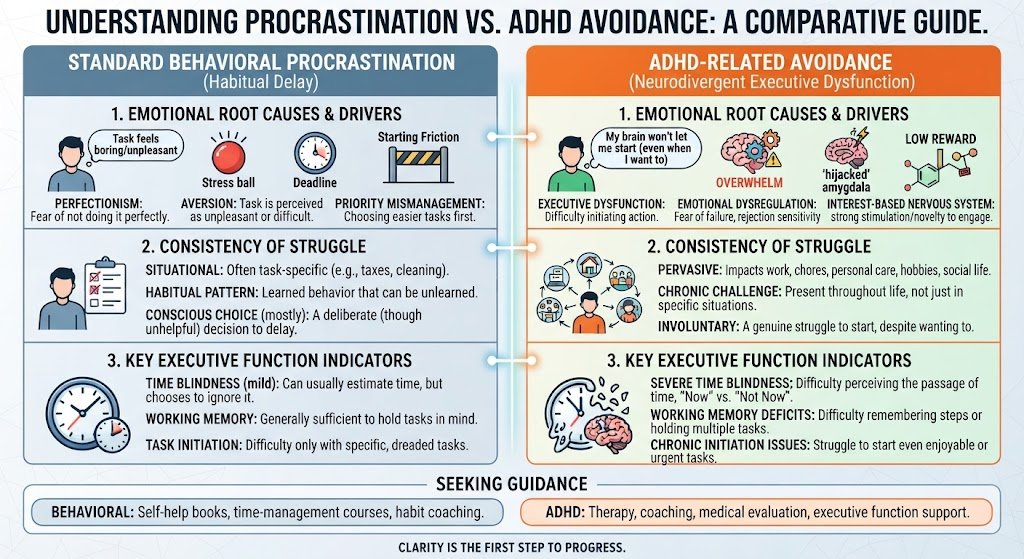
While everyone delays tasks from time to time, chronic avoidance that severely disrupts daily life can sometimes stem from underlying neurodivergence rather than simple habit. Understanding the distinction between behavioral procrastination and executive dysfunction is essential for finding the right coping strategies.
Key Differences Between Normal Procrastination and ADHD-Related Avoidance
Standard procrastination is typically an emotional regulation issue where a person avoids an unpleasant task to seek temporary comfort. In contrast, ADHD-related avoidance is rooted in neurological executive dysfunction, involving core challenges with attention regulation, working memory, and task initiation.
Emotional vs. Neurological Roots: Standard procrastination happens because a task feels stressful or boring; ADHD procrastination occurs because the brain struggles to activate and sustain interest without intense urgency or novelty.
Consistency of Struggle: Behavioral procrastination is usually task-specific or situational, whereas ADHD-related paralysis affects all areas of life—even hobbies and activities the person genuinely enjoys.
Task Blindness: Individuals with ADHD often experience time blindness and difficulty breaking down sequential steps, making the starting line feel invisibly blocked rather than merely avoided.
When to Consider Talking to a Professional
If you have tried standard productivity frameworks, environmental design, and time-management techniques without seeing meaningful improvement, it may be time to seek a formal evaluation. Chronic executive dysfunction can be deeply frustrating, but professional guidance offers clarity and tailored support.
Pervasive Impairment: Consult a qualified healthcare professional if chronic delays consistently jeopardize your academic performance, career stability, or personal relationships.
Co-Occurring Symptoms: Look out for patterns such as chronic disorganization, emotional dysregulation, chronic restlessness, and severe working memory issues alongside task avoidance.
Targeted Interventions: A professional diagnosis can unlock specialized behavioral therapies, coaching, or medical management designed specifically to address executive functioning challenges.
How to Stop Procrastinating Without Relying on Willpower or Discipline
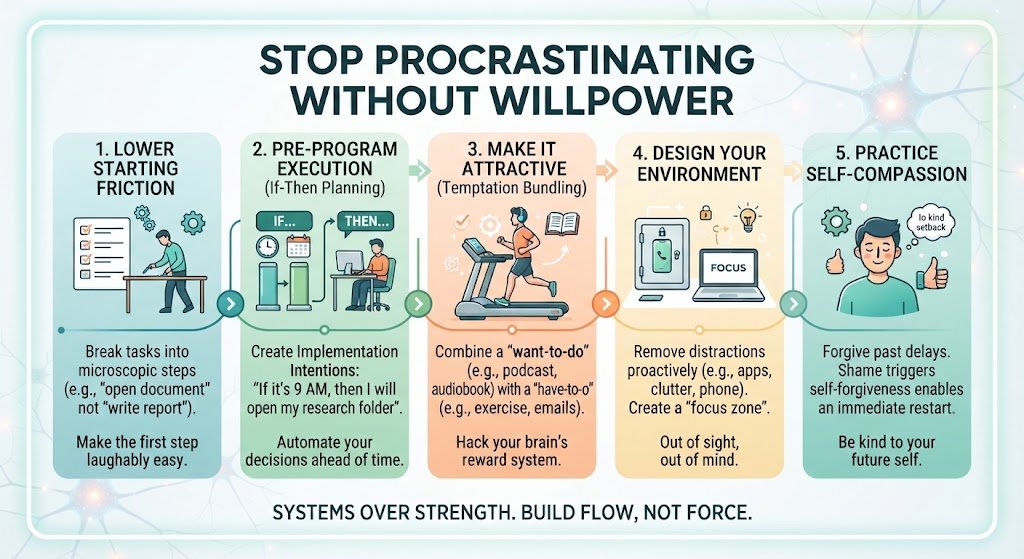
Traditional productivity guides often preach intense discipline, treating goal attainment as a battle of pure grit. However, relying on willpower depletion is a flawed strategy because mental energy naturally drains throughout the day. Sustainable productivity relies on building automated systems that bypass the need for constant conscious struggle.
Why Willpower-Based Advice Usually Fails
Telling yourself to “just be stronger” or more disciplined ignores the biological limits of the human brain. Willpower acts like a finite battery that gets depleted by stress, decision-making, and emotional regulation.
The Fatigue Trap: Constant resistance against temptations exhausts your cognitive reserves by midday, making evening tasks nearly impossible to start.
Flawed Premise: Assuming failure is due to weak character ignores the root emotional and environmental causes driving the procrastination cycle.
Systems Over Motivation — Automate the Decision
Instead of waking up and deciding whether you “feel” like working, design structural systems that make execution the path of least resistance.
Removing Choice: Automating your daily routine eliminates the internal debate over when or how to start a project.
Environmental Guardrails: Set up your workflow so that starting requires zero active negotiation with your moods or motivation levels.
The “Two-Minute Trigger” Habit Stack
Habit stacking couples an automatic daily routine with a tiny execution trigger, letting you slide into productive work effortlessly.
Anchor Habits: Attach a new or avoided task directly to an established daily ritual, such as opening your laptop immediately after pouring your morning coffee [10:38].
Frictionless Entry: Combine anchored cues with a micro-commitment rule to trigger automatic behavior without needing a burst of motivation [10:44].
Watch the referenced video The ONLY Way to Stop Procrastinating For Good.
Effective Strategies to Overcome Procrastination for Students
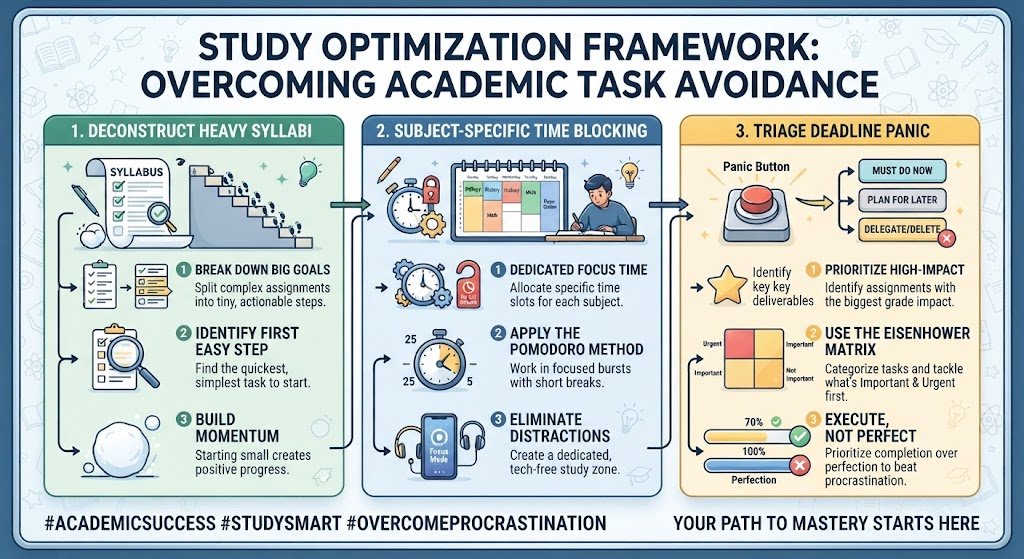
Balancing heavy syllabi, upcoming board examinations, and major assignments often triggers intense academic anxiety and task avoidance. Student procrastination is rarely about laziness; rather, it stems from the immense emotional pressure of trying to tackle massive academic workloads without clear, manageable execution systems.
Beating Assignment and Exam Procrastination
Approaching large study targets or major essays requires dismantling the daunting mountain of coursework into non-threatening daily milestones. Shifting your focus from the final grade to the immediate micro-step neutralizes the threat response in your brain.
Deconstruct the Syllabus: Break big exam preparation blocks into specific textbook chapters, past paper reviews, or targeted concept revisions rather than writing vague goals like “study computer science.”
Micro-Scheduling: Dedicate specific blocks of time to single, isolated deliverables, preventing your mind from getting overwhelmed by everything you have not covered yet.
Study-Specific Time Blocking Techniques
Time blocking replaces chaotic studying with structured momentum by assigning dedicated calendar windows to specific academic subjects or revision tasks. Working with defined boundaries helps preserve your mental energy.
Subject Isolation: Dedicate uninterrupted blocks exclusively to challenging subjects while your cognitive energy is highest, leaving lighter administrative tasks for later.
Built-In Resets: Combine structured focus intervals with short physical breaks to prevent mental burnout during long study sessions.
Dealing With Deadline Panic the Right Way
When a looming exam or essay deadline creates intense panic, freezing or abandoning the task altogether only deepens the cycle of stress. Converting panic into structured action helps you salvage your performance under pressure.
Triage the Requirements: Identify the highest-impact components of the assignment or syllabus that will yield the maximum points in the shortest available time.
Drop the Perfectionism: Give yourself permission to complete a rough, imperfect draft or rapid revision pass instead of waiting for ideal study conditions.
Quick Self-Check — What's Actually Causing Your Procrastination?
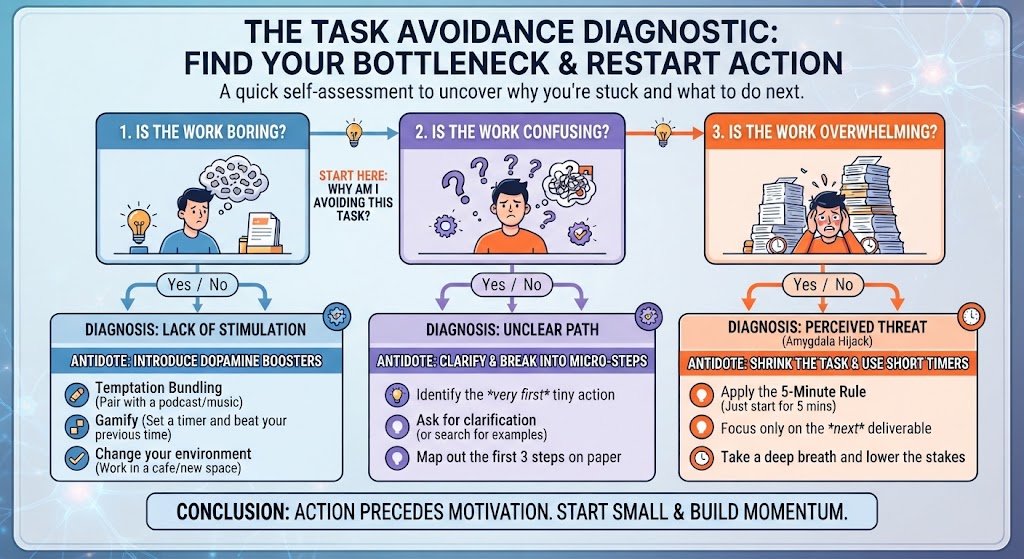
Pinpointing the exact emotional or cognitive bottleneck behind your hesitation is essential because applying the wrong tactic will only lead to continued frustration. Identifying whether a task feels tedious, unclear, or terrifying lets you apply the precise antidote needed to restart momentum.
Self-Diagnostic Checklist — Boring, Confusing, or Overwhelming?
Before forcing yourself to sit down and work, take sixty seconds to audit your internal resistance and categorize the exact nature of the block. Diagnosing the root cause replaces vague guilt with clear actionable data about your current workflow state.
Is it Boring? If the work lacks stimulation or excitement, your brain starves for dopamine, leading you to seek quick distractions.
Is it Confusing? If you do not know the very next physical step or feel unqualified, ambiguity triggers an immediate threat response and emotional avoidance.
Is it Overwhelming? If the scope feels impossibly large, the sheer weight of the project freezes your executive functioning and invites panic.
Matching the Right Strategy to the Right Cause
Once you correctly diagnose why you are stalling on a specific assignment or project, you can match it with the targeted system designed to dissolve that exact barrier.
For Boredom: Pair the tedious task with an engaging environment, use habit stacking, or introduce micro-rewards to artificially boost your dopamine feedback loop.
For Confusion: Break the project down into ultra-granular micro-steps, write a single terrible opening sentence, or use if-then planning to remove all guesswork.
For Overwhelming Tasks: Apply the 2-minute rule or set a 5-minute timer to lower the barrier to entry, proving to your brain that the mountain is climbable.
Frequently Asked Questions
What are 7 ways to overcome procrastination?
Seven effective strategies to beat procrastination include using the 2-minute rule to lower starting friction, applying the 5-4-3-2-1 countdown method to interrupt hesitation, breaking large projects into micro-tasks, removing physical distractions like your phone, practicing self-forgiveness to break the guilt loop, setting up if-then implementation intentions, and working during your peak energy hours.
What is the 321 rule for procrastination?
The 3-2-1 rule is a structured planning technique designed to eliminate overwhelming choices. It involves picking three top priorities, narrowing them down to two critical execution blocks, and committing to one single essential outcome for the day, which helps preserve your mental energy for execution rather than decision-making.
What are 10 ways to stop procrastinating?
Ten ways to stop procrastinating include lowering the barrier with a 5-minute timer, utilizing implementation intentions, redesigning your physical and digital workspaces, clearing notifications, scheduling tasks according to your natural biological energy peaks, practicing self-compassion instead of toxic self-criticism, breaking tasks into granular micro-steps, finding an accountability partner, rewarding small progress, and focusing on action rather than waiting for motivation.
What is the 5-4-3-2-1 rule for procrastination?
The 5-4-3-2-1 countdown method, popularized by Mel Robbins, acts as a cognitive circuit breaker. By mentally counting down from five to one and immediately taking physical action on one, you engage your prefrontal cortex, override the emotional avoidance center in your brain, and stop hesitation loops before self-doubt creeps in.
What is the 70 rule procrastination?
The 70% rule states that you should execute when your readiness or information is at 70% rather than waiting for impossible ideal conditions. Perfectionism is often a mask for procrastination; giving yourself permission to ship an imperfect draft or project allows you to gather real-world feedback and make faster progress.
How do I train my brain to stop procrastinating?
You train your brain by shifting away from willpower and building automated systems that make execution effortless. Use habit stacking to anchor new actions to existing daily routines, celebrate small wins to create positive dopamine feedback loops, and treat missed deadlines as objective feedback on broken systems instead of personal flaws.
What did Carl Jung say about procrastination?
Carl Jung famously noted that what you resist persists, suggesting that hidden psychological fears, suppressed emotions, and internal conflicts often drive avoidance behaviors. Confronting the root emotional discomfort rather than fighting the task itself is essential for lasting behavioral change.