Overcoming the Stress Cycle Caused by a Time Crunch and Procrastination
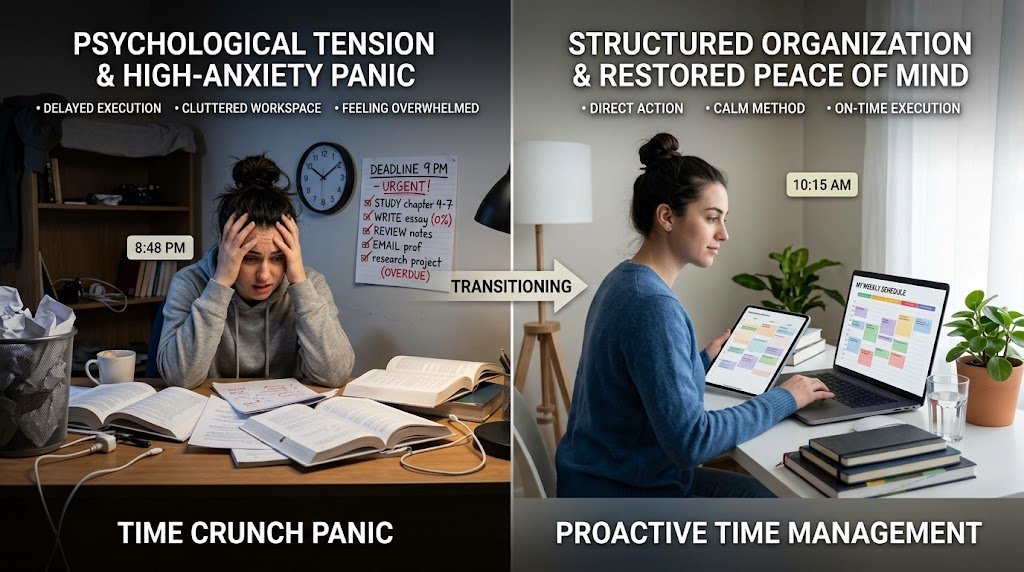
Experiencing a sudden time crunch and falling into the trap of rushed work often triggers a continuous loop of high anxiety and missed deadlines. This destructive pattern typically stems from procrastination, which forces individuals to compress massive workloads into unrealistic timeframes. Breaking this cycle requires recognizing early stress triggers, structuring daily schedules effectively, and mastering intentional time management techniques to restore productivity and peace of mind.
What Is Procrastination?

Procrastination is an active avoidance behavior where an individual unnecessarily delays a planned task despite knowing that negative consequences will follow. At its core, procrastination is not a failure of time management, but rather an emotional regulation problem rooted in a breakdown of self-regulation. When faced with tasks that induce anxiety, boredom, or self-doubt, the brain prioritizes immediate mood repair over long-term productivity.
Procrastination vs. Laziness — Why They’re Not the Same
Laziness is characterized by apathy, inactivity, and an absolute unwillingness to act, whereas procrastination involves a voluntary delay while still intending to complete the work. Understanding this distinction helps clarify why reactive task delay often causes severe psychological distress:
Active Choice vs. Inactivity: Procrastinators care deeply about the outcome and want to succeed, but they are mentally blocked by emotional friction. Laziness, by contrast, represents a low-energy state devoid of ambition or desire to engage.
Emotional Friction: Procrastination is driven by negative emotional triggers tied to a specific task, such as fear of failure or perfectionism. Laziness is a generalized reluctance to exert physical or mental effort across the board.
Guilt and Stress: Procrastination invariably triggers heavy guilt, anxiety, and a punishing stress cycle due to looming deadlines. Laziness rarely produces the same acute psychological torment because the individual is indifferent to the lack of output.
How Procrastination Affects Your Time Management
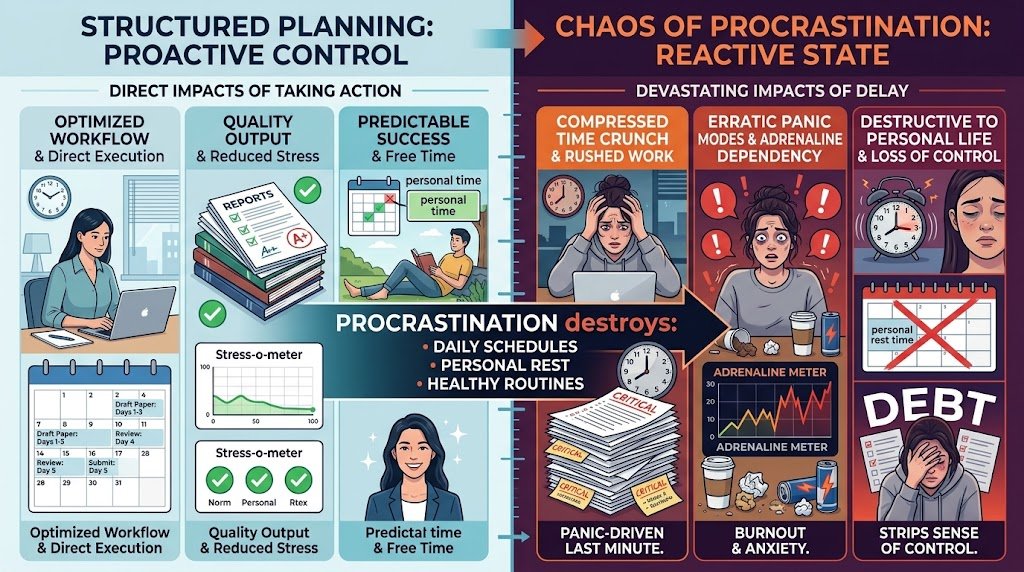
Procrastination directly fractures your schedule, turning structured planning into a constant state of firefighting. When you delay critical tasks, you create artificial resource deficits that trigger compounding disruptions across your entire day.
Creates a Time Crunch (Rushed Work, Lower Quality)
Delaying execution compresses the available window to complete an assignment, forcing you into a severe time crunch. This compressed timeline leaves no room for research, revision, or deep thinking, resulting in rushed work and significantly lower quality output.
Compressed Execution: Vital tasks are squeezed into tight windows, making careful execution impossible.
Compromised Standards: The final output often misses key criteria because speed replaces thoroughness.
Error Vulnerability: Rushed work drastically increases oversight mistakes, requiring future corrections that consume even more time.
Triggers a Stress-and-Panic Cycle
As deadlines draw dangerously close, the psychological cost of delay spikes rapidly. This shift replaces initial avoidance with intense panic, trapping you in a toxic stress cycle fueled by cortisol and adrenaline.
Spike in Cortisol: Imminent deadlines cause immediate physiological stress reactions and mental fatigue.
Paralyzing Panic: Severe anxiety often freezes decision-making, making it even harder to initiate work.
Persistent Guilt: The emotional hangover of panic leaves you drained, impairing focus on subsequent tasks.
Destroys Schedules and Eats Into Rest/Personal Time
Procrastination shatters carefully organized schedules by pushing tasks into hours originally designated for rest, sleep, or personal commitments. This boundary bleed eliminates vital recovery periods.
Schedule Collateral Damage: Overdue tasks spill over, delaying every subsequent item on your daily planner.
Sacrificed Sleep: Working late into the night to meet deadlines destroys healthy circadian rhythms.
Burnout Acceleration: Eliminating personal downtime removes the psychological recovery needed to sustain long-term productivity.
Builds Bad Habits (Adrenaline/Crisis-Mode Dependency)
Repeatedly waiting until the final hour trains your brain to associate execution exclusively with high-stakes panic. Over time, this creates an unhealthy adrenaline dependency where you feel incapable of starting tasks without a crisis.
False Motivation: You begin believing that panic is your only effective catalyst for action.
Dopamine Conditioning: The relief of finishing at the last minute reinforces the dangerous cycle of delay.
Diminished Baseline Focus: Normal, steady-state productivity feels impossible without the pressure of an immediate emergency.
Reduces Your Sense of Control Over Your Day
Chronic task delay strips away your autonomy, replacing proactive time management with reactive chaos. When you no longer dictate your schedule, external deadlines and mounting pressures dictate your every move.
Reactive Exhaustion: You spend your days putting out fires rather than executing strategic goals.
Helplessness Mindset: A chronic loss of control breeds a sense of learned helplessness and lowered self-efficacy.
Workflow Fragmentation: Constant schedule interruptions shatter deep focus, preventing meaningful progress on long-term projects.
The Psychology Behind Procrastination — Why Your Brain Delays Tasks
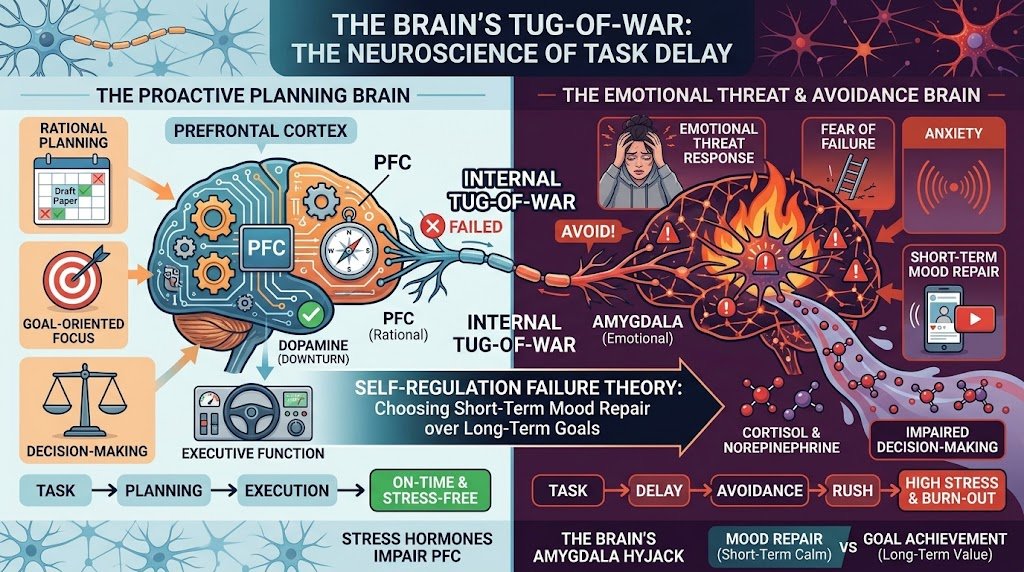
Procrastination is not a failure of character or time management; it is a complex neurological tug-of-war within the brain. When you look at an intimidating task, emotional centers in the brain often override logical planning, resulting in avoidance behavior. Understanding this psychological friction helps reframe delay not as laziness, but as a biological impulse for immediate mood repair.
The Role of the Amygdala and Fear Response
When confronted with high-stakes or ambiguous tasks, the amygdala—the brain’s emotional threat detector—perceives the assignment as a source of psychological pain. It triggers a primitive fight-or-flight response, causing you to pull away from the task as if it were a physical danger.
Threat Perception: The brain registers the frustration or potential failure of a task as an immediate threat to self-esteem.
Avoidance Impulse: The amygdala bypasses rational thought, compelling you to seek immediate comfort in low-effort distractions.
Overriding Logic: This emotional hijack explains why you intellectually know you must work, yet physically find yourself unable to open the document.
How Cortisol (Stress Hormone) Affects Decision-Making
As avoidance prolongs the timeline, stress accumulates and triggers the release of cortisol, which directly impairs executive function. High levels of cortisol disrupt the prefrontal cortex—the area responsible for planning, impulse control, and logical decision-making—making it even harder to break the cycle(https://www.ncbi.nlm.nih.gov/pmc/).
Cognitive Impairment: Excess cortisol clouds clear thinking and reduces working memory capacity.
Short-Term Bias: Under chemical stress, the brain prioritizes immediate relief over long-term consequences.
Exhaustion Loop: Chronic cortisol elevation leads to mental fatigue, accelerating burnout and further delays.
The Self-Regulation Failure Theory
Psychological research defines procrastination as a breakdown in self-regulation, where short-term mood repair triumphs over long-term goal pursuit. Your present self values immediate comfort more than the future self values success, creating a perpetual disconnect in intention and action.
Present Bias: The brain discounts future rewards and magnifies present discomfort, making task initiation feel disproportionately painful.
Emotional Regulation Deficit: Procrastination acts as a short-term coping mechanism to escape negative emotions associated with the task.
Willpower Depletion: Relying purely on raw willpower fails because self-regulation is a finite resource that depletes quickly under stress.
Types of Procrastination — Which One Are You?
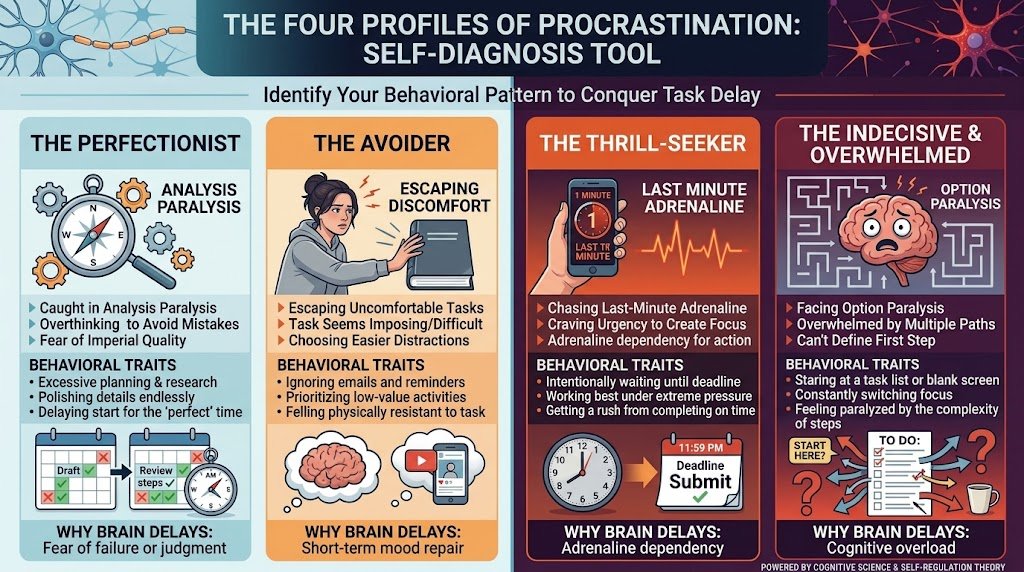
Procrastination manifests in distinct behavioral patterns, and identifying your specific type is the first step toward effective correction. Different psychological triggers—from fear of imperfection to decision paralysis—drive each category of task delay. Recognizing your primary tendency allows you to apply targeted strategies rather than relying on generic fixes.
The Perfectionist Procrastinator
Perfectionist procrastinators delay action because their internal standards are impossibly high, fearing that any flaw in the final output equates to personal failure. They spend excessive time planning or tweaking minor details while avoiding the actual execution phase.
Unrealistic Benchmarks: Demanding flawlessness creates crippling mental barriers that prevent starting.
Paralysis by Analysis: Endless preparation replaces real progress out of fear that the work won’t be good enough.
All-or-Nothing Mindset: Believing that a project must be stellar or it is completely worthless.
The Avoider
Avoiders delay tasks to escape negative feelings associated with specific assignments, such as boredom, confusion, or fear of evaluation. They prefer to protect their self-esteem by simply ignoring the task rather than risking a subpar performance.
Discomfort Intolerance: Low resilience against tedious, difficult, or unpleasant assignments.
Out-of-Sight Strategy: Pretending the deadline or project does not exist until forced to confront it.
Conflict Aversion: Avoiding tasks that require difficult conversations, feedback, or public exposure.
The Thrill-Seeker (Adrenaline-Driven)
Thrill-seekers deliberately wait until the absolute last minute to create an artificial crisis, relying on the rush of adrenaline to power through the work. They are hooked on the high-stakes excitement of beating the clock.
Crisis Dependency: Believing they only perform their best work under extreme pressure.
Boredom Avoidance: Seeking the stimulation of an impending emergency to maintain focus.
Risky Habituation: Repeatedly cutting deadlines so close that a minor mishap leads to complete failure.
The Indecisive/Overwhelmed Procrastinator
Indecisive procrastinators freeze because they face too many competing choices, unclear directions, or a massive mountain of work. This cognitive overload leads to total task paralysis as they struggle to figure out where to begin.
Prioritization Failure: Inability to rank tasks effectively, leading to circular planning.
Option Paralysis: Analyzing every possible path without committing to a single direction.
Scope Panic: Feeling crushed by the sheer volume of work required, resulting in complete inactivity.
Procrastination and Mental Health — The Hidden Connection
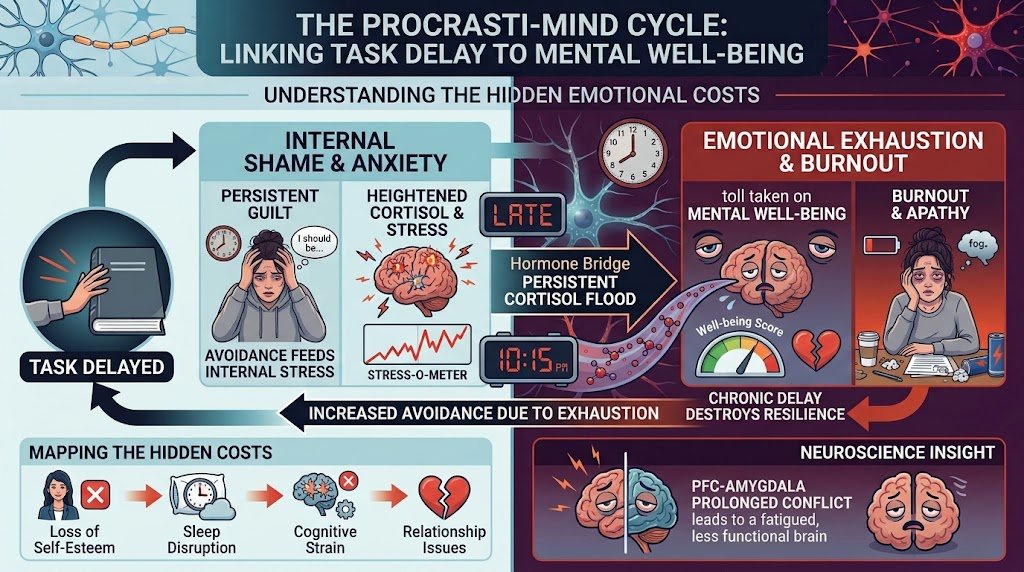
Chronic procrastination extends far beyond poor time management, acting as a heavy psychological burden that directly erodes emotional well-being. What starts as a temporary delay frequently spirals into long-term mental distress, creating a feedback loop where emotional pain fuels further avoidance.
The Guilt-Shame Loop
Delaying essential work inevitably triggers a toxic cycle of guilt and shame that makes future task initiation even harder. Instead of enjoying your downtime, you experience persistent psychological distress while neglecting your responsibilities.
Nagging Guilt: The constant awareness of unfinished work casts a shadow over your rest and personal time.
Internalized Shame: Missing marks or delaying projects often leads to harsh self-criticism, convincing you that you are inherently lazy or incompetent.
Avoidance Escalation: The worse you feel about delaying a task, the more you avoid returning to it, deepening the shame.
When Procrastination Becomes Chronic Stress or Burnout
When procrastination becomes a constant lifestyle rather than an occasional habit, it traps the nervous system in a state of chronic stress. This prolonged activation depletes your mental reserves and accelerates physical and emotional burnout.
Constant Cortisol Drain: Living from one manufactured emergency to another keeps stress hormones elevated, causing chronic fatigue.
Imposter Syndrome Fuel: Repeatedly scrambling to finish work at the last minute fosters a deep-seated fear that you are a fraud who cannot handle success sustainably.
Eroded Self-Efficacy: Every cycle of missed expectations chips away at your confidence, leaving you feeling helpless against future workloads.
Proven Techniques to Fix Procrastination and Take Back Control of Your Time
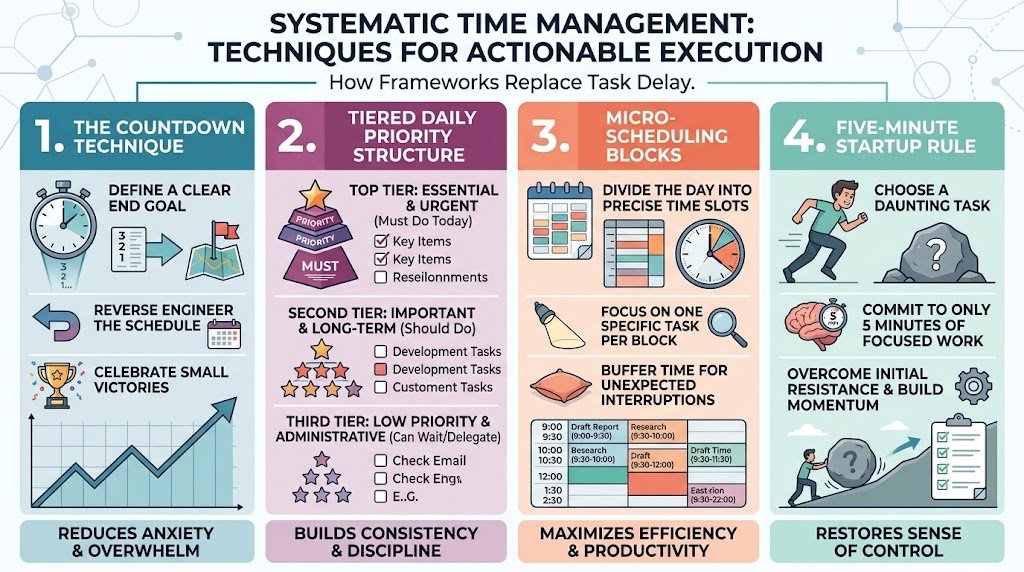
Overcoming procrastination requires structured frameworks that bypass emotional friction and lower the barrier to execution. Implementing proven time-management rules transforms overwhelming workloads into manageable steps, restoring your autonomy and daily productivity.
The 5-4-3-2-1 Rule for Procrastination
The 5-4-3-2-1 rule is a metacognitive countdown technique designed to interrupt hesitation before the brain’s emotional defense mechanisms trigger avoidance behavior. Counting backward from five and physicalizing an immediate action short-circuits the amygdala’s threat response.
Pattern Interruption: Silently counting down from five forces your focus away from anxious thoughts and onto immediate action.
Immediate Activation: Committing to move the moment you hit one prevents overthinking and rationalizing delays.
Momentum Catalyst: Physical movement, such as opening a laptop or picking up a pen, creates the momentum needed to sustain work.
The 3-3-3 Rule for Time Management
The 3-3-3 rule is a strategic scheduling framework that organizes your daily workload into manageable buckets to eliminate overwhelm and decision fatigue. Focusing on a tiered structure prevents you from scattering your energy across too many shifting priorities.
Major Goal Focus: Dedicate 3 hours to your primary, high-impact project or core professional task.
Urgent Task Management: Handle 3 shorter, secondary tasks that require immediate attention but lower cognitive load.
Maintenance Execution: Complete 3 routine administrative or organizational chores to keep your workflow clean.
The 7-8-9 Rule for Time Management
The 7-8-9 rule is a lifestyle-based productivity concept centered on balancing peak human performance with proper biological rest. Structuring your day around natural energy rhythms prevents chronic exhaustion and burnout.
Dedicated Rest: Allocate 7 to 8 hours for high-quality sleep to restore cognitive baseline and executive function.
Focused Work Windows: Target structured blocks of deep work without digital or environmental interruptions.
Recovery Integration: Build clear boundaries that separate labor from personal time to sustain long-term output.
Elon Musk’s 5-Minute Rule
Elon Musk’s time-chunking approach breaks demanding workdays into rigorous, hyper-focused 5-minute increments to eliminate idle time and procrastination pockets. This method treats micro-delays as major drains on overall efficiency.
Micro-Scheduling: Dividing hours into tight, accountable segments ensures every minute has an assigned objective.
Distraction Elimination: Concentrating entirely on a single micro-task prevents context-switching penalties.
Pace Acceleration: High-density time blocks train your brain to execute tasks with greater speed and urgency.
7 Steps to Cure Procrastination
A systematic, multi-step action plan provides a reliable roadmap for dismantling chronic avoidance habits and building lasting execution discipline. Following a sequential process ensures you address both the psychological and practical layers of delay.
Identify Triggers: Pinpoint exact emotional states or task types that cause you to pull away.
Break Down Tasks: Scale massive projects into micro-steps that take less than 10 minutes to finish.
Remove Friction: Clear your physical workspace and close unrelated browser tabs before starting.
Set Hard Boundaries: Establish strict timelines for task completion to prevent open-ended stalling.
Practice Self-Compassion: Forgive past delays to break the toxic guilt-shame feedback loop.
Track Progress: Use visual checklists to reward completed milestones and reinforce positive momentum.
Build Accountability: Share your daily goals with a peer or mentor to ensure external commitment.
The 5-Minute Procrastination Trick
The 5-minute trick requires you to commit to working on an intimidating task for just five minutes, granting yourself permission to stop if you still feel overwhelmed. This leverages the psychological reality that starting is almost always harder than continuing.
Low-Risk Commitment: Agreeing to a brief five-minute window bypasses the brain’s fear of long, tedious effort.
Inertia Overcoming: Once you break initial stillness, the psychological resistance to working drops dramatically.
Natural Continuation: Most individuals find it easier to keep working once the project has already begun.
Real-World Scenarios — How Procrastination Plays Out Day to Day
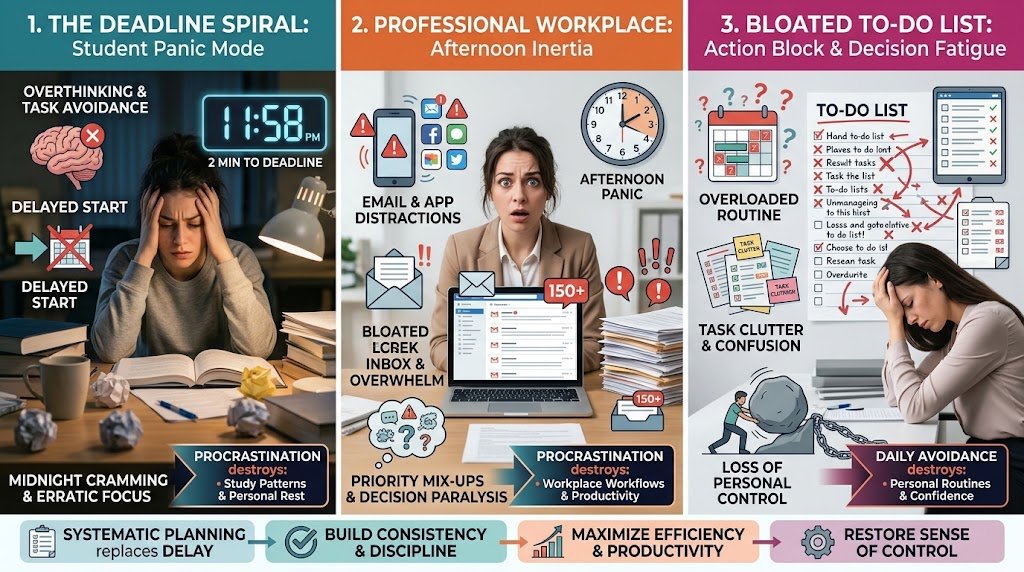
Procrastination rarely looks like doing nothing all day; instead, it usually manifests as a subtle shift toward low-priority tasks while avoiding the heavy mental lift of important responsibilities. Seeing how this behavior plays out in everyday environments helps clarify why standard time management advice often fails without addressing the root psychological friction.
The Student Deadline Spiral
Students frequently fall into a multi-week spiral where early optimism slowly dissolves into intense pre-exam panic.
The Illusion of Time: Weeks before an exam, students assume they have endless time to review, causing them to push back study blocks repeatedly.
Productive Procrastination: Instead of opening textbooks, they spend hours organizing color-coded notes or cleaning their study desks, creating a false sense of progress.
The Midnight Crunch: The night before the deadline arrives, forcing an exhausting all-nighter that destroys sleep schedules and guarantees high anxiety during the actual exam.
The Workplace “Last-Minute Scramble”
In professional settings, procrastination often hides behind busywork, corporate email checking, and endless meetings until an urgent deliverable forces a sudden emergency.
Inbox Cycling: Professionals spend the first half of the workday clearing minor emails to avoid starting a daunting strategic report.
The Afternoon Panic: As the end of the workday approaches, the realization that the primary project remains untouched triggers a massive surge of stress.
Compromised Output: The final report is rushed out the door just before the deadline, often containing easily avoidable errors that invite harsh feedback.
The Never-Ending To-Do List
Chronic task delay often results in a bloated, unmanageable to-do list that rolls over from day to day, multiplying stress and inducing paralysis.
Task Accumulation: Unfinished assignments migrate to the next day’s planner, compounding the volume of work until the list feels insurmountable.
Decision Paralysis: Staring at twenty competing action items creates cognitive overload, making it impossible to select a starting point.
Guilt-Fueled Burnout: The constant presence of unfulfilled obligations drains personal downtime, leaving the individual physically and emotionally depleted.
Frequently Asked Questions
What is the best treatment for procrastination?
The most effective approach to treating procrastination is addressing the underlying emotional and psychological friction rather than relying on raw willpower. This involves breaking tasks down into microscopic 10-minute steps, using the 5-4-3-2-1 countdown rule to short-circuit avoidance, and practicing self-compassion to break the toxic guilt-shame cycle.
What role does time management play in combating procrastination?
Effective time management provides structured boundaries and predictable execution windows that minimize decision fatigue and cognitive overload. Frameworks like time-blocking and the 3-3-3 rule eliminate vague scheduling, making it significantly harder for procrastination to find a foothold in your day.
How can I manage my time well if I always procrastinate?
If you struggle with chronic task delay, start by scaling down your daily objectives into hyper-manageable components using micro-scheduling tactics like Elon Musk's 5-minute rule. Prioritize your single most important task first thing in the morning before emotional resistance and decision fatigue set in.
What affects your time management when you procrastinate?
Procrastination disrupts time management by creating artificial resource deficits, triggering compressed time crunches, and forcing a cycle of panic and adrenaline dependency. This erratic workflow shatters structured planning and spills unfinished tasks into personal rest hours.
How do we avoid procrastination and give our best?
Avoiding procrastination requires recognizing early stress triggers, clearing workspace distractions, and committing to brief, low-risk execution windows to build initial momentum. Shifting focus away from the intimidating final outcome and onto immediate, small actions allows you to consistently deliver your highest quality work.