The Real Reason Procrastination Wrecks Your Schedule
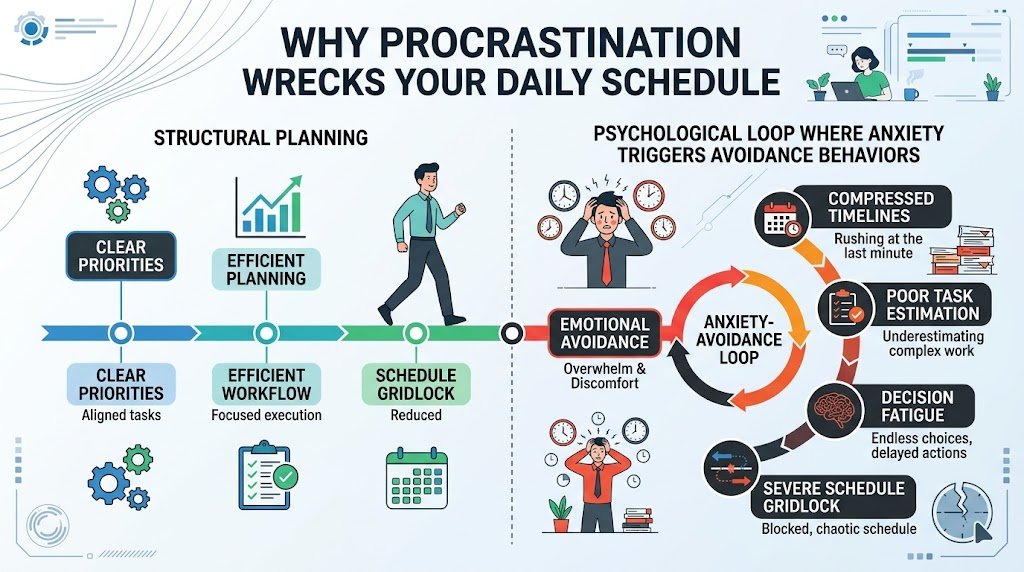
Procrastination is rarely a simple failure of time management or a sign of laziness; rather, it is fundamentally an emotional regulation problem. When faced with tasks that trigger anxiety, self-doubt, or boredom, your brain instinctively seeks immediate relief by avoiding the discomfort.
Understanding this psychological shift is critical for breaking the cycle and protecting your daily schedule.
Emotional Avoidance: Your brain treats stressful or ambiguous tasks as genuine threats, prompting an avoidance response to escape negative feelings.
The Comfort Trap: Choosing short-term mood repair over long-term productivity provides instant gratification at the expense of future stability.
Misdiagnosed Laziness: Traditional productivity hacks fail because they treat a structural emotional hurdle as a logistical scheduling flaw.
Recognizing avoidance as a coping mechanism transforms how you approach your daily tasks. Instead of doubling down on rigid planners that trigger more anxiety, effective scheduling requires building emotional resilience and addressing the underlying triggers that stall your momentum.
What specific emotional trigger do you notice most often when you find yourself putting off important tasks?
What Procrastination Actually Is (Not Laziness)
Procrastination is an emotional coping mechanism rather than a character flaw or a failure of time management. When individuals delay tasks, they are often attempting to escape the immediate psychological distress and negative emotional states triggered by a specific obligation. Research published via PMC Research Study highlights that chronic procrastination is deeply intertwined with emotion dysregulation rather than a simple lack of willpower or baseline laziness.
Why Procrastination Is Classified as an Emotional Response, Not a Character Flaw
Characterizing procrastination as laziness misdiagnoses the root mechanism, shifting the blame to work ethic instead of psychological distress tolerance. The brain treats daunting, confusing, or high-pressure tasks as direct emotional threats, prompting an instinctual urge to seek immediate mood repair.
Amygdala Hijacking: The brain’s emotional center reacts to stressful assignments with avoidance, prioritizing short-term relief over long-term goals.
The Coping Loop: Escaping the task yields instant gratification, reinforcing the neural pathway that links avoidance with emotional safety.
The Myth of Discipline: Shaming yourself for being “lazy” only increases anxiety, making the task feel even more aversive and intensifying the avoidance cycle.
The Difference Between Being Lazy and Avoiding Distress
Laziness implies a passive state of apathy where an individual simply does not want to expend energy on anything. Procrastination, conversely, is an active psychological paradox where a person desperately wants to finish a task, but is paralyzed by the emotional weight attached to it.
Action vs. Apathy: Lazy individuals feel content doing nothing; procrastinators experience intense guilt, anxiety, and distress while avoiding their work.
The Distress Tolerance Gap: Procrastination occurs when an individual’s capacity to tolerate negative emotions—such as frustration or inadequacy—is temporarily overwhelmed.
Productive Substitution: Procrastinators rarely sit in total stillness; instead, they pivot to low-stakes tasks to justify avoiding the emotional trigger of the primary objective.
How Procrastination Actually Affects Your Time Management
Procrastination systematically destroys effective time management by shifting your focus away from strategic planning and into chronic crisis mode. When emotional avoidance dictates your schedule, you stop managing hours and start managing emergencies. This emotional barrier directly translates into severe scheduling disruptions and long-term productivity loss.
Missed Deadlines and Last-Minute Rushed Work
The most immediate consequence of emotional avoidance is the compression of your working timeline into an impossibly short window. Instead of distributing effort evenly, you rely on adrenaline and panic to force execution right before the deadline.
Quality Degradation: Rushed execution forces shortcuts, leading to frequent errors and superficial results that do not reflect your true capabilities.
Constant Emergency Mode: Living from one crisis to another drains your mental reserves and leaves zero room for unexpected obstacles or revisions.
The Panic Catalyst: While last-minute adrenaline sometimes forces completion, it reinforces an unsustainable cycle that heavily damages long-term work quality.
Poor Time Estimation and Planning Fallacy
Procrastination distorts your perception of how long tasks actually take, feeding directly into the planning fallacy. Because your brain views the task as a threat, it drastically underestimates the time required to research, draft, and refine the work.
Optimistic Scheduling: You assume future tasks will take a fraction of the actual time because you are calculating based on fantasy rather than past data.
Complexity Blindness: Emotional detachment from the assignment prevents you from factoring in hidden friction points, revisions, and administrative steps.
The Schedule Collapse: When the initial unrealistic time block passes without completion, the entire schedule cascades into disarray.
Decision Fatigue and Task-Switching Costs
Constantly debating whether or not to start a task drains your cognitive resources long before any actual work begins. Every moment spent hesitating adds to your mental load.
Willpower Depletion: Using sheer willpower to force yourself past emotional resistance exhausts the exact mental energy needed for problem-solving.
Task-Switching Penalty: Jumping between low-stakes distractions and guilt-ridden thoughts about the avoided task creates costly mental friction and fragments focus.
Analysis Paralysis: The longer you delay, the more overwhelming the choices become, making it nearly impossible to prioritize effectively.
The Compounding Effect — How One Delay Snowballs Into a Backlog
A single avoided task rarely exists in isolation; it creates a domino effect that compromises your entire calendar. As deadlines overlap, minor delays mutate into a massive, unmanageable workload.
Schedule Gridlock: Pushing back one obligation forces it to collide with tomorrow’s commitments, shrinking your available time window for everything else.
The Avoidance Spiral: A growing backlog increases the emotional weight of your tasks, making the avoidance urge even stronger than before.
Total System Breakdown: Without a predictable schedule, your daily routine collapses into reactive firefighting, leaving no space for strategic growth or rest.
What specific part of your daily schedule usually breaks down first when you fall behind on a major task?
The Procrastination Habit Loop (Why It Repeats)

Procrastination persists because it operates on a powerful neurological habit loop that offers immediate emotional relief at the heavy expense of long-term progress. Understanding this cyclic pattern is the first step toward rewiring your response to difficult assignments, allowing you to intercept avoidance before it derails your schedule.
Trigger → Avoidance → Short-Term Relief → Guilt (The 4-Step Loop)
Every procrastination cycle follows a predictable behavioral sequence that reinforces itself over time. Recognizing each distinct phase gives you the power to interrupt the pattern before the avoidance behavior takes root.
The Trigger: A high-stakes, ambiguous, or tedious task sparks an uncomfortable emotional reaction like anxiety or self-doubt.
The Avoidance: You immediately turn to low-stakes distractions or comfort activities to escape the negative feelings.
The Short-Term Relief: Your brain experiences an instant drop in cortisol, reinforcing the avoidance behavior as a successful coping mechanism.
The Guilt Backlash: The temporary relief fades, replaced by intense regret, mounting pressure, and an even higher emotional barrier for the next attempt.
Why the Brain Treats Difficult Tasks as a Threat
Your brain’s evolutionary wiring heavily prioritizes immediate safety over abstract future rewards. When a task requires sustained cognitive effort or exposes you to potential failure, the emotional centers register it as a genuine threat.
The Amygdala’s Overreaction: The brain’s primitive threat detector reacts to challenging mental work the same way it reacts to physical danger, triggering a flight response.
Present Bias: Neurologically, your future self feels like a stranger; therefore, your brain chooses immediate comfort over sparing your future self from a crisis.
Fear of Inadequacy: Avoiding the task acts as a shield for your self-esteem, convincing you that failure stems from a lack of effort rather than a lack of capability.
Procrastination, Anxiety, and Mental Health
Chronic procrastination is rarely just a productivity hurdle; it is deeply intertwined with mental health, anxiety, and emotional well-being. When avoidance becomes your default response to distress, it creates a toxic environment of chronic stress that wears down your psychological resilience.
Can Anxiety Cause Procrastination?
Anxiety and procrastination share a deeply reciprocal relationship where each condition directly feeds and intensifies the other. Rather than driving productivity, heightened stress and fear of failure often paralyze your ability to take action.
The Perfectionism Paralysis: High anxiety sets impossibly rigid standards, making the fear of falling short so intense that starting the task feels terrifying.
Overwhelm and Freezing: When a project feels too large, your nervous system responds with cognitive overload, locking you in a state of inaction.
The Avoidance Feedback Loop: Using avoidance to escape anxiety only provides temporary comfort, leaving the underlying fear unresolved and stronger for the next encounter.
The Mental Health Toll of Chronic Delay (Stress, Shame, Burnout)
Living in a constant state of delayed execution extracts a heavy psychological price that extends far beyond missed deadlines and disorganized schedules. The cumulative weight of unfulfilled obligations creates persistent internal friction.
Chronic Stress Elevation: Keeping unfinished tasks at the back of your mind maintains a low-grade, constant release of stress hormones like cortisol.
The Shame Spiral: Constant self-criticism for “failing” to be productive erodes your self-worth, breeding deep-seated feelings of inadequacy.
Exhaustion and Burnout: Spending more emotional energy feeling guilty about work than actually doing the work drains your mental battery, leading straight to complete burnout.
Which phase of the habit loop—the initial trigger, the avoidance behavior, or the post-delay guilt—tells the most accurate story of your current productivity struggles?
Is Procrastination a Trauma Response or Defense Mechanism?
Procrastination frequently operates beyond simple habit or poor planning, serving as a complex psychological defense mechanism designed to protect the mind from emotional overwhelm. When individuals face environments characterized by harsh judgment, chronic stress, or high expectations, delay can evolve into a protective behavioral shield.
Is Procrastination a Trauma Response?
While procrastination itself is not a clinical trauma diagnosis, it can function as a direct behavioral response to past emotional pain, hyper-criticism, or chronic stress. For individuals who grew up facing unrealistic performance pressures, the act of producing work can subconsciously feel like standing trial for judgment.
The Safety of Inaction: Not finishing a task leaves room for the illusion of potential, shielding your self-worth from the sting of concrete failure or criticism.
Conditioned Perfectionism: When mistakes were historically met with harsh consequences, the brain learns to associate high-stakes tasks with emotional danger.
Freeze Response Activation: Just like fight or flight, the nervous system can respond to overwhelming psychological triggers by freezing, rendering intentional action impossible.
How It Functions as a Psychological Defense Mechanism
As an unconscious defense mechanism, procrastination protects your immediate emotional equilibrium by postponing exposure to discomfort, vulnerability, or perceived inadequacy. It creates a temporary psychological fortress against internal and external demands.
Self-Handicapping Shield: Procrastinating allows you to blame poor outcomes on a lack of time rather than a lack of intelligence, preserving your fragile self-image.
Boundary Setting Through Delay: In high-pressure environments, subconscious delay can act as an unauthorized rebellion or a way to claw back personal control when demands feel intrusive.
Dopamine Seeking as Regulation: Turning to low-stakes activities acts as a rapid emotional stabilizer, soothing a nervous system overloaded by the stress of an intimidating task.
Have you ever noticed your avoidance habits spiking specifically when working on projects that involve high visibility or potential judgment from others?
Does Personality Type Affect How Much You Procrastinate?
Personality traits significantly influence how susceptible an individual is to chronic procrastination. Traits like low conscientiousness, high impulsivity, and perfectionism form a direct psychological vulnerability, turning everyday tasks into major emotional hurdles.
Which Personality Types Are Most Prone to Procrastination
Certain behavioral traits and personality profiles struggle heavily with emotional regulation, making them primary candidates for chronic avoidance loops. Understanding these tendencies helps explain why some individuals thrive under pressure while others freeze.
Low Conscientiousness: Individuals who struggle with organization, discipline, and goal persistence find it difficult to self-regulate when faced with boring or complex tasks.
High Impulsivity: A strong desire for immediate gratification makes it hard to resist short-term distractions in favor of long-term rewards.
Perfectionistic Tendencies: Striving for flawless outcomes sets an impossible standard, triggering intense anxiety and paralyzing the initial step-taking process.
Do you find that your scheduling struggles stem more from a lack of structured organization or from the pressure of wanting everything you do to be perfect?
Is Procrastination Ever Useful? (The Overlooked Side)
While chronic procrastination is primarily destructive, psychological research reveals a nuanced distinction between harmful delay and purposeful pausing. When managed intentionally, tactical delay can sometimes serve as an adaptive tool rather than a pure emotional failure.
Active vs. Passive Procrastination
Procrastination manifests in two distinct forms that produce entirely different psychological and practical outcomes. Differentiating between them explains why some intentional delays lead to success while others trigger a crisis.
Active Procrastination: A deliberate choice to delay a task because you perform better under pressure or need to prioritize competing, higher-value objectives.
Passive Procrastination: The traditional, destructive form of avoidance driven by anxiety, self-doubt, and an inability to regulate negative emotions.
Intentional Control: Active procrastinators feel in control of their timeline and avoid the guilt spiral, whereas passive procrastinators suffer from stress and paralysis.
When Delay Can Actually Improve Decision-Making
Strategic delay can sometimes benefit complex problem-solving by allowing your subconscious mind to process information in the background. This process, known as incubation, prevents premature closure on difficult choices.
The Incubation Period: Stepping away from a complex challenge gives your brain time to connect disparate ideas without the friction of forced focus.
Information Gathering: Pausing an immediate response provides valuable window space to absorb new data that may change your initial approach.
Preventing Premature Action: Rushing into execution without adequate reflection often creates costly errors that require far more time to fix later.
Have you ever deliberately set a task aside to let your thoughts mature, and did it ultimately improve the final result?
Academic Procrastination as a Coping Mechanism
Academic procrastination is a pervasive issue among students, functioning primarily as an emotional coping mechanism rather than a logistical scheduling failure. When schoolwork triggers performance anxiety, fear of failure, or a deep sense of inadequacy, students often turn to avoidance to protect their self-esteem.
Why Students Procrastinate on Assignments and Exams
School environments naturally amplify pressure because assignments and exams are tied directly to grades, external evaluations, and personal identity. When a project feels too monumental or confusing, the emotional barrier skyrockets.
Fear of Harsh Evaluation: Subconsciously, students believe that delaying an assignment until the last minute shifts the blame for a poor grade from a lack of intelligence to a lack of time.
Task Aversion and Boredom: Monotonous homework or complex exam syllabi trigger immediate resistance, causing students to seek rapid dopamine fixes through distractions.
The Overwhelm Paralysis: When facing multiple competing subjects or major board examinations, students often freeze because they lack a structured framework to prioritize their workload.
How Academic Procrastination Differs From Workplace Procrastination
While both forms involve emotional avoidance, academic procrastination operates within a heavily structured, institutional timeline with clear, non-negotiable boundaries.
External vs. Internal Stakes: Academic procrastination is dictated by fixed school terms, semester deadlines, and standardized exams, whereas professional procrastination often involves shifting project scopes and manager-led milestones.
The Grading Consequence: In academics, delay directly results in lowered marks or academic penalties; in the workplace, delay can impact team output, revenue, or career trajectory.
Support Systems: Students typically rely on academic advisors, key books, and structured study plans to regain control, whereas workplace procrastination often requires independent workflow redesign.
When preparing for major academic milestones or exams, what is the hardest part of pushing past the initial urge to avoid your study materials?
How to Break the Procrastination Cycle and Reclaim Your Time
Breaking the procrastination cycle requires shifting your focus away from rigid willpower and toward emotional regulation and system design. Because avoidance stems from psychological distress rather than a lack of discipline, true recovery depends on lowering your brain’s threat response and making action feel manageable.
The 5-Minute Rule (Lowering the Brain’s Threat Response)
The 5-Minute Rule bypasses your brain’s defense mechanisms by lowering the psychological barrier to entry. By committing to work on an avoided task for just five minutes without any pressure to finish it, you defuse the amygdala’s alarm system.
Low-Stakes Commitment: Promising yourself a brief, five-minute work session tricks your threat-detection center into standing down.
Momentum Generation: Once you overcome the friction of starting, the dread usually dissipates, making it easy to keep working past the initial limit.
Eliminating Perfectionism: Knowing you can stop after five minutes removes the heavy burden of having to deliver a flawless result right away.
Chunking — Breaking Large Tasks Into Manageable Steps
Massive, ambiguous tasks trigger immediate overwhelm and freeze your productivity. Chunking breaks a monolithic assignment down into microscopic, concrete steps that require minimal cognitive effort to execute.
Micro-Milestones: Instead of scheduling “work on project,” define tasks as “write a three-sentence introduction” or “locate two research sources.”
Cognitive Load Reduction: Smaller tasks look harmless to your brain’s emotional center, preventing the fight-or-flight response from activating.
Progress Tracking: Checking off micro-tasks delivers steady dopamine hits, replacing anxiety with a sense of control and accomplishment.
Self-Compassion as a Time-Management Tool
Self-criticism creates a toxic shame spiral that intensifies avoidance and ruins your future focus. Research shows that forgiving yourself for past procrastination lowers stress and reduces the likelihood of delaying the next task.
Breaking the Guilt Cycle: Treating yourself with kindness after missing a deadline stops the emotional downward spiral.
Stress Hormone Reduction: Dropping the inner critic lowers cortisol levels, freeing up vital mental energy for problem-solving.
Resilience Building: Accepting past slip-ups as normal human hurdles rather than character flaws makes it easier to bounce back immediately.
Practical Time-Blocking Techniques for Procrastinators
Traditional scheduling fails procrastinators because open-ended hourly blocks invite distraction. Time-blocking creates structured boundaries that protect your focus while factoring in inevitable emotional resistance.
Buffer Zones: Always build extra time between blocked sessions to absorb the mental friction of switching between different types of tasks.
Energy-Matched Scheduling: Assign your highest-friction, most intimidating tasks to the specific hours of the day when your mental energy peaks.
Distraction Quarantine: Isolate your workspace from digital and physical triggers during active focus intervals to safeguard your attention span.
Which of these practical strategies—the 5-minute rule, task chunking, self-compassion, or time-blocking—feels like the most natural starting point for your daily schedule?
Signs You're Procrastinating (Self-Check)
Recognizing the subtle warning signs of procrastination allows you to catch avoidance patterns before they spiral into missed deadlines and mounting stress. Because emotional avoidance often masquerades as busyness, a regular self-check helps distinguish between productive effort and sophisticated delay tactics.
Common Signs and Patterns of Chronic Procrastination
Procrastination rarely looks like sitting on the couch doing nothing; instead, it frequently hides behind disguised activities that feel productive while avoiding the core priority. Reviewing these common patterns helps you identify when your schedule is being driven by emotional avoidance rather than strategic execution.
Productive Procrastination: Spending excessive time organizing your desk, sharpening pencils, or formatting notes to avoid tackling the actual high-friction task.
Constant Task-Jumping: Constantly shifting between low-stakes responsibilities without finishing any single assignment, resulting in fragmented focus and zero real progress.
Perpetual Rescheduling: Moving the same intimidating task to tomorrow’s to-do list day after day while feeling a heavy knot of dread each time you look at it.
Justification Framing: Convincing yourself that you “work better under pressure” to mask the fact that anxiety and fear of failure are driving your delay.
Physical Fatigue and Boredom: Experiencing sudden, overwhelming exhaustion or sleepiness the exact moment you open an important document or study material.
Which of these warning signs shows up most frequently in your daily routine when you are trying to avoid a difficult assignment?
Frequently Asked Questions
What are the 7 steps to cure procrastination?
Overcoming chronic procrastination requires dismantling the emotional avoidance loop and replacing it with sustainable execution habits. Implementing these seven practical steps helps retrain your brain to handle high-friction tasks without triggering panic:
- 1. Reframe the Emotion: Acknowledge that procrastination stems from emotional discomfort and anxiety, not laziness or a lack of discipline.
- 2. Lower the Bar with the 5-Minute Rule: Commit to working on the avoided task for just five minutes to bypass your brain's threat detection center.
- 3. Chunk Big Tasks Into Micro-Steps: Break overwhelming assignments down into tiny, manageable actions that require minimal cognitive effort.
- 4. Build a Distraction Quarantine: Clear your physical and digital workspace of triggers during your scheduled focus blocks.
- 5. Practice Self-Compassion: Forgive past delays to eliminate the toxic shame spiral that intensifies future avoidance.
- 6. Match Energy to Tasks: Schedule high-friction, complex assignments during your peak mental energy windows.
- 7. Establish Accountability Loops: Share your incremental goals with peers, mentors, or structured tracking sheets to maintain momentum.
What are 10 ways to stop procrastinating?
Interrupting the avoidance cycle relies on practical system design and psychological tools that reduce friction. Utilizing these ten actionable strategies helps you reclaim your schedule and restore daily productivity:
- 1. Use the 5-Minute Rule: Start small to eliminate the initial dread of beginning an intimidating project.
- 2. Implement Task Chunking: Turn monolithic workloads into effortless, bite-sized micro-milestones.
- 3. Try Time-Blocking: Assign specific, bounded hours to distinct tasks instead of relying on open-ended to-do lists.
- 4. Eliminate Digital Friction: Put your phone in another room or use website blockers during focus sessions.
- 5. Practice Self-Forgiveness: Release past guilt to lower cortisol levels and prevent immediate re-procrastination.
- 6. Externalize Your Progress: Use visual checklists or decision matrices to map out clear next steps.
- 7. Identify the Emotional Trigger: Ask yourself what specific anxiety or uncertainty is making you avoid the task.
- 8. Build Buffer Zones: Add breathing room between scheduled blocks to absorb task-switching friction.
- 9. Lower Perfectionist Standards: Accept "good enough" for initial drafts to break the paralyzing grip of flawless expectations.
- 10. Reward Completion: Celebrate small wins to reinforce positive neural pathways and build long-term momentum.
What is a famous quote about procrastination?
Reframing procrastination as an emotional hurdle rather than a time management flaw is echoed by writers, historians, and thinkers who understand the psychological toll of delay.
"Procrastination is the thief of time, collar him." — Charles Dickens
Mark Steve
Mark Steve is a tech, business, and lifestyle writer with over 5 years of experience analyzing digital trends, startups, and online business models. He publishes well-researched, fact-checked content focused on clarity, credibility, and real-world value.