Imposter Syndrome and Procrastination: Why You Delay and How to Finally Stop
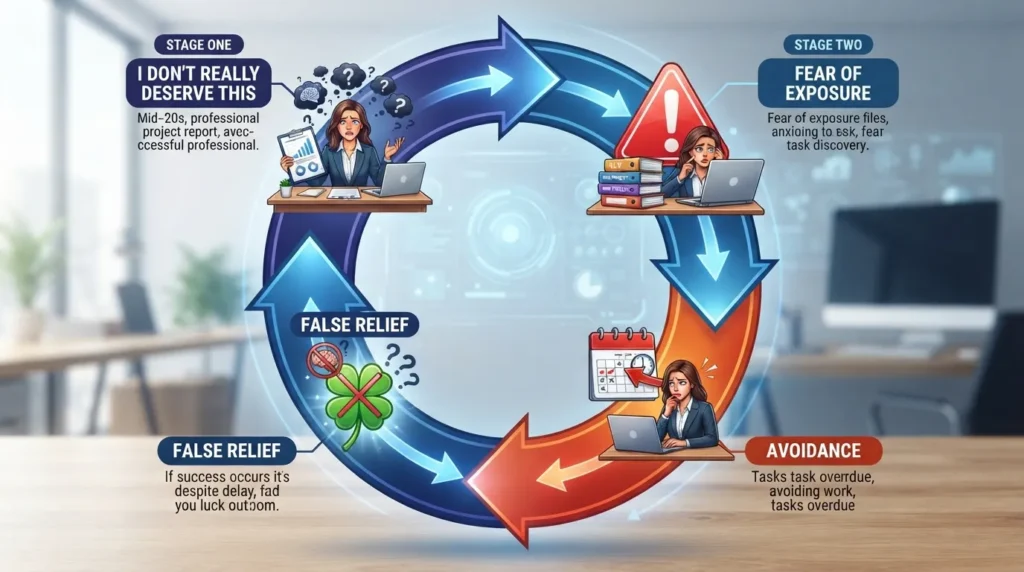
If you’ve ever sat staring at a task you’re fully capable of doing, only to find yourself reorganizing your desk instead, you already know how closely imposter syndrome and procrastination are tangled together. It’s not laziness, and it’s not really about time management either. Underneath the delay is usually a quiet, exhausting fear: what if I start this and everyone finds out I’m not as capable as they think?
Let’s walk through exactly why this happens, how to recognize it in yourself, and — more importantly — how to actually break the cycle instead of just understanding it.
Why Imposter Syndrome Makes You Procrastinate
Procrastination, in this context, isn’t a productivity problem. It’s a protection strategy. When a task feels like it might expose you as “not good enough,” your brain treats starting it the same way it would treat any other threat — and delay feels safer than risk.
Three patterns show up again and again:
1. The fear of being “found out”
Every new task can feel like a test that might reveal you’re a fraud. Putting it off delays that possible verdict, even temporarily, and that delay feels like relief in the moment.
2. The trapdoor of luck
Here’s the cruel twist: if you procrastinate, rush the work at the last minute, and it still turns out fine, your brain doesn’t credit your skill. It credits luck, adrenaline, or “just barely getting away with it.” So instead of building confidence, each success quietly reinforces the belief that you’re faking it — which makes the next task even harder to start.
3. Perfectionism that turns into paralysis
When your internal standard is “flawless or worthless,” starting anything feels overwhelming, because the gap between where you are and where you think you need to be feels too wide to cross. So you freeze, and freezing looks like procrastination from the outside.
The pattern to notice: it’s rarely the task itself that’s hard. It’s what finishing — or failing — the task might mean about your competence.
Early Signs You’re Dealing With This Cycle
Before it becomes a full pattern, imposter-driven procrastination usually shows up in smaller ways:
- You over-prepare instead of starting — endless research, no action
- You downplay your role when a project goes well (“I just got lucky” or “anyone could have done that”)
- You feel disproportionate dread before tasks you’re actually qualified for
- You compare your unfinished work to other people’s finished work
- You wait for the “right mood” or “right moment” that never quite arrives
If several of these feel familiar, the procrastination probably isn’t the root issue — it’s a symptom.
Is Imposter Syndrome a Mental Illness?
No — imposter syndrome isn’t classified as a mental illness or a formal diagnosis. It’s better understood as a psychological pattern: a persistent, internal disconnect between your actual competence and how competent you feel. That said, it can exist alongside anxiety, depression, or burnout, and in those cases the emotional weight can feel just as heavy as a diagnosable condition — even though it isn’t one itself.
The 5 Types of Imposter Syndrome
Psychologist Dr. Valerie Young identified five common patterns, and knowing which one fits you makes the procrastination easier to interrupt, because each type stalls for a slightly different reason.
| Type | How It Shows Up |
|---|---|
| The Perfectionist | Sets unreachable standards; a single flaw feels like total failure, so starting feels risky. |
| The Superhero/Superwoman | Overworks to prove worth in every role, then burns out and avoids tasks to protect what’s left. |
| The Natural Genius | Believes real ability should come easily; struggling with a task feels like proof of fraud, so it gets avoided. |
| The Soloist | Believes asking for help exposes incompetence, so tasks stall rather than get delegated or discussed. |
| The Expert | Feels they must know everything before acting, so more research keeps replacing actual starting. |
What Causes This Pattern in the First Place
Imposter syndrome usually isn’t random — it tends to trace back to a few common roots:
- Early comparison or conditional praise — growing up where achievement, not effort, earned approval
- Being “the only one” — the only newcomer, the only woman, the only person without a certain background in a room, which can amplify self-doubt
- Sudden change in role or status — a promotion, a new industry, or new responsibility outpacing your sense of readiness
- High-achieving or critical environments — where mistakes were treated as character flaws rather than normal parts of learning
This is also why procrastination linked to imposter feelings can sometimes trace back to earlier experiences of criticism or unpredictability — the brain learned that visibility carried risk, so avoiding tasks became a way of staying safe.
Who Tends to Experience This Most
It shows up across almost every field, but it’s especially common among high achievers, people early in a new role, career-changers, students in competitive programs, and anyone working in an environment where they stand out as different from the majority around them — by background, gender, age, or experience level. Ironically, the more capable and conscientious someone is, the more likely they are to hold themselves to standards that make imposter feelings worse.
The Imposter Syndrome and ADHD Connection
If you have ADHD, this cycle can hit differently. Executive function challenges already make starting and finishing tasks harder on a practical level — so when a task also gets delayed, it’s easy to interpret that delay as a personal failing rather than a brain-wiring difference. Over time, a history of missed deadlines, forgotten details, or inconsistent follow-through — even when the underlying ability was always there — can feed a deep sense of “I’m not actually as capable as people think.” The procrastination isn’t proof of incompetence in these cases; it’s often a mix of genuine executive function difficulty layered with the anxiety of imposter syndrome, and the two reinforce each other.
You’re in Good Company
This feeling doesn’t discriminate by achievement level. Well-known actors, authors, and executives have openly described moments of feeling like a fraud despite years of visible success — a reminder that the feeling of being an imposter has very little correlation with actual competence. It’s a thinking pattern, not an accurate measure of skill.
How to Actually Break the Cycle
Understanding the pattern helps, but interrupting it takes a few deliberate habits. Here’s what tends to work:
Give yourself permission to write a bad first draft
Lower the bar on purpose. The goal of a first attempt isn’t to be good — it’s to exist. Progress, not polish, is what breaks the freeze.
Trade perfectionism for “good enough”
Shift the internal question from “is this perfect?” to “does this meet what’s actually needed?” A satisfactory, finished piece of work almost always beats an infinitely delayed perfect one.
Start absurdly small
Break the task into a step so small it feels almost silly — open the document, write one sentence, commit to five minutes. This signals safety to your nervous system and builds momentum without triggering the fear response a “big” task does.
Keep a record of evidence, not opinions
Save positive feedback, completed projects, and specific results in one place. When your inner critic insists your success was luck, you’ll have something concrete — not just a feeling — to argue back with.
How to Support Someone Else Going Through This
If someone close to you is stuck in this cycle, the most helpful thing usually isn’t reassurance about the task — it’s reassurance about them. A few things that genuinely help:
- Ask what part of the task feels riskiest, rather than just asking why they haven’t started
- Point to specific, past evidence of their competence instead of general compliments
- Normalize imperfect first attempts by sharing your own, rather than only offering advice
- Avoid comparing their pace or output to others, even with good intentions — it usually reinforces the fear rather than easing it
- Offer to sit with them while they take the first small step, rather than just telling them to “just start”
Frequently Asked Questions
Can imposter syndrome affect how intelligent you feel, even if you’re not?
Yes. Imposter syndrome doesn’t lower actual intelligence or ability — but it distorts how you perceive your own competence, which can affect confidence, decision-making, and willingness to speak up or take opportunities, even when your skills are fully sufficient.
Does everyone with imposter syndrome procrastinate?
Not always. Some people respond to imposter feelings by overworking instead of avoiding — pushing themselves harder to “prove” their worth. Procrastination and overworking are two different coping responses to the same underlying fear.
How long does it take to overcome this pattern?
There’s no fixed timeline. For many people, it eases gradually as small, repeated evidence of competence builds up — but it can also resurface during major transitions like a new job or a new challenge, even after years of confidence. The goal isn’t to eliminate the feeling permanently, but to stop letting it control your actions.