Is Procrastination a Mental Disorder? What It May Mean
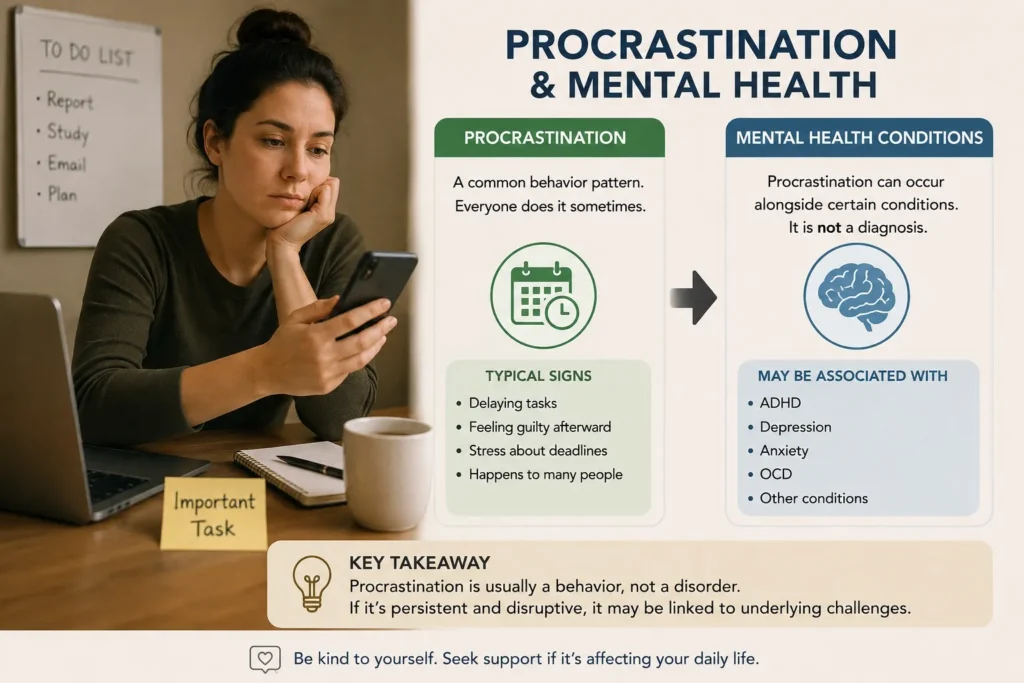
If you have ever wondered, “Is procrastination a mental disorder?”, the short answer is no: procrastination itself is not generally classified as a mental disorder. It is a behavior that can happen to anyone, including people who do not have a mental health condition.
However, frequent or severe procrastination can sometimes occur alongside conditions such as ADHD, depression, anxiety, or obsessive-compulsive disorder (OCD). That does not mean procrastination automatically indicates any of these conditions. The context, pattern, severity, and other symptoms matter.
The key distinction: Procrastination is a behavior, not a diagnosis by itself. If delaying tasks is persistent, causes significant problems, or occurs together with other concerning symptoms, it may be worth discussing the broader pattern with a qualified mental health professional.
Is Procrastination a Mental Disorder?
No. Procrastination is not itself considered a mental disorder. It describes a tendency to delay starting or completing something even when you know the delay may have unwanted consequences.
People procrastinate for many different reasons. A task may feel boring, difficult, overwhelming, stressful, uncertain, or emotionally uncomfortable. Sometimes putting it off provides short-term relief even though it creates more pressure later.
Research also treats procrastination as a complex behavior rather than a single disease with one established cause. A 2025 psychiatric literature review described procrastination as a complex phenomenon that can appear in several psychiatric conditions but does not have a single established definition or pathophysiology. :contentReference[oaicite:0]{index=0}
What Is Procrastination, Exactly?
Procrastination means voluntarily delaying an intended task or decision despite knowing that the delay may create problems later. It can involve putting off schoolwork, household tasks, appointments, paperwork, work projects, or other responsibilities.
Occasional procrastination is common. For example, you might delay a difficult assignment because you would rather do something easier first. That alone does not mean there is something medically wrong.
The more useful question is not simply “Do I procrastinate?” but rather:
- How often does it happen?
- What kinds of tasks trigger it?
- Does it interfere with school, work, relationships, or everyday responsibilities?
- What emotions or difficulties appear before the delay?
- Are there other symptoms happening at the same time?
Why Do People Procrastinate?
There is no single reason why people procrastinate. Different people may delay tasks for very different reasons.
Emotional discomfort
A task can bring up boredom, frustration, fear of failure, uncertainty, or anxiety. Delaying it may temporarily make those feelings easier to avoid.
Difficulty getting started
Some tasks are difficult to break into manageable steps. When the starting point is unclear, a person may keep postponing the task rather than deciding what to do first.
Perfectionism
Someone who feels they must perform perfectly may avoid starting because beginning the task also means confronting the possibility of making mistakes.
Attention and self-regulation difficulties
Some people have difficulty maintaining attention, organizing tasks, regulating emotions, or initiating activities. These difficulties can contribute to procrastination, but they do not by themselves establish a diagnosis.
Can Procrastination Be a Sign of ADHD?
It can occur alongside ADHD, but procrastination alone does not mean you have ADHD.
ADHD can involve difficulties with attention, organization, task initiation, time management, and executive functioning. Those difficulties can make it harder for some people to begin or finish tasks.
Importantly, a recent 2026 systematic review found a consistent positive association between ADHD symptoms and procrastination across the studies it examined. Inattention was the strongest correlate reported, while executive functioning, emotion regulation, and motivational processes were also discussed. The researchers also noted that much of the evidence was cross-sectional, so the findings do not establish that ADHD causes procrastination. :contentReference[oaicite:1]{index=1}
What this means: If procrastination happens together with persistent attention, organization, or other difficulties, the broader pattern may be worth discussing with a qualified professional. A person should not try to diagnose ADHD from procrastination alone.
Can Depression Cause Procrastination?
Depression can make everyday tasks harder, and procrastination may occur alongside depressive symptoms such as low energy, reduced motivation, difficulty concentrating, or loss of interest.
However, procrastination does not diagnose depression. A person can procrastinate without being depressed, and someone experiencing depression may not describe their difficulties primarily as procrastination.
Recent research supports an association between procrastination and negative emotions, including depression, anxiety, and stress. A 2025 systematic review and meta-analysis covering 88 studies and more than 63,000 participants found a moderate positive association between procrastination and these negative emotional states. Association, however, does not prove that procrastination causes depression or that depression always causes procrastination. :contentReference[oaicite:2]{index=2}
Is Procrastination Linked to Anxiety?
Yes, procrastination can be associated with anxiety. A person may postpone a task because thinking about it produces worry, uncertainty, fear of making a mistake, or fear of being judged.
That does not mean every person who procrastinates has an anxiety disorder. The important distinction is between an occasional emotional reaction to a difficult task and a persistent pattern of anxiety that significantly affects daily life.
Can OCD Be Related to Procrastination?
Procrastination can occur in people experiencing obsessive-compulsive symptoms, particularly when fear, doubt, perfectionism, or repetitive behaviors make it difficult to start or complete a task.
But procrastination by itself is not evidence that someone has OCD. OCD involves a broader pattern of obsessions and/or compulsions that can cause significant distress or impairment.
Research reviews have identified procrastination as a behavior that may appear across different psychiatric conditions, including ADHD, anxiety disorders, and OCD, which is why the surrounding symptoms and circumstances matter. :contentReference[oaicite:3]{index=3}
Is Procrastination the Same as Laziness?
No. Procrastination and laziness are not the same thing.
Procrastination is about delaying an intended task. A person may genuinely want to complete something and still struggle to start it.
Calling every procrastinating person “lazy” can also hide the reason the behavior is happening. Someone may be dealing with an overwhelming task, anxiety, perfectionism, attention difficulties, low energy, poor planning, or another barrier.
At the same time, not every delay needs a psychological explanation. Sometimes people simply choose a different activity because it feels more rewarding or important at that moment.
What Are Signs That Procrastination May Be a Bigger Problem?
Occasional procrastination is usually different from a persistent pattern that repeatedly interferes with everyday life.
It may be worth paying closer attention when you notice patterns such as:
- repeatedly delaying important responsibilities despite wanting to complete them;
- missing deadlines or appointments because tasks are repeatedly postponed;
- feeling unusually overwhelmed whenever you try to begin certain tasks;
- having persistent difficulty starting or organizing everyday activities;
- experiencing ongoing anxiety, low mood, concentration problems, or other symptoms alongside procrastination;
- or experiencing significant problems at school, work, home, or in relationships because of the pattern.
None of these signs automatically means you have a mental disorder. They simply suggest that it may be useful to look at the bigger picture rather than labeling yourself based on procrastination alone.
When Should You Talk to a Professional?
Consider talking with a qualified mental health professional if procrastination is persistent and is causing meaningful problems in your everyday life, especially when it appears together with other symptoms that concern you.
A professional can look at the complete pattern rather than trying to identify a condition from one behavior. Depending on the situation, that may include discussing attention, mood, anxiety, sleep, stress, routines, school or work demands, and other relevant factors.
If you are unsure whether what you are experiencing is significant, you do not need to diagnose yourself before asking for help. You can simply explain what has been happening and how it affects your daily life.
How Can You Start Managing Procrastination?
If procrastination is interfering with your routine, start by making the task easier to begin rather than waiting until you feel perfectly motivated.
- Choose one specific task. Replace a vague goal such as “study” with something concrete, such as “read the first two pages.”
- Make the first step small. A smaller starting action can feel less overwhelming than trying to complete everything at once.
- Identify what you are avoiding. Ask whether the obstacle is boredom, uncertainty, fear of mistakes, difficulty concentrating, or simply not knowing where to start.
- Reduce distractions. Make it easier to focus by changing the environment around the task.
- Use realistic time blocks. Give yourself a manageable period to work rather than expecting yourself to stay focused indefinitely.
- Look for the larger pattern. If the same difficulty keeps appearing across many areas of life, consider discussing it with a trusted adult or qualified professional.
Can Procrastination Be Treated?
There is not one treatment for “procrastination disorder” because procrastination itself is not a standalone diagnosis. What helps depends on why the behavior is happening and whether another difficulty is involved.
For some people, practical changes to planning, task initiation, routines, and the environment may help. If procrastination is occurring as part of a broader mental health or attention-related problem, a professional can help determine what kind of support is appropriate.
This is one reason it is better to focus on the underlying pattern instead of trying to find a single medication or diagnosis for procrastination itself.
Frequently Asked Questions
Is procrastination a psychological disorder?
No. Procrastination itself is not generally classified as a psychological disorder. It is a behavior that can occur for many reasons and may sometimes appear alongside mental health or attention-related conditions.
Is procrastination a mental illness?
Procrastination by itself is not a mental illness. It can, however, occur alongside conditions such as ADHD, depression, anxiety, or OCD. The presence of procrastination alone is not enough to identify any of these conditions.
What is procrastination a symptom of?
Procrastination can occur alongside several different difficulties, including attention problems, anxiety, depression, perfectionism, stress, or other challenges with self-regulation. It is not specific to one condition.
Is procrastination a sign of ADHD?
It can occur in people with ADHD, and research has found an association between ADHD symptoms and procrastination. But procrastination alone cannot diagnose ADHD. :contentReference[oaicite:4]{index=4}
Can depression cause procrastination?
Depression can make motivation, concentration, energy, and everyday tasks more difficult, so procrastination may occur alongside depression. However, procrastination itself does not mean someone is depressed.
Is there medication for procrastination?
There is no medication specifically approved simply for “procrastination” as a standalone disorder. If procrastination is connected with another diagnosed condition, a qualified professional can discuss appropriate treatment options for that condition.
Is procrastination a disease?
No. Procrastination is a behavior rather than a disease. It can become persistent and disruptive, and it may occur alongside other psychological or attention-related difficulties, but the behavior itself is not a disease diagnosis.
The Bottom Line
So, is procrastination a mental disorder? No. Procrastination itself is not generally classified as a mental disorder. It is a common behavior that can happen for many reasons.
At the same time, persistent procrastination can sometimes occur alongside ADHD, depression, anxiety, OCD, stress, or other difficulties. Current research supports associations between procrastination and several psychological symptoms, but those associations should not be treated as proof of a diagnosis. :contentReference[oaicite:5]{index=5}
If procrastination is repeatedly getting in the way of your everyday life, the most useful next step is to look at the whole pattern rather than labeling yourself based on one behavior. A qualified professional can help you understand what may be contributing to the difficulty and what kind of support could be appropriate.
Explore Topics
Sub-Topics & Guides
Featured Guides
Top Industry Resources
Editorial Integrity
Our content is 100% human-written, evidence-backed, and continuously updated to fulfill reader intent with maximum honesty.
"Small, consistent habits compounded over time create unshakeable momentum."