Procrastination and Self-Efficacy: How Self-Belief Helps You Stop Delaying Tasks
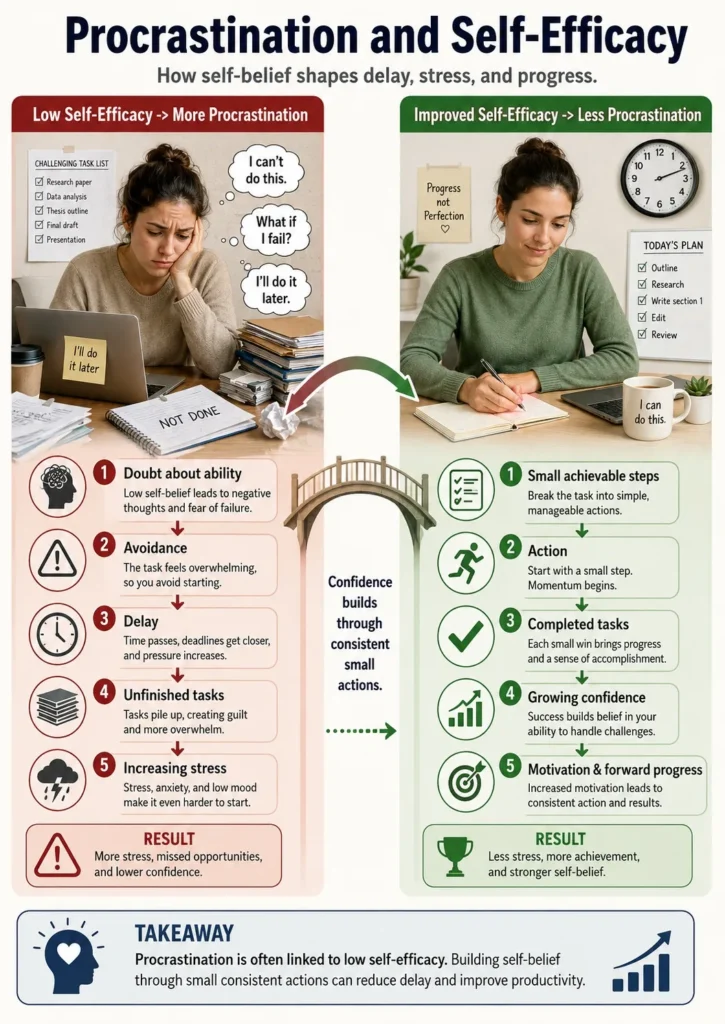
Procrastination and self-efficacy are closely connected. When you doubt your ability to complete a task, difficult work can feel overwhelming, which may lead to avoidance, anxiety, and delaying important actions. Research-based discussions of this relationship often highlight that low self-efficacy can increase procrastination through fear of failure, emotional regulation challenges, and reduced task persistence. :contentReference[oaicite:0]{index=0}
What Is Self-Efficacy?
Self-efficacy is your belief in your ability to successfully complete a specific task or achieve a desired outcome. It is not the same as general confidence. A person can have high self-efficacy in one area, such as writing, but lower self-efficacy in another area, such as public speaking.
People with stronger self-efficacy are more likely to approach difficult tasks, continue working after setbacks, and believe their effort can improve results. Self-efficacy is commonly linked with motivation, persistence, and commitment toward goals. :contentReference[oaicite:1]{index=1}
Example of Low vs High Self-Efficacy
| Low Self-Efficacy | High Self-Efficacy |
|---|---|
| “This task is too difficult. I probably cannot finish it.” | “This is challenging, but I can learn and complete it step by step.” |
What Is Procrastination?
Procrastination is the habit of unnecessarily delaying important tasks even when you know that postponing them may create problems later.
It often involves avoiding tasks that feel difficult, stressful, boring, or connected with fear of failure. A person may delay starting not because they do not care, but because the task creates uncomfortable emotions.
The Connection Between Procrastination and Self-Efficacy
Self-efficacy influences how you approach challenges. When your belief in your ability is low, a task may appear more threatening than manageable.
The common cycle looks like this:
Breaking this cycle requires improving both your skills and your belief that you can improve.
How Low Self-Efficacy Can Increase Procrastination
- Fear of failure: You may avoid starting because you worry about making mistakes.
- Feeling overwhelmed: Large tasks can appear impossible when you doubt your ability.
- Negative self-talk: Thoughts like “I cannot do this” reduce motivation.
- Avoidance behavior: Delaying the task creates short-term emotional relief but increases future pressure.
Academic Procrastination and Self-Efficacy
Students often experience procrastination when they do not feel capable of handling assignments, exams, or complex subjects. Low academic self-efficacy can make studying feel more difficult and increase avoidance.
Building confidence through small achievements, better study strategies, and realistic goals can help students become more consistent.
How to Build Self-Efficacy and Stop Procrastinating
1. Break Large Tasks Into Smaller Steps
A large project can create mental resistance. Divide it into smaller actions that feel easier to start.
2. Use the 10-Minute Rule
Commit to working for only ten minutes. Starting is often the hardest part, and small progress can build momentum.
3. Create Small Wins
Completing manageable tasks provides evidence that you are capable, which gradually strengthens self-efficacy.
4. Replace Negative Self-Talk
Instead of saying “I cannot do this,” ask yourself, “What is the next small step I can take?”
5. Practice Self-Compassion
Treat mistakes as opportunities to learn instead of proof that you are incapable. Self-compassion can reduce performance anxiety and help you continue moving forward. :contentReference[oaicite:2]{index=2}
Common Mistakes That Keep Procrastination Going
- Waiting until you feel completely motivated before starting.
- Trying to complete a large task in one sitting.
- Comparing your progress with others.
- Seeing past failures as proof that you cannot improve.
Frequently Asked Questions
Can procrastination be related to mental health?
Procrastination can sometimes be connected with stress, anxiety, emotional difficulties, or other challenges. Understanding the reason behind delaying behavior is important.
How can I stop procrastinating and start studying?
Start with a small study goal, remove distractions, create a realistic schedule, and focus on building confidence through consistent progress.
Can CBT techniques help with procrastination?
Cognitive behavioral approaches can help people identify unhelpful thoughts, challenge negative beliefs, and develop healthier action patterns.
What is the root cause of procrastination?
The cause varies from person to person. Common factors include fear of failure, low confidence, unclear goals, stress, and difficulty managing emotions.
Final Thoughts
Procrastination and self-efficacy are connected because the way you see your own ability affects the way you approach difficult tasks. If you constantly doubt yourself, avoidance can become a habit. However, confidence can be rebuilt through small actions, consistent practice, and realistic progress.
The goal is not to become perfectly motivated before starting. The goal is to take small steps that prove to yourself that progress is possible.
Explore Topics
Sub-Topics & Guides
Featured Guides
Top Industry Resources
Editorial Integrity
Our content is 100% human-written, evidence-backed, and continuously updated to fulfill reader intent with maximum honesty.
"Small, consistent habits compounded over time create unshakeable momentum."