What Does Procrastination Mean?
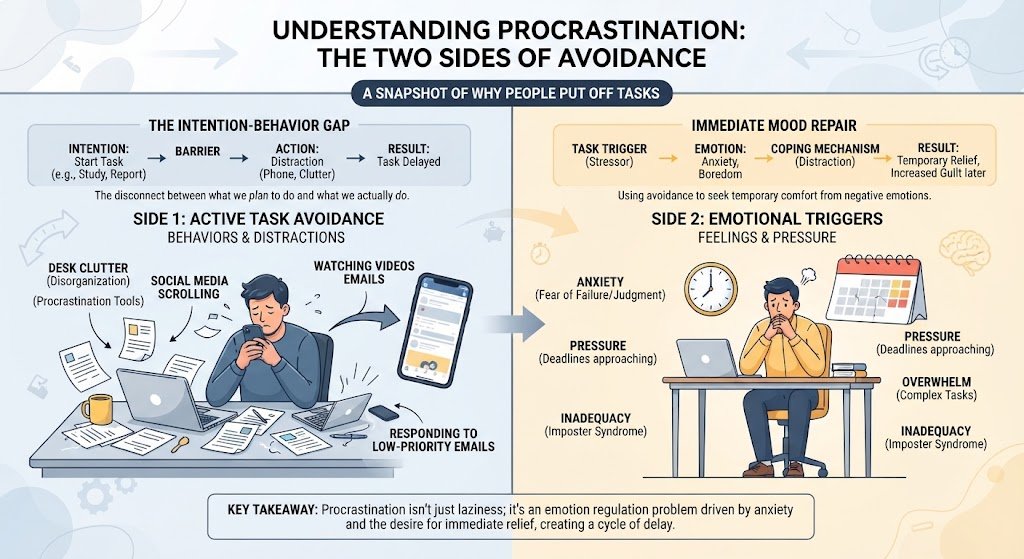
Procrastination is the habitual or intentional act of delaying or postponing tasks, decisions, or actions despite knowing that negative consequences will follow. Rather than an issue of poor time management, psychological research identifies it as an emotion-regulation failure where immediate mood repair takes precedence over long-term goals.
Procrastination Meaning in Simple Words
At its core, procrastination means putting off what needs to be done right now in favor of easier, less important, or more pleasurable activities. It moves beyond simple prioritization or strategic task-switching into active avoidance.
Task Avoidance: Pushing critical obligations to the last minute or abandoning them entirely to escape discomfort, anxiety, or boredom.
Intention-Behavior Gap: Experiencing a disconnect between what you genuinely plan to do and the actual actions you take.
Wasting Time: Engaging in low-value distractions—often called “productive procrastination”—while high-priority duties remain untouched.
Pronunciation Guide (/prəˌkræs.tɪˈneɪ.ʃən/)
Pronouncing the word correctly involves breaking down its four distinct syllables with stress placed primarily on the third syllable.
Phonetic Breakdown: pruh-kras-tuh-nay-shuhn
Detailed Syllable Breakdown:
pro- (/prə/ or /proʊ/) — A soft, unstressed initial sound, similar to the beginning of the word protect.
-cras- (/kræs/) — Pronounced with a short vowel sound, exactly like the word class or mass.
-ti- (/tɪ/) — A very quick, short vowel sound like the “i” in sit.
-na-tion (/ˈneɪ.ʃən/) — The primary stressed syllable, rhyming completely with station.
Putting It All Together
Say the parts smoothly in order without pausing: pruh-KRAS-tuh-nay-shuhn.
Procrastination Meaning in Urdu / Bilingual Explanation
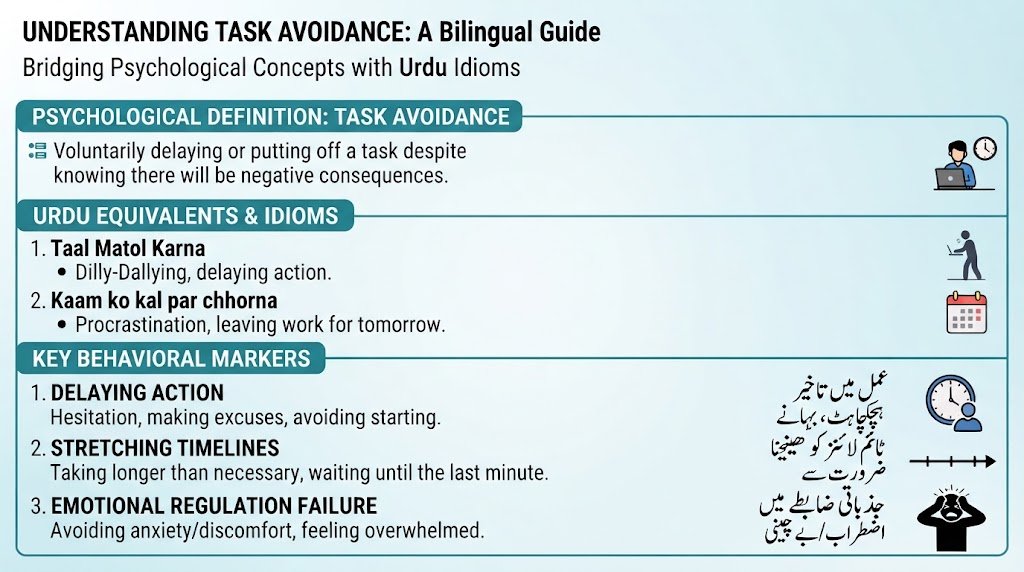
Exploring procrastination through a bilingual perspective helps connect English psychological definitions with everyday understanding, making the concept universally clear for bilingual readers without relying on Roman Urdu scripts.
Urdu Translation and Core Equivalents
In Urdu, procrastination is commonly translated as “taal matol karna” (procrastinating or dilly-dallying) or “kaam ko kal par chhorna” (leaving work for tomorrow). It describes the habit of unnecessarily delaying essential tasks despite knowing the negative outcomes that will follow.
Delaying Action: Pushing off a task scheduled for today onto tomorrow or an indefinite future date.
Stretching Timelines: Failing to complete obligations on time and dragging out the process unnecessarily.
Avoidance Behavior: Making excuses and dodging the initiation of work due to reluctance or hesitation.
Simple Explanation of the Concept
Procrastination is fundamentally an issue of emotional regulation rather than a simple failure of time management. When a task feels difficult, tedious, or anxiety-inducing, your brain seeks immediate relief by drifting toward easier, more pleasurable distractions like scrolling through a phone.
Task Avoidance: Feeling overwhelmed by critical responsibilities like professional projects or academic studies, and deliberately ignoring them.
Immediate Mood Repair: Sacrificing long-term goals in the present moment solely to make yourself feel comfortable right now through avoidance.
Wasting Time: Spending precious hours on low-value activities while knowing the pressure will only accumulate later.
Word Family & Grammar Breakdown
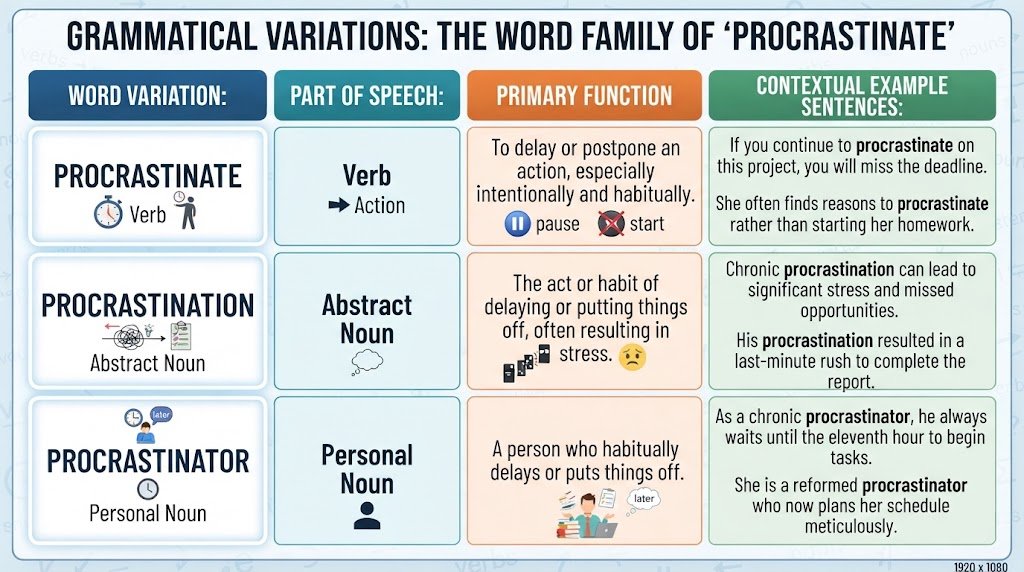
Mastering the word family and grammatical variations of procrastination helps clarify how to use each term correctly in professional and everyday writing. Every form stems from the same Latin root, yet each serves a distinct functional role in a sentence.
Procrastinate (Verb) – Definition & Usage
Procrastinate functions as an intransitive or transitive verb that describes the action of delaying or putting off an obligation. It represents the physical or mental behavior of postponing what needs to be done.
Definition: To delay or postpone action; to put off doing something that should be done immediately.
Grammatical Function: Acts as the action word in a sentence, expressing what the subject is doing or failing to do.
Example Usage: “I need to stop a habit of procrastination, but it is far too easy to procrastinate when facing a difficult project.”
Procrastination (Noun) – Definition & Usage
Procrastination serves as an abstract noun representing the concept, habit, or psychological state of delay itself. It is the most commonly searched term in this word family.
Definition: The action or habit of delaying or postponing something, especially as an emotional regulation failure.
Grammatical Function: Functions as a singular, uncountable noun that acts as the subject or object of a sentence.
Example Usage: “Chronic procrastination can severely damage academic performance and career growth over time.”
Procrastinator (Noun – Person) – Definition & Usage
A procrastinator is a concrete noun used to describe the individual who habitually engages in the act of delaying tasks. It puts a human face to the abstract behavior.
Definition: A person who habitually puts off tasks until the last possible moment.
Grammatical Function: Functions as a countable noun that can be pluralized (procrastinators).
Example Usage: “As a lifelong procrastinator, she learned to break large assignments into tiny steps to stay on track.”
Part of Speech Table (Word Form Breakdown)
| Word Form | Part of Speech | Primary Function | Example Sentence |
| Procrastinate | Verb | Describes the action of delaying | Do not procrastinate on your taxes. |
| Procrastination | Noun (Abstract) | Describes the habit or concept | Procrastination is a thief of time. |
| Procrastinator | Noun (Person) | Describes the individual performing the action | He is a chronic procrastinator. |
Procrastination Used in a Sentence (Examples)
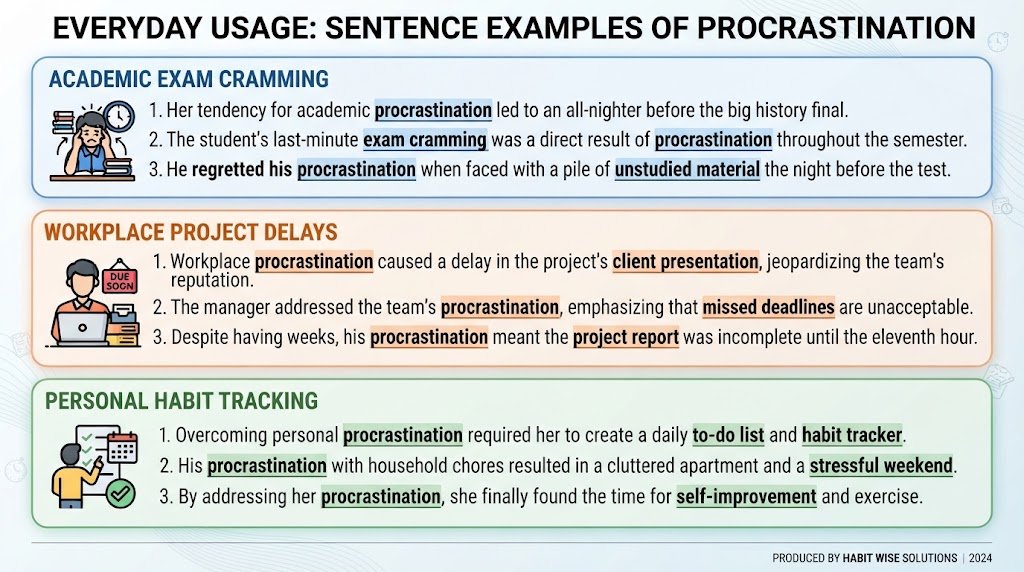
Seeing a word applied in context solidifies its meaning and shows how to weave it naturally into conversation or writing. These examples illustrate how the abstract concept and its active verb form function across academic, professional, and daily life scenarios.
5 Example Sentences Using “Procrastination”
Academic Performance: His chronic procrastination led to a stressful night of cramming just hours before the final exam.
Professional Setting: The team realized that unchecked procrastination was the primary reason the project missed its initial deadline.
Personal Growth: Overcoming deep-seated procrastination requires recognizing that the root issue is emotional discomfort rather than a lack of time.
Daily Habits: Clearing away distractions from the desk is a practical step toward reducing daily procrastination.
Behavioral Pattern: Psychological research shows that procrastination often spikes when individuals face ambiguous or unstructured tasks.
How to Use “Procrastinate” in a Sentence
The verb form, procrastinate, requires careful placement to describe the active choice of delaying a duty. It usually pairs with prepositions like “on” or appears as an infinitive following an auxiliary verb.
Following Auxiliary Verbs: Use it with modal verbs to express a warning, goal, or necessity (e.g., “I must not procrastinate if I want to finish early”).
Connecting with Prepositions: Follow the verb with “on” to specify the exact duty being delayed (e.g., “Do not procrastinate on submitting your application”).
Indicating Action vs. Intent: Deploy it when you want to emphasize the ongoing behavior of hesitation rather than the static concept itself.
Procrastination vs Laziness vs Deliberation
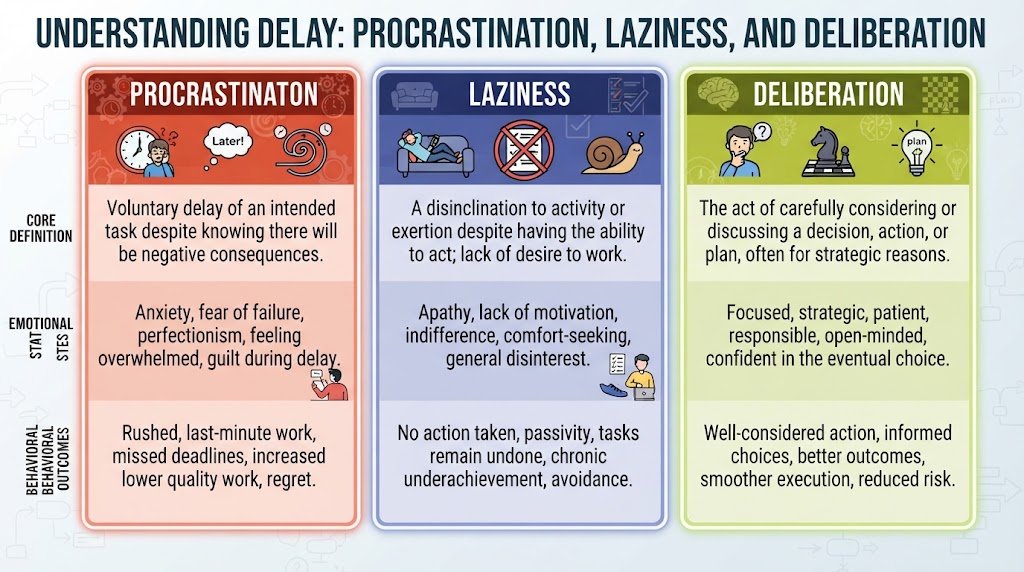
Distinguishing procrastination from adjacent concepts like laziness and deliberation is essential for understanding why people delay tasks. While all three involve a lack of immediate action, their underlying psychological drivers, intentions, and behavioral patterns are entirely different.
Is Procrastination the Same as Laziness? (Comparison Table)
Procrastination is frequently mislabeled as laziness, but they stem from completely different mindsets. Laziness involves apathy, inactivity, and a general unwillingness to act, whereas procrastination involves active avoidance where you choose to do something else instead of the primary task due to emotional distress or overwhelm.
| Feature | Procrastination | Laziness | Deliberation |
| Core Motivation | Escaping emotional discomfort or anxiety | Apathy, low energy, or unwillingness to care | Strategic pausing for information or better timing |
| Behavioral State | Active (doing low-priority tasks like cleaning or scrolling) | Inactive (doing nothing, resting, or remaining idle) | Controlled (weighing options before committing) |
| Emotional Impact | Accompanied by guilt, stress, and self-blame | Generally accompanied by contentment or indifference | Accompanied by clarity, focus, and logical thought |
| Task Status | The task matters to you, but you feel blocked | The task does not matter to you at all | The task is being evaluated for optimal execution |
Procrastination vs Deliberation: Key Difference
Deliberation is an intentional, calculated delay, whereas procrastination is an emotional, counterproductive delay. Understanding this distinction clarifies whether a pause is productive or harmful.
Intentional vs. Reactive: Deliberation is a conscious choice to gather more facts, weigh risks, and make a sound decision. Procrastination is a reactive, impulsive escape from a task that triggers negative emotions.
Outcome and Control: During deliberation, you remain in control of the timeline and feel purposeful. During procrastination, you lose control, experience rising anxiety, and suffer negative consequences.
Productivity Impact: Deliberation improves final execution by ensuring thorough preparation. Procrastination compromises final quality due to rushed last-minute execution.
10 Real-Life Examples of Procrastination
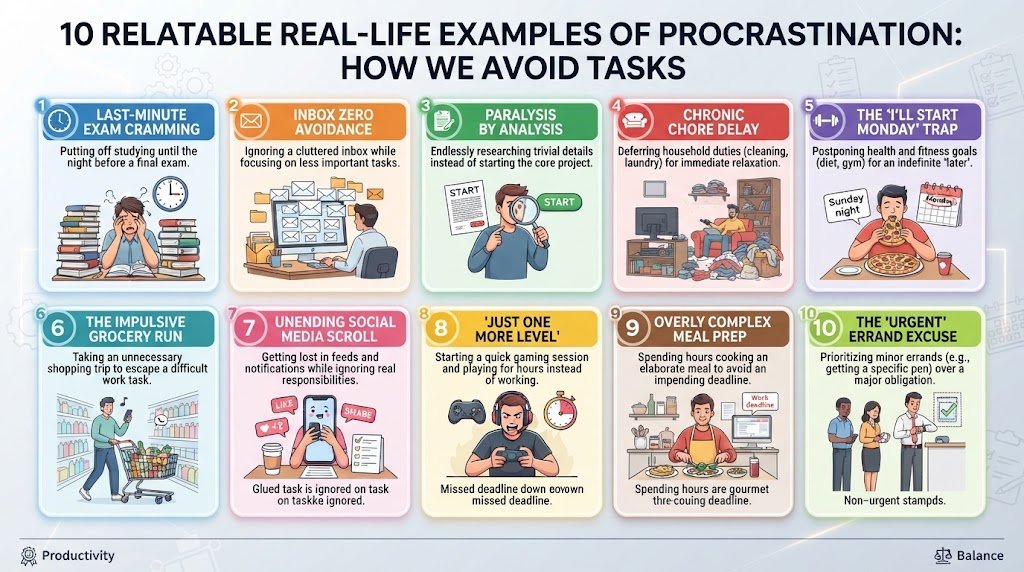
Recognizing how procrastination manifests in daily life helps bridge theoretical definitions with personal experience. These real-world examples highlight common scenarios where task-switching, deadline avoidance, and digital distractions derail productivity across work, study, and home environments.
Everyday Examples (Work, Study, Home Tasks)
Exam Cramming: Waiting until the night before a major exam to open textbooks, driven by the false belief that high-pressure panic equals better focus.
Last-Minute Report Submissions: Staring at a blank document for days, dealing with rising anxiety, and rushing to finish a professional report one hour before the deadline.
The “I Need to Clean First” Trap: Suddenly deciding to scrub the entire kitchen floor or organize a closet the exact moment a high-priority work project is due.
Unopened Mail Pileup: Leaving official bills, tax notices, and bank statements sitting in an unopened stack for weeks to avoid confronting financial stress.
Deferred Home Repairs: Ignoring a leaking faucet or a squeaky door hinge for months until minor maintenance snowballs into an expensive emergency repair.
Digital-Age Examples (Social Media, Notifications)
Endless Social Media Scrolling: Opening Instagram or TikTok for a quick five-minute break and losing two hours to short-form video feeds instead of writing an essay.
The Email Refresh Loop: Constantly checking and refreshing an inbox for incoming messages as a substitute for tackling a complex, demanding task.
Notification Rabbit Holes: Pausing a coding task to reply to a single notification, only to get sidetracked by related tech articles, forums, and chat groups.
Tab Hoarding: Keeping forty browser tabs open with research articles and tutorials while reading unrelated entertainment news instead of working.
Productive Digital Busywork: Spending hours organizing desktop icon folders, changing font color schemes, or downloading new productivity apps while leaving core duties untouched.
Why Do People Procrastinate? (Causes & Psychology)
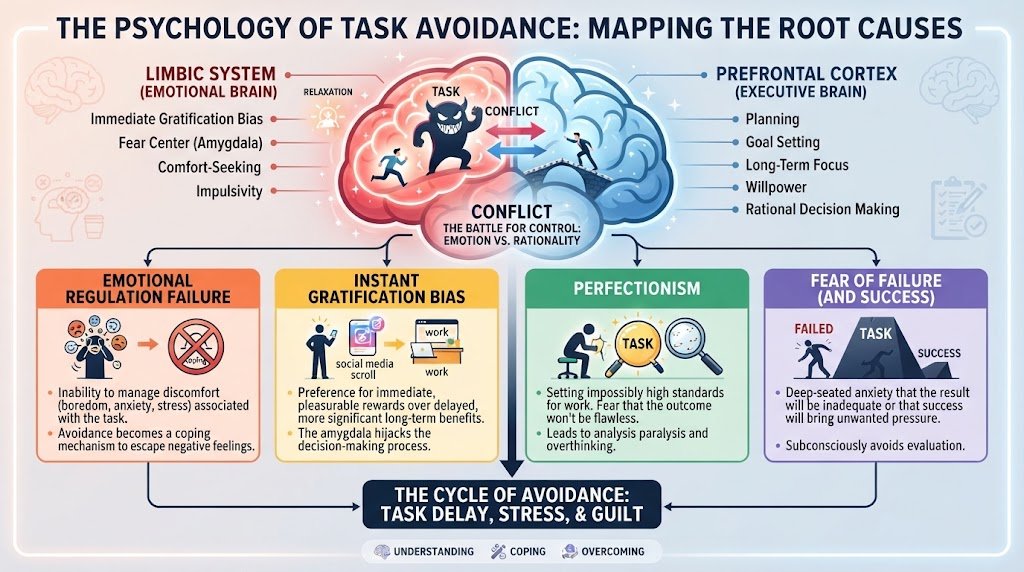
Procrastination is rarely a simple failure of time management or laziness; rather, it is deeply rooted in emotional regulation and psychological friction. Understanding the underlying drivers helps explain why individuals knowingly sabotage their own long-term goals for temporary relief.
Most Common Causes of Procrastination
Psychological research reveals that procrastination stems from how the human brain processes immediate emotional discomfort versus future rewards. When a task triggers negative feelings, the brain seeks immediate mood repair by switching to safer, easier activities.
Fear of Failure: Worrying that the final output will not meet personal or external standards, causing the ego to avoid starting altogether.
Perfectionism: Setting unrealistically high bars that create immense pressure, leading to total paralysis when perfection feels unattainable.
Task Aversion: Experiencing boredom, confusion, or overwhelming complexity when looking at an unstructured or uninspiring duty.
Instant Gratification Bias: Prioritizing the immediate pleasure of scrolling social media over the distant, abstract reward of finishing a project.
What Personality Type Procrastinates the Most?
Certain psychological traits and personality configurations correlate heavily with chronic procrastination. The interplay between self-control, emotional stability, and organizational tendencies shapes an individual’s vulnerability to delay.
Low Conscientiousness: Individuals who struggle with self-discipline, organization, and goal persistence are significantly more likely to drift into chronic delay.
High Neuroticism: People prone to anxiety, self-doubt, and emotional reactivity often procrastinate because tasks trigger intense stress responses.
Low Self-Efficacy: Those who lack confidence in their ability to successfully execute a task tend to avoid starting to protect themselves from perceived inadequacy.
Signs Someone Is Procrastinating
Spotting the behavioral markers of procrastination allows individuals to interrupt the cycle before deadlines trigger panic. These warning signs manifest across both mental state and daily routines.
Engaging in Low-Priority Busywork: Prioritizing trivial chores like sharpening pencils, cleaning desks, or organizing files while major deadlines loom.
Frequent Distraction Seeking: Constantly checking phones, opening new browser tabs, or walking away to get snacks every few minutes.
Expressing Chronic Guilt: Exhibiting visible stress, frustration, and self-blame while avoiding the actual work that needs completion.
Does Procrastination Mean Low Intelligence?
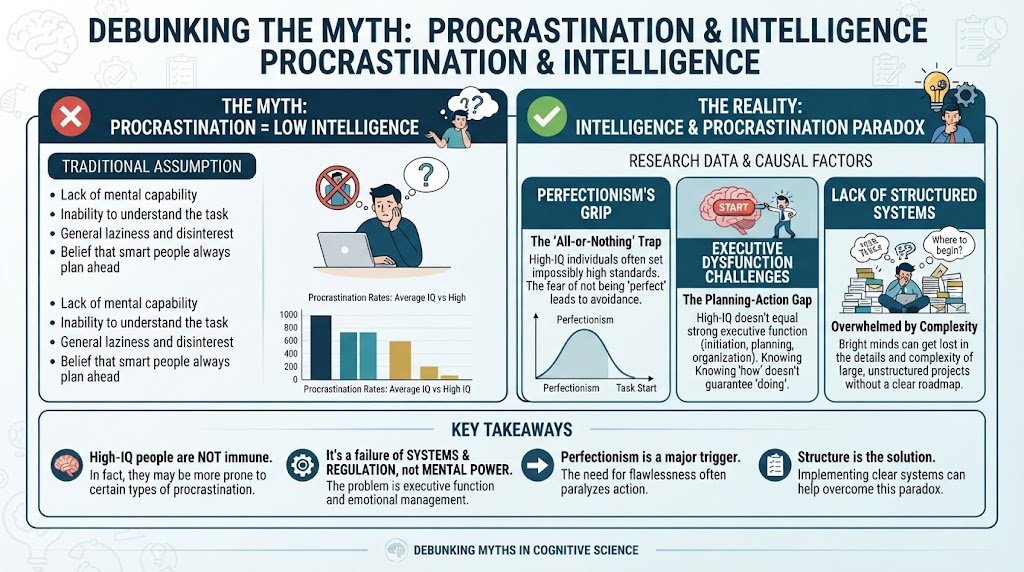
Procrastination is not an indicator of low intelligence. Psychological research confirms that intelligence quotient (IQ) measures cognitive ability and problem-solving capacity, whereas procrastination is an emotion-regulation failure. A person can possess exceptional intellect while simultaneously struggling with task initiation and emotional control.
The Link Between IQ and Procrastination
Intelligence scores measure raw cognitive ability, processing speed, and analytical reasoning, none of which govern emotional self-regulation. Because procrastination stems from anxiety, task aversion, and stress avoidance, high intellect offers no natural immunity against it.
Cognitive Ability vs. Emotional Control: IQ reflects how effectively the brain processes information, while procrastination reflects how the brain manages stress surrounding a task.
Executive Function Disconnect: High intelligence can coexist with gaps in executive function—the mental skills involved in planning, impulse control, and sustaining effort toward long-term goals.
Research Consensus: Studies consistently show near-zero correlation between a person’s IQ score and their likelihood of delaying high-priority tasks.
Why Smart People Procrastinate Too
High-IQ individuals often experience unique psychological triggers that actively encourage task delay. Advanced cognitive ability can actually fuel sophisticated excuses, paralyzing overanalysis, and unrealistic standards.
Perfectionism and Overthinking: High cognitive ability allows individuals to foresee every potential error or flaw, creating intense pressure that leads to paralysis before starting.
Cognitive Overconfidence: Highly intelligent people often discover early in life that they can achieve strong results in a fraction of the time, reinforcing the habit of last-minute rushes.
Advanced Rationalization: Superior intellect enables individuals to construct highly convincing, logical arguments to justify putting off essential work without immediate self-blame.
Boredom with Repetitive Work: Highly active minds require intellectual stimulation, causing severe task aversion when faced with mundane, routine, or poorly structured assignments.
Synonyms and Opposite of Procrastination
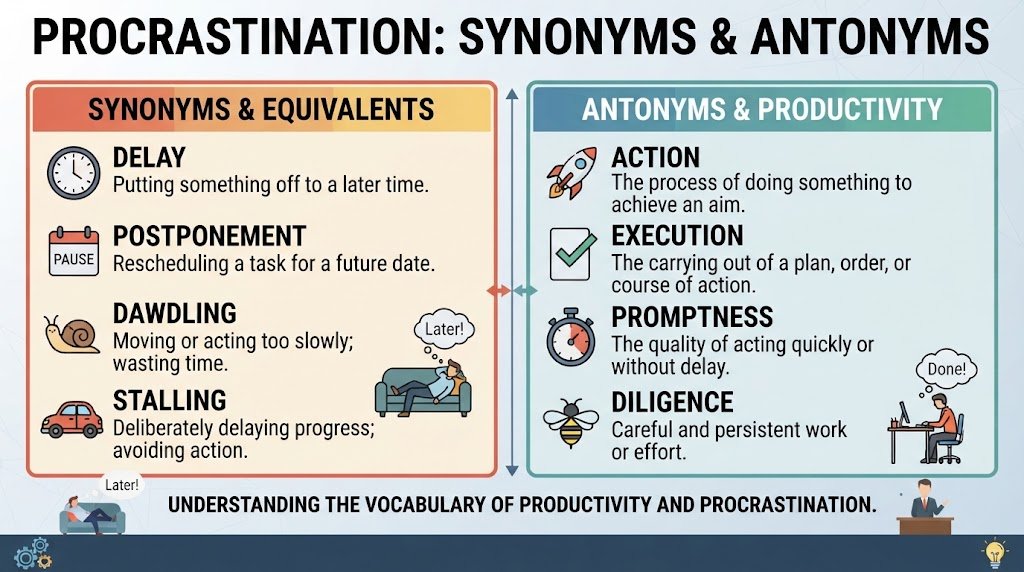
Expanding vocabulary related to procrastination enriches writing and provides precise terminology for different degrees of task delay. Understanding both synonyms and antonyms clarifies the spectrum between passive avoidance and decisive execution.
Common Synonyms (Delay, Postponement, Dawdling, Dilly-dallying)
Various terms capture specific shades of putting off actions, ranging from formal scheduling adjustments to casual wasting of time.
Delay: The general act of making something happen later than planned or expected.
Postponement: A deliberate or circumstantial decision to put an obligation off to a future date.
Dawdling: Moving slowly, wasting time, or lingering instead of pressing forward with purpose.
Dilly-dallying: Indecisively wasting precious time through hesitation or trivial distractions.
Stalling: Intentionally wasting time to avoid confronting a difficult or unwanted responsibility.
What Is the Opposite of Procrastination?
The antonym of procrastination is not merely speed, but rather the proactive and timely execution of responsibilities. These opposites emphasize decisive action and mental readiness.
Proactivity: Taking initiative and acting in anticipation of future needs or goals without waiting for pressure to mount.
Promptness: Completing actions immediately or precisely on schedule without unnecessary hesitation.
Punctuality: Adhering strictly to established timelines and deadlines.
Execution: Channeling focus directly into doing the work rather than avoiding it.
How to Stop Procrastinating (Quick Practical Tips)
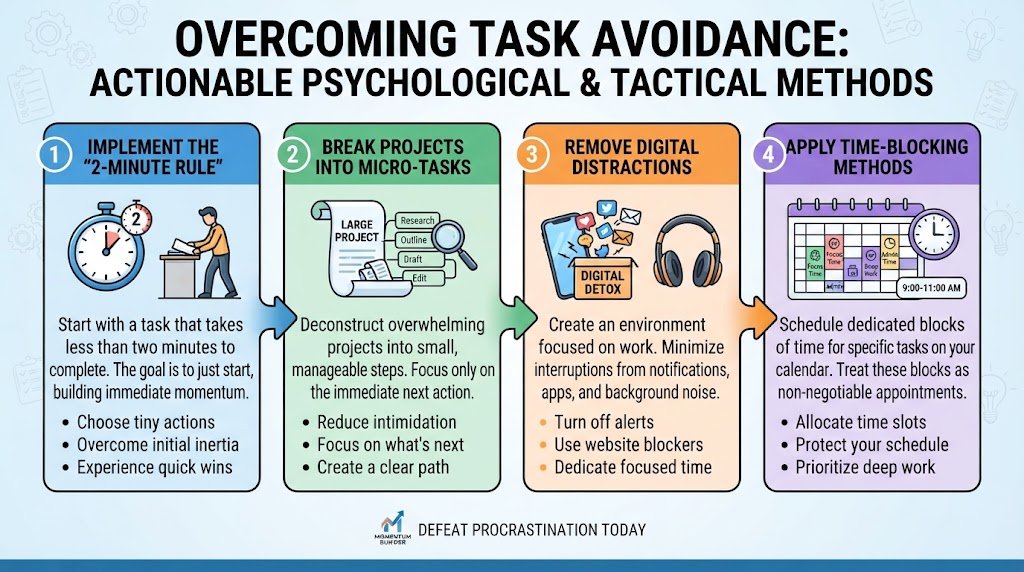
Overcoming procrastination requires shifting focus away from the overwhelming scope of a project and toward manageable, immediate actions. Because procrastination is an emotional regulation issue, the most effective strategies are designed to lower anxiety, reduce friction, and make starting effortless.
5 Simple Techniques to Beat Procrastination
Breaking the cycle of delay depends on practical, bite-sized interventions that bypass the brain’s defense mechanisms against difficult tasks.
The 2-Minute Rule: If a task takes less than two minutes to complete, do it immediately. For larger projects, commit to working on them for just two minutes to eliminate the initial resistance of starting.
The Pomodoro Technique: Work with intense, uninterrupted focus for 25 minutes, followed by a mandatory 5-minute break. This prevents mental burnout and makes overwhelming duties feel approachable.
Task Breakdown: Chop intimidating assignments into tiny, specific micro-steps (e.g., instead of “write research paper,” write “find three sources and draft an outline”).
Eliminate Digital Friction: Put phones in another room or use website blockers to remove the temptation of easy distractions during focused blocks of time.
Forgive Past Delays: Research shows that self-blame and guilt increase stress, which fuels further procrastination. Acknowledging a slip-up and starting fresh reduces future avoidance.
The Best Long-Term Cure for Chronic Procrastination
Quick tricks help in the moment, but lasting behavioral change requires addressing the emotional triggers behind chronic task avoidance.
Identify the Emotional Root: Ask yourself what uncomfortable feeling—boredom, fear of failure, or confusion—is causing you to avoid the task, and address that emotion directly.
Redefine Success: Shift away from rigid perfectionism toward a growth mindset that values progress, iteration, and completed drafts over flawless first attempts.
Frequently Asked Questions
What is a simple word for procrastination?
According to the text-decoration: Dictionary, a simple synonym for procrastination is delay or postponement. In everyday language, people often use casual phrases like putting things off, stalling, or dragging your feet.
How do we call someone who procrastinates?
An individual who routinely puts off tasks is called a procrastinator. When this behavior becomes an ingrained, long-term habit that repeatedly disrupts personal or professional goals, they are often referred to as a chronic procrastinator.
Do we have different meanings of procrastination in different contexts?
While the core psychological definition of avoiding tasks due to emotional discomfort remains constant, its contextual meaning shifts depending on the environment. In academics, it manifests as exam cramming; in the workplace, as missed project deadlines; and in everyday life, as neglected personal chores or deferred financial admin.
What type of people procrastinate the most?
Individuals who score low in conscientiousness and high in neuroticism exhibit the highest rates of procrastination. People crippled by perfectionism, low self-efficacy, or an intense fear of failure also experience severe task avoidance because difficult responsibilities trigger overwhelming stress.