Jump to:
ToggleJournaling Methods & Styles: The Ultimate Guide to Daily Techniques & Formats
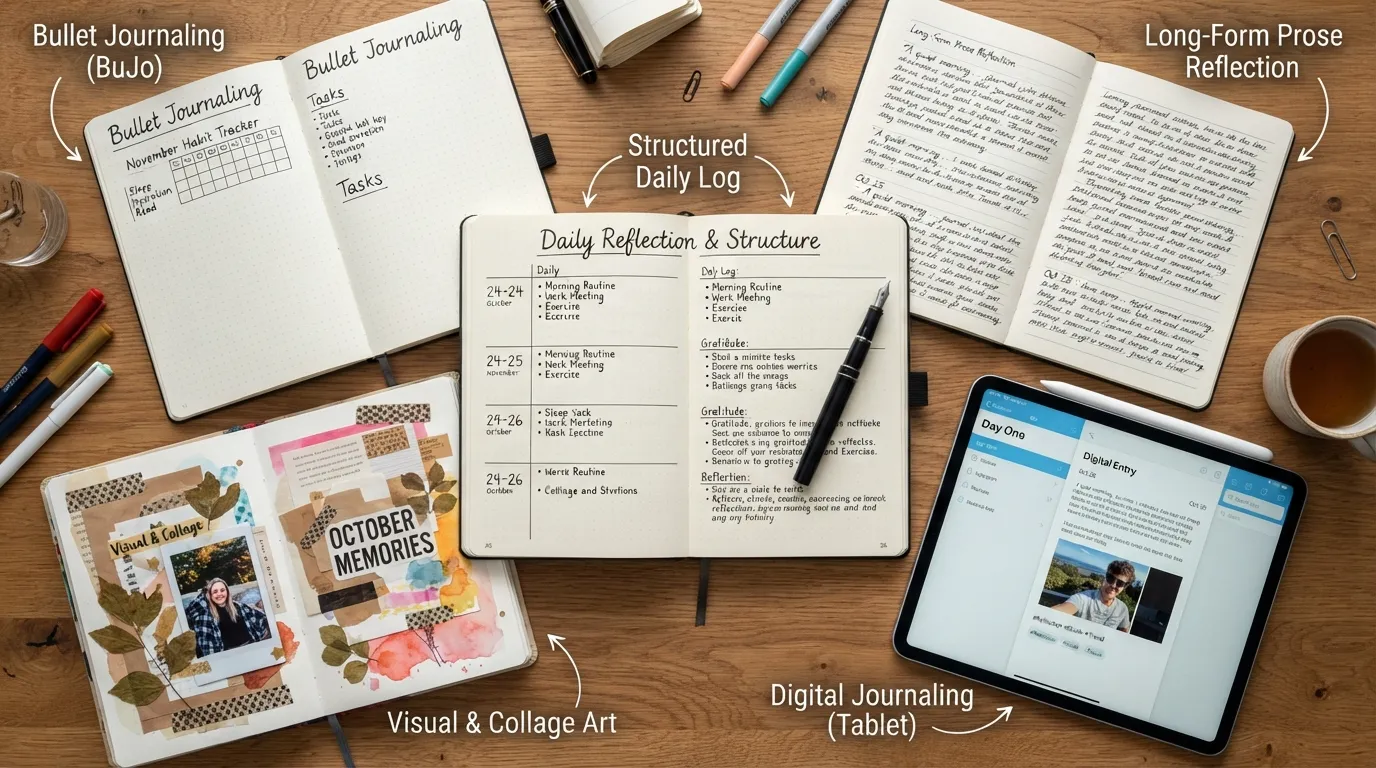
Journaling is one of the most adaptable tools available for personal development. Whether you use it for self-reflection, strategic daily planning, creative expression, mental decluttering, memory keeping, or emotional processing, keeping a journal helps translate internal thoughts into tangible clarity.
However, there is no single “correct” way to keep a journal. The key to building a sustainable daily practice lies in finding an approach aligned with your specific goals, daily schedule, and personality. A technique that suits a structured professional planning a busy work week will differ completely from what works for someone managing stress or seeking creative inspiration.
This ultimate guide breaks down the most effective journaling techniques, comparing formats, structures, and daily practices to help you select, customize, and maintain the ideal journaling method for your lifestyle.
Quick Answer: Journaling methods are structured, repeatable systems designed to record thoughts, experiences, plans, emotions, or observations. Popular journaling styles range from unstructured free-form writing to hyper-organized frameworks like the Bullet Journal, cognitive-behavioral techniques like CBT thought logs, rapid daily check-ins such as the 3-3-3 or 3-2-1 methods, and creative formats like art or dream journaling.
Choosing Your Journaling Path
What Are Journaling Methods, Styles, Types, and Formats?
To build a consistent journaling practice, it helps to understand how different aspects of writing interact. People often use terms like “method,” “style,” “type,” and “format” interchangeably, but they represent distinct elements of your practice. Clarifying these definitions ensures you choose tools and structures aligned with your personal goals.
Your journaling purpose is your foundational “why”—the reason you put pen to paper, such as improving focus or managing stress. A journaling method is the specific process or step-by-step framework you use to capture information. Your journaling style reflects how you express thoughts within that framework, whether through flowing prose or concise lists. The journal type defines the core subject matter of the notebook, while the journal format is the physical or digital medium housing your entries.
Journaling Method
A journaling method is a repeatable system or step-by-step structure used to write an entry. Methods dictate the rules or workflow of your writing session.
Freewriting: Continuous stream-of-consciousness writing without editing or stopping.
3-3-3 Method: A structured prompt system focusing on priorities, gratitudes, or observations in sets of three.
3-2-1 Method: A rapid reflection framework (e.g., 3 wins, 2 lessons, 1 main goal).
Rapid Logging: Short, bulleted entries categorized by symbols, popularized by the Bullet Journal system.
CBT Thought Records: A structured cognitive-behavioral framework designed to analyze and reframe negative thoughts.
Journaling Style
A journaling style describes the creative or structural voice you use to convey information.
Reflective: Thoughtful, analytical prose focused on internal feelings and lessons learned.
Narrative: Storytelling format detailing events in chronological sequence.
Visual: Incorporating sketches, doodles, mind maps, or diagrams alongside text.
List-Based: Concise, bulleted entries focused on brevity and scannability.
Structured: Template-driven writing that follows fixed prompts every session.
Creative: Uninhibited exploration utilizing poetry, fiction, or artistic layouts.
Journal Type
A journal type categorizes the notebook based on its dedicated topic or subject matter.
Gratitude Journal: Focused exclusively on recording appreciations and positive experiences.
Dream Journal: Used immediately upon waking to record dreams and subconscious patterns.
Travel Journal: Dedicated to documenting itineraries, cultural experiences, and trip memories.
Reading Journal: Tracks book logs, key quotes, chapter summaries, and literary reflections.
Goal Journal: Centers on habit tracking, milestone planning, and long-term ambition mapping.
Journal Format
A journal format refers to the structural medium or layout used to contain your writing.
Lined Notebook: Traditional lined pages best suited for long-form narrative prose.
Dot-Grid Notebook: Flexible grid layout ideal for custom spreads, tracking, and bulleting.
Blank Journal: Unlined pages offering complete freedom for sketching and unstructured writing.
Guided Journal: Pre-printed notebooks containing specific daily prompts and exercises.
Digital App: Software or note-taking apps offering searchable, multi-device accessibility.
Audio Journal: Voice recordings capturing spoken thoughts for quick, hands-free reflection.
Journaling Terms Explained
| Term | Meaning | Practical Example |
|---|---|---|
| Purpose | The underlying objective or reason for writing | Improve daily focus and self-awareness |
| Method | The specific process or framework applied | Rapid logging via bullet points |
| Style | The tone and form of expression used | Reflective prose mixed with short summaries |
| Type | The dedicated subject focus of the journal | Reading log and literary commentary |
| Format | The physical or digital medium of choice | Dot-grid paper notebook |
Journal vs. Diary: Are They the Same?
While people often use the terms interchangeably in everyday conversation, distinct nuances separate a journal from a diary. Traditionally, a diary functions as a chronological, day-to-day record of personal events, occurrences, and personal experiences. In contrast, a journal offers a broader, more flexible toolkit. Beyond simple event-logging, journals frequently incorporate self-reflections, habit trackers, creative brainstorming, long-term goal setting, mind maps, and structured prompts. To understand how these distinct recording styles affect your writing habit, explore our full breakdown on journal vs diary.
Neither term carries a single, universally enforced definition, and modern writers frequently blend both concepts into a single hybrid practice. However, distinguishing between their typical characteristics helps you select the right framework for your personal goals.
Main Difference Between a Journal and a Diary
| Feature | Diary | Journal |
|---|---|---|
| Structure | Strictly chronological daily entries | Flexible structure; chronological or topic-based |
| Content Focus | Records specific daily events and experiences | Explores deep reflection, goal planning, and ideas |
| Format & Style | Predominantly personal narrative prose | Blends prose, lists, trackers, sketches, or diagrams |
| Primary Purpose | Private record of life events | Versatile tool for mental clarity and personal growth |
For a deeper dive into choosing between a event-focused log or a multidimensional workspace, read our guide on the difference diary and journal.
What Is the Difference Between a Diary and a Journal?
Understanding what is the difference between a diary and a journal comes down to intent and structure. A diary primarily logs sequential daily events and personal experiences in narrative form. A journal is a multi-purpose tool designed for deeper self-reflection, planning, creative exploration, and habit tracking, often utilizing diverse formats beyond simple chronological entries.
What Are the Seven Main Types of Journals?
There is no universally official list of seven journal types. For practical use, journals can be grouped into reflective, gratitude, productivity, psychology-informed, creative, memory-based, and dream-related journals. Categorizing journals this way helps individuals select the framework best suited to their lifestyle, emotional needs, and organizational goals.
Seven Journal Types at a Glance
| Type | Main Purpose | Best For | Example |
|---|---|---|---|
| Reflective | Understanding experiences | Self-awareness | Freewriting |
| Gratitude | Noticing positive moments | Appreciation | Blessings journal |
| Productivity | Organizing tasks and goals | Planning | Bullet Journal |
| Psychology-informed | Examining thoughts and emotions | Structured reflection | CBT thought record |
| Creative | Visual or artistic expression | Creativity | Art journal |
| Memory-based | Preserving experiences | Memory keeping | Travel journal |
| Dream-related | Recording dreams and nightmares | Pattern tracking | Dream journal for nightmares |
1. Reflective Journaling
Reflective journaling centers on processing daily experiences, internal dialogues, and emotional reactions. By writing out unstructured thoughts through stream-of-consciousness writing or guided daily logs, this approach builds deep self-awareness. It helps writers evaluate how they responded to challenges, what they learned from interactions, and how their personal values align with their daily actions.
2. Gratitude and Positive Journaling
Gratitude journaling shifts cognitive focus toward positive moments, personal wins, and overlooked daily benefits. Common practices include writing down “three good things,” recording daily wins, or maintaining dedicated appreciation entries. A popular variations of this approach is a blessings journal, which encourages writing detailed entries about supportive relationships, unexpected kindnesses, or simple daily comforts to foster contentment and resilience.
3. Productivity and Planning Journals
Productivity-focused journals bridge the gap between daily self-reflection and actionable task management. These systems combine goal setting, project planning, and routine tracking into a unified layout. Popular formats include:
Bullet Journaling: A customizable rapid-logging system for tasks, events, and notes.
Goal Journals: Dedicated setups for breaking down long-term objectives into monthly milestones.
Habit Trackers: Visual grids designed to monitor routine consistency over time.
Project & Daily Planner Journals: Hybrid workspaces that pair daily schedules with project breakdowns.
4. Psychology-Informed Journals
Psychology-informed journaling uses evidence-based frameworks to help track emotional patterns, identify cognitive distortions, and cultivate resilience. Key approaches include cognitive-behavioral therapy (CBT) thought records, mood trackers, trigger logs, and self-compassion exercises designed to reframe harsh self-talk.
Mental Health Disclaimer: While psychology-informed journaling methods can support self-reflection and emotional clarity, they are wellness tools and should not replace professional mental health care or therapeutic treatment.
5. Creative and Visual Journals
Creative journaling moves beyond standard prose to incorporate multimedia, design, and artistic expression. Writers and artists use these formats to overcome creative blocks and experiment with visual ideas. Common styles include:
Art Journals & Collage Journals: Mixing watercolor, acrylics, ephemera, and cutouts with written prompts.
Junk & Sketch Journals: Using recycled materials, scrap papers, and raw sketches for informal creation.
Black-Paper Journals & Blackout Poetry: Creating bold visual layouts using gel pens on dark pages or redacting newspaper text to create original poems.
6. Memory and Subject-Specific Journals
Memory-based and niche journals focus on documenting specific activities, ongoing learning, or life milestones over time. Rather than covering general daily thoughts, these journals serve as targeted archives:
Travel & Nature Journals: Documenting trip itineraries, local cultures, field observations, and outdoor flora/fauna.
Reading & Learning Journals: Capturing book reviews, lecture notes, key insights, and educational progress.
Work Journals & Commonplace Books: Logging professional achievements and centralizing quotes, ideas, and research snippets in one reference volume.
7. Dream and Sleep Journals
Dream and sleep journals are kept near the bed to capture subconscious thoughts immediately upon waking. Writers use them to improve dream recall, monitor sleep quality, log recurring imagery, and record lucid dream observations. For those managing persistent sleep disruptions or unsettling dreams, maintaining a dedicated dream journal for nightmares can help identify stress triggers, track sleep quality patterns, and reframe unsettling dream narratives alongside sleep hygiene routines.
How to Choose the Right Journaling Method
Selecting the best journaling method comes down to matching a technique with your primary objectives, available time, and preference for structure. Rather than forcing yourself into a rigid system, choose an approach that fits seamlessly into your daily lifestyle.
Choose According to Your Main Goal
Your primary objective dictates which journaling framework will yield the most value:
Understand thoughts & emotions: Select unstructured or psychology-informed writing like freewriting or CBT thought records.
Organize daily life & tasks: Focus on productivity frameworks like rapid logging or time-block planning.
Build gratitude & optimism: Opt for targeted list-based entries like daily wins or gratitude logs.
Preserve memories: Use narrative daily logs, travel notebooks, or life logs.
Improve creativity: Embrace visual formats, stream-of-consciousness pages, or art journaling.
Track dreams: Keep a dedicated bedside notebook for immediate morning recall.
Support self-improvement: Apply structured reflection frameworks featuring weekly reviews and goal setting.
Choose According to Time Available
Consistency depends on choosing a method that fits your daily schedule.
One to Three Minutes
One-line journal: Record a single impactful sentence summarizing your day.
Mood plus reason: Log your dominant emotion along with a brief explanation.
Three good things: List three positive moments or appreciations.
Daily highlight: Write down the single most memorable event of the day.
Five to Ten Minutes
3-3-3 method: Record three priorities, three gratitudes, and three observations.
3-2-1 method: Note three wins, two lessons learned, and one primary goal.
Gratitude journaling: Complete short structured prompts highlighting appreciation.
Brain dump: Rapidly offload urgent thoughts onto paper to clear mental clutter.
Daily review: Briefly assess progress, completed tasks, and evening reflections.
Fifteen Minutes or More
Morning Pages: Complete three pages of stream-of-consciousness longhand writing.
Expressive writing: Deeply explore personal experiences, emotions, or complex challenges.
Art journaling: Combine visual art, collage, paint, and written reflection.
Weekly reflection: Conduct an end-of-week review of achievements and upcoming objectives.
Detailed dream entries: Write extensive narrative breakdowns of subconscious dream patterns.
Choose According to Structure Preference
Low Structure: Best for freeform thinkers. Examples: Freewriting, morning pages, art journaling.
Medium Structure: Ideal for guided clarity. Examples: Prompts, gratitude lists, daily logs.
High Structure: Designed for systematic organization. Examples: CBT thought records, Bullet Journaling, 3-3-3, 3-2-1.
Journaling Method Selector
| Goal | Recommended Method | Time | Structure | Main Drawback |
|---|---|---|---|---|
| Mental clarity | Freewriting | 10 min | Low | Can become repetitive without intent |
| Daily organization | Bullet Journal | 5–10 min | High | Can become overcomplicated to maintain |
| Positive focus | Gratitude journal | 5 min | Medium | May feel repetitive over long periods |
| Self-improvement | Structured reflection | 10 min | High | Requires consistent review to be effective |
| Memory keeping | Daily log | 3–10 min | Medium | Missed days may discourage continuity |
| Creativity | Art journal | Flexible | Low | Requires art supplies and physical space |
| Dream tracking | Dream journal | 5–15 min | Medium | Requires immediate recording upon waking |
Choose Your Method in 30 Seconds
Want freedom? Try freewriting.
Want structure? Try 3-2-1.
Want organization? Try Bullet Journaling.
Want emotional analysis? Try a CBT thought record.
Want creativity? Try art journaling.
Want quick consistency? Try one-line journaling.
Popular Daily Journaling Methods
Freewriting
Freewriting is an unstructured technique designed to bypass your internal editor. You set a timer—typically for 5 to 10 minutes—and write continuously without pausing to correct grammar, spelling, or sentence structure. The objective is to record whatever occupies your mind, transferring raw thoughts directly onto the page. To ensure the session leads to practical clarity, always conclude your entry by identifying one actionable next step or key realization.
Simple Freewriting Prompt
What is taking up the most space in my mind today?
Morning Pages
Originating from Julia Cameron’s creative recovery framework, Morning Pages are traditionally written immediately upon waking. This practice involves writing three longhand pages of stream-of-consciousness thought to clear mental clutter, release anxiety, and unlock creative energy before daily distractions set in. While the traditional rule calls for three full pages, adapting the practice to one or two pages is just as effective for those with busy morning routines.
One-Line-a-Day Journaling
One-line-a-day journaling requires writing just a single sentence, key event, notable lesson, or primary emotion each day. This low-friction format removes the intimidation of blank pages, making it ideal for beginners, busy professionals, or anyone building a consistent writing habit. For those who prefer physical notebooks, utilizing a preformatted daily journal book offers a structured layout with dated lines to track multi-year entries effortlessly. To learn how to maintain consistency across months and years, explore our guide to keeping a day by day journal.
The 3-3-3 Journaling Method
Note on Variations: The 3-3-3 journaling method has several online variations and is not a universally standardized psychological framework. The structure below represents our recommended version for daily clarity.
Recommended 3-3-3 Format
3 meaningful events or accomplishments: Log key milestones or completed tasks.
3 thoughts, emotions, or appreciations: Note mental states or positive observations.
3 priorities or next steps: Define actionable focus areas for the upcoming day.
Best Use Cases
Evening reflection: Reviewing progress and closing out the workday.
Gratitude: Balancing practical wins with positive appreciation.
Daily planning: Setting clear, manageable targets for tomorrow.
Short structured entries: Maintaining momentum when time is limited.
The 3-2-1 Journaling Method
The 3-2-1 journaling method uses a descending numerical prompt system to distill daily experiences into key takeaways. Different publishers and creators use varying prompt combinations, but the core objective remains keeping daily reflection concise and actionable.
Recommended 3-2-1 Daily Format
3 things learned or appreciated: Capture unexpected insights or gratitude.
2 things enjoyed or handled well: Highlight personal wins or positive interactions.
1 priority for tomorrow: Define the single critical task that matters most.
Weekly Variation
3 wins: Major achievements across the week.
2 challenges: Obstacles encountered and how they were navigated.
1 adjustment: One specific change to implement in the coming week.
Gratitude Journaling
Gratitude journaling focuses on recognizing positive experiences to cultivate mental resilience and perspective. Rather than listing generic phrases like “my family” or “good weather,” focus on specific, detailed moments—such as a helpful comment from a colleague or a quiet morning coffee—and note why it mattered. Crucially, avoid forcing optimism when experiencing genuine hardship; authentic gratitude can exist alongside difficult emotions without invalidating them.
The Five Whys Method
Adapted from root-cause analysis in systems engineering, the Five Whys method helps unpack complex emotions, stubborn problems, or recurring habits. You begin with a single problem statement (e.g., “I felt overwhelmed at work today”), ask why it happened, and use the response to form the next question. Repeating this five times uncovers the underlying root cause rather than superficial symptoms. Always end with a concrete solution rather than staying stuck in endless self-analysis.
The Three-Act Journal Method
The Three-Act Journal method uses classical story structure to evaluate daily experiences as meaningful narratives rather than random events.
Act One — Context
What happened? State the essential facts, setting, and events of the day objectively.
Act Two — Tension
What conflict, challenge, or decision appeared? Identify the primary friction point, internal doubt, or obstacle you encountered.
Act Three — Meaning
What changed, and what comes next? Reflect on what the experience taught you and how you will navigate similar situations in the future.
Thank–Learn–Connect Journaling
The Thank–Learn–Connect method provides a simple, three-part framework designed to foster appreciation, personal growth, and interpersonal awareness daily:
Thank: Record one specific detail, gesture, or comfort you appreciated today.
Learn: Document one lesson, insight, skill, or realization you gained during the day.
Connect: Note a meaningful interaction with another person, an inspiring idea, or a deep moment of self-alignment.
Bullet Journaling and Dot-Grid Methods
What Is the Bullet Journal Method?
Created by designer Ryder Carroll, the official Bullet Journal Method is an analog organization system that combines daily planning, rapid logging, task tracking, personal notes, and mindfulness reflection into a single notebook. Rather than using rigid pre-printed planners, it uses a flexible framework designed to adapt to your changing needs.
Rapid Logging
Rapid logging uses short, structured bullet points paired with simple symbols (signifiers) to quickly record entries:
Tasks ($\cdot$): Action items to complete.
Events ($\circ$): Date-specific experiences, appointments, or occurrences.
Notes ($-$): Facts, ideas, thoughts, or observations.
Index and Logs
Index: The table of contents at the front of the notebook to locate entries easily.
Future Log: A multi-month overview for recording long-term goals, events, and future commitments.
Monthly Log: A two-page spread featuring a monthly calendar alongside a master task list.
Daily Log: A flexible space for day-to-day rapid logging of tasks, appointments, and quick thoughts.
Collections and Migration
Collections: Thematic pages created to group related information—such as book lists, habit trackers, or project plans.
Migration: The monthly review process of reviewing open tasks and transferring relevant items forward while crossing out tasks that no longer matter.
How Dot-Grid Journals Work
Dot-grid notebooks feature subtle arrays of lightly printed dots that provide subtle alignment guides without the heavy visual distraction of traditional ruled or graph paper. They offer the ideal balance between structural guidance and total creative freedom.
- ☐ Finalize section outline
- ☑ Review analytics report
- o 10:00 AM — Team Sync
- o 02:30 PM — Client Call
- • Key takeaways from meeting
- • Need follow-up email on API
High energy in morning session; focus on 1 main task tomorrow.
To learn step-by-step techniques for setting up your own pages and custom trackers, read our detailed guide on how to use a dotted journal. You can also explore flexible layouts and grid strategies in our tutorial on how to use a dot grid journal.
Minimalist vs. Decorative Bullet Journaling
| Feature | Minimalist Bullet Journaling | Decorative Bullet Journaling |
|---|---|---|
| Setup Time | Fast and straightforward | Time-intensive, highly visual |
| Core Focus | Pure function, speed, and clarity | Blends productivity with artistic expression |
| Required Supplies | A notebook and a single pen | Markers, stickers, tape, and colored pens |
| Maintenance | Low effort; easy to sustain long term | High effort; requires ongoing creative dedication |
Remember: A Bullet Journal does not have to be artistic, decorative, or picture-perfect. The core purpose of the system is mindful productivity and functional clarity, not visual complexity.
Psychology-Informed Journaling Methods
Mental Health Disclaimer: Journaling can be a valuable tool for emotional reflection, stress management, and coping, but it is not a diagnostic tool, emergency service, or guaranteed replacement for professional mental health treatment. If you are experiencing severe distress, emotional crisis, or underlying mental health challenges, please consult a qualified healthcare provider or licensed therapist.
What Do Psychologists Say About Journaling?
Psychological research suggests that structured writing can clarify complex emotional experiences and strengthen self-regulation. According to research on expressive writing, putting emotional experiences into words helps translate overwhelming thoughts into coherent narratives. Furthermore, a systematic review of journaling for mental health indicates that structured reflective practices can improve emotional awareness, reduce stress symptoms, and support personal resilience.
However, outcomes vary significantly depending on the method used, individual personality traits, and specific life circumstances. Writing is not universally beneficial in every scenario; a comprehensive meta-analysis of expressive writing revealed that unstructured journaling can sometimes prove counterproductive when it devolves into repetitive rumination—endlessly replaying negative feelings without shifting toward constructive reflection or practical problem-solving.
Expressive Writing
Expressive writing encourages deep emotional processing through short, focused writing sessions. When exploring a difficult event or emotional hurdle, structure your entry using these five guiding questions:
What happened? Objectively outline the situation without immediate judgment.
What did I think and feel? Identify the underlying cognitive reactions and core emotions triggered.
Why was it meaningful? Reflect on why this specific event affected your values, self-image, or goals.
What do I understand differently now? Reframe the situation to extract a broader perspective or lesson.
What support or action may help? Identify practical steps or external resources that can assist moving forward.
CBT Journaling and Thought Records
Cognitive Behavioral Therapy (CBT) journaling relies on a structured examination of the connections between external situations, automatic thoughts, emotional reactions, and subsequent behaviors. Practicing a standard CBT thought record helps uncover cognitive distortions and replace unhelpful thinking patterns with balanced, realistic assessments.
Situation: What specific event, conversation, or memory triggered the distress?
Thoughts and Emotions: What immediate, automatic thought appeared, and what emotion (with its intensity rating) followed?
Evidence For and Against: What concrete facts validate this thought, and what objective evidence contradicts or challenges it?
Balanced Interpretation: What is a more proportionate, realistic, and constructive way to view the situation?
Next Action: What practical, healthy action can be taken right now?
Mood and Trigger Journaling
Mood and trigger logs help identify environmental, interpersonal, or internal factors that influence emotional changes over time.
Recommended Log Fields
Situation: Context, time of day, and environment.
Mood & Intensity: Specific emotion rated on a 1–10 scale.
Body Sensations: Physical cues (e.g., muscle tension, racing heart, fatigue).
Automatic Thought: The underlying interpretation driving the mood.
Response: How you reacted behaviorally to the feeling.
Result: The eventual outcome or consequence of that response.
Caution: Avoid tracking every minor shift in mood compulsively. Fixating excessively on subtle emotional fluctuations throughout the day can heighten anxiety and trigger hypervigilance.
Self-Compassion Journaling
Self-compassion journaling helps interrupt harsh internal self-criticism by rechanneling empathy inward. Use these three core prompts whenever you encounter failure, setback, or self-doubt:
What was difficult? Acknowledge the hardship or mistake without minimizing or exaggerating it.
What would I say to a close friend? Write out the exact encouraging, understanding words you would offer a friend in the same position.
What supportive action do I need? Identify one gentle, comforting step you can take for yourself today.
What Is the Dark Side of Journaling?
While keeping a journal is widely recognized as a valuable tool for personal growth, it is not without drawbacks. As highlighted in resources on journaling for mental health and wellness, the practice can sometimes become counterproductive or emotional exhausting if approached without awareness. Recognizing potential pitfalls helps ensure writing remains a constructive habit rather than a source of stress or anxiety.
Rumination Instead of Reflection
Unstructured writing can easily degenerate into passive rumination—replaying negative thoughts repeatedly without moving toward resolution or practical solutions.
Key Signs of Journaling Rumination
Repeating the same story across multiple entries without shifting perspective.
Rehearsing hypothetical arguments or past disagreements endlessly.
Ending sessions feeling more distressed or anxious than when you began.
Reaching no new understanding or actionable insights.
Using writing to avoid taking real-world action.
Reflection-to-Action Questions
To break out of unhelpful loops, ask yourself these five questions:
What is fact? (Separate objective occurrences from emotional assumptions.)
What is interpretation? (Identify personal stories or biased assumptions.)
What is within my control? (Isolate factors you can directly influence.)
What support do I need? (Identify external help, advice, or resources.)
What is my next action? (Commit to one small, concrete step forward.)
Emotional Overload and Re-Triggering
Writing about traumatic or highly distressing experiences can sometimes overwhelm your coping mechanisms and increase psychological distress. You do not need to force yourself to write about deeply painful memories or disclose every distressing thought on paper. If an entry triggers intense anxiety or physical distress, feel empowered to shorten the writing session, shift to a grounding exercise, or pause writing entirely.
Journaling as Avoidance
Journaling can become a subtle form of procrastination when used as a substitute for action. Common examples include:
Writing about a personal conflict repeatedly instead of having the necessary direct conversation.
Refining plans and schedules over and over without executing the initial tasks.
Designing habit trackers and aesthetic goals instead of doing the actual work required to achieve them.
Perfectionism and Broken-Streak Anxiety
The pressure to maintain an immaculate journal can undermine its benefits. Many writers struggle with “broken-streak anxiety”—the fear that missing a single day invalidates their entire effort—or the fear of “ruining” a fresh, pristine notebook with messy handwriting. Comparing your everyday entries to curated, decorative spreads on social media often fuels unnecessary self-criticism and artistic perfectionism.
Compulsive Tracking
While monitoring routines can build self-awareness, over-tracking can become an obsessive burden. Be cautious of compulsively logging every minor variation in:
Moods and emotional shifts
Food intake and calorie counts
Sleep duration and nighttime wakefulness
Habit completion and productivity metrics
Privacy Risks
Because journals often contain your most private thoughts, concerns over privacy can create tension and inhibit self-expression. Key risks to consider include:
Physical security: Leaving unkeyed paper notebooks in shared living areas.
Digital vulnerability: Storing unencrypted notes or failing to use password-protected apps.
Shared devices & Cloud syncs: Automated backups unintentionally syncing personal entries across family devices or shared cloud drives.
Third-party privacy: Writing detailed personal information about family, friends, or colleagues.
When to Pause Journaling
Pause or modify your journaling practice if writing repeatedly increases your distress, interferes with sleep or daily functioning, or causes you to relive painful memories without gaining emotional clarity or practical support. Journaling should support your mental well-being, not diminish it.
Gratitude, Blessings, and Positive Journaling
Positive journaling techniques help reframe daily focus toward appreciation, personal growth, and resilience. Rather than ignoring life’s challenges, these methods highlight meaningful moments and personal wins to build a balanced perspective.
Gratitude Journal
To make gratitude journaling impactful, avoid generic bullet points. Use this structured format for deeper reflection:
What happened? Identify a specific, positive interaction or moment from your day.
Why did it matter? Reflect on why this moment brought joy, relief, or satisfaction.
Who or what contributed? Recognize the people, conditions, or actions that made it possible.
What do I want to remember? Capture the sensory details or core feeling you want to preserve.
Blessings Journal
A blessings journal expands traditional gratitude into a practice of quiet appreciation or spiritual mindfulness. Whether framed around religious faith, spiritual connections, or simply a deep appreciation for life, this format invites you to record supportive relationships, meaningful coincidences, answered prayers, and moments of inner peace.
Wins Journal
A wins journal focuses on personal agency, capability, and tangible progress by documenting daily achievements:
What was completed: Log tasks, projects, or milestones finished.
What challenge was handled: Note obstacles navigated or difficult conversations held.
What skill was used: Identify personal strengths applied during the day.
What should happen next: Define the next logical step forward based on today’s progress.
Positive Journaling Without Toxic Positivity
Practicing positive journaling does not mean suppressing genuine sadness, anger, or anxiety. True emotional resilience allows gratitude and personal wins to exist alongside grief, stress, or disappointment. Avoid forcing optimism when experiencing hardship, and remember that positive writing is a supportive tool—not a substitute for systemic solutions, physical rest, or professional support during serious crises.
Goal and Self-Improvement Journaling
Goal-focused journaling converts vague ambitions into structured, actionable progress. By tracking milestones and assessing personal growth on paper, you transform long-term aspirations into clear daily habits.
Goal Journaling
To keep goals actionable, structure entries beyond simple wish lists:
Desired Outcome: Define the exact, measurable target you are pursuing.
Motivation: Clarify why this goal matters to maintain commitment when challenges arise.
Milestones: Break the master objective into smaller, time-bound checkpoints.
Obstacles: Anticipate potential friction points, distractions, or skill gaps early.
Daily Actions: Specify the small, repeatable habits required to build momentum.
Review Date: Schedule fixed weekly or monthly intervals to evaluate progress.
Future-Self Journaling
Future-self journaling helps bridge the gap between present behavior and long-term vision. Reflect on these core prompts during planning sessions:
What values and standards does my future self prioritize?
Which of my current daily habits contributed most to that future state?
What unproductive habit or distraction did I choose to abandon?
What single concrete action must I begin today to stay aligned with that vision?
What Is Reverse Journaling?
Methodology Note: Reverse journaling is a creative visualization technique rather than a standardized clinical or psychological methodology.
Reverse journaling involves adopting the perspective of a future version of yourself who has already achieved your target goal. From that future vantage point, you look backward to map out the specific sequence of decisions and actions that brought success. You then convert those imagined historical steps into realistic actions for your present routine.
Reverse Journaling Format
Future Date: Select a specific date in the future (e.g., August 7, 2027).
Desired Result: Describe your completed achievement as a present-day reality.
Steps That Led There: Trace the key actions and milestones in reverse order.
Main Obstacle: Identify the biggest hurdle you had to overcome along the way.
First Present-Day Action: Commit to the immediate first step you must take today.
Structured Self-Improvement Journaling
Using a consistent writing in journal format keeps self-reflection targeted and objective. To streamline your daily check-ins, adopt a pre-built layout that evaluates progress without unnecessary fluff.
Review the structured journal outline above before filling in your daily metrics:
Current Focus: The specific skill, habit, or mindset you are refining.
Desired Improvement: The target state or measurable upgrade you are working toward.
Evidence of Progress: Objective proof, metrics, or behaviors showing improvement.
Challenge: Internal or external obstacles encountered during the process.
Experiment: A new approach or habit change to test over the coming days.
Next Adjustment: The immediate modification needed based on recent outcomes.
To jumpstart your habit tracking and personal growth reviews, download our complete self improvement journal template.
Creative, Visual, and Experimental Journaling
Creative journaling expands beyond prose, using visual media, textures, and experimentation to capture ideas and emotions. These methods prioritize expression over neatness, offering dynamic alternatives for visual thinkers and those facing writer’s block.
Art Journaling
Art journaling integrates visual expression with personal reflection. It utilizes drawing, painting, vibrant color palettes, personal symbols, and concise captions to convey thoughts that prose might miss. You can experiment with mixed media by layering materials such as acrylics, watercolors, ink, and pasted papers. Crucially, professional artistic skill is not a requirement; the objective is authentic creative release rather than technical perfection.
Junk and Collage Journaling
Junk journaling is the art of repurposing everyday ephemera into a cohesive record. It thrives on found materials, giving new life to items that would typically be discarded. Common materials to collage and layer into entries include:
Tickets, stubs, and boarding passes
Interesting receipts or business cards
Pieces of maps, book pages, or magazines
Product packaging, labels, or tags
Personal photographs and printed images
Scraps of fabric, lace, or ribbon
Personal notes, lists, or sketches
How to Make a Journal
For those seeking a completely personalized canvas, creating your own notebook allows you to customize the paper type, page count, and dimensions. Journal making involves selecting paper suitable for your preferred media (such as thick cardstock for art or lined paper for writing), deciding on a manageable size, and choosing a binding technique.
You can learn the step-by-step process—including binding methods and cover ideas—in our complete guide on how to make a journal.
What Is Blackout Journaling?
“Blackout journaling” is an ambiguous term that describes two completely different visual styles.
Black-Paper Journaling
This format utilizes a notebook constructed with black pages. Writers use opaque writing tools—such as white, metallic, or neon gel pens, or pastel pencils—to create high-contrast entries, illustrations, and decorative layouts.
Blackout Poetry Journaling
This is a form of found poetry. You begin with an existing page of printed text (from an old book or newspaper). You isolate specific words to create a new phrase, sentence, or poem, and then obscure the remaining, unselected text using markers, paint, or illustrations.
It was [STARS] bright and quiet.
jumps over the lazy dog.
Photo and Visual Journaling
Photo-based journals use imagery as the primary narrative device. These entries often focus on chronological memory-keeping and documentation. Popular variations include:
One photo per day: Capturing the daily highlight or essential moment.
Photo plus caption: Using the image to anchor a brief descriptive paragraph.
Digital photo diary: Maintaining sequential visual folders or albums.
Visual memory pages: Creating structured spreads around travel, events, or developmental milestones.
Memory and Subject-Specific Journaling Styles
Subject-specific journaling isolates a single domain of life—such as professional development, literary exploration, or personal travel—creating a targeted archive of experiences and insights.
Subject-Specific Journals at a Glance
| Journal Type | What to Record | Best Format |
|---|---|---|
| Travel journal | Places, events, cultural encounters, itineraries | Narrative prose paired with photos or ephemera |
| Reading journal | Quotes, reactions, book reviews, chapter summaries | Structured notes and rating templates |
| Nature journal | Weather conditions, seasonal shifts, flora, fauna | Field sketches paired with observation notes |
| Work journal | Key decisions, professional lessons, task progress | Dated chronological log |
| Learning journal | New skills, concepts, research, follow-up questions | Topic notes followed by reflection paragraphs |
| Commonplace book | Categorized ideas, quotes, excerpts, research snippets | Indexed thematic collection |
| Memory journal | Everyday milestones, family events, personal history | Daily logs or weekly narrative entries |
Memory Journaling
Memory journaling captures transient moments, family milestones, and everyday experiences that might otherwise fade over time. When documenting a specific experience, use these four guiding prompts:
What happened? Record the key sequence of events, settings, and timeline clearly.
Who was there? List the people present and their roles in the event.
What small detail may be forgotten? Capture sensory nuances—specific conversations, sights, sounds, or weather conditions.
Why did it matter? Reflect on why this specific memory holds personal value or significance.
Reading Journals and Commonplace Books
While both formats archive intellectual discovery, they serve distinct organizational purposes:
Reading Journals: Focus specifically on books, audiobooks, and literature. They typically track reading lists, book reviews, character analyses, structural notes, and personal reactions to full texts.
Commonplace Books: Function as an intellectual repository. Rather than focusing solely on literature, commonplace books compile quotes, ideas, observations, poetry, formulas, and article clippings from diverse sources, organized systematically using a custom index or thematic tagging.
Work and Project Journals
Work and project journals maintain a clear paper trail of your professional growth, career milestones, and operational decisions. Keeping a structured log helps during performance reviews, portfolio updates, and team debriefs.
Suggested Work Log Fields
Decision: The choice, policy, or project direction agreed upon.
Reason: The context, rationale, and data supporting the choice.
Action: The concrete operational steps taken to execute the decision.
Result: The measurable outcome, impact, or metric observed.
Lesson: Key takeaways, mistakes, or insights gained during the process.
Next Step: Immediate follow-up items or strategic adjustments needed.
Privacy Warning: Avoid logging confidential company data, proprietary code, client personal identifiable information (PII), or non-disclosure agreement (NDA) protected trade secrets in personal notebooks or unsecured digital apps.
Dream Journaling and Nightmare Tracking
Keeping a record of your dreams helps map subconscious patterns, trace stress triggers, and improve memory recall. When done systematically, it bridges the gap between nighttime sleep quality and daytime emotional awareness.
How to Keep a Dream Journal
According to the Sleep Foundation, consistency is the most important factor when learning how to keep a dream journal. Following these core steps helps preserve fragile dream memories before they fade:
Keep your notebook near the bed: Store your journal and pen within arm’s reach so you do not need to move or get up upon waking.
Record details immediately: Write down everything you remember the second you wake up, even if it is just a single image or emotion.
Log core elements: Note specific people, locations, dominant emotions, colors, and sensory details.
Separate description from interpretation: Record the objective details of the dream first before adding personal reflections or theories.
Review recurring themes: Periodically scan past entries to spot repeating symbols, environments, or emotional patterns.
Dream Observation vs. Dream Interpretation
It is important to distinguish between documenting a dream and analyzing its meaning. Dream observation is the factual process of recording what occurred. Dream interpretation is a subjective, personal hypothesis about why the dream happened. Universal “dream dictionaries” that claim specific symbols have fixed meanings across all individuals should not be treated as objective psychological diagnoses.
Nightmare Tracking
For individuals dealing with disturbing dreams, keeping a dedicated dream journal for nightmares helps identify environmental or psychological triggers and provides actionable data for health professionals. Utilizing a structured log clarifies whether distressing dreams correlate with stress, diet, late-night screen time, or schedule changes. Exploring the benefits of a dream journal in therapy sessions allows individuals to discuss recurring patterns, monitor emotional progress, and develop targeted coping strategies with their provider.
Recommended Nightmare Tracking Fields
Date & Wake Time: When the nightmare occurred.
Nightmare Summary: Objective description of events.
Emotional Intensity: Rating from 1–10.
Awakening: Did it wake you up abruptly?
Possible Trigger: Late meal, high stress, media, medication.
Recurring Theme: Repeated symbols or scenarios.
Daytime Effect: Fatigue, lingering anxiety, or mood shifts.
Questions for Professional: Specific points to discuss with a provider.
Nightmare Journaling vs. Imagery Rehearsal Therapy
While nightmare journaling focuses on recording and tracking disturbing dreams as they occur, Imagery Rehearsal Therapy (IRT) is an active, evidence-based intervention. As highlighted by VA Research, Imagery Rehearsal Therapy involves consciously rewriting or rescripting the nightmare scenario while awake—replacing distressing outcomes with neutral or positive endings—and mentally rehearsing the new narrative. IRT is a structured clinical protocol, not simply passive dream logging.
Safety Notice: Seek professional medical or psychological support if nightmares occur frequently, are linked to traumatic experiences, cause fear or avoidance of sleep, or significantly disrupt your daytime functioning.
What Should a Journal Entry Look Like?
A journal entry does not need to follow a rigid visual standard, but using a structured framework prevents aimless writing and ensures your sessions remain insightful and actionable.
Basic Journal Entry Structure
Every effective journal entry benefits from a clear, repeatable hierarchy that moves from objective context to subjective reflection and actionable outcomes:
Date: Establishes a chronological reference point for future reviews.
Optional Context (Time & Location): Anchors your mindset and physical environment.
Event or Prompt: Outlines the specific experience, thought, or question being explored.
Thoughts: Captures your cognitive reactions, assumptions, and logical evaluations.
Emotions: Identifies underlying feelings without immediate judgment.
Meaning or Lesson: Extracts the broader takeaway, insight, or reframing.
Next Action: Defines a clear, practical step forward based on your reflection.
Simple Daily Journal Format
Using a standardized daily journal template ensures consistency while keeping writing friction low:
Date:
Today’s main event:
What I noticed:
What I felt:
What I learned:
One thing I appreciated:
Tomorrow’s next step:
Completed Journal Format Example
Date: August 7, 2026 | Time: 8:30 AM
Main Event: Delivered the quarterly project kickoff presentation to stakeholders.
What I Noticed & Felt: I felt a sudden spike of anxiety right before opening my slides, noticing tense shoulders and shallow breathing. Once I began walking through the data, my cadence leveled out and I felt in control.
What I Learned: Anxiety is often just physical arousal before a high-stakes task; it doesn’t mean I am unprepared.
Appreciation: The team jumped in immediately during the Q&A to help clarify timeline technicalities.
Next Step: Send the follow-up summary email to project leads by noon today.
Review this complete journal format example to see how structured entry points translate directly into daily practice.
Additional Journal Examples
Depending on your goal, entry formats can be adapted to various styles:
Reflective Example: Stream-of-consciousness entries analyzing personal values or life changes.
Gratitude Example: Bulleted lists detailing specific appreciations and why they mattered.
Daily Log: Time-blocked chronologies tracking completed tasks, appointments, and quick observations.
Goal Journal Example: Target tracking paired with habit metrics and weekly review check-ins.
Dream Journal Example: Immediate morning records detailing subconscious themes and emotional states.
To explore real-world layouts across these different styles, review our full selection of journal samples. (If you are looking for a complete example of an journal to mirror for your morning routine, structured daily logs offer the most balanced starting point.)
List-Based Journal Format
For those who find long prose time-consuming, list-based journaling provides high clarity with low friction. Organize entries under short, scannable headers:
Wins: Key accomplishments and completed milestones.
Lessons: Mistakes made or insights gained.
Worries: Offloaded anxieties or stress points.
Ideas: Raw concepts, creative hooks, or project thoughts.
Decisions: Choices made and the rationale behind them.
Next Actions: Immediate, single-step tasks to execute.
Question-and-Answer Format
The Q&A format replaces blank pages with specific, targeted prompts. This structured style is ideal for:
Beginners building their first consistent writing habit.
Guided journals focused on specific themes like mindfulness or leadership.
CBT exercises challenging negative automatic thoughts.
Weekly reviews evaluating performance and personal growth.
Overcoming blank-page anxiety by providing immediate writing direction.
Lined, Dotted, Blank, Digital, Audio, or Video Journaling?
The medium you choose directly shapes your journaling experience. While paper notebooks offer tactile focus free from digital notifications, electronic and spoken media provide searchability, accessibility, and speed. Selecting the right format depends on whether you value visual freedom, structural guidance, or quick recording.
Journal Format Comparison
| Format | Best For | Main Advantage | Main Limitation |
|---|---|---|---|
| Lined | Long-form narrative prose | Clean, automatic line alignment | Less flexible for custom visual spreads |
| Dotted | Bullet Journaling & custom grids | Versatile structure for writing and drawing | Requires manual layout setup |
| Blank | Art, sketching, & mind maps | Total visual freedom without constraints | Harder to keep text lines horizontal |
| Guided | Beginners & prompt-driven entry | Pre-printed questions eliminate blank-page fear | Fixed prompts can feel restrictive over time |
| Digital | Searchability & cross-device access | Instant indexing, tagging, and portability | Potential screen distractions and privacy risks |
| Audio | Fast spoken reflections & accessibility | Hands-free; records tone, speed, and emotion | Difficult to scan or review quickly |
| Video | Capturing non-verbal expressions | Records facial cues, posture, and voice | Higher storage demands and privacy concerns |
Lined Journals
Lined journals are the classic choice for traditional prose. The pre-printed horizontal lines guide your handwriting across the page without requiring conscious effort, making them ideal for:
Narrative entries: Detailed chronological logs of daily events and conversations.
Unsent letters: Therapeutic writing exercises expressing unspoken feelings.
Long-form reflections: In-depth, continuous stream-of-consciousness writing.
Dotted Journals
Dotted journals balance structure and creative freedom. A subtle matrix of light dots provides precise alignment markers without cluttering the page with solid lines. They are uniquely suited for:
Bullet Journaling: Rapid logging of tasks, notes, and events.
Habit trackers & goal grids: Drawing custom tables and progress charts without a ruler.
Hybrid layouts: Combining structured prose side-by-side with diagrams or mind maps.
Blank Journals
Blank notebooks contain plain, unruled paper, offering an unrestricted canvas for visual thinkers. They eliminate all structural constraints, making them the premier choice for:
Art journaling & mixed media: Painting, drawing, and layering watercolors without page bleed.
Rapid sketching: Illustrating concepts, places, or figures alongside brief notes.
Collage & junk journaling: Taping down ephemera, tickets, and photos in unstructured layouts.
Mind mapping: Freeform brainstorming where ideas radiate outward in all directions.
Digital Journals
Digital journaling apps transform your personal archive into a searchable, portable database. Writing on a laptop, tablet, or smartphone offers distinct technical advantages alongside unique drawbacks:
Search & Tags: Instant keyword search allows you to locate past entries, specific dates, or tagged topics across years of writing.
Backups & Passwords: Encrypted cloud storage and biometric locks (Face ID, fingerprint) protect sensitive entries from physical loss or unauthorized access.
Privacy & Distractions: Storing private entries online requires strong passwords and secure cloud settings. Additionally, writing on connected devices exposes you to pop-up notifications, email alerts, and screen fatigue.
Audio and Video Journals
For those who find physical writing slow or physically taxing, alternative media offer an accessible pathway to self-expression. As noted by HelpGuide.org in their guides on journaling for mental health and wellness, non-paper alternatives ensure that fine-motor limitations or writing fatigue do not stand in the way of consistent daily reflection.
Spoken and visual formats are best for:
People who dislike physical writing: Removing the physical barrier of pen-and-paper or typing.
Accessibility needs: Providing an intuitive alternative for individuals with dysgraphia, chronic wrist pain, or visual impairments.
Walking reflections: Capturing thoughts hands-free during commutes, daily walks, or outdoor exercise.
Recording nuance: Preserving vocal tone, emotional inflections, pauses, and facial expressions that written words cannot fully capture.
Seven-Day Journaling Method Sampler
If you are unsure which journaling method suits your lifestyle, test a different format each day for one week. This low-friction sampler exposes you to minimal, structured, reflective, visual, and productivity-focused styles, helping you identify what fits naturally into your routine.
One Method Per Day
| Day | Method | Time | Core Prompt or Focus |
|---|---|---|---|
| Day 1 | One-line journal | 2 min | What is the single most important thing to remember from today? |
| Day 2 | 3-2-1 method | 5 min | What 3 things did I learn/appreciate, 2 things did I enjoy, and 1 main priority for tomorrow? |
| Day 3 | Freewriting | 10 min | What is taking up the most space in my mind right now? |
| Day 4 | Gratitude journal | 5 min | What specific moment mattered today, and why did it bring value? |
| Day 5 | Bullet daily log | 5 min | Rapid log today's tasks (•), events (ˆ), and notes (-). |
| Day 6 | Creative journal | 15 min | How can I represent today's energy visually using sketches, color, or collage? |
| Day 7 | Weekly reflection | 10 min | What worked well this week, what created friction, and what adjustment comes next? |
Method Scorecard
At the end of each daily session, rate the method on a simple 1–5 scale across these five criteria to identify your ideal long-term style:
Ease: How frictionless was it to start writing?
Enjoyment: How engaging was the process?
Usefulness: Did the entry produce clarity, calm, or actionable insights?
Time fit: Did it fit smoothly into your schedule?
Desire to repeat: Would you want to use this method again tomorrow?
What to Do When Traditional Journaling Does Not Work
If writing long, uninterrupted pages of daily prose feels tedious, stressful, or unproductive, you do not need to abandon journaling altogether. Instead, adapt the practice to eliminate friction and align with your natural workflow.
Common Journaling Problems and Practical Solutions
The Blank Page Feels Overwhelming
Sentence starters: Complete partial sentences like “Today I noticed…” or “Right now I need…”
Checkboxes & Lists: Use rapid-log checkboxes or list three quick bullet points instead of paragraphs.
One fixed question: Answer the exact same single prompt every session to eliminate decision fatigue.
Guided templates: Rely on pre-printed entry layouts or structured digital frameworks.
Long-Form Writing Feels Exhausting
Voice options: Switch to audio recordings or use voice-to-text dictation on your phone.
Minimalist entry: Keep a one-line log or snap a single photo paired with a one-sentence caption.
Short lists: Limit your entry strictly to bulleted lists of wins, tasks, or lessons.
Journaling Increases Overthinking
Time limits: Set a strict 5-minute timer to stop yourself from endlessly analyzing thoughts.
Structured action: Use CBT thought records that end with one concrete, real-world next step.
Neutral observation: Shift focus from raw emotions to objective facts and external surroundings.
You Cannot Maintain a Daily Habit
Weekly cadence: Switch to a weekly review schedule rather than forcing daily entries.
Event-based writing: Write only when major events, decisions, or emotional milestones occur.
Ditch streak tracking: Remove “days in a row” tracking to eliminate broken-streak guilt.
Privacy Is a Concern
Digital security: Use password-protected notes apps with biometric locks (Face ID or fingerprint).
Anonymize details: Use initials, codenames, or abstract symbols instead of full names and locations.
Physical security: Store physical notebooks in locked drawers or use temporary, erasable media.
You Prefer Visual or Spoken Expression
Visual formats: Experiment with art journaling, mind maps, or photo-based documentation.
Spoken media: Record quick audio notes or video journals to log non-verbal nuance effortlessly.
Journaling Problems and Alternatives
| Problem | Possible Cause | Recommended Alternative |
|---|---|---|
| Blank-page anxiety | Too little structure or guidance | Guided prompts, templates, or Q&A formats |
| Missed days & guilt | Unrealistic daily schedule expectations | Weekly journal reviews or event-based entries |
| Overthinking & rumination | Unstructured stream-of-consciousness writing | Structured reflection-to-action or CBT formats |
| Writing fatigue | Forcing long, continuous prose entries | Audio journaling, voice-to-text, or one-line logs |
| Perfectionism | Aesthetic pressure from social media | Minimalist rapid logging with a single pen |
| Privacy concerns | Insecure physical or digital storage | Password-protected apps or anonymized shorthand |
Common Journaling Mistakes
Even experienced journalers run into pitfalls that transform a helpful reflection tool into a source of stress or inaction. Recognizing these common missteps allows you to adjust your approach and keep your practice functional, sustainable, and grounded.
Trying to Write Perfectly
Journaling is a private space for uncensored thinking, not a publication intended for an audience. Focusing on polished grammar, neat handwriting, or full sentences creates friction that blocks raw expression. Treat your entries as a draft for your own clarity—spelling errors, messy lines, and incomplete thoughts are a natural part of the process.
Starting Too Many Trackers
It is tempting to design intricate habit grids tracking dozens of daily metrics, from water intake and screen time to mood and sleep quality. Overwhelming yourself with data collection quickly leads to tracker fatigue. Begin with one or two meaningful metrics that directly serve your current personal or professional goals, expanding only when those habits are established.
Copying Someone Else’s Aesthetic
Social media often presents journaling as highly decorated artwork featuring calligraphy, stickers, and color-coded themes. While creative spreads work well for some, forcing an aesthetic standard can distract from self-reflection. Focus on function first; a simple pen and a plain page often yield the most profound insights.
Treating Every Thought as a Fact
Stream-of-consciousness writing can inadvertently validate cognitive distortions if left unchecked. To prevent mind-mapping from turning into spiraling anxiety, separate entry details into distinct elements:
Event: The objective reality of what occurred.
Thought: The initial cognitive reaction.
Emotion: The physical or psychological feeling.
Assumption: The narrative or unverified leap created by the mind.
Evidence: The objective facts that support or disprove that assumption.
Writing Without Taking Action
Journaling about a recurring problem without moving toward a resolution leads to rumination. Whenever you use your journal to process a obstacle, strain, or workplace conflict, close your entry with at least one concrete outcome:
A definitive decision
A planned conversation
A clear boundary
A specific request
An immediate next step
Forcing Daily Consistency
Believing that journaling must happen daily creates unnecessary guilt when life gets busy. Missing days does not mean a habit has failed. Weekly reviews, bi-weekly check-ins, or event-based entries during periods of transition or decision-making provide equal—and often more concentrated—value without the burden of maintaining an unbroken streak.
Forcing Emotional Disclosure
There is no rule requiring you to revisit deep emotional wounds or trauma in your journal to “do it correctly.” Processing intense emotional distress on the page without proper readiness can cause re-traumatization. Journaling can remain focused on light topics, daily planning, skill development, or task clarity whenever deep disclosure feels uncomfortable.
Replacing Professional Support With Journaling
While journaling provides self-awareness, stress reduction, and mental clarity, it is a self-reflection tool—not a substitute for medical evaluation, psychotherapy, or clinical care. It works best alongside professional guidance when managing mental health conditions, trauma recovery, or persistent anxiety.
Watch Journaling Methods in Action
Daily Journaling Techniques
Learn how to structure daily entries, overcome writer's block, and build a consistent writing routine.
Journaling Methods Comparison
Compare 5 popular reflection frameworks to find the right system for your goals and lifestyle.
Beginner Walkthrough Guide
A simple, step-by-step setup designed for beginners to start journaling effortessly without blank-page anxiety.
Frequently Asked Questions About Journaling Methods
What Is the 3-3-3 Journaling Method?
What Is the 3-2-1 Method for Journaling?
What Are the Seven Main Types of Journals?
What Is the Dark Side of Journaling?
What Is Blackout Journaling?
What Is Reverse Journaling?
What Do Psychologists Say About Journaling?
What Should I Do When Traditional Journaling Does Not Work?
Is Morning or Evening Journaling Better?
Do I Need to Journal Every Day?
Can Journaling Make Anxiety Worse?
What Is the Best Journaling Method for Beginners?
What Does a Real Journal Entry Look Like?
Final Takeaway: Build a Journaling Practice That Fits You
The best journaling method is ultimately the one that aligns with your specific goals, lifestyle, and mental bandwidth. If long-form entries feel overwhelming, remember that short, simple formats like one-line logs or bulleted lists are often much easier to maintain over time.
You do not need to limit yourself to a single style—feel free to combine different techniques, blending a daily productivity log with a weekly reflective review. Above all, a healthy journaling system should cultivate clarity, organization, memory preservation, self-expression, or action. It should never become an additional source of pressure or perfectionism, and you can switch methods whenever your current routine stops serving you.
Start with one small entry today to build momentum, then explore our daily journal template for a clean, ready-to-use format that keeps writing simple and effective.
Pimchanok Srisuk
Pimchanok Srisuk is the Journaling Editor at Holistic Wellbeing Living. She writes about journaling prompts, reflective writing, emotional clarity, and mindful routines. With seven years of experience creating personal-growth content, Pimchanok helps readers use simple writing practices to understand their thoughts and make calmer everyday decisions.