Another Word for Disciplinary: Top Synonyms, Phrases & Meanings
What Does "Disciplinary" Mean?
Punitive or Corrective
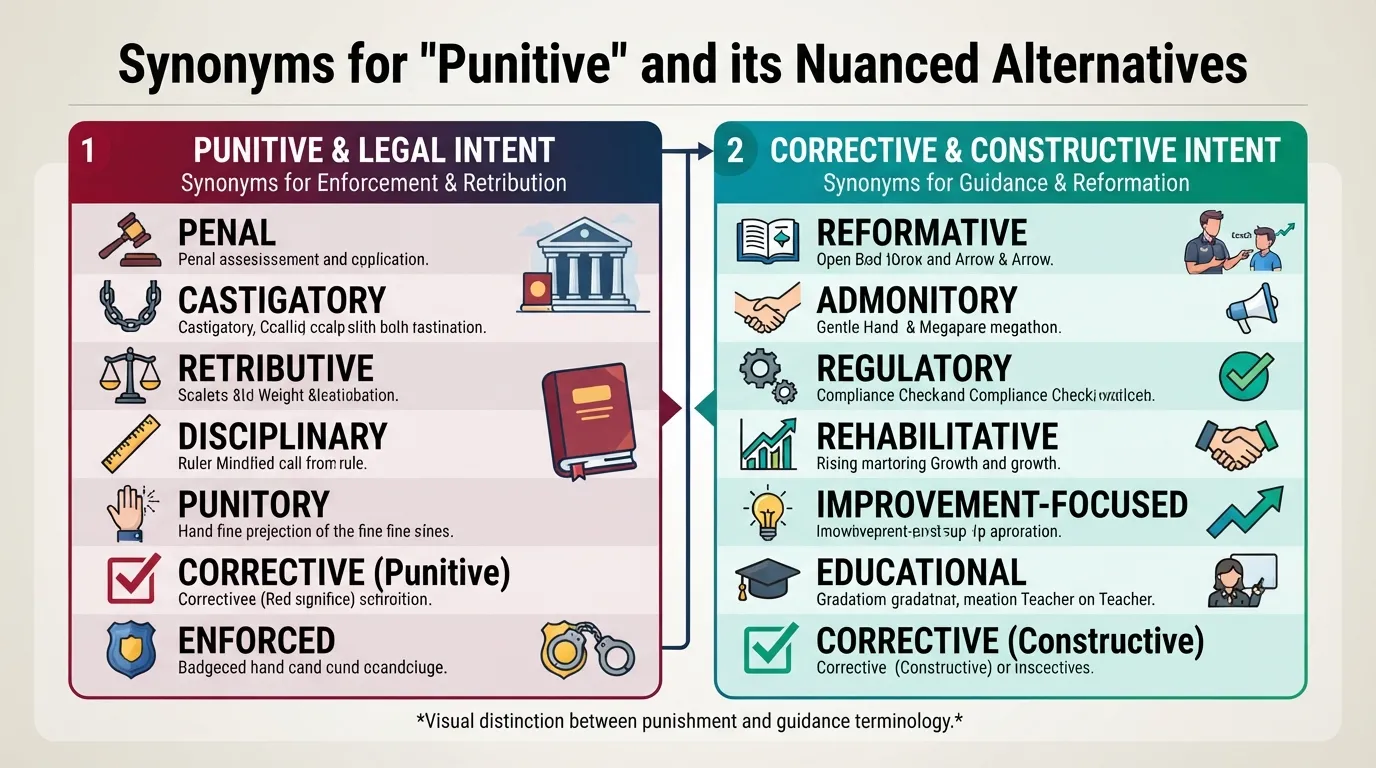
Disciplinary primarily means intended to enforce rules or correct behavior. Depending on the context, its closest synonyms are punitive (focused on punishment for rule violations) or corrective (focused on guidance and behavioral improvement).
What “Disciplinary” Means as a Word
The term disciplinary functions as an adjective derived from the noun “discipline.” It describes actions, measures, or procedures related to the enforcement of order, rules, or a code of conduct.
Grammatical Function: Adjective modifying a noun (e.g., disciplinary action, disciplinary committee).
Core Definition: Connected to the training of people to obey rules or codes of behavior, using punishment to correct disobedience when necessary.
Semantic Nuance: While often associated with negative consequences, it equally encompasses professional development, coaching, and institutional compliance standards.
Key Synonyms and Contextual Usage
Understanding the exact disciplinary meaning requires looking at how the term shifts depending on whether the intent is penalization or rehabilitation.
Punitive Measures: Refers to actions taken to penalize an individual for a specific infraction, deterring future rule-breaking.
Corrective Actions: Focuses on training, mentoring, and altering behavior to align with expected standards without immediate harsh penalties.
Related Terms: Includes punitive, correctional, regulative, instructive, and penal.
What specific context are you exploring disciplinary measures within—workplace, education, or legal?
Common Synonyms for "Disciplinary" (With Meaning & Tone)
Full Synonym List
Selecting the right term depends heavily on the specific context, severity, and intent of the action being described. The following comprehensive list captures the primary semantic variations and synonyms for disciplinary:
Punitive: Focused strictly on imposing a penalty or punishment for a rule violation.
Corrective: Aimed at fixing an error, improving behavior, or providing constructive guidance.
Penal: Strictly legal or official terminology relating to imposed punishments or criminal penalties.
Castigatory: Highly formal and severe, implying harsh criticism or castigation for wrongdoing.
Retributive: Rooted in the concept of payback or deserved retaliation for an offense.
Regulatory: Focused on maintaining operational compliance, standard procedures, and institutional rules.
Admonitory: Serving to warn, caution, or gently reprove an individual before escalation.
Reformative: Designed to rehabilitate the offender and foster long-term behavioral change.
Chastening: Focused on humbling an individual or teaching a sobering lesson through consequence.
Punishing: A more casual, direct adjective describing harsh or exhausting physical/mental consequences.
Reprimanding: Centered around formal scolding, rebuke, or official warnings for misconduct.
Formal vs Informal Tone Table
Different writing environments—such as human resources policies, academic papers, or casual discussions—require careful lexical selection to match the appropriate register.
| Synonym | Tone Category | Best Suited For | Avoid Using In |
| Penal | Highly Formal / Legal | Legal briefs, corporate compliance frameworks, statutory documents | Everyday writing, casual workplace emails |
| Punitive | Formal / Professional | HR handbooks, official disciplinary notices, policy guidelines | Casual conversations, gentle coaching contexts |
| Corrective | Professional / Constructive | Performance reviews, management coaching, educational plans | Strict penal or criminal legal proceedings |
| Regulatory | Institutional / Formal | Industry compliance manuals, auditing guidelines, governance reports | Personal behavioral discussions |
| Punishing | Informal / Descriptive | Athletic commentary, casual storytelling, conversational writing | Official corporate or legal documentation |
Example Sentences for Top 5 Synonyms
Seeing these terms in action clarifies how nuance shifts a sentence’s underlying meaning and severity.
Punitive: The board of directors approved punitive measures against the executives found guilty of financial negligence.
Corrective: Management implemented corrective action plans to help the underperforming employee meet weekly quotas.
Penal: The country’s penal system underwent major reforms to prioritize rehabilitation over extended isolation.
Admonitory: The supervisor issued an admonitory memo regarding minor dress code infractions before escalating to formal penalties.
Reformative: Modern juvenile justice frameworks heavily favor reformative programs over traditional incarceration.
Which specific industry or document type are you currently drafting synonyms for?
Discipline vs Disciplinary — What's the Difference?
Discipline (Noun) vs Disciplinary (Adjective) — Quick Comparison Table
The fundamental difference between discipline and disciplinary lies entirely in their part of speech and grammatical function. One serves as the core concept, while the other acts as the modifying descriptor.
| Feature | Discipline | Disciplinary |
| Part of Speech | Noun (or Verb) | Adjective |
| Core Function | Represents a system of rules, a field of study, or self-control | Modifies a noun to denote something relating to or enforcing rules |
| Primary Meaning | Training expected to produce specific character or pattern of behavior | Pertaining to the enforcement of order or corrective measures |
| Common Collocations | Self-discipline, academic discipline, strict discipline | Disciplinary action, disciplinary hearing, disciplinary committee |
Simple Example: Using Both Words in One Sentence
Seeing both terms deployed within a single sentence clarifies how their distinct grammatical roles work together harmoniously.
Example: “Maintaining strict discipline ($noun$) across the department requires clear guidelines and fair disciplinary ($adjective$) procedures for any policy violations.”
In this context, discipline establishes the overall standard or environment of order, whereas disciplinary directly modifies the specific mechanisms used to enforce that order.
What Is Disciplinary Action? (Definition + Context)
Disciplinary Action Meaning in the Workplace
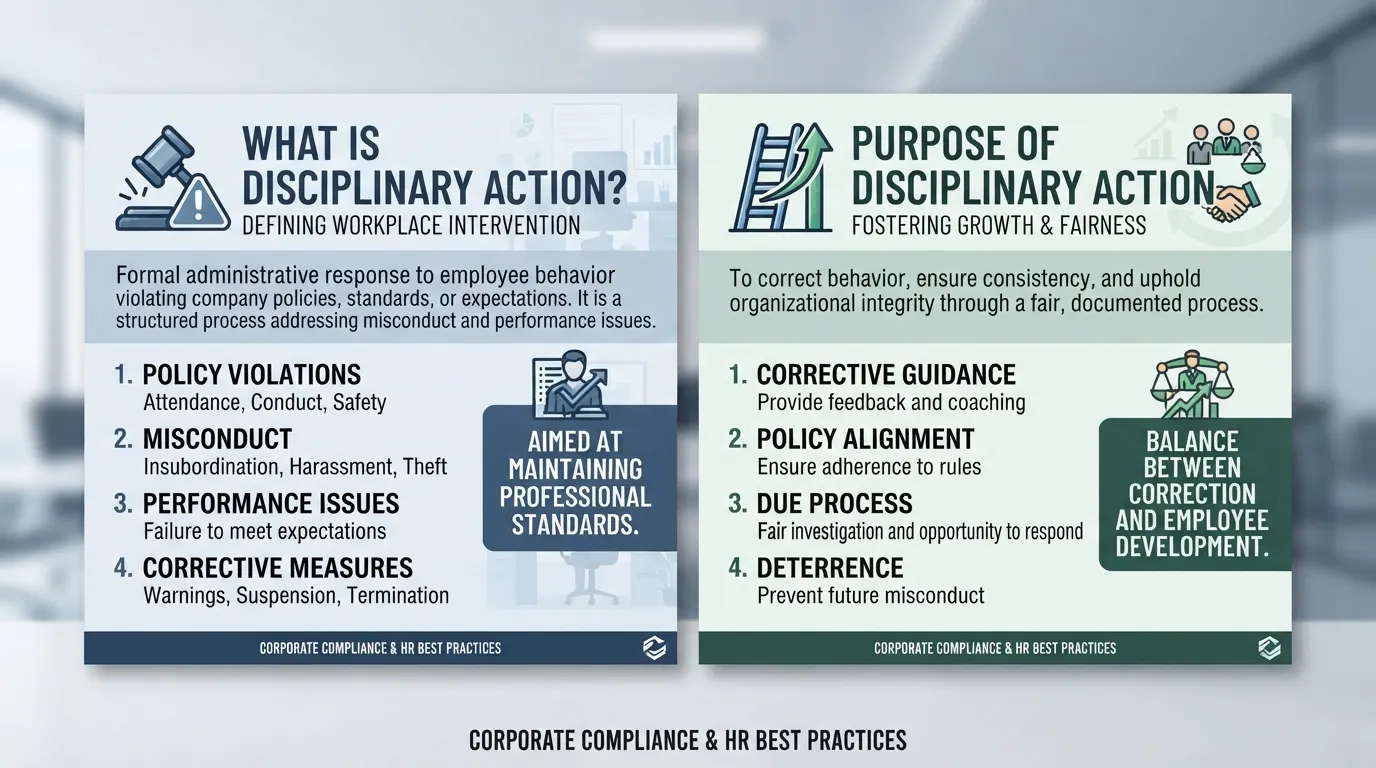
Disciplinary action refers to the official steps taken by an employer against an employee whose performance, attendance, or behavior fails to meet established company standards. This formal process is designed to address policy violations, correct substandard performance, and maintain a safe, productive work environment through structured human resources protocols.
Formal Definition: An administrative or managerial response to workplace misconduct or chronic underperformance.
Key Components: Clear documentation, adherence to company policy, objective investigation, and an opportunity for the employee to respond.
Range of Responses: Spanning from informal verbal coaching to formal written warnings, suspension, demotion, or termination.
Why Companies Use Disciplinary Action (Correction, Not Punishment)
Modern human resources frameworks emphasize that effective disciplinary action prioritizes correction over punishment. While punitive measures exist for severe offenses, the primary goal of workplace discipline is rehabilitation and performance alignment.
Behavioral Alignment: Guides employees back to expected operational norms before minor issues escalate into major operational disruptions.
Legal and Policy Protection: Creates a transparent, documented paper trail that protects both the organization and the employee by ensuring fairness and due process.
Team Morale and Standards: Preserves accountability across the organization, demonstrating that company rules apply equally to all team members.
Types of Disciplinary Action (Real Workplace Examples)
Verbal Warning
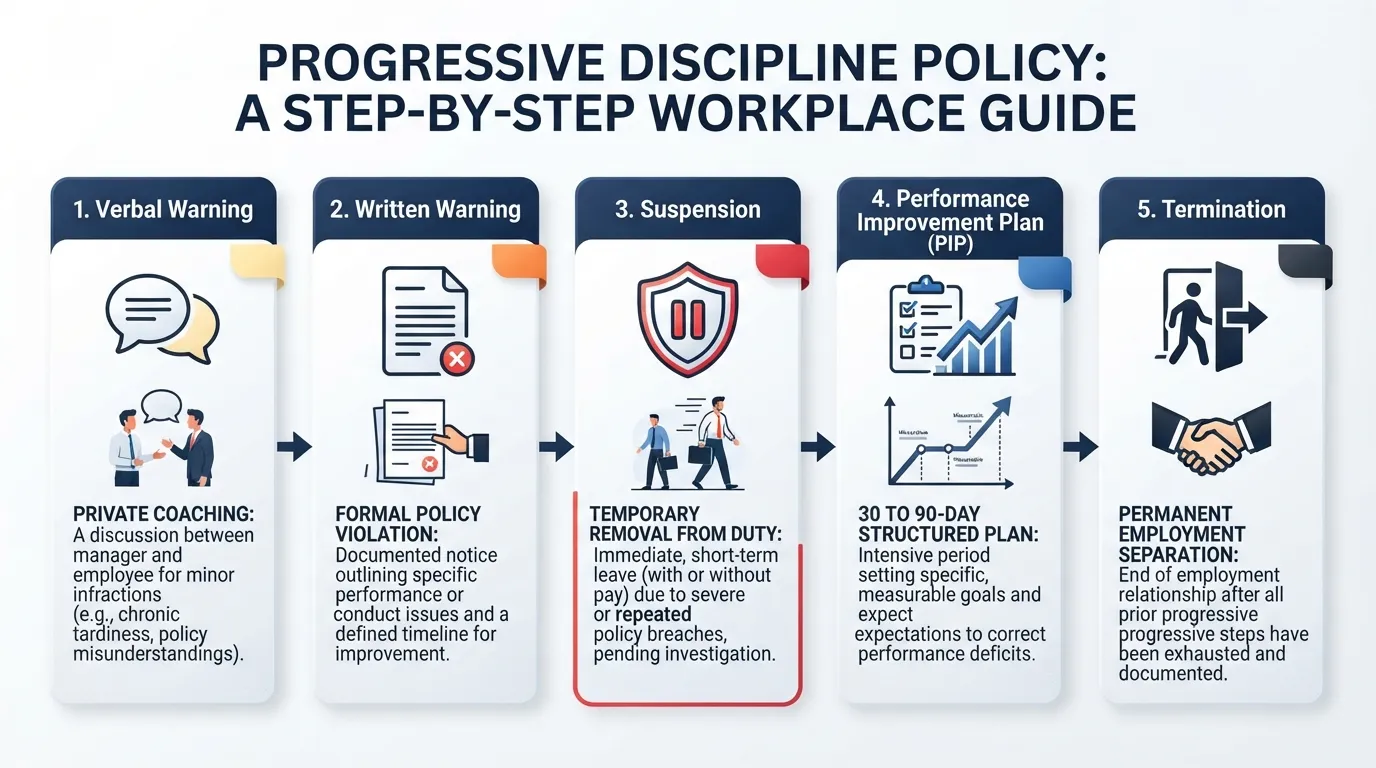
A verbal warning is typically the first formal step in a progressive discipline process. It involves a private conversation between a manager and an employee to address minor infractions, such as occasional tardiness or a brief lapse in protocol.
Primary Purpose: To bring awareness to a minor issue early and correct it informally before it impacts overall performance.
Documentation Note: Despite the name, HR departments usually document the date and topic of a verbal warning in an internal personnel file to track potential patterns.
Written Warning
A written warning becomes necessary when a verbal warning fails to correct the behavior, or when the initial infraction is more severe. This formal document outlines the specific policy violation, expected behavioral changes, and consequences of further non-compliance.
Key Components: A clear description of the offense, a timeline for improvement, and signatures from both the manager and employee.
Strategic Intent: Serves as a vital legal and administrative record, signaling that the issue has graduated beyond casual coaching.
Suspension
A suspension involves temporarily removing an employee from their duties, either with or without pay, due to serious misconduct, repeated policy breaches, or ongoing investigations.
Primary Trigger: Used for major infractions such as insubordination, safety violations, harassment, or suspected theft.
Operational Impact: Gives the organization time to conduct a thorough investigation while demonstrating the absolute unacceptability of the behavior.
Performance Improvement Plan (PIP)
A Performance Improvement Plan (PIP) is a structured, time-bound action plan typically lasting 30 to 90 days, designed specifically to address chronic underperformance or skill gaps.
Core Structure: Outlines measurable goals, required milestones, check-in schedules, and resources provided to help the employee succeed.
Ultimate Outcome: If goals are met, the employee returns to good standing; if failed, it often leads directly to termination.
Termination
Termination is the final and most severe form of disciplinary action, resulting in the permanent separation of the employee from the organization.
When It Occurs: Following the failure of a progressive discipline sequence, or immediately for zero-tolerance violations (e.g., gross misconduct, violence, or severe breach of confidentiality).
Mitigation Value: Protects company culture, operational integrity, and legal compliance once all avenues of correction have been exhausted.
Real Example: How Progressive Discipline Escalates
Understanding how these steps link together provides a practical blueprint for fair, structured management. Consider a scenario involving chronic absenteeism:
Stage 1 (Verbal Warning): The manager notices an employee arriving 30 minutes late four times in a month, holding a private discussion to clarify schedule expectations.
Stage 2 (Written Warning): The tardiness continues for another two weeks, prompting HR to issue a formal written warning detailing the attendance policy and upcoming consequences.
Stage 3 (Performance Improvement Plan / Suspension): When improvement stalls, management places the employee on a strict 30-day attendance-focused PIP or a brief suspension pending review.
Stage 4 (Termination): If the employee misses key milestones and continues unexcused absences, the organization executes formal termination.
What Is a Disciplinary Process? (Step-by-Step)
Step 1: Identify the Issue
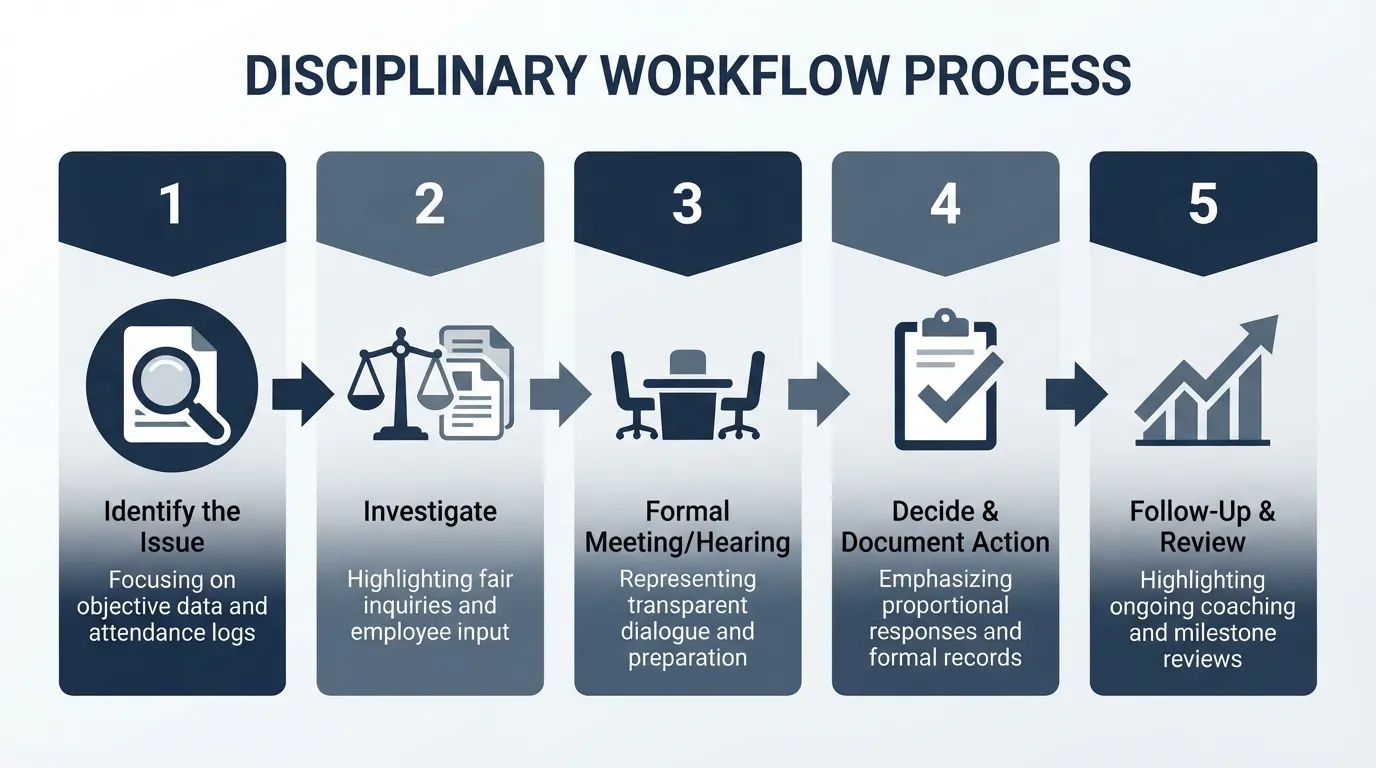
The disciplinary process begins the moment a clear deviation from company policy, performance expectations, or professional conduct standards is identified. Managers or human resources personnel must document specific incidents with dates, times, and measurable impacts rather than relying on vague impressions.
Actionable Focus: Gather initial objective data, such as attendance logs, missed deadlines, or witness accounts.
Core Objective: Establish whether the issue is a genuine performance gap, a training failure, or an intentional policy violation.
Step 2: Investigate
Before taking any formal steps, a fair and impartial investigation must be conducted to gather all relevant facts. This ensures that decisions are based on objective evidence rather than assumptions or personal bias.
Key Inquiries: Interview witnesses, review relevant documentation, and examine communication logs.
Employee Input: Give the employee an initial opportunity to share their side of the story or explain mitigating circumstances.
Step 3: Formal Meeting/Hearing
Once the investigation is complete, schedule a private, formal meeting or hearing with the employee. This dedicated session provides a structured environment to discuss the findings openly and transparently.
Preparation: Notify the employee in advance of the meeting’s purpose and allow them representation if required by company policy.
Discussion Format: Present the documented evidence clearly, explain which policies were breached, and actively listen to the employee’s explanation.
Step 4: Decide & Document Action
Following the hearing, management and human resources evaluate all gathered information to determine the appropriate response. The chosen measure must align proportionally with the severity of the infraction and established company precedent.
Decision Factors: Consider past offenses, the employee’s overall tenure, and any mitigating factors discussed during the hearing.
Documentation Standards: Draft a comprehensive report detailing the violation, the discussion summary, the agreed-upon action, and required timelines for improvement.
Step 5: Follow-Up & Review
A disciplinary process does not conclude when a warning or action plan is issued; ongoing follow-up is critical for true behavioral correction. Regular check-ins ensure that the employee receives necessary support and understands their current standing.
Review Schedule: Set formal milestone dates (e.g., 30, 60, or 90 days out) to review progress against established targets.
Final Resolution: Document whether performance has successfully improved or if further progressive steps are required.
Opposite of Disciplinary (Antonyms)
Common Antonyms (Lenient, Permissive, Indulgent)
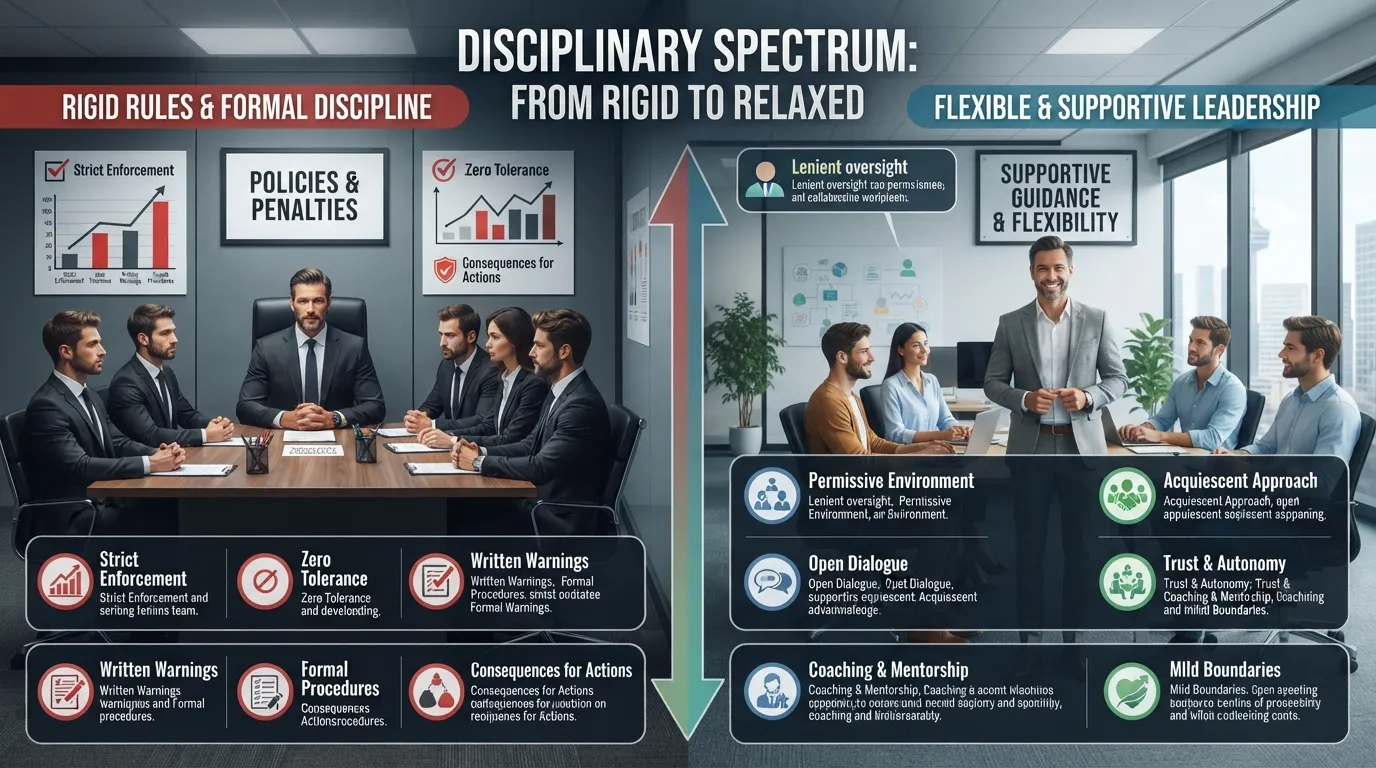
Understanding the opposite side of the lexical spectrum helps clarify the boundaries of the term. While disciplinary focuses on rules, penalties, and structure, its antonyms center on flexibility, freedom, and a lack of strict enforcement.
Lenient: Characterized by mildness, mercy, or a lack of severity when dealing with rule violations or infractions.
Permissive: Allowing considerable freedom of behavior with minimal oversight, structure, or enforced boundaries.
Indulgent: Excessively generous, yielding to desires or misbehavior without imposing corrective measures.
Acquiescent: Submissive or compliant, readily accepting behavior without challenging or penalizing it.
When These Words Apply
Antonyms for disciplinary find their place in contexts where rules are intentionally relaxed, coaching is entirely positive, or management styles lean toward autonomy rather than oversight.
Lenient Management: Applied when leaders choose to overlook minor infractions or issue gentle warnings rather than formal penalties, as verified by linguistic authorities like the Merriam-Webster Thesaurus.
Permissive Environments: Describes cultural frameworks, educational philosophies, or parenting styles that prioritize self-direction and freedom over rigid structural compliance.
Indulgent Approaches: Used when oversight is minimal, allowing individuals extensive latitude without fear of reprimand or structured evaluation.
Frequently Asked Questions (FAQ)
What’s another word for disciplinary?
Common synonyms for disciplinary include punitive, corrective, penal, castigatory, retributive, and regulatory. The right choice depends on whether the intent is penalizing rule violations or providing constructive guidance.
What is another word for disciplinary action?
Alternative phrases for disciplinary action include corrective action, punitive measure, sanction, reprimand, and formal disciplinary measure. These terms help clarify the severity and intent of the intervention in professional documentation.
What is another word for discipline?
Depending on the context, synonyms for discipline as a noun include order, control, training, rigor, structure, and regulation. When referring to an academic or professional field, synonyms include specialty, domain, branch of study, or subject.
What does “disciplinary” mean?
Disciplinary is an adjective meaning connected with the enforcement of rules, order, or a code of conduct. It describes measures, actions, or committees established to maintain standards and address infractions.
What does disciplinary mean at work?
At work, disciplinary refers to official administrative or managerial steps taken by an employer to address employee misconduct, policy breaches, or chronic underperformance. Its primary goal is behavioral correction rather than punishment.
What are the types of disciplinary?
The primary types of workplace disciplinary actions include verbal warnings, written warnings, suspensions, performance improvement plans (PIPs), and formal termination. Each step represents a stage in a progressive discipline framework.
What does disciplinary action mean?
Disciplinary action means the formal response taken by an organization or authority when an individual violates established rules, performance metrics, or behavioral expectations. It establishes accountability and guides corrective behavior.
What is the difference between “discipline” and “disciplinary”?
Discipline primarily functions as a noun representing a system of rules, self-control, or a field of study. Disciplinary is an adjective that modifies a noun to denote something pertaining to the enforcement of those rules, such as disciplinary action.
What are examples of disciplinary action?
Examples include a manager giving a verbal warning for tardiness, HR issuing a written warning for missed deadlines, suspending an employee during an investigation, placing someone on a 30-day PIP, or terminating employment for gross misconduct.
What is a disciplinary process?
A disciplinary process is a structured, step-by-step procedure used by organizations to identify policy issues, investigate facts objectively, conduct a formal hearing, determine proportional actions, and follow up on behavioral improvements.
Conclusion / Key Takeaway
Best Synonyms to Use in Different Contexts
Mastering the right terminology transforms how effectively you communicate institutional policies, human resources guidelines, and professional expectations. Choosing the precise word or phrase ensures clarity, maintains fairness, and sets the right tone for leadership communication.
For Punitive Contexts: Use terms like punitive, penal, or sanction when addressing severe policy breaches, legal compliance, or strict rule enforcement.
For Constructive Leadership: Rely on terms like corrective, admonitory, or reformative to emphasize growth, mentorship, and behavioral realignment.
For Workplace Policies: Opt for clear phrases like corrective action or disciplinary measure to establish structured, transparent accountability across your team.
By aligning your vocabulary with the true intent of the intervention, you foster an environment where professional discipline serves as a tool for excellence rather than mere punishment.
What specific workplace policy or leadership document are you refining next?