Discipline in Education: Complete Guide, Types & Strategies
What Is Discipline in Education?
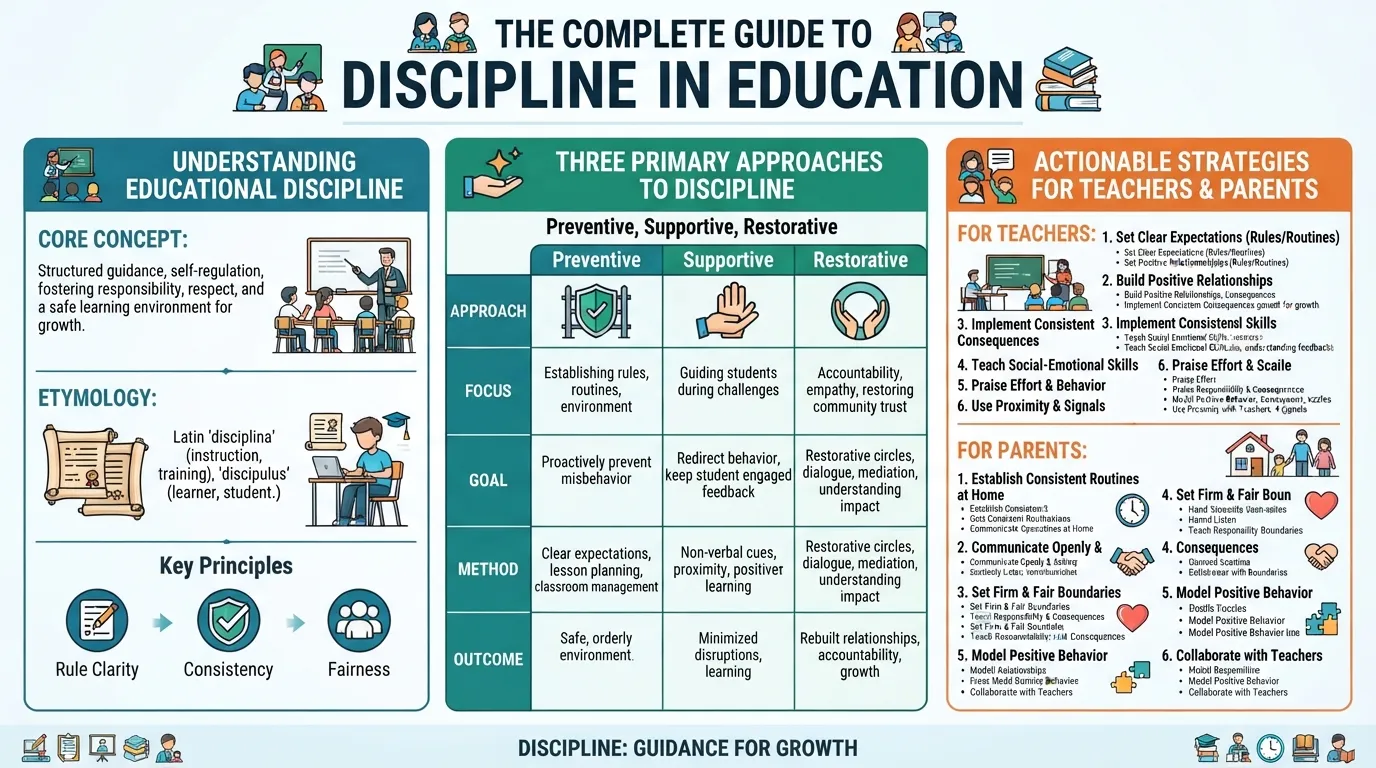
Discipline in education forms the foundational framework that guides student behavior, promotes self-control, and cultivates personal responsibility. It establishes clear boundaries and expectations, creating a safe learning environment where educators can teach effectively and students can thrive academically and socially without disruption.
Discipline in Education: A Quick Definition
Discipline in education refers to the systems, rules, and guidance strategies used to foster appropriate behavior and self-control among students. Rather than relying solely on punishment, modern educational discipline focuses on teaching students accountability, emotional regulation, and social responsibility within a structured academic setting.
Core Purpose: To maintain a safe learning environment conducive to focus and academic progress.
Key Outcome: Developing long-term self-control and personal accountability in learners.
Primary Approach: Balancing clear behavioral boundaries with supportive guidance and instruction.
The Origin of the Word “Discipline”
Understanding the true meaning of educational discipline requires looking at its historical etymology. The term originates from the Latin word disciplina, which translates directly to instruction, training, or knowledge.
Etymological Roots: Derived from disciplina, meaning instruction or teaching.
Shared Connections: Shares a direct linguistic root with the word disciple, meaning one who learns.
Historical Shift: Originally centered on the transmission of knowledge from a teacher to a learner, evolving over centuries to encompass behavioral management.
What Discipline Really Means for Students Today
In contemporary classrooms, effective discipline has evolved far beyond compliance and fear-based control. It is viewed as an active teaching tool designed to empower learners to make positive, independent choices.
Fostering Self-Control: Helping students recognize their impulses and develop healthy coping mechanisms for stress and frustration.
Building Responsibility: Encouraging learners to understand the natural and logical consequences of their actions.
Creating Safety: Ensuring every student feels physically and emotionally secure, which is essential for optimal cognitive development.
Discipline vs. Punishment — Clearing the Confusion
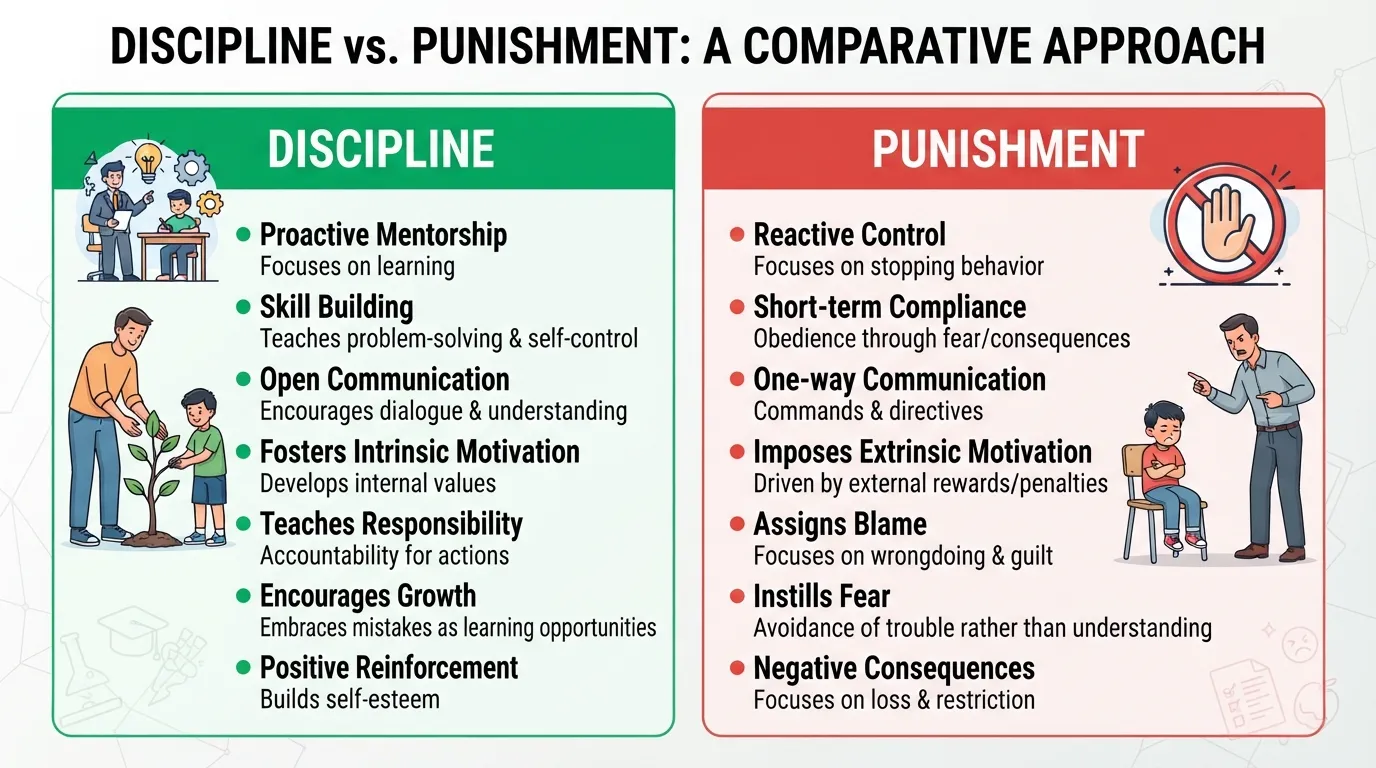
Discipline focuses on teaching, guiding, and fostering long-term self-regulation in students. In contrast, punishment relies on punitive measures and fear of negative consequences to secure short-term compliance without building internal accountability.
Why Discipline Is About Teaching, Not Controlling
True educational discipline operates on the principle that misbehavior represents an underdeveloped skill rather than a defiant character flaw. Educators use these moments as vital learning opportunities to guide students toward better decision-making.
Proactive Guidance: Focuses on teaching appropriate behavioral frameworks before conflicts arise.
Skill Building: Equips learners with emotional regulation and conflict-resolution tools.
Empowerment: Encourages students to manage their own actions rather than depending on external surveillance.
Punishment vs. Discipline: The Key Difference
Understanding the distinction between these two approaches determines whether a classroom fosters genuine growth or merely temporary obedience. The core methodology and psychological impact differ significantly.
Punishment Characteristics: Relies on retribution, arbitrary penalties, and fear to suppress unwanted actions immediately.
Discipline Characteristics: Employs logical consequences, constructive feedback, and continuous instruction to correct behavior.
Primary Objective: Punishment seeks to stop a specific action through negative reinforcement, whereas discipline aims to build lifelong self-control.
Why This Distinction Matters for Long-Term Student Behavior
Recognizing that discipline means teaching rather than punishing transforms student-teacher dynamics and drives sustainable behavioral improvements.
Internalized Regulation: Students develop intrinsic motivation to behave appropriately because they understand the “why” behind the rules.
Trust and Safety: Replaces anxiety and resentment with mutual respect, creating a secure environment for learning.
Sustainable Results: Prevents the repetition of negative habits by addressing root causes rather than just masking symptoms.
The 3 Core Approaches to Discipline in Education
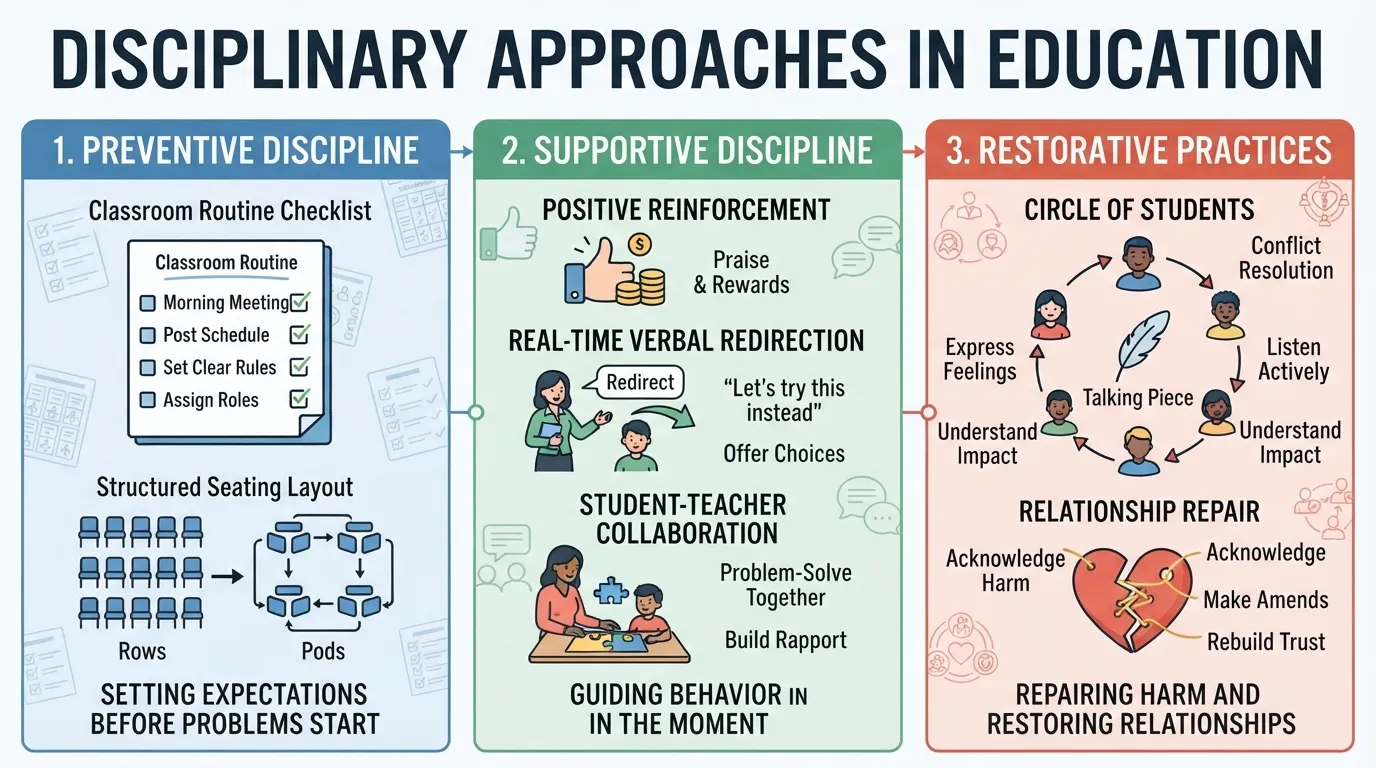
Effective classroom management relies on three distinct yet interconnected frameworks: preventive discipline, supportive discipline, and restorative practices. Together, these approaches shift the focus from reactive control to proactive skill-building and community restoration.
Preventive Discipline: Setting Expectations Before Problems Start
Preventive discipline focuses on establishing clear classroom routines, transparent expectations, and predictable structures before behavioral issues ever occur. By designing an organized environment, educators minimize confusion and eliminate many common triggers for student disruption.
Establishing Routines: Creating consistent daily procedures for transitions, assignments, and classroom movement.
Proactive Planning: Designing engaging lesson plans that keep learners actively focused and reduce downtime.
Clear Boundaries: Setting transparent behavioral expectations collaboratively with students from day one.
Supportive Discipline: Guiding Students Through Positive Reinforcement
Supportive discipline takes place during the learning process when a student begins to drift off-task or shows early signs of misbehavior. Instead of harsh penalties, educators use real-time redirection and positive reinforcement to guide students back on track.
Verbal and Non-Verbal Redirection: Using gentle reminders, proximity, or subtle cues to refocus attention.
Positive Reinforcement: Acknowledging and praising appropriate behavior to reinforce good choices.
Collaborative Support: Helping students identify alternative ways to manage their frustration or loss of focus.
Restorative Discipline: Repairing Relationships, Not Just Correcting Behavior
Restorative discipline centers on repairing the harm caused by misbehavior rather than simply imposing arbitrary punishments. This approach emphasizes accountability, empathy, and restoring trust within the classroom community.
Conflict Resolution: Engaging students in guided dialogues to understand the impact of their actions on others.
Accountability: Requiring learners to take active steps to fix mistakes and restore a positive classroom climate.
Community Healing: Rebuilding broken trust so that all students feel safe, valued, and ready to re-engage with learning.
Types of Discipline for Students (Extended Breakdown)
Classroom management requires diverse strategies tailored to different student needs, developmental stages, and behavioral situations. A comprehensive understanding of the various discipline models allows educators to balance structure, autonomy, and accountability.
Understanding Diverse Classroom Management Frameworks
Different disciplinary styles offer unique benefits for fostering self-control and maintaining an orderly learning environment. Below is a structured breakdown of the primary discipline frameworks utilized in modern education.
| Discipline Type | Core Focus | Primary Benefit |
| Self-Discipline | Internalized motivation and self-regulation | Empowers students to manage impulses independently |
| Positive Discipline | Mutual respect and collaborative problem-solving | Builds long-term emotional intelligence and resilience |
| Assertive Discipline | Clear, confident boundaries and consistent rules | Eliminates ambiguity and ensures a structured environment |
| Democratic Discipline | Shared decision-making and student voice | Encourages accountability and community ownership |
| Corrective Discipline | Logical consequences addressing specific misbehavior | Stops disruptions while teaching better behavioral alternatives |
| Peer-Guided Discipline | Collaborative accountability within student groups | Strengthens social responsibility and group cohesion |
Basic Principles and Rules of Discipline
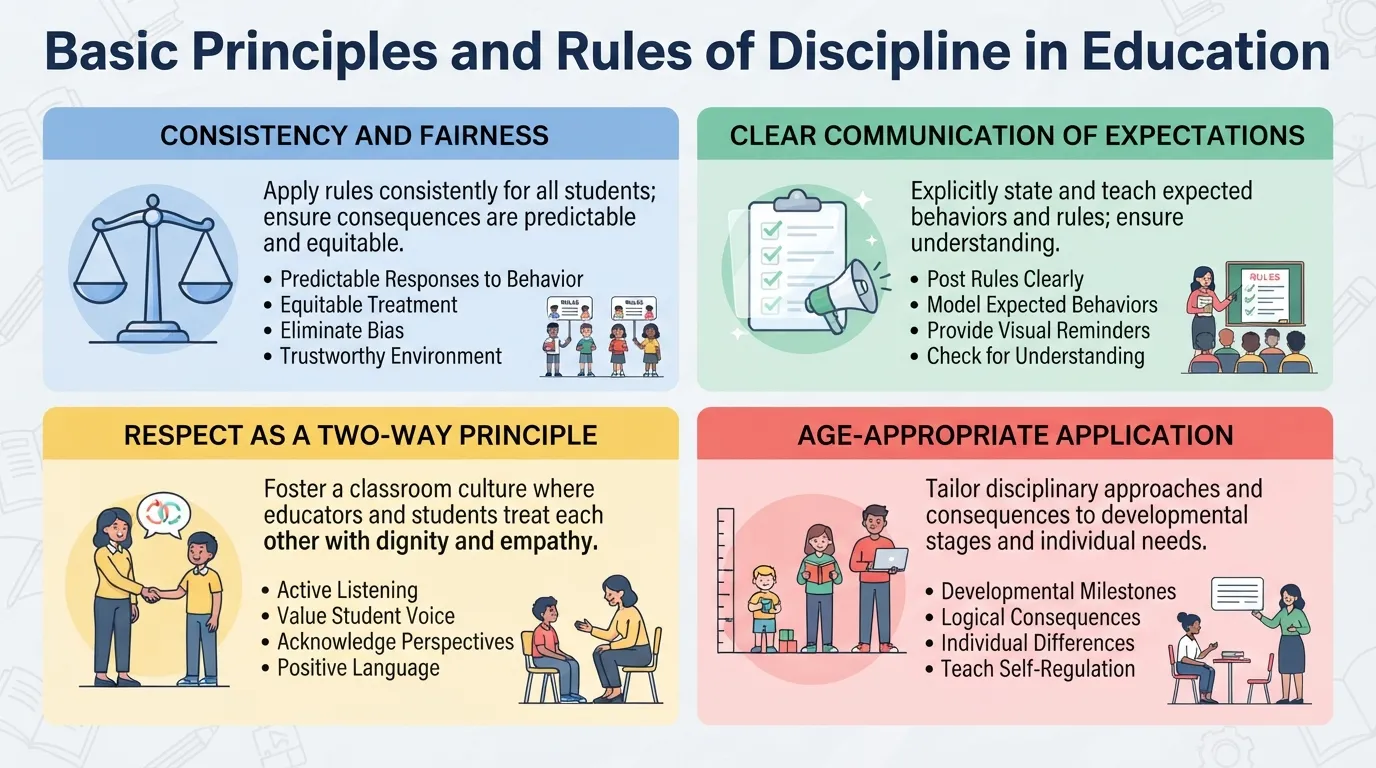
Establishing a healthy learning atmosphere relies on fundamental rules and core principles that prioritize equity, consistency, and respect. Educational frameworks outlined by institutions like the U.S. Department of Education’s School Climate and Student Discipline Resources emphasize that proactive, fair strategies are essential for maintaining safe and inclusive schools.
Consistency and Fairness
Consistency and fairness form the bedrock of trusted classroom management. When rules are applied reliably and without bias, students feel secure in knowing what to expect every single day.
Predictable Enforcement: Applying guidelines uniformly across all situations prevents confusion and eliminates perceived favoritism.
Transparent Standards: Ensuring that consequences match the infraction consistently builds institutional trust.
Equitable Treatment: Aligning disciplinary actions with objective standards supports fair learning environments for every student.
Clear Communication of Expectations
Ambiguity breeds disruption, making explicit communication of behavioral standards vital before academic activities begin. Students cannot meet expectations if those standards remain unexpressed or unclear.
Explicit Instruction: Outlining expected behaviors during routines, transitions, and collaborative tasks.
Collaborative Framing: Involving learners in establishing classroom norms to boost comprehension and commitment.
Accessible Reminders: Posting visual or verbal cues that keep primary behavioral goals visible.
Respect as a Two-Way Principle
Effective discipline requires mutual respect between educators and learners, moving away from authoritarian compliance toward collaborative dignity. When teachers model respectful behavior, students reciprocate naturally.
Active Listening: Acknowledging student perspectives before addressing behavioral infractions.
Preserving Dignity: Correcting mistakes through private, constructive feedback rather than public reprimands.
Valuing Autonomy: Treating learners as capable participants in managing their own conduct.
Age-Appropriate Application of Rules
Disciplinary strategies must scale with the cognitive and emotional development of the students. Rules that work effectively for high schoolers differ fundamentally from techniques required in early childhood education.
Developmental Alignment: Tailoring interventions to match a child’s capacity for emotional regulation and impulse control.
Progressive Independence: Granting greater autonomy as students mature and demonstrate internal accountability.
Age-Specific Framing: Using concrete, immediate guidance for younger learners while applying reflective, long-term problem-solving for adolescents.
Steps and Stages of Implementing Discipline
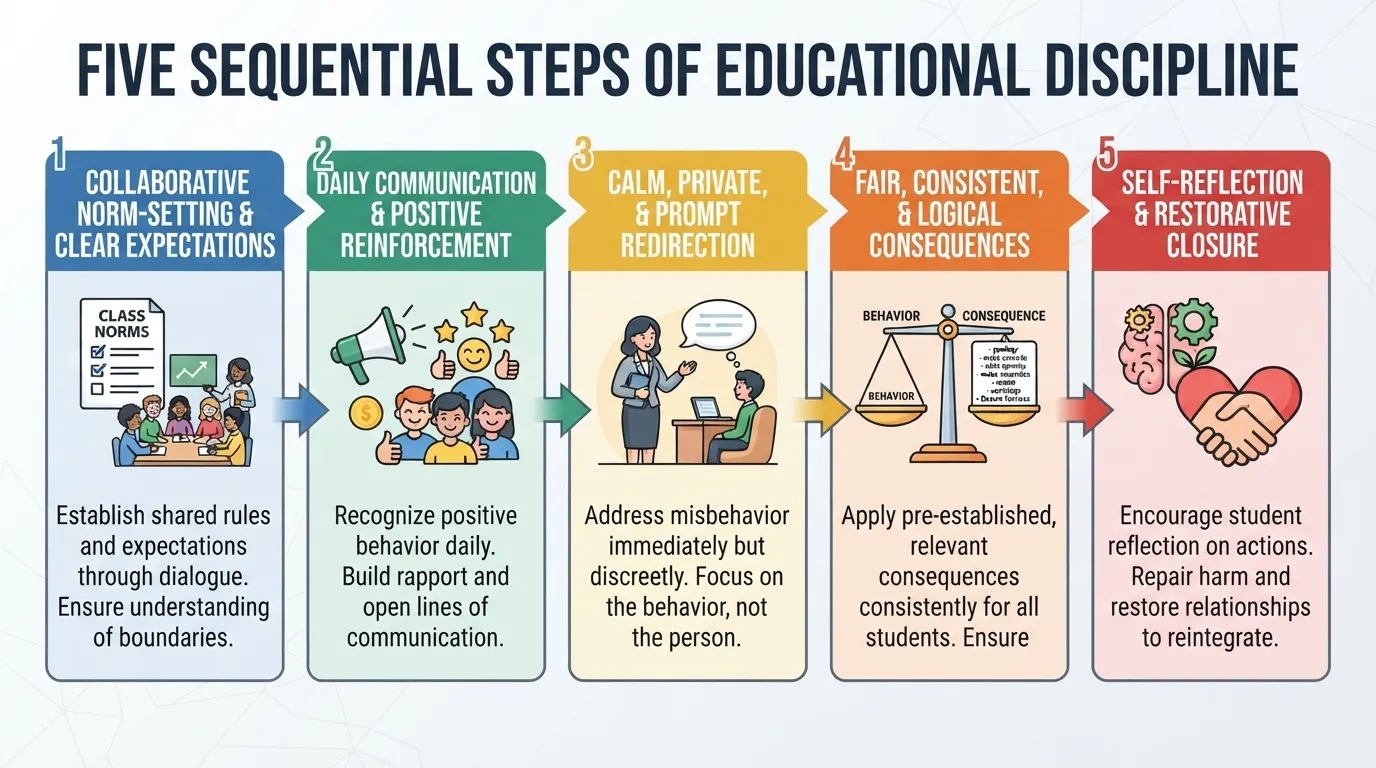
Implementing an effective discipline process requires a structured, multi-stage approach that transitions seamlessly from proactive prevention to restorative reflection. Following a systematic methodology ensures educators can address classroom disruptions fairly while teaching vital accountability and self-regulation skills.
Step 1: Set Clear Expectations
The foundation of successful classroom management begins before any instruction takes place by establishing explicit behavioral norms. Setting transparent expectations prevents ambiguity and gives students a clear framework for appropriate conduct.
Collaborative Norm-Setting: Involving students in defining classroom guidelines to foster shared ownership.
Explicit Modeling: Demonstrating what expected behaviors look like during various routines and transitions.
Documented Standards: Keeping core behavioral expectations visible and accessible within the learning environment.
Step 2: Communicate and Reinforce
Consistency relies on regular communication and positive reinforcement to keep standards top of mind. Reinforcing good choices helps internalize proper habits before minor infractions ever escalate.
Daily Reminders: Reviewing core behavioral standards during morning meetings or before complex tasks.
Positive Recognition: Acknowledging students who consistently demonstrate responsibility and self-control.
Proactive Alignment: Ensuring all educators and staff maintain aligned messaging regarding behavioral standards.
Step 3: Address Behavior Calmly and Privately
When a disruption occurs, swift de-escalation prevents minor issues from turning into major conflicts. Addressing misbehavior privately preserves the student’s dignity and keeps the rest of the learning environment stable.
Immediate De-escalation: Using calm tones and non-verbal cues to lower emotional tension.
Private Interventions: Pulling the student aside rather than issuing public reprimands that trigger defensiveness.
Active Listening: Giving the learner a brief chance to explain their perspective before delivering correction.
Step 4: Apply Fair, Consistent Consequences
Consequences must be logically tied to the infraction and applied uniformly to maintain trust. This stage ensures accountability without resorting to punitive, arbitrary reactions.
Logical Connections: Linking the consequence directly to the behavior so the student understands the cause and effect.
Objective Enforcement: Applying rules equally across all learners to eliminate perceived bias.
Escalation Control: Following a structured progression that addresses repeat infractions without overreacting.
Step 5: Reflect and Rebuild (Restorative Close)
The final stage of the discipline process focuses on self-reflection and repairing any harm done to the classroom community. This step transforms a mistake into a powerful lesson in emotional growth.
Guided Self-Reflection: Helping the student evaluate alternative choices they could have made.
Community Restoration: Requiring constructive actions that repair trust and relationships with peers or teachers.
Fresh Starts: Closing the loop definitively so the student can re-engage with learning free of lingering resentment.
Why Discipline Matters in Education
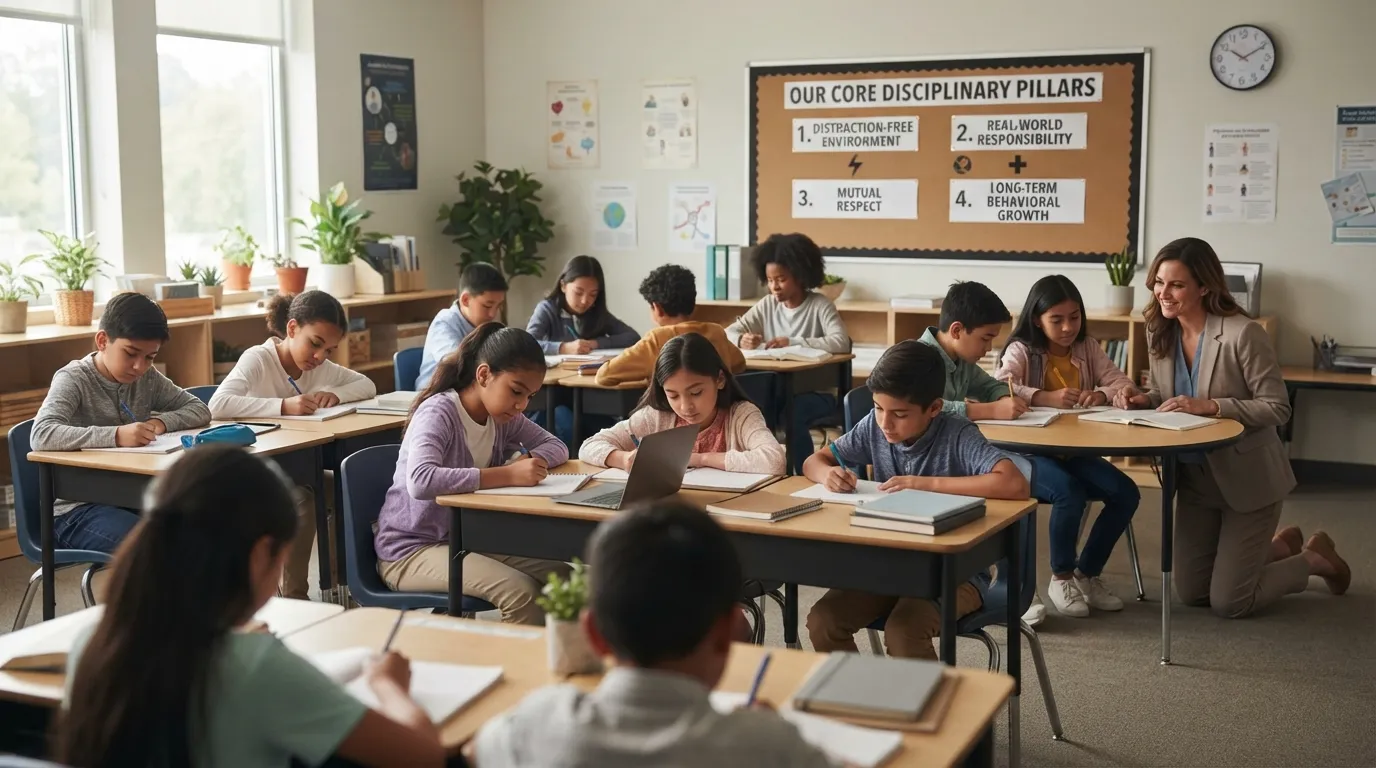
Discipline serves as the structural heartbeat of any successful educational institution, directly influencing academic outcomes and personal growth. Far beyond maintaining mere quiet, thoughtful guidance builds the reliable framework students need to master complex tasks and develop lifelong emotional resilience.
Builds a Focused, Distraction-Free Learning Environment
When expectations are clear and consistently upheld, classrooms transform into stable zones optimized for deep focus. Educators spend less instructional time managing recurring disruptions and more time delivering core academic content.
Maximized Instructional Time: Predictable routines minimize transition friction and lost minutes.
Cognitive Safety: Students feel secure enough to take academic risks, ask questions, and engage in collaborative problem-solving.
Equitable Access: A structured environment ensures every learner has an uninterrupted opportunity to absorb the curriculum.
Develops Responsibility and Real-World Life Skills
Daily exposure to structured discipline teaches students how to self-regulate, plan ahead, and manage their impulses. These foundational habits translate directly into the self-discipline required for higher education and professional careers.
Internalized Accountability: Learners shift from relying on external supervision to managing their own actions independently.
Goal Persistence: Students learn to push through frustration and maintain focus on long-term objectives.
Practical Decision-Making: Experiencing logical consequences helps young people evaluate risks and make better choices.
Strengthens Respect Between Students and Teachers
Modern discipline replaces authoritarian control with mutual respect, turning classrooms into collaborative communities. When educators address misbehavior with calm fairness rather than punitive reactions, trust flourishes.
Open Communication: Students feel comfortable seeking help before small academic struggles become major behavioral roadblocks.
Dignity Preservation: Constructive guidance reinforces the worth of every student while correcting the action.
Shared Community Norms: Mutual respect encourages students to treat their peers with similar empathy and consideration.
Reduces Behavioral Issues Over Time
Proactive and consistent disciplinary frameworks systematically decrease the frequency of disruptions across the entire school year. By addressing root causes and teaching replacement behaviors early, schools prevent minor issues from compounding into severe disciplinary crises.
Proactive Interventions: Catching behavioral drift early stops escalation before it disrupts the wider group.
Cultural Stability: A predictable school climate establishes a positive peer pressure toward positive conduct.
Long-Term Habit Formation: Repeated exposure to fair guidance replaces disruptive impulses with productive coping strategies.
Classroom Scenario in Action
Imagine a middle school science lab where two students begin arguing over shared equipment, raising their voices and disrupting nearby groups. Instead of shouting or issuing an immediate detention, the teacher uses a calm, measured redirection: pausing the class instruction momentarily, separating the students quietly, and asking them to identify the core issue. After a brief two-minute cool-down and structured problem-solving conversation, both students agree to share the workspace fairly and resume their experiment. This approach resolves the immediate disruption, preserves dignity, and teaches practical conflict-resolution skills for the future.
Practical Discipline Strategies for Teachers and Parents
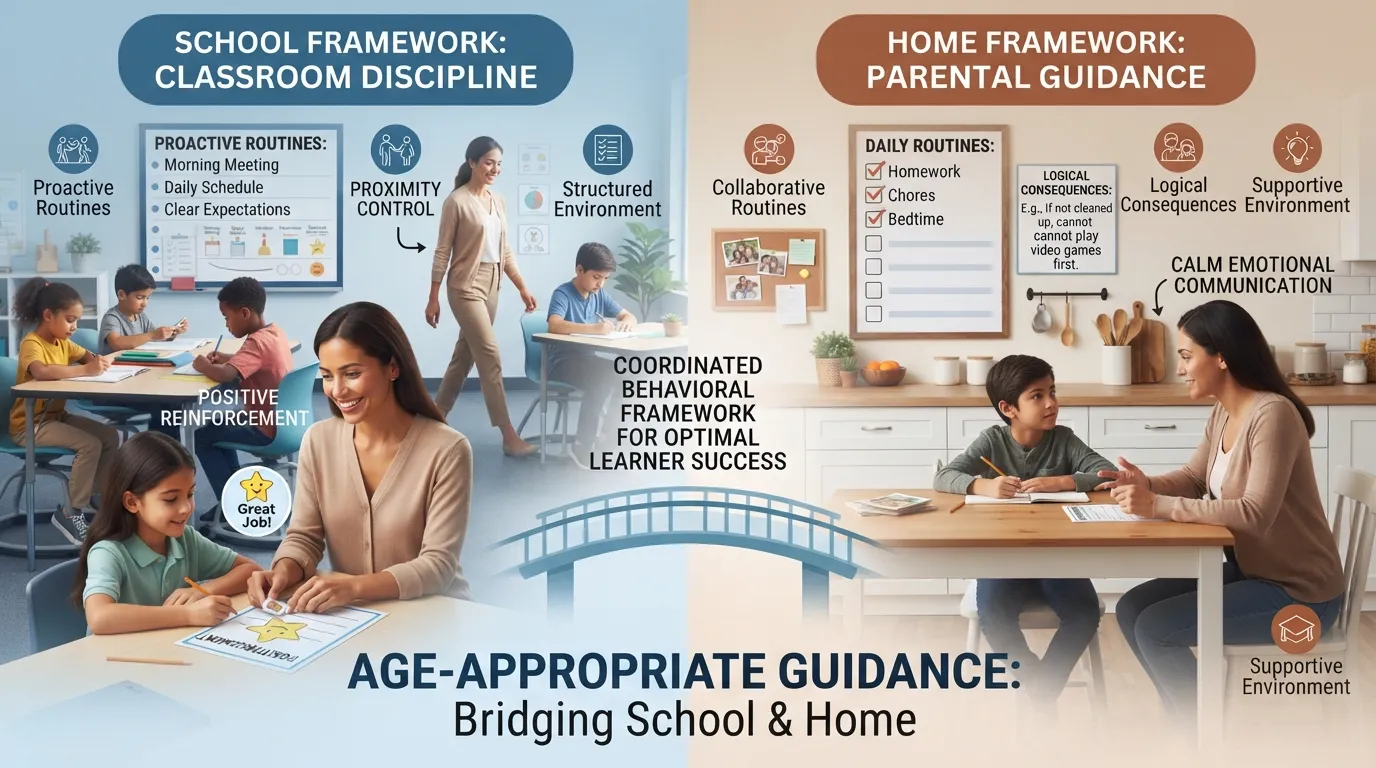
Effective discipline bridges the gap between the classroom and the home, requiring coordinated strategies that reinforce positive habits across all environments. Applying cohesive techniques ensures students receive consistent behavioral messaging whether they are navigating school routines or home responsibilities.
Strategies for Teachers in the Classroom
Teachers manage diverse group dynamics by implementing proactive frameworks that prioritize structure, clear communication, and immediate, supportive redirection.
Proactive Routine Design: Establishing predictable transitions and clear expectations to minimize downtime and confusion.
Proximity Control: Moving closer to distracted learners to gently encourage focus without calling them out publicly.
Positive Framing: Recognizing and rewarding on-task behavior to encourage a cooperative classroom culture.
Strategies for Parents at Home
Parents reinforce institutional learning by maintaining consistent boundaries, encouraging open communication, and modeling emotional regulation at home.
Consistent Routines: Setting predictable schedules for homework, bedtime, and chores to build foundational self-discipline.
Logical Consequences: Linking household privileges directly to responsibilities, helping children connect actions to outcomes.
Emotional Modeling: Demonstrating calm problem-solving when facing conflicts, showing children healthy ways to handle frustration.
Adapting Discipline by Age Group (Elementary vs. High School)
Disciplinary approaches must evolve with a student’s cognitive maturity, shifting from immediate, concrete guidance in early childhood to reflective self-management in adolescence.
Elementary Approach: Focuses on concrete rules, immediate positive reinforcement, and hands-on emotional coaching.
High School Approach: Emphasizes student autonomy, collaborative problem-solving, and long-term accountability for academic choices.
How Discipline in Education Differs From Workplace Discipline
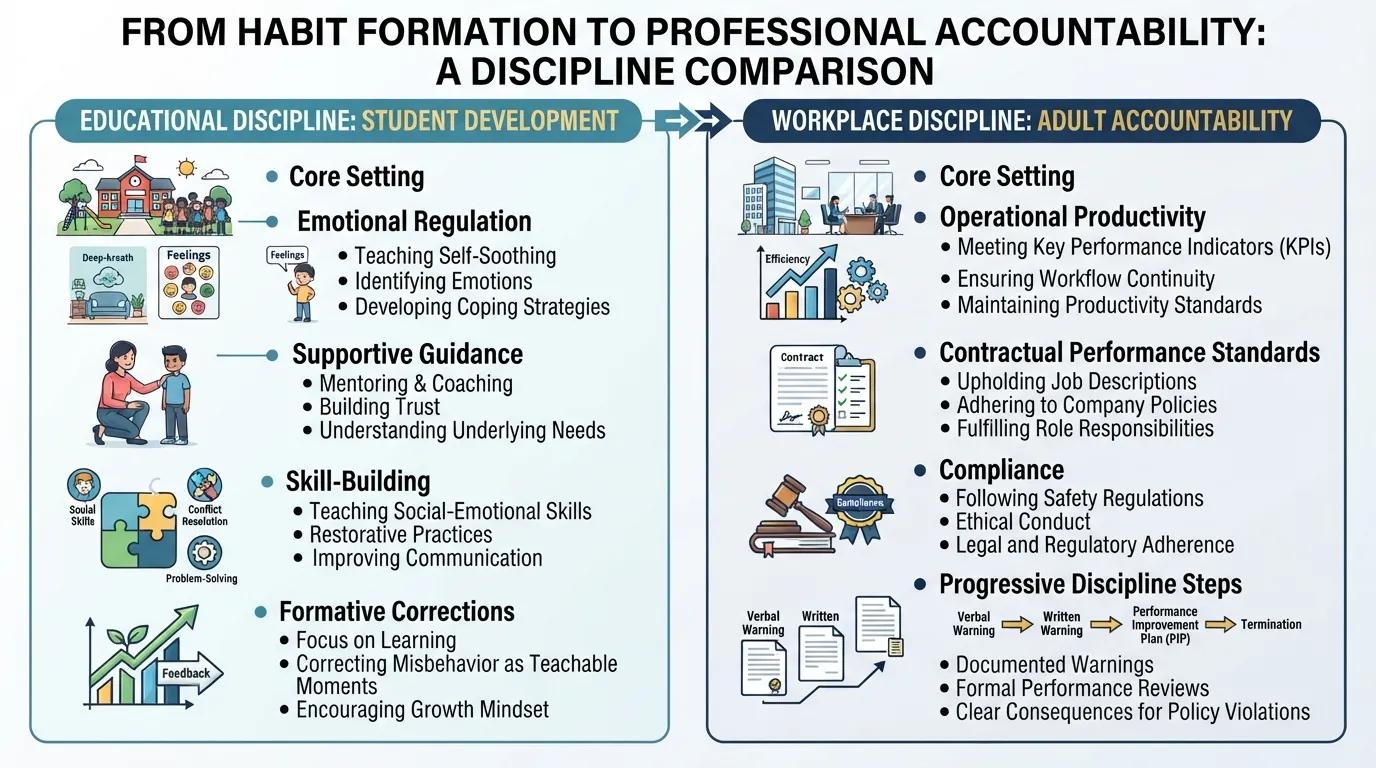
Educational discipline prioritizes teaching, growth, and skill development, whereas professional workplace discipline focuses primarily on contractual performance and operational compliance. Understanding the boundary between these two domains helps clarify how youthful habit formation eventually transitions into adult professional accountability.
Educational Discipline vs. Workplace Disciplinary Process
While both systems rely on rules and consequences, their underlying goals and structural mechanisms differ fundamentally. Educational settings view mistakes as learning opportunities, whereas organizations often utilize formal protocols like progressive discipline to manage performance and legal compliance.
Primary Objective in Education: To teach emotional regulation, build social responsibility, and correct developmental behaviors.
Primary Objective in Workplaces: To ensure operational productivity, uphold safety standards, and maintain organizational compliance.
Structural Approaches: Schools rely on restorative guidance and supportive counseling, while professional settings often follow rigid, documented steps such as verbal warnings, written notices, and performance improvement plans.
Why the Foundation Learned in School Carries Into Professional Life
The self-discipline, time management, and accountability developed during a student’s academic journey form the exact behavioral foundation required for career success. Early experiences with logical consequences and group expectations prepare individuals for adult professional environments.
Internalized Self-Regulation: Students who learn to manage their impulses independently transition smoothly into self-directed professionals.
Respect for Shared Norms: Respecting classroom rules mirrors the collaborative teamwork and adherence to company policies expected in modern workplaces.
Accountability for Outcomes: Accepting responsibility for academic assignments builds the reliability and professional accountability demanded in career settings.
Frequently Asked Questions
What is discipline in education?
Discipline in education refers to the systems, rules, and guidance strategies used to foster appropriate behavior, self-control, and responsibility among students. Rather than relying solely on punishment, modern educational discipline focuses on teaching students accountability and emotional regulation within a structured environment.
What are the three types of discipline?
The three core approaches to educational discipline are preventive discipline, supportive discipline, and restorative practices. Preventive discipline sets expectations before problems occur, supportive discipline offers real-time redirection, and restorative discipline focuses on repairing harm and relationships.
What are the five steps of discipline?
The five steps of implementing effective discipline include setting clear expectations, communicating and reinforcing standards consistently, addressing behavior calmly and privately, applying fair logical consequences, and engaging in self-reflection and restorative closure.
What are the basic principles of discipline?
Basic principles of discipline include maintaining consistency and fairness, communicating rules clearly, practicing mutual respect, and tailoring interventions to be age-appropriate. These principles ensure an equitable, secure, and supportive environment for all learners.
What is the difference between discipline and punishment?
Discipline is a proactive teaching tool focused on building long-term self-regulation, skill development, and internal accountability. Punishment relies on fear, retribution, and negative reinforcement to secure short-term compliance without addressing the root cause of misbehavior.
What is a good definition of discipline?
A strong definition of discipline is the practice of teaching self-control, order, and proper conduct through structured guidance and consistent boundaries. It empowers individuals to regulate their own behavior and make responsible, independent choices.
Conclusion
Discipline in education is far more than a mechanism for maintaining order; it is the essential framework that transforms classrooms into safe, focused environments where genuine learning can occur. By shifting our approach from punitive control to proactive teaching, supportive guidance, and restorative practices, educators and parents empower students to cultivate true self-discipline and personal responsibility. When young learners understand the reasons behind boundaries and experience fair, consistent consequences, they internalize the emotional regulation needed for lifelong success. Embracing discipline as a continuous process of growth ensures that every student is equipped to navigate future challenges with resilience, confidence, and respect.