The 21-Day Habit Theory: Myth or Fact?
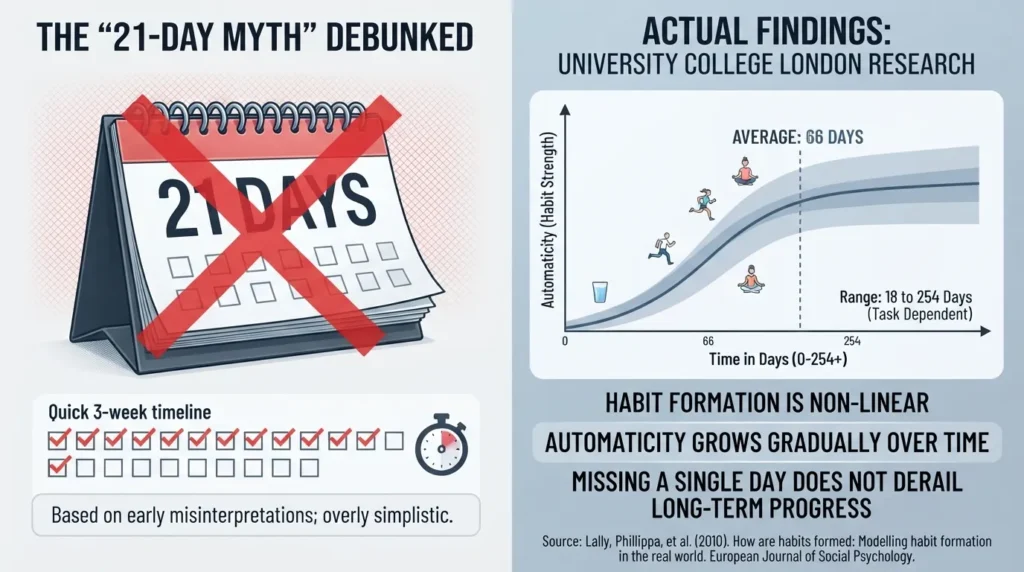
The widely cited belief that it takes exactly 21 days to form a habit is a complete myth. Modern behavioral science reveals that the actual average time required for a new behavior to become automatic is 66 days, with a broad real-world timeline ranging from 18 to 254 days.
Origin of the 21-Day Myth: This misconception stems from Dr. Maxwell Maltz, a 1960s plastic surgeon who observed that patients took about 21 days to get used to their new facial features or amputated limbs. Popular self-help culture mistook this anecdotal observation about surgical adjustment for hard psychological data on habit formation.
The Reality of Habit Formation: Groundbreaking research published by health psychologist Dr. Phillippa Lally at University College London established that automaticity develops along a curve rather than a fixed timeline. Simple behaviors (like drinking a glass of water daily) can anchor in closer to 18 days, while complex routines require months of consistent repetition.
Impact of Consistency and Slips: Lally’s study demonstrated that missing a single day of your routine has zero measurable impact on long-term habit formation. The psychological danger lies entirely in abandoning the process out of guilt, rather than the isolated slip-up itself.
Where Did the 21-Day Habit Myth Come From?

The enduring belief that habits require precisely 21 days to form originates from a widespread misinterpretation of clinical observations made over half a century ago. This timeline does not represent a scientific law of psychology, but rather an informal estimate drawn from cosmetic surgery patients.
Dr. Maxwell Maltz and the Book Psycho-Cybernetics
In 1960, plastic surgeon Dr. Maxwell Maltz published Psycho-Cybernetics, a self-help book that explored self-image and behavioral modification. The text became a massive cultural phenomenon, selling millions of copies and shaping generations of motivational speakers and productivity gurus.
The Core Premise: Maltz utilized principles of cybernetics to explain how the human brain acts as a goal-seeking mechanism.
The Target Audience: The book was written to help patients adjust mentally to profound physical changes, such as reconstructive procedures or limb amputations.
What Maltz Actually Observed in His Patients
Maltz noticed a distinct psychological pattern among the individuals he treated in his clinical practice. He observed that patients required a specific timeframe to mentally reconcile their self-image with their new physical reality.
The Timeline: He documented that it took a minimum of 21 days for patients to stop seeing their phantom limbs or to get accustomed to their altered facial features.
The Nuance: Maltz never claimed this window applied to building habits, breaking addictions, or learning new lifestyle routines. He explicitly stated that this was simply the minimum period required for the mind to adapt to a physical change.
How a Personal Observation Became a Global Rule
Subsequent generations of authors and motivational coaches extracted Maltz’s observation about surgery patients and stripped away all contextual caveats. They repackaged the phrase as a hard biological rule for human behavior.
The Dropped Qualifier: Over decades of retelling, Maltz’s careful use of “a minimum of 21 days” was shortened to a definitive “it takes 21 days.”
The Self-Help Echo Chamber: Later writers cited Maltz without reading his original work, cementing the misconception into mainstream culture as an undisputed psychological truth.
What Does Science Actually Say? The Real Number Revealed

Scientific research proves that forming a new habit takes an average of 66 days, not 21. Groundbreaking empirical data shattered the long-standing self-help myth by tracking real people as they attempted to build lasting behavioral routines in everyday environments.
The University College London (UCL) Study Explained
Researchers at University College London conducted the first major empirical investigation into how habits actually form in real-time. Published in the European Journal of Social Psychology, the study monitored 96 participants over a 12-week period as they chose a new daily behavior—such as eating a piece of fruit or running before lunch.
Tracking Automaticity: Participants logged onto a daily website to report whether they performed the behavior and how automatic it felt.
Measuring Plateau Points: The researchers tracked the progression until the behavior reached an asymptotic curve—the point where automaticity leveled off and required zero conscious effort.
Meet the Researcher: Phillippa Lally’s Findings
Health psychology researcher Phillippa Lally led the landmark study, uncovering the exact mechanics of behavioral automaticity. Her findings changed how behavioral scientists understand habit loops.
The Power of Repetition: The study confirmed that habit formation relies strictly on associative learning—repeating a specific action within a consistent context until environmental cues trigger the behavior automatically.
The Asymptotic Curve: Automaticity increases rapidly during early repetitions, but the rate of growth slows progressively until it hits a permanent plateau.
The Real Range: 18 to 254 Days (Not Just 66)
While 66 days is widely cited as the average, Lally’s data revealed an immense disparity among individuals and tasks. Human psychology cannot be boxed into a single rigid window.
The Fastest Adapters: Simple actions—like drinking a glass of water after breakfast—became automatic for some participants in as little as 18 days.
The Slowest Adapters: Complex physical routines—such as completing 50 sit-ups before dinner—required up to 254 days for full neurological automaticity to lock in.
Why 66 Days Is an Average, Not a Deadline
Treating 66 days as a strict deadline sets people up for unnecessary psychological failure. The figure represents a statistical midpoint, meaning half of all people take longer than 66 days to anchor a standard routine.
Complexity Dictates Speed: The neurological weight of the task directly dictates the timeline; mental adjustments and complex physical behaviors take significantly longer than micro-habits.
Individual Variability: Genetics, lifestyle stability, environmental cues, and personal motivation levels cause timelines to fluctuate wildly from person to person.
How Many Times Do You Actually Need to Repeat a Habit?
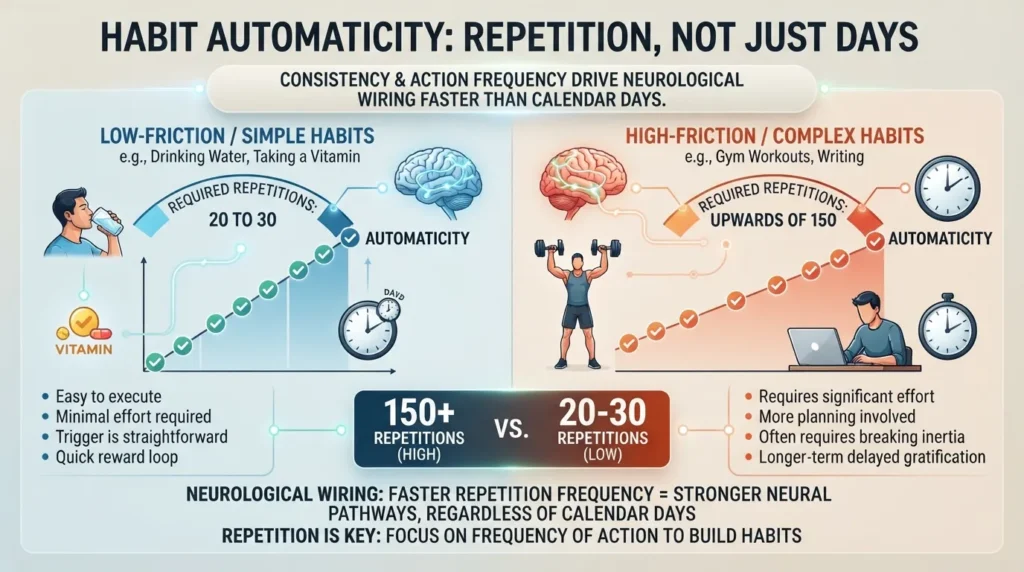
Understanding how many times to repeat a behavior matters far more than counting calendar days. Habit formation relies fundamentally on context-dependent repetition, meaning the actual frequency of execution within a stable environment drives neurological wiring rather than the passage of time alone.
Repetition vs. Time: Why Days Isn’t the Full Picture
The human brain does not automatically update its neural pathways simply because 24 hours have passed. Automaticity builds exclusively through the act of firing the neural circuit associated with the cue, routine, and reward loop.
Action Over Calendar Days: If you skip performing the behavior, those intervening days contribute zero progress toward building the habit, regardless of how many weeks have gone by.
The Accumulation of Cues: A person who repeats a trigger-action sequence twice a day will cement the neural pathway much faster than someone who attempts it once a week over a longer timeframe.
Consistency Beats Perfection (the Missing-a-Day Factor)
A widespread misconception dictates that missing a single day resets your progress back to zero. Empirical tracking proves that isolated slip-ups cause no measurable long-term damage to habit formation.
The Slips Study: Research shows that missing a day occasionally does not significantly disrupt the overall trajectory of automaticity development.
The Psychological Trap: The primary threat of a missed repetition is behavioral abandonment driven by guilt, rather than any chemical reset in the brain.
Simple Habits vs. Complex Habits — Real Examples
The total number of required repetitions scales directly with the cognitive and physical load of the task. Different behaviors demand vastly different levels of reinforcement before achieving effortless automaticity.
Simple Habits: Actions requiring minimal effort—such as drinking a glass of water immediately after waking up—frequently lock in after roughly 20 to 30 successful repetitions due to their low friction.
Complex Habits: Multi-step routines—such as executing a 45-minute gym workout or writing 1,000 words before breakfast—often require upwards of 150 to 200 consistent repetitions to become second nature.
21-Day Habit Formation — A Realistic Day-by-Day Roadmap
Successfully building a sustainable routine requires navigating distinct psychological phases. Rather than a flat, effortless incline, habit formation follows a predictable biological timeline governed by the brain’s neuroplasticity.
The Willpower Phase (Days 1–7): The initial week is driven entirely by conscious intent and high motivation. The brain recognizes the novelty of the behavior, but zero automaticity exists, meaning every repetition requires active mental energy and deliberate focus.
The Friction Phase (Days 8–21): This critical window is where the initial novelty wears off and psychological resistance peaks. Dr. Phillippa Lally’s research highlights that this is when the highest rate of dropout occurs because the brain is actively working to rewire old neural pathways while constructing new ones.
The Automaticity Phase (Days 22–66): Once you cross the three-week threshold, the behavior begins shifting from conscious choice to automatic execution. As reinforcement continues toward the 66-day average, environmental cues trigger the routine effortlessly with minimal cognitive load.
A First-Hand 21-Day Habit Experiment
To understand how this timeline plays out in practice, I tested building a micro-habit of writing 500 words every morning immediately after pouring coffee.
The Setup: Leveraging the cue-routine-reward loop, the coffee pot served as the environmental trigger, writing was the routine, and immediate checkbox tracking provided the mental reward.
The Reality Check: By Day 14, the “Mastery Mirage” hit—the routine felt deceptively easy, tempting me to slack off on consistency.
The Takeaway: By Day 21, the habit was far from automatic; skipping a single morning still demanded deliberate friction to restart. True behavioral ease did not manifest until well past the six-week mark, proving that the 21-day mark is merely a stepping stone rather than the finish line.
Beyond 21 Days — Other Habit Frameworks You Should Know
Alternative psychological frameworks provide more realistic blueprints for behavioral transformation than the outdated 21-day model. Structured methodologies like the 3-3-3 rule and the 7-21-90 framework offer deeper clarity on how the human brain actually adapts to long-term changes.
What Is the 3-3-3 Rule for Habits?
The 3-3-3 rule is a structured prioritization framework designed to help individuals build sustainable consistency without overwhelming their cognitive load. Instead of trying to overhaul an entire lifestyle at once, it breaks focus down into manageable categories.
Focus Areas: You target three core habits across three distinct pillars of life (such as health, career, and personal growth) while dedicating three weeks of intense tracking to establish them.
Reduction of Friction: By capping your active focus at a strict limit, you prevent decision fatigue and protect your mental energy from burnout.
What Is the 7-21-90 Rule?
Popularized by modern productivity experts, the 7-21-90 rule maps out the structural milestones required to transition a short-term goal into an permanent lifestyle change. It acknowledges that human psychology operates across distinct psychological thresholds.
First 7 Days (The Commitment Phase): The initial week focuses purely on breaking old inertia, overcoming initial resistance, and establishing basic compliance with the new routine.
Days 8 to 21 (The Integration Phase): This phase aligns with Dr. Maxwell Maltz’s original surgical observations, marking the window where conscious discomfort begins to ease and the routine starts feeling familiar.
Days 22 to 90 (The Identity Habit Phase): Spanning roughly three months, this extended period cements the behavior into your subconscious identity, making it feel unnatural not to perform the action.
How These Compare to the 21-Day Theory
Comparing alternative models to the rigid 21-day myth highlights why multi-stage frameworks yield vastly superior results in real-world behavior modification.
Staged Progression: While the 21-day theory treats habit formation as a single sprint, frameworks like the 7-21-90 rule account for the vulnerable middle phase where most people stumble.
Psychological Reality: Multi-week models align closely with modern empirical data from University College London, proving that sustainable wiring requires months of reinforcement rather than a quick three-week fix.
How Many Days Does It Take to Break a Habit?
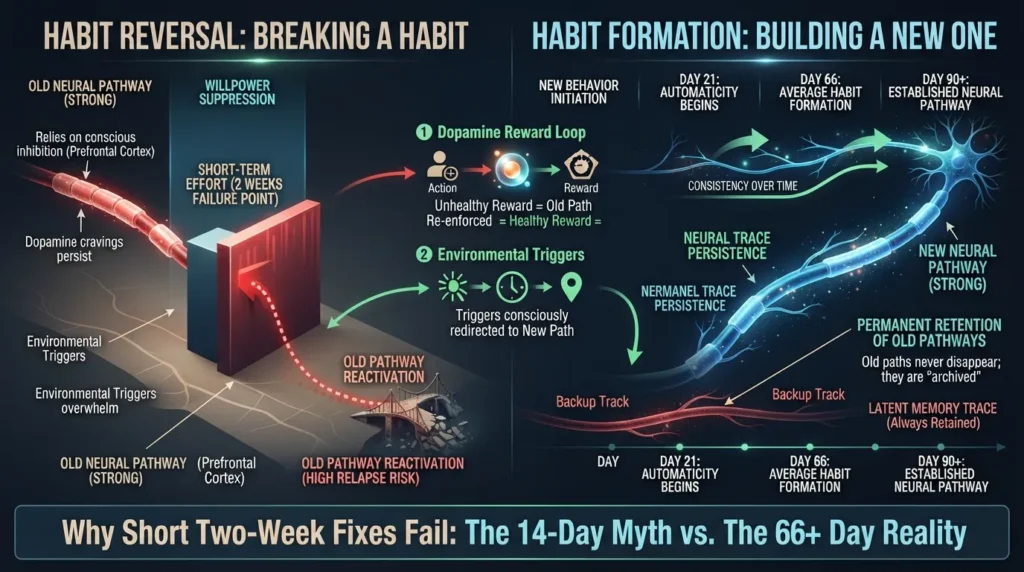
Breaking an existing habit typically takes longer than 66 days because you are actively fighting deep-seated neural pathways rather than simply laying down new ones. Eradicating an unwanted behavior requires dismantling established dopamine loops and rewriting automatic behavioral responses.
Is Breaking a Habit Faster or Slower Than Building One?
Unlearning an established routine is significantly slower than constructing a new one. The human brain prioritizes neural efficiency, meaning old behavioral tracks remain permanently embedded as backup routes even after a new habit forms.
Neural Persistence: Old habits never truly disappear from the brain’s circuitry; they are merely overridden by stronger competing neural pathways.
The Vulnerability Window: Under conditions of acute stress, fatigue, or environmental triggers, the brain instantly defaults to the older, deeply grooved neural highway rather than the newly built alternative.
Can You Really Break a Habit in 2 Weeks?
The popular claim that you can completely eliminate an unwanted behavior in 14 days is a physiological impossibility. While you can interrupt a routine temporarily through sheer willpower, two weeks is insufficient time to permanently alter an entrenched neural loop.
The Willpower Illusion: Stopping a behavior for two weeks merely suppresses the action; the underlying neurological craving and environmental triggers remain fully intact.
The Rebound Effect: Attempting to force a rapid cessation without addressing the root cue-reward cycle almost always triggers a severe behavioral relapse once conscious attention wanes.
Practical Steps to Break an Old Habit Faster
Accelerating the habit-reversal process requires leveraging behavioral psychology to disrupt the automatic trigger-response cycle rather than relying on brute-force suppression.
Identify the True Cue: Isolate the exact environmental, emotional, or temporal trigger that initiates the unwanted behavior (such as stress prompting nail-biting or boredom triggering phone-checking).
Deploy a Replacement Behavior: Instead of trying to stop an action entirely, substitute the routine with a healthier action that satisfies the same underlying reward loop.
Friction Optimization: Increase the environmental friction of the bad habit (e.g., removing junk food from the house) while lowering the barrier to entry for your preferred replacement action.
What Happens If You Miss a Day? (The Guilt-Free Truth)
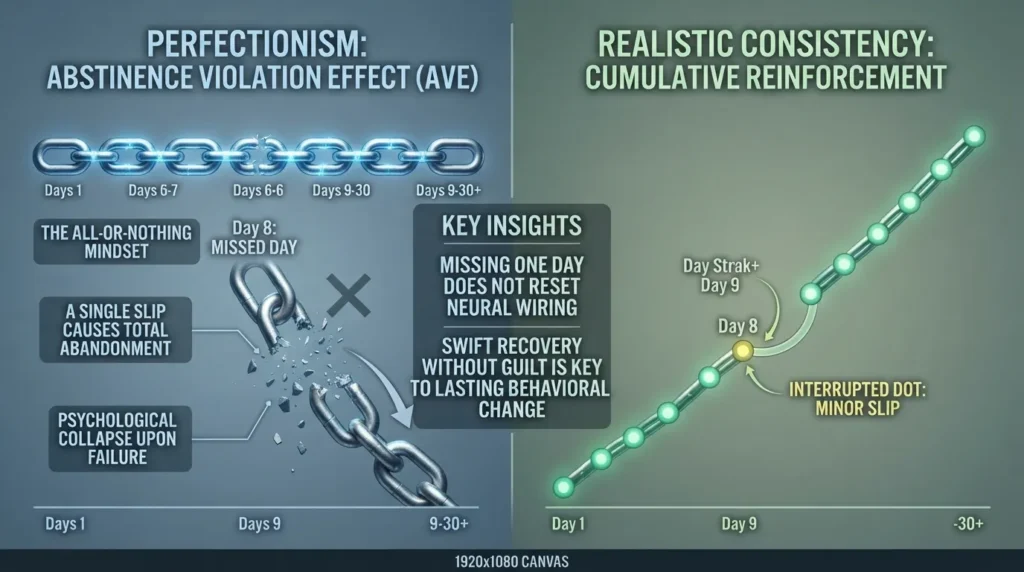
Missing a single day of your routine causes zero measurable damage to your long-term habit formation. Clinical data confirms that an isolated slip-up does not reset your psychological progress or erase the neural wiring you have built.
The Science: One Missed Day Doesn’t Break the Chain
Behavioral tracking studies demonstrate that perfectionism is far more destructive to habit formation than inconsistency. When researchers monitored people building daily routines, they found that missing one or even two days consecutively had no statistically significant impact on the ultimate formation of automaticity.
Cumulative Reinforcement: Habit formation is driven by the total number of cumulative repetitions over time, not an unbroken, uninterrupted streak.
Neural Stability: Once a neural pathway begins forming, an occasional gap in execution fails to unravel the structural changes taking place in the brain.
Why All-or-Nothing Thinking Sabotages Habits
The greatest threat to building a lasting routine is not the missed action itself, but the psychological spiral that follows. Adopting a rigid, perfectionist mindset turns a minor human lapse into a catastrophic failure.
The Abstinence Violation Effect: Believing that a single missed day ruins everything often triggers a total abandonment of the goal out of frustration.
Guilt as Friction: Punishing yourself mentally creates emotional resistance, making it significantly harder to summon the motivation to restart the next day.
How to Get Back on Track Without Starting Over
Recovering from a missed day requires treating the lapse as a normal data point rather than a moral failing. Swiftly resuming the behavior neutralizes the setback entirely.
Never Miss Twice: Use the strict rule of never allowing a single slip to turn into a two-day streak of inaction.
Lower the Bar: On the day you return to the habit, scale the intensity down (such as reading just one page or doing a five-minute workout) to eliminate friction and secure an easy win.
Frequently Asked Questions
Is the 21-day habit rule true?
The 21-day habit rule is a myth rooted in a misinterpretation of 1960s cosmetic surgery observations by Dr. Maxwell Maltz. Modern behavioral science from University College London shows that forming a new routine actually takes an average of 66 days, with real-world timelines ranging widely from 18 to 254 days.
What is the 3-3-3 rule for habits?
The 3-3-3 rule is a structured behavioral framework designed to prevent cognitive overload. It directs you to focus on three core habits across three vital life categories, dedicating three weeks of intense tracking to establish them before expanding your personal development goals further.
What’s more effective, 21 days or 66 days?
The 66-day timeline is vastly more effective because it reflects empirical data rather than an arbitrary self-help myth. While 21 days is only enough to move past initial novelty, targeting 66 days provides the necessary neurological repetition to achieve true behavioral automaticity.
What is the 7-21-90 rule?
The 7-21-90 rule is a progress framework dividing behavioral change into three distinct milestones. It maps out the first 7 days for initial commitment, the next 21 days for breaking old resistance, and the final 90 days for cementing the behavior into your permanent subconscious identity.
Is it true that it takes 60 days to make a habit?
While close to the scientific average, research pinpoints the exact figure at 66 days rather than 60. This duration varies extensively based on task complexity, individual consistency, and how much friction the new behavior introduces into your daily environment.
How many days does it take to fully break a habit?
Breaking an established habit typically takes longer than 66 days because unlearning requires overriding deep-seated neural pathways. Because the brain permanently retains old pathways as backup tracks, eliminating an unwanted behavior demands sustained disruption of its underlying dopamine and reward loops.
Is 21 days enough to build a habit?
Twenty-one days is rarely enough to build a permanent habit, except for extremely simple actions. For most standard routines, the 21-day mark represents the fragile phase where initial motivation fades and the brain is only beginning to transition from conscious effort to automatic processing.
Can you break a habit in 2 weeks?
You cannot permanently break an entrenched habit in two weeks. Stopping a behavior for 14 days only suppresses the action temporarily; the underlying neurological cravings and environmental triggers remain fully intact, making a rapid relapse almost inevitable under stress.
Conclusion — Key Takeaways
The pervasive belief that habits form in 21 days is a persistent myth born from a historical misquote. Modern behavioral science demonstrates that true automaticity requires an average of 66 days, with timelines shifting dramatically depending on task complexity and individual consistency.
Quick Recap: 21 Days vs. 66 Days vs. Reality
The Myth: Twenty-one days is an arbitrary timeline derived from a 1960s cosmetic surgery observation by Dr. Maxwell Maltz.
The Science: University College London research proves the actual average is 66 days, spanning a realistic range from 18 to 254 days.
The Reality: Habit formation relies on context-dependent repetition and consistency rather than rigid calendar streaks, meaning isolated slip-ups cause zero long-term damage.
Your Next Step
Stop aiming for an arbitrary three-week finish line and focus entirely on mastering your daily environment. Pick one micro-habit, anchor it to an existing daily cue, and commit to showing up consistently for the long haul.
Kittisak Wattanakul
Kittisak Wattanakul is the Discipline Editor at Holistic Wellbeing Living. He writes about routines, focus, consistency, and practical follow-through. With nine years of experience creating personal-growth content, Kittisak helps readers build realistic systems for steady progress without extreme productivity pressure.