Academic Discipline: Definition, 4 Main Branches, & Types
What Is an Academic Discipline?
An academic discipline is a formalized branch of knowledge that is systematically taught and researched at the college or university level. It functions as a structured area of expertise defined by specific methodologies, theoretical frameworks, and scholarly communities within higher education.
Academic Discipline: A Clear, Direct Definition
At its core, an academic discipline establishes the boundaries of specialized human knowledge and inquiry. Institutions of higher education organize departments, faculties, and research initiatives around these defined domains to advance scholarly understanding.
Systematic Investigation: Relies on peer-reviewed research, empirical testing, or recognized theoretical critique to expand the domain.
Institutional Structure: Anchored by dedicated university departments, specialized journals, and professional associations.
Specialized Terminology: Utilizes a distinct lexicon, conceptual frameworks, and methodological toolkits unique to the branch of knowledge.
Academic Discipline vs. Field of Study vs. Major — Are They the Same?
These terms are frequently used interchangeably in everyday conversation, but they represent distinct structural layers within educational systems. Recognizing their precise differences clarifies how curricula and student pathways are organized.
Academic Discipline: The overarching, formalized branch of knowledge (e.g., History, Physics, Sociology) grounded in long-standing research traditions.
Field of Study: A broader or sometimes interdisciplinary category that can encompass multiple disciplines or professional tracks (e.g., Environmental Studies, Cognitive Science).
Major: The specific, structured set of degree requirements and coursework a student completes as a credential at the college/university level.
Key Characteristics of an Academic Discipline
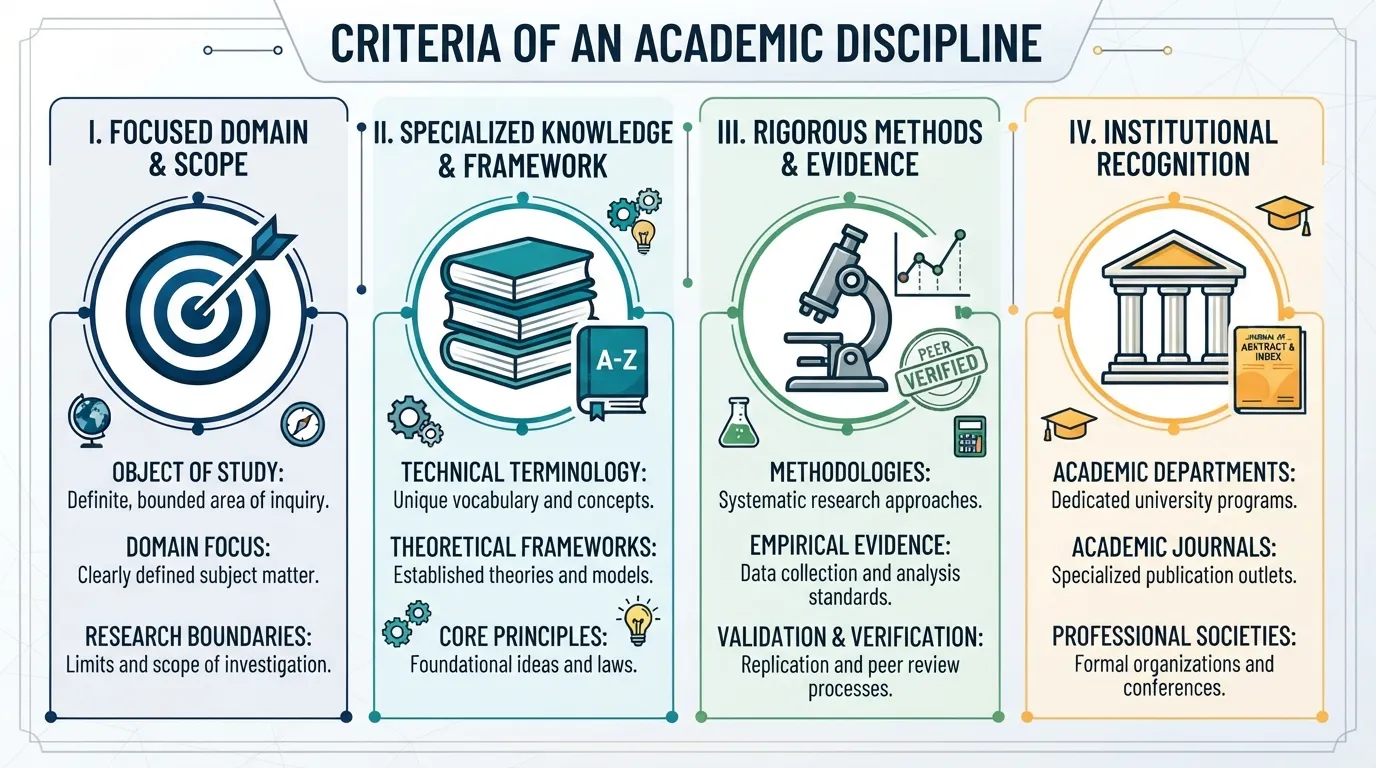
An academic discipline is distinguished by a specific object of study, a robust body of specialized knowledge, rigorous research methods, and formal institutional recognition. These structural pillars separate established scholarly fields from casual hobbies or unverified bodies of information.
Object of Study (Subject/Domain Focus)
Every academic discipline centers on a clearly defined object of study that establishes its distinct scope and boundaries. This subject focus dictates what questions the discipline asks and what phenomena it seeks to explain.
Bounded Scope: Limits the field of inquiry so researchers can focus deeply on specific aspects of the natural world, human behavior, or abstract systems.
Core Questions: Formulates foundational inquiries that guide ongoing research and theoretical development within the domain.
Interdisciplinary Overlaps: Intersects with other areas of higher education while maintaining a distinct core identity.
Specialized Body of Knowledge & Terminology
Disciplines accumulate decades or centuries of specialized knowledge, theories, and technical terminology that serve as the shorthand for complex concepts. Mastering this vocabulary is essential for participating in scholarly discourse.
Theoretical Frameworks: Utilizes established models and conceptual structures to interpret data and phenomena.
Technical Lexicon: Employs precise terminology unique to the area of expertise to prevent ambiguity among researchers.
Cumulative History: Builds upon previous discoveries, literature, and critiques rather than restarting investigations from scratch.
Defined Research Methods & Evidence Standards
Rigorous research methods and evidence standards provide the criteria for what counts as valid proof within a given branch of knowledge. Different disciplines rely on methodologies tailored to their specific objects of study.
Methodological Toolkits: Employs quantitative experiments, qualitative fieldwork, textual analysis, or mathematical modeling depending on the domain.
Peer Verification: Submits findings to critical evaluation by other experts in the same field before acceptance.
Replicability: Demands that studies can be tested or re-evaluated under similar conditions to ensure reliability.
Institutional Recognition (Departments, Journals, Societies)
An established discipline requires structural backing within the higher education ecosystem to survive, reproduce, and evolve. This institutional infrastructure provides the professional homes where scholars collaborate and train the next generation.
Academic Departments: Occupies formal organizational units within colleges and universities dedicated to teaching and research.
Peer-Reviewed Journals: Maintains dedicated publishing outlets where new research is vetted and cataloged.
Learned Societies: Organizes professional societies that host conferences, set ethical standards, and foster global collaboration.
The 4 Main Branches of Academic Disciplines
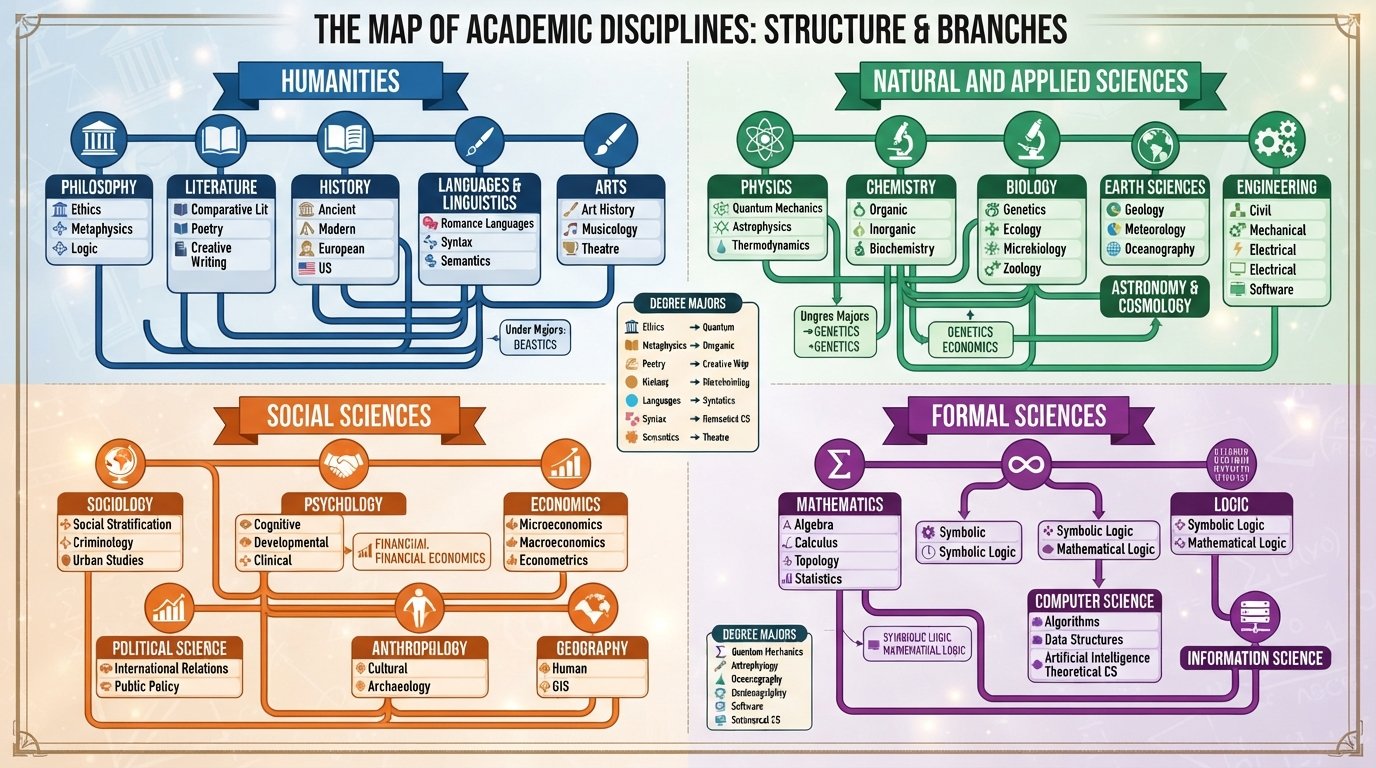
The four main branches of academic disciplines are the humanities, natural and applied sciences, social sciences, and formal sciences. Each branch utilizes distinct methodologies, ranging from empirical methods to abstract systems, to investigate different dimensions of human experience and the natural world.
Humanities (Philosophy, Languages, Art, Cultural Studies)
The humanities explore human culture, values, history, and creative expression through qualitative analysis and critical interpretation. Rather than relying solely on empirical data, this branch examines how people document and process the human experience.
Core Focus: Analyzes literature, philosophy, art history, and global languages to understand human meaning-making.
Methodologies: Employs textual critique, historical analysis, and philosophical reasoning.
Scholarly Goal: Cultivates critical thinking, ethical awareness, and an appreciation for cultural diversity.
Natural & Applied Sciences (Physics, Chemistry, Biology, Computer Science)
The natural and applied sciences investigate the physical and natural world using rigorous empirical methods and systematic experimentation. This branch seeks to uncover universal laws, predictable patterns, and practical technological solutions.
Core Focus: Explores physical matter, living organisms, ecosystems, and engineered systems.
Methodologies: Relies on laboratory experiments, controlled observation, quantitative data collection, and technological development.
Scholarly Goal: Generates verifiable explanations of physical phenomena and creates innovations that solve tangible problems.
Social Sciences (Sociology, Psychology, Economics, Political Science)
The social sciences study human society, social relationships, and individual behavior through a mix of empirical and qualitative approaches. This branch bridges scientific inquiry with humanistic observation to map societal structures.
Core Focus: Investigates institutions, economic markets, government systems, and cognitive behaviors.
Methodologies: Utilizes surveys, statistical modeling, behavioral experiments, and ethnographic fieldwork.
Scholarly Goal: Understands the forces shaping human interaction and informs public policy, governance, and community well-being.
Formal Sciences (Mathematics, Logic, Statistics)
The formal sciences deal with abstract systems, formal logic, and theoretical structures rather than empirical physical evidence. This branch provides the foundational language and calculation tools used by almost all other disciplines.
Core Focus: Explores numbers, quantities, logical deductions, probabilities, and algorithmic structures.
Methodologies: Relies on deductive reasoning, mathematical proofs, and axiom-based systems.
Scholarly Goal: Establishes rigorous frameworks for processing information, quantifying uncertainty, and modeling complex relationships.
How Many Types of Academic Disciplines Are There? (Numbered FAQ Block)
Classification systems for higher education vary, but academic disciplines are most commonly categorized into 4 core branches, 5 extended types, 10 specific sub-fields, or 3 traditional historical groups. Understanding these structural breakdowns clarifies how higher education organizes knowledge across different institutions and global frameworks.
The 4 Core Academic Disciplines (Broad Classification)
The standard global framework divides higher education into four foundational branches that map out the primary domains of human inquiry.
Humanities: Focuses on human culture, philosophy, languages, and history.
Natural Sciences: Investigates the physical and biological world through empirical testing.
Social Sciences: Examines human society, behavior, institutions, and relationships.
Formal Sciences: Studies abstract systems, mathematics, logic, and theoretical structures.
The 5 Commonly Cited Types (Including Interdisciplinary Studies)
Modern classification systems frequently expand the standard four branches to include a fifth category that bridges traditional boundaries to tackle complex real-world challenges.
Humanities & Arts: Encompasses creative expression, literature, and philosophical inquiry.
Natural Sciences: Covers physical, chemical, and biological sciences.
Social Sciences & Behavioral Studies: Groups psychological, sociological, and economic research.
Applied Sciences & Professional Fields: Includes engineering, medicine, agriculture, and business.
Interdisciplinary Studies: Combines methods from multiple fields to study complex modern topics like environmental science or data analytics.
Breaking It Down Further: 10 Types/Sub-fields of Academic Disciplines
Granular academic databases, such as the Organisation for Economic Co-operation and Development (OECD) Frascati Manual, break broad areas down into ten specific sub-fields for research tracking and funding.
Natural Sciences: Physics, chemistry, biology, and earth sciences.
Engineering and Technology: Civil, mechanical, electrical, and computer engineering.
Medical and Health Sciences: Clinical medicine, public health, and nursing.
Agricultural Sciences: Agronomy, forestry, and veterinary science.
Social Sciences: Economics, sociology, psychology, and political science.
Humanities: History, philosophy, art, and literature.
Formal Sciences: Mathematics and computer science.
Applied Arts: Design, architecture, and fine arts.
Interdisciplinary Fields: Environmental science and cognitive science.
Professional Studies: Law, education, and business administration.
The 3 Broadest Historical Categories (Traditional View)
Historical classifications of higher education date back centuries and divide knowledge into three broad philosophical pillars.
Natural Philosophy: The study of nature and the physical universe, which evolved into modern natural sciences.
Moral Philosophy: The study of human behavior, ethics, politics, and society, which birthed the social sciences and humanities.
Metaphysics and Logic: The study of abstract reasoning and first principles, which shaped the formal sciences.
Academic Discipline vs. Professional Discipline
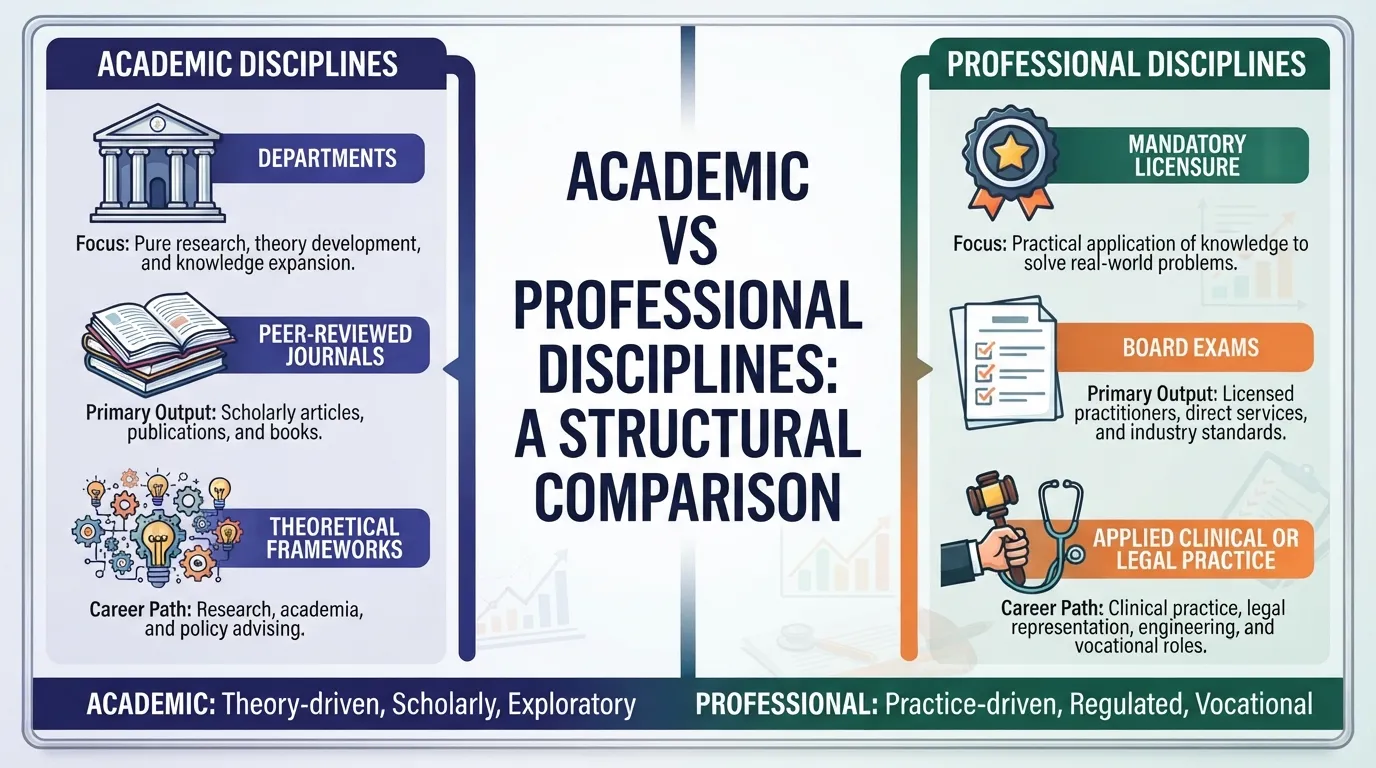
A professional discipline is an area of study specifically structured to prepare students for direct entry into a licensed, regulated career by combining theoretical research with practical vocational training. Unlike purely academic disciplines, which pursue knowledge for its own sake, professional disciplines exist to solve immediate, real-world problems and enforce industry standards.
What Makes a Discipline “Professional” Instead of Purely Academic?
Professional disciplines are defined by their strict alignment with external industry standards, practical application, and mandatory licensure requirements. While academic disciplines focus heavily on expanding theoretical frameworks, professional tracks prioritize client outcomes, safety, and specialized execution.
Mandatory Licensure: Requires graduates to pass board exams, state bar tests, or engineering boards to practice legally.
Applied Focus: Translates abstract theories directly into actionable protocols, tools, and interventions used in the field.
External Regulation: Governed by professional associations and accrediting bodies that dictate curriculum requirements to protect public safety.
Examples: Law, Medicine, Engineering as Professional-Academic Hybrids
Fields like law, medicine, and engineering operate as professional-academic hybrids because they maintain rigorous research traditions while functioning as applied practices. These disciplines bridge the gap between university laboratories and high-stakes commercial or public environments.
Medicine: Blends the academic discipline of biological science with clinical practice, patient care, and strict medical board licensing.
Law: Combines the philosophical and historical study of jurisprudence with practical courtroom advocacy, contracts, and bar examinations.
Engineering: Integrates the formal and natural sciences with applied design, structural safety codes, and professional engineer (PE) certification.
Academic Discipline vs. Self-Discipline in Studying — Clearing the Confusion
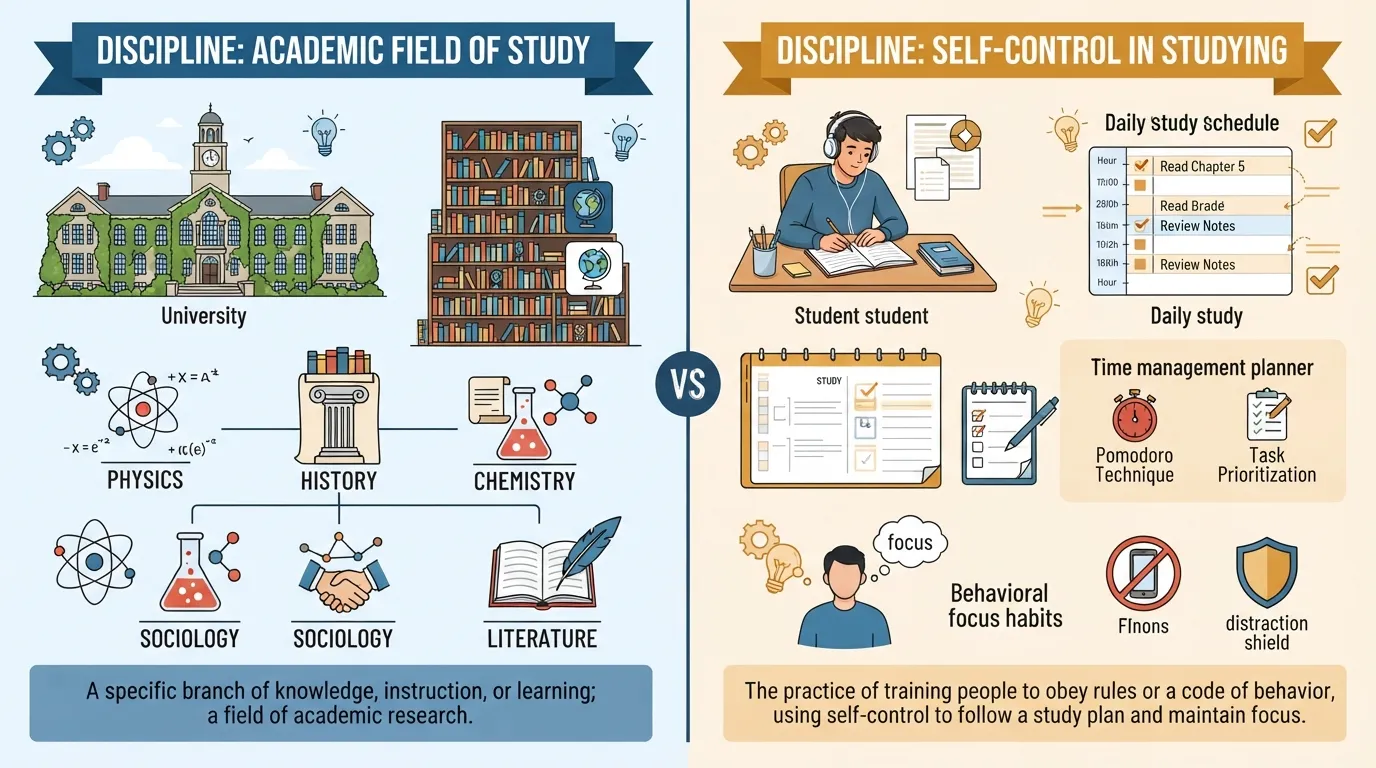
The word discipline in an educational setting can refer to an established academic branch of knowledge or the personal self-discipline required to study effectively. Confusing these two distinct concepts often leads students to the wrong learning resources.
Two Different Meanings of “Discipline” in Academic Contexts
Understanding how context changes the definition prevents confusion when navigating educational literature. One definition describes a structural field of expertise, while the other addresses personal behavior and focus.
Academic Discipline: A formal branch of knowledge taught and researched at a college or university level, such as physics or history.
Self-Discipline in Studying: The behavioral habit of maintaining focus, following a study schedule, and managing time to achieve academic goals.
Why Students Often Search for Both Meanings
Search engines frequently merge these distinct concepts because students use the exact same root word when researching their college majors versus looking for tips to improve their daily study habits.
Vocabulary Overlap: Both terms regularly appear in academic settings, creating ambiguity in broad keyword searches.
Parallel Goals: Succeeding within a difficult academic discipline requires intense personal self-discipline and structured daily habits.
How to Choose the Right Academic Discipline for Your Career
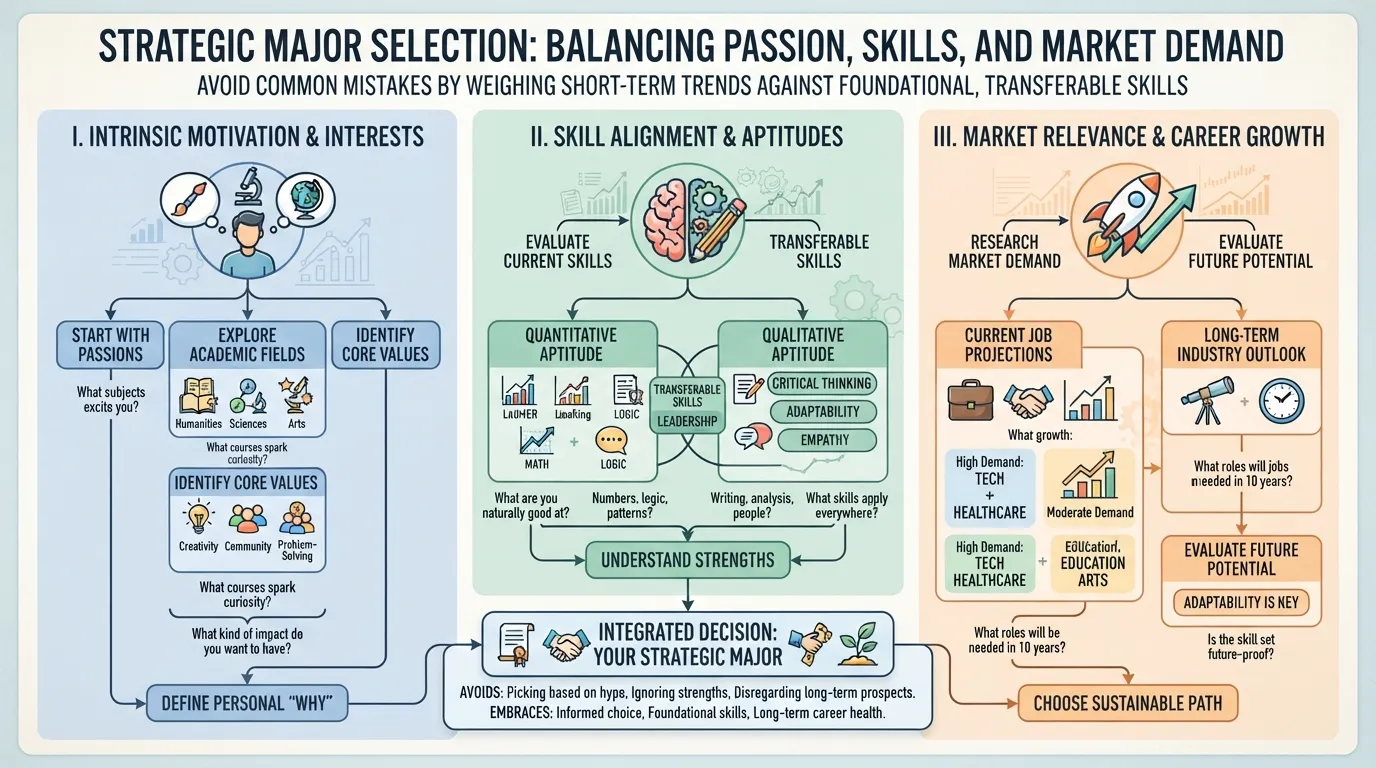
Choosing the right academic discipline requires balancing intellectual curiosity with long-term professional realities. A structured decision-making framework prevents common pitfalls and ensures your major aligns with sustainable career opportunities.
Assessing Your Interests vs. Career Goals
Effective major selection begins where personal strengths intersect with market demand. Focusing exclusively on passion without evaluating employment outcomes can lead to career friction, while choosing solely based on salary can cause early burnout.
Intrinsic Motivation: Identify subjects that naturally capture your attention and sustain your intellectual curiosity over years of rigorous study.
Skill Alignment: Evaluate your natural aptitudes, whether they lean toward quantitative data analysis, creative expression, or interpersonal communication.
Market Relevance: Research long-term industry projections, starting salaries, and entry-level requirements via resources like the U.S. Bureau of Labor Statistics Occupational Outlook Handbook to understand real-world viability.
Common Mistakes Students Make When Picking a Discipline
Navigating higher education choices often leads students into predictable traps that complicate their academic timeline and career readiness. Avoiding these missteps protects both your time and financial investment.
Chasing Short-Term Trends: Selecting a specialized major based on a temporary hiring boom rather than foundational, transferable skills.
Ignoring Prerequisite Rigor: Overlooking the specific mathematical, technical, or writing demands required to successfully complete upper-level coursework in a discipline.
Treating the Choice as Permanent: Forgetting that undergraduate degrees build adaptable problem-solving frameworks rather than binding legal contracts for life.
How One Student Evaluated Two Overlapping Disciplines
When faced with choosing between Psychology and Sociology, a student can cut through the confusion by analyzing how each discipline investigates human behavior through a different lens.
The Dilemma: The student wanted to work in public health advocacy but could not decide if the individual cognitive focus of Psychology or the structural community focus of Sociology was a better fit.
The Evaluation: Reviewing course syllabi revealed that Psychology required extensive quantitative statistics and lab experiments centered on individual mental processes, whereas Sociology emphasized ethnographic fieldwork, qualitative research, and systemic social institutions.
The Decision: The student chose Sociology because it aligned better with a long-term career goal of designing large-scale public health policy rather than clinical practice.
How Academic Disciplines Evolve (Interdisciplinary Trends)
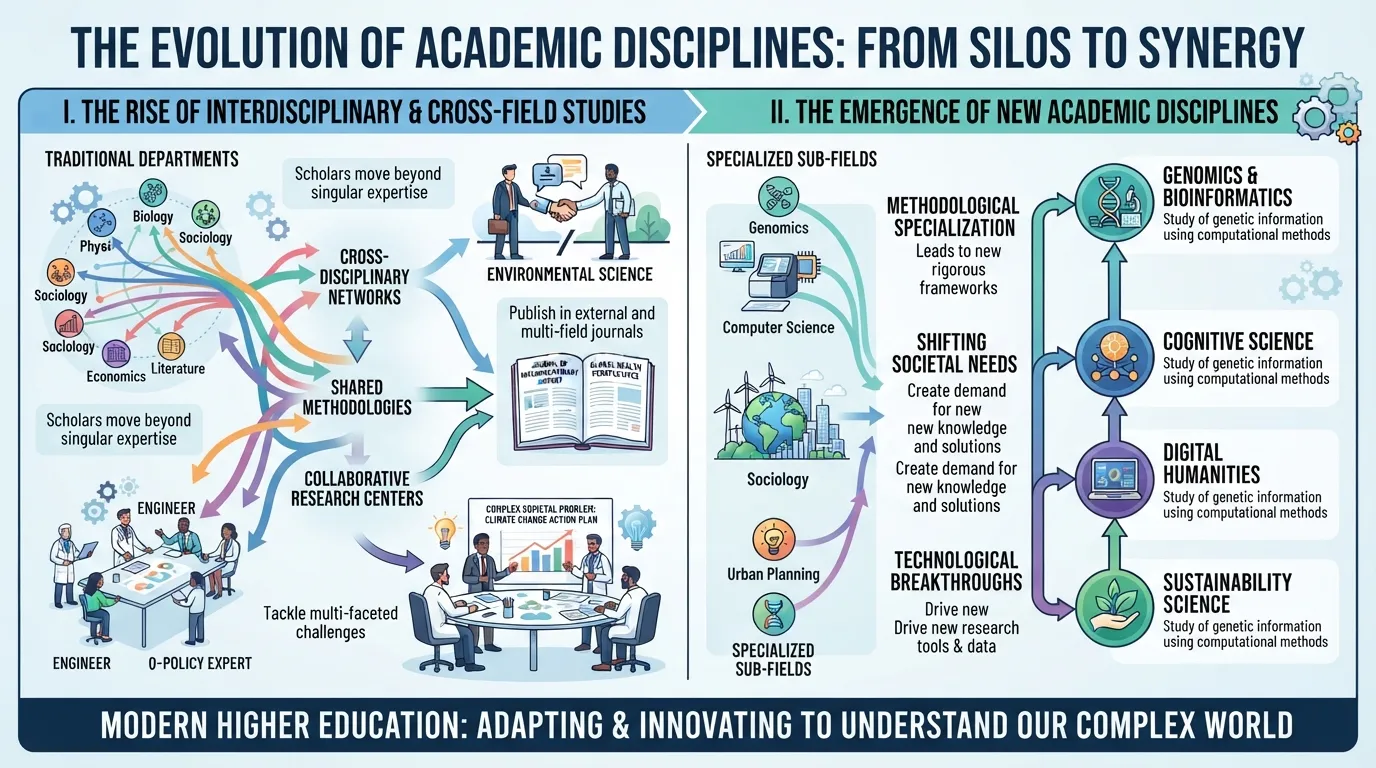
Academic disciplines are not static containers; they continuously adapt as new research methods, societal pressures, and cross-disciplinary collaborations reshape boundaries over time. Modern higher education is moving away from rigid institutional silos to address complex global problems that cross traditional academic lines.
Rise of Interdisciplinary and Cross-Field Studies
Interdisciplinary studies combine methods and theories from multiple distinct fields to explore complex issues like climate change, artificial intelligence ethics, and public health. Research tracking academic career tracks demonstrates that scientists and scholars frequently drift from their original doctoral roots as they engage in cross-disciplinary projects.
Fluid Affiliations: Scholars often collaborate across traditional department lines, publishing in external journals and adopting broader professional identities.
Complex Problem Solving: Real-world crises require integrated insights from the natural sciences, social sciences, and humanities simultaneously.
Institutional Adaptation: Universities increasingly fund hybrid research centers that transcend conventional faculty boundaries to foster innovation.
Why New Disciplines Emerge Over Time
New academic disciplines form when existing methodologies can no longer adequately explain newly discovered phenomena or technological shifts. This evolutionary process mirrors how specialized fields like computer science, data analytics, and cognitive science broke away from older parent disciplines.
Technological Breakthroughs: Novel tools, such as gene editing or machine learning, demand entirely new theoretical frameworks and training models.
Shifting Societal Needs: Economic, environmental, and cultural changes prompt academic institutions to establish formal departments for emerging areas of expertise.
Methodological Specialization: Sub-fields accumulate enough distinct literature and specialized peer-reviewed outlets to declare independence as full-fledged disciplines.
Frequently Asked Questions (FAQ Schema Block)
An academic discipline is a formal branch of knowledge systematically taught and researched within higher education, characterized by its own distinct theoretical frameworks, research methodologies, and scholarly discourse communities.
What do you mean by academic discipline?
An academic discipline is a structured branch of knowledge formally taught and investigated at the college or university level. It features specialized terminology, recognized methodologies, and dedicated departments within higher education.
What is an example of an academic discipline?
Physics is a classic example of a natural science discipline. It investigates the fundamental laws of nature, matter, and energy using empirical experimentation, peer-reviewed research, and mathematical modeling within university physics departments.
What are the five types of disciplines?
The five commonly cited types include the humanities, natural sciences, social sciences, applied sciences and professional fields, and interdisciplinary studies. This extended model integrates professional and cross-disciplinary training into traditional academic frameworks.
What are the 10 types of disciplines?
Granular classification models, such as the OECD Frascati framework, divide higher education into ten sub-fields: natural sciences, engineering and technology, medical and health sciences, agricultural sciences, social sciences, humanities, formal sciences, applied arts, interdisciplinary fields, and professional studies.
What are the four main academic disciplines?
The four core branches of academic disciplines are the humanities, natural sciences, social sciences, and formal sciences. These broad categories cover everything from cultural history and empirical physics to societal behavior and mathematical logic.
What are three types of discipline?
Traditional classification systems break broad academic inquiry into three historical pillars: natural philosophy, which evolved into the natural sciences; moral philosophy, which birthed the social sciences and humanities; and metaphysics or logic, which shaped the formal sciences.
What are some examples of disciplines?
Common examples span multiple branches of knowledge, including history and philosophy in the humanities, sociology and economics in the social sciences, chemistry and biology in the natural sciences, and mathematics and computer science in the formal sciences.
What are professional disciplines?
Professional disciplines are hybrid areas of study designed to prepare students for licensed, regulated careers. Fields like law, medicine, and engineering combine academic research traditions with practical vocational training and strict external industry standards.