Active Recall: The Ultimate Guide to Mastering Long-Term Memory
What Is Active Recall?
Active Recall Definition
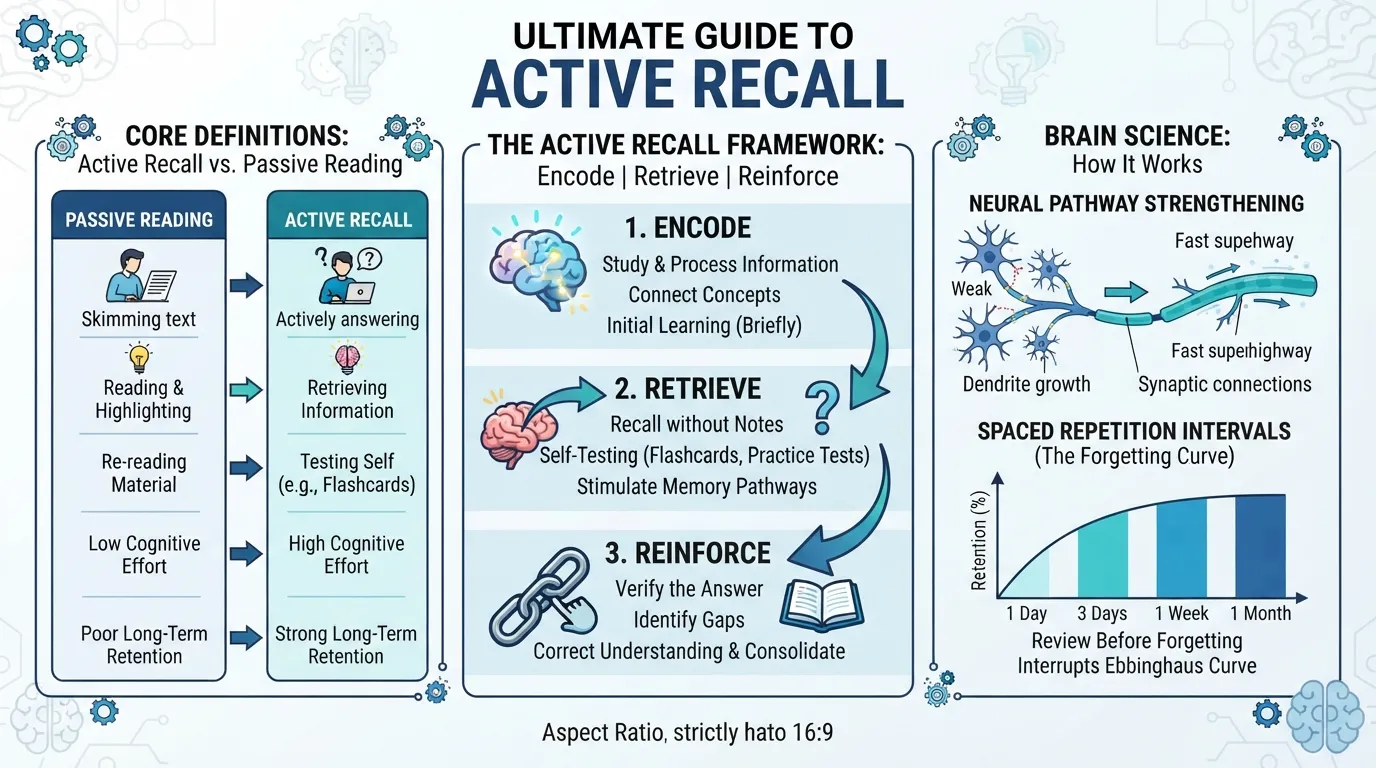
Active recall is a cognitive learning strategy that forces your brain to retrieve information from memory rather than passively reviewing study materials. Instead of re-reading textbooks or highlighting notes, you stimulate memory pathways by actively testing yourself on the concepts you are trying to learn.
Definition: The deliberate practice of stimulating the retrieval of knowledge from memory.
Core Mechanism: Forcing the brain to reconstruct information rather than recognizing it visually on a page.
Primary Benefit: Significantly strengthens neural connections for long-term retention compared to traditional review methods.
Active Recall vs. Passive Reading
| Feature | Active Recall | Passive Reading |
| Cognitive Effort | High; requires active generation of answers | Low; requires visual scanning and recognition |
| Information Retention | High; creates durable memory traces | Low; fades rapidly within 24 to 48 hours |
| Feedback Loop | Immediate; reveals knowledge gaps instantly | Delayed or absent; creates an illusion of competence |
| Core Methods | Flashcards, practice tests, self-explanation | Re-reading, highlighting, listening to lectures |
The Science: Why Your Brain Needs “Desirable Difficulty”
The effectiveness of active memory recall is rooted in the psychological concept of desirable difficulty. Coined by cognitive psychologist Robert Bjork, desirable difficulty refers to learning tasks that require significant effort and strain, which ultimately triggers deeper cognitive processing and long-term memory consolidation.
Neural Pathway Strengthening: Every successful act of retrieval physically strengthens the synaptic connections associated with that piece of information.
The Testing Effect: Decades of cognitive science research demonstrate that retrieving information alters the memory trace, making it easier to access in the future than simply studying it again.
Combating the Forgetting Curve: Challenging the brain disrupts the natural rate of memory decay, dramatically shifting information from short-term working memory into durable long-term storage.
The 3-Step Active Recall Study Method
Step 1 — Encode (Read & Understand Once)
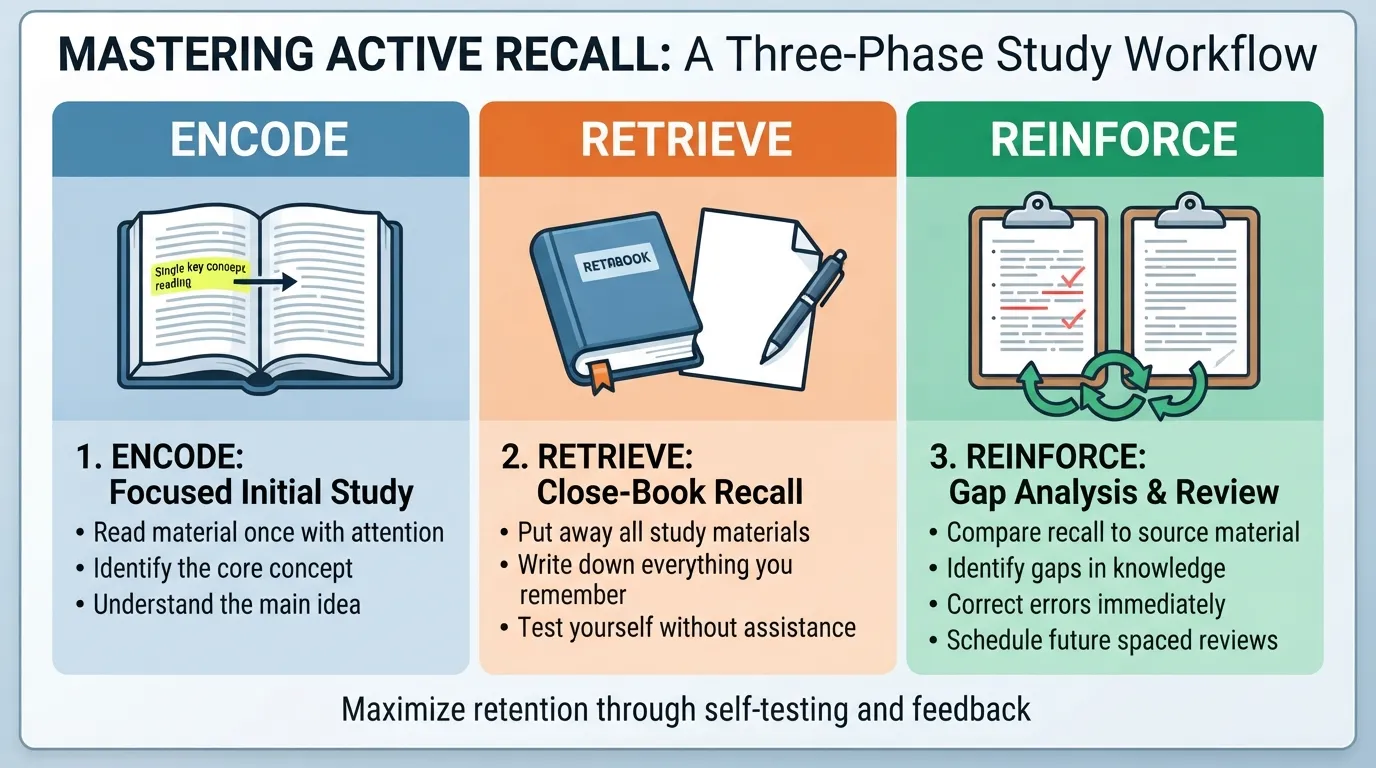
The active recall method begins with focused initial encoding to ensure you fully grasp the material before attempting any memory retrieval. Read through your textbook, lecture notes, or source material precisely once with maximum concentration, prioritizing deep comprehension over rote memorization.
Primary Focus: Build a mental model of the core concepts rather than trying to memorize every word.
Actionable Rule: Close your books or hide your digital notes immediately after this single reading phase to prevent falling into the trap of passive review.
Key Objective: Prepare your cognitive architecture by establishing baseline neural tracks that you will target during the upcoming retrieval phase.
Step 2 — Retrieve (Close the Book & Self-Test)
The core of the active memory recall process requires you to close all source materials and force your brain to reconstruct the information from scratch. Grab a blank sheet of paper or an open document and write down everything you can remember without looking at your notes.
The Close-Book Technique: Force your brain to dig into long-term memory instead of relying on visual recognition cues.
Self-Testing Execution: Draft flashcards, explain the concept aloud in your own words, or answer pre-made practice questions.
Productive Struggle: Embrace the mental friction; struggling to recall an answer is the exact mechanism that triggers deep neurological encoding.
Step 3 — Reinforce (Review Gaps & Repeat)
After completing your retrieval session, open your source materials to immediately check your answers and identify missing pieces or errors. This targeted feedback loop corrects misconceptions and permanently cements accurate data into your long-term memory.
Gap Analysis: Compare your retrieved output against the source text to pinpoint exact areas of misunderstanding.
Iterative Loop: Re-test only the specific concepts or questions you missed during the initial self-testing phase.
Spaced Integration: Schedule subsequent retrieval practice sessions at increasing intervals to combat the natural forgetting curve.
Quick-Reference 3-Step Framework Box
Encode: Read the source material once with deep focus, then close the book completely.
Retrieve: Force self-testing by writing down, speaking, or generating answers from memory.
Reinforce: Compare outputs against the source text, correct gaps, and repeat at scheduled intervals.
The Science Behind Active Recall (Why It Works)
The Testing Effect Explained
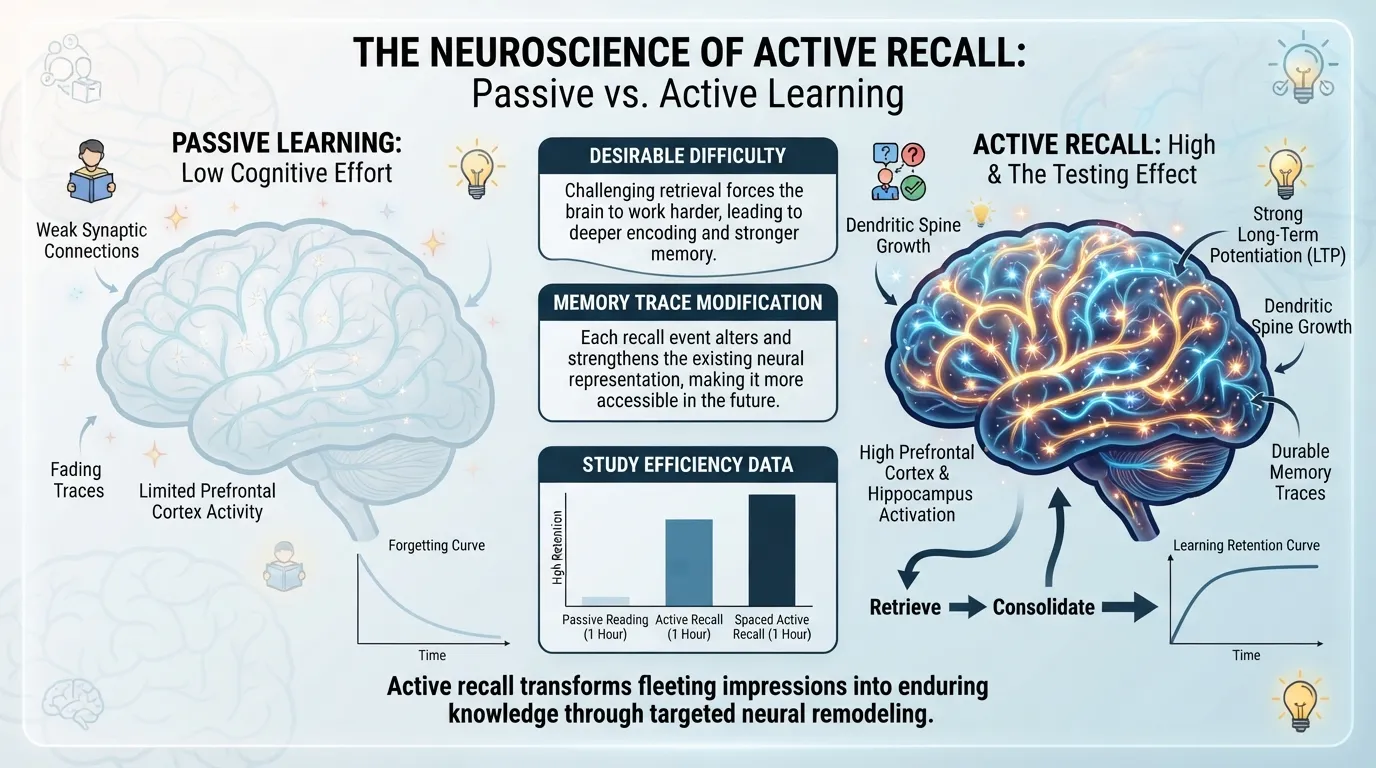
The testing effect is a well-documented cognitive phenomenon proving that long-term memory retention is significantly higher when information is retrieved through testing rather than through prolonged, passive study. Decades of psychological research demonstrate that the act of pulling knowledge out of your brain alters the memory trace, making it fundamentally easier to access later.
Active vs. Passive: Research highlighted in PubMed Research on Retrieval Practice establishes that retrieval practice consistently outperforms standard review methods across diverse learner groups.
Trace Modification: Every time you successfully recall a fact, the neural pathway is updated and stabilized, counteracting the natural rate of memory decay.
Diagnostic Feedback: Testing immediately exposes what you actually know versus what you merely recognize, eliminating the dangerous illusion of competence.
What Happens in the Brain During Retrieval
When you practice active memory recall, your brain experiences a state of productive cognitive strain that triggers physical changes in neural architecture. Neuroplasticity ensures that the synapses involved in retrieving the target information fire together repeatedly, building thicker and more efficient pathways.
Synaptic Potentiation: Active retrieval stimulates long-term potentiation, strengthening the communication signals between neurons.
Prefrontal Activation: The prefrontal cortex engages heavily during self-testing to search, filter, and reconstruct data from the hippocampus.
Consolidation Processing: Successful retrieval signals the brain that the retrieved information is valuable, accelerating its transfer from temporary working memory into permanent storage.
Fewer Study Hours, Better Retention (Efficiency Data)
Data from comparative cognitive studies show that students who swap passive highlighting for active recall achieve superior exam performance while cutting their overall study time. By focusing exclusively on retrieval practice, learners eliminate wasted hours spent re-reading familiar material.
Time Optimization: High study efficiency means you spend less time at your desk while retaining up to 50% more core concepts.
Exam Performance: Testing-based study groups consistently score higher on standardized tests and comprehensive final exams compared to traditional re-readers.
Diminishing Returns: Passive study yields diminishing returns after the first hour, whereas active retrieval maintains high cognitive yield throughout the session.
How to Practice Active Recall (Step-by-Step Techniques)
Flashcard Method (Question-Front, Answer-Back)
The flashcard method is the cornerstone of active recall studying examples, forcing a binary test of your memory before you flip to see the correct answer. Write a single, specific question or prompt on the front of a card, and place only the concise answer on the back.
Front-Side Rule: Keep prompts narrow and focused on one distinct concept to avoid cognitive overload.
Digital vs. Physical: Use physical index cards or apps like Anki that integrate spaced repetition algorithms.
Honest Grading: Only mark a card as correct if you can state the answer clearly from memory beforeturning it over.
Turn Notes Into Questions
Instead of passively reviewing headings and bullet points, convert every section of your study notes into interrogative exam questions. This simple shift transforms static reference text into an interactive self-quizzing bank.
Transformative Formatting: Change a heading like “The Causes of the French Revolution” into the active prompt: “What were the three primary economic triggers of the French Revolution?”
Margin Prompting: Write question prompts in the margins of your notebooks so you can cover your notes and test yourself on subsequent reviews.
Targeted Depth: Focus your questions on mechanisms, why-statements, and core definitions rather than trivial dates or names.
The Feynman Technique — Teach It to Someone Else
The Feynman Technique leverages verbal active recalling techniques to expose hidden gaps in your understanding by forcing you to explain complex topics in plain language. If you cannot teach a concept simply, your memory retrieval is incomplete.
Simulated Teaching: Stand up and explain the core topic out loud as if you are teaching a complete beginner or a twelve-year-old child.
Jargon Ban: Eliminate academic buzzwords and technical acronyms; force yourself to use everyday analogies.
Immediate Correction: Note the exact moments you stumble or rely on vague phrasing, then return to your source material to patch those specific knowledge gaps.
Blurting Method (Write Everything You Remember, Then Check)
The blurting method is an intensive, high-speed writing technique designed to dump everything your brain holds onto a blank page before you evaluate accuracy. It provides an immediate visual representation of your actual long-term memory retrieval strength.
Speed Writing: Set a timer for five to ten minutes and rapidly write down every term, formula, and concept you remember about a chapter without stopping to edit.
Color-Coded Auditing: Switch to a red pen and check your blurt sheet against your original textbook, correcting errors and adding missed points in real-time.
High Impact: This technique prevents the illusion of competence by instantly revealing which sub-topics you cannot actually recall under pressure.
Real Example: Applying Active Recall to a Language-Learning Topic
When studying conversational Spanish past tenses, traditional students repeatedly re-read verb conjugation tables until their eyes glaze over. An active recall approach replaces passive review with targeted production drills.
Prompt Generation: Write down English action phrases on a sheet of paper (e.g., “They went to the market yesterday”) instead of studying the verb chart.
Memory Retrieval: Cover the answer key and write out the full Spanish translation (
Ellos fueron al mercado ayer) completely from memory.Targeted Review: Immediately check your spelling and tense agreement against your grammar guide, marking missed irregular forms for a secondary review session later that day.
Active Recall + Spaced Repetition (The Power Combo)
What Is Spaced Repetition?
Spaced repetition is an evidence-based learning strategy that involves reviewing information at systematically increasing time intervals rather than cramming all at once. By exposing your brain to a concept right as it is about to fade from memory, you reset the forgetting curve and lock data into long-term storage with minimal effort.
Interval Scaling: Review periods expand progressively from one day, to three days, to a week, and eventually to months.
Algorithmic Efficiency: Digital flashcard systems automate these review intervals based on how difficult you found a specific prompt.
Forgetting Curve Interruption: Timed reviews catch memory decay at its steepest decline, drastically reducing the total number of study hours required.
Why Combining Both Methods Beats Using Either Alone
Active recall forces your brain to retrieve knowledge under cognitive strain, while spaced repetition dictates when you should perform that retrieval for maximum neurological impact. Merely testing yourself on the same day yields diminishing returns, just as reviewing material on a spaced schedule without active retrieval remains purely passive.
Synergistic Retention: Active recall builds robust neural pathways, while spaced repetition ensures those pathways survive long-term memory consolidation.
Elimination of Cramming: The power combo replaces stressful, inefficient all-nighters with predictable, micro-study sessions.
Maximized ROI: Learners achieve superior retention rates and exam performance while spending a fraction of the time compared to traditional methods.
Sample Weekly Spaced-Repetition Schedule Using Active Recall
Implementing a structured weekly schedule prevents you from guessing when to study and guarantees your active recall sessions align with optimal review intervals. Use this framework to map out a multi-subject learning routine across a standard seven-day cycle.
| Day | Core Action | Active Recall Technique | Target Material |
| Monday | Initial Encoding & First Review | Notes-to-Questions / Flashcards | New chapter concepts learned that day |
| Tuesday | 24-Hour Review Interval | Close-Book Blurting | Monday’s study notes |
| Wednesday | New Material Acquisition | Teach via Feynman Technique | Fresh lecture topics |
| Thursday | 72-Hour Spaced Review | Flashcard Self-Quizzing | Monday and Wednesday concepts |
| Friday | Weekly Gap Analysis | Practice Test / Mock Exam | Comprehensive check of weekly material |
| Saturday | Rest / Light Consolidation | None or Optional Review | Catch up on missed prompts |
| Sunday | 7-Day Long-Term Interval | Full Blurting Method | Review core principles from the entire week |
Is Active Recall Good for ADHD?
Why Active Recall Can Help ADHD Learners (Short Bursts, Active Engagement)
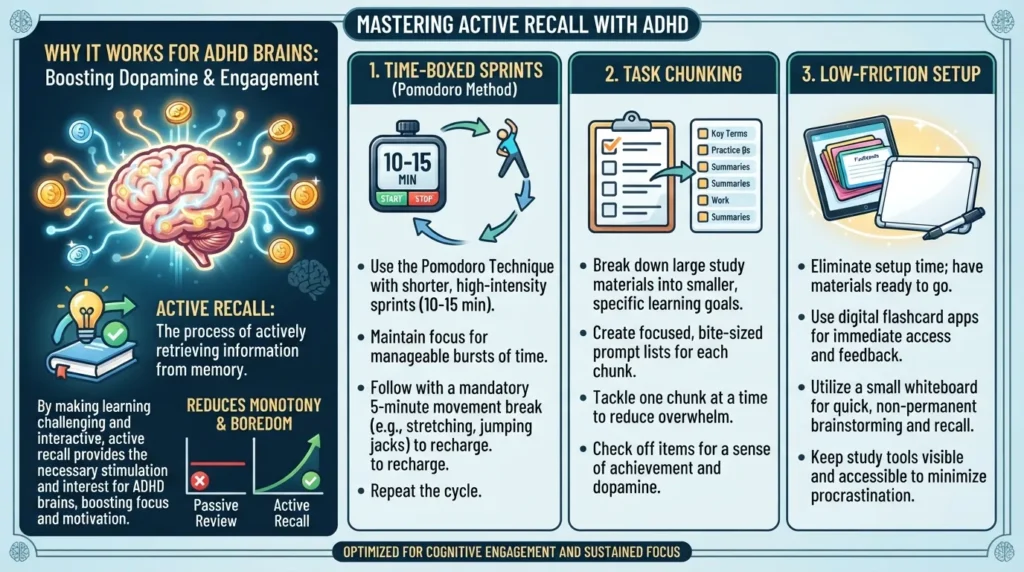
Active recall provides the high-intensity engagement and instant feedback loops that neurodivergent brains need to maintain focus. Traditional study methods like passive reading cause minds to wander because they lack immediate mental stimulation, whereas active self-testing forces constant cognitive participation.
Dopamine Activation: The immediate challenge and reward of successfully retrieving an answer trigger micro-doses of dopamine, which naturally sustain motivation and attention.
Elimination of Monotony: Replacing long hours of re-reading with rapid-fire questions breaks the study session into dynamic, high-engagement micro-tasks.
Externalized Focus: Forcing an output—such as writing on a whiteboard or speaking aloud—keeps physical energy channeled directly into the learning task.
Practical Adjustments: Shorter Recall Sessions, More Frequent Breaks
Traditional study blocks often fail neurodivergent learners, requiring tailored structural adjustments to accommodate fluctuating attention spans and executive function hurdles. Modifying session lengths prevents mental burnout and keeps the cognitive friction of active recall manageable.
The Pomodoro Modification: Cut standard study intervals down into rapid 10-to-15-minute active recall sprints followed by mandatory 5-minute movement breaks.
Task Chunking: Break large study chapters into tiny, bite-sized prompt lists rather than tackling an entire subject all at once.
Low-Friction Setup: Keep physical flashcards or digital apps pre-loaded and easily accessible to eliminate the friction of organizing study materials.
Tools That Work Well for ADHD-Friendly Active Recall
Leveraging the right physical and digital tools streamlines the active recall process, removing executive dysfunction barriers that make getting started difficult. The best tools minimize setup time and maximize immediate interactive feedback.
Digital Flashcard Apps with Gamification: Platforms like Anki or Quizlet provide structured prompts with built-in reward feedback and automated scheduling.
Large Erasable Whiteboards: Writing answers on a vertical wall-mounted whiteboard engages gross motor skills and keeps visual focus elevated.
Voice-Recording Apps: Use smartphone voice memos to practice the Feynman Technique aloud without the friction of writing things down.
Best Apps & AI Tools for Active Recall (2026)
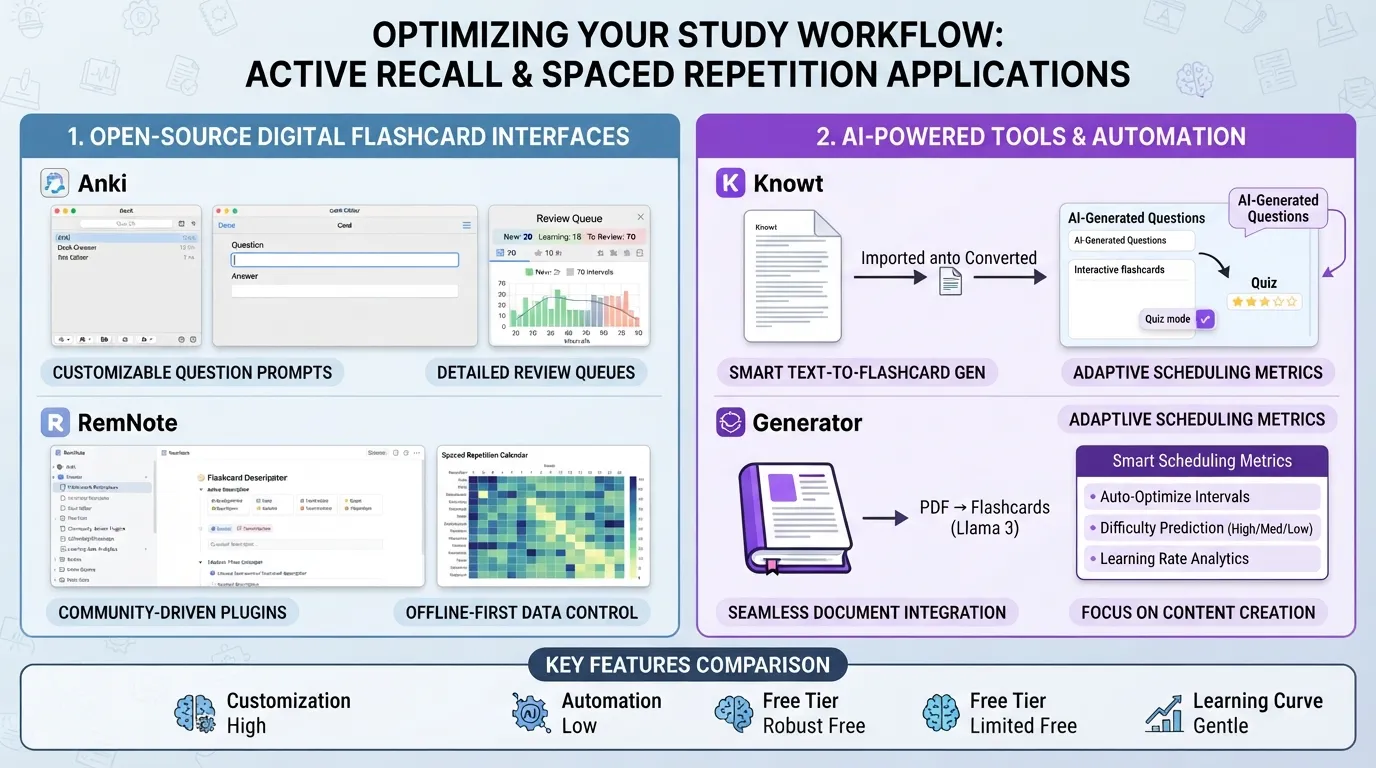
Free Active Recall Apps (Anki, Quizlet, RemNote)
Choosing the right active recall app eliminates setup friction and automates your review queues. Free and open platforms give you immediate access to digital flashcards, custom templates, and built-in spaced repetition intervals without locking core features behind a paywall.
Anki: The gold standard open-source flashcard app utilizing the SM-2 algorithm. It is completely free on desktop, Android, and web, offering infinite customization and rich media support for serious long-term retention.
Quizlet: The most popular web and mobile app for beginner learners. It features millions of pre-made community study sets, making it ideal for quick vocabulary checks and collaborative group studying.
RemNote: A powerful hybrid tool combining hierarchical note-taking, PDF annotation, and automated flashcard generation. It turns your daily lecture notes into active recall prompts instantly.
Best AI-Powered Tools for Automated Active Recall
Manually creating flashcards is often the biggest bottleneck in maintaining a consistent study routine. Modern AI study tools solve this friction by automatically turning lengthy PDFs, slides, and lecture notes into ready-to-study flashcards and practice test questions.
Knowt: A popular free alternative to traditional quiz tools that integrates AI note generation, automated flashcard creation, and spaced repetition without charging for core study modes.
Brainscape: Incorporates AI flashcard generation to ingest complex source documents and build structured decks optimized for confidence-based review schedules.
AI-Native Schedulers: Newer generative platforms allow you to upload reading materials and instantly output target question banks tailored to your exact curriculum.
Free vs. Paid: Which Option Is Worth It?
Deciding whether to upgrade from a free active recall app to a paid subscription depends heavily on your timeline, technical patience, and need for advanced automation. Most students can achieve top-tier academic results using entirely free software if they establish consistent daily review habits.
Free Tiers: Ideal for most learners. Apps like Anki and Knowt provide unrestricted access to core testing features, spaced repetition schedules, and custom card creation at zero financial cost.
Paid Subscriptions: Worth considering if you want frictionless cloud synchronization across iOS devices, automated AI document-to-card pipelines, or pre-curated professional exam prep decks.
No paid app can replace the cognitive effort of active retrieval; invest your time into rigorous self-testing before spending money on premium tool upgrades.
Frequently Asked Questions
What is active recall?
Active recall is a high-yield study technique that forces your brain to retrieve information from memory rather than passively re-reading or highlighting text. Instead of staring at notes, you stimulate neural pathways by testing yourself on core concepts through flashcards, practice questions, or self-explanation.
Core Mechanism: Forcing your brain to reconstruct information rather than recognizing it visually.
Primary Objective: Moving data from short-term working memory into durable long-term storage.
What are the benefits of active recall?
The primary benefits of active recall include dramatically higher information retention, significantly shorter study hours, and elimination of the dangerous illusion of competence. By introducing desirable difficulty into your routine, you achieve superior exam performance while cutting wasted review time.
Better Retention: Drastically improves long-term memory compared to passive reading.
Time Efficiency: Reduces total study hours by cutting out redundant, ineffective re-reading sessions.
Instant Feedback: Exposes knowledge gaps immediately so you know exactly what to study next.
Is active recall effective?
Decades of cognitive science research confirm that active recall is one of the most effective learning strategies available. Studies on the testing effect demonstrate that the act of retrieving knowledge permanently alters memory traces, making information fundamentally easier to access and retain over time.
Scientific Backing: Supported by robust psychological research on memory consolidation and neuroplasticity.
Proven Results: Outperforms traditional study methods across every educational level, from primary school to professional board exams.
Can I use active recall for online learning?
You can easily apply active recall to online learning by pausing video lectures to summarize concepts aloud, turning digital PDF readings into custom flashcard decks, or using specialized AI study platforms. Turning passive screen time into interactive self-testing is essential for retaining digital coursework.
Video Interruption: Pause online lectures every ten minutes to quiz yourself on what the instructor just explained.
PDF Integration: Use software like RemNote or Anki to convert online readings directly into active review prompts.
What are the best websites for active recall?
The best websites for active recall include AnkiWeb for open-source spaced repetition, Quizlet for community-generated flashcard sets, and AI-driven platforms like Knowt that automate flashcard creation from your notes. These online tools remove setup friction and keep your daily review queues organized.
AnkiWeb: The leading free platform for custom decks and robust spaced repetition algorithms.
Knowt & Quizlet: Excellent online options for quick flashcard creation and pre-made study sets.
Conclusion — Key Takeaways
Why Active Recall Beats Passive Studying
Active recall fundamentally transforms study sessions by replacing passive review with deliberate, high-effort retrieval practice. Instead of falling into the trap of the illusion of competence, forcing your brain to pull knowledge from memory builds durable neural pathways and permanently improves long-term memory retention.
Cognitive Effort: Embracing desirable difficulty triggers deeper neuroplasticity and strengthens synaptic connections.
Efficiency: Cutting out redundant re-reading hours lets you master complex material in a fraction of the time.
Proven Framework: Combining the 3-step encode, retrieve, and reinforce method guarantees systematic progress across any subject.
Your Next Step
Mastering active recall studying does not require overhauling your entire routine overnight. Start your first active recall session today by taking a single set of existing notes, turning them into five core question prompts, and testing your memory without looking at the answers.
Immediate Action: Pick one upcoming study topic and apply the close-book retrieval technique for just ten minutes.
System Integration: Download a free app like Anki or set up a simple weekly schedule to embed spaced repetition into your habits.
Consistent Progress: Commit to small, daily self-testing sessions to watch your retention and exam performance soar.