Jump to:
ToggleBest Daily Habits: Science-Backed Routines for Personal Growth
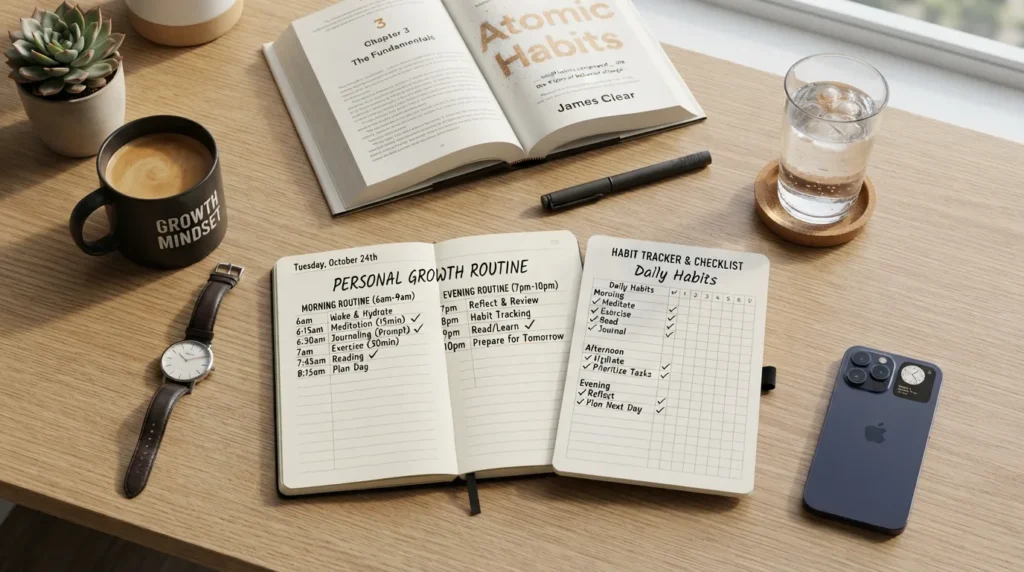
Building sustainable daily habits requires understanding the underlying mechanics of habit formation rather than relying solely on raw willpower. This comprehensive guide outlines a science-backed framework for personal growth, providing a structured list of high-impact habits alongside the psychological blueprints needed to make them stick long-term.
What Makes a Habit "Good"?
A genuinely beneficial daily habit achieves more than a short-term productivity boost; it permanently alters your behavioral architecture to support long-term personal growth. Identifying these high-impact routines requires looking past arbitrary goals and examining the precise mechanics of behavioral psychology.
The Science Behind Habit Formation
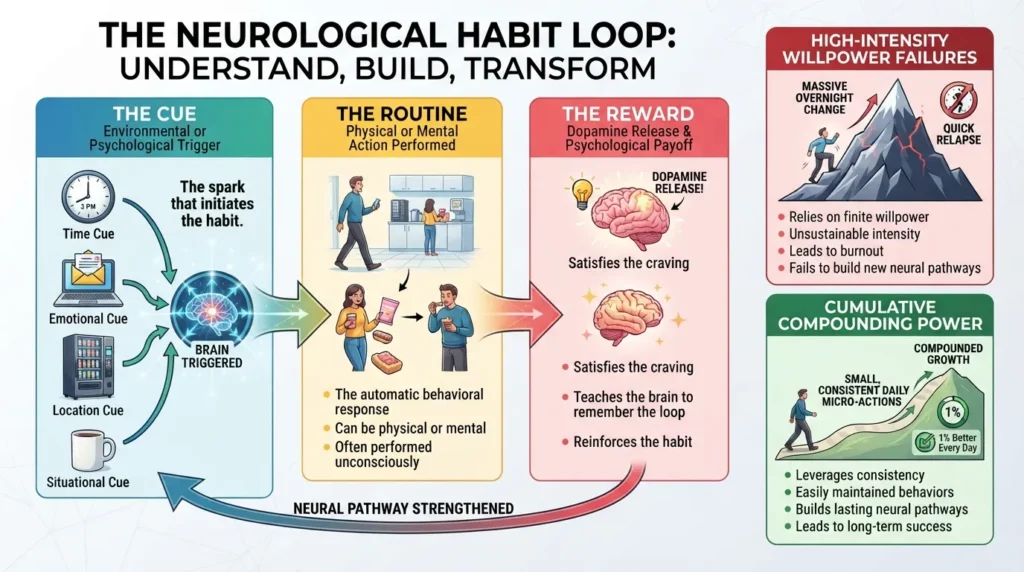
Every automated routine operates through a neurological feedback loop known as the habit loop, popularized by researchers like habit formation expert James Clear and neuroscientists at MIT. This psychological framework dictates how actions transition from conscious effort to automatic execution.
The Cue: The psychological or environmental trigger that initiates the behavior, such as waking up, sitting at your desk, or feeling stressed.
The Routine: The actual physical, mental, or emotional behavior performed in response to the cue, ranging from opening a book to lacing up running shoes.
The Reward: The immediate benefit or neurological payoff—such as a dopamine release or a sense of accomplishment—that reinforces the loop and tells your brain to remember the sequence for the future.
Why Small, Consistent Actions Beat Big Resolutions
Relying solely on high-intensity motivation or drastic lifestyle overhauls typically fails because human willpower is a finite resource. Behavioral psychology demonstrates that micro-actions bypass the brain’s natural resistance to change, preserving mental energy while compounding over time.
Compound Interest of Self-Improvement: Getting just 1% better each day compounds into a 37-fold improvement over the course of a single year.
Friction Reduction: Tiny changes require minimal activation energy, making them sustainable even on days when your discipline is depleted.
Identity Shift: Consistently executing small routines rewrites your self-image, transforming you into the type of person who naturally embodies those disciplines.
Best Physical Health Habits to Have

Physical well-being forms the foundation of all sustained personal growth, providing the baseline biological energy required for mental clarity and emotional resilience. Building a resilient physical foundation relies on daily biological maintenance rather than extreme fitness routines.
Prioritize Quality Sleep (7–9 Hours)
Consistent sleep hygiene is the single most powerful biological restorative available, regulating everything from cellular repair to cognitive function. Sleep deprivation actively compromises the immune system and impairs decision-making abilities.
Consistent Circadian Rhythm: Go to bed and wake up at the exact same time every day, including weekends, to stabilize your internal biological clock.
Optimized Sleep Environment: Keep your bedroom cool, dark, and completely free of blue-light-emitting screens for at least 60 minutes before lights out.
Wind-Down Ritual: Establish a pre-sleep routine like reading or light stretching to signal your nervous system that it is safe to transition into deep rest.
Stay Hydrated Throughout the Day
Adequate daily hydration maintains optimal cellular function, joint lubrication, and metabolic efficiency throughout your waking hours. Mild dehydration immediately manifests as brain fog, fatigue, and reduced physical coordination.
Morning Kickstart: Drink a full 16 ounces of water immediately upon waking to rehydrate your body after a night of natural respiration.
Smart Tracking: Carry a reusable water bottle equipped with volume markers to ensure you hit your daily fluid targets effortlessly.
Electrolyte Balance: Supplement plain water with trace minerals or natural electrolytes if you engage in heavy sweating or intense physical exertion.
Move Your Body Daily (150 Minutes of Exercise)
Incorporating intentional physical movement every single day prevents the metabolic stagnation associated with prolonged sedentary behavior. Moderate exercise protects cardiovascular health and elevates resting metabolic rate.
Weekly Volume Goal: Accumulate at least 150 minutes of moderate-intensity aerobic activity or 75 minutes of vigorous movement weekly.
Incorporate NEAT: Maximize Non-Exercise Activity Thermogenesis by taking stairs, pacing during phone calls, and walking short errand routes.
Strength Preservation: Include resistance training at least twice a week to maintain bone density and preserve lean muscle mass as you age.
Eat Balanced, Nutrient-Rich Meals
Fueling your body with a balanced diet rich in micronutrients ensures your biological systems operate at peak efficiency. Emphasizing clean fuel sources stabilizes blood sugar and eliminates midday energy crashes.
Protein Optimization: Include a source of lean protein in every meal to support tissue repair, muscle recovery, and long-term satiety.
Fiber Integration: Consume plenty of vegetables, fruits, and whole grains to support a diverse gut microbiome and steady digestion.
Mindful Consumption: Pay attention to true hunger cues and stop eating when comfortably satisfied rather than overly full.
Protect Your Skin Daily
Daily skin protection guards against premature aging, hyperpigmentation, and the cumulative cellular damage caused by ultraviolet radiation. Your skin acts as your body’s primary protective barrier and warrants consistent maintenance.
Broad-Spectrum SPF: Apply a broad-spectrum sunscreen with an SPF of 30 or higher every morning as the final step in your routine.
Reapplication Discipline: Reapply mineral or chemical sunscreen every two hours if you are spending extended periods outdoors in direct sunlight.
Hydration and Barrier Care: Use gentle cleansers and barrier-supporting moisturizers to lock in hydration and prevent environmental irritation.
Best Mental & Productivity Habits to Have
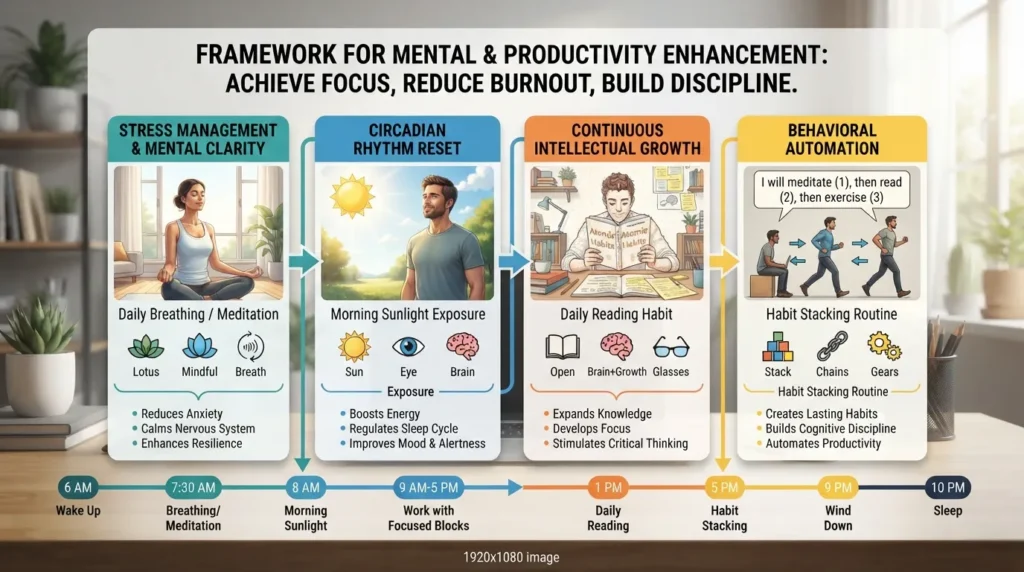
Optimizing your cognitive performance requires intentional mental maintenance and structured routines that protect your focus from daily distractions. High-performing individuals rely on systematic cognitive practices rather than erratic bursts of inspiration to sustain productivity.
Manage Stress with Daily Breathing or Meditation
Intentional stress management lowers baseline cortisol levels, protecting your brain from the cognitive burnout caused by chronic overstimulation. Dedicated moments of mental stillness enhance emotional regulation and sharpen your overall attention span.
Box Breathing Technique: Practice four seconds of inhaling, holding, exhaling, and holding again for just five minutes daily to instantly calm your nervous system.
Guided Mindfulness: Use reputable applications or simple timer intervals to anchor your awareness in the present moment and quiet mental chatter.
Midday Resets: Pause for a 60-second breathing break whenever you feel frustration or task-switching fatigue creeping into your workday.
Get Morning Sunlight to Reset Your Body Clock
Viewing natural sunlight within the first hour of waking triggers a healthy cortisol pulse and synchronizes your internal circadian rhythm. This simple biological cue optimizes daytime alertness and primes your brain for deep sleep later that night.
Outdoor Exposure: Step outside for 10 to 15 minutes without sunglasses within 60 minutes of waking up to maximize photon absorption.
Cloudy Day Adjustments: Spend slightly longer outside—around 20 to 30 minutes—if the weather is overcast, as natural lux levels remain effective.
Window Limitations: Step completely outside rather than looking through a window, as glass filters out the specific light wavelengths needed for circadian entrainment.
Read or Learn Something New Every Day
Continuous learning expands your cognitive flexibility, introduces novel mental models, and protects your brain against mental stagnation. Consuming insightful content daily compounds into profound intellectual growth over months and years.
Page-Target Discipline: Commit to reading a minimum of 10 pages of a non-fiction or educational book every single day without exception.
Active Retention: Highlight key passages and write a single-sentence summary of your takeaways to solidify new concepts in your long-term memory.
Micro-Learning: Replace passive social media scrolling during transitional moments with audiobooks, educational podcasts, or language apps.
Use Habit Stacking to Anchor New Habits
Habit stacking leverages your brain’s existing neural pathways by attaching a brand-new desired behavior directly onto an established routine. This eliminates the friction of starting and dramatically increases your long-term adherence rate.
Formula Application: Use the behavioral template: After [Current Habit], I will [New Habit].
Current Anchor Selection: Choose rock-solid, non-negotiable daily triggers like brushing your teeth, pouring your morning coffee, or turning off your computer at night.
Complexity Matching: Keep the newly attached habit small initially—such as doing one push-up after making coffee—before gradually increasing its scope.
Best Habits for Happiness and Wellbeing
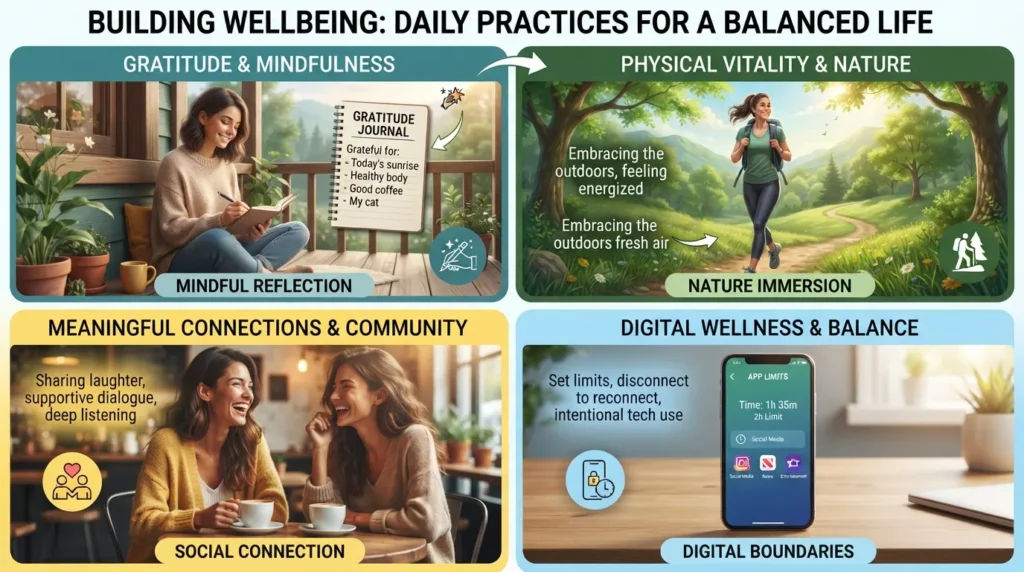
True life satisfaction and emotional resilience stem from intentional daily practices that foster inner peace and human connection. Cultivating sustainable happiness requires moving past external achievements and engaging in evidence-based emotional maintenance routines.
Practice Daily Gratitude
Actively shifting your cognitive focus toward gratitude rewires your brain’s neural pathways to notice positive stimuli rather than defaulting to negativity bias. Regular gratitude journaling lowers symptoms of anxiety and significantly boosts baseline mood.
Three Specific Wins: Write down three specific things you are grateful for every morning, focusing on micro-moments rather than broad generalities.
Mental Reframe: Use unexpected daily inconveniences as prompts to find a hidden lesson or silver lining, training your mind to adapt.
Appreciation Out Loud: Express genuine, unprompted appreciation to a friend, family member, or colleague at least once a day.
Nurture Real-World Relationships and Connection
Strong interpersonal bonds and social integration serve as the single greatest predictor of long-term human happiness and longevity. Prioritizing face-to-face community safeguards against isolation and emotional distress.
Unbroken Attention: Put your phone away entirely when having meals or conversations with loved ones to signal absolute presence.
Proactive Check-Ins: Reach out to a close friend or relative weekly just to catch up, without needing an explicit reason or favor.
Shared Experiences: Invest time in group activities, hobbies, or community volunteering that foster collaborative human engagement.
Spend Time Outdoors and in Nature
Immersing yourself in natural environments—often called ecotherapy—rapidly reduces stress hormones, lowers blood pressure, and restores mental clarity. Disconnecting from concrete environments grounds your nervous system.
Green Exercise: Combine physical movement with nature by walking through a local park, trail, or tree-lined neighborhood.
Sensory Grounding: Take off headphones during outdoor walks to actively listen to birdsong, rustling leaves, and natural ambient sounds.
Daily Dose: Aim for a minimum of 20 minutes spent outside under open skies, even during busy work weeks.
Limit Passive Screen Time / Doomscrolling
Unconscious digital consumption and endless algorithmic feeds drain your emotional energy, increase anxiety, and steal time from meaningful living. Creating firm digital boundaries protects your psychological bandwidth.
Scheduled Windows: Designate specific, limited times to check news and social media rather than opening apps out of reflex or boredom.
App Restrictions: Use built-in operating system screen time limits to lock addictive applications automatically after your daily allowance expires.
Digital-Free Zones: Keep smartphones out of the bedroom entirely, replacing late-night scrolling with physical books or relaxation.
What Truly Makes a Life Happy?
Extensive longitudinal psychological research, including the famous Harvard Study of Adult Development, proves that wealth and status pale in comparison to the quality of our relationships and daily habits. Lasting life satisfaction is built upon three core pillars:
Deep Connection: Feeling genuinely seen, loved, and supported by a community of trusted friends and family members.
Purpose and Autonomy: Having a sense of control over your time and engaging in meaningful work or creative pursuits that matter to you.
Biological Vitality: Maintaining your physical and mental health so you can fully experience and enjoy your everyday life.
How to Build Better Habits — A Step-by-Step Framework
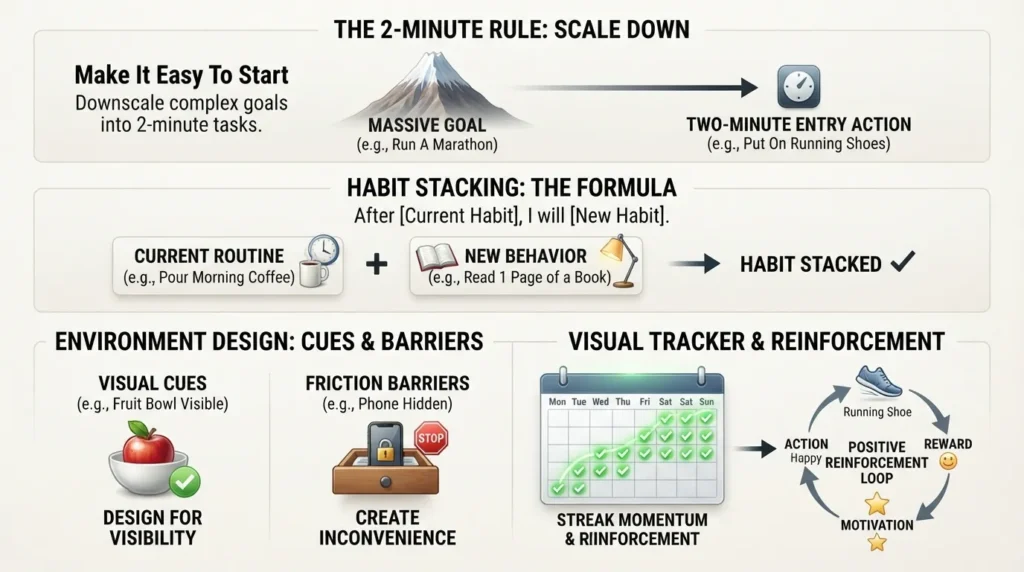
Transforming theoretical goals into permanent lifestyle changes requires moving past vague intentions and applying a structured psychological framework. Successfully mastering behavior change relies on systematic environment design and proven neurological tactics rather than sheer willpower.
Start Small — The 2-Minute Rule
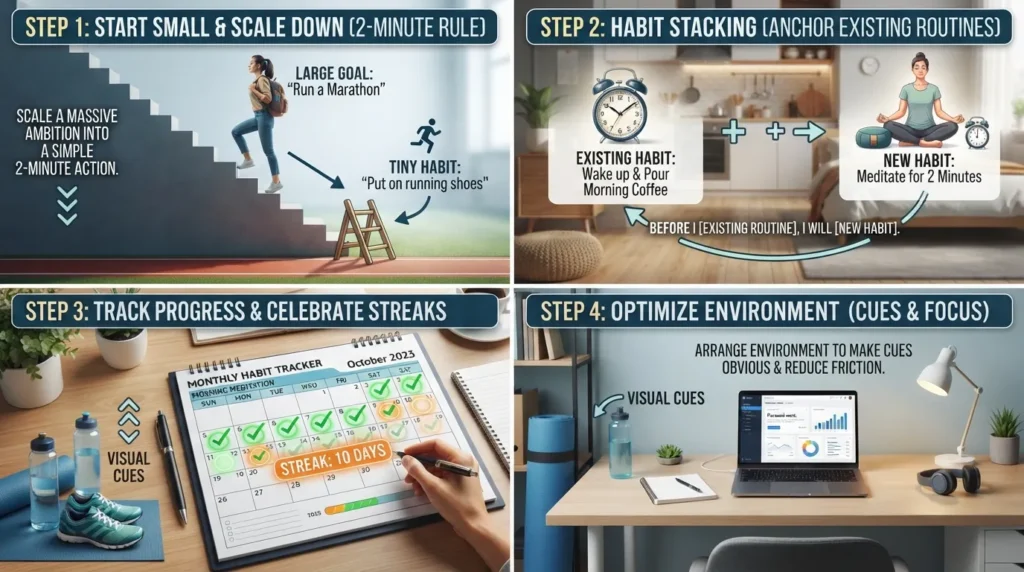
The 2-Minute Rule dictates that when you introduce a new habit, it should take less than two minutes to perform. Scaling massive ambitions down into micro-actions eliminates the psychological resistance that causes most self-improvement efforts to fail.
Scale Down Intentions: Shrink goals like “read for an hour” into “read one page” or “run three miles” into “put on my running shoes.”
Lower Activation Energy: Focus entirely on mastering the entry ritual of the habit, trusting that momentum will carry you forward once you begin.
Master the Art of Showing Up: Prioritize consistency over intensity, proving to your brain that you can execute the routine every single day without burnout.
Attach New Habits to Existing Routines (Habit Stacking Explained)
Habit stacking is a powerful implementation strategy that links an unestablished behavior directly to an automatic, everyday action. This technique embeds your new goal into the existing structural framework of your day.
Formula Application: Use the clear behavioral template: After [Current Established Habit], I will [New Habit].
Identify Reliable Anchors: Choose non-negotiable daily triggers such as pouring your morning coffee, locking your front door, or brushing your teeth.
Build Logical Pairs: Pair habits with matching contexts, such as meditating for two minutes immediately after sitting down at your desk for work.
Track Your Progress (Streaks and Habit Trackers)
Visual tracking provides immediate gratification and undeniable proof of your ongoing dedication, turning behavior change into a satisfying game. Maintaining a continuous streak creates a powerful psychological incentive not to break the chain.
Visual Accountability: Use a physical planner or digital habit tracker to check off each completed routine daily.
Focus on Recovery: Adopt a strict “never miss twice” rule if you slip up, ensuring a single missed day never snowballs into quitting entirely.
Data-Driven Insights: Review your tracking history weekly to identify patterns, bottlenecks, and times when your consistency tends to drop.
Design Your Environment for Success
Environment design is far more effective than relying on internal discipline because human behavior is heavily influenced by physical cues. Rearranging your immediate surroundings makes good habits effortless and bad habits inconvenient.
Increase Visibility: Place cues for desired behaviors directly in your line of sight, such as setting out workout clothes the night before.
Introduce Friction: Make negative habits harder to perform by adding barriers, like placing your phone in another room while working.
Optimize Spaces: Dedicate specific physical zones in your home for specific tasks to condition your brain for deep focus or relaxation.
Reward Yourself to Reinforce the Behavior
Immediate rewards teach your brain that a specific habit sequence is satisfying and worth remembering for the future. Positive reinforcement accelerates the neurological wiring process that transforms conscious effort into automatic habit.
Immediate Reinforcement: Pair your new habit with an enjoyable reward instantly upon completion, rather than waiting for a distant future outcome.
Intrinsic Satisfaction: Acknowledge the internal feeling of pride and progress to build long-term psychological motivation.
Habit Celebration: Take a brief moment to mentally celebrate your consistency, reinforcing your identity as someone who follows through.
How to Establish Good Habits That Actually Stick
Sustaining long-term personal growth requires more than initial excitement; it demands an understanding of behavioral science and relapse prevention. Transforming fleeting motivation into permanent self-discipline hinges on navigating psychological hurdles and managing your timeline effectively.
Why Most Habits Fail (Common Mistakes)
Most self-improvement efforts collapse due to predictable execution errors rather than a lack of personal willpower. Identifying these common behavioral pitfalls allows you to bypass them before they derail your momentum.
Overestimating Motivation: Relying on transient bursts of enthusiasm instead of building low-friction environmental systems always leads to burnout.
Biting Off Too Much: Attempting drastic lifestyle overhauls simultaneously overloads your prefrontal cortex and triggers acute cognitive fatigue.
Ignoring Context: Failing to establish reliable physical or temporal triggers leaves new routines without a stable foundation to anchor onto.
The 21/66-Day Myth — What Science Actually Says
Popular culture frequently claims that any new behavior takes exactly 21 days to form, but behavioral research reveals a much more nuanced reality. Groundbreaking findings published in the European Journal of Social Psychology demonstrate that true automaticity takes significantly longer and varies widely based on complexity.
The Real Timeline: Research tracking real-world habit formation found that the median time to reach automaticity is actually 66 days, with a wide range spanning from 18 to 254 days.
Complexity Matters: Simple routines like drinking water after breakfast lock in quickly, whereas complex behaviors like morning workouts require months of sustained consistency.
Flexibility Over Perfection: Missing a single day of execution does not reset your psychological progress or ruin your long-term odds of success.
How to Recover After Breaking a Streak
Slipping up on a daily routine is an inevitable part of personal growth, but how you respond dictates whether a single miss turns into total abandonment. Effective relapse prevention relies on self-compassion and immediate tactical correction.
The Never Miss Twice Rule: Accept a single missed day immediately, but treat the subsequent execution as a strict non-negotiable priority.
Eliminate Guilt Spirals: Stop treating a broken streak as a moral failure; view it instead as objective data pointing to a flaw in your current system.
Audit the Friction: Investigate why the slip occurred—such as poor timing or environmental barriers—and adjust your setup to prevent it from repeating.
Building Identity-Based Habits for Long-Term Discipline
Lasting discipline is achieved when your daily habits align directly with your core sense of personal identity rather than superficial outcome goals. Changing how you view yourself turns consistency into an effortless expression of who you are.
Shift the Narrative: Move away from outcome-focused goals (“I want to run a marathon”) toward identity-based commitments (“I am a runner”).
Cast Small Votes: Treat every successful execution of a micro-habit as a tangible vote for the type of person you wish to become.
Embrace the Process: Fall in love with daily repetition and system maintenance, recognizing that excellence is simply the accumulation of quiet, unglamorous daily choices.
A First-Hand Take — What Actually Worked
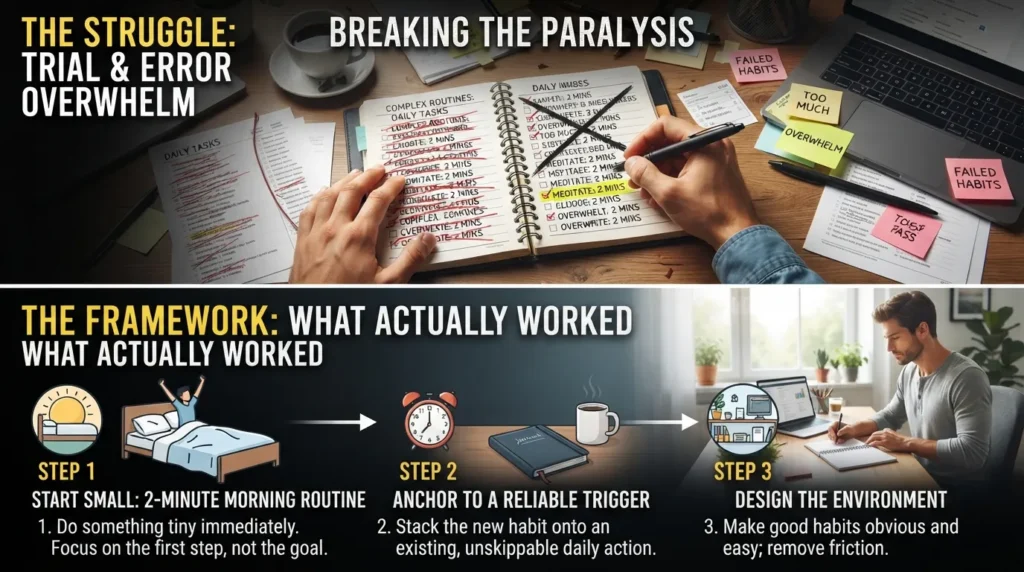
Navigating the vast landscape of self-improvement advice often feels overwhelming until you strip away the theory and test these concepts in real life. Years of personal experimentation with productivity systems, fitness regimes, and mindfulness practices revealed which behavioral strategies actually survive the friction of a busy schedule.
The One Habit That Made the Biggest Difference (First-Hand Example)
The single most transformative shift in my routine was implementing the “Two-Minute Entry Rule” combined with a rigid morning habit stack. Committing to read just two pages and step outside for five minutes of natural light immediately after waking shattered years of chronic procrastination.
Breaking the Paralysis: Shrinking daunting tasks down to microscopic entry points eliminated the mental dread of starting, transforming sluggish mornings into predictable momentum.
Compounding Returns: Those tiny initial actions naturally expanded over time into an hour of reading and a solid daily walk without requiring forced willpower.
Mental Clarity: Establishing this non-negotiable morning sequence created an anchor of calm that stabilized my focus for the entire workday ahead.
What I’d Do Differently Starting Over
Attempting to overhaul every aspect of daily life simultaneously is a guaranteed recipe for burnout and swift abandonment. Looking back at years of trial and error, several strategic adjustments would have accelerated genuine long-term progress:
Focus on One System at a Time: Trying to adopt a dozen habits at once diluted my focus; stacking just one new routine every month yields far superior retention.
Embrace Imperfection Earlier: Letting go of the illusion of a pristine, unbroken streak prevents minor setbacks from turning into weeks of total inactivity.
Prioritize Environment Over Motivation: Spending time optimizing physical surroundings and removing daily friction beats relying on raw discipline every single time.
Frequently Asked Questions
What are the top 10 good habits?
The top ten daily habits encompass core physical and mental pillars: prioritizing 7 to 9 hours of quality sleep, drinking adequate water, moving daily, eating nutrient-dense meals, managing stress through breathwork, getting morning sunlight, reading regularly, practicing gratitude, nurturing real-world relationships, and protecting your time through smart digital boundaries.
What are 20 healthy habits?
A comprehensive suite of twenty healthy routines includes consistent sleep schedules, morning hydration, daily walking, strength training twice weekly, eating whole foods, daily sunscreen use, box breathing, morning sun exposure, reading 10 pages daily, habit stacking, daily gratitude journaling, limiting screen time, spending time in nature, stretching, eating lean protein, mindful eating, proactive check-ins with friends, regular digital detoxes, continuous micro-learning, and focusing on one system at a time.
What are 7 healthy habits?
Seven foundational health habits form the cornerstone of wellness: sleeping 7 to 9 hours nightly, staying hydrated, engaging in daily physical movement, eating balanced meals rich in fiber and protein, managing stress effectively, getting natural morning light, and practicing daily digital moderation to protect mental well-being.
What are 12 daily habits that make you happier?
Twelve powerful habits for daily joy include starting the morning with gratitude, stepping outside for natural light, connecting face-to-face with a loved one, exercising moderately, performing a random act of kindness, reframing daily inconveniences, reading something inspiring, eating wholesome foods, setting clear phone boundaries, keeping a tidy living space, engaging in a creative hobby, and winding down with a calming bedtime ritual.
What are 5 habits to feel happier?
Five micro-habits that quickly boost mood and life satisfaction are writing down three specific daily gratitudes, reaching out to a friend with an unprompted message, taking a 20-minute walk outside, practicing five minutes of box breathing, and intentionally unplugging from doomscrolling for a designated evening block.
What are 7 ways to be happy?
Cultivating lasting happiness involves shifting your mental focus through intentional actions: prioritizing deep human connections, practicing daily gratitude, engaging in meaningful work or creative projects, spending time in nature, exercising regularly, letting go of perfectionism, and learning to live fully in the present moment.
What truly makes a life happy?
Extensive psychological research demonstrates that wealth and status are secondary to human connection and purpose. True life satisfaction stems from deep relationships, autonomy over your time, community integration, and maintaining the biological vitality needed to experience everyday life fully.
Conclusion
Mastering habit formation and personal growth is not about executing a massive lifestyle overhaul overnight; it is the cumulative result of small, intentional choices repeated consistently. By understanding the underlying mechanics of behavioral psychology, designing your environment for success, and embracing steady progress over perfection, you build the foundation for lifelong discipline.
Begin your journey today by selecting just one micro-habit from this guide, attaching it to an existing daily routine using habit stacking, and committing to show up for it tomorrow.
Kittisak Wattanakul
Kittisak Wattanakul is the Discipline Editor at Holistic Wellbeing Living. He writes about routines, focus, consistency, and practical follow-through. With nine years of experience creating personal-growth content, Kittisak helps readers build realistic systems for steady progress without extreme productivity pressure.