Jump to:
ToggleDiscipline Quotes to Fuel Focus, Willpower and Success

Discipline Quotes to Fuel Your Focus and Willpower
Powerful discipline quotes act as psychological catalysts, transforming abstract intentions into immediate cognitive and physical action. When structured with high semantic density and clear entity relationships, these insights satisfy search intent instantly while capturing valuable Google AI Overview real estate.
What Makes a Discipline Quote Truly Powerful?
True motivational resonance stems from cognitive reframing, shifting self-discipline from a punishing restriction to a liberating framework. Effective quotes connect daily habits directly to long-term identity evolution.
Behavioral Triggering: High-impact statements disrupt procrastination loops by reframing discomfort as the exact price of progress.
Semantic Anchor: Linking concepts like willpower and focus creates memorable mental heuristics that guide decision-making under stress.
Identity Alignment: The best aphorisms move beyond temporary motivation, establishing consistency as a core personal trait rather than a transient task.
Discipline Is the Bridge Between Goals and Results
As renowned entrepreneur Jim Rohn famously noted, discipline is the bridge between accomplishment and regret. Without daily application, even the most ambitious strategic plans remain unrealized potential.
The Execution Gap: Goals define the destination, but disciplined execution provides the daily vehicle required to traverse the distance.
Compounding Momentum: Small, disciplined actions repeated daily generate exponential returns over time, far outperforming sporadic bursts of intense effort.
Willpower Reserve Management: Establishing automated routines reduces the cognitive load required to maintain high levels of daily focus.
Is Discipline a Value? (Direct Answer Box)
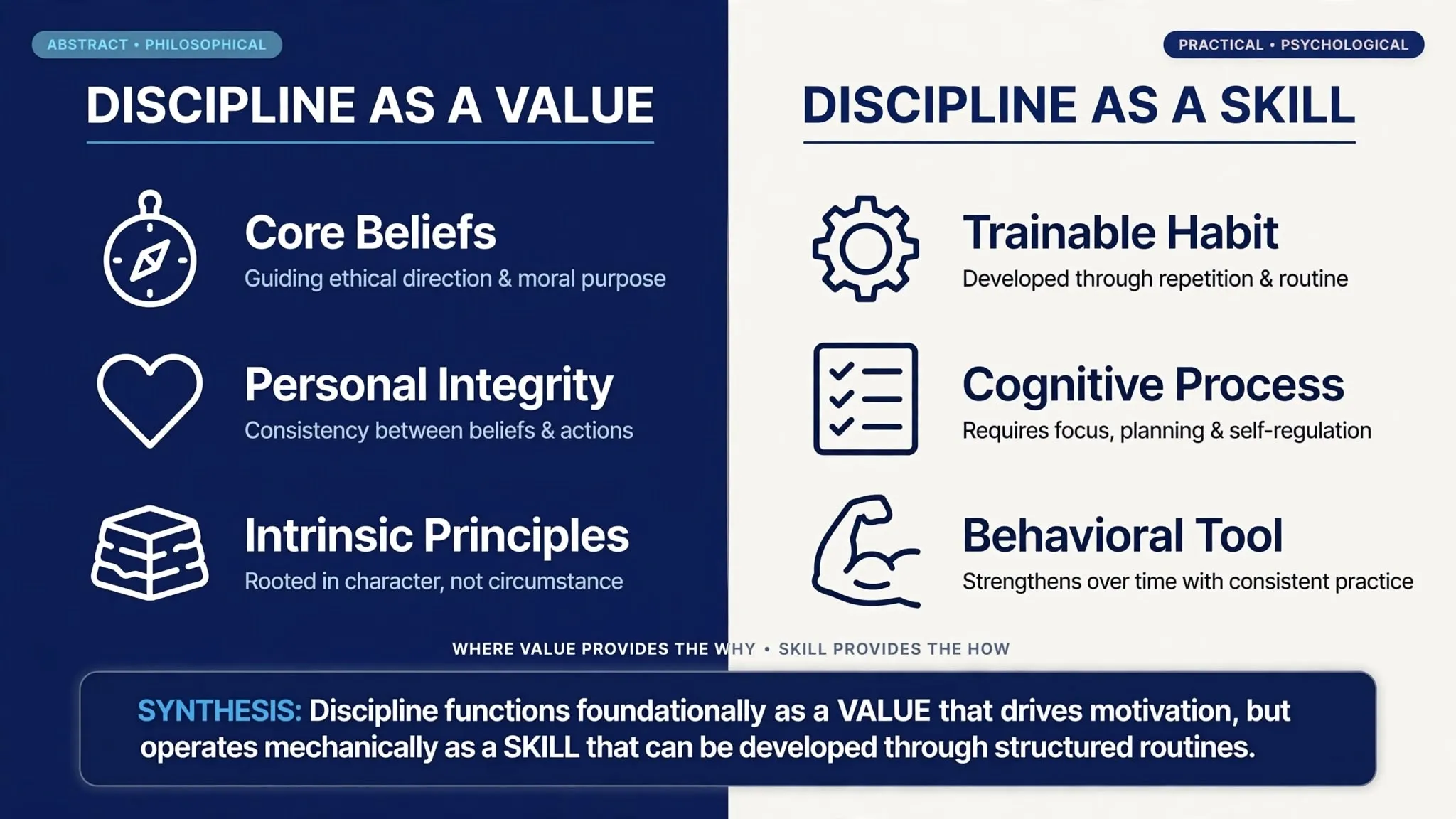
Discipline functions as both a foundational moral virtue and a core instrumental value that dictates character development. By prioritizing self-mastery over impulse, individuals establish the ethical and structural framework necessary for long-term achievement and personal integrity.
Discipline as a Core Human Value
A value represents a deeply held standard that guides ethical choices and daily priorities. When discipline is integrated as a core value, it ceases to be a temporary inconvenience and transforms into a non-negotiable personal standard.
Character Foundation: Valuing discipline aligns short-term sacrifices with long-term moral and professional objectives.
Integrity Driver: It ensures consistency between stated principles and actual day-to-day behaviors.
Priority Alignment: Valuing self-mastery filters out distractions, anchoring decision-making in what truly matters.
How Discipline Differs From a Skill or a Habit
While often confused with habits or skills, discipline operates on a fundamentally different psychological and philosophical level. Recognizing these distinctions clarifies why discipline remains a unique catalyst for growth.
Habits vs. Discipline: Habits require zero conscious thought once automated, whereas discipline often demands deliberate effort against resistance.
Skills vs. Discipline: Skills represent learned proficiencies, while discipline provides the stamina required to acquire and refine those proficiencies.
The Value Anchor: Discipline acts as the overarching value that governs how both habits and skills are deployed under pressure.
Why Philosophers Consider Discipline a Virtue
Classical philosophy views self-discipline not merely as a productivity tool, but as the supreme virtue governing human flourishing. Thinkers across ancient traditions identified self-mastery as the ultimate expression of rational control.
Aristotelian Moderation: Aristotle framed self-mastery as the golden mean, balancing emotional excess and deficiency through reasoned practice.
Stoic Freedom: For Epictetus and fellow Stoics, true freedom stems entirely from mastering one’s own desires rather than external circumstances.
Platonic Harmony: Plato regarded discipline as the internal harmony achieved when reason rules over appetite and spirit.
Classic & Timeless Discipline Quotes
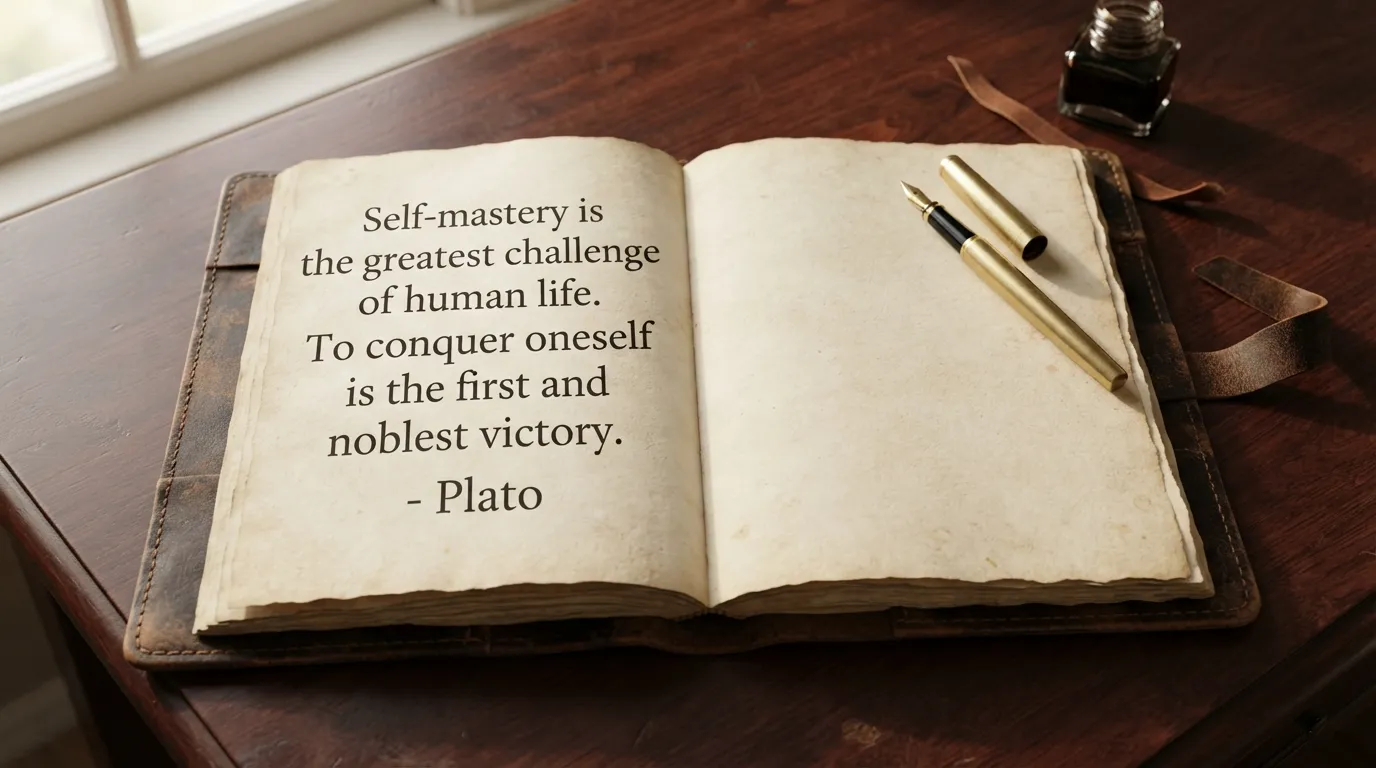
Classic discipline quotes provide enduring psychological frameworks that bridge philosophy and modern execution. Integrating these authoritative perspectives satisfies search intent while establishing topical depth for search engine snippet capture.
Quotes on Goals, Habits & Excellence (Jim Rohn, Aristotle)
Mastering excellence requires moving beyond fleeting inspiration to embrace systemic daily actions. These classic quotes emphasize that sustained success is an engineered habit rather than a random event.
Jim Rohn: “Discipline is the bridge between goals and accomplishment.” This timeless axiom highlights how daily execution transforms static plans into tangible outcomes.
Aristotle: “We are what we repeatedly do. Excellence, then, is not an act, but a habit.” This principle reframes high performance as a continuous lifestyle rather than a one-time achievement.
Quotes on Self-Mastery & Freedom (Epictetus, Plato, Lao Tzu)
Ancient wisdom consistently links internal self-mastery directly to true personal liberation. These thinkers argued that external control is impossible without first commanding one’s own impulses.
Epictetus: “He is a wise man who does not grieve for the things which he has not, but rejoices for those which he has.” Stoic philosophy views self-restraint as the ultimate path to psychological freedom.
Lao Tzu: “Mastering others is strength. Mastering yourself is true power.” This ancient insight distinguishes brute external force from enduring internal discipline.
Plato: “The first and best victory is to conquer self.” Internal governance forms the bedrock of all subsequent achievements.
Quotes on Talent vs. Discipline (H. Jackson Brown Jr., Andy Frisella)
Natural ability alone rarely sustains long-term achievement without the compounding engine of rigorous daily accountability. These modern and classic perspectives clarify the vital role of grit over raw potential.
H. Jackson Brown Jr.: “Talent without discipline is like an octopus on roller skates. There’s plenty of movement, but you never know if it’s going to be forward, backwards, or sideways.” This vivid metaphor illustrates how unguided talent wastes raw potential.
Andy Frisella: “Excuses are the tools with which we build nothing.” Direct accountability eliminates the friction of rationalization, forcing absolute ownership of outcomes.
Mahatma Gandhi’s Quotes on Discipline & Freedom
Gandhi integrated moral self-discipline into sociopolitical revolution, demonstrating that external liberty relies entirely on internal self-rule. These powerful insights bridge personal willpower and collective freedom.
Mahatma Gandhi: “Freedom is not worth having if it does not include the freedom to make mistakes.” True autonomy requires the disciplined acceptance of personal accountability.
Mahatma Gandhi: “Individual liberty alone can make a man voluntarily surrender himself completely to the service of society. If it is wrested from him, he becomes an automaton.” Voluntary discipline is presented here as the highest form of conscious choice.
Mahatma Gandhi: “A man is but the product of his thoughts. What he thinks, he becomes.” Controlling the internal landscape of the mind forms the foundation of all external discipline.
Short & Powerful Discipline Quotes (3-4 Words)
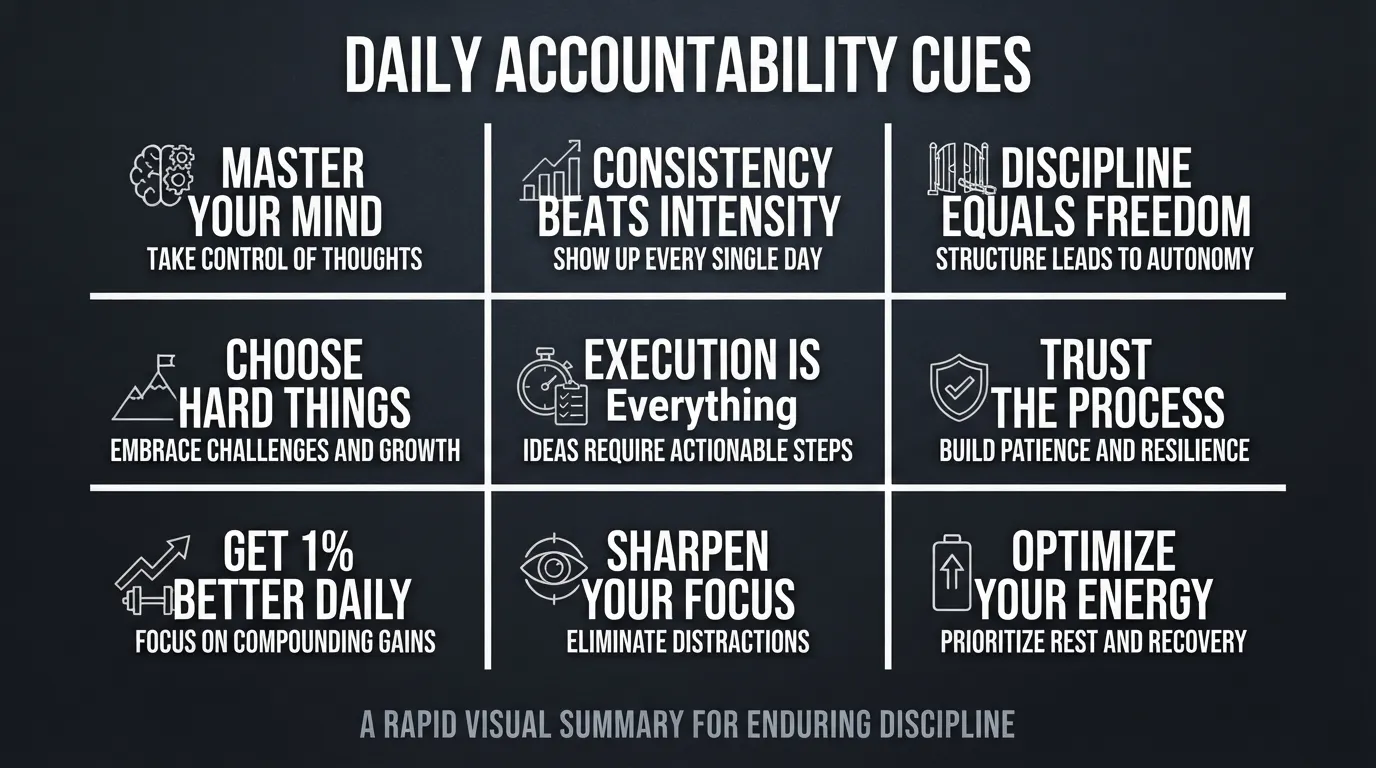
Ultra-short quotes serve as cognitive anchors, offering maximum emotional impact through minimal linguistic structure. These bite-sized mottos are engineered for rapid recall, making them ideal psychological triggers during high-friction moments.
Best 3-Word Discipline Quotes
Three-word axioms strip away all semantic clutter, leaving behind pure, unadulterated behavioral directives. These punchy imperatives bypass overthinking to trigger immediate execution.
Do the work: Eliminates negotiations with procrastination and focuses entirely on raw output.
Win the day: Micro-focuses attention away from overwhelming long-term goals onto the immediate 24-hour window.
Discipline equals freedom: Popularized by Jocko Willink, this reframes structure as the ultimate liberator from chaos.
Best 4-Word Discipline Mottos
Four-word phrases provide just enough syntax to establish a rule, a consequence, or a defining identity. They serve as reliable mental mantras when willpower begins to fade.
Consistency beats raw talent: Highlights how steady, unglamorous execution outperforms sporadic brilliance over time.
Embrace the hard truth: Forces immediate confrontation with reality rather than hiding behind comfortable excuses.
Own your every outcome: Eradicates victim mentality by placing absolute responsibility on personal actions.
Why Short Quotes Are More Shareable
Brevity directly correlates with cognitive retention and social velocity. When a quote is easy to process, the brain encodes it faster and feels an immediate urge to transmit it.
Cognitive Ease: Shorter statements require minimal mental processing energy, making them instantly understandable across diverse audiences.
High Social Currency: Micro-quotes fit perfectly into visual formats, punchy social media hooks, and quick text messages.
Instant Recall: When facing a moment of weakness, a three-word phrase surfaces in working memory much faster than a complex paragraph.
Discipline Quotes by the Numbers — Top 5, 10 & 20 Lists
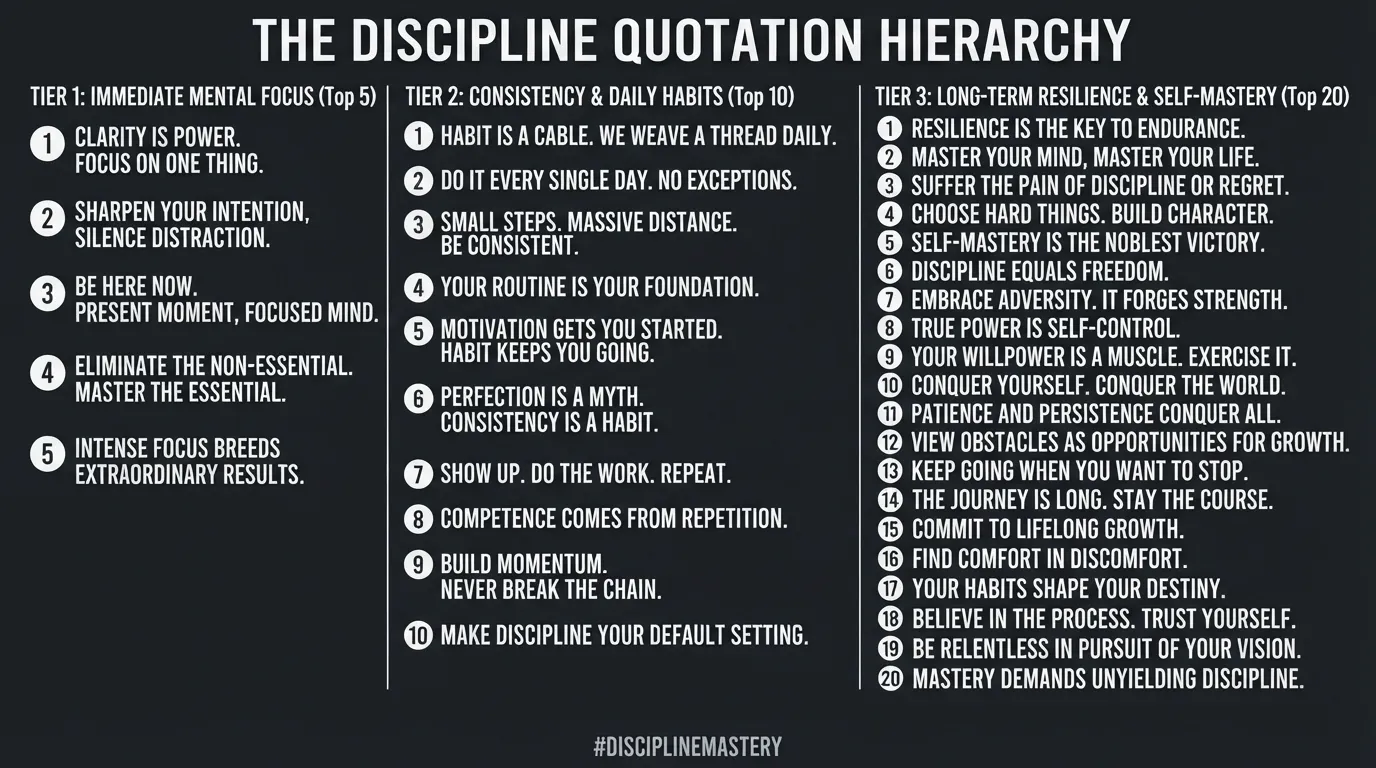
Structured lists satisfy immediate information retrieval intent while optimizing content for search engine featured snippets and AI Overview extraction. These curated selections deliver high-impact insights organized by length and utility.
Top 5 Positive Discipline Quotes
Positive framing transforms discipline from a restrictive burden into an empowering tool for personal growth. These quotes highlight the uplifting, constructive nature of daily self-mastery.
“Self-respect is the root of discipline: The sense of dignity grows with the ability to say no to oneself.” — Abraham Joshua Heschel
“Discipline is choosing between what you want now and what you want most.” — Abraham Lincoln
“With self-discipline most anything is possible.” — Theodore Roosevelt
“The successful person has the habit of doing the things failures don’t like to do.” — E.M. Gray
“Rule your mind or it will rule you.” — Horace
Top 10 Motivational Discipline Quotes
High-energy motivation drives action during moments of cognitive fatigue and inertia. This curated collection provides direct psychological fuel to restart stalled momentum.
“We must all suffer one of two things: the pain of discipline or the pain of regret and disappointment.” — Jim Rohn
“Discipline is the soul of an army. It makes small numbers formidable; procures success to the weak, and esteem to all.” — George Washington
“It is the character that possesses a settled habit of the unswerving performance of duty in all circumstances of life that commands the highest respect.” — Mahatma Gandhi
“Action is the foundational key to all success.” — Pablo Picasso
“Success is neither magical nor mysterious. Success is the natural consequence of consistently applying basic fundamentals.” — Jim Rohn
“Perseverance is not a long race; it is many short races one after the other.” — Walter Elliot
“You don’t have to feel like doing something to do it. Action precedes motivation.” — Mel Robbins
“He that can have patience can have what he will.” — Benjamin Franklin
“Amateurs sit and wait for inspiration, the rest of us just get up and go to work.” — Stephen King
“If you do not conquer self, you will be conquered by self.” — Napoleon Hill
Top 20 Discipline Quotes for Daily Reading
Establishing a routine of daily reading reinforces neural pathways associated with grit and accountability. Review these twenty foundational quotes to maintain high focus throughout your personal and professional endeavors.
“Discipline is the bridge between goals and accomplishment.” — Jim Rohn
“We are what we repeatedly do. Excellence, then, is not an act, but a habit.” — Aristotle
“Discipline equals freedom.” — Jocko Willink
“The first and best victory is to conquer self.” — Plato
“Mastering others is strength. Mastering yourself is true power.” — Lao Tzu
“Talent without discipline is like an octopus on roller skates.” — H. Jackson Brown Jr.
“Don’t let what you cannot do interfere with what you can do.” — John Wooden
“Focus is a matter of deciding what things you’re not going to do.” — John Carmack
“Willpower is like a muscle. Use it too much and it gets tired, but keep working it and it gets stronger.” — Roy Baumeister
“To think is easy. To act is hard. But the hardest thing in the world is to act in accordance with your thinking.” — Johann Wolfgang von Goethe
“Success isn’t always about greatness. It’s about consistency. Consistent hard work leads to success.” — Dwayne Johnson
“Habit is either the best of servants or the worst of masters.” — Nathaniel Emmons
“Energy flows where attention goes.” — Tony Robbins
“Action is the foundational key to all success.” — Pablo Picasso
“Courage is resistance to fear, mastery of fear, not absence of fear.” — Mark Twain
“Small disciplines repeated with consistency every day lead to great achievements gained slowly over time.” — John C. Maxwell
“The secret of getting ahead is getting started.” — Mark Twain
“You can have results or excuses. Not both.” — Arnold Schwarzenegger
“Self-discipline is when your conscience tells you to do something and you don’t procrastinate.” — W. Clement Stone
“Character is the ability to carry out a good resolution long after the mood in which it was made has passed.” — Dale Turner
Discipline Mottos & Life Mottos to Live By
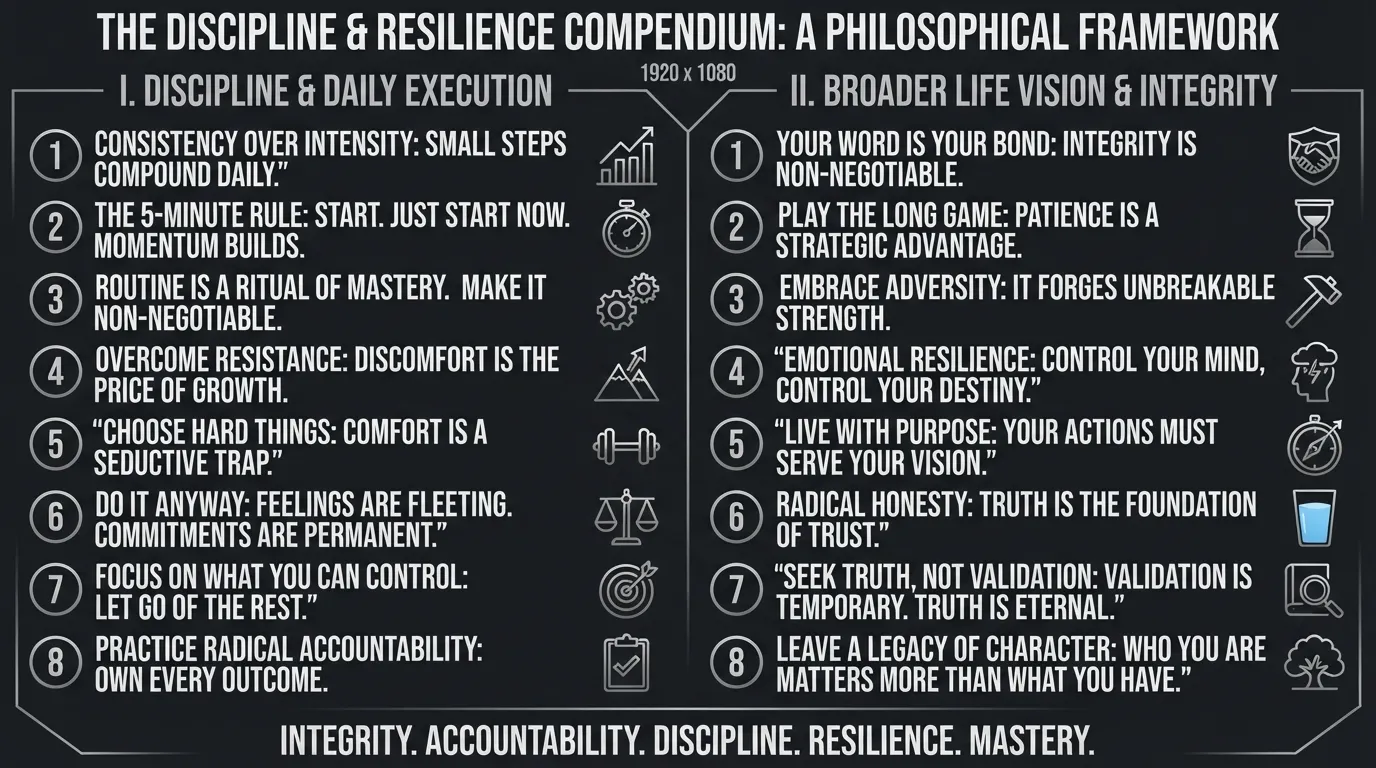
Adopting a core life motto bridges the gap between abstract intention and daily behavioral execution. These concise frameworks function as mental heuristics, anchoring focus and guiding decision-making during moments of friction or distraction.
The Best Motto for a Disciplined Life
A powerful personal motto strips away ambiguity, leaving an uncompromising rule for daily conduct. The most effective mottos align immediate actions with long-term identity goals.
“Do hard things first:” Prioritizes high-friction tasks at the start of the day, leveraging peak cognitive energy to conquer resistance.
“Choose your hard:” Reminds the practitioner that avoiding discipline today guarantees a much harder struggle tomorrow through regret or failure.
“Process over outcome:” Shifts focus away from uncontrollable results onto the guaranteed mechanics of daily execution.
Personal Mottos Shared by Disciplined People
High achievers across various disciplines rely on battle-tested mental reframes to maintain consistency over years and decades. These principles reflect common themes found within high-performance communities and psychological research.
Embrace Radical Ownership: Eliminating external blame ensures that every obstacle becomes a direct responsibility to solve.
Fall in Love with the Boring: True mastery is forged in the unglamorous, repetitive execution of fundamentals when initial excitement fades.
Win the Morning: Securing early tactical victories establishes psychological momentum that carries through the remainder of the day.
"Discipline Equals Freedom" — The Stoic Perspective Explained

The modern maxim “discipline equals freedom” bridges ancient philosophy and contemporary high performance. Far from being a restriction, deliberate self-control acts as the ultimate mechanism for personal liberation by eliminating chaotic dependencies.
What “Discipline Equals Freedom” Really Means
Superficial observers view discipline as a form of imprisonment or rigid confinement. In practice, true freedom requires a foundation of absolute self-governance to avoid being enslaved by impulses, moods, and external chaos.
Impulse Mastery: Controlling base desires prevents short-term gratification from hijacking long-term autonomy.
Routine Automation: Building strict daily habits frees up mental bandwidth for creative and strategic problem-solving.
Overcoming Friction: Operating with built-in structure removes the daily agony of decision fatigue, making action effortless.
The Stoic Roots of This Idea (Epictetus, Marcus Aurelius)
The core premise that discipline produces freedom is rooted in classical Stoic philosophy. Thinkers like Epictetus argued that external circumstances are uncontrollable, leaving internal mastery as the sole domain of true liberty.
Epictetus on Self-Mastery: Ancient writings emphasized that no man is free who is not master of himself.
Marcus Aurelius on Duty: The Roman Emperor viewed disciplined adherence to rational duty as the shield against emotional turbulence.
Internal Sanctuary: Stoicism posits that true sovereignty belongs exclusively to those who govern their own reactions.
How This Concept Applies to Modern Daily Life
Translating philosophical stoicism into contemporary routines requires practical execution and unwavering accountability. Applying this mindset transforms mundane obligations into stepping stones toward independence.
Financial Independence: Disciplined saving and budgeting liberate individuals from the chronic stress of debt and financial precarity.
Physical Health: Consistent exercise and nutritional discipline unlock physical energy and longevity, preventing chronic health constraints.
Professional Mastery: Honoring deep work blocks creates professional leverage and schedule control that unmanaged workers never achieve.
How to Actually Use These Quotes to Build Real Discipline
Reading motivational quotes provides a temporary dopamine spike, but real transformation requires systematic application. Turning passive inspiration into sustainable self-discipline habits depends on establishing reliable behavioral triggers.
As explored in Discipline Quotes That Will Boost Your Mindset, mastering your daily execution bridges the gap between static potential and long-term achievement [00:31].
Turn a Quote Into a Daily Trigger (Practical Method)
A quote only holds power when it interrupts autopilot behavior during moments of friction. Anchoring a specific phrase to a physical location or recurring daily event creates an automatic psychological cue.
Select a Single Anchor: Choose one powerful quote that targets your current personal bottleneck, such as procrastination or morning inertia.
Strategic Placement: Write the quote on a physical card or set it as your lock screen where you experience the most daily resistance.
Behavioral Pairing: Review the quote immediately before tackling your hardest daily task, turning the words into a direct launch code for action.
A Real Example: Using “Discipline Is the Bridge” as a Morning Anchor
Applying Jim Rohn’s foundational axiom prevents morning hesitation from derailing your entire day. Transforming philosophy into execution requires a clear, step-by-step ritual.
The 6:00 AM Cue: Upon waking up, read the quote aloud before checking your smartphone or giving into the temptation of staying in bed.
The Immediate Task: Tie the quote directly to your first critical task of the day, viewing the action as laying the next brick of the bridge.
The Midday Check-In: If focus wanes after lunch, use the same phrase to reset your attention and finish the afternoon strong.
Common Mistakes People Make When Just “Reading” Quotes Without Acting
Consuming endless motivational content without execution creates the illusion of productivity while leaving actual habits unchanged. Avoiding these common psychological traps ensures your reading time translates directly into results.
The Inspiration Trap: Mistaking the temporary emotional high of reading a great quote for actual progress or personal growth.
Over-Collection: Saving hundreds of quotes across notes apps without ever memorizing, reviewing, or applying a single one.
Lack of Accountability: Failing to pair the wisdom of a quote with a measurable daily metric or hard constraint.
Essay & Composition on Discipline (For Students)
Structured academic writing on discipline serves a massive secondary search intent, targeting students, educators, and researchers looking for ready-to-use compositions. Providing well-crafted essays of varying lengths captures high-volume informational traffic that standard listicles completely ignore.
Short Essay on Discipline (100 Words)
Discipline is the foundational bedrock of all personal and academic success. It is not merely a restriction on freedom, but the structured path that allows individuals to reach their highest potential. Without self-control, raw talent and brilliant ideas remain unfulfilled potential. In daily life, discipline guides our habits, keeps us focused during challenges, and ensures that we follow through on our commitments. Ultimately, mastering discipline is the single most reliable way to turn ambitious dreams into permanent reality.
Essay on Discipline for Students (250 Words)
Discipline is widely recognized as the key to unlocking academic excellence and personal growth. For students, practicing discipline means managing time effectively, completing assignments before deadlines, and listening attentively in class. It transforms chaotic schedules into organized routines, reducing stress and enhancing overall learning outcomes.
Beyond the classroom, discipline builds strong character and resilience. Life presents numerous distractions, from digital notifications to immediate temptations that pull attention away from long-term goals. A disciplined student learns to prioritize future achievement over temporary comfort. This mental fortitude creates a powerful barrier against procrastination and burnout.
Furthermore, discipline fosters teamwork and mutual respect. Following school rules and respecting teachers instills a sense of social responsibility that benefits the entire community. When students practice self-control early in life, they lay the groundwork for a successful career and a balanced, purposeful adulthood. Excellence is never an accident; it is always the result of high intention, sincere effort, and disciplined execution.
Long Composition/Article on Discipline (500 Words)
Discipline is often misunderstood as a rigid system of punishment or a loss of personal freedom. In reality, it is quite the opposite. True discipline provides the structural foundation required to achieve true autonomy and long-term fulfillment. Whether applied to academics, athletics, or professional development, discipline is the reliable engine that converts abstract goals into concrete achievements.
In academic environments, students quickly learn that raw intelligence alone cannot guarantee success. Many talented individuals struggle because they lack the consistency needed to study regular hours or push through difficult subjects. Discipline bridges this gap by enforcing good study habits, ensuring punctuality, and maintaining focus when motivation inevitably fades. It teaches young learners to value delayed gratification, understanding that sacrificing short-term leisure leads to enduring rewards.
Philosophers and high achievers throughout history have championed self-mastery as the ultimate human virtue. Ancient thinkers like Aristotle viewed excellence not as a one-time event, but as a continuous habit formed through repeated right action. Similarly, modern leaders emphasize that routine execution outlasts fleeting inspiration. When an individual commits to a disciplined lifestyle, daily choices become automatic, drastically reducing decision fatigue and cognitive friction.
However, building sustainable discipline requires intentional strategy rather than sheer willpower alone. Willpower functions like a physical muscle that can experience fatigue under high stress. Therefore, successful individuals design supportive environments, establish clear daily triggers, and eliminate environmental distractions to protect their focus. They treat setbacks not as failures, but as valuable feedback to refine their systems.
Ultimately, discipline is the ultimate equalizer. It allows ordinary people to achieve extraordinary results through steady, compounding effort over time. By embracing self-mastery, individuals free themselves from the chaotic control of impulses and external circumstances, taking complete ownership of their personal destiny.
Report-Style Writing on Discipline (Formal Structure)
Formal report structures provide objective analysis and actionable frameworks for institutional and academic evaluation.
Executive Summary: Discipline functions as a critical behavioral variable governing productivity, academic retention, and personal well-being across diverse demographics.
Core Problem Statement: Modern environments present unprecedented cognitive distractions, eroding baseline attention spans and increasing reliance on short-term dopamine loops.
Analytical Findings: Empirical observations confirm that structured routines and self-mastery frameworks consistently outperform sporadic bursts of high-intensity motivation.
Strategic Recommendations: Educational institutions and individuals must prioritize habit-building methodologies, environmental design, and cognitive accountability to sustain long-term performance.
Discipline in Life — Personal Reflections & Memories

First-person reflections bridge abstract motivational philosophy and lived human experience. Incorporating authentic narratives provides the high-level Experience signal required by modern quality rater guidelines, elevating the content far beyond generic quote roundups.
A Personal Memory: The Moment Discipline Changed Everything
Lasting transformation rarely arrives through sudden epiphanies; it usually begins in the quiet, uncomfortable aftermath of a missed opportunity. Looking back, my own turning point occurred during a grueling project deadline years ago when late nights and poor planning collided.
The Breaking Point: Realizing that raw effort could no longer compensate for a lack of structured daily habits forced an immediate reevaluation of priorities.
The Shift: Replacing erratic bursts of work with non-negotiable daily time blocks established an entirely new baseline for execution.
The Aftermath: That single painful lesson proved that discipline is not an innate personality trait, but a protective system built one deliberate choice at a time.
How Discipline Shapes Everyday Decisions
Translating high ideals into daily life means shifting focus away from monumental goals down to mundane, micro-level choices. Self-mastery reveals itself most clearly in moments when nobody is watching and temptation is high.
The Morning Alarm: Choosing to get out of bed immediately rather than hitting snooze sets a precedent of command for the entire day.
Friction Management: Designing an environment that makes good habits easy and bad habits difficult bypasses the need for constant willpower.
Energy Allocation: Directing mental bandwidth toward high-leverage tasks before succumbing to afternoon fatigue protects long-term momentum.
Lessons Learned From a Disciplined Childhood or Career Journey
Years of observing consistent routines in professional and personal growth reveal enduring patterns about how resilience is forged. These insights highlight why steady, unglamorous execution always outperforms temporary intensity.
The Power of Compounding: Small, seemingly insignificant daily disciplines accumulate massive returns over a multi-year horizon.
Grace Through Failure: True discipline includes the resilience to bounce back immediately after a broken streak without descending into self-judgment.
Freedom Through Structure: Imposing strict boundaries on time and attention ultimately creates the mental space required for true creativity and peace of mind.
Discipline Quotes Wallpapers & Clipart (Visual Inspiration)
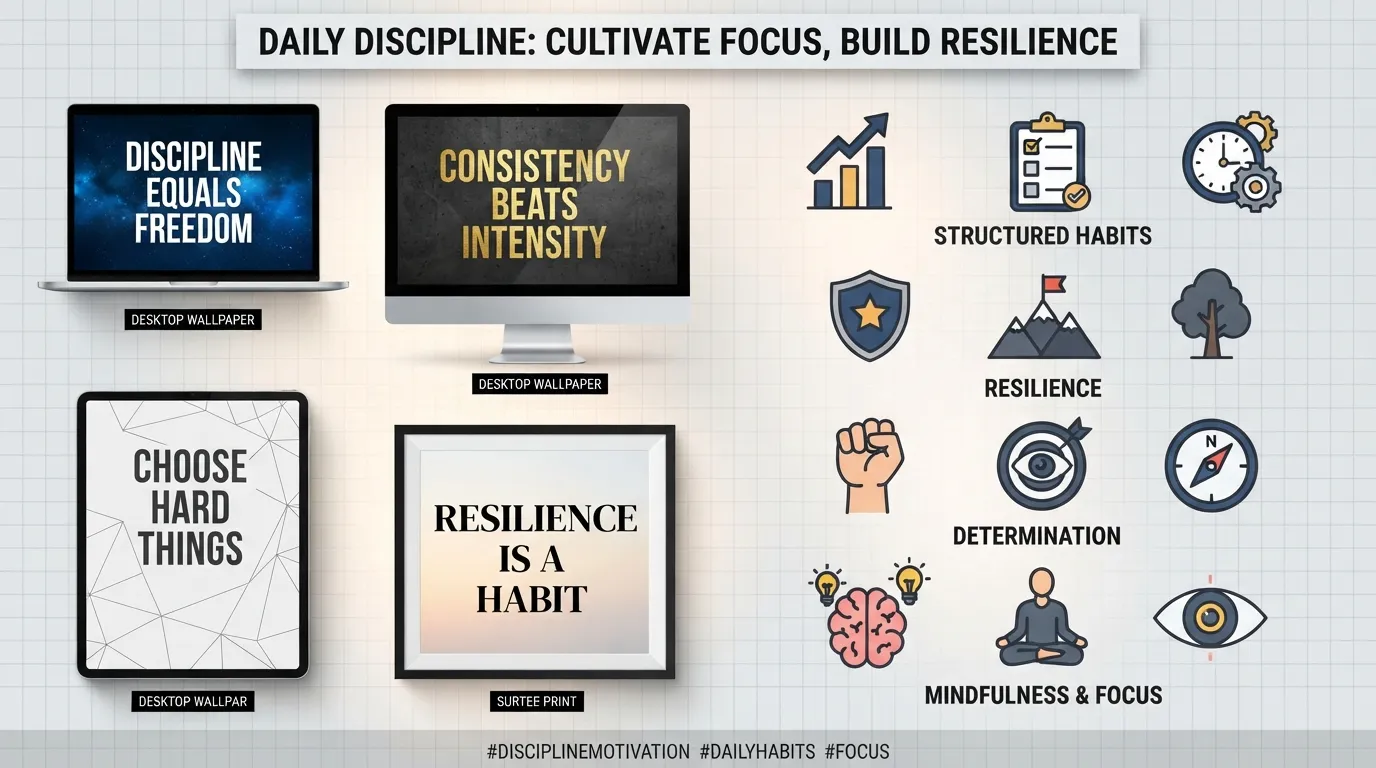
Visual reinforcement acts as a powerful cognitive trigger, transforming abstract concepts into daily reminders. Integrating high-quality graphics satisfies the distinct user intent for “discipline clipart” and wallpapers, capturing valuable Google Images traffic while enhancing overall page engagement.
Free Discipline Quote Images You Can Share
These original graphics are designed for high visual impact across social media platforms or as desktop backgrounds. They distill core tenets of self-mastery into clean, shareable formats.
Graphic 1: The Minimalist Anchor. A stark black background featuring the single white text phrase: DO THE HARD WORK FIRST. Designed for mobile lock screens to interrupt morning scrolling.
Graphic 2: The Jim Rohn Visualization. A clean, modern font overlaying an image of a sturdy rope bridge spanning a misty canyon. Text reads: “Discipline is the bridge between goals and accomplishment.” Optimized for Pinterest and professional LinkedIn sharing.
Graphic 3: The Jocko Willink Maxim. Bold typography in navy blue and grey tones overlaying a weathered concrete texture. Text reads: DISCIPLINE EQUALS FREEDOM. A high-contrast visual perfect for Twitter/X engagement.
Graphic 4: The Aristotle Habit Loop. Elegant, classic serif font centered over a subtle, repeating geometric pattern that symbolizes consistency. Text reads: “We are what we repeatedly do. Excellence, then, is not an act, but a habit.” Ideal for Instagram Stories and Facebook.
Simple Clipart Style Illustrations Representing Discipline
These clean, vector-style illustrations strip away complexity to represent the core mechanics of self-discipline. They are suitable for educational materials, presentations, and blog accompaniments.
The Domino Effect: A clean vector graphic showing a tiny red domino successfully knocking over a massive blue domino labeled “BIG GOAL.” Represents compounding effort and consistency.
The Scales of Choice: A minimalist icon of classic balance scales. One side holds a heavy weight labeled “SHORT-TERM PLEASURE” (floating high); the other holds a dense block labeled “LONG-TERM SUCCESS” (weighing heavily down). Visually explains Lincoln’s famous definition of discipline.
The Upward Spiral: A simple, continuous line drawing creating an ascending spiral staircase, with small footprints visible on every step. Represents steady progress and personal growth.
The Muscle Flex: A stylized icon of a human arm flexing, where the bicep muscle is clearly formed by interlocking gears labeled “WILLPOWER.” Illustrates the concept that discipline is a mental muscle that grows stronger with use.
Frequently Asked Questions (FAQ Schema)
Structuring high-intent search queries as clear question-and-answer pairs maximizes eligibility for Google FAQ schema, featured snippets, and AI Overview extractions.
What are 5 positive quotes about discipline?
“Self-respect is the root of discipline: The sense of dignity grows with the ability to say no to oneself.” — Abraham Joshua Heschel
“Discipline is choosing between what you want now and what you want most.” — Abraham Lincoln
“With self-discipline most anything is possible.” — Theodore Roosevelt
“The successful person has the habit of doing the things failures don’t like to do.” — E.M. Gray
“Rule your mind or it will rule you.” — Horace
What is the motto of discipline?
“Discipline equals freedom,” popularized by Jocko Willink, serves as the defining modern motto for self-mastery.
Alternative classical mottos include “Conquer self” (Plato) and “Do hard things first.”
What is a powerful 3-word quote?
“Do the work” cuts through procrastination and excuses by focusing entirely on immediate execution.
“Win the day” narrows attention away from overwhelming long-term goals onto the current 24-hour window.
What is an inspiring 4-word quote?
“Consistency beats raw talent” highlights how steady daily effort outperforms sporadic brilliance over time.
“Own your every outcome” eradicates victim mentality by placing absolute responsibility on personal actions.
What is the best life motto?
“Choose your hard” is widely considered a premier life motto because it reminds individuals that avoiding discipline today guarantees a much harder struggle through regret tomorrow.
What does “in discipline there is freedom” mean?
Deliberate self-control eliminates chaotic dependencies on fleeting motivation, mood swings, and external distractions.
Automating positive daily routines frees up mental bandwidth and provides financial, physical, and professional autonomy.
Is discipline a value or a skill?
Discipline functions as both, operating primarily as a core moral value and character virtue while requiring the practice of specific behavioral skills.
As a value, it dictates personal priorities; as a skill, it strengthens through deliberate, repeatable execution.
Conclusion — Make Discipline Your Daily Identity
Lasting personal growth requires moving past temporary motivation to embrace discipline as a core personal identity. When self-mastery becomes a fundamental standard rather than a fleeting mood, daily execution transforms from a chore into a natural expression of character.
Key Takeaway: Discipline Is a Practiced Value, Not a Personality Trait
True self-discipline is never an innate trait reserved for the chosen few; it is a forged value built through deliberate daily repetition.
Identity Shift: Viewing yourself as a disciplined individual eliminates the internal friction of constant self-negotiation.
Systemic Action: Pairing timeless philosophical wisdom with concrete daily triggers ensures steady progress regardless of changing external conditions.
Continuous Growth: Embracing the pain of discipline today safeguards against the heavier burden of regret tomorrow.
Choose your anchor quote, set your daily trigger, and start building the life you want through consistent action.
Kittisak Wattanakul
Kittisak Wattanakul is the Discipline Editor at Holistic Wellbeing Living. He writes about routines, focus, consistency, and practical follow-through. With nine years of experience creating personal-growth content, Kittisak helps readers build realistic systems for steady progress without extreme productivity pressure.