How to Study for Exams: Proven Science-Based Tips to Ace Any Test
Why Most Study Methods Fail
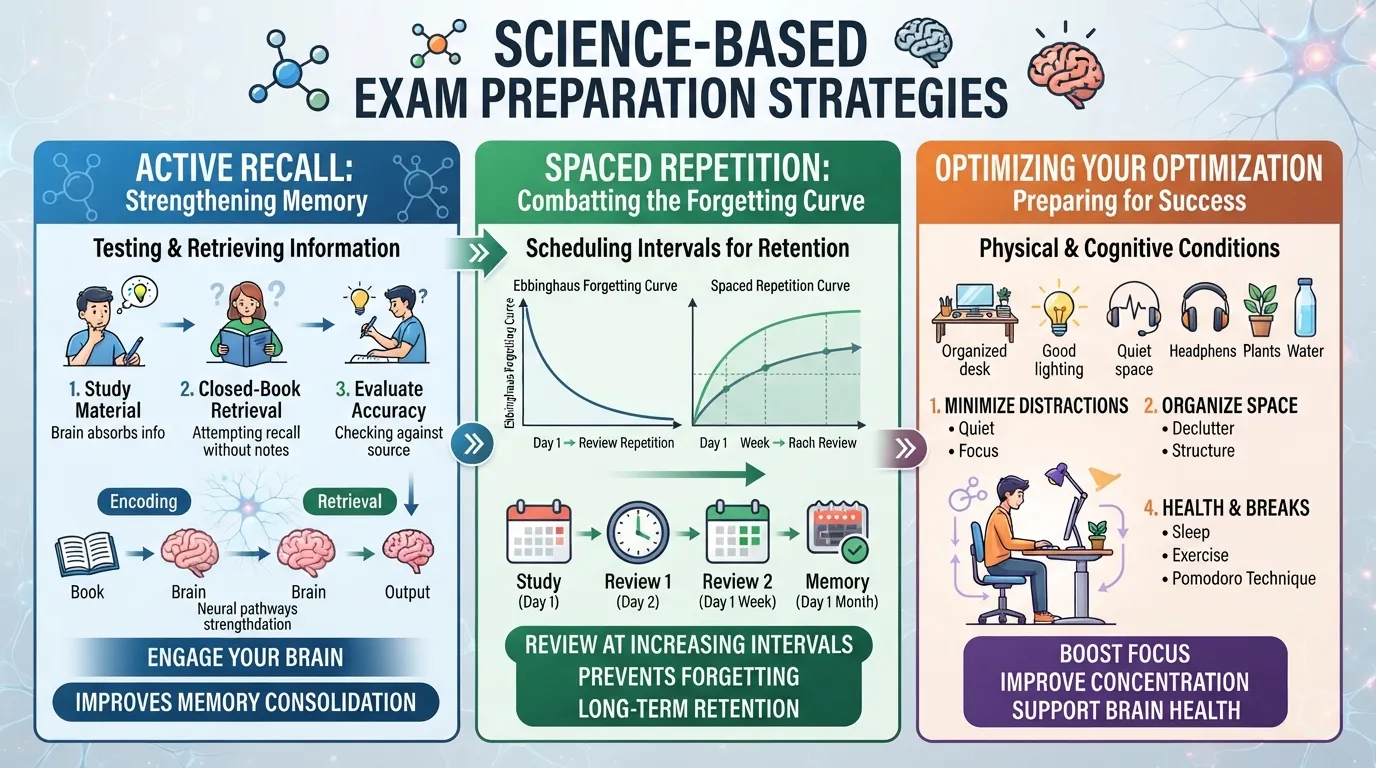
Studying for hours only to blank out on an exam is a universally frustrating experience rooted in flawed learning habits rather than a lack of effort. Most students rely heavily on passive rereading and highlighting, mistaking the illusion of familiarity for actual cognitive retention. True academic performance requires pivoting away from comfortable routines toward evidence-based strategies that force the brain to struggle and encode information permanently.
The Rereading Trap: Reviewing notes multiple times creates fluent recognition, but fails to build the retrieval pathways needed during high-stress testing.
The Illusion of Competence: Feeling like you understand material while reading a textbook is a cognitive bias that evaporates the moment a blank exam page appears.
The Shift to Science: Moving away from time-wasted hours toward study smarter not harder frameworks transforms how memory consolidation operates.
Mastering effective exam study tips begins with understanding that memory is built through retrieval, not storage. Implementing active recall forces your brain to reconstruct knowledge from scratch, exposing gaps before they cost you grades.
What is the single most counterproductive study habit you find yourself falling back on when exams approach?
How to Study for Exams Effectively (Core Framework)
Mastering effective exam preparation requires shifting from passive consumption to an active, structured system. Implementing evidence-based workflows maximizes cognitive retention and eliminates wasted hours.
Organize Your Study Materials First
Structuring your workspace and study resources before diving into heavy content prevents decision fatigue. Scoping the subject helps you understand the broader structural framework before getting lost in minor details [18:03].
Curate Core Resources: Gather your syllabus, lecture notes, textbook chapters, and official past papers in one centralized location.
Build a Conceptual Skeleton: Outline the major chapters or themes first so you can anchor granular facts to a broader logical tree [19:06].
Clean Your Workspace: Eliminate digital and physical clutter to maintain unbroken cognitive focus during deep-work blocks.
Active Recall – Testing Yourself Instead of Rereading
Active recall forces your brain to retrieve knowledge from scratch rather than passively recognizing highlighted textbook phrases. This psychological friction is what builds permanent neural pathways for high-stress testing environments [01:17:18].
Close the Book: Read a section, close your source material, and immediately write down everything you can remember on a blank sheet.
Identify Gaps Instantly: Compare your output against the text to pinpoint exact conceptual misunderstandings while studying.
Practice Testing Under Real Exam Conditions
Simulating high-pressure environments through practice testing conditions your brain to manage time constraints and combat anxiety. Incorporating mock exams bridges the gap between knowing theoretical concepts and applying them under pressure.
Timed Constraints: Complete past papers strictly without notes and under exact exam time limits.
Post-Test Diagnostics: Grade your practice papers rigorously to analyze recurring mistakes and optimize future study topics.
Interleaving – Mixing Subjects Instead of Single-Topic Blocks
Interleaving involves switching between different topics or subjects within a single study session rather than spending hours on just one subject. This variation forces your brain to constantly adapt and differentiate between concepts.
Prevent Cognitive Fatigue: Alternating subjects keeps mental energy high and reduces burnout during long study sessions.
Boost Discrimination Skills: Mixing related problem types helps you identify which core formula or strategy to apply when facing random questions on test day.
The Feynman Technique – Teach It to Learn It
The Feynman technique relies on simplifying complex terminology into plain language to prove true conceptual mastery [03:03]. If you cannot explain a concept simply, your understanding has gaps.
Strip Away Jargon: Write down a complex topic using simple, everyday vocabulary as if explaining it to a beginner.
Target Missing Links: Note down any moments where you stumble or rely on technical buzzwords, then revisit those specific source notes.
The Named Study Rules Everyone Is Searching For
Structured learning frameworks give your revision measurable momentum by replacing vague study goals with strict psychological frameworks. Memorizing and applying these specific rules eliminates procrastination and optimizes memory consolidation before test day.
What Is the 3-2-1 Rule for Studying?
The 3-2-1 rule is a strategic memory-consolidation framework designed to rapidly review complex topics by scaling down information into compressed takeaways. It forces your brain to distill massive chapters into high-yield conceptual anchors.
3 Core Concepts: Write down three primary takeaways or major formulas immediately after finishing a study session.
2 Real-World Applications: Formulate two practical examples or use cases where these concepts apply in real life.
1 Clarifying Question: Draft one lingering question or point of confusion to target during your next review block.
What Is the 1/3, 5/7 Rule in Study?
The 1/3, 5/7 rule dictates how you should balance your time between deep learning and active testing. It mandates that a full third of your total preparation time must be spent absorbing input, while the remaining time is dedicated to rigorous output and spaced retrieval.
Input vs. Output Ratio: Spend no more than one-third of your available study schedule reading texts, watching lectures, and organizing notes.
Spaced Testing Intervals: Dedicate the remaining two-thirds of your timeline to active testing across 5-day and 7-day reinforcement windows to lock in long-term memory.
Eliminate Passive Cycles: Prevent the trap of endless rereading by enforcing strict limits on how many times you open a textbook before testing yourself.
What Is the 137 Rule in Study?
The 137 rule is a precise spaced repetition schedule that leverages the psychological forgetting curve to make information permanent. It tells you the exact days you must revisit a newly learned topic to prevent cognitive decay.
First Review (Day 1): Revisit your summary notes and test yourself exactly 24 hours after your initial study session.
Second Review (Day 3): Re-test the same material on the third day to catch early signs of memory fading.
Final Review (Day 7): Perform a final active recall session on day seven, which securely transfers the data into your long-term memory vault.
Building a Study Schedule That Actually Works
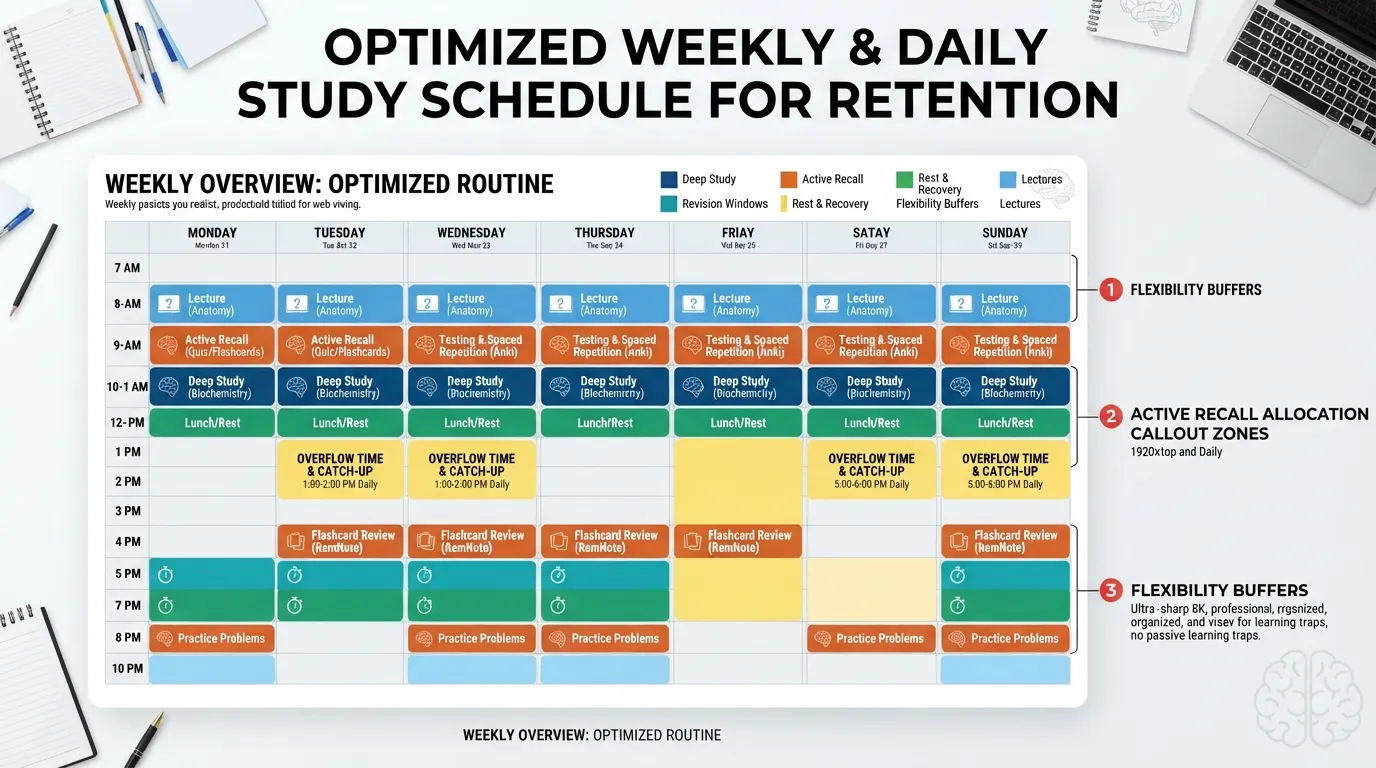
Structuring your timeline efficiently prevents last-minute burnout and replaces destructive cramming habits with science-backed spaced repetition. Organizing a tailored study plan ensures every hour invested moves you closer to exam mastery without wasting cognitive energy.
If You Have 7 Days Left Before the Exam
A full week allows you to deploy a classic 5-day study plan framework combined with two days of high-yield simulated testing. This window provides enough runway to break materials into manageable chunks and catch memory gaps early.
Split the Content: Divide your syllabus into four equal thematic chunks (A, B, C, and D) across days one through four.
Incorporate Cumulative Review: Spend the first 30 minutes of each study block reviewing previous chunks before introducing new material [1.1.4].
Simulate Real Tests: Dedicate days six and seven exclusively to completing timed past papers and diagnosing weak points.
If You Have 3 Days Left Before the Exam
With only 72 hours remaining, abandon exhaustive textbook reading and pivot entirely to high-yield triage. Focus strictly on heavily weighted syllabus topics and active problem-solving.
Identify Core Yield Topics: Review past exam papers to isolate concepts that appear most frequently, ignoring niche peripheral details.
Error-Driven Revision: Go straight to practice questions, note what you miss, and review only those specific theoretical blind spots.
If You Have Only 1 Day Left Before the Exam
A 24-hour countdown requires damage control focused on mental stabilization and confidence building rather than learning new content. Avoid all-nighters, as sleep deprivation destroys memory consolidation.
Flashcard Rapid Fire: Run through curated flashcards or summary sheets rather than opening dense textbooks.
Prioritize Sleep: Stop studying at least two hours before bed to allow your brain to lock in accumulated data during REM sleep cycles.
How Many Hours Should You Study Each Day?
Optimizing your daily workflow requires balancing deep-work blocks with strict recovery periods to maintain high cognitive efficiency. Academic time-management resources, such as the Cornell Learning Strategies Center guidelines, recommend limiting single-subject focus blocks to two hours before switching tasks to prevent mental fatigue [1.1.1].
Target Sustainable Blocks: Aim for 3 to 5 hours of deep, distraction-free study daily rather than tracking 10-hour marathon sessions of passive reading.
Enforce Active Rhythms: Break your hours down using structured intervals, such as 25 minutes of intense focus followed by a 5-minute cognitive break [1.1.1].
Should You Study the Night Before an Exam?

Cramming the night before an exam provides a false sense of security while actively damaging your long-term memory retrieval under stress. While light review can help stabilize formulas or vocabulary fresh in your mind, pulling an all-nighter guarantees cognitive fatigue and impaired logic during the test.
The Pros and Cons of Last-Minute Studying
Balancing last-minute preparation requires understanding the fine line between targeted mental priming and destructive sleep deprivation. Weighing these factors helps you decide whether to open your textbooks or close them for the night.
Pros of Light Review: Quickly scanning formula sheets or major summaries keeps definitions fresh and calms anxiety by giving you a sense of control.
Cons of Deep Cramming: Trying to learn new concepts overnight overloads your hippocampus, making it nearly impossible to synthesize information clearly the next morning.
The Sleep Penalty: Sacrificing REM sleep destroys your brain’s ability to consolidate data, leading to blank-outs on questions you studied hours prior.
What to Do Instead If You’re Down to One Night
If you find yourself underprepared the night before test day, abandon massive textbook chapters and shift to a damage-control triage protocol. Protecting your mental stamina matters far more than cramming low-yield details.
Cap Your Timeline: Stop all intensive studying at least two hours before your planned bedtime to let your nervous system wind down.
Review High-Yield Sheets Only: Spend your final hour skimming concise flashcards or core cheat sheets rather than reading full paragraphs.
Prepare Logistics Early: Lay out your student ID, pens, calculators, and exam venue directions so you eliminate morning panic.
How to Focus 100% While Studying (Beating Distractions)
Maintaining total focus while studying requires building environmental boundaries that protect your attention span from digital interruption. Achieving true concentration is less about sheer willpower and more about systematically removing temptations before you sit down to work.
Removing Digital Distractions (Phone, Notifications)
Your smartphone is the single greatest enemy of deep work, as every notification breaks your cognitive flow and resets your focus timer. Enforcing digital discipline ensures your brain stays immersed in high-yield problem solving rather than mindless scrolling.
Isolate Your Device: Put your phone in another room or lock it inside a drawer out of arm’s reach while completing study blocks.
Deploy DND Modes: Turn on strict “Do Not Disturb” settings and block social media applications using website limiters during deep-work intervals.
The Pomodoro Technique for Deep Focus
The Pomodoro technique breaks intimidating study sessions into manageable, high-intensity sprints followed by mandatory rest periods. This rhythmic structure prevents mental exhaustion and sustains high energy across hours of revision.
Sprint Intervals: Study with absolute, distraction-free concentration for 25 minutes straight without checking tabs or messages.
Recharge Breaks: Step away from your desk for a 5-minute break to stretch, hydrate, or rest your eyes before starting the next block.
Creating a Distraction-Free Study Environment
Designing an optimized, distraction-free environment conditions your brain to transition into work mode the moment you sit at your desk. Your physical surroundings should communicate zero tolerance for interruptions.
Clear the Surface: Keep only your immediate study materials—such as flashcards, pens, and a notebook—on your desk to reduce visual clutter.
Control Audio Triggers: Use instrumental background tracks like binaural beats or white noise to drown out household sounds and maintain a steady workflow.
Why Some Students Study Less but Score Higher
High-achieving students often spend significantly fewer hours at their desks than their peers while still securing top marks through extreme study efficiency. Their success is not the result of natural genius, but rather a ruthless prioritization of quality over quantity in every revision session.
Quality of Study Time vs Quantity
Tracking total hours spent reading textbooks is a vanity metric that fails to account for cognitive fatigue and diminishing returns. True academic performance depends entirely on how deeply engaged your brain is during every minute of your work blocks.
Avoid the Time-Spent Trap: Studying for 10 hours with background distractions yields far less retention than 2 hours of intense, distraction-free active recall.
Optimize Cognitive Energy: High scorers recognize when their mental stamina drops and immediately take breaks rather than pushing through unproductive hours of passive rereading.
Common Habits of High-Efficiency Students
Students who master smart studying operate like strategists rather than manual laborers, focusing heavily on output rather than input. They bypass ineffective habits by implementing systemic protocols before tackling any exam syllabus.
Ruthless Triage: They analyze past exam papers first to identify high-yield topics, completely ignoring peripheral textbook chapters that rarely appear on tests.
Immediate Output Conversion: Instead of making decorative notes, they convert textbook chapters directly into flashcards or practice questions on day one.
Strategic Recovery: They protect their sleep schedules fiercely, recognizing that cognitive processing and memory consolidation happen overnight.
The Fastest Way to Study for an Exam (When Time Is Short)
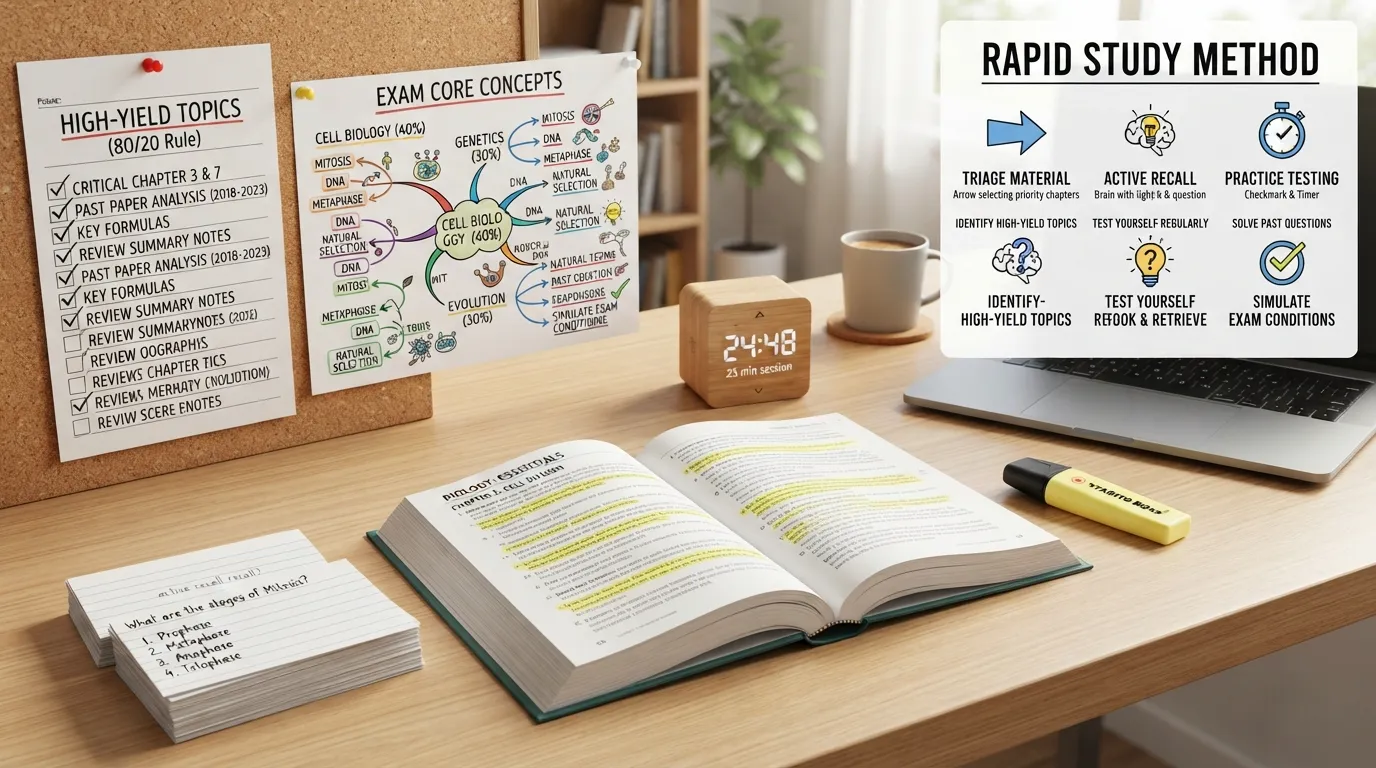
Studying under severe time constraints requires aggressive prioritization and immediate abandonment of low-yield review methods like reading full textbook chapters. Deploying priority-based studying ensures you capture the maximum possible points in the shortest available window.
Prioritizing High-Weightage Topics First
When hours are limited, attempting to cover an entire syllabus from start to finish guarantees failure. You must audit your course materials to isolate the core concepts that dictate the majority of your exam score.
Audit Past Papers: Review previous exams and study guides to find recurring themes, formulas, and essay prompts that appear consistently.
Cut Peripheral Material: Ruthlessly ignore niche footnotes and introductory chapters that carry minimal weightage on test day.
Focus on Foundation: Master fundamental principles first, as complex exam questions are almost always built on core baseline concepts.
Rapid Active Recall Drills
Passive reading will run out your clock without cementing data into your memory. Transforming your remaining hours into aggressive rapid revision drills forces instant cognitive retrieval under pressure.
Blitz Flashcards: Run through high-yield flashcards or summary sheets rather than opening dense review books.
Error-Driven Correction: Answer practice questions immediately, look up missed answers, and re-test those exact gaps until you get them right on the first try.
Quick-Fire FAQs (PAA Capture Block)
What Are the 5 Best Tips for Studying?
The five most effective study strategies focus on cognitive output rather than passive input to maximize long-term retention.
Active Recall: Test yourself continuously instead of rereading notes.
Spaced Repetition: Review material over expanding intervals using the 1-3-7 rule.
Eliminate Distractions: Keep phones in another room during deep-work blocks.
Practice Testing: Solve past papers under strict time limits.
Prioritize Sleep: Stop studying early to allow REM consolidation overnight.
What Are the 3 Best Study Techniques?
Three scientifically validated techniques consistently outperform traditional reading and highlighting methods across academic disciplines.
The Feynman Technique: Simplify complex concepts into plain language to expose knowledge gaps.
Interleaving: Mix different topics or subjects within a single study session to boost problem-solving adaptability.
The Pomodoro Technique: Work in intense 25-minute sprints followed by 5-minute recovery breaks.
What Are 5 Study Tips?
Quick, actionable adjustments to your daily routine can instantly elevate your study efficiency without requiring extra hours.
Target High-Yield Content: Focus exclusively on heavily weighted syllabus topics first.
Create a Skeleton Outline: Map out the broader structural framework of a chapter before studying minor details.
Avoid Cramming: Spread study hours across multiple days instead of pulling all-nighters.
Use Blurting: Write down everything you remember on a blank sheet immediately after reading a section.
Audit Your Errors: Thoroughly review missed practice questions rather than ignoring mistakes.
Your Exam Study Action Plan
Entering an exam room with complete confidence is the direct result of replacing passive anxiety with an actionable, science-backed revision system. Mastery comes from consistency, prioritization, and trusting the neural pathways you built through active testing rather than last-minute panic.
Audit Your Syllabus: Isolate high-weightage topics and past paper trends before opening a single textbook.
Deploy Active Recall: Close your notes, test yourself relentlessly, and use the 1-3-7 spacing rule to lock information into long-term memory.
Protect Your Focus: Isolate digital distractions using strict Pomodoro sprints and distraction-free environmental boundaries.
Prioritize Recovery: Abandon destructive all-nighters in favor of disciplined sleep schedules that allow your brain to consolidate data overnight.
Action cures fear. Take your first step today by organizing your study materials and running a single active recall drill on your hardest topic.