Habit Loop: Complete Guide to Rewiring Your Brain & Building Discipline
What Is a Habit Loop? (Quick Definition)
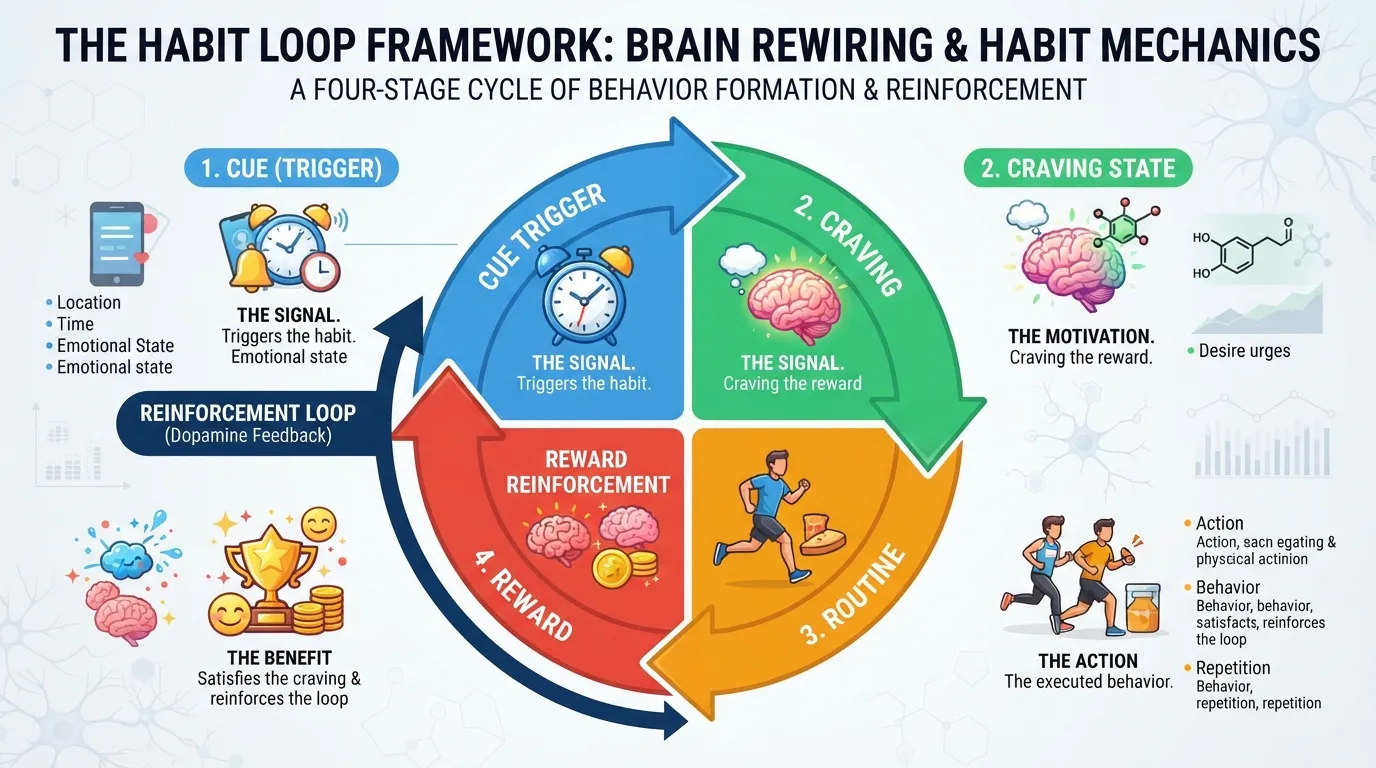
The habit loop is a neurological feedback loop that governs every routine behavior, consisting of four psychological stages: a cue, a craving, a response, and a reward. Popularized by researchers and authors like Charles Duhigg and James Clear, this mental blueprint explains how the human brain automates repetitive actions to conserve cognitive energy.
Habit Loop: A Simple Definition
At its core, a habit loop transforms a deliberate action into an automatic behavior through continuous repetition. When the brain identifies a specific trigger, it executes a learned behavioral pattern to secure a dopamine-driven payoff.
Cue: The environmental, emotional, or temporal trigger that initiates the behavior.
Craving: The motivational force and desire behind the habit that pushes you to act.
Routine (Response): The actual physical, mental, or emotional action performed.
Reward: The ultimate benefit or satisfaction gained, which teaches the brain to remember the loop for the future.
Why This Pattern Runs Your Daily Behavior
Over 40% of daily human actions are driven by automatic routines rather than conscious decision-making. By delegating frequent tasks to the habit loop, the basal ganglia allows the prefrontal cortex to rest and process complex problems.
Cognitive Efficiency: Freeing up mental bandwidth by automating mundane or repetitive daily tasks.
Neural Reinforcement: Strengthening synaptic pathways every time a reward is successfully delivered after a cue.
Behavior Modification: Enabling intentional personal growth by identifying, disrupting, and rebuilding the core triggers and rewards of undesirable routines.
The Habit Loop Explained — 3-Stage vs. 4-Stage Model
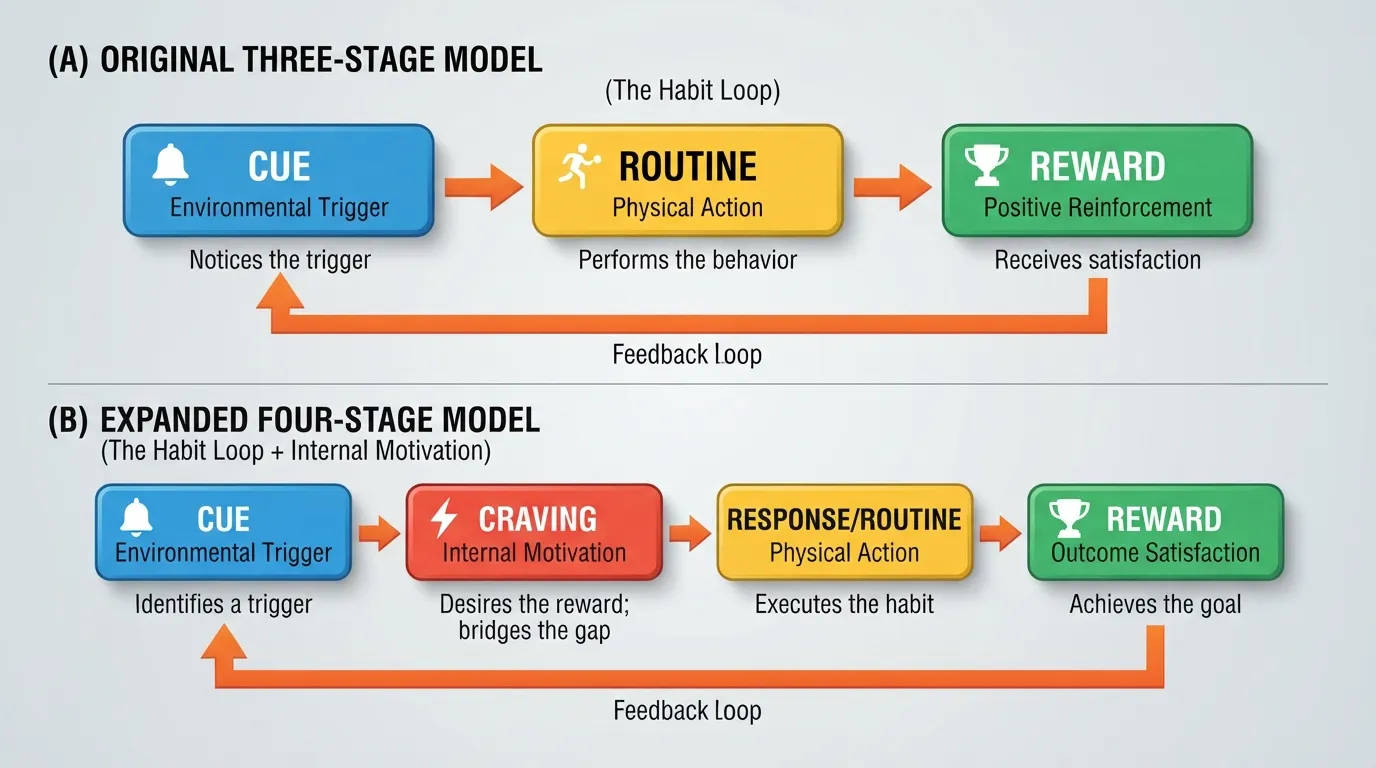
The habit loop framework exists in two primary academic interpretations popularized by Charles Duhigg in The Power of Habit and James Clear in Atomic Habits. Understanding the evolution from a three-stage to a four-stage psychological model clarifies how internal motivation bridges the gap between environmental triggers and physical actions.
The Original 3-Part Model (Cue – Routine – Reward)
Charles Duhigg introduced the foundational three-part framework to demonstrate how neurological loops operate within organizations and human neurology. This streamlined model focuses strictly on the physical trigger, the executed behavior, and the ultimate physiological or psychological payoff.
Cue: The environmental signal that tells your brain to go into automatic mode and which habit to use.
Routine: The behavioral execution itself, which can be physical, mental, or emotional.
Reward: The positive reinforcement that helps your brain figure out if this particular loop is worth remembering for the future.
The Expanded 4-Part Model (Cue – Craving – Response – Reward)
James Clear expanded Duhigg’s framework into a four-stage continuous feedback loop by separating the motivational force from the physical action. This addition isolates the internal state of desire, making it significantly easier to diagnose why a habit is triggered and how it can be modified.
Cue: The initial spark or trigger that predicts a reward in your environment.
Craving: The motivational drive and internal desire for the change that the cue promises.
Response: The actual habit or action you perform to satisfy the craving.
Reward: The end goal and satisfaction gained from experiencing the response, which completes the neurological cycle.
Which Model Should You Use? (Practical Clarification)
Both models describe the exact same underlying neuropsychological process, but serve different tactical purposes depending on your goals. Choosing between them depends on whether you need a high-level operational summary or a granular tool for behavior change.
Use Duhigg’s 3-Part Model when you want to quickly identify external triggers and analyze the immediate feedback loop of an existing routine.
Use Clear’s 4-Part Model when you are actively trying to build a new habit or break a bad one by targeting internal cravings and making the response frictionless.
Visual Breakdown — Habit Loop Diagram (Cue → Craving → Routine → Reward)
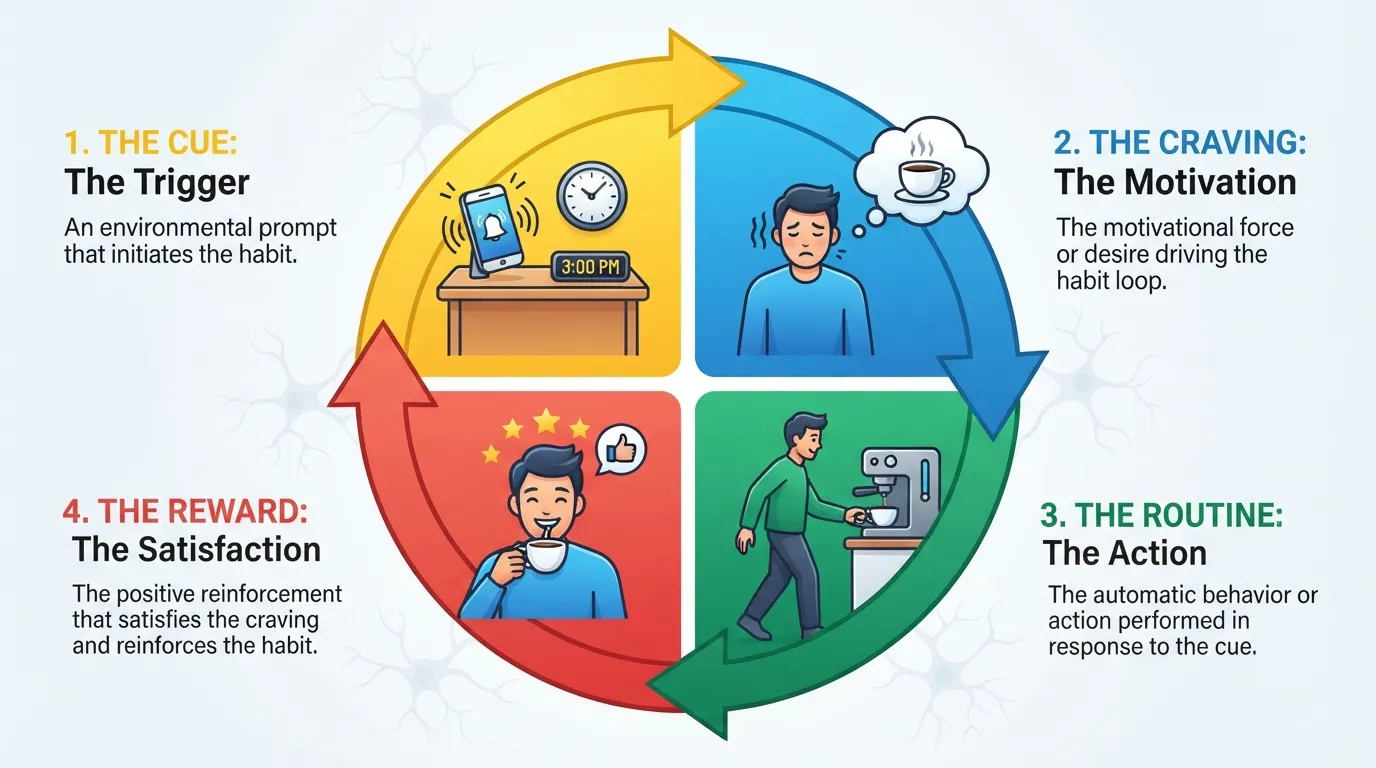
Understanding the mechanical flow of habit formation requires visualizing the neurological feedback loop. While many descriptions exist, a clear diagram is essential to grasp how the four distinct stages—Cue, Craving, Response, and Reward—interact to create an automatic behavior. The following visual representation illustrates this continuous cycle.
[Insert Custom Labeled Infographic Here — Writer/Designer Note: build an original diagram, do not use a stock/competitor visual]
Diagram Description and Design Specifications:
To satisfy the high-value visual intent for keywords like “habit loop cue routine reward image,” the custom infographic must be a clean, professional vector illustration. It must be designed as a continuous circular flow, not a linear process, emphasizing the cyclical nature of behavior.
The diagram should be structured as follows, using distinct, contrasting colors for each stage:
The Core Loop: A prominent central circle divided into four equal segments or quadrants.
Stage 1 (Top Left – e.g., Blue): Labeled “1. The CUE“. Include a small icon representing a trigger (e.g., a smartphone notification icon or a clock showing 3:00 PM). Text below: The Trigger: Predicts a reward.
Stage 2 (Top Right – e.g., Red): Labeled “2. The CRAVING“. Include a small icon representing internal desire (e.g., a thought bubble with a coffee cup or a dopamine molecule symbol). Text below: The Motivation: Desire for change.
Stage 3 (Bottom Right – e.g., Yellow/Orange): Labeled “3. The RESPONSE (Routine)“. Include a small icon representing action (e.g., a person walking or taking an action). Text below: The Action: The habit you perform.
Stage 4 (Bottom Left – e.g., Green): Labeled “4. The REWARD“. Include a small icon representing satisfaction (e.g., a smiling face or a star/trophy icon). Text below: The Benefit: Satisfies the craving.
Directional Flow: Thick, bold arrows must connect 1→2, 2→3, 3→4, and crucially, 4→1, indicating that the successful completion of the reward reinforces the cue for the next cycle.
Header: A clear title above the graphic: The Neurological Habit Loop Cycle.
Sub-text Below Diagram: A brief caption summarizing the loop: The habit loop is a continuous cycle where a Cue triggers a Craving, leading to a Response (Routine), which delivers a Reward, ultimately reinforcing the initial Cue.
Breaking Down Each Component of the Habit Loop
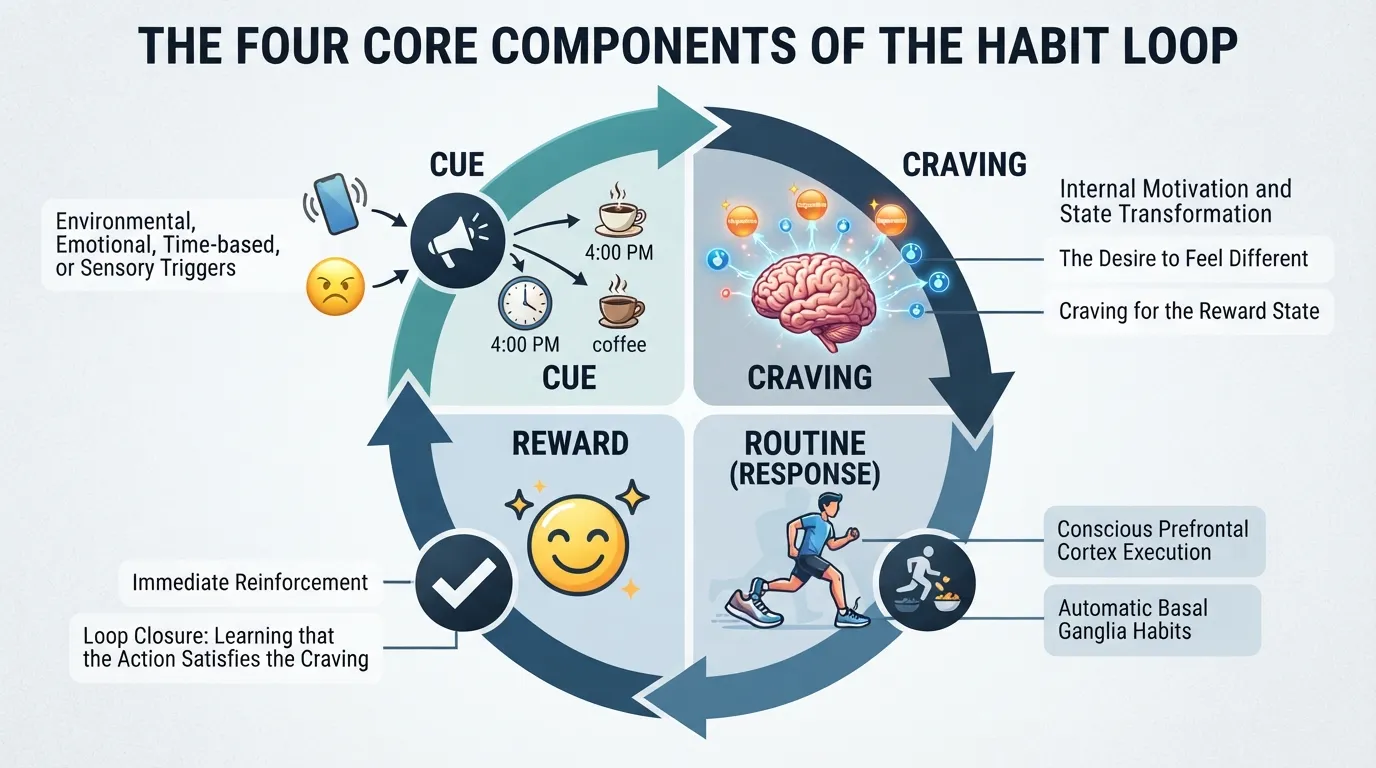
Deconstructing the habit loop into its individual components reveals how everyday actions become hardwired into the brain. Each stage in the neurological sequence serves a distinct psychological function, transforming raw sensory input into automatic behavior.
The Cue (Trigger): Environmental, Emotional, Time-Based, Sensory
The cue is the initial spark that alerts your brain to initiate a stored behavioral routine. Acting as a silent trigger, it pulls information from your surroundings or internal state to predict that a reward is nearby.
Environmental Cues: Physical objects or locations that prompt action, such as walking into the kitchen and immediately seeing a bowl of candy.
Emotional Cues: Internal psychological states like stress, boredom, or anxiety that signal a need for comfort or escape.
Time-Based Cues: Specific hours of the day or routines that create predictable temporal triggers, such as feeling hungry right at 12:30 PM.
Sensory Cues: External stimuli like the smell of fresh coffee or the chime of a smartphone notification that instantly capture attention.
The Craving: Why the Urge Appears Before the Action
Cravings represent the motivational engine of the habit loop, bridging the gap between a neutral environmental cue and your physical response. You do not crave the routine itself; instead, you crave the internal change in state that the routine promises to deliver.
Dopamine Release: The brain releases a surge of dopamine not when the reward is received, but the moment the cue is recognized and the craving begins.
State Transformation: The urge reflects a desire to move from an uncomfortable or neutral state to a more satisfying emotional or physical condition.
Motivational Fuel: Without a strong craving, the cue lacks the psychological pressure required to push you into action.
The Routine (Behavior): Conscious vs. Fully Automatic
The routine is the actual behavior executed to fulfill the craving, ranging from a simple physical movement to a complex multi-step sequence. Once a habit is fully ingrained, this phase requires minimal cognitive effort because the basal ganglia takes over executive control.
Conscious Execution: Initial habit formation requires high cognitive load, deliberate focus, and active decision-making through the prefrontal cortex.
Automatic Execution: Repeated cycles encode the pathway into procedural memory, allowing the routine to run on autopilot with virtually zero conscious thought.
Flexibility of Scale: Routines can be extremely brief, like checking your inbox, or span hours of complex habitual behavior.
The Reward: Why It Locks the Loop In
The reward is the final objective of the habit loop, delivering two distinct benefits: satisfying your immediate craving and teaching your brain which sequence is worth remembering. This phase triggers neural reinforcement, cementing the connection between the cue, craving, and routine for future cycles.
Immediate Satisfaction: Providing instant relief, pleasure, or validation that resolves the original discomfort triggered by the craving.
Evolutionary Learning: Helping the brain audit the environment to determine if the behavior was efficient enough to store as a permanent procedural shortcut.
Loop Closure: Completing the neurological circuit, which ensures the next time the cue appears, the brain instantly recalls the reward and re-runs the entire cycle.
The Neuroscience Behind the Habit Loop (What's Actually Happening in Your Brain)
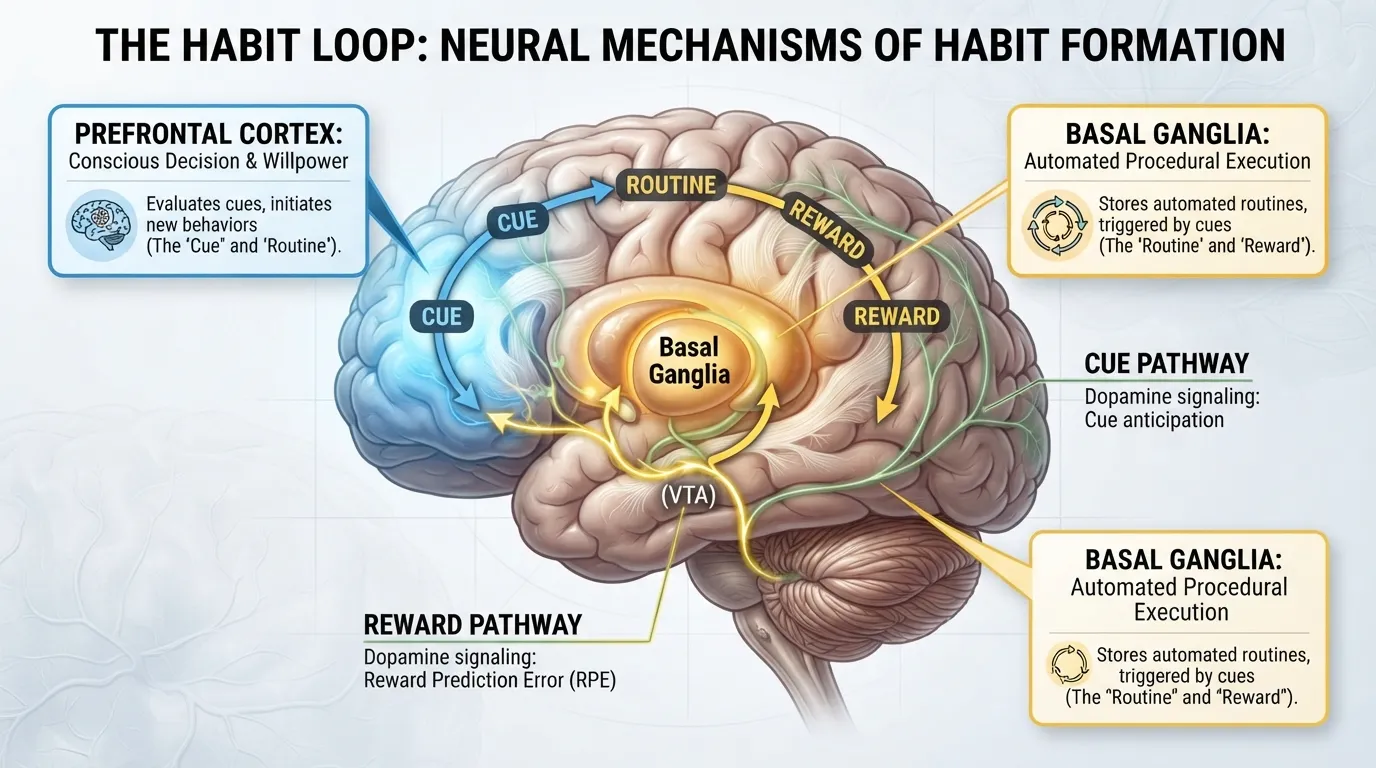
Habits are physical neural pathways carved into the brain’s architecture rather than mere choices of willpower. Understanding the underlying neurobiology explains why routines feel nearly impossible to break once fully consolidated.
The Basal Ganglia: Your Brain’s Autopilot System
The basal ganglia is a group of subcortical nuclei located at the base of the forebrain that acts as the brain’s central processing unit for automated behavior. When a behavior is repeated frequently, the dorsolateral striatum within the basal ganglia takes over executive control.
Cognitive Offloading: Shifting routine execution from the energy-intensive prefrontal cortex to the efficient basal ganglia to save mental bandwidth.
Chunking Behavior: Grouping a complex sequence of individual actions into a single neurological block that runs automatically.
Permanent Storage: Encoding procedural memories so deeply that once a habit loop is formed, the neural trace remains intact indefinitely.
Why Willpower Alone Fails Against a Habit Loop
Willpower relies on the prefrontal cortex, a region that experiences decision fatigue and consumes significant metabolic energy. When you try to resist an established habit through raw force, you fight an entrenched, effortless loop in the basal ganglia with a tiring executive center.
Metabolic Cost: The prefrontal cortex burns through glucose rapidly during conscious restraint, leading to quick mental exhaustion.
Loop Dominance: Because the basal ganglia never truly erases an old habit trace, stress or distraction easily bypasses the fatigued prefrontal cortex.
The Override Illusion: Relying solely on grit treats the symptom rather than disrupting the underlying cue-craving-reward sequence.
Reward-Based Learning: How the Brain Updates the Loop
The brain continuously updates its behavioral programming through reward-based learning, driven by dopamine signaling that calculates outcome errors. Research published in the Journal of Neuroscience details how striatal circuits adapt during reinforcement learning to optimize future decision-making.
Prediction Error: Dopamine neurons fire intensely when a reward exceeds expectations, or drop when a reward falls short, teaching the brain to adjust the routine.
Synaptic Potentiation: Repeatedly firing the same loop strengthens the synaptic connections between neurons via long-term potentiation.
Automaticity Threshold: Over time, the brain requires less dopamine anticipation for the reward as the routine becomes completely hardwired into procedural memory.
Real-World Examples of the Habit Loop
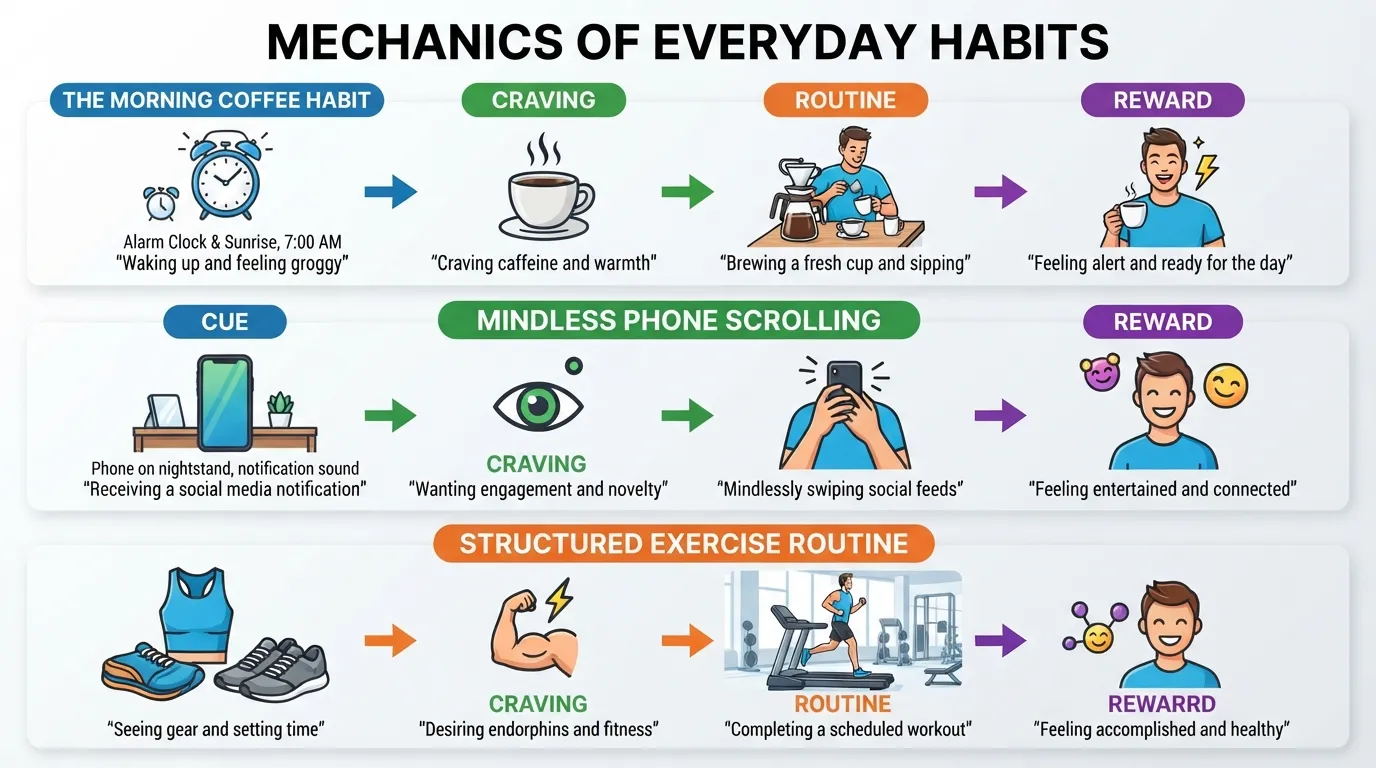
The habit loop operates continuously beneath the surface of daily life, dictating everything from minor automated ticks to major lifestyle patterns. Deconstructing everyday actions into their distinct neurological components reveals how easily these invisible loops form and dictate behavior.
Everyday Habit Loop Examples (Morning Coffee, Phone Scrolling, Nail-Biting)
Most daily habits are automatic responses to subtle environmental or emotional triggers designed to deliver quick psychological or sensory payoffs. Analyzing these common routines highlights the predictable mechanics of the loop in action.
The Morning Coffee Loop: The alarm sounding or walking into the kitchen serves as the Cue, triggering a Craving for warmth and caffeine, leading to the Routine of brewing a cup, which delivers the Reward of alertness and comfort.
The Phone Scrolling Loop: Feeling a momentary wave of boredom or sitting down at a desk acts as the Cue, creating a Craving for mental stimulation, prompting the Routine of unlocking social media apps, and resulting in the Reward of novelty and distraction.
The Nail-Biting Loop: Experiencing work stress or anxiety functions as the Cue, sparking a Craving for physical tension release, which leads to the Routine of biting fingernails, yielding the immediate Reward of stress mitigation and sensory grounding.
A Positive Habit Loop Example (Exercise Routine)
Constructive routines follow the exact same neural pathways as destructive ones, allowing you to engineer positive behavior change by deliberately pairing cues with rewarding outcomes. Building an intentional exercise habit requires identifying a reliable daily anchor.
The Cue: Placing workout shoes directly beside the bedroom door right before going to bed.
The Craving: Seeing the shoes upon waking, which triggers a desire for morning energy and physical accomplishment.
The Routine: Changing clothes and completing a 20-minute morning workout without overthinking the decision.
The Reward: Enjoying a refreshing post-workout shower and the dopamine boost of checking off a major goal early in the day.
First-Hand Example: A Real Case Walkthrough (writer’s own mapped habit loop, with specific cue/routine/reward — no generic filler)
Breaking down a personal productivity bottleneck revealed a persistent afternoon slump loop that was silently derailing editorial focus. Mapping the exact stages exposed how an innocuous trigger was hijacking workflow.
The Cue: Staring at a complex content outline on the screen precisely at 3:15 PM every day.
The Craving: An acute urge to escape cognitive fatigue and experience a quick mental break.
The Routine: Opening a new browser tab to check sports headlines and social media feeds for ten minutes.
The Reward: Temporary mental distraction and a brief dopamine spike that paradoxically worsened afternoon exhaustion.
How to Break a Bad Habit Loop (Step-by-Step)
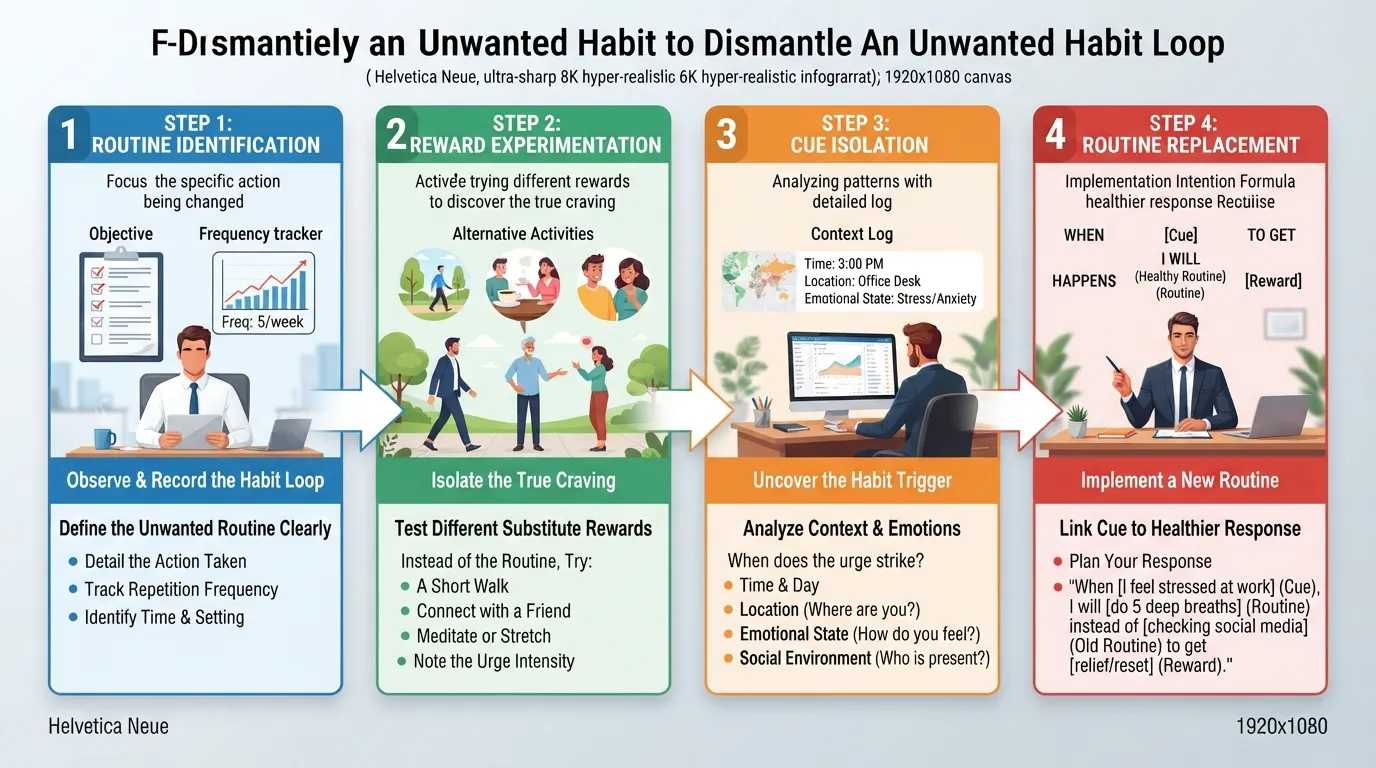
Breaking a bad habit requires preserving the underlying loop while deliberately swapping out the intermediate behavior. Because the basal ganglia never truly erases an established neural pathway, the most effective strategy is isolating the trigger and substituting a new response that delivers a similar reward.
Step 1: Identify the Routine
You cannot modify a behavior until you observe it with absolute clarity and document the exact physical actions you perform. When you feel the urge to engage in an unwanted habit, pause for a moment and write down the precise sequence of steps you are taking.
Pinpoint the Action: Detail the physical movements, duration, and environment associated with the unwanted routine.
Remove Judgment: Treat the observation objectively as a data-gathering exercise rather than an emotional failure.
Track Frequency: Note the exact times of day and emotional states when the routine surfaces most consistently.
Step 2: Experiment With Different Rewards
Cravings are driven by a deeper psychological need, meaning the routine you execute might not actually be what your brain truly wants. To test what reward you are actually chasing, deliberately substitute different rewards during your next urge and wait 15 minutes to see if the craving subsides.
Test Alternative Outcomes: If the urge to grab a sugary snack hits, try walking around the office for five minutes or talking to a coworker instead.
Evaluate Satisfaction: Assess whether the alternative activity successfully eliminates the craving or if you still feel compelled to eat the snack.
Isolate the True Need: Figure out if you are actually craving a burst of energy, social connection, stress relief, or simple sugar.
Step 3: Isolate the Actual Cue
Most habits are triggered by one of five primary categories: location, time of day, emotional state, other people, or an immediately preceding action. Tracking these variables across multiple occurrences reveals the exact environmental signal activating your loop.
Log the Context: Write down your location, current time, emotional state, who is nearby, and what you were doing right before the urge hit for five consecutive days.
Find the Common Denominator: Review your logs to spot the single repeating variable that appears every time the routine triggers.
Target the Trigger: Once identified, you can either avoid the cue entirely or prepare a counter-strategy for when it appears.
Step 4: Replace the Routine (Keep the Cue and Reward)
The secret to lasting behavioral modification is keeping the original cue and the final reward intact while swapping the destructive routine for a healthy alternative. This creates a new neural path that satisfies the old craving without the negative consequences.
Design a Plan: Write out an explicit implementation intention stating: “When [Cue] happens, I will immediately do [New Routine] so I can get [Reward].”
Reduce Friction: Lower the barrier to entry for the new routine so it requires less activation energy than the old habit.
Reinforce the Loop: Practice the new substitution consistently until the basal ganglia encodes the upgraded behavior as the default response.
How to Build a New (Positive) Habit Loop
Constructing a new, positive habit loop requires designing an environment where the desired behavior is obvious, easy to execute, and immediately satisfying. Because the human brain naturally prioritizes instant gratification over delayed benefits, engineering the reward phase is critical for long-term behavioral adherence.
Choosing a Clear, Obvious Cue
New habits frequently fail because they lack a precise trigger, leaving the brain guessing when to initiate the action. Relying on vague intentions like “I will read more” fails because it provides no environmental anchor.
Habit Stacking: Anchor your new habit directly to an existing daily routine by using the formula: “After [Current Habit], I will [New Habit].”
Environmental Design: Place visual cues directly in your path, such as putting a book on your pillow or leaving a water bottle on your desk.
Contextual Clarity: Define the exact time and location for the behavior to eliminate decision fatigue when the moment arrives.
Keeping the Routine Small and Easy
Initial motivation is a poor foundation for consistency; making the behavior frictionless ensures execution even on low-energy days. Scaling the routine down to its smallest possible denominator allows the basal ganglia to begin encoding the neural pathway.
The Two-Minute Rule: Scale any new habit down so it takes two minutes or less to perform, such as writing just one sentence or doing a single push-up.
Eliminate Friction: Remove physical barriers between you and the routine by preparing your workspace or workout gear the night before.
Prioritize Consistency Over Intensity: Building the neural track of showing up daily matters infinitely more than the volume of work completed early on.
Designing an Immediate (Not Delayed) Reward
Positive long-term outcomes like better health or career growth are too abstract for the brain’s dopamine receptors to lock in immediately. You must attach an instant, tangible payoff to the end of the routine to signal safety and success.
Immediate Reinforcement: Give yourself an immediate mental pat on the back, a physical checkmark on a calendar, or a small experiential treat right after finishing the routine.
Dopamine Association: Teach your brain that executing the action reliably results in a positive emotional state.
Bridging the Gap: Use immediate artificial rewards until the natural, long-term benefits of the habit become intrinsically rewarding.
Self-Mapping Template: Map Your Own Cue / Routine / Reward
| Habit Component | Your Personal Design | Example (Daily Reading) |
| The Cue | [Define your specific time, place, or preceding habit] | Pouring my morning cup of coffee at 7:00 AM |
| The Craving | [Identify the internal state or desire you want to fulfill] | The desire for quiet mental stimulation before work |
| The Routine | [Specify the small, actionable behavior] | Reading exactly 5 pages of a book |
| The Reward | [Choose your immediate positive reinforcement] | Enjoying the first sip of coffee while reflecting on the pages |
Frequently Asked Questions
What are the four stages of the habit loop?
The four stages of the habit loop are the cue, the craving, the response, and the reward. The cue acts as an environmental trigger, the craving creates the internal motivation, the response is the routine or action performed, and the reward delivers the satisfaction that reinforces the cycle.
Cue: The trigger that initiates the behavior.
Craving: The motivational desire for change.
Response: The physical or mental routine executed.
Reward: The benefit that locks the loop into memory.
What is the 3-3-3 rule for habits?
The 3-3-3 rule is a behavioral productivity framework used to maintain focus and build sustainable daily execution habits. It requires focusing on three major tasks, spending up to three hours on the primary objective, and dividing remaining time across three smaller secondary tasks.
Core Focus: Completing three high-impact tasks each day.
Time Boxing: Allocating dedicated blocks of uninterrupted deep work.
Task Triage: Prioritizing actionable goals to prevent cognitive overload.
What is the 21-90 rule for habits?
The 21-90 rule suggests it takes 21 days to form a new habit and 90 days to make it a permanent lifestyle change. While popularized by plastic surgeon Maxwell Maltz, modern neurological research shows timeline variance depends entirely on the complexity of the behavior.
21-Day Phase: The initial period required to break through resistance and establish basic behavioral familiarity.
90-Day Phase: The extended duration needed for the basal ganglia to fully hardwire the routine into automatic procedural memory.
Individual Variance: Simpler habits solidify in weeks, while complex lifestyle changes require months of consistent repetition.
How long does it take to break a habit loop?
Breaking a habit loop takes anywhere from 18 to 254 days, with a study published in the European Journal of Social Psychology finding an average of 66 days for a new automatic behavior to take hold. The exact timeline depends on behavioral complexity, environmental friction, and individual consistency.
Simple Adjustments: Minor tweaks to existing routines can be cemented in under three weeks.
Complex Patterns: Deeply ingrained stress responses often require months of conscious cue management and routine substitution.
Environmental Support: Removing external triggers accelerates the dismantling of unwanted neural loops.
Can a habit loop ever fully disappear?
A habit loop never truly disappears from the brain’s architecture because the basal ganglia permanently stores neural pathways once they are deeply encoded. Instead of erasing an old habit, you override it by building a competing loop that becomes your default automatic response.
Permanent Traces: The neurological pathway remains intact in the brain indefinitely, which explains why old habits resurface during times of high stress.
Path Replacement: Successful behavior change relies on swapping the routine while keeping the cue and reward intact.
Synaptic Dominance: Consistent repetition of a new response strengthens alternative pathways, making the old loop dormant and difficult to trigger.
Key Takeaways and What's Next
Mastering the mechanics of the habit loop transforms behavior change from a battle of willpower into a structured design challenge. By understanding how environmental cues spark internal cravings, drive automatic routines, and lock in rewards, you gain the precise blueprint needed to dismantle destructive patterns and engineer lasting personal growth.
Quick Recap
The Four Stages: Every automated action relies on a continuous loop consisting of a Cue, a Craving, a Routine, and a Reward.
Neurological Autonomy: The basal ganglia stores these loops permanently to conserve cognitive energy, making raw willpower ineffective against deep-seated habits.
Strategic Replacement: Breaking bad habits requires preserving the cue and reward while substituting a healthier response, rather than trying to delete the neural pathway.
Systematic Building: Positive habit formation succeeds by pairing obvious triggers with small routines and immediate, tangible reinforcements.
Continuing Your Discipline & Habit Formation Journey (Series Lead-In)
Understanding the neurological anatomy of a habit loop is just the opening phase of mastering personal discipline. In the next part of our Discipline and Habit Formation Series, we explore advanced strategies for environmental design and tactical friction reduction to make building good habits effortless. Continue your journey by diving into our comprehensive guide on How to Design Your Environment to Eliminate Bad Habits at the Source.