Habit Stacking: The Ultimate Guide to Building New Habits Effortlessly
Introduction — What Is Habit Stacking?
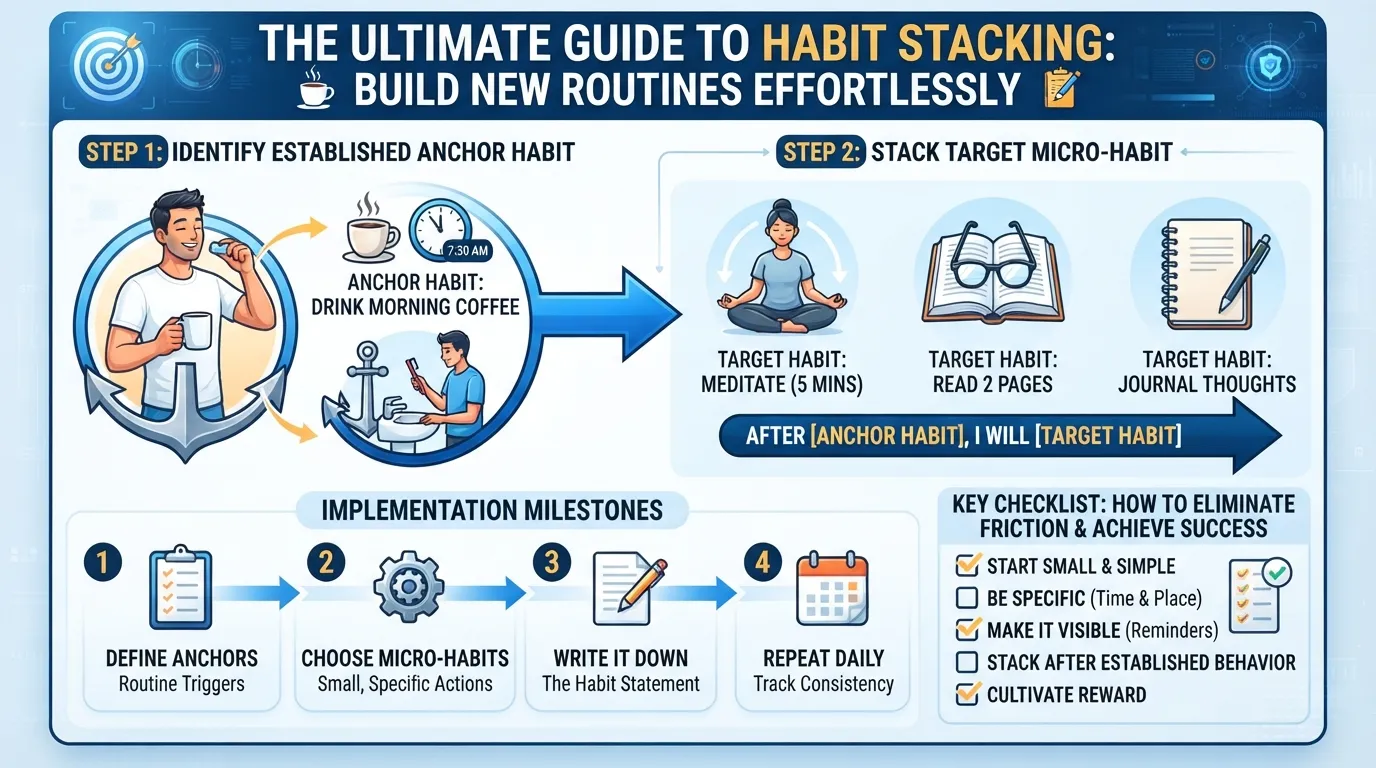
Habit stacking is a behavioral psychology strategy that links a brand-new habit directly to an established daily routine, creating an automatic sequence of actions. Coined by productivity expert S.J. Scott and popularized by James Clear in Atomic Habits, this technique leverages existing neural pathways to eliminate the friction of remembering to start something new.
Busy schedules and overwhelming daily to-do lists often cause people to abandon personal growth goals because they lack a reliable trigger. Instead of relying on motivation or a vague reminder, habit stacking turns your current daily behaviors into the ultimate visual and contextual cues.
How Habit Stacking Works
The Anchor Habit: An established, automatic behavior you already perform every single day without fail, such as brewing morning coffee or brushing your teeth.
The New Habit: A small, manageable action you want to integrate into your routine, such as meditating for two minutes or taking daily vitamins.
The Formula: The psychological architecture follows a strict behavioral template: “After [Current Habit], I will [New Habit].”
Core Benefits for Daily Productivity
Eliminates Decision Fatigue: Removes the mental effort required to decide when to perform a task by anchoring it to a predictable trigger.
Maximizes Existing Time: Integrates personal development goals into routines you already complete, saving precious time.
Leverages Behavioral Momentum: Uses the satisfaction of completing a routine behavior to propel you seamlessly into the next action.
What Is Habit Stacking? (Definition & Core Concept)
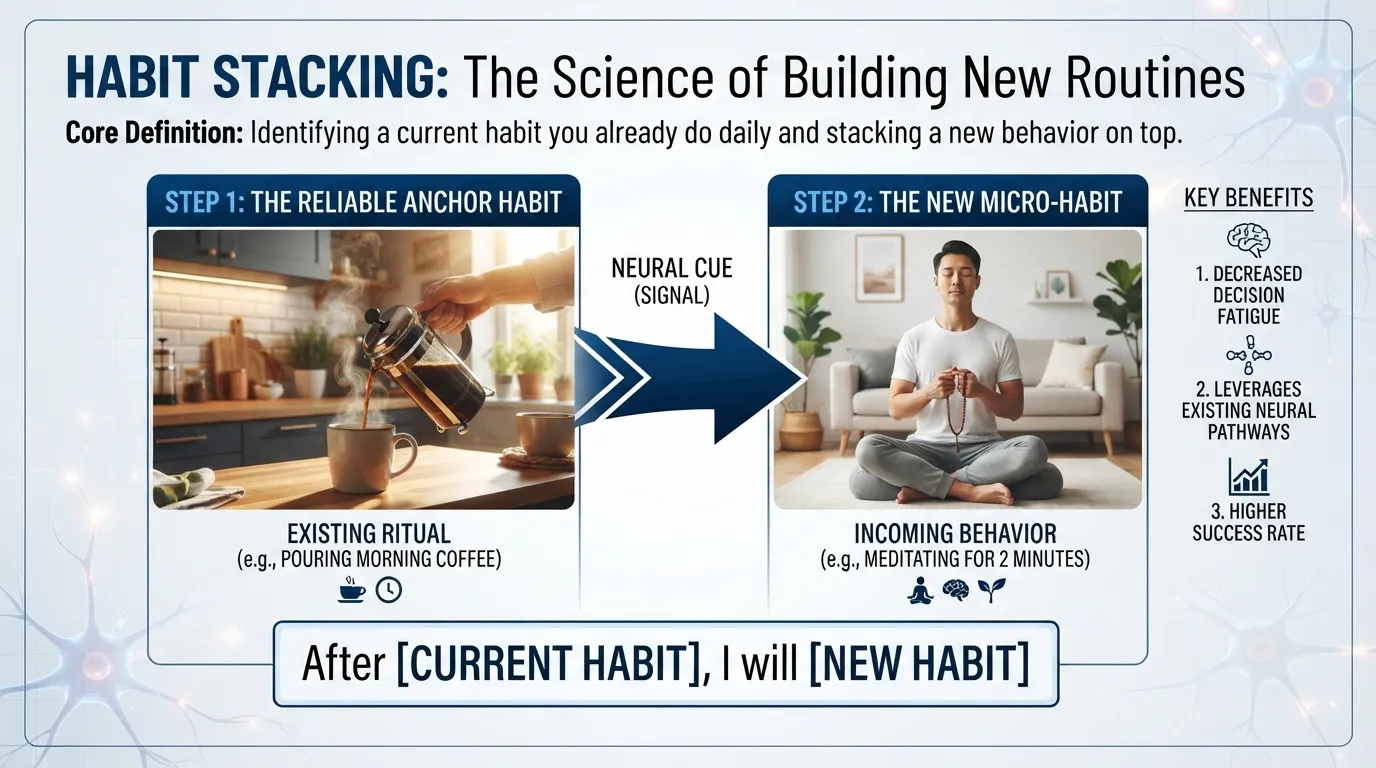
Habit stacking is a specialized form of implementation intention where you pair a desired new behavior with an existing, automatic routine. By anchoring an unfamiliar action to a deeply ingrained cue, you transform your current daily schedule into an organized trigger system that drastically increases consistency.
The Habit Stacking Formula
“After [CURRENT HABIT], I will [NEW HABIT].”
The Anchor: Your reliable current habit acts as an unyielding psychological anchor that you already perform automatically, such as pouring your morning coffee or locking your front door.
The Insertion: Your target new habit is cleanly inserted immediately following the completion of the anchor, removing guesswork from the equation.
The Integration: This specific cue-based structure ensures that the completion of the first action serves as the explicit instruction manual for the second.
How Habit Stacking Differs from a Regular New Habit
Dependency on Triggers: Traditional goal-setting relies on vague time-based reminders, whereas habit stacking uses concrete physical behaviors as built-in contextual cues.
Cognitive Load: Standard habit formation demands heavy mental energy to initiate, while stacking leverages existing neurological pathways to reduce decision fatigue.
Failure Rates: Creating a habit from scratch often fails due to a lack of environmental scaffolding; stacking relies on pre-existing momentum to carry the new behavior forward.
Where Habit Stacking Came From (Origin & Entity Differentiation)
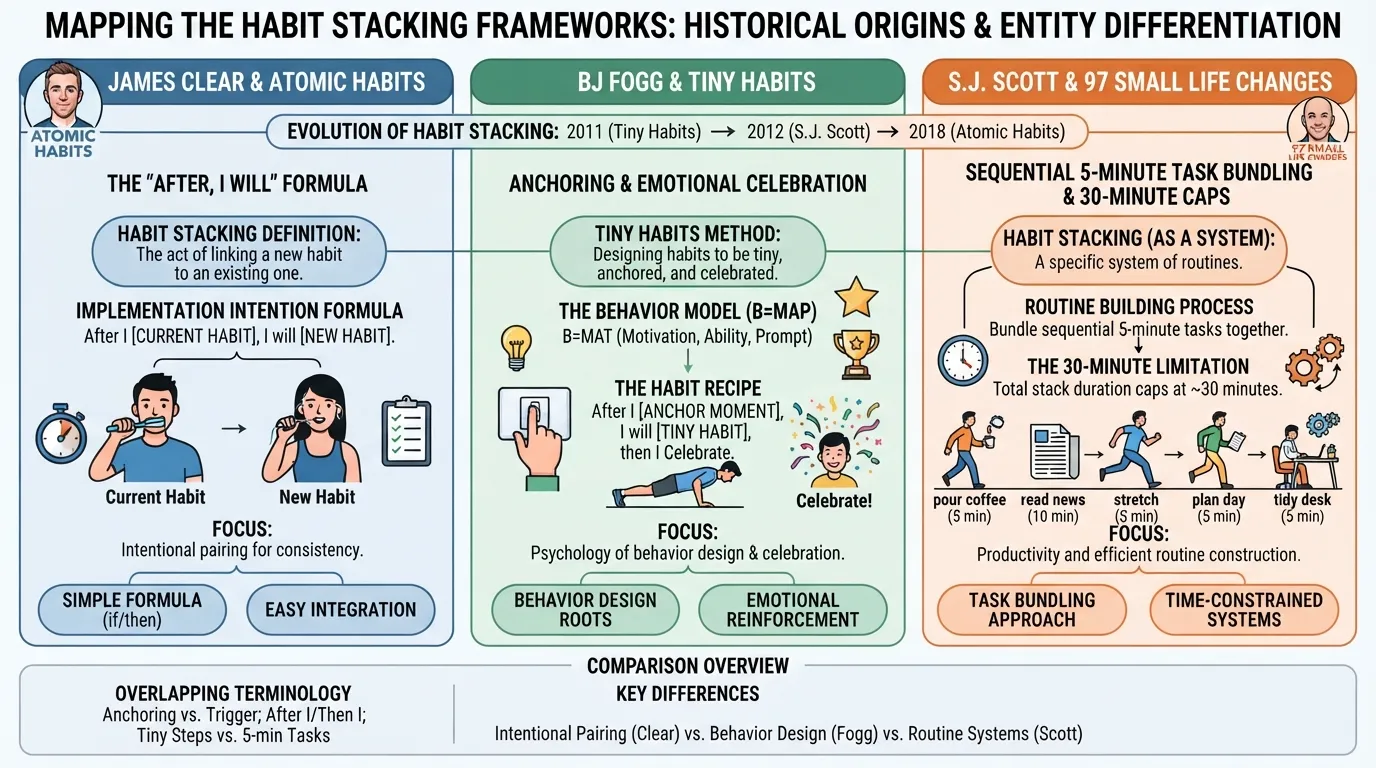
Habit stacking is a collaborative evolution of behavioral psychology, drawing from distinct frameworks popularized by three major authors. Understanding these roots prevents confusion between overlapping methodologies like James Clear’s habit stacking, BJ Fogg’s anchoring, and S.J. Scott’s micro-habit lists.
James Clear and Atomic Habits — The Popularized Version
James Clear popularized the exact phrase habit stacking in his 2018 bestseller Atomic Habits. He refined the concept into a practical formula centered around specific environmental triggers.
The Core Mechanism: Clear emphasized connecting a new behavior directly to an existing daily routine using the “After [Current Habit], I will [New Habit]” structure.
Predictability: This approach treats your daily schedule as a interconnected system where one established action naturally kicks off the next.
Mass Adoption: Clear brought the term into mainstream productivity culture by showing how tiny changes compound into remarkable results.
BJ Fogg’s Tiny Habits — The Original “Anchoring” Concept
Stanford behavioral scientist BJ Fogg pioneered the underlying science in his Tiny Habits framework, calling the method “anchoring” rather than stacking.
The Recipe Formula: Fogg utilizes a similar recipe format: “After I [Anchor Moment], I will [New Tiny Behavior].”
Emotional Amplification: Fogg introduced an essential psychological element, requiring practitioners to immediately celebrate or feel a positive emotion after completing the tiny habit to wire the neural pathway.
Scale and Simplicity: Fogg focuses strictly on making the new behavior microscopic, such as flossing a single tooth or doing two pushups after flushing the toilet.
S.J. Scott’s Book “97 Small Life Changes” — A Different (Related) Approach
Author S.J. Scott published Habit Stacking: 97 Small Life Changes That Take Five Minutes or Less in 2014, introducing a slightly different structural interpretation of the term.
Sequential Bundling: Rather than just linking two habits, Scott’s model groups multiple small tasks into a structured morning or evening routine sequence—such as a 30-minute block containing stretching, hydration, and goal review.
The 5-Minute Rule: Every individual item within Scott’s stack is designed to be completed in five minutes or less to prevent overwhelm.
The 30-Minute Cap: Scott generally recommends keeping an entire sequential habit stack capped at around 30 minutes total to maintain high execution rates.
The Science Behind Habit Stacking (Why It Works)
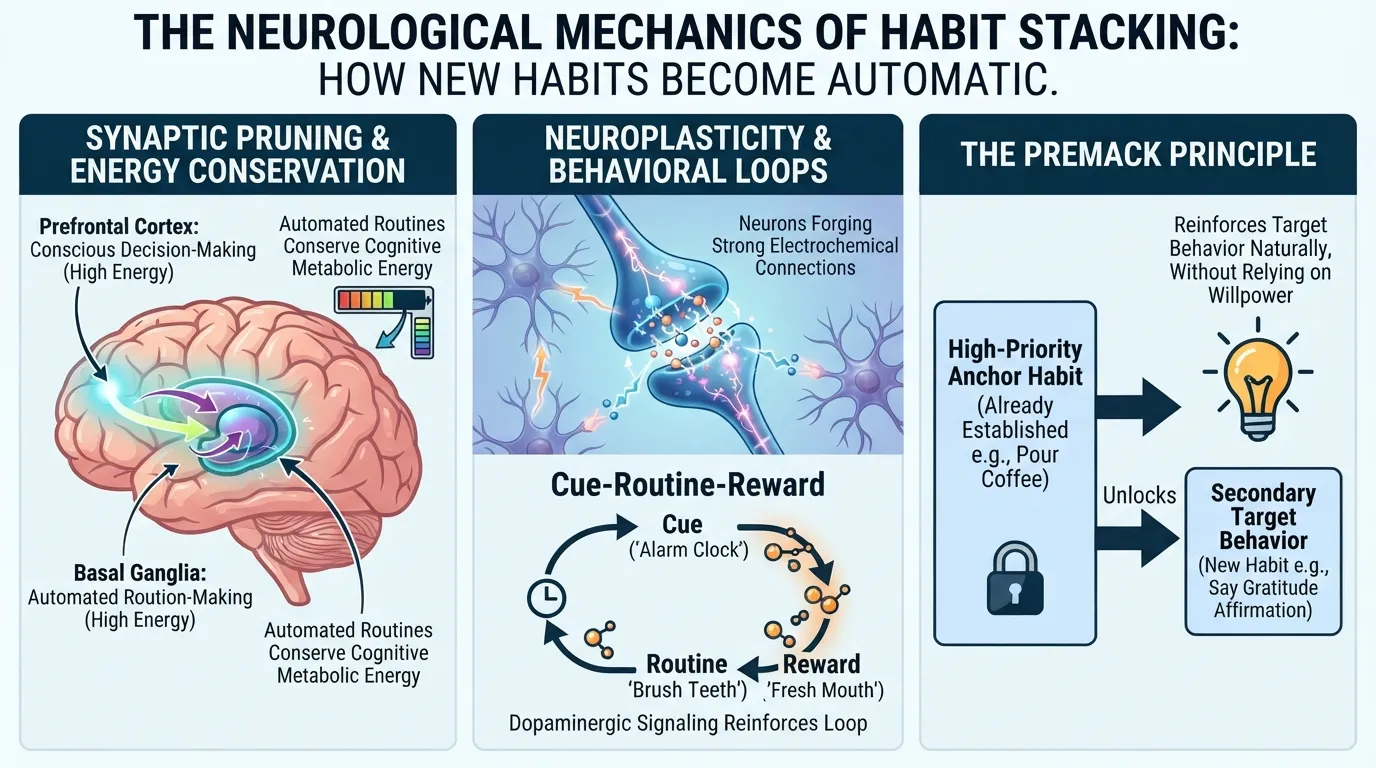
Habit stacking works because it bypasses the brain’s high-energy decision-making centers by hijacking established neural pathways. Grounded in behavioral neuroscience, this strategy transforms your daily routines into automated loops that require minimal cognitive bandwidth.
Synaptic Pruning and Brain Efficiency
The human brain constantly seeks ways to conserve energy by automating repetitive tasks through a process tied to neural optimization and synaptic pruning.
Energy Conservation: Conscious thought requires heavy metabolic fuel processed in the prefrontal cortex, which tires out quickly when faced with too many choices.
The Autopilot Shift: When you anchor a new behavior to an established action, the basal ganglia takes over, turning the sequence into a streamlined neurological “chunk”.
Friction Reduction: This structural shift reduces mental resistance, allowing complex multi-step routines to run smoothly in the background without wearing out your willpower.
Neuroplasticity and the Brain’s Linking Mechanism
Self-directed neuroplasticity allows the brain to physically rewire itself by forging new synaptic connections whenever patterns are repeated consistently.
Pathway Reinforcement: Every time your anchor habit triggers your new behavior, the electrical bond between those two distinct neurons strengthens.
Contextual Cues: The hippocampus uses environmental and situational context to map out exact firing sequences, ensuring the second habit fires automatically whenever the first concludes.
Dopaminergic Signaling: Successful execution triggers predictable bursts of dopamine, signaling the reward centers to cement the connection permanently.
The Premack Principle (Reward-Based Reinforcement)
Developed by psychologist David Premack, this behavioral principle states that a more desired behavior can serve as an effective reinforcement for a less desired behavior.
Behavioral Premise: By pairing a task you need to do immediately after a routine you already enjoy or execute routinely, you leverage natural behavioral momentum.
Incentive Architecture: The completion of the first stable habit functions as the psychological permission slip and immediate catalyst for the next.
Sustained Adherence: This framework removes the need for external rewards by turning the natural flow of your day into a self-sustaining cycle of productivity.
How to Create Your Own Habit Stack (Step-by-Step)
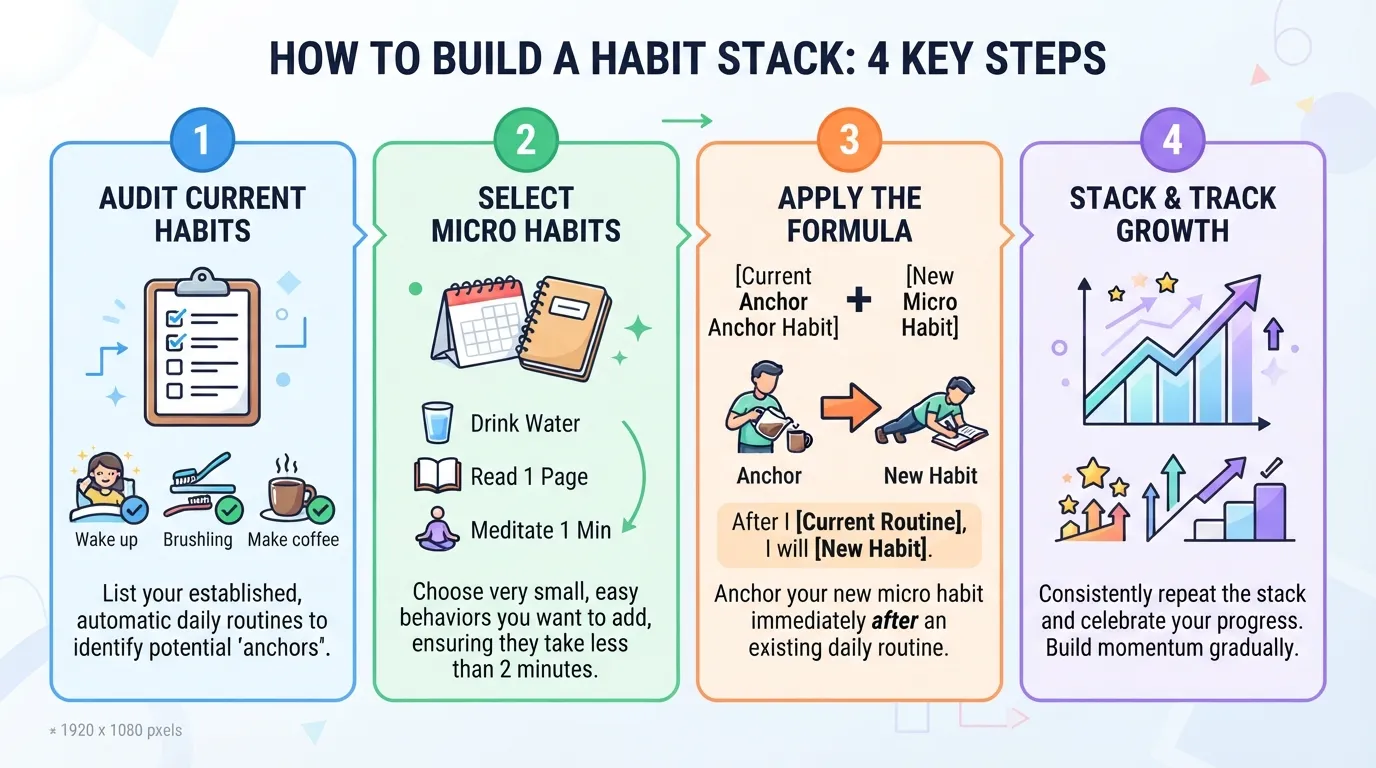
Creating an effective habit stack requires a systematic audit of your current routines and intentional matching. Follow these four practical steps to design a reliable framework that locks in new behaviors effortlessly.
Step 1 — List Your Current Daily Habits
Perform a Habit Audit: Write down every reliable action you complete every single day without fail to build your personal habit scorecard.
Identify Inflexible Anchors: Look for rock-solid anchors that happen at the exact same time, such as brewing morning coffee, brushing your teeth, or locking your front door.
Map Natural Transitions: Note the exact sequence of your morning, afternoon, and evening so you can pinpoint prime real estate for new additions.
Step 2 — List the New Habits You Want to Build
Brainstorm Target Behaviors: Write down every personal development, health, or productivity habit you want to integrate into your life.
Keep Actions Micro-Sized: Ensure each new target can be completed in two minutes or less to prevent immediate friction or burnout.
Filter by Intent: Focus on high-leverage habits that directly align with your long-term goals rather than trying to change everything at once.
Step 3 — Match the Right Cue to the Right Habit
Apply the Formula: Use the precise trigger structure by pairing your chosen anchor with your micro-habit: “After [Current Habit], I will [New Habit].”
Ensure Specificity: Match logical contexts, such as placing a vitamin bottle next to your coffee maker or keeping a journal directly on your pillow.
Eliminate Friction: Verify that the physical environment supports the transition so that executing the second habit requires zero preparation.
Step 4 — Start Small and Expand the Stack Gradually
Test One Stack at a Time: Focus on mastering a single habit stack for at least two weeks before attempting to build complex multi-step routines.
Layer Slowly: Once your primary stack feels completely automatic, add a subsequent habit to the end of the sequence.
Track Consistency: Monitor your daily execution and adjust your triggers if you find yourself skipping the new behavior consistently.
Habit Stacking Examples (By Category)
Applying the habit stacking formula across different areas of your life transforms vague intentions into automatic actions. These category-based examples illustrate how to link micro-habits to everyday anchors to drive consistent results.
Morning Routine Habit Stack Examples
Hydration Anchor: After I pour my morning cup of coffee, I will drink a full glass of water.
Mindfulness Anchor: After I finish brushing my teeth, I will sit in silence and take five deep breaths.
Movement Anchor: After I step out of the shower, I will do one minute of light stretching.
Evening Routine Habit Stack Examples
Digital Sunset Anchor: After I turn off my bedside lamp to sleep, I will leave my phone charging across the room.
Gratitude Anchor: After I slide into bed, I will mentally list three things that went well today.
Planning Anchor: After I place my alarm clock on my desk, I will write down my top three priorities for tomorrow.
Productivity Habit Stack Examples
Workspace Setup Anchor: After I sit down at my desk in the morning, I will clear all clutter and open only my primary work tab.
Email Management Anchor: After I finish my morning team check-in call, I will process my inbox for exactly fifteen minutes.
Task Review Anchor: After I close my laptop for lunch, I will review my daily checklist to track progress.
Health & Fitness Habit Stack Examples
Nutrition Anchor: After I unpack my groceries, I will wash and cut a portion of fresh vegetables for snacks.
Supplement Anchor: After I pour my post-workout protein shake, I will take my daily multi-vitamin.
Posture Anchor: After my office chair lowers into position, I will adjust my posture and tighten my core for thirty seconds.
Relationship & Social Habit Stack Examples
Appreciation Anchor: After I pour my partner’s morning tea, I will tell them one thing I appreciate about them today.
Check-In Anchor: After I park my car in the driveway after work, I will send a quick text message to check in on a close friend or family member.
Family Connection Anchor: After we sit down for dinner, everyone will share one highlight from their day before eating.
Finance Habit Stack Examples
Savings Anchor: After my paycheck is deposited on Friday, I will automatically transfer a fixed amount into my savings account.
Expense Tracking Anchor: After I buy groceries with my card, I will log the expense in my budgeting app immediately.
Review Anchor: After I pay my monthly utility bills, I will check my subscription dashboard to cancel unused services.
Habit Stacking for ADHD
Habit stacking offers a powerful framework for managing neurodivergent routines, but traditional implementation methods often clash with executive dysfunction. Tailoring the core concept to accommodate working memory limitations and dopamine-seeking behaviors turns rigid rules into an adaptable, ADHD-friendly system.
Why Habit Stacking Can Be Harder with ADHD
Working Memory Deficits: Remembering to execute the second step of a habit stack requires a level of active mental maintenance that easily slips away when distractions occur.
Variable Dopamine Baselines: Traditional routines can quickly trigger boredom, causing individuals to abandon reliable anchors once the novelty wears off.
Time Blindness: Difficulty perceiving the passage of time makes it challenging to accurately gauge how long a habit stack actually takes to complete.
ADHD-Friendly Adjustments to the Habit Stacking Method
Incorporate External Visual Cues: Place physical objects directly in your path—such as leaving your vitamins on top of your keyboard—so the environment triggers the action instead of your memory.
Build Novelty into the Stack: Rotate your secondary habits or switch up your environment occasionally to maintain dopamine engagement and prevent monotony.
Keep Stacks Incredibly Short: Limit your habit sequences to just two steps to prevent cognitive overload and ensure you experience the satisfaction of completion quickly.
Common Mistakes in Habit Stacking
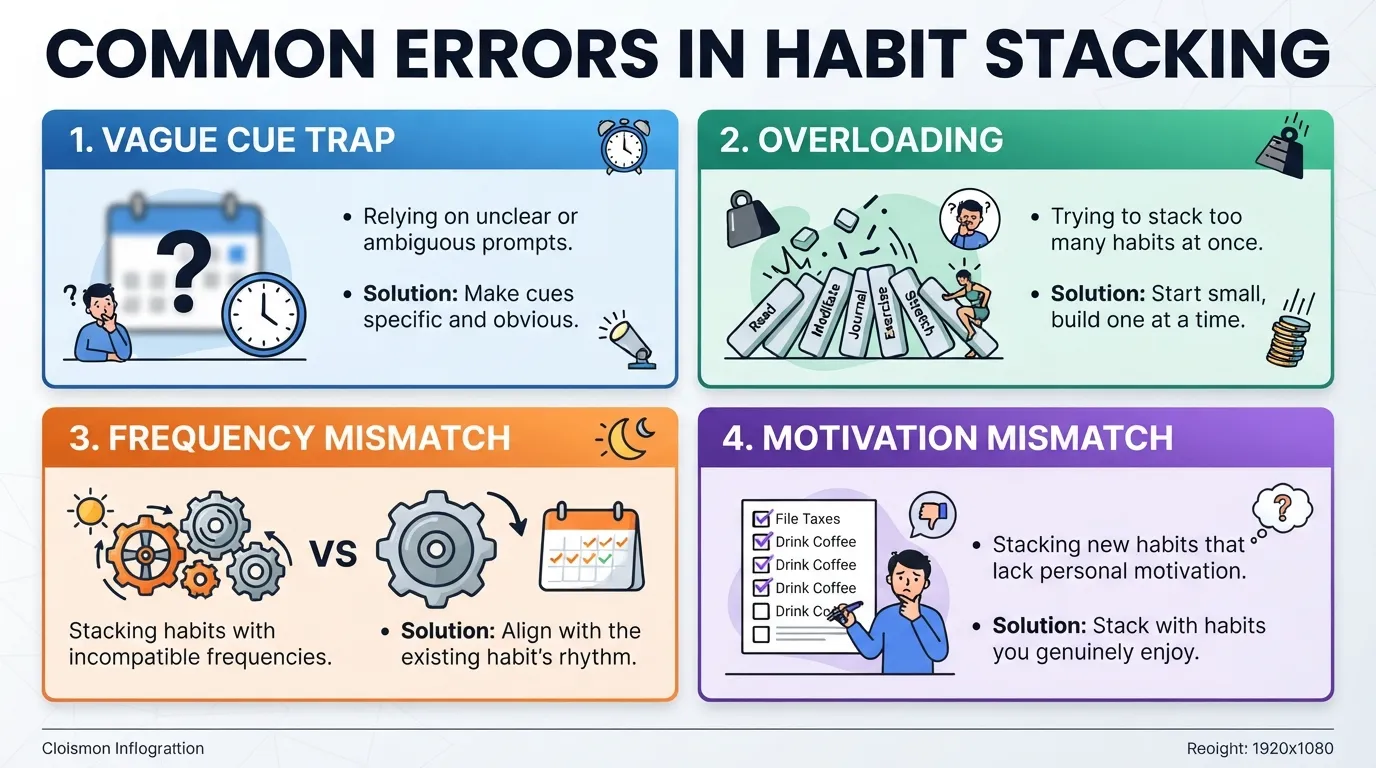
Habit stacking fails when practitioners skip foundational planning or attempt to force complex routines without adjusting their environment. Avoiding these frequent execution errors ensures your new behaviors stick long-term.
Choosing a Vague or Unclear Cue
The Trap: Using an ambiguous anchor like “After I get home” or “When I have a free moment” creates loopholes because the trigger lacks exact timing.
The Fix: Anchor your new behavior to an unyielding, specific physical action, such as “After I close my laptop at 5:00 PM.”
Why It Matters: Absolute clarity eliminates the mental hesitation of deciding when to execute the new habit.
Stacking Too Many Habits Too Soon
The Trap: Overloading a single morning routine with five or six new micro-habits causes immediate cognitive fatigue and total system collapse.
The Fix: Master a single two-step habit stack for at least two weeks before appending any additional actions to the sequence.
Why It Matters: Sustainable neurological conditioning requires incremental growth rather than overwhelming lifestyle overhauls.
Mismatching Habit Frequency (Daily vs. Weekly Cues)
The Trap: Trying to stack a weekly maintenance task onto a daily anchor—or vice versa—disrupts the predictable rhythm of your neural loops.
The Fix: Pair daily habits with daily anchors (like brushing your teeth) and weekly habits with weekly anchors (like taking out the trash).
Why It Matters: Consistency depends on contextual alignment; if the trigger doesn’t happen when the habit is due, the chain breaks instantly.
Picking a Habit You Don’t Actually Want to Do
The Trap: Forcing yourself into a productivity or fitness habit solely because it looks good on paper rather than aligning with your genuine values.
The Fix: Audit your target habits to ensure they directly serve a personal goal or bring intrinsic satisfaction.
Why It Matters: Resistance multiplies when you stack an unaligned behavior onto an anchor, making long-term adherence nearly impossible.
Habit Stacking Rules You Should Know (3-3-3 Rule & 21-90 Rule)
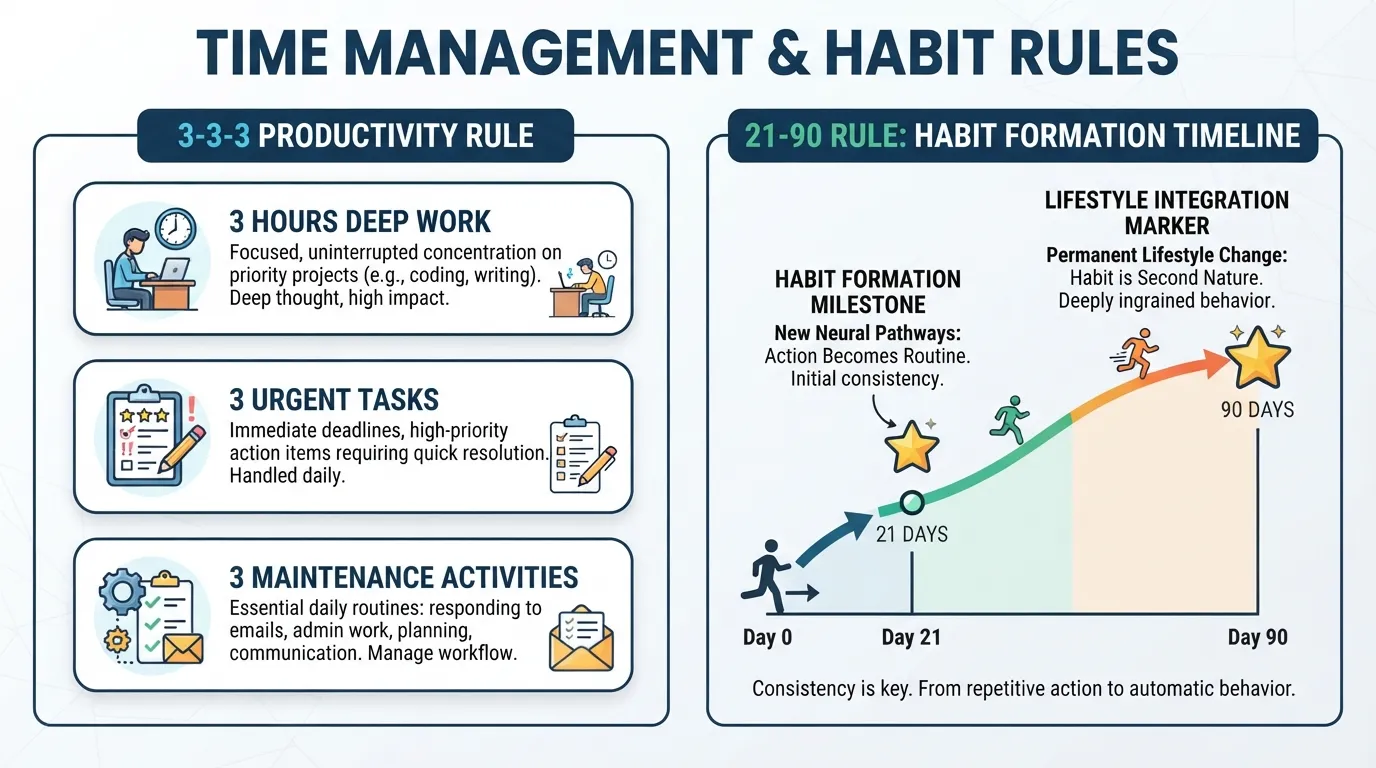
Mastering habit stacking goes beyond simple pairing formulas; it requires understanding structural frameworks that govern focus and time. Applying established productivity models like the 3-3-3 rule and the 21-90 rule optimizes your daily routines and prevents burnout.
What Is the 3-3-3 Rule for Habits?
The 3-3-3 rule is a prioritization framework designed to manage energy and prevent overwhelm when organizing daily goals. It structures your daily output into manageable tiers so you can focus your mental bandwidth efficiently.
3 Hours of Deep Work: Dedicate three uninterrupted hours to your single most important project or high-leverage task.
3 Urgent Tasks: Complete three secondary tasks that require immediate attention but do not demand deep creative focus.
3 Maintenance Activities: Handle three routine administrative or organizational chores to keep your daily operations running smoothly.
What Is the 21-90 Habit Rule?
The 21-90 rule outlines the general timeline required to transition a conscious behavior into an automatic, subconscious lifestyle change. While individual timelines vary based on complexity, this dual-phase milestone marker tracks mental adaptation.
21 Days to Form a New Habit: It takes roughly three weeks of consistent daily repetition for a new behavior to become familiar and lose its initial resistance.
90 Days to Form a Lifestyle: Committing to the routine for 90 consecutive days embeds the behavior into your core identity, making it a permanent part of who you are.
The Reality of Neuroplasticity: Research shows actual habit formation can take anywhere from 18 to 254 days, making the 90-day benchmark a reliable average for long-term retention.
How These Rules Combine with Habit Stacking
Structural Synergy: Use the 3-3-3 rule to decide what tasks belong in your habit stacks, ensuring you focus on high-impact priorities rather than trivial busywork.
Timeline Patience: Apply the 21-90 rule to set realistic expectations, understanding that your habit stack needs at least three weeks of unbroken execution before it feels natural.
Compounding Success: Pairing these time-tested frameworks with cue-based habit stacking transforms sporadic motivation into a predictable, automated system for personal growth.
Bedtime Stacking (A Specific Habit Stack Variation)

Bedtime stacking is a specialized variation of habit stacking designed to systematically transition your brain and body from high alert into deep, restorative sleep. By linking a sequence of relaxing cues to your nightly wind-down routine, you eliminate late-night friction and build foolproof sleep hygiene.
What Is Bedtime Stacking?
Bedtime stacking involves chaining a series of low-stimulus nighttime habits together using your final evening actions as reliable triggers.
The Core Mechanism: Just like morning stacking, you use the “After [Current Habit], I will [New Habit]” formula, but anchor every action to the end of your day.
Circadian Signaling: This sequence sends powerful hormonal and neurological signals to your body that it is time to lower cortisol and produce melatonin.
Decision Fatigue Elimination: Establishing an automated evening loop prevents you from mindlessly scrolling on your phone or skipping essential skincare and prep tasks.
Sample Bedtime Habit Stack
Digital Sunset Anchor: After I plug my phone into its charger across the room, I will turn off my overhead lights and switch on my bedside reading lamp.
Skincare Anchor: After I finish brushing my teeth for bed, I will immediately apply my nighttime moisturizer and lip balm.
Mindfulness Anchor: After I slide under the covers, I will read five pages of a physical book.
Sleep Anchor: After I close my book on the nightstand, I will practice three slow, deep belly breaths before closing my eyes.
Habit Trackers — Best Methods and Common Mistakes
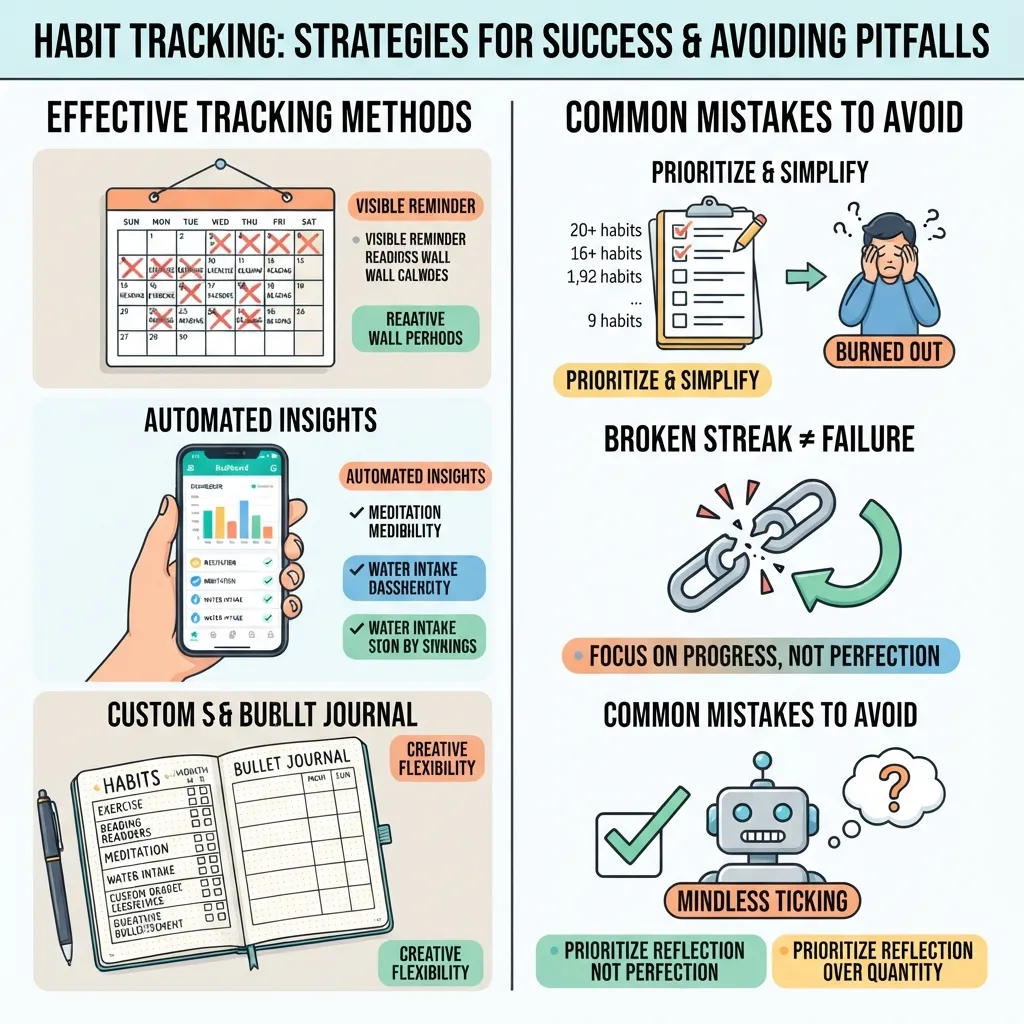
Habit trackers provide the crucial visual feedback needed to maintain momentum, validate your daily consistency, and prevent broken chains. Choosing the right tracking medium and avoiding common tracking traps ensures your habit stacks remain sustainable rather than stressful.
Best Habit Tracking Methods (Checklist, App, Journal)
The Paper Checklist (Visual Wall Calendar): Hanging a physical monthly calendar on your wall and drawing a bold red “X” over completed days leverages the satisfaction of visual completion and keeps triggers top-of-mind.
Dedicated Habit Tracking Apps: Mobile tools like Streaks or Habitica send automated notifications and generate digital analytics, making them ideal for tracking multi-step routines on the go.
The Bullet Journal / Habit Log: Drawing a custom grid inside a daily notebook allows you to monitor your habit stacks alongside your regular daily to-do lists and reflections.
Common Mistakes People Make with Habit Trackers
Becoming Obsessed with Streaks: Letting a broken streak ruin your motivation often leads to complete abandonment of the habit stack; view a missed day as a statistical outlier rather than a failure.
Tracking Too Many Metrics: Monitoring twenty different daily habits creates administrative burnout, turning your habit tracker into a stressful chore instead of a helpful guide.
Using the Tracker as the Habit: Merely checking off a box without actually reflecting on the quality or consistency of the execution defeats the purpose of behavioral change.
Does Habit Stacking Actually Work? (Honest, Balanced Take)
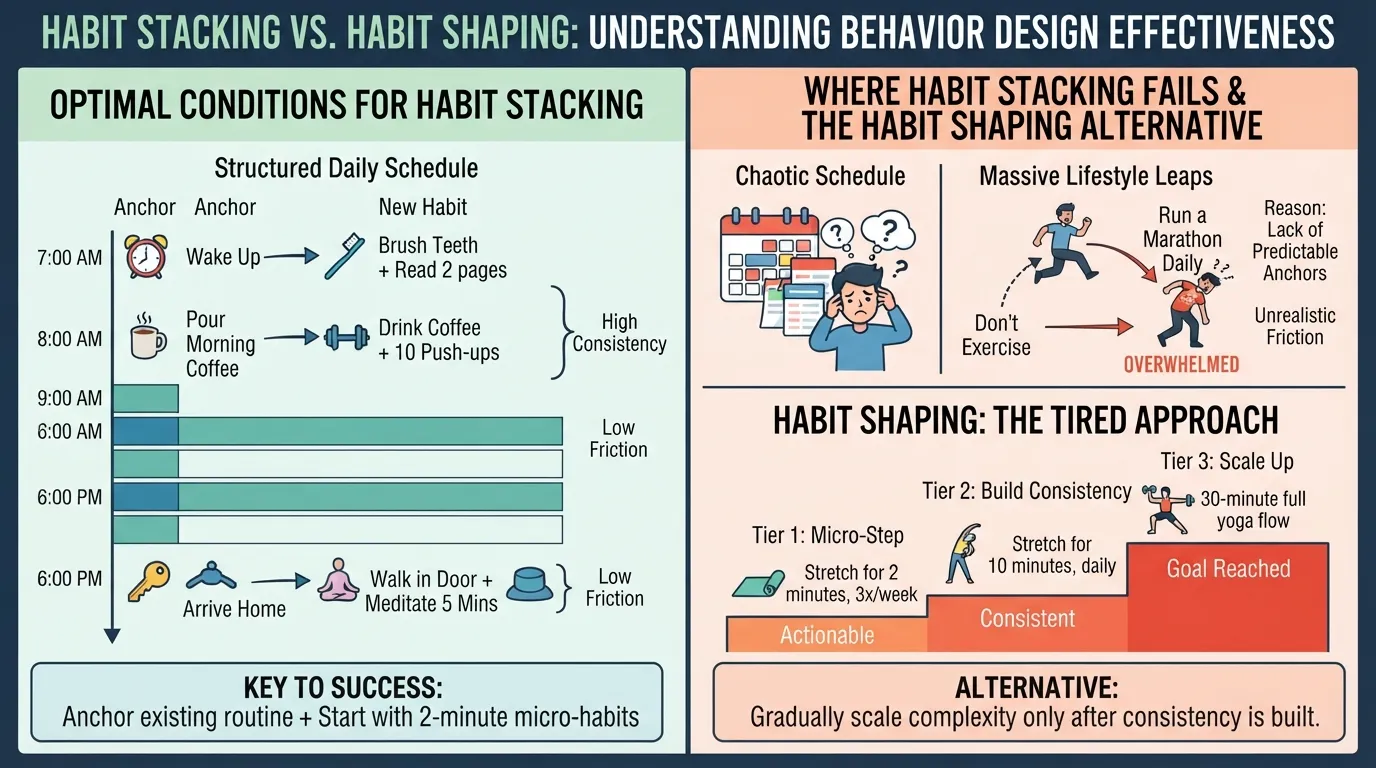
Habit stacking is not a magic fix, but a scientifically grounded behavioral strategy that succeeds when applied with realistic expectations and clear environmental design. It works exceptionally well for cementing small, incremental changes, but it is not a cure-all for deep-seated motivational resistance or chaotic daily schedules.
When Habit Stacking Works Best
Clear Environmental Cues: It thrives when your anchor habits are fixed, predictable, and happen at the exact same time every single day without fail.
Micro-Sized Behaviors: It delivers maximum results when the new habit takes less than two minutes to complete, keeping initial friction virtually nonexistent.
Established Routines: It bridges the gap effortlessly if you already possess a consistent baseline of daily structure that can absorb new micro-actions.
When Habit Stacking Doesn’t Work (And What to Try Instead — Shaping)
Chaotic Schedules: If your daily routine changes entirely every single day, you lack the reliable anchor habits required to trigger the stack.
Massive Behavioral Leaps: Trying to stack a thirty-minute workout onto a two-minute coffee routine creates immediate resistance because the new task is too heavy.
The Solution — Habit Shaping: When a stack fails due to mismatched difficulty, use habit shaping by breaking the target behavior down into progressively larger micro-steps until your baseline capacity catches up.
What Does James Clear Say About Habit Stacking? (Direct Attribution Section)
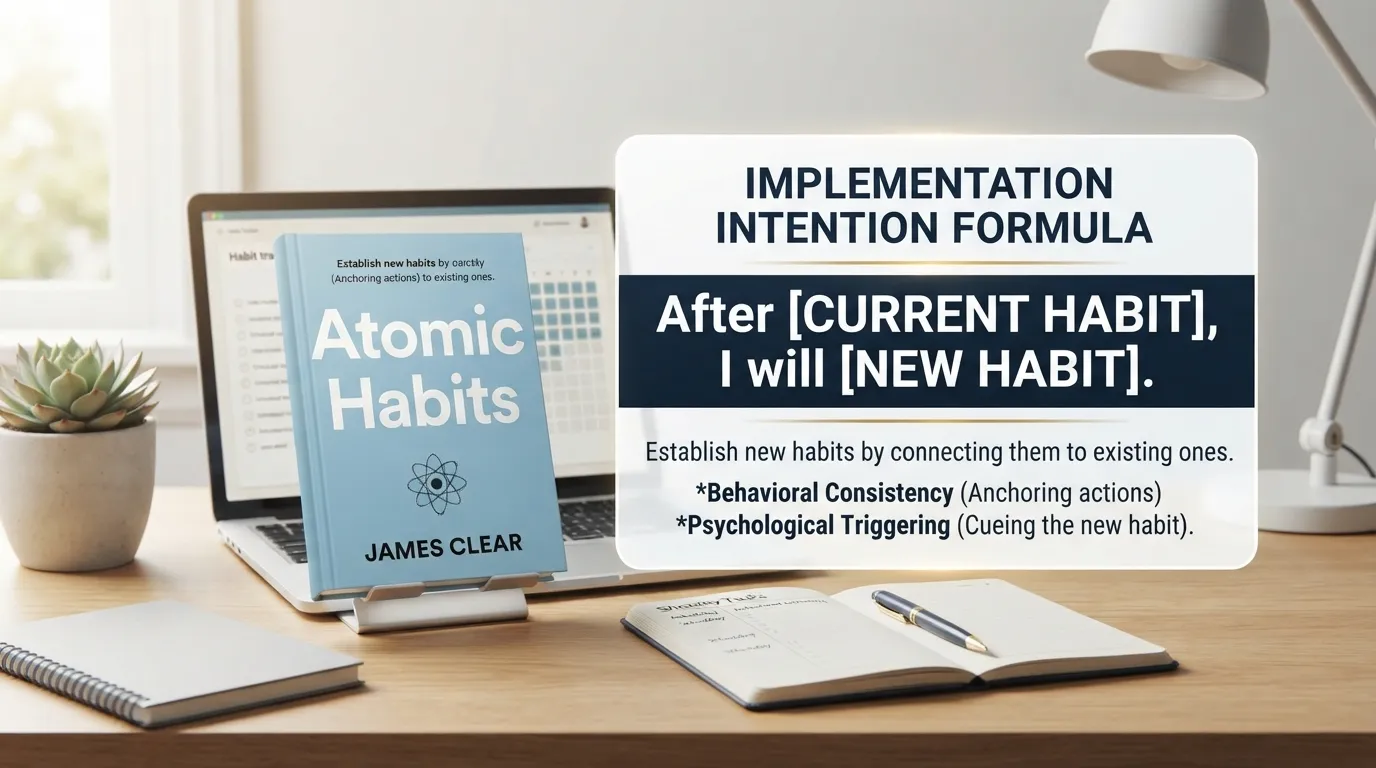
James Clear states that habit stacking is one of the most successful ways to build a new habit because it integrates seamlessly into your existing life without requiring a complete schedule overhaul. In Atomic Habits, he explains that your current habits are already wired into your brain, making them reliable triggers for implementation intentions. By explicitly defining the connection through the formula “After [Current Habit], I will [New Habit],” you remove the friction of relying on motivation and let your established routines do the heavy lifting. Clear emphasizes that success relies on choosing an anchor habit that happens with absolute consistency and keeping the new behavior small enough to execute without resistance.
Frequently Asked Questions
Can habit stacking help with weight loss or fitness goals?
Habit stacking provides a reliable behavioral framework to integrate health and fitness targets into your daily schedule. By anchoring small, manageable actions like doing five push-ups after brushing your teeth or packing gym clothes before bed, you remove the friction that causes fitness goals to fail.
How many habits should be in one stack?
Beginners should stick to a single, two-step habit stack to ensure high execution rates. Once that initial sequence becomes fully automatic, you can gradually append subsequent actions, though keeping total stacks to three or fewer prevents cognitive overload.
Can you habit stack with a habit that isn’t daily?
Non-daily habits can be successfully stacked by pairing them with weekly or occasional anchor routines. For example, you can anchor a weekly financial review to the moment you pay your monthly utility bills or take out the trash on Sunday nights.
What happens if you miss a day in your habit stack?
Missing a single day breaks the neurological chain temporarily, but it does not erase your baseline progress. The key is to treat a missed day as a statistical outlier rather than a failure, and simply resume your anchor routine on the following morning.
How long does it take for a habit stack to feel automatic?
Research shows that forming a completely automated habit takes anywhere from 18 to 254 days, with an average of about 66 days for most people. Committing to a consistent 21-day initial window helps establish familiarity before the routine integrates permanently into your lifestyle.
Conclusion — Key Takeaways
Habit stacking transforms personal growth from a battle of willpower into an automated system by anchoring new behaviors directly to your established daily routines. By leveraging the formula “After [Current Habit], I will [New Habit],” you remove the friction of decision fatigue and utilize existing neural pathways for effortless consistency.
Starting small and mastering a single two-step stack creates the momentum needed for long-term behavioral change. Choose one reliable anchor today, pair it with a micro-sized habit you actually want to do, and let your daily routine handle the heavy lifting.
Mark Steve
Mark Steve is a tech, business, and lifestyle writer with over 5 years of experience analyzing digital trends, startups, and online business models. He publishes well-researched, fact-checked content focused on clarity, credibility, and real-world value.