How to Study in College When You Feel Lost or Stuck: A Discipline-First Guide

How to Study in College When You Feel Lost or Stuck
Feeling completely lost or stuck in college is a universal experience, yet it is rarely addressed by standard academic advice. When academic burnout, choice paralysis, and sheer overwhelm take over, waiting around for inspiration or motivation will only lead to further procrastination. True academic turnaround does not begin with a better highlighter; it starts with building reliable behavioral systems and psychological discipline.
Why Most Study Tips Don’t Work Long-Term
Traditional study advice almost exclusively relies on short-term motivation and superficial productivity hacks that fail the moment emotional exhaustion sets in. When you are genuinely stuck, tips like “just use the Pomodoro technique” or “make a pretty color-coded schedule” ignore the root cause of your academic paralysis.
The Motivation Trap: Motivation is a volatile emotional state rather than a sustainable fuel source for long-term academic success.
Flawed Mechanics: Most advice treats studying as a passive information-gathering task instead of an active cognitive workout.
Neglected Mental States: Standard tips completely fail to account for severe burnout, choice paralysis, and the anxiety of feeling academically behind.
Sustainable progress requires shifting away from fleeting bursts of inspiration and moving toward disciplined execution. By establishing a reliable study routine, you remove the daily friction of deciding how or when to work, making academic progress automatic even on low-energy days.
What This Guide Will Cover
This guide bypasses generic productivity fluff to give you an actionable, discipline-first roadmap designed for students who feel completely overwhelmed. We will break down psychological barriers and replace them with concrete operational steps to help you regain absolute control over your academic trajectory.
Root Cause Diagnosis: How to pinpoint whether your academic block stems from poor study technique, burnout, or deep-seated major misalignment.
Discipline Frameworks: Step-by-step methods to build an unbreakable study routine that functions smoothly regardless of your current motivation levels.
Cognitive Re-engagement: Practical strategies to re-engage with complex material when you are severely behind and don’t know where to start.
By the end of this resource, you will possess a clear blueprint to transform erratic study habits into structured, consistent momentum. Let’s dismantle the overwhelm and build a practical foundation that actually works for your college career.
Why Studying Feels Hard — The Real Problem Isn't Technique

Struggling in college is rarely a reflection of your intelligence or your capacity to learn new material. When studying feels impossible, the underlying culprit is almost always a flawed approach to emotional regulation, structural fatigue, or mismanaged cognitive load rather than a simple lack of effort.
The Motivation Trap: Why Willpower Alone Fails
Relying entirely on motivation to drive your academic habits is a guaranteed recipe for cyclical burnout and repeated failure. Motivation is a fleeting emotional byproduct, meaning it naturally fluctuates based on stress, sleep, and external pressures.
The Volatility Risk: Waiting to feel inspired means you will only study when things are easy, abandoning your books the moment stress spikes.
Decision Fatigue: Constantly negotiating with yourself about when to open your laptop drains vital cognitive resources before you even start reading.
The Discipline Alternative: High-performing students do not rely on hype; they rely on automated systems and disciplined routines that bypass feelings entirely.
True academic consistency means showing up for your coursework even when every fiber of your being wants to quit. Shifting your mindset away from waiting for inspiration allows you to build a resilient study routine that protects your GPA on your worst days.
Procrastination vs. Lack of Discipline (The Real Difference)
Many students heavily misdiagnose their avoidance behaviors, mistakenly punishing themselves for being “lazy” when they are actually paralyzed by psychological friction. Understanding the precise boundary between procrastination and discipline is vital for fixing the root cause.
Procrastination as Emotional Regulation: Procrastination is rarely a time-management issue; it is a coping mechanism for anxiety, perfectionism, and fear of failure.
Discipline as Friction Reduction: True discipline focuses on lowering the barrier to entry so that starting a complex task requires minimal emotional bandwidth.
The Diagnostic Shift: Treating an emotional avoidance problem with a strict calendar template will fail, just as treating a skill gap with positive thinking will yield zero results.
Recognizing why you are avoiding your coursework helps you stop the cycle of guilt-induced paralysis. Instead of beating yourself up, you can reframe your study habits to address the underlying emotional resistance head-on.
What Can I Do to Help With Studying?
Breaking free from chronic academic stagnation requires replacing vague intentions with concrete, micro-level behavioral interventions. When you feel completely stuck, the most effective step is shrinking the scope of your work until it feels psychologically safe to begin.
Lower the Activation Energy: Commit to opening your textbook or reading a single paragraph for just five minutes to bypass initial resistance.
Audit Your Environment: Remove digital and physical distractions from your workspace to eliminate unnecessary decision-making during study blocks.
Anchor Your Habits: Attach your study sessions to an existing daily trigger, such as sitting down at your desk immediately after your morning coffee.
Implementing these structural changes transforms studying from an overwhelming chore into a predictable, manageable daily routine. Taking small, consistent actions rebuilds your self-efficacy and gets your academic momentum moving forward again.
Building a Study Discipline System
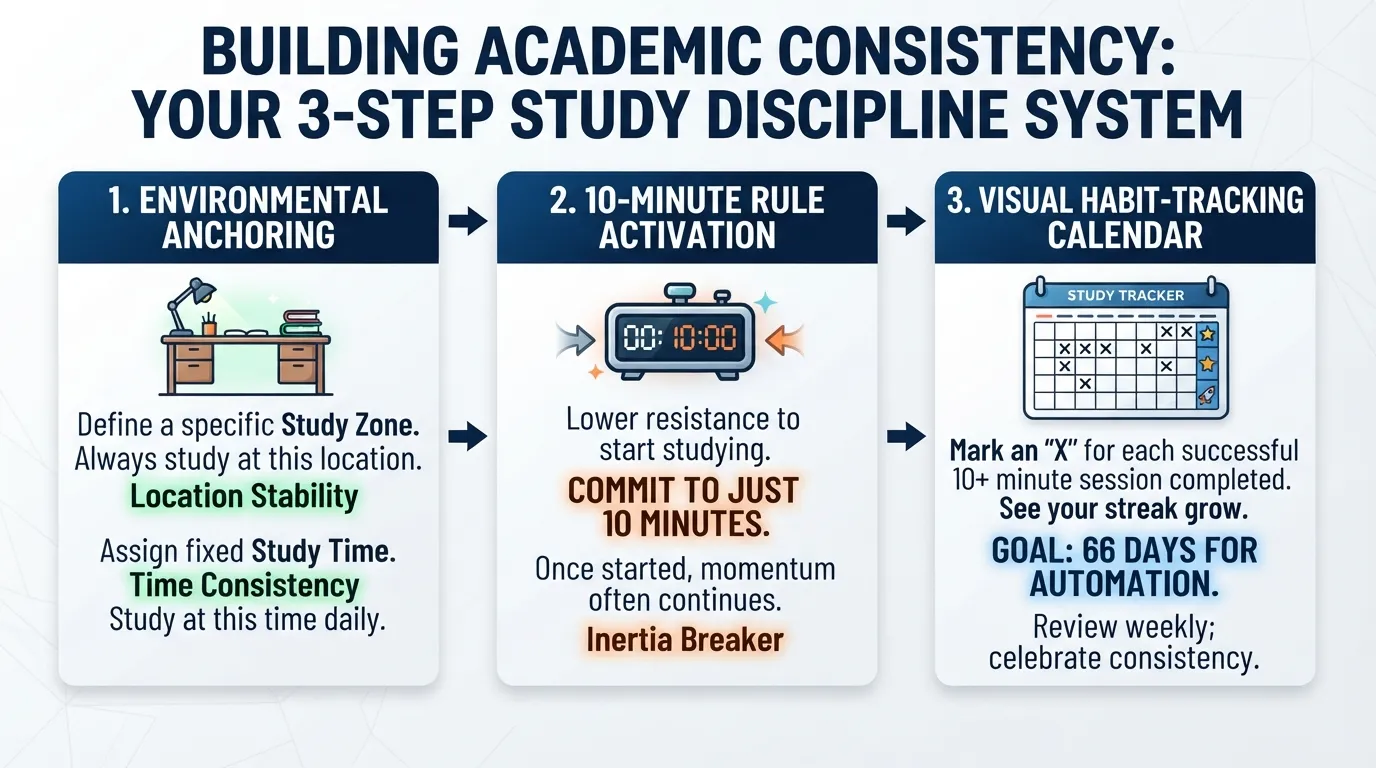
Transforming your academic performance requires replacing chaotic study habits with an intentional, systematic discipline framework. When you build a reliable structure, you eliminate the daily mental debate of whether or not you should open your books.
Step 1: Set a Fixed Study Trigger (Time/Place Anchoring)
Establishing a consistent time and dedicated physical location creates a powerful neurological cue that signals your brain it is time to work. Relying on random pockets of free time throughout the day guarantees high friction and constant procrastination.
Environmental Conditioning: Designate a specific workspace—like a quiet corner of the library or a clean desk—exclusively for studying to build deep focus associations.
Contextual Anchoring: Pair your study sessions with an existing daily habit, such as sitting down at your desk immediately after lunch or right after your morning class.
Predictable Scheduling: Lock in consistent time blocks on your calendar so your mind prepares for the workload well in advance.
Step 2: Start With a 10-Minute Rule to Beat Resistance
The hardest part of any study session is the initial transition from resting to executing complex cognitive tasks. Committing to a massive three-hour block triggers anxiety and avoidance, whereas shrinking your initial commitment completely bypasses that mental block.
Micro-Commitments: Tell yourself you only need to read, write, or review material for ten minutes without any pressure to finish the assignment.
Momentum Generation: Overcoming the initial activation energy almost always makes it easy to continue working long past your initial ten-minute mark.
Reduced Stakes: Lowering the emotional barrier prevents perfectionism from paralyzing you before you even write your first sentence.
Step 3: Track Consistency, Not Perfection
Many students abandon their study routine entirely the moment they miss a single day or fail to hit an unrealistic daily goal. True discipline is built on long-term aggregate consistency rather than flawless execution across every single week.
Visual Accountability: Use a physical habit tracker or calendar to check off each day you successfully execute your study routine.
Graceful Recovery: Treat a missed study session as a minor data point rather than a catastrophic failure that ruins your progress.
Focus on Input: Measure your success by whether you showed up and put in the designated effort, regardless of how fast you completed the material.
Real Example: When engineering student Marcus felt completely overwhelmed and burnt out, he stopped trying to study for four hours a day. Instead, he anchored a strict 25-minute focus block to his daily 4:00 PM routine using the 10-minute rule. By lowering the stakes and tracking his daily streaks rather than his grades, his follow-through skyrocketed, and his GPA rebounded within a single semester.
Proven Study Techniques That Actually Work
Mastering academic success requires moving far beyond passive study habits like rereading notes or highlighting textbooks. Research-backed cognitive strategies force your brain to struggle productively, transforming temporary exposure into long-term neural retention.
Active Recall: How to Test Yourself the Right Way
Active recall requires forcing your brain to retrieve information from memory rather than passively reviewing an already printed page. Rereading creates an illusion of competence, tricking you into believing you know material that will vanish during an exam.
The Retrieval Mechanism: Close your textbook and write down everything you can remember about a concept from scratch [04:30].
Embrace the Struggle: Getting answers wrong during self-testing highlights critical knowledge gaps and strengthens neural pathways when you correct them [07:27].
Peer Teaching: Explain complex lecture topics out loud to a classmate, exposing weaknesses in your own understanding [08:15].
Spaced Practice: How to Actually Schedule It
Cramming an entire semester’s worth of material into a single night relies on short-term memory storage that evaporates almost immediately after the test. Spaced practice forces you to revisit information at gradually increasing intervals, interrupting the natural forgetting curve.
Distributed Timelines: Review a specific topic on Day 1, Day 3, Day 7, and Day 14 rather than studying it continuously for four hours straight.
Micro-Pauses: Integrate brief 10-to-30-second silent micro-breaks during study blocks to allow your hippocampus to rapidly replay and consolidate information [08:51].
Calendar Integration: Map out your review sessions across multiple weeks so your preparation happens automatically without last-minute panic.
Elaborative Questioning: Asking “Why” and “How” to Retain Concepts
Memorizing isolated definitions without understanding their underlying mechanisms makes it impossible to apply knowledge to complex exam questions. Elaborative questioning connects new information to concepts you already understand, anchoring ideas deeply into your long-term memory.
The Feynman Approach: Ask yourself why a specific process works and explain it in plain, simple language as if teaching a beginner.
Contextual Bridging: Connect theoretical course concepts directly to real-world applications or personal experiences.
Root-Cause Interrogation: Challenge every bullet point in your notes by asking how and why it happens instead of accepting it at face value.
Common Mistakes Students Make With These Techniques
Implementing high-impact study methods incorrectly can lead to frustration and premature abandonment of your new routine. Avoiding these major pitfalls ensures your time investment yields maximum academic returns.
Confusing Volume with Depth: Spending hours rereading a chapter feels productive, but it generates zero long-term retention compared to twenty minutes of active self-testing [05:37].
Avoiding Initial Failure: Stopping a practice test the moment you get a question wrong prevents you from discovering the correct answer and learning from the mistake [07:27].
Inconsistent Spacing: Treating spaced repetition as a random event instead of a scheduled system causes intervals to stretch out too far, forcing you to relearn the material from scratch.
Study Frameworks Explained: 1-3-5-7 Rule and 3-2-1 Method
Structuring your long-term study schedule with proven cognitive frameworks eliminates the guesswork of exam preparation. Instead of relying on ad-hoc review sessions, structured scheduling systems utilize spaced repetition intervals to lock complex concepts directly into your long-term memory.
What Is the 1-3-5-7 Rule for Studying?
The 1-3-5-7 rule is a cumulative spaced repetition framework designed to combat the natural human forgetting curve. By spacing out your reviews over specific day intervals, you force your brain to reconstruct memories just as they begin to fade.
Day 1 (Initial Encoding): Learn the new material for the first time, take raw notes, and immediately test your recall to identify knowledge gaps.
Day 3 (First Reinforcement): Revisit the material 48 hours later using active self-testing instead of passive rereading to strengthen the neural pathway.
Day 5 to 7 (Long-Term Consolidation): Conduct subsequent review sessions at the five-day and seven-day marks to cement the information before it enters long-term storage.
What Is the 3-2-1 Method for Studying?
The 3-2-1 method provides a rapid, high-intensity review structure designed to synthesize dense reading material or lecture notes into concise conceptual anchors. This framework forces active mental processing rather than passive text scanning.
3 Key Takeaways: Distill a textbook chapter or lecture into three core concepts written entirely in your own words.
2 Real-World Examples: Create two distinct, concrete examples or practical applications for the concepts to anchor abstract theories.
1 Linguring Question: Formulate one remaining question or core uncertainty about the material to investigate during your next study block.
Which One Should You Use? (Comparison Based on Subject Type)
Choosing between structured frameworks depends entirely on the nature of your coursework and the types of exams you are preparing to take. Matching the framework to your subject matter maximizes your study efficiency.
Use the 1-3-5-7 Rule for Heavy Memorization: Best suited for content-dense subjects like biology, law, or history that require long-term retention of massive volumes of factual data.
Use the 3-2-1 Method for Conceptual Synthesis: Ideal for analytical or problem-solving subjects like economics, coding, or philosophy where understanding underlying principles matters more than rote memorization.
Combine Both for Ultimate Mastery: Apply the 3-2-1 method immediately after a lecture to capture core concepts, then map those takeaways onto a 1-3-5-7 schedule for long-term exam prep.
Best Digital Tools to Support Your Study Routine
Navigating college coursework efficiently requires leveraging the right software to automate your review schedules and organize dense information. Rather than getting bogged down by endless productivity apps, integrating a few targeted platforms into your daily routine can dramatically reduce your preparation time. For additional evidence-based strategies on optimizing your academic workflow, consult the UNC Learning Center Study Smarter Guide {.external} to validate your study techniques.
Quizlet — Best for Flashcards and Quick Review
Quizlet remains an industry standard for digital flashcard creation, making it ideal for rapid vocabulary memorization and definition drills. Its accessibility across mobile and desktop devices allows you to utilize dead time—like waiting for class or riding the bus—for quick active recall sessions.
Pre-Made Decompositions: Access millions of user-generated flashcard decks for common college courses to jumpstart your review process.
Learn Mode Adaptive Algorithm: Dynamically adjusts question difficulty based on your previous answers to target your specific knowledge gaps.
Collaborative Deck Building: Share study sets with classmates to divide the workload of summarizing dense textbook chapters.
StudyFetch — Best for Turning Lectures Into Practice Quizzes
StudyFetch uses AI-driven architecture to convert passive lecture recordings, slide decks, and heavy PDFs into interactive practice materials instantly. This platform bridges the gap between raw note-taking and active self-testing without requiring hours of manual flashcard creation.
Instant Practice Exams: Automatically generates custom multiple-choice tests directly from your uploaded syllabus and lecture transcripts.
AI Tutor Integration: Provides real-time explanations and chat-based guidance when you encounter complex problem sets or confusing theories.
Automated Note Summarization: Compresses hours of recorded lectures into clean, scannable study outlines.
Google NotebookLM — Best for Summarizing and Organizing Notes
Google NotebookLM acts as a personalized, AI-powered knowledge base that grounds all generated summaries strictly in your uploaded source materials. This makes it an invaluable tool for synthesizing research papers, lecture notes, and long-form reading assignments into cohesive conceptual maps.
Source-Grounded Answers: Eliminates hallucinations by pulling summaries, study guides, and cross-references exclusively from your uploaded documents.
Audio Overview Generation: Converts your notes into engaging conversational audio discussions to help auditory learners reinforce core concepts on the go.
Cross-Document Synthesis: Connects disparate themes across multiple lecture notes and PDFs to highlight overarching course patterns.
StudySmarter — Best for Managing PDFs and Flashcards Together
StudySmarter combines comprehensive document annotation tools with robust flashcard creation and time-management features into a single workspace. It is particularly useful for students who want to annotate digital textbooks while simultaneously building an active recall library.
All-in-One Workspace: Annotate PDFs, highlight key definitions, and convert highlighted passages directly into flashcards without switching apps.
Automated Study Plans: Generates custom revision schedules based on your exam dates and current mastery levels across different topics.
Progress Analytics: Tracks your daily study hours, correct answer percentages, and topic completion rates visually to maintain accountability.
Which Tool Fits Your Study Style? (Quick Decision Guide)
Selecting the right software depends entirely on your primary bottleneck—whether you struggle with active recall, organizing research, or generating practice material from lectures. Matching your workflow to the right platform maximizes your technological efficiency.
Choose Quizlet if you need a lightweight, dedicated flashcard app primarily for vocabulary drills and quick definitions.
Choose StudyFetch if your biggest challenge is converting raw lecture audio and slides into interactive practice quizzes.
Choose Google NotebookLM if you manage massive amounts of reading material and need reliable, source-grounded summaries and study guides.
Choose StudySmarter if you want an all-in-one platform to annotate course PDFs and manage your flashcards simultaneously.
How to Study in College Specifically

Transitioning to college academics demands a complete overhaul of your cognitive approach, as the comfortable safety nets of high school supervision disappear entirely. Succeeding as a college student requires mastering self-directed learning, managing massive reading volumes, and navigating vast blocks of unstructured free time without falling behind.
The Biggest Difference Between High School and College Studying
In high school, academic success is often driven by frequent homework checks, daily attendance rules, and teachers who actively guide you through the material. College completely flips this dynamic by shifting the entire burden of accountability onto your shoulders.
Explosive Volume Increases: A single college lecture can cover as much conceptual ground as an entire month of high school curriculum.
Drastically Reduced Contact Hours: You spend only a fraction of your week inside a physical classroom, leaving massive blocks of unsupervised time that easily breed chronic procrastination.
Autonomy in Assessment: Professors rarely check if you did the assigned readings, meaning the consequences of skipping prep work only surface as sudden, failing exam grades.
Adapting to this environment requires recognizing that university professors expect you to learn independently rather than just memorizing facts for a Friday quiz. Building strong self-discipline becomes your primary non-negotiable requirement for academic survival.
How to Build Independence Without Losing Structure
Because college schedules are wide open, trying to study “whenever you have free time” is a guaranteed recipe for chaos and burnout. True independent learning relies on artificially engineering your own structure to mimic a disciplined professional routine.
Treat Classes Like a 9-to-5 Job: Fill the empty hours between morning and afternoon lectures with dedicated study blocks in the library instead of returning to your dorm room bed.
Pre-Plan Your Weekly Milestones: Map out your reading assignments and problem sets on a calendar every Sunday night so your daily tasks are predetermined.
Establish Environmental Boundaries: Separate your rest spaces from your work spaces entirely, ensuring your brain associates your desk exclusively with deep cognitive effort.
Balancing Study Time With College Life
Trying to achieve a pristine GPA while maintaining a vibrant social life, campus clubs, and part-time commitments creates intense friction for most undergraduates. Sustainable college studying is not about locking yourself in a room forever; it is about ruthless prioritization and ruthless efficiency.
Adopt the Two-Hour Rule: Plan for roughly two hours of independent study outside of class for every single credit hour you take each semester.
Protect Your Sleep Architecture: Sacrificing sleep for a late-night cram session destroys your memory consolidation, reducing your focus and cognitive capacity in class the next day.
Batch Your Social Commitments: Schedule your social activities and extracurriculars as fixed calendar events rather than letting them bleed into and disrupt your planned study blocks.
When Focus Itself Is the Problem

Maintaining continuous concentration during demanding study sessions is one of the most significant hurdles college students face. When your mind constantly drifts, sitting in front of a textbook for hours yields frustratingly little progress, making even basic academic tasks feel exhausting.
Does ADHD Make It Harder to Study?
Attention-related challenges can significantly impact how an individual processes, organizes, and retains complex academic material. While focus difficulty affects many students for various reasons, neurodivergent conditions like ADHD present unique structural hurdles to traditional learning environments.
Executive Function Friction: Managing long-term projects, prioritizing competing deadlines, and initiating tasks require significant mental effort when executive functioning is strained.
Variable Attention Span: Concentration may fluctuate dramatically, making it easy to hyperfocus on engaging subjects while struggling to maintain attention on drier reading assignments.
Working Memory Overload: Retaining multi-step instructions or holding complex formulas in mind while solving a problem can quickly deplete cognitive energy.
Study Strategies That Help With Focus Difficulty
Overcoming focus challenges requires tailoring your environment and study habits to work with your brain’s natural tendencies rather than fighting against them. Implementing low-friction, high-engagement techniques helps sustain attention through demanding coursework.
Use Body Doubling: Work alongside a focused peer, join a silent study group, or use virtual co-working platforms to create gentle social accountability.
Micro-Chunk Assignments: Break large tasks into tiny, discrete action steps to reduce overwhelming friction and make initiation easier.
Incorporate Kinesthetic Engagement: Stand while reading, use tactile fidget tools, or dictate summaries out loud to keep your mind active during review blocks.
Optimize External Stimuli: Experiment with brown noise, instrumental soundtracks, or noise-canceling headphones to minimize disruptive environmental background chatter.
When to Talk to a Professional About Study-Related Struggles
If persistent focus difficulty, chronic disorganization, or academic anxiety continuously undermine your efforts despite trying structured study systems, seeking external support can provide clarity and relief.
Campus Academic Resource Centers: Universities offer specialized learning specialists who help students build customized organization, time management, and study frameworks.
Student Disability Services: Reaching out to your institution’s accessibility office can unlock reasonable academic accommodations, such as extended testing time or reduced-distraction environments.
Healthcare Professionals: Consulting a qualified medical or mental health professional allows you to explore underlying causes, receive comprehensive evaluations, and access personalized support plans.
Sample Weekly Study Schedule Template
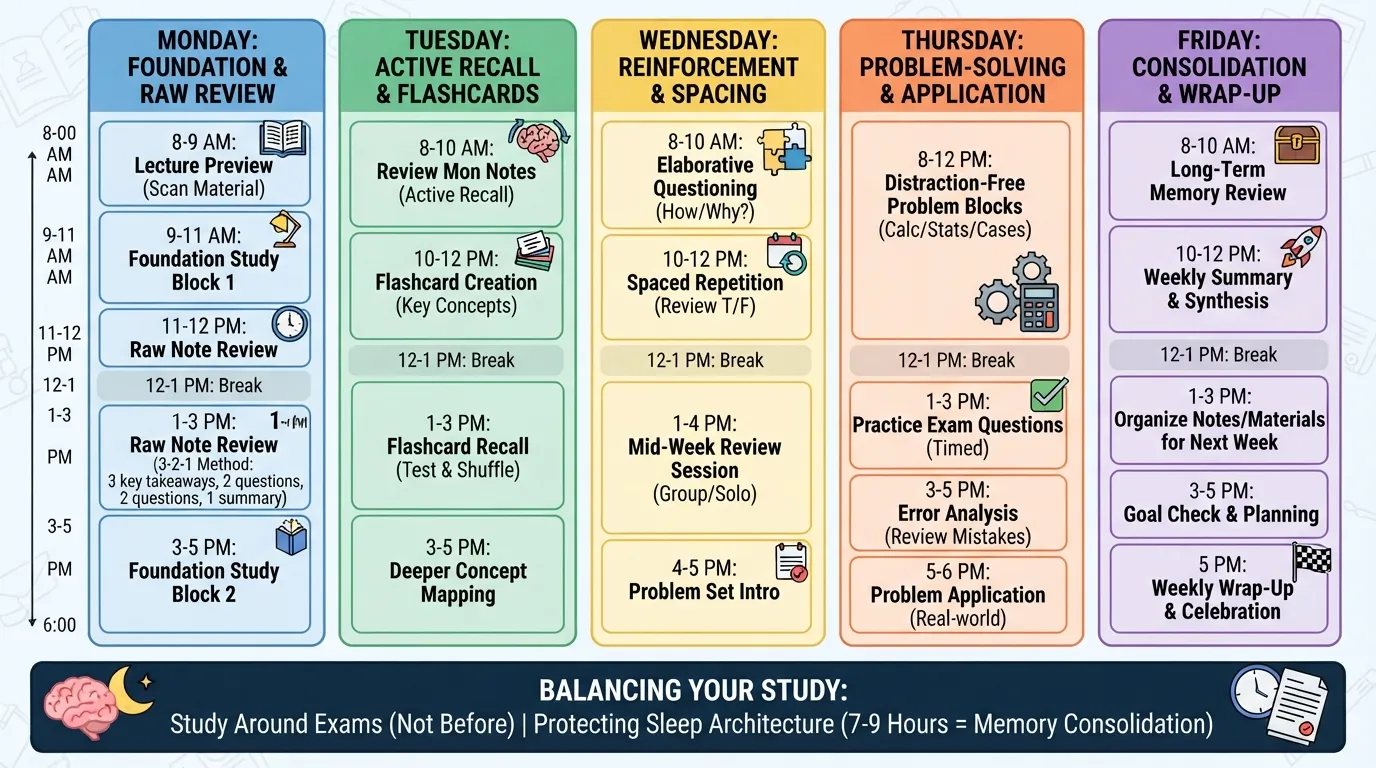
Navigating college coursework without a structured weekly blueprint often leads to reactive cramming and constant anxiety. Implementing a repeatable weekly schedule removes daily decision fatigue and ensures you consistently allocate time for high-impact study techniques like active recall and spaced practice.
A Simple 5-Day Study Routine You Can Copy
Consistency relies on predictable execution. This balanced 5-day template distributes your cognitive load evenly across the week, ensuring you never have to pull an exhausting all-nighter before an exam.
Monday (Foundation & Preview):
Morning/Afternoon: Attend classes and take raw notes.
Evening (45 Mins): Review new lecture notes using the 3-2-1 method to extract core takeaways and identify lingering questions.
Tuesday (Active Recall & Integration):
Afternoon (1 Hour): Convert lecture notes into flashcards or practice questions.
Evening (45 Mins): Run a quick active recall session covering Monday’s material and apply the Day 1 interval of the 1-3-5-7 rule.
Wednesday (Mid-Week Reinforcement):
Afternoon (1 Hour): Tackle difficult reading assignments using elaborative questioning (asking “why” and “how”).
Evening (45 Mins): Execute the Day 3 spaced repetition review for Monday’s notes to reinforce fading neural pathways.
Thursday (Problem Solving & Practice):
Afternoon (1 Hour): Work through practice problem sets or past exam questions in a distraction-free environment.
Evening (30 Mins): Do a rapid self-test on any tricky concepts discovered during your problem-solving blocks.
Friday (Consolidation & Wrap-Up):
Afternoon (1 Hour): Complete the Day 5/7 review interval for older topics to cement them into long-term memory before the weekend.
Evening: Clear your desk, organize your digital files, and review your calendar for the upcoming week.
How to Adjust It Around Exams or Deadlines
A standard weekly routine serves as your baseline, but heavy exam weeks or major assignment deadlines require strategic flexibility. Adapting your schedule prevents total burnout while maintaining forward momentum.
Pivot to Reverse Engineering: When an exam is seven days away, map out your review blocks backward from test day, dedicating each day to a specific chapter or module.
Prioritize High-Yield Tasks: Drop low-priority readings during crunch weeks and focus exclusively on active self-testing, practice exams, and reviewing past mistakes.
Protect Your Sleep Architecture: Never sacrifice sleep for extra study hours right before an exam; your brain needs rapid eye movement (REM) sleep and hippocampal memory replay to consolidate everything you reviewed.
Frequently Asked Questions
What can I do to help with studying?
Improving your academic performance requires replacing passive habits like rereading notes with evidence-based cognitive strategies.
Lower Activation Energy: Use the 10-minute rule to commit to studying for just a few minutes, which bypasses initial procrastination.
Practice Active Recall: Close your textbook and force your brain to retrieve information from memory rather than passively reviewing pages.
Implement Spaced Repetition: Spread your review sessions across multiple days using structured frameworks to combat the natural forgetting curve.
What is the 1-3-5-7 rule for studying?
The 1-3-5-7 rule is a cumulative spaced repetition schedule designed to lock complex information into your long-term memory.
Day 1: Learn the new material and immediately test your recall.
Day 3: Revisit the material 48 hours later using active self-testing.
Day 5 and 7: Conduct subsequent review sessions at the five-day and seven-day marks to cement the concepts before they fade.
What’s the 3-2-1 method for studying?
The 3-2-1 method is a rapid review framework that helps you synthesize dense reading material and lecture notes into actionable conceptual anchors.
3 Key Takeaways: Distill the core concepts into three distinct points written in your own words.
2 Real-World Examples: Create two practical applications or concrete examples for the material.
1 Linguring Question: Formulate one remaining uncertainty to investigate during your next study block.
How to study with ADHD?
Managing attention difficulties requires structuring your environment and tasks to maintain engagement and reduce executive function friction.
Use Body Doubling: Study alongside a focused peer or join a virtual co-working space to build gentle accountability.
Micro-Chunk Assignments: Break large tasks into tiny, discrete action steps to make starting feel manageable.
Incorporate Kinesthetic Movement: Stand while reading, use fidget tools, or dictate summaries out loud to keep your mind active.
Does ADHD make it harder to study?
Attention-related challenges can significantly impact how an individual processes, organizes, and retains complex academic material.
Executive Function Strain: Planning long-term projects, prioritizing competing deadlines, and initiating tasks require intensive mental effort.
Variable Concentration: Focus may fluctuate dramatically, making it easy to hyperfocus on interesting topics while struggling with drier assignments.
Working Memory Limits: Holding multi-step instructions or complex formulas in mind can quickly deplete available cognitive energy.
Conclusion — Discipline Beats Motivation
Waiting around for motivation to strike is a trap that keeps countless college students trapped in cycles of chronic procrastination and academic burnout. When you feel completely lost or stuck, the solution is not a prettier planner or a magic highlighter—it is building reliable behavioral systems and psychological discipline.
Your Next Step: Start With One Small Habit Today
Transforming your academic trajectory does not require overhauling your entire life by tomorrow morning. Sustainable progress is built through small, intentional, and repeatable actions that accumulate over time.
Pick One Technique: Choose a single evidence-based strategy from this guide, such as the 10-minute rule or the 3-2-1 method, and apply it to your toughest class today.
Anchor Your Routine: Establish a fixed time and a dedicated physical workspace to remove daily decision fatigue and signal your brain that it is time to focus.
Prioritize Consistency: Celebrate showing up and putting in the work, knowing that aggregate discipline will always outperform fleeting bursts of inspiration.