Jump to:
ToggleHow to Discipline a Cat: The Right Way (No Punishment)
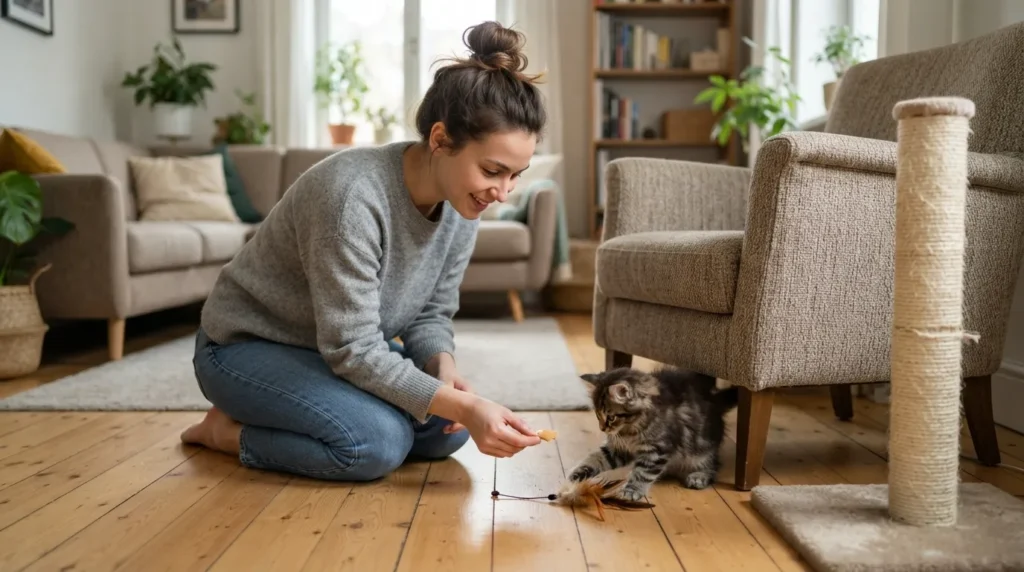
Can You Discipline a Cat?
Traditional punishment-based discipline does not work on cats and will backfire by destroying your bond and increasing fear-based aggression. Instead of punishing bad behavior after the fact, successful cat guidance relies on environmental modification, redirecting natural instincts, and positive reinforcement to encourage desirable habits.
Yes — But It’s Different From Disciplining a Dog
Cats do not possess the same social cognitive structure or pack mentality as dogs, meaning they cannot associate delayed punishment with a past action. When you scold or physically correct a cat, they do not think, “I shouldn’t jump on the counter”; they think, “My human is an unpredictable threat.”
The Dog Model: Relies on pack hierarchy, verbal reprimands, and corrections because dogs are domesticated pack animals bred to work closely with human leaders.
The Cat Model: Relies on voluntary cooperation and resource control because cats are solitary hunters who view their environment through a lens of safety and territory.
Association Gap: If you punish a cat after they scratch a sofa, they learn to fear you or fear getting caught, rather than connecting the punishment to the scratching behavior.
What “Discipline” Actually Means for Cats
Effective cat behavior correction is proactive rather than reactive, focusing on redirecting energy and managing the physical environment rather than imposing penalties. Modern behavior science frames training as teaching alternative behaviors rather than stopping unwanted ones.
Environmental Modification: Change the setup so the undesired behavior becomes impossible or unappealing, such as placing double-sided tape on counters or providing higher alternative perches.
Redirected Energy: Interrupt inappropriate actions by offering an acceptable outlet, like guiding a cat from your hand to a kicker toy during play.
Immediate Positive Reinforcement: Reward desired choices instantly with high-value treats, verbal praise, or affection to build a strong psychological association with good behavior.
Zero Aversives: Eliminate squirt bottles, shouting, or physical swats, which only elevate stress levels and trigger redirected aggression toward other household pets or humans.
Why Traditional Punishment Fails With Cats
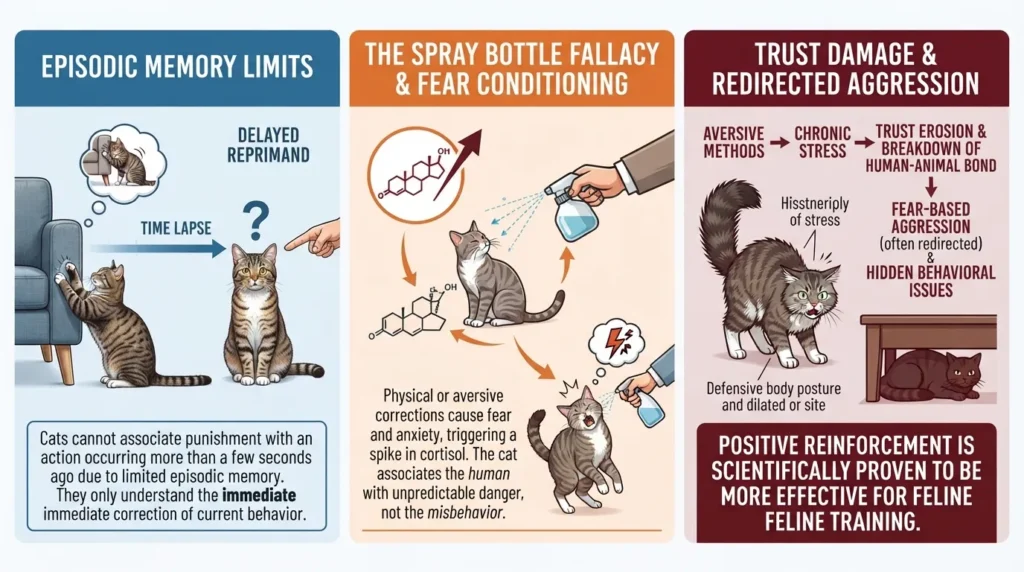
Traditional punishment fails because felines lack the cognitive architecture to connect human retribution to past actions, turning corrective measures into sources of severe psychological stress. Relying on methods like yelling or a spray bottle initiates fear conditioning, which damages your bond and frequently worsens the exact behavioral problems you want to fix.
Cats Live in the Moment (No Delayed Cause-and-Effect Memory)
Felines operate primarily on immediate instinct and environmental cues rather than retrospective reasoning or moral accountability. If you reprimand a cat minutes—or even seconds—after they commit an infraction, their brain cannot bridge the chronological gap between the deed and the consequence.
Episodic Memory Limits: Unlike humans, cats do not mentally replay past events to evaluate right from wrong or analyze where they made a mistake.
Association Failure: A delayed reaction means the cat associates the punishment with your presence or a random environmental sound, not their prior behavior.
Confusion and Anxiety: Because they cannot link the penalty to their action, punishments feel entirely random and unfair, throwing the cat into a state of chronic confusion.
How Yelling, Hitting, or Water Spray Creates Fear — Not Understanding
Aversive techniques like yelling, physical swats, or using a spray bottle do not teach alternative behavior; they simply teach the cat to fear the person administering the correction. This triggers an involuntary survival response rather than a cognitive learning moment.
Spray Bottle Fallacy: Spraying water does not teach a cat not to jump on counters; it only teaches them to wait until you are out of sight before jumping.
Human Association: Instead of fearing the act, the cat learns to view you as an unpredictable source of sudden, frightening stimuli.
Stress Responses: Aversives spike cortisol and adrenaline levels, leading to displacement behaviors like excessive grooming, hiding, or compulsive scratching.
The Trust Damage: Why Punishment Can Increase Aggression
Physical and psychological intimidation erodes the foundational trust required for a harmonious human-animal household. When a cat feels perpetually threatened in their own territory, defense mechanisms take over, which often leads to redirected aggression.
Defensive Aggression: Fearful cats will hiss, swat, or bite because they feel cornered and must protect themselves from perceived human hostility.
Hidden Behavioral Issues: Punished cats often learn to hide their natural habits, meaning they may eliminate outside the litter box in secret locations rather than stopping the issue.
Relationship Breakdown: Repairing a bond damaged by fear conditioning requires weeks or months of patience, puzzle feeders, and entirely positive interactions to reverse the psychological toll.
Is It Okay to Physically Discipline a Cat?
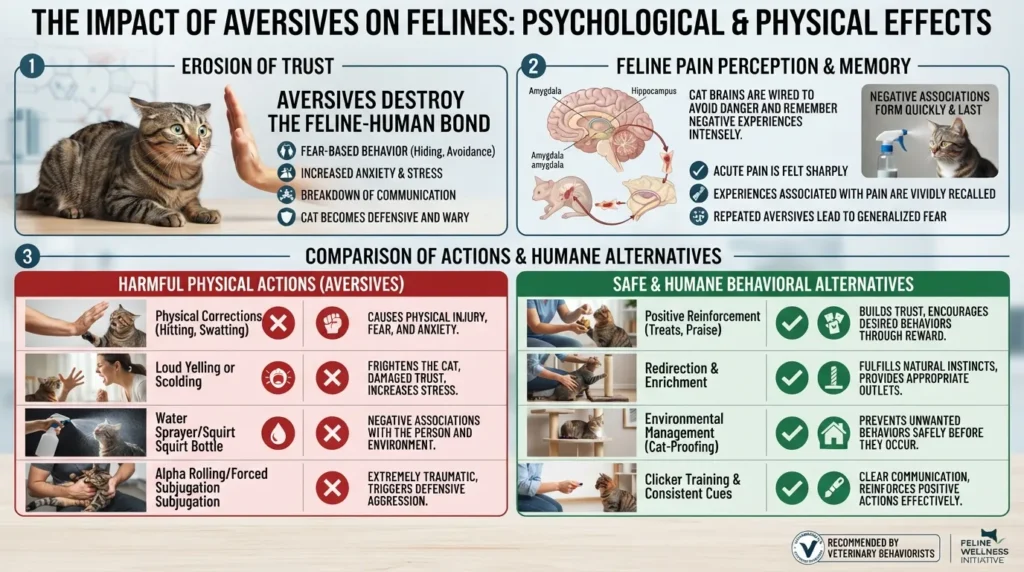
Physical discipline is never acceptable, as animal welfare authorities emphasize that direct physical correction damages the human-animal bond and triggers severe fear and aggression. Resorting to physical punishment often stems from caregiver frustration, but it inflicts needless harm on a creature that cannot comprehend the intent behind the act.
Do Cats Forgive After Being Hit?
Cats do not process interpersonal “forgiveness” in the human sense; instead, they operate on ongoing risk assessment and memory of safety. When you physically harm a cat, you permanently alter their risk calculation regarding your presence.
Erosion of Safety: Repeated physical corrections teach a cat that your hands—which should mean food, play, and comfort—signal unpredictable violence.
Conditional Tolerance: While a cat may continue living in your home out of dependency, their affectionate displays are often replaced by hypervigilance and a guarded demeanor.
Rebuilding a Baseline: Restoring a sense of safety requires months of strictly hands-off interaction, predictability, and letting the cat dictate the terms of engagement.
Can Cats Feel Pain the Same Way We Do?
Felines possess a sophisticated nervous system equipped with the same primary pain receptors (nociceptors) as humans, meaning physical slaps, swats, or toe-taps register as genuine physical agony.
Neurological Parity: Their physiological processing of sharp impacts, bruises, and joint stress matches our own, causing acute physical suffering.
Concealing Distress: Cats instinctively hide pain as a survival mechanism against predators, meaning a physically punished cat may suffer silently without outward whimpering.
Medical Masking: Stress induced by physical handling can exacerbate underlying medical issues like feline lower urinary tract disease or arthritis.
Will Your Cat Remember Being Punished?
Your cat will not remember the specific misbehavior they supposedly committed, but they will vividly remember the physical trauma associated with your body.
Contextual Memory: Felines build long-term associations around specific environments and humans who cause them pain, steering clear of those triggers in the future.
Grudge Misconceptions: People often mistake a cat’s lingering avoidance for a “grudge,” when it is actually a natural, instinctual self-preservation response to a recognized hazard.
How to Move Forward If You’ve Already Used Physical Punishment
Making mistakes out of ignorance or sudden frustration happens, but breaking the cycle requires immediate behavioral accountability from the human. As highlighted in the SF SPCA’s guide on correcting unwanted behavior, direct physical actions like spanking, scruffing, or nose-tapping must be permanently replaced with management and positive reinforcement.
Cease All Aversives Cold Turkey: Eliminate any form of physical retaliation, loud shouting, or threatening gestures immediately.
Apologize Through Resources: Invest heavily in environmental enrichment, interactive wand toys, and puzzle feeders to fulfill their natural drives safely.
Let Them Approach You: Stop forcing affection; allow your cat to initiate contact on their own terms to rebuild trust organically over time.
The 3-3-3 Rule — Why New or Young Cats Misbehave
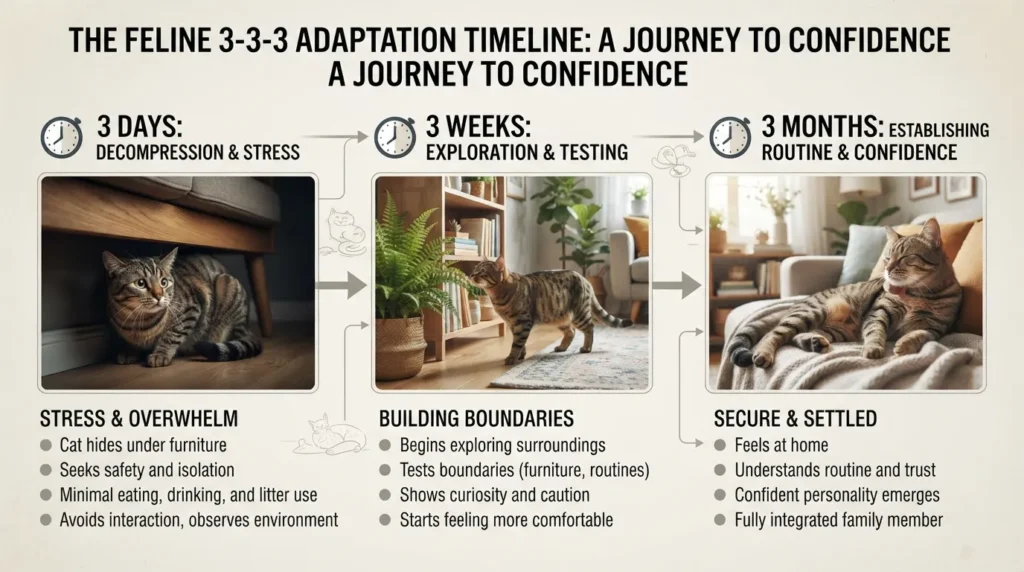
Behavioral challenges in a new environment are almost always symptoms of transition stress rather than stubbornness, making the 3-3-3 rule an essential framework for understanding feline adjustment phases. Recognizing that adjustment takes time shifts your perspective from punishment to patience, letting you support the cat through decompression instead of reacting with frustration.
What Is the 3-3-3 Rule for Cats?
The 3-3-3 rule is a general guideline profiling the stages a cat goes through when adapting to a completely new home, environment, or family. It outlines distinct timelines for nervous system stabilization, shedding light on why sudden litter box lapses, hiding, or nighttime vocalization are normal stress reactions rather than disciplinary issues.
Decompression Timeline: Provides a realistic schedule for how long a cat’s brain takes to process safety and territorial security.
Misbehavior Reframe: Treats unwanted actions as coping mechanisms for high cortisol levels instead of intentional disobedience.
3 Days, 3 Weeks, 3 Months — What Happens at Each Stage
Every phase of the 3-3-3 framework presents unique neurological challenges and behavioral adjustments as the cat moves from acute survival mode to feeling entirely at home.
First 3 Days: The cat feels overwhelmed, terrified, and insecure, often hiding under beds, refusing to eat, or avoiding the litter box out of sheer panic.
First 3 Weeks: The cat begins to settle in, learns household routines, and starts exploring wider territories while still testing boundaries and processing residual anxiety.
First 3 Months: Complete comfort and confidence are established, true personalities emerge, and the cat finally feels secure in their bond with you and their environment.
Why Discipline Should Wait Until Your Cat Feels Secure
Attempting to correct or train a cat during their initial decompression window increases anxiety and disrupts the natural bonding process. A cat cannot learn alternative behaviors or process training concepts when their brain is flooded with survival hormones.
Safety First: Prioritize a quiet “safe room,” predictable feeding schedules, and low-stress handling to let the nervous system calm down naturally.
Letting Go of Control: Allow your new cat to set the pace for exploration and affection without forcing interactions that could trigger defensive reactions.
Building a Foundation: Focus exclusively on positive reinforcement, patience, and resource availability until the 3-month mark cements mutual trust.
What Age Are Cats Most "Rebellious"?
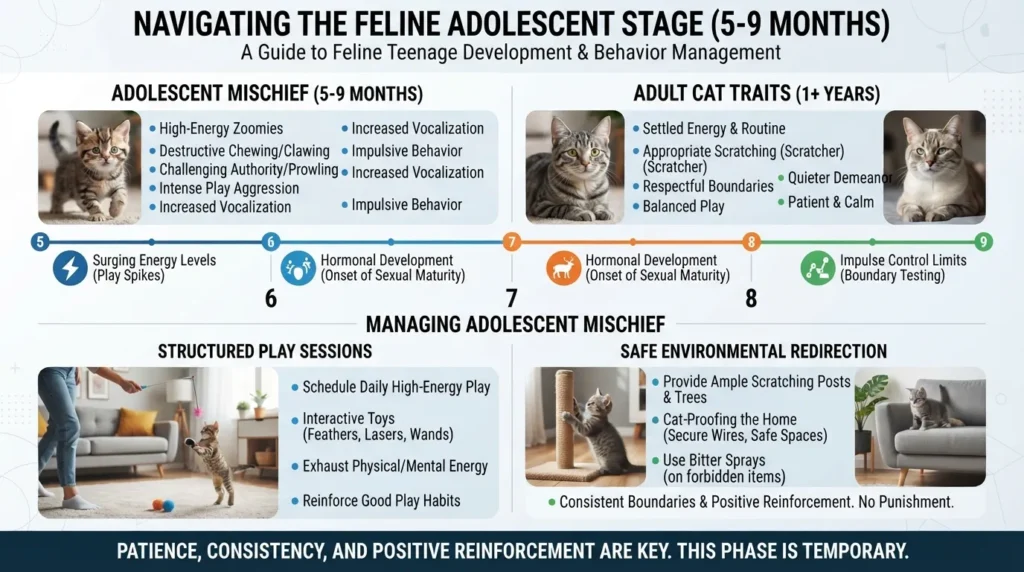
Felines experience their most high-energy and boundary-pushing phase during kitten adolescence, which typically spans from 5 to 9 months of age. During this window, surging hormones and a rapid growth spurt can make a once-sweet kitten seem chaotic, destructive, and seemingly intent on ignoring household rules.
The Kitten “Teenage Phase” (Roughly 5–9 Months)
Adolescent kittens undergo massive hormonal shifts and neurological maturation, mirroring the human teenage years in their desire to test limits and explore boundaries. While often labeled as “rebellious,” this behavior is simply the natural expression of juvenile curiosity and pent-up predatory energy.
Surging Energy Levels: Kittens in this age bracket possess seemingly endless stamina, leading to late-night zoomies, frantic scratching, and dramatic leaps onto forbidden high surfaces.
Hormonal Development: Unsterilized kittens experience intense biological drives to mark territory, roam, or vocalize as they reach sexual maturity.
Boundary Testing: Adolescents frequently jump on restricted counters or claw furniture to see what kind of dynamic reaction or interactive play they can elicit from you.
How Adolescent Behavior Differs From Adult Cat Behavior
Understanding the distinction between an adolescent phase and established adult habits prevents owners from misinterpreting normal developmental stages as permanent behavior problems.
Adolescent Impulse Control: Teen kittens act on sudden impulses with little forethought, often abandoning calm behavior the second a shadow moves or a toy rattles.
Adult Predictability: Mature cats past the one-year mark generally settle into predictable routines, showing greater emotional regulation and lower baseline anxiety.
Energy Management: While adults spend much of the day resting, adolescents require dedicated interactive play sessions to burn off the intense chemical energy driving their youthful mischief.
Effective, Humane Methods to Discipline a Cat (Core Section)
Humane feline discipline relies entirely on redirecting natural instincts, modifying environmental triggers, and using positive reinforcement instead of punishment. As demonstrated in the guidance provided by AnimalWised, successful education focuses on rewarding good choices and managing the surroundings so the cat naturally chooses appropriate behaviors [00:51].
Redirect the Behavior (Scratching Post, Toy Swap, Stop-and-Walk-Away)
Redirection interrupts an unwanted action by immediately channeling your cat’s physical energy and mental focus into an approved, constructive outlet. This prevents conflict and teaches acceptable alternatives without causing stress.
Scratching Post Swap: If your cat claws the sofa, gently pick them up or guide them toward a nearby sisal scratching post, rewarding them with praise when they use it.
Toy Swap Interruption: If your cat attacks your ankles or hands during play, quietly substitute a wand toy or kicker mouse to satisfy their predatory drive safely.
Stop-and-Walk-Away: If your cat bites or acts out for attention, freeze completely, avoid eye contact, and walk away to eliminate the reward of your reaction [01:34].
Modify the Environment (Double-Sided Tape, Aluminum Foil, Motion-Activated Air Canisters — How and Where to Place Them)
Environmental modification makes prohibited areas unappealing or physically inaccessible without requiring you to scold or chase your cat. This teaches the cat that the environment itself makes the action unpleasant.
Double-Sided Tape: Apply specialized sticky tape along counter edges or furniture sides; cats dislike the tacky sensation on their paw pads and will avoid the surface entirely.
Aluminum Foil Sheets: Lay lightweight sheets of aluminum foil across countertops or restricted zones; the sudden crinkle sound and slick texture deter cats from jumping up.
Motion-Activated Air Canisters: Place compressed air units near restricted areas like trash cans or kitchen islands; a harmless hiss of air when they approach startles them away without human association [00:11].
Remove Attention (The “Ignore” Method Done Correctly)
Many nuisance behaviors—such as knocking objects off tables or excessive meowing—are performed strictly to demand human interaction. Withholding attention teaches your cat that bad behavior achieves the exact opposite of what they want.
Absolute Zero Reaction: When undesirable attention-seeking occurs, do not shout, scold, or even look directly at the cat.
Delayed Reward: Wait until the cat stops the behavior and remains calm for a few quiet moments before offering affection or treats [01:13].
Timing Matters — Correcting Within Seconds, Not Minutes
Because cats live entirely in the immediate present, successful guidance requires instant intervention during the exact moment the behavior occurs.
The Immediate Window: If you cannot intervene within a two-second window of the action, abandon the correction entirely because the cat will not connect it to the deed [00:13].
Proactive Prevention: Focus your efforts on removing the trigger or blocking access ahead of time rather than trying to correct a finished action.
Positive Reinforcement — Rewarding Good Behavior
Positive reinforcement is the most powerful tool for shaping feline habits, relying on immediate rewards to encourage choices you want to see repeated. Building a well-behaved cat means recognizing that rewarding desirable actions builds trust and long-term compliance far more effectively than any form of correction.
Catching Good Behavior in the Act (The 1–2 Second Rule)
Timing is just as critical for rewards as it is for intervention, requiring you to deliver positive reinforcement within one to two seconds of the desired action.
Instant Association: If you wait too long to hand out a treat after your cat uses a scratching post, their brain will link the treat to whatever they happen to be doing in that exact later second.
Clicker Training: Using a clicker right when the correct behavior occurs marks the exact moment of success, giving you a brief window to follow up with a treat.
Consistency Wins: Spotting and rewarding small wins—like stepping away from a counter or resting quietly on a mat—builds predictable positive habits.
Treats, Praise, and Play as Reinforcement Tools
Effective reinforcement goes beyond food, utilizing a diverse menu of high-value rewards tailored to what your individual cat finds most motivating.
High-Value Treats: Use small, aromatic morsels like freeze-dried chicken or salmon flakes exclusively for rewarding good choices to maximize their impact.
Verbal Praise: Pair treats with a calm, high-pitched, encouraging tone of voice so your cat learns to associate your voice with safety and approval.
Playtime Rewards: Use interactive play with a feather wand or laser pointer as a direct reward for calm behavior or using designated furniture properly.
Giving Your Cat Enough Outlets (Vertical Space, Toys, Daily Play)
Preventing misbehavior requires satisfying your cat’s natural predatory drives and territorial needs through proper environmental enrichment.
Vertical Real Estate: Install multi-level cat trees, wall shelves, and window perches to satisfy their instinctual need for high observation points and safe territory.
Active Toy Rotation: Keep toys fresh by rotating them weekly and hiding unused items to prevent boredom-driven destructive behaviors.
Scheduled Daily Play: Commit to at least two 15-minute interactive play sessions daily to burn off pent-up physical energy before it turns into midnight zoomies or unwanted scratching.
How to Discipline a Cat or Kitten for Biting
Stopping biting requires identifying the root trigger behind the attack and eliminating hand-play entirely, as physical retaliation teaches cats to view your hands as prey. Successfully resolving bite issues relies on calm de-escalation, immediate redirection to toys, and establishing clear physical boundaries.
Why Cats and Kittens Bite (Play Aggression vs. Overstimulation)
Feline bites are rarely malicious; instead, they serve as communication tools signaling boredom, excess energy, or an overwhelmed nervous system. Recognizing the specific motivation helps you address the root cause rather than punishing the symptom.
Play Aggression: Common in single kittens who lack littermates to teach bite inhibition, leading them to stalk and pounce on moving human ankles or hands.
Petting Overstimulation: Occurs when a cat enjoys being petted until a sensory threshold is crossed, resulting in a sudden warning nip to signal that they’ve had enough.
Unmet Hunting Drives: Bored indoor cats with pent-up predatory energy often redirect their natural stalking instincts toward household occupants.
Step-by-Step: Stopping the Bite in the Moment
Immediate, non-punitive reactions teach felines that biting makes interactive fun stop instantly, effectively removing the reward of the behavior.
Freeze and Go Limp: Stop moving your hand or limb completely the second teeth make contact, as pulling away triggers a predatory chase reflex.
Provide a High-Pitched Chirp: Let out a short, sharp vocalization or gasp (similar to how a littermate would react) to startle the cat without scaring them.
Withdraw Attention: Immediately stand up, drop any toys, and walk away or close a door for two minutes to end all engagement.
Redirect to a Kicker Toy: Keep a soft plush kicker toy nearby to shove gently into their paws if they attempt to latch onto your arm during play.
Kitten Biting vs. Adult Cat Biting — What’s Different
Addressing biting habits requires understanding the developmental gap between a young, learning kitten and an adult cat with established behavioral patterns.
Kitten Bite Inhibition: Young kittens are still learning how fragile human skin is, meaning consistent redirection and absence of hand-wrestling quickly teach them gentle limits.
Adult Defensive Biting: Adult cats rarely bite for mere play; if an adult suddenly bites, it usually indicates underlying medical pain, chronic stress, or severe fear requiring environmental adjustments.
Intervention Complexity: While a kitten’s play biting corrects easily with routine redirection, an adult cat’s established biting habits often demand professional ethology support and careful triggers mapping.
How to Discipline a Cat for Attacking Humans
Cat attacks on humans require calm, strategic de-escalation rather than emotional retaliation, as striking out will only escalate the defensive hostility. Successfully stopping feline aggression starts with identifying whether the trigger stems from unreleased predatory energy, fear, or hidden medical discomfort.
Identifying the Trigger (Fear, Redirected Aggression, Pain-Based)
Pinpointing why an attack happens allows you to treat the root cause instead of dealing with random outbursts. Felines rarely attack out of pure malice; their behavior is usually a direct response to a specific environmental stressor.
Fear Aggression: Triggered when a cat feels cornered, startled by sudden movements, or threatened by unfamiliar people or household noises.
Redirected Aggression: Occurs when a cat becomes deeply agitated by an outside stimulus (such as a stray cat outside the window) and directs their pent-up fury onto the nearest human.
Pain-Based Aggression: Happens when handling a sensitive area triggers an instinctive defensive lash-out from an animal suffering from hidden joint pain, dental disease, or trauma.
Safe De-escalation During an Attack
When a cat launches an unprovoked attack, maintaining your composure prevents minor scratches from escalating into a full-scale safety emergency.
Freeze Instantly: Stop moving your body entirely, as pulling away or running away triggers the cat’s innate predatory chase instinct.
Avoid Eye Contact: Refrain from staring down an aggressive cat, which they interpret as a direct threat or challenge.
Create Physical Distance: Use a neutral barrier like a pillow, thick blanket, or closing a door to separate yourself safely without yelling or swinging your arms.
Long-Term Behavior Correction Steps
Resolving chronic aggression requires structured environmental changes and predictable daily routines that lower your cat’s baseline stress level.
Identify and Remove Triggers: Block window views of outdoor cats using privacy film or relocate feeding stations away from high-traffic household bottlenecks.
Channel Predatory Drive: Direct excess energy into daily interactive wand play sessions, ensuring your cat can stalk, catch, and “kill” safe toys instead of human ankles.
Establish Predictable Pacing: Maintain consistent daily feeding, play, and resting schedules to give anxious cats a secure sense of territorial control.
When Attacking Could Signal a Medical Issue
Sudden or uncharacteristic aggression is frequently a red flag indicating an underlying health problem or acute physical pain.
Veterinary Screening: Take your cat for a comprehensive veterinary checkup to rule out hidden medical conditions like urinary tract infections, hyperthyroidism, or arthritis.
Pain Masking: Because cats instinctively hide physical discomfort, unprovoked biting or swatting when touched may be their only way of crying out for medical help.
How to Discipline a Cat for Bullying or Aggression Toward Other Cats
Multi-cat aggression and bullying require careful territorial management and slow re-introductions rather than direct discipline, as punishing a bully cat only increases anxiety and triggers further fighting. Resolving tension between felines involves reallocating vital resources and breaking the cycle of intimidation without taking sides.
Signs of Bullying Between Cats
Feline bullying is not always as obvious as a physical fight; it frequently involves subtle, psychological intimidation that causes chronic stress for the victimized cat.
Resource Blocking: A bully cat strategically lies in hallways, near litter boxes, or in front of food stations to prevent other cats from accessing basic necessities.
Stalking and Ambushing: One cat persistently tracks, stares down, or springs upon another cat the moment they try to relax or use common spaces.
Submissive Posturing: The victimized cat frequently exhibits flattened ears, a tucked tail, hiding behaviors, or hesitant movements around the house.
Why Isolation/Crating Isn’t a Long-Term Fix
Locking a bully cat away in a separate room or a crate for extended periods fails to address the root territorial insecurity and often worsens hostility upon release.
Temporary Band-Aid: Crating isolates the cat without teaching them how to share space harmoniously, leaving underlying tensions completely unresolved.
Increased Frustration: Isolation spikes stress and frustration levels, which typically explodes into worse aggression the moment the enclosure door opens.
Scent Deprivation: Extended physical separation can cause scent disorientation, meaning the cats will view each other as complete strangers when reunited.
Managing Territory, Resources, and Reintroduction
Successful multi-cat harmony relies on eliminating scarcity, expanding vertical territories, and executing a controlled, gradual scent re-introduction.
The Plus-One Rule: Provide multiple litter boxes, food bowls, and water stations scattered across different rooms so no single cat can guard all vital resources.
Vertical Space Expansion: Install cat trees and wall shelves to create distinct vertical highways, allowing cats to pass each other without forced physical confrontation.
Controlled Re-introduction: Separate the cats entirely for a few days, feed them on opposite sides of a closed door to build positive food associations, and slowly reintroduce them using baby gates.
Litter Box Accidents — Why Discipline Won't Help

Punishing a cat for eliminating outside the litter box is entirely counterproductive, as inappropriate elimination is a distress signal communicating an underlying medical problem, stress, or a dirty environment. Scolding or reprimanding your cat after an accident only heightens their anxiety, which frequently causes them to avoid the box even more.
Common Medical and Stress Causes Behind Litter Box Issues
Felines do not soil carpets or beds out of spite or disobedience; sudden changes in elimination habits are almost always tied to physical discomfort or emotional upheaval.
Medical Illness: Urinary tract infections (UTIs), bladder stones, or painful arthritis make entering and using a rigid litter box physically agonizing.
Environmental Stressors: Sudden changes in the household, new pets, rearranged furniture, or a dirty litter box can trigger severe territorial anxiety.
Aversion to Setup: Cats will reject boxes that are too small, placed in noisy high-traffic areas, or filled with litter they dislike.
What to Do Instead of Punishing
Resolving litter box lapses requires a detective mindset to identify the root trigger and make using the box as appealing as possible.
Schedule a Vet Check: Rule out physical illness immediately by taking your cat to the veterinarian for a urinalysis and physical exam.
Evaluate Box Hygiene: Scoop boxes daily, completely wash them weekly, and follow the golden rule of having one box per cat plus one extra.
Enzyme Cleaning: Use a specialized enzymatic cleaner to thoroughly eliminate pet urine odors on carpets or furniture, preventing your cat from returning to the same spot.
How Mother Cats Discipline Kittens (Nature's Blueprin
Observing how a mother cat corrects her kittens offers valuable insight into natural feline education, emphasizing instant feedback and boundary setting without destroying trust. Mother cats teach social etiquette through instinctual, non-malicious actions that establish clear limits while nurturing healthy emotional development.
Scruffing, Hissing, and Physical Repositioning Explained
Feline mothers rely on swift, precise behavioral cues to correct rough play, wandering off, or dangerous exploration among their litter.
Immediate Scruffing: A gentle pinch of the neck scruff immobilizes an unruly kitten instantly, mimicking how she carries them and signaling an immediate pause in activity.
Warning Hisses and Growls: Sharp vocalizations communicate immediate displeasure, teaching kittens to recognize auditory boundaries before situations escalate.
Physical Repositioning: A firm nudge or a light paw-swipe guides a kitten away from unsafe areas or forces them to settle down during nursing and resting periods.
What Human Owners Can (and Cannot) Copy From Natural Feline Behavior
While mother cats use physical touch to guide their kittens, human owners cannot replicate these methods safely or effectively.
The Biology Barrier: A mother cat communicates from a place of parental instinct and shared scent within the litter, whereas human hands are often perceived as alien, larger threats when administering physical corrections.
Why Humans Should Not Copy Scruffing: Picking up an adult cat by the scruff causes physical pain and severe stress, making it an inappropriate and harmful technique for human-cat relationships.
Emulating the Timing: You can copy the mother cat’s instant, direct timing by interrupting bad behavior immediately with a sharp vocal cue or redirection, keeping your bond intact.
Kitten vs. Adult Cat — Discipline Differences
Tailoring your approach to your cat’s exact life stage is essential, because kittens are in a rapid developmental window of learning socialization, while adult cats require patience to break deeply ingrained habits. Recognizing these developmental differences prevents mismatched expectations and ensures your training methods actually match your cat’s cognitive capacity.
Patience and Socialization Needs for Kittens
Kittens under one year old absorb environmental lessons quickly, but they lack impulse control and depend on constant guidance to learn appropriate boundaries.
The Socialization Window: Between two and seven weeks of age, kittens learn feline language and bite inhibition from their mother and littermates, shaping how they interact with humans later.
Redirection over Restriction: Because their brains are still developing, kittens respond best to immediate toy swaps and gentle interruptions rather than rigid rules.
High Energy Management: Frequent, short play sessions help burn off the boundless energy that drives kittens to climb curtains or pounce on ankles.
Established Habits and Consistency for Adult Cats
Adult cats possess fixed behavioral patterns and established territorial boundaries, meaning unwanted habits require weeks or months of consistent environmental modification to change.
Stubborn Neural Pathways: An adult cat that has scratched the same sofa corner for three years has reinforced a powerful neural habit that cannot be broken overnight.
Patience and Routine: Modifying adult behavior relies on long-term environmental changes—such as adding scratching posts and altering furniture layouts—paired with absolute routine consistency.
Respecting Established Temperaments: Trying to force a mature cat into unfamiliar social situations or sudden lifestyle changes usually results in severe stress and defensive aggression.
Do's and Don'ts of Disciplining a Cat (Quick Reference Table)
Mastering feline behavior management requires knowing which common corrections to eliminate immediately and which positive alternatives build lasting trust. This quick-reference guide contrasts harmful punishment methods with effective, science-backed strategies for a harmonious home.
| Discipline Approach | What It Is | Why It Fails or Succeeds |
| Don’t: Physical Punishment | Hitting, swapping, or toe-tapping | Triggers severe fear conditioning, damages your bond, and escalates aggressive defense mechanisms. |
| Don’t: Yelling or Loud Noises | Shouting, clapping, or using noise cans | Exploits sensitive feline hearing, causing chronic anxiety without teaching the desired lesson. |
| Don’t: Rubbing Noses in Messes | Forcing a cat near litter box accidents | Fails to connect the consequence to the action, increasing distress and litter box avoidance. |
| Do: Environmental Modification | Using double-sided tape, foil, or air cans | Makes restricted surfaces unappealing without human association, preventing future unwanted access. |
| Do: Behavioral Redirection | Swapping forbidden targets for toys or posts | Channels natural hunting and scratching drives into approved, constructive outlets instantly. |
| Do: Positive Reinforcement | Rewarding good choices with treats and praise | Reinforces desirable actions within seconds, building long-term habits and strengthening mutual trust. |
Discipline Methods to Avoid
Eliminating aversives protects your cat’s psychological well-being and prevents your household from becoming a source of stress.
Never Use Water Bottles: Spraying water teaches cats to fear you and hide their actions rather than stopping the underlying behavior.
Never Scruff Adult Cats: Lifting or shaking an adult cat by the neck causes intense physical pain and shatters trust.
Never Punish Delatedly: Any correction applied more than two seconds after an action is entirely useless and only causes confusion.
Positive Alternatives That Work
Embracing positive reinforcement fosters a cooperative relationship where your cat feels safe, secure, and understood.
Invest in Enrichment: Provide abundant vertical perches, puzzle feeders, and daily interactive play to eliminate boredom-driven mischief.
Reward Instantly: Deliver high-value treats or calm praise immediately when your cat makes a good choice, cementing the positive habit.
Frequently Asked Questions
Addressing common questions about feline behavior clarifies persistent misconceptions and provides direct, actionable guidance for cat owners. These concise answers target frequent search queries to help you navigate everyday training challenges effectively.
How Do You Teach a Cat “No”?
Cats do not understand spoken prohibitions like the word “no” in the way humans or dogs do. Instead of relying on verbal commands, teach boundaries by using immediate redirection, environmental deterrents, or simply walking away to stop the behavior.
Auditory Cues: Use a firm, neutral sound like a gentle “ah-ah” only as an immediate interruption paired with a toy swap.
Consistency: Pair verbal sounds with immediate physical redirection to guide the cat toward an acceptable alternative.
Do Cats Know When You’re Disciplining Them?
Cats do not recognize human concepts of discipline or moral correction; they only register immediate consequences and environmental feedback. When you punish a cat, they do not understand that they broke a rule—they only perceive you as a source of unpredictable hostility.
Lack of Conscience: Felines operate on immediate survival instincts and territorial security rather than guilt or remorse.
Association Risks: Punishments teach cats to fear your hands or your presence rather than connecting the penalty to their past actions.
What’s a Cat’s Worst Fear?
Felines are primarily driven by a deep instinctual need for safety, predictability, and territorial control. Their greatest fears revolve around feeling trapped, losing control of their environment, and experiencing sudden, unpredictable threats.
Losing Safe Spaces: Being denied access to high perches or quiet hiding spots causes severe chronic anxiety.
Unpredictable Loud Noises: Sudden high-decibel sounds trigger an acute fight-or-flight response due to their highly sensitive hearing.
What Is the Most Effective Way to Discipline a Cat?
The most effective approach is proactive management combined with positive reinforcement rather than reactive punishment. Shaping behavior requires making good choices rewarding and bad choices impossible.
Environmental Adjustments: Use double-sided tape or motion-activated air canisters to make restricted zones self-correcting.
Immediate Rewards: Deliver high-value treats or praise within two seconds of desirable behavior to cement new habits.
How Effective Is Crating or Confining a Cat as Punishment?
Crating or isolating a cat as a punitive measure is entirely ineffective and actively harmful to their emotional well-being. Confinement fails to address the root cause of the behavior and spikes stress levels.
Anxiety Amplification: Locking a cat away induces panic and makes them associate enclosures with punishment rather than safety.
Missed Learning Opportunities: Isolation prevents you from redirecting the energy into a constructive, positive outlet.
Conclusion — Key Takeaways
Successful feline behavior management requires abandoning outdated punishment models in favor of environmental control, redirection, and positive reinforcement. Because cats lack the cognitive capacity to connect delayed human retribution to past actions, traditional disciplinary tactics like yelling or physical correction only induce fear and damage your bond.
The Bottom Line on Disciplining Cats and Kittens
Transforming unwanted habits into harmonious routines is entirely achievable when you work with your cat’s natural instincts rather than against them.
Focus on Prevention: Modify your home environment with deterrents like double-sided tape, aluminum foil, or motion-activated air canisters to make forbidden areas unappealing without human involvement.
Master Redirection: Swap out inappropriate targets—such as scratching furniture or biting ankles—for approved scratching posts and interactive toys instantly.
Reward Consistently: Cement good habits by delivering high-value treats and praise within seconds of desirable behavior.
Prioritize Patience: Pair routine consistency with abundant vertical space and daily play sessions to ensure a secure, stress-free household.
Kittisak Wattanakul
Kittisak Wattanakul is the Discipline Editor at Holistic Wellbeing Living. He writes about routines, focus, consistency, and practical follow-through. With nine years of experience creating personal-growth content, Kittisak helps readers build realistic systems for steady progress without extreme productivity pressure.