Jump to:
ToggleToddler Discipline That Works: Strategies for Every Age and Condition

You have tried every gentle parenting script, bought the recommended books, and still found yourself locking eyes with a screaming toddler on the supermarket floor while a dozen strangers judge your every move. That overwhelming cycle of guilt, burnout, and losing your temper does not mean you are failing as a parent; it means standard, one-size-fits-all advice was never built for your reality.
Traditional behavior guidance often fails because neurodivergent minds and complex developmental profiles process the world entirely differently. Whether you are navigating the relentless energy of ADHD, the sensory overload of autism, the intense opposition of ODD, the nervous system panic of PDA, or early-onset Conduct Disorder, typical toddler discipline strategies simply fall flat.
This guide abandons generic listicles and surface-level tips to deliver a comprehensive framework tailored to both neurotypical development and condition-specific needs. You will discover actionable, evidence-based tools that transform daily power struggles into moments of connection, restoring calm to your home and confidence to your parenting journey.
What Does "Discipline" Actually Mean?
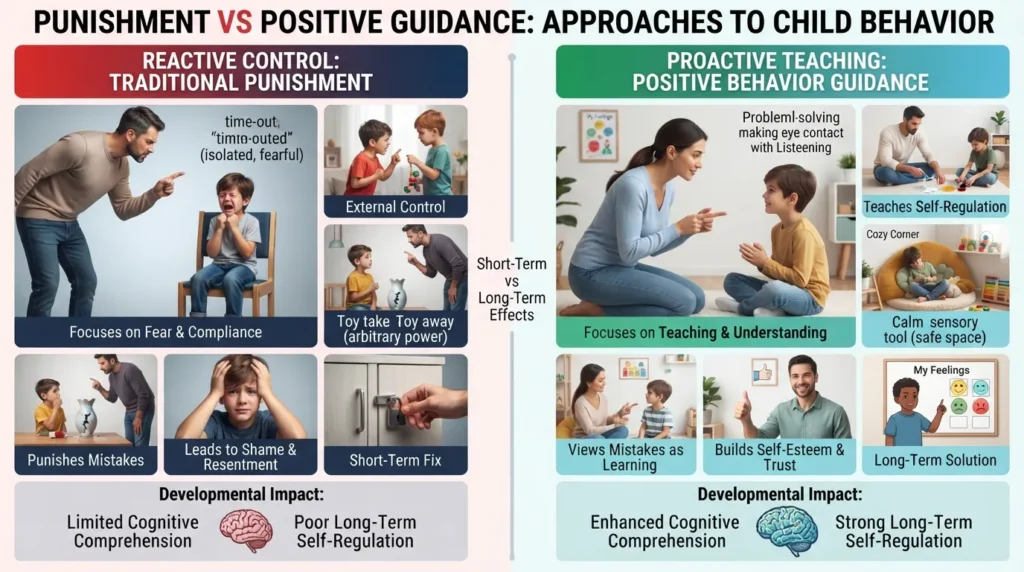
At its root, discipline is not about imposing penalties or control; it is about teaching, guiding, and building internal self-regulation. Effective behavior guidance provides children with the emotional tools and cognitive frameworks they need to manage their impulses long after the immediate crisis has passed.
Discipline vs. Punishment — The Core Difference
Discipline focuses on teaching children how to handle difficult emotions and adjust future choices through structured support. Punishment relies on fear, shame, or arbitrary power to stop an immediate behavior, which ultimately damages trust and connection.
Proactive Teaching: Discipline anticipates behavioral triggers and teaches replacement skills before meltdowns happen.
Reactive Control: Punishment reacts to a behavior after the fact by taking away privileges or imposing distress.
Skill Building: Effective guidance helps a child understand natural consequences and logical consequences so they learn accountability.
Compliance vs. Comprehension: Punishment demands blind obedience, whereas true discipline fosters genuine cognitive and emotional comprehension.
Why Traditional Discipline Methods Often Backfire
Traditional discipline models—such as time-outs, yelling, and token economies—frequently fail because they do not address the root neurological cause of a behavior. When children are overwhelmed, stressed, or neurodivergent, punitive measures escalate their fight-or-flight response.
Emotional Flooding: Shaming or isolating a dysregulated child triggers a panic state, shutting down the prefrontal cortex required for learning.
Escalating Cycles: Punitive measures often breed resentment, leading to defiance rather than cooperation.
Ignoring Neurodiversity: Standard gentle parenting scripts and reward charts frequently clash with the unique needs of children with ADHD, autism, or ODD.
Missing Skill Deficits: Punishing a child for a skill they simply do not yet possess is as ineffective as punishing someone for being unable to read a foreign language.
Core Toddler Discipline Strategies (Foundational)
Mastering how to discipline a toddler requires balancing firm safety limits with predictable, calm responses. When looking to guide young children effectively, establishing foundational habits stops power struggles before they start and helps children learn self-regulation.
Set Clear, Safe Boundaries
Environmental control forms the bedrock of toddler behavior guidance. By proactively using baby gates, cabinet locks, and strict room-proofing, you minimize the need for constant verbal corrections [00:15].
Environment-Proofing: Remove hazardous or highly tempting items from a toddler’s reach to prevent conflicts entirely.
Proactive Limits: Establishing physical boundaries early protects safety while reducing the number of daily power struggles over forbidden objects.
Tell Them What TO Do (Not Just “No”) — Positive Phrasing Scripts
Toddlers process concrete actions far better than abstract prohibitions. Using positive phrasing directs their physical energy toward acceptable alternatives rather than leaving them confused [01:36].
Avoid Vague Commands: Instead of shouting “Stop running!”, swap it for a precise instruction like “Walking feet inside, please.”
Model the Action: Show your toddler what to do using your own hands or a toy, reinforcing physical understanding alongside verbal cues [01:38].
Stay Calm — Respond, Don’t React
A child’s developing brain looks to adult caregivers to regulate their own internal state. Staying grounded during emotional outbursts prevents accidental reinforcement of negative behavior [01:30].
Neutral Delivery: Avoid dramatic reactions, yelling, or big eyes when a child misbehaves, as dramatic responses often act as a reward [01:21].
Predictable Boundaries: Maintain a steady tone of voice to signal safety and authority without triggering a fight-or-flight response [01:33].
Use Quick, Relevant Consequences
Discipline should connect directly to the behavior so the child understands the immediate cause and effect. Keeping consequences swift and straightforward ensures they match a toddler’s short memory span [01:56].
Logical Actions: If a child throws food, the meal ends calmly; if they hit, play pauses briefly to ensure safety [01:59].
Avoid Complex Time-Outs: Traditional time-outs often confuse young toddlers; focus instead on immediate physical redirection and emotional co-regulation [02:16].
Catch and Praise Good Behavior
Where parental attention goes, child behavior grows [02:08]. Actively noticing positive actions reinforces cooperation far more effectively than only reacting to misbehavior.
Targeted Affirmations: Notice when your toddler shares, uses gentle touches, or transitions smoothly, and offer specific praise [02:02].
Proactive Encouragement: Catching them being good builds positive neural pathways and encourages repetition of desired habits [02:05].
For further insights on managing toddler discipline and understanding why emotional reactions backfire, watch the full video on YouTube.
Why Standard Discipline Doesn't Work for Every Child
Standard behavior charts and time-outs frequently fail because they assume a child has neurological access to impulse control, emotional regulation, and auditory processing. When a child’s brain processes sensory input, demands, or emotional triggers differently, punitive measures do not teach skills—they only increase nervous system distress.
Sensory Overwhelm and Meltdowns vs. Tantrums
Treating a neurological meltdown like a behavioral tantrum is one of the most common pitfalls in parenting. While tantrums usually have a goal and stop when the child gets what they want, meltdowns are involuntary responses to intense sensory or emotional overload.
Neurological Flooding: Meltdowns occur when the brain’s alarm system (the amygdala) completely overrides logical processing, making behavioral compliance neurologically impossible.
Lack of Control: During a meltdown, children cannot manipulate the situation; they require safety, quiet, and co-regulation rather than consequences or discipline.
Sensory Triggers: Loud noises, crowded environments, or uncomfortable textures can silently drive a child into sensory panic without any intentional defiance.
Executive Function Delays (Why “Just Listen” Doesn’t Work)
Telling a child with executive function delays to “just listen” or “remember the rules” is equivalent to telling someone with a broken leg to just walk. The neural pathways responsible for working memory, impulse inhibition, and task switching are still developing or impaired.
Working Memory Deficits: Children often forget multi-step instructions halfway across the room because their brains cannot hold the information while navigating distractions.
Inhibitory Control: The physical capacity to stop an action mid-stream is governed by the prefrontal cortex, which goes completely offline under stress or fatigue.
Processing Speed: Neurodivergent children frequently require extra time to translate verbal commands into physical actions before they can comply.
Rejection Sensitivity and Demand Avoidance
Traditional discipline often relies on shame, disappointment, or social pressure, which backfires intensely with children who experience rejection sensitivity or extreme autonomy needs. These children experience ordinary requests as genuine threats to their nervous system.
Intense Emotional Pain: Rejection Sensitive Dysphoria (RSD) turns mild corrections into devastating emotional wounds, triggering instant defensive aggression or withdrawal.
Perceived Loss of Autonomy: Conditions like Pathological Demand Avoidance (PDA) mean that standard demands trigger a panic response, making collaboration essential over direct orders.
Shame Cycles: Punitive discipline increases feelings of worthlessness, leading to a loop of chronic anxiety and escalating behavioral outbursts.
When Behavior Is Communication, Not Defiance
Every challenging behavior serves as an adaptive survival mechanism or an SOS when a child lacks the verbal or emotional vocabulary to express their internal state. Labeling these actions as “bad behavior” completely misses the underlying message.
Unmet Needs: Aggression, withdrawal, or screaming often communicate hunger, exhaustion, sensory pain, or overwhelming anxiety.
Skill Deficits: If a child hits or runs away, they are usually communicating that current environmental demands exceed their coping resources.
Decoding the Signal: Shifting the parenting lens from “What punishment does this behavior deserve?” to “What is this behavior trying to tell me?” completely transforms intervention outcomes.
How to Discipline a Child With ADHD

Navigating discipline with an ADHD child requires recognizing that behavior is driven by neurological differences in dopamine regulation and executive functioning rather than willful disobedience. Because the ADHD brain has a weaker internal reward center, traditional delayed consequences—like losing privileges next weekend—hold zero motivational value. Instead, successful ADHD parenting relies on high structure, immediate feedback, and environment-driven support systems.
Why Punishment-Based Discipline Fails With ADHD
Punitive measures such as long lectures, grounding, or taking away privileges weeks down the line are entirely ineffective for children and teens with ADHD.
Dopamine Deficit: The ADHD brain chronically lacks adequate dopamine, making long-term goals feel invisible and unmotivated.
Working Memory Limitations: By the time a delayed consequence is enforced, the child has often completely disconnected the punishment from the original action.
Shame Amplification: Punishing children for symptoms they cannot control—such as forgetfulness, fidgeting, or blurting out—only breeds frustration and defensive defiance.
Effective Strategies (Visual Schedules, Immediate Consequences, Movement Breaks)
Creating an external architecture for your child compensates for internal executive dysfunction and helps reset their nervous system before friction occurs.
Visual Schedules: Use picture charts or checklist boards for morning and bedtime routines so the environment prompts the next step instead of verbal nagging.
Immediate Feedback: Deliver praise or logical consequences instantly—within seconds of the behavior—so the neural connection forms correctly.
Movement Breaks: Integrate physical activity or heavy work breaks between focused tasks to burn off restless energy and reset attention spans.
Discipline Scripts for Impulsive Behavior
When an impulsive outburst happens, keep your language brief, low-emotion, and structurally direct to prevent cognitive overload.
The Interruption Script: Instead of shouting “Stop that!”, use a calm, firm directive paired with physical guidance: “Hands down. Let’s take a deep breath together.”
The Correction Script: Guide them toward the right choice instantly: “You threw the toy because you were frustrated. We do not throw toys; we use our words or stomp our feet. Show me how you stomp.”
The Pause Script: If escalating, use minimal words: “I see your motor is running too fast. Let’s sit quietly by the couch for two minutes until it slows down.”
Disciplining a Teenager With ADHD (Age-Adjusted Approach)
As children grow into adolescence, ADHD discipline must transition from parental control to collaborative problem-solving and coaching.
Micro-Contracts: Establish clear, immediate daily agreements rather than sweeping rules, allowing teens to earn privileges day by day.
Externalize Organization: Support your teen in utilizing phone alarms, digital calendar reminders, and automated apps to manage homework and chores independently.
Collaborative Debriefs: After a meltdown or argument, wait until the emotional storm passes, then problem-solve together: “What went wrong with the schedule today, and how can we set you up for success tomorrow?”
How to Discipline a Child With Autism
Navigating discipline when raising an autistic child requires a fundamental shift away from compliance-based methods and toward nervous system support. Traditional punitive approaches backfire intensely on the autism spectrum because they treat sensory overload, communication barriers, and processing differences as intentional disobedience.
Can You Discipline an Autistic Child? (Reframing the Question)
Traditional discipline relies on shame, loss of privileges, and social pressure to modify behavior, which damages trust with an autistic child. Effective autism parenting redefines discipline as teaching, environmental adjustment, and co-regulation rather than punishment.
Regulation Before Reason: An autistic child cannot process behavioral corrections or morals while experiencing sensory or emotional flooding.
Teaching Missing Skills: Behavior issues on the spectrum typically stem from communication deficits or executive dysfunction, requiring direct skill-teaching rather than penalties.
Collaboration over Control: Success comes from adapting the environment and expectations to match the child’s neurological capacity.
What to Do When an Autistic Child Isn’t Listening
When an autistic child appears to ignore instructions, it is rarely out of stubbornness; it is usually due to auditory processing delays, sensory distractions, or cognitive overload.
Reduce Verbal Clutter: Strip away long explanations and questions, using simple, concrete, single-step directives instead.
Ensure Eye Contact and Attention: Gain your child’s physical attention gently before speaking, allowing extra time for their brain to process the auditory input.
Check Sensory Barriers: Ensure background noises, bright lights, or uncomfortable clothing are not blocking their ability to focus on your words.
What to Do When an Autistic Child Hits or Bites
Aggressive outbursts on the spectrum are almost always involuntary survival responses driven by frustration, sensory overload, or an inability to communicate an urgent need.
Prioritize Physical Safety: Calmly block or redirect the hit with minimal words, immediately removing the child from the overwhelming trigger [01:50].
Avoid Punitive Escalation: Shaming, yelling, or putting an autistic child in isolation triggers a deeper fight-or-flight response, escalating future aggression.
Teach Alternative Outlets: Once calm, use visual aids or social stories to practice safe ways to express anger, such as stomping feet, using a sign, or squeezing a stress ball [00:00].
Visual Supports and Predictable Routines as Discipline Tools
Autistic brains rely heavily on visual processing and predictability to navigate a chaotic world, making environmental structures the most powerful proactive discipline tool available.
Visual Schedules: Use picture cards, checklists, or visual timers to communicate transitions and expectations, eliminating anxiety-driven resistance.
Predictable Environments: Maintain consistent daily routines and prepare your child well in advance for any disruptions or changes in schedule.
Social Stories: Read personalized or illustrated stories together that model expected social behaviors and coping mechanisms for challenging situations.
For additional perspectives on effective guidance and managing challenging behaviors without relying on harsh reactions, watch the full discussion on YouTube.
How to Discipline a Child With ODD (Oppositional Defiant Disorder)
Disciplining a child with Oppositional Defiant Disorder (ODD) using traditional authoritarian tactics is a recipe for endless escalation. Because the core feature of ODD is an intense, persistent pattern of angry moods, argumentativeness, and vindictiveness, standard commands and direct orders act as fuel on a fire. Effective guidance requires shifting away from control and moving toward collaborative, low-conflict frameworks that defuse power struggles before they explode.
Recognizing ODD vs. Normal Defiance
Every toddler and child pushes boundaries as part of healthy development, but ODD involves a chronic, clinically intense refusal to cooperate that severely disrupts daily functioning.
Frequency and Duration: Normal defiance is situational and temporary; ODD behaviors persist for at least six months and target authority figures consistently.
Malicious Intent vs. Emotional Dysregulation: ODD often features deliberate spitefulness, resentment, and a relentless drive to argue over minor rules.
Impact on Family Dynamics: While typical stubbornness resolves with a firm boundary, ODD creates an entrenched cycle of hostility where the child feels perpetually at war with adults.
Avoiding Power Struggles (Collaborative Problem-Solving Approach)
Children with ODD have an urgent psychological need for autonomy. When adults use top-down ultimatums, the child’s reflex is to dig their heels in, turning every minor issue into a battle of wills.
Offer Limited Choices: Instead of commanding “Put your shoes on now,” give structured autonomy: “Are we putting on the red shoes or the blue shoes first?”
Proactive Collaboration: Use collaborative problem-solving during calm moments to address recurring friction points, inviting the child to help build the rule.
Lower the Emotional Temperature: When a child argues, avoid taking the bait or raising your voice; use a flat, neutral tone to state the boundary once and step back.
When ADHD and ODD Overlap — Combined Strategy
Comorbidity between ADHD and ODD is exceptionally common, creating a complex mix of executive dysfunction, impulsivity, and aggressive opposition.
Address the ADHD First: Treat underlying focus and dopamine deficits with structure, movement, and visual cues so the child has the cognitive bandwidth to cooperate.
Shorten Directives: ADHD brains miss long lectures, and ODD brains rebel against them; keep all instructions down to three words or less delivered calmly.
Immediate, Non-Punitive Follow-Through: Replace heavy-handed punishments with predictable, neutral logical consequences that enforce safety without triggering the child’s instinct to fight back.
How to Discipline a Child With PDA (Pathological Demand Avoidance)

Pathological Demand Avoidance (PDA)—often understood as a profile on the autism spectrum—turns everyday instructions and expectations into immediate threats to a child’s nervous system. Traditional discipline methods fail completely here because they rely on direct demands, which trigger an intense fight-or-flight panic response in a PDA child. Guiding a child with a PDA profile requires ditching traditional rules and adopting a specialized, low-demand lifestyle that prioritizes nervous system safety over compliance.
What Makes PDA Different From Typical Defiance
While typical defiance or ODD involves behavioral opposition driven by anger or a desire for control, PDA is fundamentally rooted in an overwhelming, anxiety-driven need for autonomy.
Anxiety-Driven Avoidance: A PDA child does not refuse a task because they are stubborn; they refuse because direct demands create visceral panic and physical dread.
Avoidance Tactics: PDA children mask their panic through elaborate distractions, changing the subject, physical meltdowns, or flatly running away when pressed.
Equivalency of Demands: Even basic, fun activities like eating ice cream or opening a birthday present feel like unbearable demands if phrased imperatively.
Low-Demand Parenting Approaches That Work
Managing a PDA profile requires flattening the hierarchy of everyday commands and replacing them with a collaborative, low-pressure atmosphere that lowers baseline anxiety.
Radical Reduction of Demands: Temporarily strip away all non-essential rules, chores, and expectations to allow the child’s chronic nervous system activation to reset.
Humor and Novelty: Use playfulness, silliness, or dramatic role-play to bypass the brain’s threat detector, turning a chore into a game.
Shared Control: Give the child genuine choices throughout the day so they retain a deep sense of autonomy over their environment and choices.
Reducing Direct Commands (Indirect Language Strategies)
Direct second-person commands (like “Put your shoes on” or “Eat your lunch”) will instantly trigger a PDA shutdown. Indirect language disarms the threat response by removing the personal demand.
Third-Person Statements: Direct complaints to the room instead of the child: “Oh look, shoes are sitting lonely by the door, wondering who is going to take them outside.”
Declarative Language: State observations rather than orders: “It’s getting pretty chilly outside,” instead of “Go put on a jacket.”
Collaborative Wondering: Invite joint problem-solving: “I wonder how we are going to get these groceries inside before the ice cream melts. Any ideas?”
How to Discipline a Child With Conduct Disorder
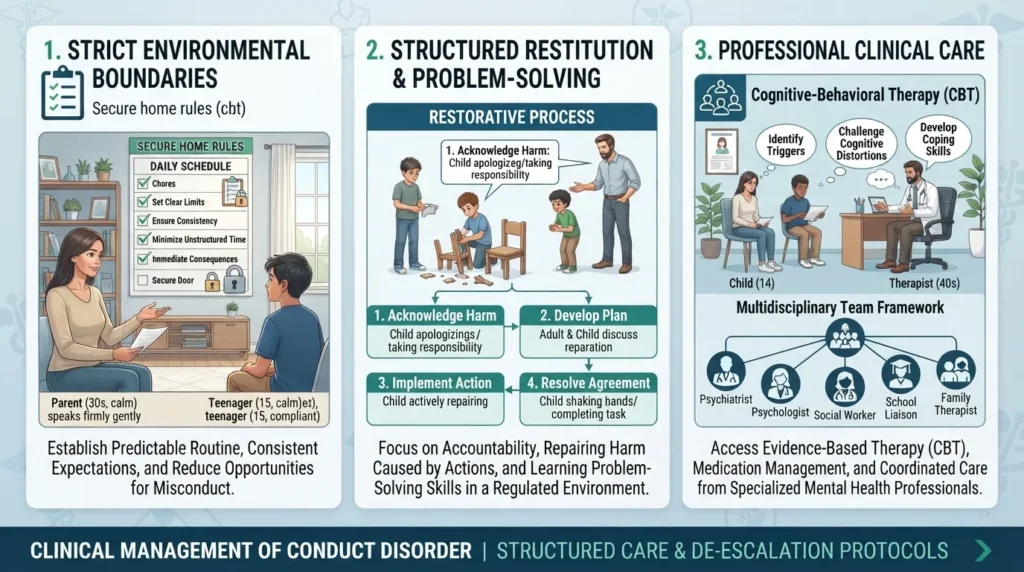
Conduct Disorder (CD) is a complex neurobehavioral and emotional condition that extends far beyond typical childhood defiance, characterized by a persistent pattern of behavior that violates the basic rights of others and major societal norms. Standard parenting strategies and casual behavioral corrections are entirely inadequate for managing this level of disruption. Guiding a child or adolescent with Conduct Disorder requires specialized clinical support, high levels of external structure, and coordinated professional intervention.
Signs That Go Beyond Typical Misbehavior
Recognizing the distinction between ordinary developmental rebellion and Conduct Disorder is essential for securing appropriate clinical care early.
Aggression Toward People and Animals: Involves chronic bullying, physical intimidation, weapon use, or cruelty to animals.
Destruction and Deceit: Features intentional property destruction, fire-setting, repeated lying, or breaking into homes and cars to steal.
Severe Rule Violations: Manifests as chronic truancy, running away from home, or breaking major parental and legal prohibitions before the age of legal maturity.
Structured, Consistent Consequences That Help
Managing daily behavior at home requires an unwavering, predictable framework where boundaries are non-negotiable and decoupled from emotional reactions.
Strict Environmental Boundaries: Establish clear, unyielding house rules paired with immediate, consistent logistical consequences for violations.
Eliminate Emotional Battles: Avoid shouting, moralizing, or engaging in long arguments, as emotional reactions can inadvertently reinforce adversarial dynamics.
Focus on Accountability: Require the child to directly participate in repairing any property damage or rectifying broken rules through structured restitution.
When to Involve a Behavioral Therapist
Conduct Disorder cannot be managed through home discipline alone; it requires a multidisciplinary medical and psychological approach.
Early Clinical Evaluation: Consult a pediatrician, child psychologist, or psychiatrist immediately if behavioral patterns involve violence, severe destruction, or disregard for safety.
Evidence-Based Therapies: Professional treatment typically incorporates Cognitive-Behavioral Therapy (CBT) and family therapy to restructure behavior and improve household communication.
Comprehensive Care Teams: Severe cases often benefit from school-based support programs and specialized medical oversight to address co-occurring conditions like ADHD or mood disorders.
Discipline for Related Traits and Temperaments
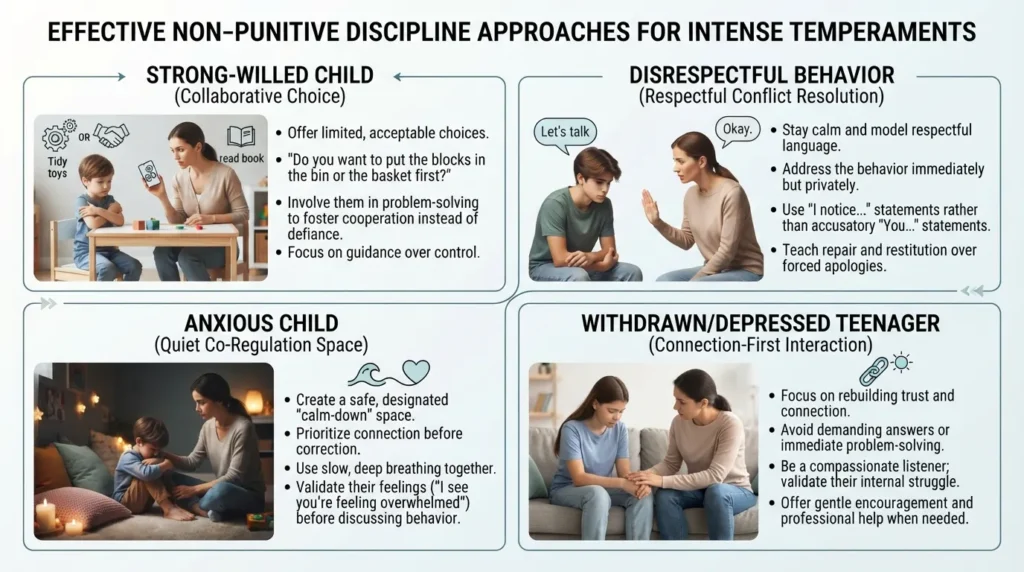
Many children exhibit challenging behaviors or intense temperaments that disrupt family life without ever meeting the diagnostic criteria for a formal clinical disorder. Navigating these personality traits requires shifting away from compliance-focused tactics and toward strategies that build emotional regulation, preserve connection, and respect autonomy.
How to Discipline a Strong-Willed Child
Strong-willed children possess an intense drive for independence and autonomy, meaning authoritarian demands will always trigger immediate resistance.
Offer Validated Choices: Give structured options rather than closed commands so the child retains a sense of control over their actions.
Respect Their Agency: Frame directions around cooperation rather than dominance, using collaborative language instead of ultimatums.
Natural Consequences: Allow safe natural outcomes to teach lessons, letting the environment do the disciplining rather than parental force.
How to Discipline a Disrespectful Child
Addressing backtalk, defiance, or rude language requires keeping your own emotional temperature entirely flat to prevent a power struggle.
Separate Tone From Content: Address the emotional delivery separately from the underlying issue, waiting until calm returns to discuss respectful communication.
Logical Restitution: If a child speaks disrespectfully, require a constructive repair action, such as rephrasing the statement politely or writing a note of apology.
Avoid Emotional Baiting: Refuse to engage with insults or eye-rolling; state the boundary once in a neutral tone and withdraw your attention until respect is restored.
How to Discipline a High-Anxiety Child
Anxiety-driven misbehavior often looks like avoidance, tantrums, or emotional outbursts, which get worse when treated with traditional punishment.
Co-Regulation First: Lower physical and emotional distress through deep breathing, quiet spaces, and a soothing presence before expecting compliance.
De-Escalate Fear: Recognize that resistance often stems from a panic response rather than defiance, requiring reassurance of safety over discipline.
Incremental Exposure: Break overwhelming tasks or transitions into tiny, manageable steps to prevent the anxiety cycle from triggering an outburst.
How to Discipline a Depressed Teenager
Disciplining a teenager experiencing depression requires separating underlying mental health struggles from willful misbehavior or disobedience.
Look Beneath the Surface: Recognize that withdrawal, irritability, or rule-breaking are frequently externalized signs of deep emotional pain and exhaustion.
Prioritize Connection Over Control: Focus on rebuilding trust, open listening, and unconditional support before enforcing strict disciplinary measures.
Professional Guidance: Involve a qualified mental health clinician or counselor to address the root causes of teen depression alongside family communication strategies.
Quick-Reference Comparison Table
| Condition or Trait | Best Discipline Approach | What to Avoid |
| ADHD | Visual schedules, immediate feedback, and short movement breaks | Long lectures, delayed consequences, and shaming |
| Autism | Predictable routines, sensory accommodations, and visual supports | Punitive isolation, loud overstimulation, and abrupt changes |
| ODD | Collaborative problem-solving and limited choices | Authoritarian ultimatums, power struggles, and shouting |
| PDA | Low-demand lifestyle, indirect language, and radical autonomy | Direct second-person commands and rigid rule enforcement |
| Conduct Disorder | Strict environmental boundaries, restitution, and professional CBT | Casual corrections, emotional arguments, and home-only discipline |
| Strong-Willed | Validated choices, natural consequences, and collaborative phrasing | Dominance-based demands, threats, and forced compliance |
| Disrespectful | Neutral emotional delivery and logical verbal restitution | Emotional baiting, matching their anger, and lecturing |
| High-Anxiety | Co-regulation, calming spaces, and incremental exposure | Traditional punishment, yelling, and forced fast transitions |
| Depressed Teenager | Connection-first support, open listening, and professional therapy | Strict punitive measures, shaming, and ignoring withdrawal |
Age-Specific Discipline Notes (Toddler to Teenager)

Effective behavior guidance must evolve alongside a child’s cognitive development, emotional maturity, and neurological growth. Applying toddler strategies to a teenager or expecting adolescent reasoning from a preschooler guarantees friction. Adjusting your discipline framework to match each developmental stage ensures your approach remains effective, empathetic, and age-appropriate.
Toddlers and Preschoolers (Ages 1–5)
During the early childhood years, children lack the brain architecture for impulse control, long-term memory, and emotional regulation. Discipline at this stage focuses entirely on environmental safety, immediate cause-and-effect learning, and physical co-regulation.
Environmental Control: Rely heavily on baby gates, cabinet locks, and childproofing to prevent danger before it requires verbal intervention.
Immediate Redirection: Deliver simple, short-phrase instructions paired with physical guidance the moment an unwanted behavior occurs.
Co-Regulation Support: Act as your child’s external nervous system during tantrums, offering a calm physical presence rather than isolation or complex lectures.
School-Age Children (Ages 6–12)
School-age children develop logical reasoning skills and the capacity to understand past actions and future outcomes. Discipline shifts toward teaching accountability, problem-solving, and utilizing logical consequences.
Collaborative Discussion: Involve children in setting household rules and discussing the natural outcomes of breaking agreements.
Logical Consequences: Connect discipline directly to the action, such as having a child clean up a mess they made or repair a broken item.
Skill Building: Teach emotional vocabulary and conflict-resolution strategies so children can independently manage peer friction and academic frustration.
Teenagers (Ages 13+)
Adolescence brings a massive neurological rewiring of the prefrontal cortex, accompanied by an intense drive for peer acceptance, autonomy, and identity formation. Discipline must transition from parental control to coaching, mutual respect, and collaborative negotiation.
Coaching Over Controlling: Act as a consultant rather than an authoritarian ruler, guiding teens through decision-making and letting them experience natural stakes safely.
Micro-Agreements: Establish clear, flexible boundaries and daily responsibilities through mutual discussion rather than top-down ultimatums.
Preserving Connection: Prioritize emotional safety and open communication above immediate compliance, ensuring your teen knows support remains unconditional.
Frequently Asked Questions
How do you discipline a 2-year-old who doesn’t listen?
A two-year-old who appears not to listen is usually experiencing the normal developmental limits of working memory and impulse control rather than acting out of deliberate defiance.
Get Eye-Level: Crouch down, establish gentle physical contact, and make eye contact before delivering a single-step, concrete instruction.
Remove Environmental Distractions: Turn off screens and lower background noise so their auditory processing system can focus entirely on your words.
Keep Commands Brief: Swap out long explanations or multi-step requests for short directives like “Walking feet” or “Hold my hand.”
What is the 3-3-3 rule for toddlers?
The 3-3-3 rule is an effective grounding and emotional regulation technique used to help toddlers navigate intense sensory overload or early panic spirals by shifting their focus outward.
Name 3 Things You See: Ask your toddler to look around and point out three visible objects in their immediate environment to interrupt the stress cycle.
Name 3 Things You Hear: Have them listen carefully and identify three distinct sounds, shifting their cognitive load away from internal frustration.
Move 3 Body Parts: Guide them to wiggle their fingers, shrug their shoulders, or stomp their feet to discharge physical tension through movement.
What is a red flag behavior for a 2-year-old?
While everyday tantrums and boundary testing are standard parts of early childhood, certain persistent signs warrant professional pediatric evaluation.
Complete Lack of Response: Consistently failing to respond to their name, avoiding eye contact, or showing zero interest in social interaction.
Severe Loss of Skills: Any abrupt regression in language, gesture use, or previously acquired self-care milestones.
Extreme, Unproportional Outbursts: Frequent meltdowns that last for extended periods, involve severe self-injury, or cannot be consoled by co-regulation.
How can parents handle disrespectful behavior without physical punishment?
Addressing backtalk or rudeness without physical discipline requires establishing firm, non-reactive boundaries that model emotional self-regulation.
Maintain a Flat Emotional Tone: Refuse to match your child’s anger or take insults personally, as emotional reactions often reinforce the behavior.
Enforce Logical Restitution: Require the child to repair the impact of their words, such as rephrasing a demand politely or helping clean up an upset they caused.
Address the Underlying Trigger: Look past the disrespect to identify whether hunger, exhaustion, sensory overload, or anxiety drove the outburst.
Is it appropriate to discipline a toddler who may not understand their actions?
Traditional punishment is entirely inappropriate for very young children who lack the neurological capacity for moral reasoning, but gentle guidance and physical boundaries are essential.
Focus on Teaching, Not Penalizing: View early misbehavior as an unrefined experiment or a lack of skills rather than willful wrongdoing.
Use Environmental Boundaries: Rely on baby gates, baby locks, and immediate physical redirection to prevent dangerous situations instead of relying on verbal reprimands.
Model Safe Alternatives: Show your toddler what to do instead using gentle touch or toys, building positive neural pathways through consistent repetition.
How do you discipline a toddler when nothing works?
When standard positive parenting scripts and conventional tips seem entirely ineffective, it usually signals that the child’s unique temperament or neurodivergent profile requires a customized approach.
Radically Reduce Demands: Temporarily strip away non-essential rules and lower environmental stress to help reset an overloaded nervous system.
Shift to Co-Regulation: Abandon isolation tactics like traditional time-outs and instead offer a calm physical presence to help the child regulate.
Investigate Developmental Needs: Consult a pediatrician or behavioral specialist to screen for underlying conditions like ADHD, autism, or a PDA profile that require specialized strategies.
Conclusion — Key Takeaways
Parenting a child whose behavior tests your absolute limits is an exhausting, emotionally draining journey, but it does not mean you are failing. True discipline is never about exerting control or punishing a child into compliance; it is an ongoing process of teaching, guiding, and supporting brain development. When standard gentle parenting scripts and universal advice fall flat, the answer is not to try harder with methods built for a different child—it is to adapt your approach to fit your child’s unique neurological reality.
Whether you are navigating the sensory overload of autism, the high-octane impulses of ADHD, the unrelenting opposition of ODD, the nervous system panic of PDA, or the deep struggles of a strong-willed temperament, your patience and willingness to look beneath the surface matter profoundly. By trading frustration for curiosity, environmental control for reactive punishment, and isolation for co-regulation, you transform daily power struggles into moments of genuine connection.
Change takes time, and new neural pathways require at least thirty days of steady, predictable consistency to take root. Extend grace to your child, but remember to extend that exact same grace to yourself. You are building a foundation of emotional safety and trust that will anchor your child long after the toddler years are gone.
Kittisak Wattanakul
Kittisak Wattanakul is the Discipline Editor at Holistic Wellbeing Living. He writes about routines, focus, consistency, and practical follow-through. With nine years of experience creating personal-growth content, Kittisak helps readers build realistic systems for steady progress without extreme productivity pressure.