Jump to:
ToggleHow to Learn Self-Control: The Ultimate Science-Based Guide to Master Willpower and Discipline
Introduction — What Self-Control Really Means
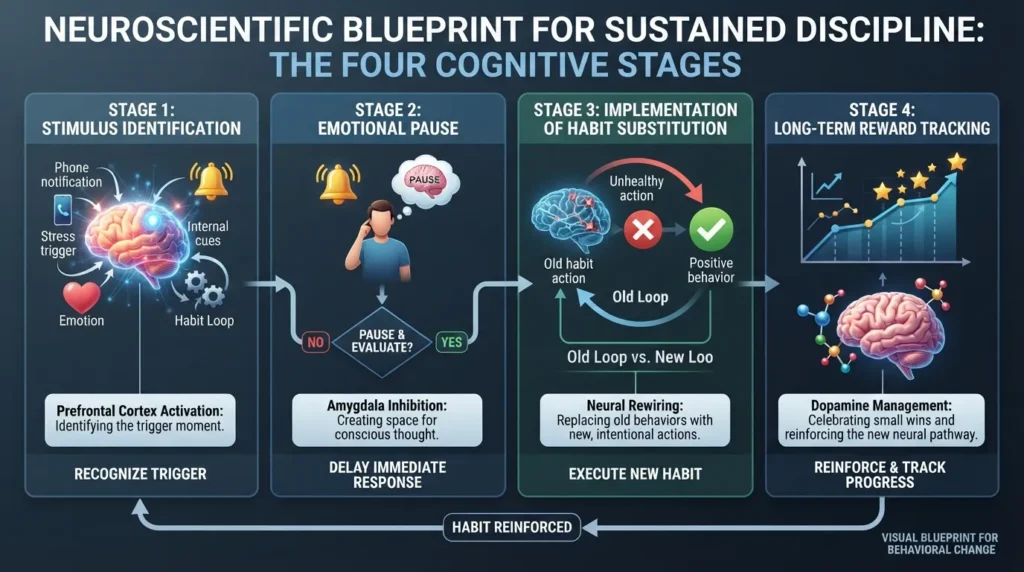
Self-control is the foundational cognitive and behavioral capacity that allows individuals to override short-term impulses, resist immediate gratification, and align actions with long-term goals. Far from being a fixed trait of rigid restriction, modern psychological research defines self-regulation as a dynamic mental resource governing attention, emotion, and decision-making under pressure.
What Is Self-Control? (Quick Working Definition)
Core Behavioral Mechanism: The active inhibition of dominant impulses, emotional reactivity, or habitual routines in favor of goal-directed alternatives.
The Dual-System Model: Operates through a constant neurological tension between the limbic system (seeking immediate rewards) and the prefrontal cortex (evaluating long-term consequences).
Dynamic Capacity vs. Fixed Trait: Functioning less like a permanent personality badge and more like a renewable psychological muscle that can be systematically strengthened through deliberate practice.
Interconnected Terminology: Encompasses related constructs such as impulse control, self-discipline, and emotion regulation, each contributing to sustained behavioral execution.
Why Most People Struggle to Build It
Relying Solely on Raw Willpower: Treating self-control as an endless reservoir rather than an energy-limited resource leads to rapid decision fatigue and eventual burnout.
Neglecting Environmental Design: Forcing continuous internal resistance against constant temptations (like smartphone notifications or easily accessible junk food) rather than removing friction-points from the surrounding environment.
Setting Ambiguous Objectives: Vague resolutions lack the clear neural pathways required for the prefrontal cortex to execute quick override protocols during high-stress moments.
Ignoring Physiological Regulators: Depriving the brain of stable blood glucose, consistent circadian rest, and stress-management outlets directly impairs the neurochemical engine required for effective self-regulation.
Self-Control vs. Self-Discipline — The Real Difference
Self-control and self-discipline are frequently used interchangeably, yet they represent two distinct psychological mechanisms operating across different time horizons. Understanding the structural boundaries between reactive impulse management and proactive system building is essential for lasting behavioral change.
Self-Control: The In-the-Moment Reaction
Immediate Impulse Inhibition: Acts as an emergency brake designed to halt sudden temptations, emotional outbursts, or urges for instant gratification.
High Cognitive Load: Relies heavily on executive function and active prefrontal cortex energy, making it prone to depletion during high-stress situations.
Reactive Nature: Engages only after a trigger or temptation has already presented itself in the immediate environment.
Short-Term Defense: Prevents immediate failure or yielding, but does little on its own to build permanent, repeatable performance frameworks.
Self-Discipline: The Long-Term System
Proactive Routine Construction: Involves setting up premeditated structures, schedules, and constraints that eliminate the need for constant in-the-moment fighting.
Habit Formation Engine: Converts effortful behaviors into automated neural pathways through consistent repetition over extended periods.
Reduced Friction: Minimizes reliance on raw willpower by redesigning daily environments and workflows to make productive choices the path of least resistance.
Long-Term Investment: Focuses on cumulative progress, skill acquisition, and sustained goal attainment over months and years.
How They Work Together (Comparison Table)
| Feature | Self-Control | Self-Discipline |
| Temporal Focus | Immediate present (reactive) | Future-oriented (proactive) |
| Primary Function | Stopping bad impulses | Building productive systems |
| Energy Cost | Extremely high and depletable | Lower over time due to automation |
| Metaphor | The emergency brake in traffic | The paved highway steering your route |
Why Self-Control Matters The Science-Backed Case
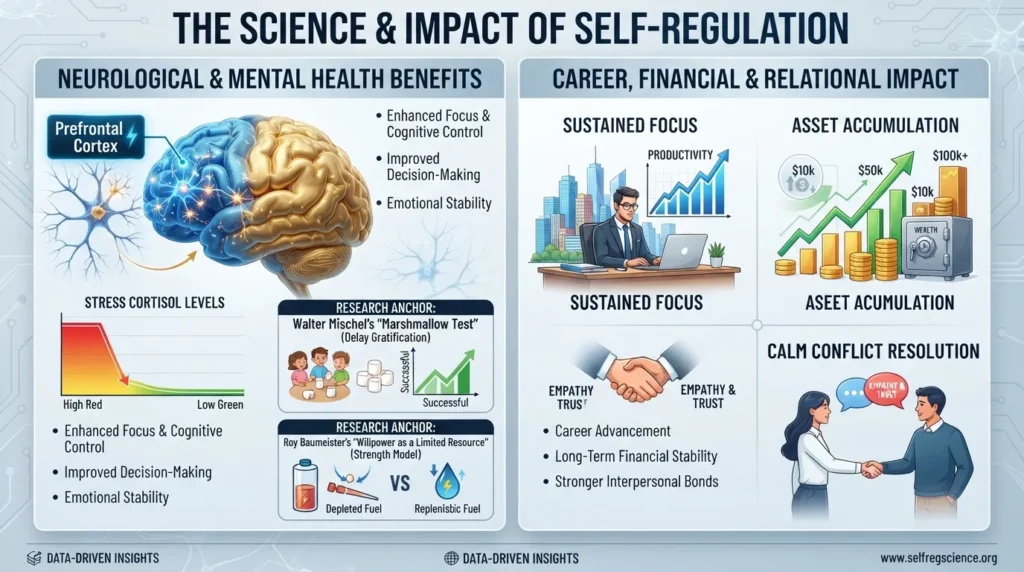
Self-control serves as a master predictor of life outcomes, influencing everything from neurological stress responses to lifetime financial security far more reliably than raw intelligence. Mastering this capacity transforms how individuals handle daily friction, turning erratic emotional reactions into predictable, measured responses.
Mental Health & Emotional Regulation Benefits
Stress Mitigation: Lowers systemic cortisol production by halting catastrophic thought loops before they trigger acute anxiety.
Mood Stabilization: Prevents cyclical emotional crashes by interrupting impulsive reactions to minor inconveniences or social provocations.
Resilience Under Pressure: According to Harvard Health, self-regulation strategies directly affect long-term emotional stability and psychological coping capacity.
Depression Reduction: Keeps rumination in check, allowing individuals to process negative experiences without falling into prolonged depressive stagnation.
Career, Financial, and Relationship Impact
Professional Advancement: Enables deep, focused work free from digital distractions, driving superior output and complex problem-solving.
Financial Preservation: Restrains impulse buying and encourages long-term asset accumulation over short-term consumption.
Conflict Resolution: Pauses defensive communication patterns during marital or workplace disputes, substituting constructive dialogue for emotional reactivity.
Trust and Reliability: Fosters stable interpersonal bonds as peers and partners rely on consistent, predictable behavioral standards.
What Psychology Research Says About Self-Control
The Marshmallow Study Legacy: Walter Mischel’s foundational delayed gratification research established that children who could resist immediate rewards achieved higher adult academic and professional success metrics.
The Strength Model: Roy Baumeister’s experiments revealed that self-control functions as a limited metabolic resource that requires strategic pacing and scheduled recovery intervals.
Executive Function Correlates: Neuroscientific imaging demonstrates that high self-regulation correlates with denser gray matter in the prefrontal cortex, enhancing overall cognitive control.
The 4 Types of Self-Control Know Your Weak Points
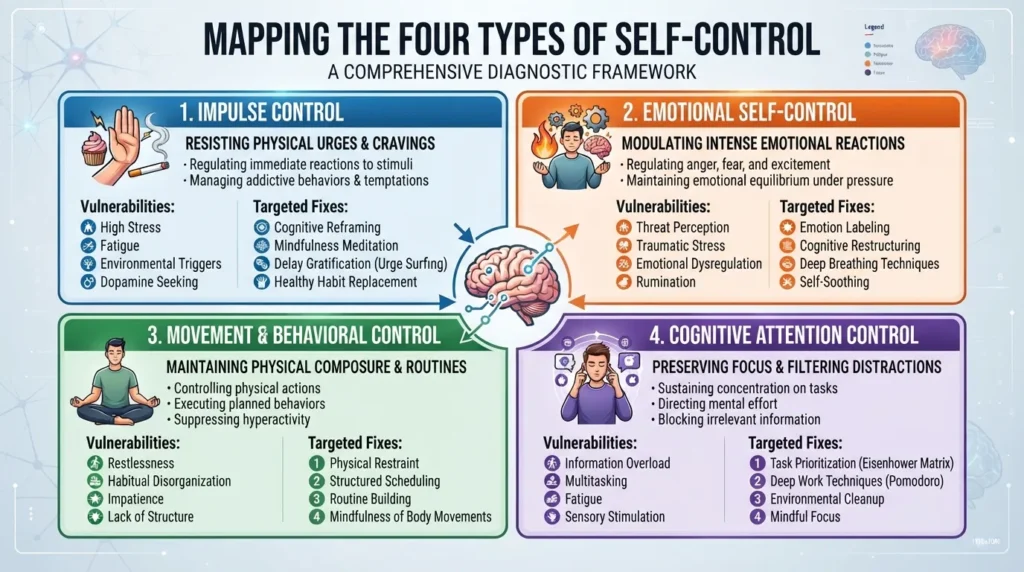
Mastering self-control requires recognizing that restraint is not a singular trait; rather, it manifests across four distinct cognitive and physical domains. Identifying which specific domain represents your primary vulnerability allows you to deploy targeted interventions rather than relying on generic willpower tactics.
Impulse Control
Definition: The ability to stop immediate behavioral urges, physical cravings, or sudden desires before translating them into action.
Common Vulnerability: Yielding instantly to physical temptations, such as mindless snacking, impulse shopping, or binge-watching entertainment late into the night.
Targeted Fix: Implement mandatory friction points, such as a 24-hour waiting period before online purchases or keeping trigger foods out of the immediate physical workspace.
Emotional Self-Control
Definition: The capacity to manage and modulate intense emotional reactions, preventing frustration, anger, or excitement from dictating behavior.
Common Vulnerability: Reacting defensively to constructive criticism, snapping at colleagues during high-stress projects, or making erratic choices while overwhelmed.
Targeted Fix: Practice tactical pauses and deep-breathing protocols to bridge the gap between emotional triggers and outward responses.
Movement/Behavioral Control
Definition: The physical restraint needed to maintain bodily composure, inhibit nervous habits, or execute precise, deliberate physical routines.
Common Vulnerability: Restlessness during long sessions of deep work, nervous fidgeting that destroys focus, or abandoning physical exercise routines due to temporary discomfort.
Targeted Fix: Structure physical activity into defined blocks and utilize ergonomic environmental adjustments to anchor your physical state during critical tasks.
Cognitive/Attention Control
Definition: The power to direct mental focus intentionally and resist internal or external distractions that pull awareness away from priority goals.
Common Vulnerability: Chronic context-switching, falling into social media rabbit holes during deep work, or entertaining unproductive mental rumination.
Targeted Fix: Deploy absolute digital isolation techniques, such as website blockers and time-blocking, to protect attention spaces from cognitive fragmentation.
The 4-Step "Pause & Redirect" Method — How to Learn Self-Contro
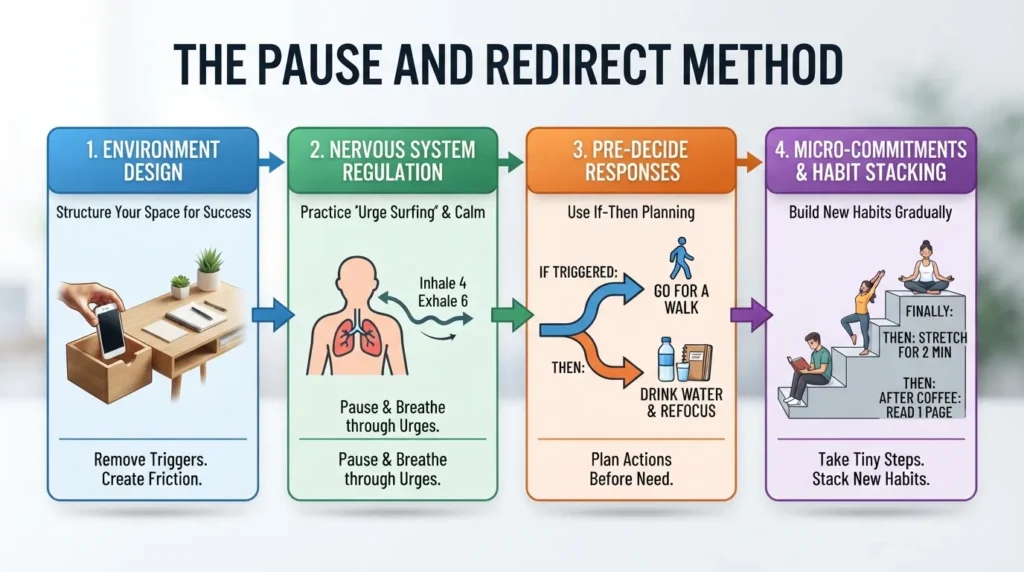
Developing robust self-control is not about suffering through continuous internal friction; it is a systematic process of environment design, neurological pacing, and strategic habit execution. By implementing a clear sequence, you transform self-regulation from a battle of raw exhaustion into an automated, predictable routine.
Step 1: Redesign Your Environment (Remove the Temptation)
Friction Elimination: Reduce the effort required to make positive choices while artificially increasing the barrier to counterproductive habits.
Out of Sight, Out of Mind: Physically relocate triggers—such as placing your smartphone in another room during deep work or clearing junk food out of pantry sightlines.
Decision Pre-Loading: Let your physical workspace do the heavy lifting so you do not have to rely on willpower when motivation dips.
Step 2: Pause and Breathe (Reset Your Nervous System)
The Urge Surfing Technique: Recognize that intense impulses peak and subside within minutes; riding the wave without reacting stops automatic looping.
Vagal Nerve Activation: Take slow, diaphragmatic breaths to override the fight-or-flight response mediated by the limbic system.
Creating a Gap: Insert a deliberate 10-second delay between an external trigger and your behavioral response to reactivate prefrontal cortex oversight.
Step 3: Pre-Decide Your Response (Plan Ahead for Triggers)
Implementation Intentions: Draft precise if-then plans (e.g., “If I feel stressed at 3 PM, then I will take a five-minute walk instead of checking social media”).
Automating Choices: Eliminate real-time negotiating by pre-scheduling when, where, and how you will tackle high-friction tasks.
Vulnerability Mapping: Identify predictable weak spots in your daily schedule and map out alternative outlets before temptations arrive.
Step 4: Start Small and Stack Wins (One Habit at a Time)
Micro-Commitments: Focus on building capacity through tiny, un-fail-able steps rather than attempting massive lifestyle overhauls overnight.
The Snowball Effect: Keeping small commitments to yourself builds psychological confidence and expands your overall self-regulatory threshold.
Single-Goal Focus: Channel your mental energy into mastering one specific behavioral change before spreading your focus across multiple domains.
Bonus Factor: Why Sleep Is Your Hidden Self-Control Tool
Neurological Restoration: Deep REM and non-REM sleep cycles directly replenish the metabolic energy consumed by the prefrontal cortex.
Impulse Amplification: Chronic sleep deprivation impairs glucose metabolism in brain regions responsible for impulse inhibition and emotional regulation.
Baseline Resilience: Prioritizing consistent circadian rest ensures your mental engine starts each day at maximum capacity.
To see expert insights on building better daily habits and eliminating discipline stealers, check out this Ed Mylett Self-Control Guide. This video is relevant because it breaks down practical rules from top performance coaches on how to maintain consistency and eliminate distractions.
Self-Discipline Exercises to Practice Daily
Transforming self-discipline from an abstract aspiration into a concrete daily reality requires treating it like a physical skill that responds directly to progressive overload. By implementing targeted behavioral drills, you condition your nervous system to tolerate discomfort without defaulting to immediate escape.
The 10-Minute Delay Rule
Urge Neutralization: When confronted with an immediate craving or distraction, mandate a strict 10-minute waiting window before deciding to yield.
Prefrontal Recalibration: This brief pause shifts cognitive processing away from the emotionally reactive limbic system and back toward executive control.
Behavioral Disruption: The vast majority of impulsive cravings naturally dissipate or lose their intense grip once this short buffer period expires.
Cold Exposure & Discomfort Training (Building Tolerance)
Physical Stress Adaptation: Intentionally introducing controlled discomfort—such as ending a shower with 30 seconds of cold water—trains the brain to remain calm under physiological stress.
Overriding Avoidance Circuits: Repeatedly facing minor, voluntary discomfort rewires neural pathways, making it easier to stay composed during high-stakes psychological challenges.
Building Mental Toughness: Expands your overall psychological baseline, reducing the perceived threat level of everyday annoyances or difficult tasks.
Digital Detox Drill (Phone-Free Blocks)
Attention Protection: Establish absolute screen-free intervals (such as the first and last hour of your day) to prevent external inputs from hijacking your focus.
Dopamine Baseline Reset: Interrrupting the constant cycle of micro-notifications reduces baseline reward-seeking behaviors and restores attention span depth.
Friction Creation: Physically isolating your phone in another room during key execution periods removes the automatic muscle memory of mindless scrolling.
Tracking Habit Streaks
Visual Accountability: Utilize a physical calendar or habit tracker to mark off completed performance standards, creating an undeniable record of execution.
Loss Aversion Leverage: The psychological momentum of protecting an established daily streak provides an extra layer of motivation during low-energy moments.
Objective Progress Evaluation: Converts intangible efforts into measurable data points, allowing you to identify consistency gaps and optimize your daily routines.
To dive deeper into overcoming the hidden emotional loops behind procrastination and mastering real-time regulation, watch The Mindset Mentor Podcast Self-Control Guide. This video provides tactical frameworks on how to regulate your nervous system and reclaim control from autopilot habits [00:00].
I Lost Self-Control — What Should I Do Now? Recovery Section
Experiencing a lapse in self-control does not erase your previous progress; it simply provides diagnostic feedback on where your current system or emotional threshold experienced friction. Treating a single slip as a catastrophic failure triggers unnecessary guilt loops, whereas analyzing the trigger converts a setback into actionable data for future resilience.
Why “Falling Off Track” Is Normal (Not Failure)
The Imperfection Baseline: Behavioral change is non-linear, and neurological rewiring inherently involves occasional regression under high stress or fatigue.
The All-or-Nothing Fallacy: Believing that one mistake ruins an entire habit streak causes people to completely abandon their goals rather than executing an immediate course correction.
System Diagnostic Value: A lapse highlights precise environmental vulnerabilities, emotional triggers, or energy deficits that need reinforcement in your daily routine.
The 3-Minute Reset After a Slip
Immediate Emotional Neutralization: Stop self-flagellation instantly; harsh inner criticism spikes cortisol and depletes the prefrontal energy required to recover stability.
Physiological Down-Regulation: Take three slow, deliberate breaths to exit the panic state and deactivate the brain’s acute stress response.
Objective Fact-Retrieval: Briefly note the exact trigger, time of day, and emotional state that preceded the slip without emotional judgment or rationalization.
How to Get Back on Track Without Guilt Spirals
The Two-Day Rule: Enforce a strict personal boundary that allows missing a habit once, but never permits missing it two days in a row.
Instant Habit Resumption: Immediately execute the smallest possible version of your routine (such as doing a single push-up or writing one sentence) to re-engage psychological momentum.
Proactive Adjustment: Modify your immediate environment or schedule to protect against the specific vulnerability that caused the slip, preventing identical future failures.
What It Feels Like to Have Strong Self-Control (Real Insight)

Having strong self-control does not feel like an exhausting daily battle against constant temptation; rather, it feels like an unexpected, quiet calmness inside the mind. When you finally build robust self-regulation systems, the frantic noise of urgency fades away, replaced by the profound realization that you are no longer at the mercy of every passing impulse or emotional trigger.
The Mental Shift That Happens Over Time
From Friction to Automation: Initial stages demand heavy conscious effort to resist bad habits, but consistent repetition eventually hard-wires new neural pathways so productive choices happen automatically.
The Disappearance of Urgency: Cravings and stressful moments no longer demand an immediate, panicky reaction; instead, they appear as distant waves that you can observe and let pass without jumping in.
Absolute Ownership of Time: Your days stop feeling like a chaotic series of reactions to notifications, emotions, and environment triggers, shifting entirely into intentional, deliberate execution.
Real Example: A Before/After Self-Control Transformation
The Before State: Years ago, every workday began with immediate distraction—checking social media feeds within seconds of waking up, living in a constant state of decision fatigue, and abandoning hard goals by Tuesday afternoon because raw willpower burned out.
The Turning Point: Recognizing that fighting my own environment was a losing battle, I stopped relying on brute-force motivation and redesigned my physical workspace while adopting a strict 10-minute pause rule for high-stress urges.
The After State: Today, deep-focus work blocks happen effortlessly because distractions are physically locked away, emotional triggers are met with deliberate diaphragmatic breathing, and consistency compounds into quiet, compounding life momentum.
Self-Control, Confidence & Emotional Intelligence — How They Connect
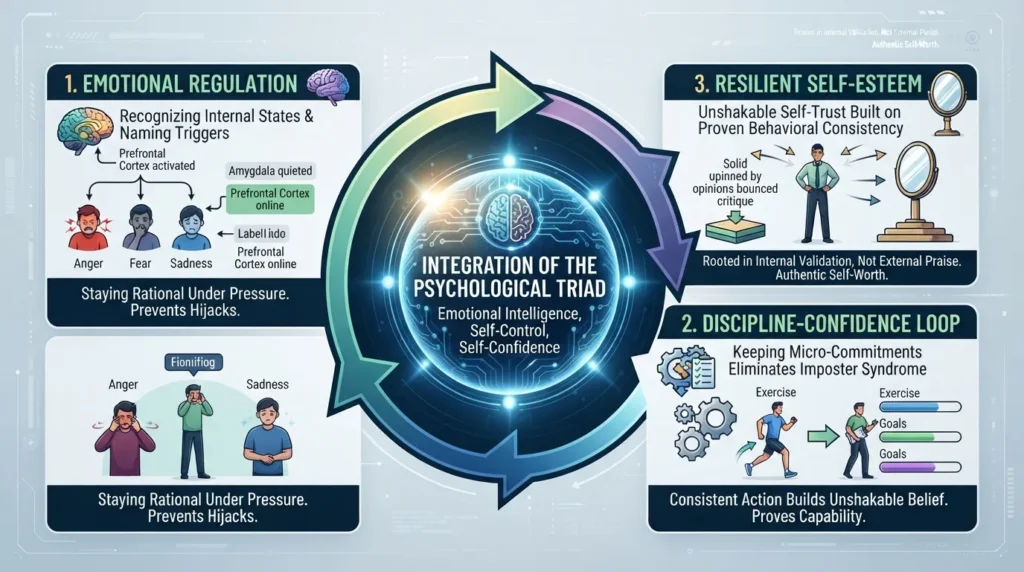
Self-control, emotional intelligence, and self-confidence operate as an interconnected psychological triad where strengthening any single pillar automatically elevates the others. True confidence is rarely born from superficial positive affirmations; rather, it is forged through the quiet self-trust built by keeping micro-commitments to yourself day after day.
The Confidence–Discipline Feedback Loop
Building Internal Trust: Every time you successfully override an impulsive urge or stick to a pre-scheduled task, you send undeniable neurological proof of competence to your own brain.
Eradicating Imposter Syndrome: Consistently executing high-friction decisions eliminates the gap between who you claim you want to be and how you actually behave.
Resilient Self-Esteem: Unlike fragile confidence built on external validation, discipline-based self-esteem remains unshakable because it relies on your proven capacity to handle discomfort.
Emotional Intelligence as a Self-Control Multiplier
Recognizing Internal States: High emotional intelligence allows you to detect subtle physiological shifts—such as rising frustration or anxiety—long before they erupt into reactive behavior.
Naming to Tame: Accurately labeling an emotional trigger immediately reduces its neurological intensity, keeping your prefrontal cortex online instead of triggering the survival-driven amygdala.
Pausing Between Stimulus and Response: Mastering emotional awareness creates the necessary psychological space to choose a deliberate, constructive path forward rather than defaulting to escape.
Frequently Asked Questions (PAA + AI Overview Capture Block)
How can I learn to control myself?
The Core Mechanism: Regulate your nervous system first through slow diaphragmatic breathing to bring your prefrontal cortex back online before attempting to execute willpower.
Environment Redesign: Systematically remove immediate physical triggers and temptations from your workspace to eliminate the need for constant in-the-moment resistance.
The 4-Step Method: Implement the Pause & Redirect framework by pausing, pre-deciding your behavioral response, and stacking small daily wins.
How can I get better at self-control?
Progressive Discomfort Training: Treat self-regulation like a physical muscle by introducing minor, controlled challenges such as short cold-water immersion or structured task delays.
Habit Automation: Replace reliance on erratic motivation with rigid systems, time-blocking, and clear environmental friction points.
Consistent Recovery: Prioritize stable circadian sleep cycles to ensure your neurological decision-making engine starts each day fully restored.
What are the 5 pillars of self-control?
Self-Awareness: Recognizing internal emotional triggers, stress states, and autopilot habits before they dictate your external behavior.
Environment Design: Shaping physical and digital surroundings to make productive choices frictionless and counterproductive impulses inaccessible.
Emotional Regulation: Modulating intense mental reactions through intentional pauses, urge surfing, and physiological down-regulation.
Goal Clarity: Maintaining hyper-specific, well-defined long-term objectives that give your prefrontal cortex an explicit reason to override short-term desires.
Rest and Recovery: Protecting cognitive energy reserves through adequate sleep, stress management, and tactical breaks to prevent executive burnout.
What are 7 ways to gain self-discipline?
Implement the 10-Minute Rule: Force a strict waiting buffer before yielding to any sudden craving or distraction.
Track Daily Streaks: Maintain visible accountability using a habit tracker to leverage loss aversion and psychological momentum.
Establish Digital Isolation: Carve out phone-free blocks to reset your dopamine baseline and protect your attention span.
Draft Implementation Intentions: Write out precise if-then plans for predictable high-stress triggers.
Break Down Micro-Goals: Focus on tiny, un-fail-able steps rather than attempting massive overnight lifestyle overhauls.
Practice Urge Surfing: Ride out intense impulses like physical waves until they naturally peak and subside.
Enforce the Two-Day Rule: Allow yourself to slip once, but never permit missing an established habit two days in a row.
What are the 7 powers of self-control?
Impulse Inhibition: The capacity to stop immediate physical cravings and sudden behavioral urges instantly.
Emotional Modulation: The ability to prevent frustration, anger, or excitement from hijacking rational decision-making.
Attention Focus: The power to direct mental energy exclusively toward priority tasks while ignoring internal and external noise.
Behavioral Composure: The physical restraint needed to maintain steady posture and eliminate nervous habits during high-pressure demands.
Resilience Under Stress: The internal fortitude required to maintain calm and execution during unexpected crises.
Long-Term Vision: The ability to sacrifice immediate gratification in service of compounding future success.
Self-Correction: The diagnostic power to analyze personal failures objectively and recalibrate systems without falling into guilt spirals.
What is the easiest and fastest way to develop total self-control?
Total self-control cannot be unlocked instantly through quick hacks or overnight shortcuts, as genuine behavioral change requires systematically rewiring neural pathways. The fastest sustainable route is to stop relying on raw willpower and immediately implement the 4-step Pause & Redirect method: redesigning your environment, regulating your nervous system, pre-planning responses, and stacking small micro-wins.
How do I develop self-control biblically?
Within faith-based traditions, self-control is viewed less as a product of human exhaustion and more as a spiritual fruit produced through alignment with divine principles. Integrating this perspective involves coupling personal discipline with prayer, viewing restraint as a form of stewardship over one’s mind and body, and relying on spiritual community for moral accountability.
Conclusion — Your Next Step
True self-control is never about punishing yourself into submission; it is a systematic art of environment design, nervous system regulation, and sustainable habit execution. By shifting away from exhausting willpower battles and stepping into proactive system-building, you permanently reclaim authority over your daily choices.
Quick Recap of the 4-Step Method
Environment Design: Strip away immediate temptations and build physical friction to make productive behaviors the path of least resistance.
Nervous System Reset: Utilize slow, diaphragmatic breathing and the 10-minute urge-surfing delay to bring your prefrontal cortex back online.
Pre-Planned Execution: Draft concrete if-then implementation intentions so you never have to negotiate with yourself during high-stress moments.
Micro-Wins and Recovery: Prioritize deep circadian rest and stack tiny, un-fail-able habit increments to compound long-term momentum.
Your First Small Action to Take Today
Pick One Vulnerability: Identify a single recurring friction point—such as mindless phone scrolling or afternoon snacking—that consistently drains your focus.
Apply the Pause: The very next time that specific trigger arises, insert a strict 10-minute waiting window and take three slow, deliberate breaths.
Execute the Micro-Fix: Relocate the trigger out of sight, write down what you are actually feeling, and take one tiny step forward to lock in your win.
Kittisak Wattanakul
Kittisak Wattanakul is the Discipline Editor at Holistic Wellbeing Living. He writes about routines, focus, consistency, and practical follow-through. With nine years of experience creating personal-growth content, Kittisak helps readers build realistic systems for steady progress without extreme productivity pressure.