Jump to:
ToggleHow to Pronounce Discipline Correctly (Step-by-Step Guide)
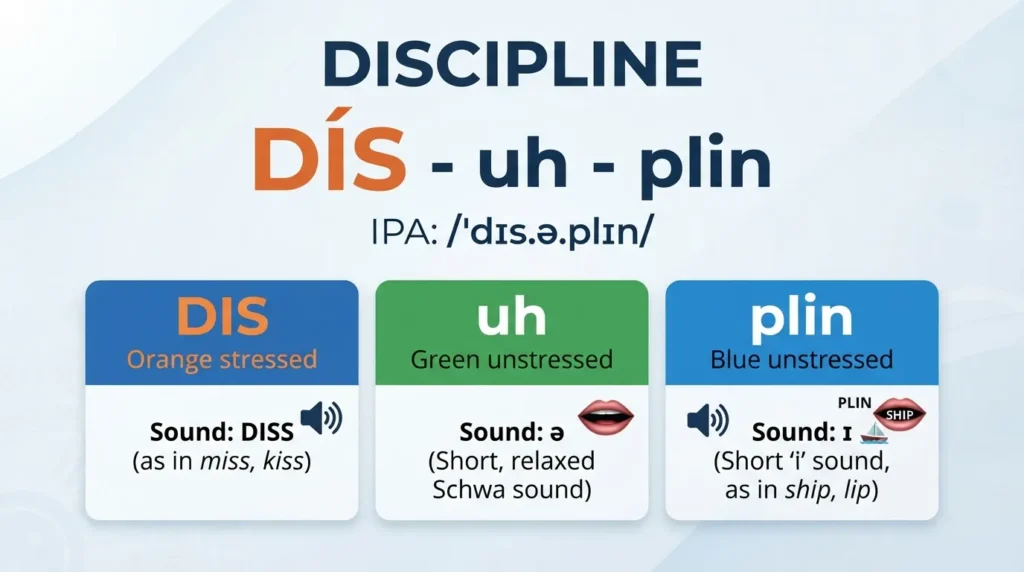
How to Pronounce "Discipline"?
DIS-uh-plin is the standard phonetic spelling for “discipline,” broken down into three distinct syllables. The primary stress falls firmly on the first syllable, while the second and third syllables are spoken with a light, unstressed cadence.
Quick Pronunciation Answer: DIS-uh-plin
First Syllable (DIS-): Pronounced with a short “i” sound, identical to the word “dis” in distance.
Second Syllable (-uh-): Reduced to a quick schwa sound, sounding like “uh” rather than a hard vowel.
Third Syllable (-plin): Ends with a crisp “plin” cluster where the ‘p’ and ‘l’ blend smoothly together without an intrusive vowel.
IPA Transcription of “Discipline”
The International Phonetic Alphabet representation for discipline pronunciation is /ˈdɪsəplɪn/.
[d]: Standard voiced alveolar plosive, as heard in dog.
[ɪ]: Near-close near-front unrounded vowel, matching the sound in kit.
[s]: Voiceless alveolar fricative, just like the sound in sip.
[ə]: The neutral schwa sound representing the unstressed middle vowel.
[p]: Voiceless bilabial plosive found in pen.
[l]: Alveolar lateral approximant as in leaf.
[n]: Alveolar nasal as in net.
Syllable-by-Syllable Breakdown of "Discipline"
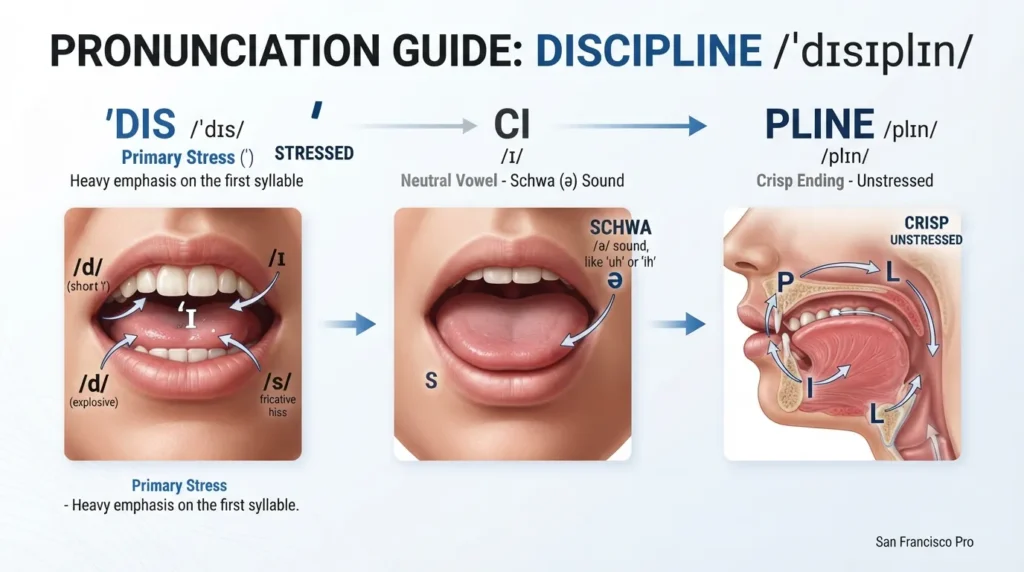
Mastering the precise syllable breakdown of dis-uh-plin requires examining how each phonetic part functions in American and British English. Breaking the word down prevents common mispronunciations and ensures natural cadence.
DIS – Sharp “D” Sound Breakdown
The first syllable carries the primary stress, meaning it receives higher pitch and louder projection.
Start with a crisp alveolar stop by tapping the tip of your tongue against the ridge behind your upper front teeth.
Immediately transition into a short, punchy “I” sound without dragging it into a long “ee” vowel.
uh (Schwa Sound ə) – The Most Common Mistake Point
Speakers often make the error of over-pronouncing the middle vowel as a hard “ah” or “ee”.
This middle element represents the classic schwa sound, a neutral, lazy vowel sound produced with a relaxed mouth.
Keep your tongue and jaw entirely relaxed, letting the sound slip out as a brief, quiet “uh”.
plin – Ending Sound Explained
The final cluster blends the voiceless bilabial plosive p directly into the lateral approximant l.
Avoid inserting an accidental extra vowel sound like “uh-plin”; the transition between p and l should happen instantly.
Close the final syllable smoothly with a clean nasal n, letting your tongue rest lightly against the gum ridge.
Mouth Position Tips for Each Syllable (E-E-A-T practical angle)
Jaw Control: Keep your jaw moderately closed throughout, dropping it slightly only on the initial stressed DIS syllable.
Lip Posture: Keep lips unrounded and neutral, especially when transitioning through the middle schwa segment.
Tongue Placement Practice: Practice saying “DIS”, then quickly dropping to “uh”, and closing with “plin” in a slow loop before speeding up to normal conversational pace.
Which Syllable Gets the Stress? (Stress Pattern)
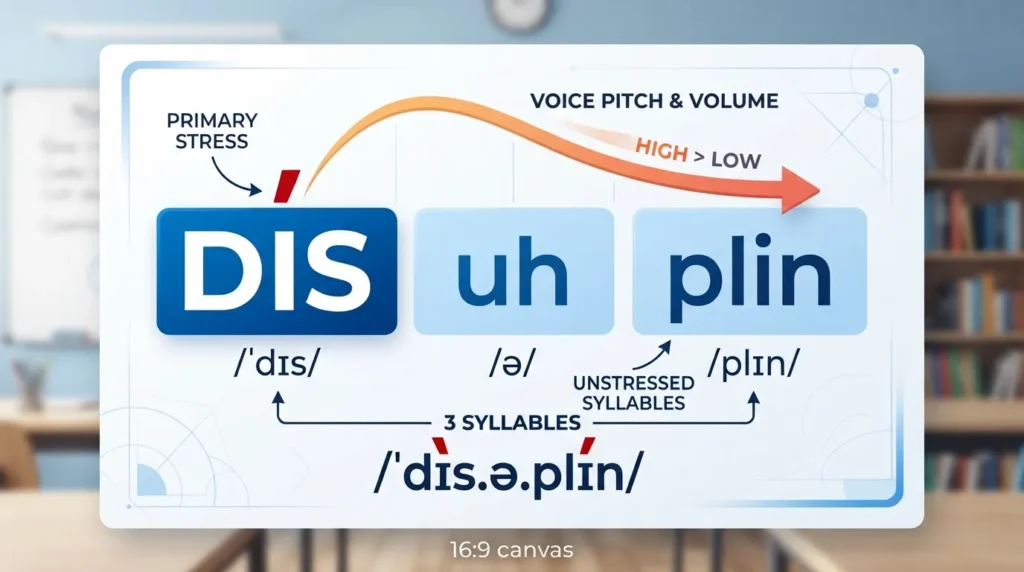
DIS-uh-plin places its primary stress firmly on the very first syllable (DIS), while the remaining two syllables are reduced and unstressed. Mastering this stress pattern is the single most important factor in sounding natural and clear to native speakers.
Primary Stress: DIS-uh-plin (First Syllable Emphasis)
Initial Loudness and Pitch: The opening DIS syllable is spoken with higher pitch, louder volume, and longer duration than the rest of the word.
The Unstressed Tail: Once you pass the first syllable, the voice drops off immediately. The middle (-uh-) and final (-plin) syllables are compressed and spoken quickly.
Rhythm Practice: Tap your finger on a table only when saying the first syllable (DIS) to feel the natural weight distribution of the word.
Why Getting Stress Wrong Changes How You Sound
Unnatural Cadence: Shifting stress to the second syllable (dis-UH-plin) or pronouncing all three syllables with equal weight instantly flags your speech as non-native or robotic.
Loss of Comprehensibility: Native English speakers rely heavily on word stress to instantly recognize vocabulary in fast-paced conversation.
The “Flat” Trap: Treating words like a flat list of equal syllables forces listeners to work harder to understand you, reducing your overall spoken fluency.
Common Mispronunciations of "Discipline" (Mistakes to Avoid)
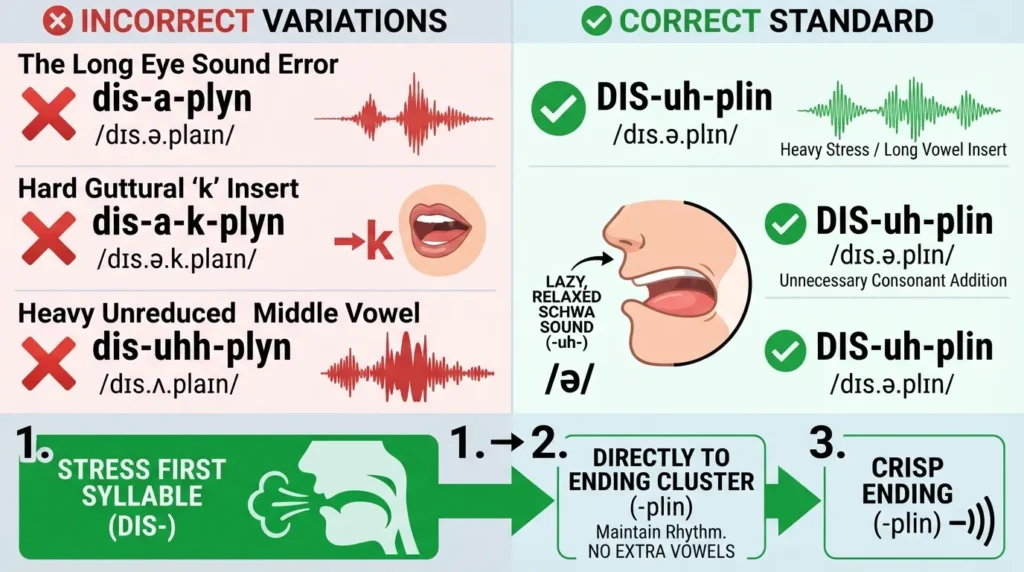
Dis-uh-plin contains subtle phonetic traps that frequently trip up English learners and native speakers alike. Recognizing these common errors is the fastest way to correct your accent and build natural speech habits.
Mistake 1: Saying “Dis-a-pline” Instead of “Dis-uh-plin”
The Error: Pronouncing the final syllable with a long “eye” sound, making it rhyme with “pine” or “line” (dis-uh-plyn).
The Correction: Treat the ending as a short, soft -plin rhyme where the “i” is completely unaccented and quick, sounding identical to the ending of “plin” in “duckling.”
Why It Happens: Readers often let standard English spelling rules override actual phonetic pronunciation, assuming words ending in “-ine” always rhyme with “line.”
Mistake 2: Hard “C” Sound Confusion (Discipline has no “K” or “S” hard sound issue)
The Error: Inserting a hard “k” sound or an unnecessary extra hissing sound into the middle of the word because of the letter “c”.
The Correction: Remember that the letters -pl- in the middle create a direct plosive-to-lateral transition, bypassing any hard guttural sounds.
Why It Happens: The spelling features a “c”, which often represents a hard “k” sound in other English contexts, leading speakers to over-articulate a stop that does not belong there.
Mistake 3: Skipping the Schwa Sound
The Error: Giving full vowel weight to the middle syllable, pronouncing it as a clear “a” or “ee” (dis-ay-plin).
The Correction: Keep your mouth relaxed and breeze through the middle syllable as a fleeting, neutral schwa sound.
Why It Happens: Non-native speakers coming from syllable-timed languages tend to give every vowel equal length and clarity, destroying the natural reduction pattern of English.
Quick Self-Check Practice Tip
Record and Compare: Say the word aloud into your phone’s voice recorder while deliberately exaggerating the first syllable stress (DIS-uh-plin).
Listen for the Tail: Play it back to check if your ending sounded short and crisp rather than drawn out.
Daily Repetition: Practice the word inside a short anchor phrase, such as “Self discipline is key,” to test how it flows naturally in context.
Is There a Silent Letter in "Discipline"? (Myth Bust)
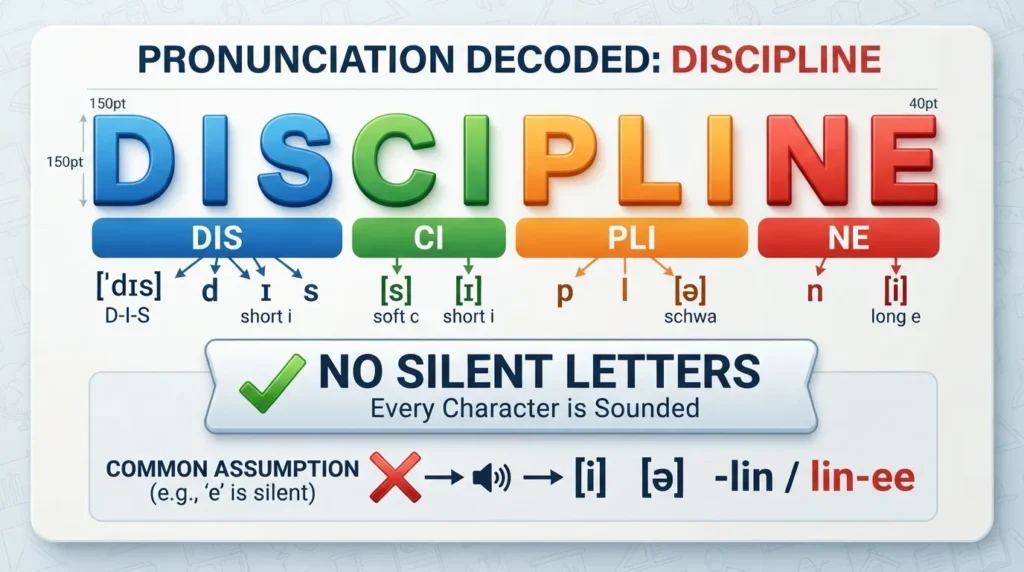
No letters are completely silent in the word “discipline.” Every single letter printed on the page corresponds to an active sound or phonetic transition in speech.
The Truth: No Silent Letter, Just a Soft Schwa Sound
Full Letter Account: From the initial d to the final e, every character plays a role in shaping the pronunciation.
The “E” Ending Function: The final “e” is not silent in the traditional sense of making a preceding vowel long (like in “bike”); instead, it anchors the preceding n and indicates the soft -plin ending structure.
Dictionary Verification: Authoritative phonetic guides, such as the Cambridge Dictionary Pronunciation Guide, confirm that all consonant and vowel graphemes map directly to spoken phonemes without any completely dropped silent letters.
Why People Think There’s a Silent Letter
Unstressed Vowel Reduction: Because the middle i and the final e are heavily reduced into quick, unstressed sounds, learners often assume they are completely omitted.
Spelling-to-Sound Disconnect: English orthography often tricks speakers into looking for hidden or silent placeholders when syllables undergo extreme reduction in fast speech.
Consonant Clustering: The rapid gliding transition from p to l makes the intervening vowel sound so faint that it feels like letters are being skipped entirely, though they are simply compressed.
How to Pronounce "Disciplined" (Past Tense Variant)
Mastering how to pronounce disciplined requires understanding how the past tense suffix transforms the base noun structure. Adding the past-tense “-ed” adds a subtle consonant blend that changes the final syllable acoustic profile without altering the primary word stress.
Quick Answer: DIS-uh-plind (IPA: /ˈdɪsəplɪnd/)
Phonetic Spelling: Spoken as DIS-uh-plind, retaining the exact same first two syllables as the root word “discipline.”
IPA Transcription: Written formally as /ˈdɪsəplɪnd/, closing with a voiced alveolar stop for the final past-tense morpheme.
Immediate Delivery: The voice glides seamlessly from the lateral l straight into the final nd cluster.
Syllable Breakdown of “Disciplined”
First Syllable (DIS-): Maintains the primary stress, voice pitch peak, and crisp initial stop consonant.
Middle Schwa (-uh-): Stays compressed and neutral, avoiding any heavy vowel expansion.
Final Compound Tail (-plind): Combines the -plin structure with a trailing voiced d sound.
Extra “-ed” Sound Explained
Voiceless Rule Application: Even though the base word ends in a voiceless n, the trailing “e” and grammatical past-tense structure sound out as a soft /d/ rather than a hard /t/.
Tongue Placement for “-nd”: Keep the tongue tip pressed against the alveolar ridge to complete the n, then drop the voice slightly while maintaining contact to release a clean d.
Flow Practice: Avoid separating the final cluster into “plin-did”; it should sound like one unified ending block (-plind).
Discipline vs Disciplined — Pronunciation & Usage Difference
Comparing discipline and disciplined clarifies how a simple grammatical shift alters both the spoken phonetic ending and the sentence function. While both share identical opening and middle syllable structures, their tails diverge to reflect their respective roles as a noun/verb versus an adjective.
Pronunciation Comparison Table (Discipline vs Disciplined)
| Word Form | Phonetic Spelling | IPA Transcription | Ending Sound Profile |
| Discipline | DIS-uh-plin | /ˈdɪsəplɪn/ | Ends on a clean nasal n sound. |
| Disciplined | DIS-uh-plind | /ˈdɪsəplɪnd/ | Adds a voiced alveolar stop d at the end. |
When to Use “Discipline” vs “Disciplined” in a Sentence
Noun Usage (Discipline): Refers to a system of rules or the ability to control one’s behavior.
Example: “Maintaining daily discipline is essential for long-term success.” (Pronounced with the standard -plin tail).
Adjective / Past Participle Usage (Disciplined): Describes a person or system characterized by order, control, or rigorous training.
Example: “She is a highly disciplined athlete who never misses a training session.” (Pronounced with the extra -plind cluster).
Key Distinction: Never substitute one ending for the other in speech, as native listeners instantly rely on the final d sound to differentiate whether you are describing an action/concept or modifying a noun.
Is "Undisciplined" a Real Word?
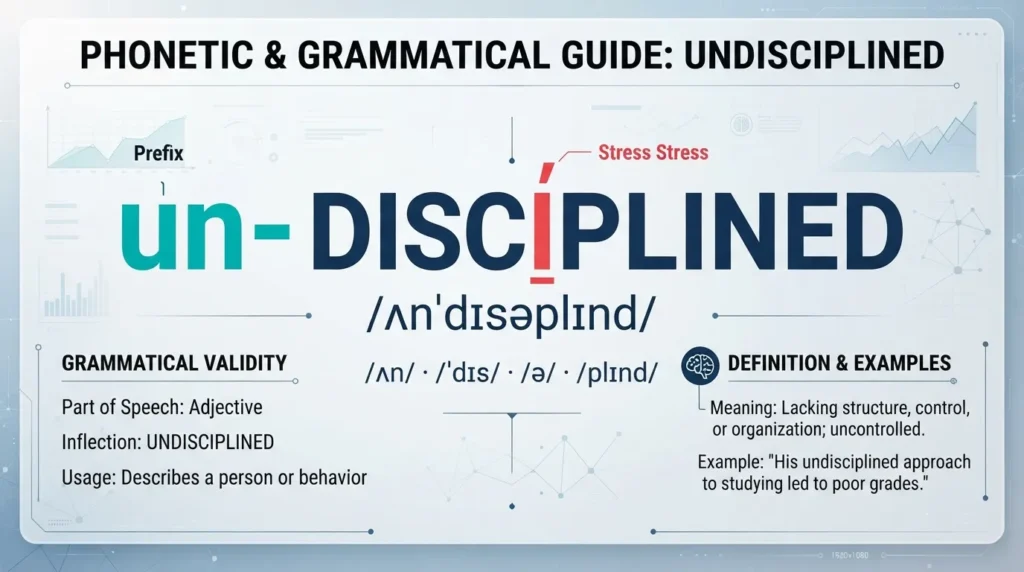
Yes, “undisciplined” is a fully correct and widely used English word. It functions as an adjective to describe someone or something that lacks self-control, training, or systematic order.
Yes, “Undisciplined” Is Correct — Meaning & Pronunciation
Phonetic Spelling: Spoken as un-DIS-uh-plind, adding the prefix sound directly to the front of the root word.
IPA Transcription: Written formally as /ʌnˈdɪsəplɪnd/.
Stress Shift: While the primary stress remains on the second syllable of the base word (DIS), a secondary stress falls on the opening prefix un-.
Usage Example: “An undisciplined approach to studying rarely leads to passing high-level exams.”
Using "Discipline" Correctly in a Sentence
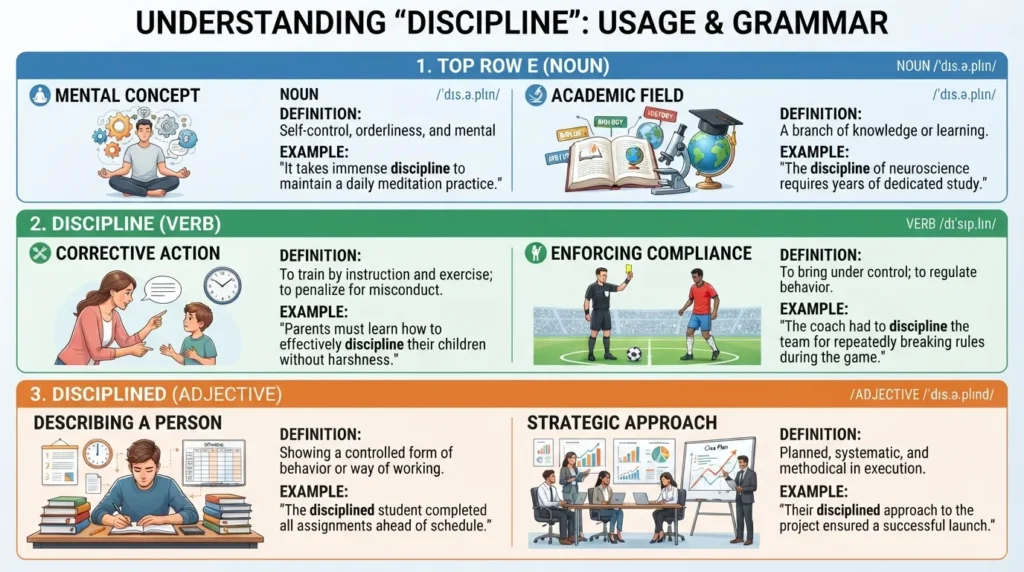
Discipline and its variants fit into sentences as either nouns, verbs, or adjectives depending on the exact context. Reviewing practical example sentences ensures you use the correct form and pronounce the word correctly in conversation.
Example Sentences Using “Discipline”
As a Noun (Concept/Rule): “Yoga requires immense mental discipline and physical focus to master advanced poses.”
As a Noun (Field of Study): “Data science is a demanding academic discipline that combines mathematics and programming.”
As a Verb (Action): “Coaches must discipline players who break team rules to maintain overall team standards.”
Example Sentences Using “Disciplined”
As an Adjective (Describing a Person): “A disciplined writer sits down to work every single day regardless of motivation.”
As an Adjective (Describing a System/Approach): “The firm followed a disciplined investment strategy during the economic downturn.”
What Does "Discipline" Really Mean? (Quick Definition)
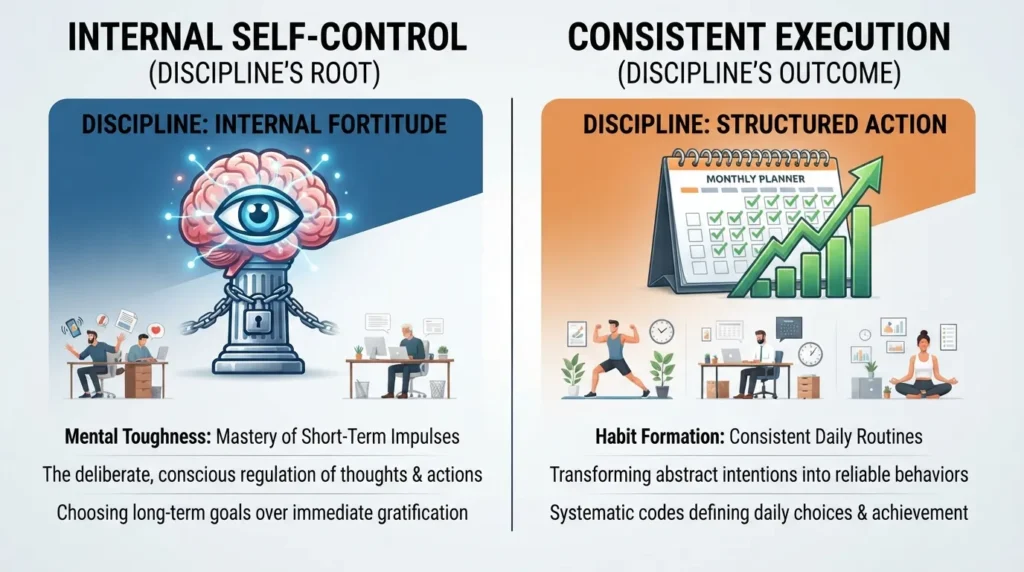
Discipline is the practice of training people to obey rules or codes of behavior, using punishment to correct disobedience or building self-control through consistent habits.
Simple Definition of Discipline (1-2 lines)
Core Meaning: At its heart, discipline represents the structured self-control needed to pursue long-term goals over short-term impulses.
Behavioral Focus: It bridges the gap between intention and action, turning abstract goals into consistent daily routines.
Brief Mention of the 3 Types of Discipline (teaser only)
Self-Discipline: The internal drive to push through discomfort and maintain habits without external supervision.
Corrective Discipline: The institutional or parental application of rules and consequences to correct unwanted behavior.
Professional Discipline: The specialized adherence to rigorous standards and protocols required within a specific trade or academic field.
Final Tips — Master the Pronunciation of "Discipline"
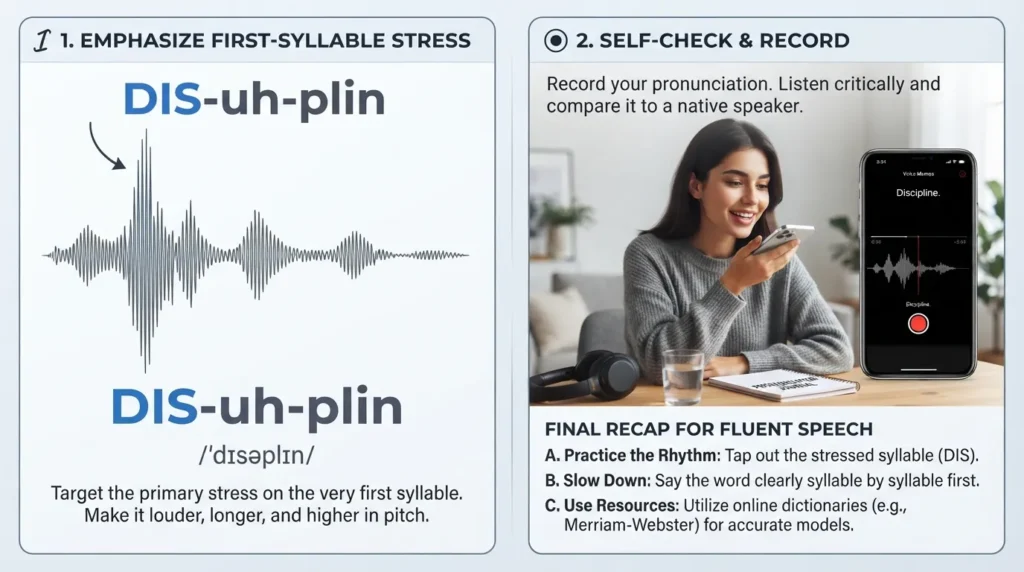
Mastering “discipline” comes down to maintaining a strong first-syllable stress while letting the middle and ending sounds glide smoothly together. Applying a few simple daily habits bridges the gap between learning phonetic rules and speaking with absolute native fluency.
Quick Recap: DIS-uh-plin
First Syllable Focus: Always emphasize DIS- with higher pitch and louder volume to establish the correct English word rhythm.
The Schwa Trap: Keep the middle vowel relaxed and quick (-uh-), avoiding heavy or exaggerated pronunciation.
Ending Cleanly: Finish with a crisp -plin for the noun form or add the soft -plind cluster when using the past-tense adjective.
Practice Tip: Record Yourself & Compare
Voice Memo Check: Record yourself saying “discipline” in a full sentence, then replay it immediately to check if your initial syllable stress sounded natural.
Shadow Native Audio: Listen to native pronunciation clips and mimic their exact mouth posture, focusing on the quick transition through the schwa sound.
Consistent Repetition: Use the word in casual daily conversation until pronouncing it correctly becomes an automatic muscle memory habit.
Frequently Asked Questions
How do you pronounce “discipline”?
Answer: It is pronounced DIS-uh-plin (IPA: /ˈdɪsəplɪn/), with the primary stress falling firmly on the first syllable and a quick, unstressed schwa sound in the middle.
Which letter is silent in the word discipline?
Answer: There are no silent letters in discipline. Every letter plays a role in spelling or phonetic transition, though the middle and final vowels are reduced into quick, unstressed sounds.
Is it “discipline” or “disciplined”?
Answer: Both are correct words used in different grammatical contexts. Discipline is typically a noun or verb (pronounced DIS-uh-plin), while disciplined is an adjective or past-tense verb with a trailing d sound (DIS-uh-plind).
Is the word “undisciplined” correct?
Answer: Yes, undisciplined is a fully valid English adjective (pronounced un-DIS-uh-plind) used to describe someone or something that lacks control, order, or regular training.
What is the real meaning of discipline?
Answer: Discipline refers to training people to follow rules or building the internal self-control necessary to execute consistent habits and achieve long-term goals.
What are the three types of discipline?
Answer: The three primary categories include self-discipline (internal drive), corrective discipline (behavioral correction through rules or consequences), and professional discipline (adherence to industry standards).
Kittisak Wattanakul
Kittisak Wattanakul is the Discipline Editor at Holistic Wellbeing Living. He writes about routines, focus, consistency, and practical follow-through. With nine years of experience creating personal-growth content, Kittisak helps readers build realistic systems for steady progress without extreme productivity pressure.