Jump to:
ToggleHow to Stop Being Lazy and Overcome Procrastination for Good
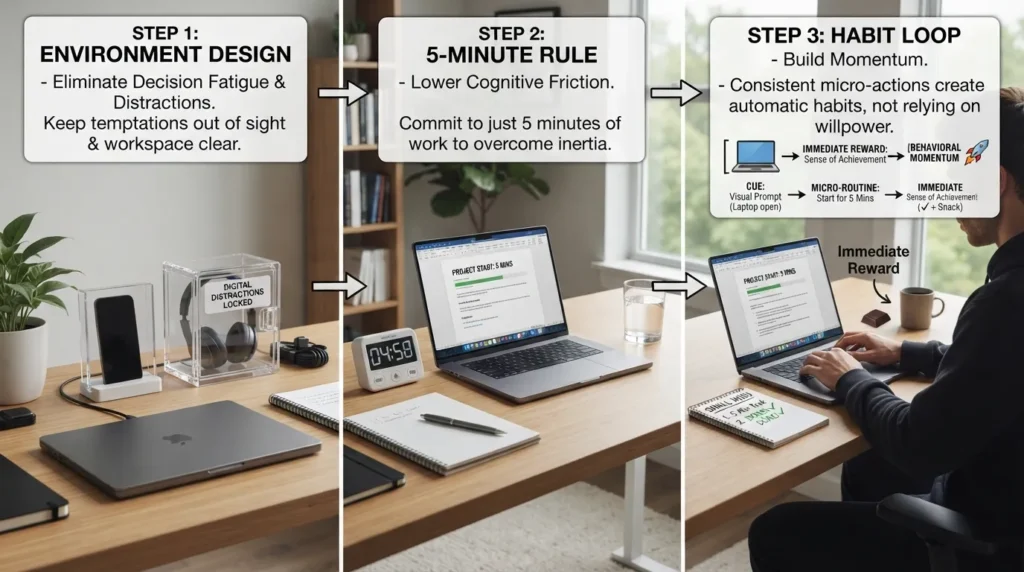
Why You keep Delaying Things
Staring at a blinking cursor while your to-do list gathers digital dust isn’t a failure of willpower, but rather a subconscious reflex known as emotional avoidance. While laziness is a passive state of doing nothing and feeling fine about it, procrastination is an active, stress-induced delay where you avoid uncomfortable feelings by trading short-term relief for long-term panic.
Emotional Avoidance: The brain perceives the task’s associated anxiety, boredom, or self-doubt as a genuine threat, triggering a protective fight-or-flight delay response.
The Motivation Myth: Waiting to “feel like” tackling a project is a trap, because motivation usually follows action rather than preceding it.
The Real Cost: Chronic delay compounds stress, erodes self-trust, and creates a punishing cycle of guilt that fuels future procrastination.
Breaking this pattern requires abandoning generic productivity hacks and instead building a reliable cognitive system that interrupts emotional avoidance before it derails your day.
What Is Laziness? (Lack of Desire to Expend Energy)
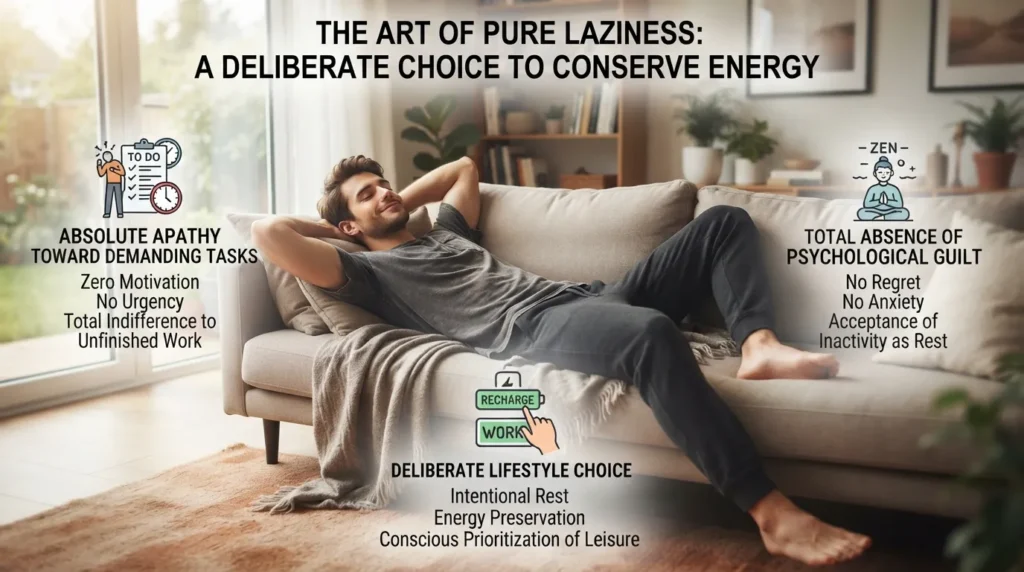
True laziness is characterized by an absolute apathy toward activity, accompanied by a complete absence of guilt or desire to change. When you are truly lazy, you consciously choose to conserve your energy and are entirely content with doing nothing.
State of Apathy: You have zero motivation and feel no psychological distress or internal conflict about leaving tasks undone.
Contentment with Inactivity: The lack of productivity does not trigger anxiety, self-criticism, or a frantic scramble to catch up later.
Energy Conservation: It operates purely as a lifestyle preference or a deliberate choice to rest without any underlying emotional friction.
What Is Procrastination? (Emotional Avoidance of a Task)
Procrastination is an active, stress-driven delay where you desperately want to complete a task but find yourself paralyzed by negative emotions. Instead of lacking energy, you are expending massive amounts of mental bandwidth worrying about the work while actively avoiding it.
Internal Resistance: The task triggers discomfort, fear of failure, perfectionism, or boredom, making your nervous system seek immediate emotional relief.
High Psychological Cost: You experience intense guilt, self-loathing, and dread while engaging in counterproductive coping mechanisms like mindless scrolling.
Desire to Act: Unlike laziness, you care deeply about getting the work done and intend to do it, but emotional blockages keep locking you out.
Quick Self-Check: Which One Are You Dealing With Right Now?
Distinguishing between these two states requires examining your emotional reaction to the delay rather than judging your output. Asking yourself the right diagnostic questions cuts through the confusion and exposes the true root of your inaction.
Check Your Conscience: Do you feel a heavy knot of guilt and anxiety about the task, or are you completely relaxed and indifferent about dropping the responsibility?
Check Your Aversion: Are you avoiding the entire concept of effort, or are you specifically dodging one high-friction task while easily doing other demanding things like cleaning or gaming?
The Verdict: Guilt, distress, and task-specific dread confirm you are dealing with procrastination, whereas total contentment with doing nothing points straight to laziness.
Fear of Failure and Perfectionism

Fear of failure is a primary catalyst for task delay, masquerading as laziness while actually stemming from intense self-protection. When you hold yourself to impossibly high standards, the gap between your ideal execution and reality creates crippling anxiety.
The Flawed Protection Mechanism: Procrastinating allows you to attribute poor outcomes to a lack of time rather than a lack of intelligence or capability.
Paralysis by Perfection: Believing a project must be flawless from the first keystroke paralyzes your ability to produce even a rough draft.
The Psychological Cost: As outlined by wellness researchers at the McMaster Wellness Centre, emotional avoidance of a task overrides future goals in favor of immediate mood repair.
Unclear Expectations or Overwhelm
Vague objectives and massive workloads trigger cognitive overload, shutting down your brain’s executive functioning system. When a project lacks a clear, defined starting point, your nervous system interprets the ambiguity as an overwhelming threat and defaults to avoidance.
The Fog of War: Vague instructions like “work on taxes” or “organize marketing” leave you guessing, which stalls momentum before you even begin.
Cumulative Burden: Stacking multiple unaddressed duties creates a psychological logjam that makes any single task feel insurmountable.
Energy Depletion: Mental exhaustion from juggling too many micro-decisions leaves zero reserve capacity for task initiation.
Low Dopamine / Environment Triggers
Modern environments are engineered to hijack your dopamine pathways, making deep work feel biochemically unrewarding compared to instant digital gratification. Low baseline dopamine or high-friction workspaces make the brain choose low-effort stimuli over high-friction tasks.
Immediate Reward Bias: Social media and notifications offer instant dopamine hits, making the delayed reward of completing a hard task look pale by comparison.
Friction Imbalance: If your workspace requires navigating five browser tabs and cleaning a messy desk before starting, your brain will take the path of least resistance.
Biological Deprivation: Chronic sleep deficits and poor physical nutrition directly depress the prefrontal cortex, tanking the executive control needed to push past friction.
Signs of a Lazy Brain: A Quick Checklist
Recognizing the exact markers of a stalling cognitive system helps you pinpoint whether you are fighting behavioral exhaustion or emotional resistance.
Task Tunnel Vision: You effortlessly spend three hours organizing your desktop icons while completely ignoring the high-priority report due tomorrow morning.
Physical Restlessness: You experience a sudden urge to clean the kitchen, fold laundry, or cook an elaborate meal the exact moment you sit down to work.
The Dread Loop: Even while engaging in fun activities like gaming or scrolling, you feel an undercurrent of guilt because you know you are running away from something important.
How ADHD Affects Task Initiation

Attention-Deficit/Hyperactivity Disorder (ADHD) causes severe executive dysfunction, making the simple act of starting a task feel like climbing an emotional and neurological mountain. This struggle is never about a lack of desire or discipline, but rather a structural difference in how the brain regulates attention, interest, and dopamine.
Interest-Driven Nervous System: An ADHD brain struggles mightily to activate for mundane, repetitive, or low-stimulation tasks, regardless of their actual importance.
Working Memory Deficits: Out-of-sight tasks literally disappear from working memory, making long-term goals feel abstract and disconnected from the present moment.
Paralysis by Overwhelm: Large multi-step projects trigger immediate cognitive gridlock because the brain cannot isolate the first actionable step.
How Depression Can Mimic “Laziness”
Clinical depression robs a person of physical energy, emotional resilience, and cognitive bandwidth, often getting mislabeled as severe laziness by outsiders or the individual themselves. When neurotransmitters like serotonin and dopamine are severely depleted, even basic hygiene or answering an email requires monumental effort.
Anhedonia and Apathy: The loss of interest in activities that once brought joy drains the internal rewards that normally fuel productivity.
Psychomotor Retardation: Physical movements and thought processes slow down significantly, making daily existence feel like moving through wet cement.
Shame Spiral: Misinterpreting depressive exhaustion as moral failure creates a heavy layer of guilt that worsens the underlying mental health condition.
When to Consider Talking to a Professional
Distinguishing between behavioral habits, emotional avoidance, and a clinical condition requires looking at persistence, scope, and the toll it takes on your daily life. If your paralysis feels systemic, unyielding, and resistant to standard productivity tips, clinical guidance is essential.
Chronic Impairment: Task avoidance consistently jeopardizes your career, academic standing, or relationships despite your desperate desire to change.
Pervasive Fatigue: Rest and lifestyle changes fail to restore your energy, and everyday responsibilities consistently trigger panic or emotional shutdowns.
Seeking Clarity: A licensed psychologist, psychiatrist, or medical doctor can accurately screen for underlying neurodivergence or mood disorders, providing a targeted treatment path rather than empty advice.
How the 5-Minute Rule Works

The 5-minute rule bypasses emotional avoidance by lowering the barrier to entry so drastically that your brain’s fear response cannot trigger. Instead of demanding that you finish a daunting project, you commit to working on it for just five miserable minutes, with full permission to stop immediately afterward if you still hate it.
Lowering the Stakes: Framing the effort as a micro-commitment neutralizes the threat response in your amygdala, preventing procrastination paralysis.
Capitalizing on Momentum: Newton’s first law applies to productivity; an object in motion stays in motion, meaning 90% of the time you will keep working past the timer.
Disproving the Motivation Myth: It forces you to take physical action first, proving that motivation follows behavior rather than preceding it.
Real Example: Applying It to a Dreaded Task
Imagine facing a towering pile of administrative work or a blank document for a massive report you have avoided for a week. Implementing this strategy transforms a mountain of stress into an approachable, bite-sized experiment.
Set the Timer: Commit to closing all distraction tabs, setting a strict five-minute timer, and doing absolute garbage work if necessary.
Embrace the Imperfection: Give yourself permission to write terrible sentences or sort messy files, because the goal is starting, not perfection.
The Result: Once the timer goes off, the initial friction is broken, the dread has dissipated, and you are usually locked into a productive flow state.
What Is the 5-4-3-2-1 Rule?
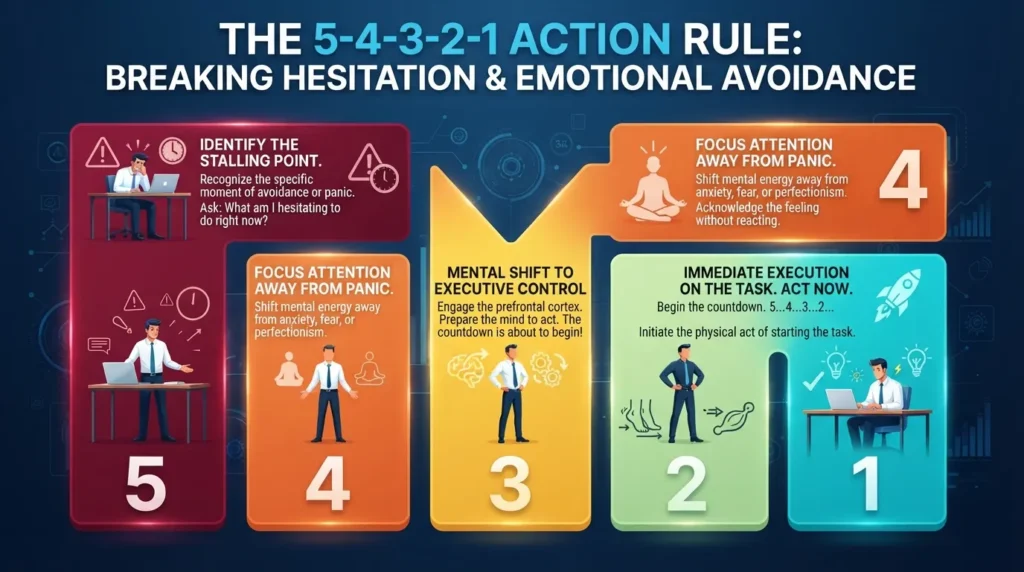
The 5-4-3-2-1 rule is a cognitive countdown technique designed to short-circuit hesitation and force your brain out of overthinking mode. Popularized by leadership expert Mel Robbins, this tool uses a backward sequence to interrupt the default mental loops that give emotional avoidance time to take root.
Prefrontal Cortex Activation: Counting backward from five shifts brain activity away from emotional panic and into the executive control center.
Biasing Toward Action: The physical act of counting creates a definitive starting gun, compelling you to move before self-doubt can paralyze you.
Breaking Hesitation: It bypasses the subconscious urge to negotiate with yourself about whether you “feel like” doing the work right now.
Step-by-Step: How to Use It
Executing this technique requires zero preparation, making it instantly deployable the exact second you catch yourself stalling. Using it consistently builds a reliable neural bridge between intention and immediate execution.
Identify the Stalling Point: Notice the exact moment you start negotiating with yourself, whether you are staring at a draft or hovering over a browser tab.
Count Backward Aloud or Silently: Firmly say “5, 4, 3, 2, 1” in your mind or under your breath with deliberate focus.
Launch Immediately: The second you hit one, you must physically move your hands to the keyboard or stand up to begin the task before hesitation creeps back in.
Kaizen (Small Continuous Improvement)
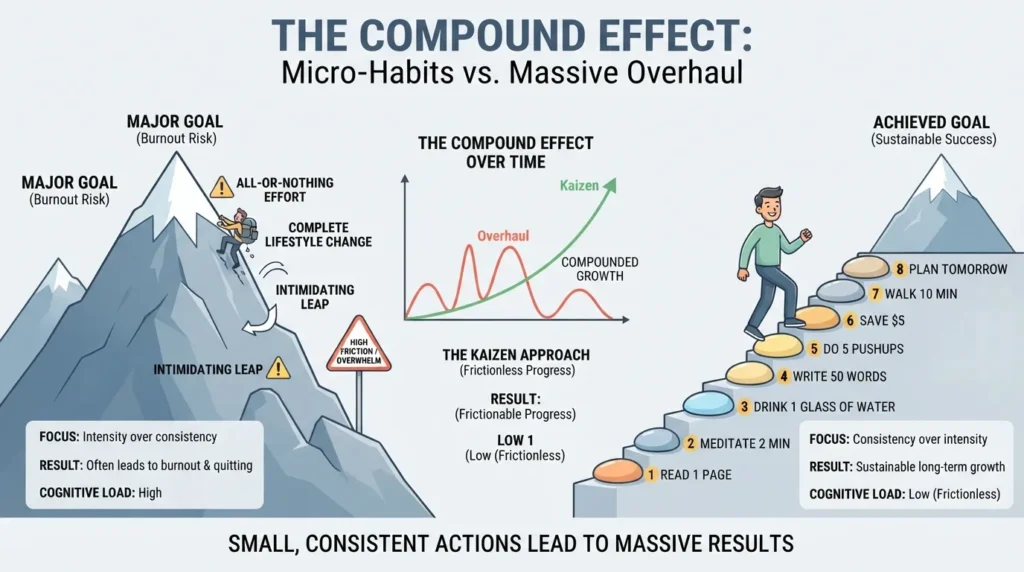
Kaizen focuses on making small, nearly imperceptible improvements to daily routines rather than demanding massive, exhausting overhauls. By shrinking the scope of progress to microscopic steps, this philosophy completely eliminates the intimidation factor that triggers task avoidance.
Micro-Habits: Committing to writing just one sentence or organizing a single desktop folder removes the cognitive friction of starting.
Compound Growth: Tiny daily gains accumulate over time, building massive momentum without overwhelming your mental bandwidth.
Consistency over Intensity: It trains your brain to associate effort with low stress, making long-term habit formation sustainable.
Ikigai (Finding Your Purpose)
Ikigai translates to finding your “reason for being” by intersecting your passions, talents, vocation, and what the world actually needs. When your daily actions connect to a deeper personal mission, the internal resistance to doing hard work naturally dissolves.
Intrinsic Motivation: Aligning tasks with a core sense of purpose replaces short-term discipline with long-term internal drive.
Clarity of Direction: Knowing why you are doing something cuts through the fog of confusion and decision fatigue.
Meaningful Engagement: Projects feel rewarding rather than punishing because they directly feed your overarching life goals.
Pomodoro-Adjacent Japanese Time Methods
Japanese productivity structures often emphasize rhythmic pacing, balancing intense focus with restorative breaks to prevent mental burnout. These systems keep your nervous system regulated so you do not hit an exhaustion wall halfway through the day.
Rhythmic Working: Alternating short bursts of work with structured pauses maintains high energy without draining your cognitive reserves.
Mental Rest: Pausing before fatigue sets in ensures you return to tasks with fresh focus rather than dragging yourself through low-quality hours.
Pace Control: Treating time as a manageable flow rather than a ticking enemy reduces anxiety-induced paralysis.
Shoshin (Beginner’s Mind) and Others
Shoshin encourages approaching tasks with an attitude of openness and eagerness, free from the heavy baggage of past failures or perfectionism. Along with complementary philosophies like Hara Hachi Bu for physical energy management, these mental frameworks clear away internal clutter.
Dropping Ego: Letting go of the need to be an expert immediately allows you to write messy drafts or make initial mistakes without shame.
Energy Management: Balancing mental inputs and physical vitality ensures your brain has the raw biological fuel needed to execute complex plans.
Continuous Reset: Treating every project as a fresh experiment keeps you adaptable, curious, and immune to stagnation.
Why "Write the Report" Fails and "Open the Document" Works

Vague goals like “write the report” or “get organized” fail because your brain cannot compute an abstract command without a clear starting point. When a task lacks a definitive physical action, your nervous system experiences cognitive overload and defaults to avoidance.
The Ambiguity Trap: Broad statements leave too many micro-decisions open, forcing your brain to spend valuable energy just figuring out where to begin.
The Micro-Action Shift: Shifting the target to a single physical behavior, such as opening a blank document, removes the intimidation factor entirely.
Cognitive Relief: Narrowing the scope tricks your brain into seeing the task as safe and manageable rather than a looming mountain of stress.
How to Build an If-Then Plan (With Examples)
Implementation intentions—pioneered by psychologist Peter Gollwitzer—use concrete if-then framing to automate your decision-making and bypass procrastination. By pre-deciding your exact response to specific triggers or obstacles, you eliminate hesitation in the moment.
Formula: Write out the exact trigger and the corresponding action using the structure: If [situation/trigger occurs], then I will [specific physical action].
Example 1 (Starting): If it is 9:00 AM, then I will open my laptop and type the title of the article.
Example 2 (Handling Distractions): If I feel the urge to check social media while writing, then I will take three deep breaths and write one more sentence.
Example 3 (Overwhelm): If the project feels too big, then I will list only the first three tiny steps on a sticky note.
Eliminate Distractions (Phone, Notifications, Website Blockers)

Your environment dictates your behavior far more effectively than sheer willpower ever could. If your workspace is cluttered with digital temptations like flashing notifications and open browser tabs, your brain will constantly default to the path of least resistance.
Digital Quarantine: Move your smartphone to another room or use strict website blockers to lock away time-wasting apps before you begin working.
Friction Engineering: Increase the effort required to access distractions by logging out of social media accounts and hiding your phone in a desk drawer.
Sensory Shielding: Wear noise-canceling headphones to block out auditory triggers that fracture your attention and invite mind-wandering.
Reduce Decision Fatigue: Plan the Night Before
Decision fatigue drains your prefrontal cortex long before you actually sit down to work, making task initiation feel twice as hard. Deciding what to do in the heat of the moment wastes valuable mental energy on choices rather than execution.
The Evening Blueprint: Write down your top three non-negotiable tasks the night before so your morning starts with absolute clarity.
Eliminate Micro-Choices: Lay out your workspace, open necessary documents, and set up your environment ahead of time.
Automated Momentum: Walking into your workspace with a pre-determined roadmap lets you bypass overthinking and dive straight into execution.
Using the Pomodoro Technique Correctly
The Pomodoro Technique breaks work into structured intervals—typically 25 minutes of intense focus followed by a 5-minute break—to prevent cognitive burnout. Using it correctly requires treating the timer as an absolute boundary rather than a loose suggestion.
Strict Focus Blocks: Commit entirely to the task during the work interval without checking tabs, emails, or messages.
Guilt-Free Pauses: Use the five-minute break to stretch, hydrate, or look away from the screen, letting your brain rest and recharge.
Sustainable Rhythm: Cycling through these focused bursts prevents the mental fatigue that causes afternoon crashes and chronic procrastination.
Why Self-Criticism Increases Procrastination
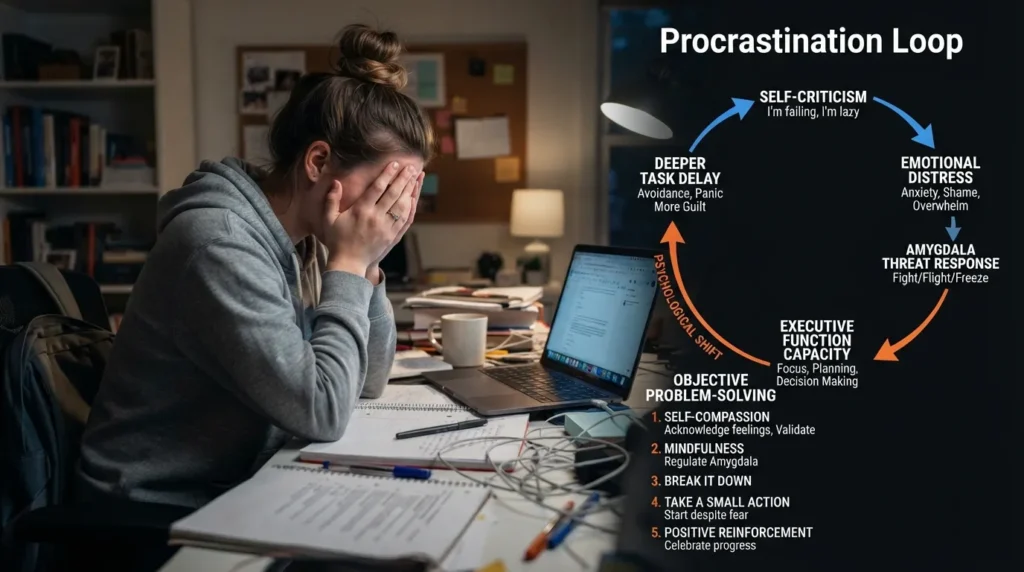
Beating yourself up for delaying a task creates a toxic cycle of stress and emotional avoidance that triggers even more procrastination. When you treat every missed deadline as a moral failure, you amplify the anxiety associated with the project, making your nervous system want to run away from it even faster.
The Shame Spiral: Harsh self-criticism activates the brain’s threat defense system, draining the cognitive bandwidth needed for problem-solving.
Perfectionist Traps: Believing you are fundamentally “lazy” or broken paralyzes your confidence and makes future task initiation feel impossible.
Emotional Exhaustion: Spending mental energy on self-loathing leaves zero fuel for actual execution, locking you deeper into paralysis.
A Simple Self-Compassion Reframe You Can Use Today
Practicing self-compassion does not mean letting yourself off the hook; rather, it means stripping away the panic so you can tackle the problem objectively. Acknowledging that struggling with a task is a normal human experience immediately calms your nervous system and restores focus.
Acknowledge the Emotion: Quietly admit to yourself that you are feeling stressed, overwhelmed, or anxious without attaching moral judgment to the feeling.
Normalize the Struggle: Remind yourself that procrastination stems from emotional avoidance, not a broken character or permanent flaw.
Pivot to Curiosity: Replace destructive self-talk with an objective question: “What is one tiny obstacle making this task feel scary or heavy right now?”
The Habit Loop: Cue, Routine, Reward
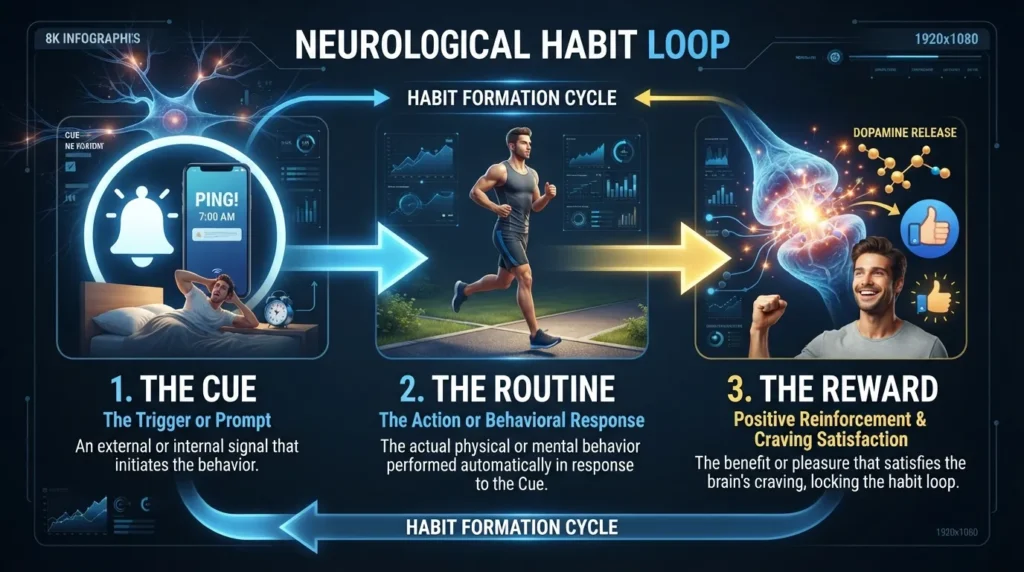
Rewiring your brain to abandon chronic procrastination requires understanding the neurological habit loop popularized by behavioral research: the cue, the routine, and the reward. When you intentionally redesign this loop, you stop relying on fleeting willpower and instead build automatic pathways that make execution effortless.
Identifying the Cue: Pinpoint the exact trigger that sets off your avoidance behavior, whether it is opening your inbox or looking at a complex project plan.
Redefining the Routine: Replace the default avoidance mechanism—such as scrolling social media—with a low-friction action like opening a document or setting a five-minute timer.
Anchoring the Reward: Immediately follow the completed action with a deliberate reward to reinforce the positive neural pathway and satisfy your brain’s dopamine craving.
Building Consistency Over Motivation
Waiting for inspiration or a sudden surge of motivation guarantees that you will stay stuck, because sustainable progress is built on systems rather than feelings. Consistency relies on lowering the bar for daily execution so that showing up becomes non-negotiable.
Embrace Micro-Steps: Focus entirely on completing a tiny fraction of the task rather than finishing the whole project in one heroic sitting.
Prioritize Frequency: Doing ten minutes of focused work every single day builds stronger neurological pathways than cramming for four hours once a week.
Remove Barrier Friction: Prepare your workspace the night before so that the physical cost of starting is as close to zero as possible.
A Real 7-Day Practice Plan (First-Hand Example)
Transforming abstract productivity theory into permanent habit change requires a structured, step-by-step roadmap that tests your new systems under real-world conditions. This weeklong framework trains your brain to break through resistance without causing burnout.
Days 1 to 2 (The 5-Minute Trigger): Commit strictly to five minutes of work on your most dreaded task each morning, stopping immediately when the timer goes off.
Days 3 to 4 (Implementation Intentions): Write down one specific if-then plan for your biggest daily distraction and execute it without exception.
Days 5 to 7 (Pomodoro Integration): Scale up to two full Pomodoro sessions per day, pre-planning your tasks the night before to eliminate morning decision fatigue.
Frequently Asked Questions
What is the 5-4-3-2-1 rule for procrastination?
The 5-4-3-2-1 rule is a cognitive countdown technique used to short-circuit hesitation and force your brain out of overthinking. By counting backward from five out loud or in your mind, you activate your prefrontal cortex, interrupt panic loops, and compel yourself to take immediate physical action before self-doubt takes root.
What are 7 Japanese techniques to overcome laziness?
These time-tested philosophies include Kaizen for small continuous improvement, Ikigai for finding deep personal purpose, and rhythmic time-blocking methods. Additional approaches like Shoshin cultivate a beginner’s mindset, while physical and mental balance practices help clear away internal clutter and maintain sustainable daily focus.
Is laziness a symptom of ADHD?
Struggling with task initiation is rarely true laziness; it is often executive dysfunction driven by ADHD. An ADHD brain struggles to activate for mundane or low-stimulation tasks due to differences in dopamine regulation, making the simple act of starting feel like an overwhelming neurological hurdle.
How to train your brain to not be lazy?
Rewiring your brain requires replacing motivation with systematic habit loops and environmental design. You can train your mind by breaking projects into micro-steps, preparing your workspace the night before to reduce decision fatigue, and pairing immediate action with consistent mental or tangible rewards.
What causes a person to be so lazy?
What appears to be laziness is typically a physiological or emotional defense mechanism rather than a character flaw. Root causes include fear of failure, perfectionism, chronic overwhelm, low baseline dopamine, or underlying mental health conditions like depression and executive dysfunction.
Is laziness a symptom of depression?
Clinical depression often masquerades as laziness by draining a person of physical energy, focus, and emotional resilience. Neurotransmitter depletion causes anhedonia and psychomotor slowing, making basic daily actions require monumental effort that outsiders frequently misinterpret.
What are the signs of a lazy brain?
A stalling cognitive system typically shows up as task tunnel vision, where you focus on low-priority chores while avoiding the main project. Other clear markers include physical restlessness like stress-cleaning, and an undercurrent of guilt even while engaging in fun activities.
How to genuinely stop being lazy?
Stopping chronic task avoidance requires bypassing emotional resistance instead of waiting for inspiration to strike. Use concrete tools like the 5-minute rule, specific if-then planning, strict distraction elimination, and self-compassion to turn daunting projects into approachable daily actions.
What are some signs of laziness?
True laziness is characterized by complete apathy toward inactivity and a total absence of guilt or desire to change. If you feel content doing nothing and experience zero internal distress over missed responsibilities, you are likely conserving energy rather than fighting emotional avoidance.
What are four ways to discourage laziness?
You can discourage task delay by shrinking projects into micro-steps, planning your exact workflow the night before to avoid decision fatigue, locking away digital distractions, and using the 5-minute rule to lower the friction of getting started.
Conclusion
Conquering laziness and procrastination is not about finding a magical surge of motivation or punishing yourself into perfection. By recognizing that task delay is usually a shield against emotional avoidance or burnout, you can stop fighting your character and start upgrading your systems. True transformation happens when you stop waiting to “feel ready” and instead rely on low-friction triggers like the 5-minute rule, if-then planning, and a distraction-free environment.
Commit to the Micro-Start: Pick one single task you have been avoiding right now, set a timer for five minutes, and simply open the document or put your hands on the keyboard.
Prioritize Systems Over Moods: Let go of self-criticism, practice self-compassion, and build small daily habits that make showing up easier than running away.
Your next step is simple: close this tab, pick your smallest friction point, and take one tiny physical action before the day is done.
Kittisak Wattanakul
Kittisak Wattanakul is the Discipline Editor at Holistic Wellbeing Living. He writes about routines, focus, consistency, and practical follow-through. With nine years of experience creating personal-growth content, Kittisak helps readers build realistic systems for steady progress without extreme productivity pressure.